


INTRODUCTION
The months during which coastal populations of bottlenose dolphins are most frequently observed close to the shore often coincide with the peak tourism season and traffic densities of leisure and tour boats. These boats produce underwater noise, principally from the operation of their propellers. In theory, this noise is of sufficient power at significant frequencies to induce hearing impairment in nearby bottlenose dolphins. These animals rely on sound for navigation, hunting and communication. If their hearing is compromised by boat noise, this would have serious impacts on their welfare and survival. Hearing impairment in mammals is usually expressed as a change in the hearing threshold at a particular frequency or bandwidth. The most severe form of hearing impairment takes the form of a permanent increase in the hearing threshold or permanent threshold shift (PTS). A temporary change in hearing threshold, or temporary threshold shift (TTS) can last from minutes or hours to several days. Sound pressure levels (SPLs) capable of producing PTS in bottlenose dolphins have never been measured directly. The induction of TTS in captive dolphins has been measured by several workers using broadband impulsive noise, pure tones and octave-band noise (Southall et al., Reference Southall, Bowles, Ellison, Finneran, Gentry, Greene, Kastak, Ketten, Miller, Nachtigall, Richardson, Thomas and Tyack2007).
When considering the impacts of noise on dolphin hearing, the frequency components of this noise are significant for at least three reasons: (i) the hearing of bottlenose dolphins, like all mammals, is frequency-dependent; (ii) the attenuation of noise over distance increases with increasing frequency; and (iii) our knowledge of the effects of noise on TTS in bottlenose dolphins comes from experiments using noise of relatively narrow bandwidths (Southall et al., Reference Southall, Bowles, Ellison, Finneran, Gentry, Greene, Kastak, Ketten, Miller, Nachtigall, Richardson, Thomas and Tyack2007). In addition, it is probable that the threshold for induction of TTS in bottlenose dolphins is frequency-dependent (Finneran, Reference Finneran2008). In order to estimate the induction of hearing impairment in marine mammals it is therefore necessary to estimate SPLs of frequency spectra received over distance. Some received noise spectra of small boats have been reported (Malme et al., Reference Malme, Miles, Miller, Richardson, Roseneau, Thompson and Greene1989; Lesage et al., Reference Lesage, Cyrille, Kingsley and Sjare1999; Kipple & Gabriele, Reference Kipple and Gabriele2004) but published figures are usually given as broadband received levels. Here, a model describing frequency-dependent transmission loss (TL) has been tested against boat noise spectra received over a range of distances. Broadband data have also been provided for comparison with other studies.
Investigations into the effects of loud noises on cetacean hearing have shown that auditory impairment is related not only to the level and frequency but also to the duration of the noise exposure (Finneran et al., Reference Finneran, Carder, Schlundt and Ridgway2005). The SPL of the fatiguing stimulus required to induce TTS decreases with increasing duration of the stimulus. The duration of the noise exposure can be taken into account by calculating the sound exposure level (SEL), a metric that incorporates both sound pressure level and duration. SEL calculations generate a single exposure equivalent value; it therefore does not assume recovery of hearing between repeated exposures. For constant noise, exposures of equal energy lead to approximately equal effects on mammalian auditory systems (Ward, Reference Ward and Crocker1997). An equal energy model predicts that two noise exposures will induce similar threshold shifts if the exposures are matched in sound energy, regardless of the temporal patterning of exposure. Energy-based exchange rules are not definitive (e.g. Kastak et al., Reference Kastak, Southall, Schusterman and Kastak2005; Mooney et al., Reference Mooney, Nachtigall, Au, Breese and Vlachos2006; Breese et al., Reference Breese, Mooney, Nachtigall, Au and Vlachos2007) but they provide a reasonable correlation between TTS, SPL and duration for relatively long exposure periods (Mooney et al., Reference Mooney, Nachtigall, Au, Breese and Vlachos2005; Southall et al., Reference Southall, Bowles, Ellison, Finneran, Gentry, Greene, Kastak, Ketten, Miller, Nachtigall, Richardson, Thomas and Tyack2007).
Finneran et al. (Reference Finneran, Carder, Schlundt and Ridgway2005) examined exposure levels necessary to induce TTS from several studies. These authors plotted SEL values for fatiguing stimuli required to induce TTS in bottlenose dolphins as a function of the base-10 logarithm of the fatiguing stimulus duration. A line of zero slope drawn through 195 dB re 1 µPa2-s (representing the mean SEL required for measurable TTS induction reported by Schlundt et al. (Reference Schlundt, Finneran, Carder and Ridgway2000)) fitted the plotted data. A similar line drawn through 190 dB re 1 µPa2-s separates those stimuli that induced TTS and those that did not. This type of line is often referred to as an equal energy line because any two continuous sounds whose mean pressures and durations fall on the line will have the same total energy flux. The studies included in this analysis consisted of a variety of fatiguing stimulus types: broadband, impulse (Finneran et al., Reference Finneran, Schlundt, Carder, Clark, Young, Gaspin and Ridgway2000, Reference Finneran, Schlundt, Dear, Carder and Ridgway2002); pure tone; 0.4, 3, 10, 20 kHz (Schlundt et al., Reference Schlundt, Finneran, Carder and Ridgway2000); pure tone, 3 kHz (Finneran et al., Reference Finneran, Carder, Schlundt and Ridgway2005); octave band; f c 7.5 kHz (Nachtigall et al., Reference Nachtigall, Pawloski and Au2003, Reference Nachtigall, Supin, Pawloski and Au2004).
This paper examines the potential threat to dolphin hearing posed by one or more 5.4 m Avon inflatable boats using estimated SELs that are likely to be experienced by the animal. This addresses a growing concern that bottlenose dolphins resident in areas of frequent leisure boat activity may suffer short- or long-term damage to their hearing. The Avon boat was chosen as it is typical of the type of leisure craft that is used in relatively high densities in coastal regions. Similar techniques could be applied to other vessels and areas although more precise estimates will depend on several parameters, including boat activity, noise characteristics and underwater topography.
MATERIALS AND METHODS
Unless otherwise stated, SPLs are root mean squared (rms) values expressed as dB re 1µPa. Source levels (1 m) were estimated by adding theoretical TL to far-field measurements. Frequency-dependent TL from the sound source to the receiver was estimated using a semi-empirical, shallow-water equation (Marsh & Schulkin, Reference Marsh and Schulkin1962):
 $$TL\lpar dB\rpar = 15\log R + \alpha R + a_T \left({R \over H} - 1 \right)+ 5\log H + 60 - k_L \eqno\lpar 1\rpar$$
where R is the range in km, H is the water depth in metres (30), α is the absorption coefficient (dB/km) which is given by α = 0.036f 1.5 and where f is the frequency in kHz, a T is a shallow-water attenuation coefficient and k L is a near-field anomaly. Both a T and k L are dependent upon sea state and bottom type and are given in tables in Marsh & Schulkin (Reference Marsh and Schulkin1962). In this case, a sand bottom was assumed and the sea state was taken to be 1.
Measurements of boat noise were made in Cook Inlet, Alaska during August 2001 by Susanna Blackwell and Charles Greene Jr (Blackwell & Greene Jr, Reference Blackwell and Greene2003). The boat consisted of a 5.4 m Avon rubber boat with a rigid hull which was driven at full speed past the point of recording where the water depth was 30 m. The engine was a Yamaha 80 hp four-cycle outboard. The hydrophone consisted of a calibrated International Transducer Corporation (ITC) 6050C model with in-built low-noise preamplifier connected to a 30 m length cable. The hydrophone was held at a depth of 10 m and strumming was avoided by attachment to a fairing. Hydrophone signals were amplified and recorded at a sampling rate of 48 kHz on two channels of a Sony model PC208Ax digital audio tape recorder. Recorded signals were transformed into calibrated signals that were nearly flat over the frequency range 4–20,000 Hz. Distances from the hydrophone to the boat were measured using a Bushnell model 20-0880 laser rangefinder.
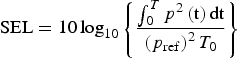
Sound exposure levels (SELs) were calculated as:
 $$\hbox{SEL} = 10 \log _{10} \left\{{ \vint_0^T p^2 \left(\rm t \right)\hbox{dt} \over \left(p_{\rm ref} \right)^2 T_0} \right\} \eqno\lpar 2\rpar$$
where p(t) is the instantaneous sound pressure, pref is 1 µPa and T0 = 1 s (ANSI, 1994). The units for SEL are dB re 1 µPa2-s.
Linear regressions were performed using the SPSS statistical analysis program (v. 17). The percentage of variation of the dependent variable explained by the models is expressed as the coefficient of determination (R2). The fits of the regression models were tested using the significance value of the F statistic.
RESULTS
Broadband boat noise
Despite the limitations of broadband noise data, they do provide a useful measure of the relative sound pressures generated by different types of vessel. Some of these are given in Table 1.
Underwater broadband noise source levels of leisure boats.

SPL, sound pressure level; data do not necessarily span all frequencies and may therefore underestimate broadband source levels.
SPLs decrease as the distance from the source is increased. Figure 1 shows broadband SPLs received over a range of distances from the Avon rubber boat. Broadband source levels were predicted by passing through the data point measured at 8 m a line described by the function SPL = 156 – 15.6 logR or by using equation (1) to calculate theoretical TL from 1-octave components. Predicted broadband source SPLs were respectively 156 and 168 dB re 1µPa at 1 m.
Recorded (closed circles) and predicted (dashed lines) broadband noise levels recorded at various ranges for a 5.4 m Avon rubber boat equipped with an 80 hp outboard engine running at maximum speed. The ambient noise level is shown by a solid line.

1-octave band boat noise
Received and estimated 1-octave SPLs are shown in Figure 2; predicted levels, using the Marsh & Schulkin (1962) model of TL, are reasonably accurate at all frequencies (0.1–16 kHz) up to 72 m distance.
Recorded (solid lines) and predicted (dashed lines) 1-octave noise spectra at various ranges for a 5.4 m Avon rubber boat equipped with an 80 hp outboard engine running at maximum speed. Mean ambient noise levels are shown by a solid line with standard deviation bars (N = 3). Ambient levels have been added to predicted levels.

This is also the case at 532 m distance for frequencies up to approximately 3 kHz but above this frequency, predicted TL is noticeably lower than that observed at this range. Ambient levels varied over time and this is shown by the standard deviation derived from 3 measurements made during a 1 minute period prior to the vessel's pass. Note that the coupling of low frequency, shallow source noise is significantly limited by the Lloyd mirror effect (Urick, Reference Urick1983)—this would be more significant in the case of smaller boats with shallower propellers.
Frequency-dependence of TTS onset
Figure 3 shows TTS onset levels obtained from studies using pure tone, 1 second, fatiguing stimuli at different frequencies. TTS studies using impulsive noise have been ignored because they tend to cover a very broad range of frequencies, often exceeding several octaves; in such cases, it is not possible to attribute the TTS to any particular frequency component. For the same reason, studies employing 1-octave fatiguing stimuli have not been included.
Left ordinate: temporary threshold shift (TTS) threshold levels as a function of the frequency of a pure tone fatiguing stimulus (1 second duration). (■, □) Schlundt et al. (Reference Schlundt, Finneran, Carder and Ridgway2000); (▴, ▵) Finneran et al. (Reference Finneran, Carder, Schlundt and Ridgway2005). Open symbols, no TTS induced; closed symbols, TTS induced. Right ordinate: bottlenose dolphin hearing threshold (x) Johnson (Reference Johnson and Tavolga1967).

It is possible that the TTS threshold is significantly lower at higher frequencies but the available data for 1 second tones are too limited to determine this (e.g. Schlundt et al., Reference Schlundt, Finneran, Carder and Ridgway2000: 75 kHz data point in Figure 3). If Schlundt et al. (Reference Schlundt, Finneran, Carder and Ridgway2000) 75 kHz data are ignored, the TTS frequency dependence is best fit by a line of –1.2 dB per doubling of frequency (R2 = 0.59, P > 0.1). If the TTS onset threshold for 75 kHz is included, the frequency-dependence is best fit by a line of –2.7 dB per doubling of frequency (R2 = 0.82, P = < 0.05). Therefore, frequency dependence exists only if the lower TTS threshold at 75 kHz is accepted and the absence of TTS at 193 dB is excluded from the data shown in Figure 3. More recent work by Finneran (Reference Finneran2008) has determined a marked difference between TTS thresholds for 64 seconds exposures to fatiguing tones at 3 kHz and 20 kHz. Using the same animal, TTS was induced by 64 seconds duration fatiguing stimuli SELs of 197 and 180 dB re 1 µPa2-s at 3 kHz and 20 kHz respectively (this represents a shift of –6.2 dB per doubling of frequency). These data suggest that the lower TTS threshold at 75 kHz (182 dB re 1 µPa2-s) reported by Schlundt et al. (Reference Schlundt, Finneran, Carder and Ridgway2000) should be included in the characterization of the frequency-dependence of TTS induction by 1 second tones.
For comparison, the hearing threshold shown in Figure 3 changes by –8.8 dB per doubling of frequency (R2 = 0.95, P < 0.01). The largest TTSs induced by either intense pure tones or bands of noise occur at frequencies 1/2-octave to 1-octave above the frequencies of the fatiguing stimuli (Schlundt et al., Reference Schlundt, Finneran, Carder and Ridgway2000; Nachtigall et al., Reference Nachtigall, Supin, Pawloski and Au2004; Finneran et al., Reference Finneran, Schlundt, Branstetter and Dear2007) as in terrestrial mammals (Kryter, Reference Kryter1994).
TTS induction by boat noise
When the SELs are the same, a tone or 1/3-octave band of noise generally causes a greater level of TTS (3 dB at 4 kHz in humans) (Kryter, Reference Kryter1994) than a 1-octave band of noise centred at the same frequency; this in turn causes a greater level of TTS (5 dB at 4 kHz in humans) (Kryter, Reference Kryter1994) than a broadband pink noise.
Sound exposure levels were calculated for 1-octave boat noise which has larger source SPLs than the 1/3-octave (data not shown) or broadband boat noise (Figure 1). Maximum 1-octave boat noise occurred at frequencies ≥250 Hz where SPLs exceeded those of 1/3-octave boat noise by 3.4–11.2 dB re 1 µPa. The 1-octave source SPLs were relatively constant over this frequency range (160.1 ±0.9 dB re 1 µPa at 1 m); the centre frequency (f c) chosen for assessment was 8 kHz, which was the highest f c measured and therefore the most likely to induce a TTS (Figure 2). This band corresponded quite closely to that of the fatiguing stimuli (f c 7.5 kHz) used in relatively long exposure duration TTS studies (Nachtigall et al., Reference Nachtigall, Pawloski and Au2003, Reference Nachtigall, Supin, Pawloski and Au2004).
Based on the calculated TL (Figure 2) constant boat noise (with a source level of 160 dB re 1µPa at 1 m) for 1 hour would produce a maximum 1-octave SEL of 190 dB re 1µPa2-s (f c 8 kHz) at approximately 1.3 m from the source. If dolphins were exposed to this noise for 8 hours, the threshold SEL would be achieved at approximately 2.3 m from the source. The impacts of long-term exposures to several boats were assessed by assuming that all boats generated the same 1-octave (f c 8 kHz) source level of 160 dB re 1µPa at 1 m and that summation was coherent (the worst case). It was also assumed that exposure would be continuous for 8 hours and that TTS would be induced by a 1-octave SEL of 190 dB re 1µPa2-s (f c 8 kHz). Accordingly, at 4 m from the source, 4 boats would be required to induce TTS; this figure increased to 19 boats at a distance of 10 m.
PTS induction by boat noise
On the basis that in humans, immediate PTS is caused by intermittent noise approximately 155 dB above the absolute threshold level (Kryter, Reference Kryter1985) Richardson & Malme (Reference Richardson, Malme, Richardson, Greene, Malme and Thompson1995) suggested that if this applies to marine mammals, given their mobility, immediate PTS is unlikely to be produced by continuous man-made noise with source levels up to approximately 195 dB re 1µPa at 1 m. Southall et al. (Reference Southall, Bowles, Ellison, Finneran, Gentry, Greene, Kastak, Ketten, Miller, Nachtigall, Richardson, Thomas and Tyack2007) estimated that PTS in cetaceans would be induced by an M-weighted (Bowles et al., Reference Bowles, Gentry, Ellison, Finneran, Greene, Kastak, Ketten, Miller, Nachtigall, Richardson, Southall, Thomas and Tyack2005) exposure of 215 dB re 1µPa2-s based on the figure of 195 dB re 1µPa2-for TTS-onset derived by Finneran et al. (Reference Finneran, Carder, Schlundt and Ridgway2005) plus 20 dB. Using the minimum value for TTS-onset of 190 dB re 1µPa2-, this would give a PTS-onset threshold of 210 dB re 1µPa2-s at 8 kHz. These values are well above those estimated to be produced by prolonged (8 hour) and close (1 m) exposure to boat noise.
DISCUSSION
The frequency and power of boat noise is generally directly related to engine speed as turbulence around the propeller increases. Propeller noise generated at relatively high frequencies is normally the result of cavitation—the continuous creation and collapse of tiny bubbles (Urick, Reference Urick1983). The correlation between propeller rotational speed and the sound generated generally means that the SPL increases with increasing speed of travel (e.g. Kipple & Gabriele, Reference Kipple and Gabriele2004). However, this is not always the case; Karnauhov et al. (Reference Karnauhov, Kruglov and Rutenko2005) have attributed this to the facts that engine noise approaches the resonant frequency of the boat hull at lower speeds and that the hull vibrations couple to the water better than those from the engine.
Broadband noise source SPLs (1 m) from previous studies of leisure boats are in broad agreement with those estimated here for the Avon 5.4 m rubber boat using extrapolation of a line described by the function SPL = 156 – 15.6 logR. Given that TTS induction is likely to occur only at relatively short ranges, the estimation of received spectral levels using the Marsh & Schulkin (Reference Marsh and Schulkin1962) model of TL seems to provide a degree of accuracy sufficient to estimate TTS. Other studies have examined the frequency distribution of noise generated by leisure boats. Malme et al. (Reference Malme, Miles, Miller, Richardson, Roseneau, Thompson and Greene1989) estimated 1/3-octave source levels at 1 m for a 5 m Zodiac boat equipped with a 25 hp outboard engine and a 7 m vessel containing twin 80 hp outboard drives running at maximum speed. The noise spectrum from the Zodiac was similar to that measured for the Avon boat with a peak source 1/3-octave SPL of 151 dB re 1µPa at a frequency of 6 kHz (peak source 1/3-octave SPL for the Avon boat was estimated to be 160 dB re 1µPa at a frequency of 5 kHz—data not shown). The maximum source 1/3-octave SPL for the 7 m vessel was 156 dB re 1µPa at a frequency of 0.5 kHz. Similar spectra have been obtained for small motor boats by Kipple & Gabriele (Reference Kipple and Gabriele2004). Lesage et al. (Reference Lesage, Cyrille, Kingsley and Sjare1999) measured noise levels generated by a 7 m vessel equipped with twin 70 hp engines at frequencies up to 16 kHz. These levels were measured from a distance of 200 m and, although not absolute, they demonstrated reasonably constant values between 10 kHz and 16 kHz.
Given that the equal energy line at 190 dB re 1µPa2-s provides a reasonable separation between sub- and supra-threshold SEL values obtained from a variety of noise sources (impulse, pure tone and 1-octave) and that the boat noise spectrum is fairly flat between 0.25 and 10 kHz (where SPLs are highest), it has been assumed that the threshold SEL for boat noise will not be substantially different from 190 dB re 1 µPa2-s. This threshold figure ignores the lower TTS thresholds observed at 75 kHz by Schlundt et al. (Reference Schlundt, Finneran, Carder and Ridgway2000) and at 20 kHz by Finneran (Reference Finneran2008). SELs at frequencies higher than those measured here are expected to be lower because as the frequency is increased, source SPLs are expected to fall (Kipple & Gabriele, Reference Kipple and Gabriele2004) and acoustic absorption by seawater will increase. Kipple & Gabriele (Reference Kipple and Gabriele2004) measured boat noise from 150 Hz to 30 kHz for a variety of boats including a 5.2 m open skiff equipped with a 65 hp outboard engine and a 7.9 m cabin cruiser equipped with an outboard engine (size not specified). Estimated source (1 yard) 1/3-octave SPLs from both vessels declined linearly between 8 kHz and 30 kHz from 157 to 143 dB re 1 µPa for the open skiff and from 159 to 145 dB re 1 µPa for the cabin cruiser (both travelling at 24 km/hour). This represents a 7.3 dB fall in SPL per doubling of frequency. Note that the authors calculated source SPLs by estimating TL using (spherical) spatial spreading only (no allowance was made for frequency-dependent TL); this would tend to underestimate the source SPLs at higher frequencies. Over the distances involved (approximately 457 m) the difference in TL for 8 kHz and 30 kHz noise would have been relatively small (2.4 dB according to the Marsh & Schulkin (1962) model; this would be equivalent to 1.2 dB per doubling of frequency). According to available data, any frequency-dependence of TTS onset appears to lie somewhere between –2.7 and –6.2 dB per doubling of frequency of the fatiguing stimulus. Any frequency-dependence of TTS induction does not seem to exceed the frequency-dependence of received SPLs generated by leisure boats. Therefore, hearing loss is expected to be no more significant at frequencies above 8 kHz than below 8 kHz.
Calculations of received levels must incorporate TL between the source and receiver. This depends upon several parameters, such as variation of sound velocity with depth, surface and bottom reflections, frequency-dependent absorption, temperature and topography. Since many of these parameters are not generally known, and since the receiving animal is continuously moving within three dimensions, it is seldom possible to estimate received SPLs to better than 3–5 dB. The accuracy of measuring sound exposures might be improved in the future by the adoption of new technologies, such as acoustic tags that can record and transmit dolphin noise exposure in real time (Johnson & Tyack, Reference Johnson and Tyack2003; Wiggins & Hildebrand, Reference Wiggins and Hildebrand2007; Van Parijs et al., Reference Van Parijs, Clark, Sousa-Lima, Parks, Rankin, Risch and Van Opzeeland2009) as well as real-time passive acoustic monitoring techniques that will reveal the acoustic ecology of the area, together with simultaneous boat data.
ACKNOWLEDGEMENTS
The author is indebted to S.B. Blackwell and C.R. Greene, Jr of Greeneridge Sciences, Inc., CA for the provision of boat noise data.



