Introduction
Leaf pubescence is one of the important adaptive morphological traits of a plant and was discovered in major taxa of vascular plants (Doroshkov et al., Reference Doroshkov, Konstantinov, Afonnikov and Gunbin2019). In cereals, it consists of unicellular epidermal hairs – trichomes of various length, distributed over the surface with different frequencies. This evolutionary adaptation protects a leaf from physical damage during dusty winds or from insect damage (Schillinger and Gallun, Reference Schillinger and Gallun1968; Roberts et al., Reference Roberts, Gallun, Patterson and Foster1979). A layer of trichomes can trap pathogen spores, preventing them from growing into leaf tissue. Pubescence also affects transpiration and drought tolerance (Hamaoka et al., Reference Hamaoka, Yasui, Yamagata, Inoue, Furuya, Araki, Ueno and Yoshimura2017; Pshenichnikova et al., Reference Pshenichnikova, Doroshkov, Osipova, Permyakov, Permyakova, Efimov and Afonnikov2019).
Two genes were found and mapped in bread wheat (Triticum aestivum L., AABBDD) that control the formation of leaf pubescence. These are the gene Hl1 mapped to chromosome 4BL (Dobrovolskaya et al., Reference Dobrovolskaya, Pshenichnikova, Arbuzova, Lohwasser, Röder and Börner2007) and the gene Hl2 localized to 7BS chromosome (Taketa et al., Reference Taketa, Chang, Ishii and Takeda2002). An analogue of the latter, the Hl2aesp gene, introgressed from the species Aegilops speltoides Tausch, was also mapped to 7BS chromosome (Dobrovolskaya et al., Reference Dobrovolskaya, Pshenichnikova, Arbuzova, Lohwasser, Röder and Börner2007). The third pubescence gene, Hl3 was determined by genetic analysis but its precise genome position is not known (Doroshkov et al., Reference Doroshkov, Afonnikov, Dobrovolskaya and Pshenichnikova2016).
Vavilov (Reference Vavilov1987) described the phenotypic diversity of leaf pubescence in di-, tetra- and hexaploid species of the genus Triticum L., noting the wide variability of the trait. Leaf pubescence was used as one of the classifying characteristics among diploid and tetraploid species in the genus Triticum L. (Dorofeev et al., Reference Dorofeev, Filatenko, Migushova, Udachin and Yakubtsiner1979). Diploid T. urartu Thum. et Gandil. and the tetraploids T. isphahanicum Heslot and T. paleo-colchicum Men. were described as carriers of velvet pubescence, while the tetraploids T. araraticum Jakubz. and T. militinae Zhuk. et Migusch. – of rare and tough pubescence. This may indicate the existence of other unknown genes for leaf pubescence in cereals. A study of the quantitative characteristics of 47 accessions from the genera Triticum and Aegilops showed that genomes A, B and D have different effects on the density and length of trichomes (Pshenichnikova et al., Reference Pshenichnikova, Doroshkov, Simonov, Afonnikov and Börner2017). The largest trichomes were found in T. timopheevii Zhuk.
The pubescence from T. timopheevii was randomly introduced into the line 821 of bread wheat obtained on the basis of the spring bread wheat cultivar Saratovskaya 29 (S29) (Budashkina, Reference Budashkina1988). Leaf pubescence in the line 821 differs significantly from the same of the recipient cultivar S29 and is similar to that of T. timopheevii. Its genetic control has not yet been studied. The aim of this work was to establish the chromosomal localization of the gene for leaf pubescence introgressed into common wheat from T. timopheevii, and to compare its phenotypic manifestation in the genetic background of two unrelated common wheat cultivars that differ in genetic control and phenotypic expression of this trait.
Materials and methods
Plant material
The line 821 from the collection of introgression bread wheat lines resistant to fungal diseases was obtained by crossing S29 with tetraploid T. timopheevii ssp. viticulosum (Budashkina, Reference Budashkina1988). According to molecular data (Leonova et al., Reference Leonova, Kalinina, Budashkina, Röder and Salina2001), the line carries introgressions of similar size in chromosomes 2A, 2B and a small introgression in the subtelomeric region of the long arm of 5A chromosome. According to tactile and visual observations, S29 has velvety, uniform pubescence, while the line 821 has prickly pubescence due to long trichomes on both leaf surfaces. For genetic analysis of the introgressed trait, genotypes with the absence of such leaf pubescence were used: spring samples – cultivar Diamant 2 (Dm2) and chromosome substitution line Chinese Spring (T. spelta 5A) and winter line 84/98w from the Arsenal collection (Lapochkina, Reference Lapochkina2001). The line 821 was crossed with these genotypes, and three F2 populations were obtained. Segregation ratios for two phenotypic classes (presence or absence of leaf pubescence typical for the line 821) were studied among 70–103 plants from each population.
For chromosomal localization of the pubescence gene, monosomic lines of S29 and Dm2 for 5A chromosome were used as maternal components of crossing. Female gametes of a monosomic plant are mostly nullisomic (over 75%) (Law and Worland, Reference Law, Worland and Lupton1987). The introgression line 821 was the donor of paternal gametes with 5A chromosome. F1 hybrids of the crosses mono 5A S29 × 821 and mono 5A Dm2 × 821 were studied using cytological analysis of anther cells stained with acetocarmine (Pausheva, Reference Pausheva1974). We selected plants carrying the univalent of 5A chromosome (20″ + 1′) in the metaphase I of meiosis. They inherited 5A chromosome from the line 821 and carried the target pubescence gene. After self-pollination, two monosomic F2 populations for S29 and Dm2 were obtained. Fifty plants from each population were grown in a hydroponic greenhouse during three different growing seasons (totally about 150 plants for each population). These plants were used to study the segregation ratios into phenotypic classes according to the types of leaf pubescence by touch. One hundred individual plants from each F2 population were involved in high-throughput phenotyping. The number and length of trichomes were determined on the image on adaxial (upper) and abaxial (lower) leaf surface. All comparisons were made with the maternal (recipient) forms.
Growing conditions
All experiments were carried out in a hydroponic greenhouse. Cultivation was carried out in rows with 10 plants per 1 m row. Expanded clay was used as a soil substrate, and Knop's solution was used as a nutrient solution. Artificial lighting (45,000–50,000 lux) for 12–14 h was applied. The temperature was 18–20°C at night and 24–26°C during the day.
Analysis of images of leaf folds
To determine quantitative characteristics of pubescence, images of transverse folds from the adaxial and abaxial surface of a boot leaf, which precedes the flag leaf, were used (Genaev et al., Reference Genaev, Doroshkov, Pshenichnikova, Kolchanov and Afonnikov2012a). Images were obtained on a Carl Zeiss Axioscop 2 plus microscope through a 5x/0.12 objective. The microscope is equipped with an AxoCam HRc digital camera with a TV2/3C 0.63x adapter. The physical size of the field of view was 2730 × 2163 μm; the resolution of digital photography was 1300 × 1030 pixels. The physical pixel size was 2.1 μm. The LHDetect 2 program (Genaev et al., Reference Genaev, Doroshkov, Pshenichnikova, Kolchanov and Afonnikov2012a) was used for obtaining the quantitative characteristics of leaf pubescence images. This program processed the standard micro-images of leaf folds, automatically identified trichomes, count them and determined the length. For each plant, three folds were analysed on the adaxial and abaxial surface of the boot leaf. Two images were taken along each fold. Thus, for each plant, 12 micrographs were examined.
Statistical methods
In genetic and monosomic analysis, the Pearson χ 2 test was used to assess the correspondence of the obtained ratios to the theoretically expected ones. Student's t-test was used to evaluate the significance of differences in average values for length and number of trichomes between the recipient cultivars and hybrid populations. The calculations were made within the MS Excel program.
Results
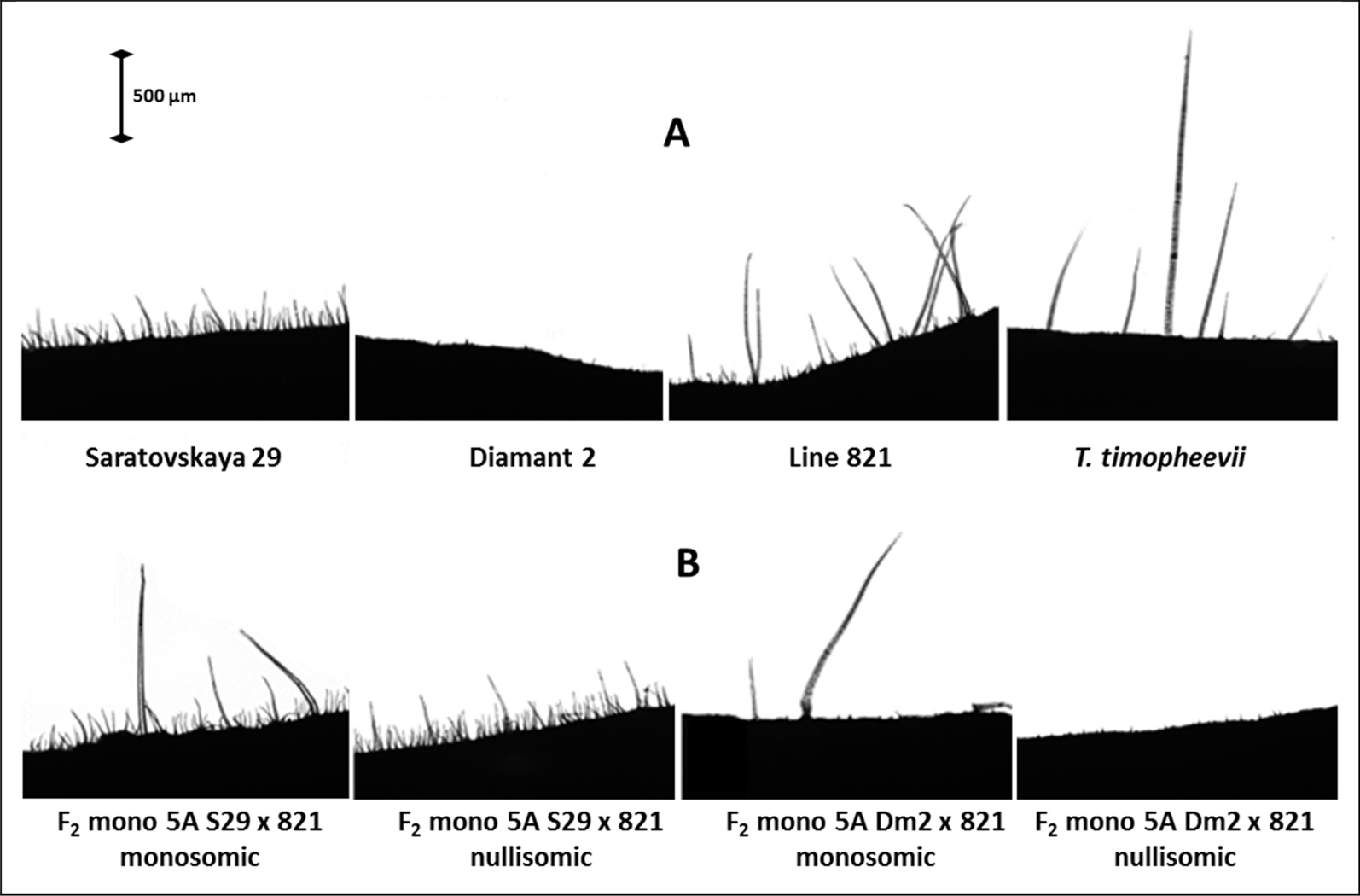
The introgression line 821 inherited leaf pubescence in the form of long rare trichomes (Fig. 1). However, their length is much shorter than that of the original donor species T. timopheevii. The line was obtained on the basis of S29 which is characterized by dense pubescence of short trichomes (Fig. 1). Both types of pubescence are well distinguishable visually and persist until the end of plant growth. Dm2 has rare short pubescence, which disappears by the end of the growing season (Fig. 1). The genetic analysis was performed to study the mode of inheritance of trichomes typical for the line 821 using three genotypes with poor pubescence. In F1 hybrids Dm2 × 821, Chinese Spring (T. spelta 5A) × 821 and 84/98w × 821, the trait was inherited according to the dominant type. In F2 populations, the ratio between the phenotypic classes corresponded to the monogenic (Table 1). Thus, the pubescence introgressed from T. timopheevii is controlled by a single dominant gene. It was designated as Hltt.
Phenotypic manifestation of leaf pubescence in different wheat genotypes. (A) Bread wheat cultivars Saratovskaya 29 (S29) and Diamant 2 (Dm2), S29 × Triticum timopheevii introgression line 821, T. timopheevii. B. F2 monosomic 5A hybrids S29 × 821 and Dm2 × 821. Nullisomic genotypes lack chromosome 5A.

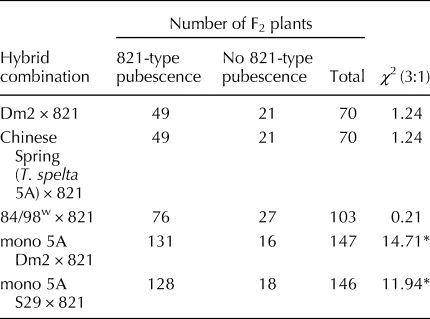
Distribution of F2 plants into phenotypic classes according to the types of leaf pubescence

*P < < 0.05.
According to molecular data, the line 821 carries extended introgressions in chromosomes 2A and 2B (Leonova et al., Reference Leonova, Kalinina, Budashkina, Röder and Salina2001). However, there is no information about the presence of leaf pubescence genes in the second group of chromosomes of bread wheat. The region of the introgression in the distal region of the long arm on 5A chromosome was designated by the markers Xgwm179 and Xgwm291 (Leonova et al., Reference Leonova, Kalinina, Budashkina, Röder and Salina2001). Additionally, this introgression is indicated by awned and speltoid spike of the line 821. The responsible genes b1 and Q are located in the same region of 5A chromosome (McIntosh et al., Reference McIntosh, Yamazaki, Dubcovsky, Roger, Morris, Appels and Xia2013). Earlier, Hl gene for leaf pubescence was found in this region, near the marker Xcfd39 in T. monococcum (Jing et al., Reference Jing, Kornyukhin, Kanyuka, Orford, Zlatska, Mitrofanova, Koebner and Hammond-Kosack2007). This diploid cereal species is a carrier of the genome A homologous to the same of bread wheat. The gene, as authors described, formed long, rare trichomes. The marker Xcfd39 is situated in 2.2 cM from the marker Xgwm179 (https://wheat.pw.usda.gov/cgi-bin/GG3/quickquery.cgi?query=nearbyloci&arg1=Xcfd39-5A&arg2=10). We assumed that the Hltt gene, which controls the formation of long trichomes in the line 821 may be located in the distal region of the long arm of 5A chromosome.
To confirm this, a monosomic genetic analysis was used, which allows to establish the chromosomal localization of the dominant gene through the segregation for the target trait in F2 monosomic population. If the dominant gene Hltt is located on 5A chromosome, the segregation of F2 plants by the presence or absence of trichomes typical for the line 821 will deviate from the expected 3:1 (Law and Worland, Reference Law, Worland and Lupton1987). This is because only the nullisomic plants (2n = 40) lacking 5A chromosome form the phenotypic class of plants without long trichomes. Nullisomics are formed in the F2 monosomic population with a low frequency. The vast majority of F2 plants will carry the dominant allele in a hemi- or heterozygous state. If the gene is located in chromosome other than 5A, the monogenic segregation will occur.
Table 1 shows the ratios of phenotypic classes for the target trait in the two monosomic F2 populations in crosses mono 5A Dm2 × 821 and mono 5A S29 × 821. In both cases, a significant prevalence for the number of plants with long trichomes determined by the Hltt gene was observed. In both cases, the χ 2 values significantly exceed the critical value of 3.84, which corresponds to the lowest significance level of P = 0.05 (Table 1). This indicates that the Hltt gene, which controls the formation of long trichomes in the line 821, is associated with 5A chromosome. The phenotypes of pubescence on the abaxial leaf surface observed in two F2 monosomic populations are shown in Fig. 1. It can be seen that in the nullisomic plants (20″) lacking 5A chromosome, this kind of pubescence is absent completely. This also proves the localization of the Hltt gene on 5A chromosome.
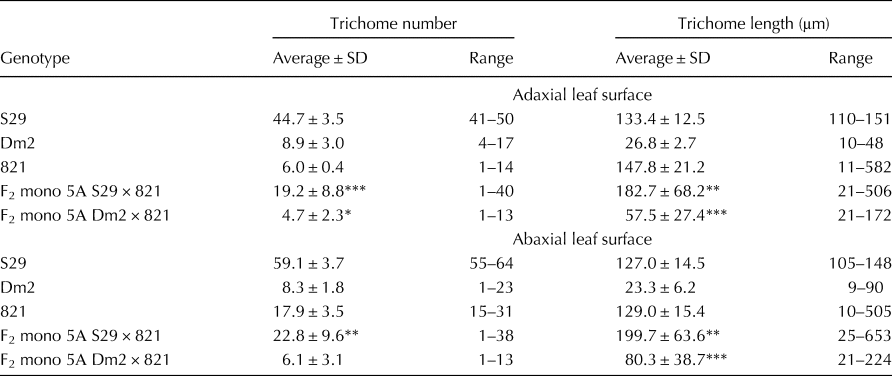
Phenotypic expression of the new type of pubescence visually differed between two populations mono 5A Dm2 × 821 and mono 5A S29 × 821. We compared the quantitative characteristics of trichomes on the adaxial and abaxial leaf surface for 100 individual plants from each F2 population with those of the maternal parents. The average values of the number of trichomes and their length are presented in Table 2.
Morphometric characteristics of leaf trichomes (average number and length on the image) of parental forms and 100 F2 plants of two monosomic populations

*P < 0.05; **P < 0.01; ***P < 0.001 in comparison with the corresponding recipient.
The average number of trichomes on the image in S29 was several times higher than that of Dm2 and the line 821 on both leaf surfaces. On the abaxial leaf surface in the line 821, the density of trichomes was twice that of Dm2. On the adaxial leaf surface, trichome density was approximately the same. The average length of trichomes in S29 and the line 821 was approximately the same on both leaf surfaces. For Dm2, this value was about five times lower. The line 821 was characterized by a large range of average length of trichomes and the maximum values were 3–4 times higher than those of the densely pubescent cultivar S29 (Table 2).
In the F2 population mono 5A S29 × 821, the average number of trichomes was halved both on the adaxial and abaxial leaf surface and significantly differed from S29 (Table 2). The average length of trichomes in the adaxial leaf surface was increased by 49.3 μm, and in the abaxial leaf surface by 72.7 μm compared to S29, and this increase was also statistically significant. In the F2 population mono 5A Dm2 × 821, the average number of trichomes halved only on the adaxial leaf surface. On the abaxial leaf surface, the decrease was not significant. The average trichome length in this population doubled on both leaf surfaces. Thus, both populations showed the same phenotypic effect after the introduction of 5A chromosome from the line 821. Additionally, the range between the minimal and maximal average length of trichome substantially expanded in both monosomic populations compared to the recipients S29 and Dm2.
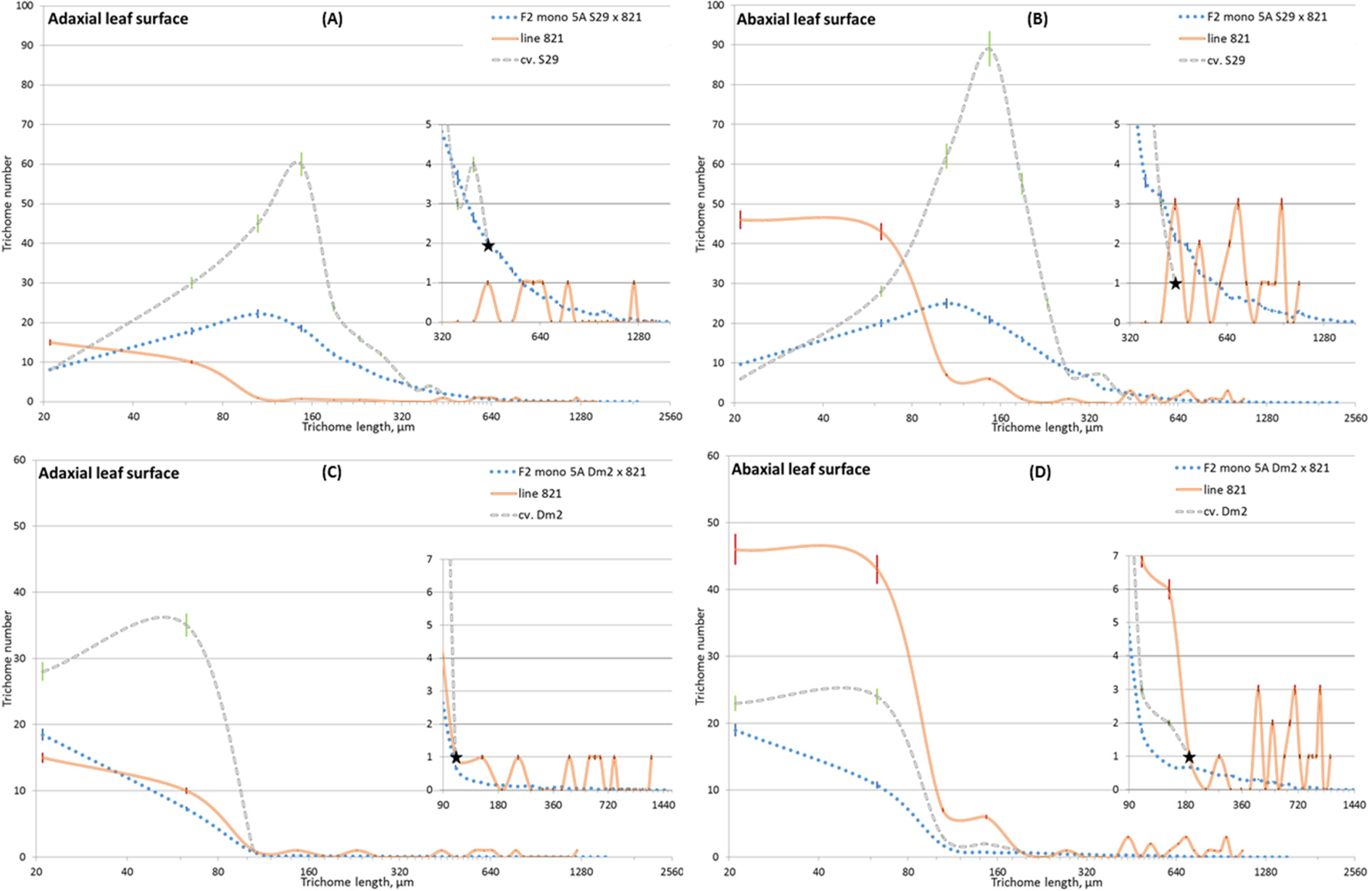
Average values of the number and length of trichomes characterize pubescence as a whole. However, they do not reflect the ratios between long and short trichomes as seen in micrographs (Fig. 1). Therefore, the distribution of the number and length of trichomes on the adaxial and abaxial leaf surface was studied in the two F2 populations. The data are presented in Fig. 2. Common for both populations is a decrease in the frequency of trichomes of a certain length and the appearance of long trichomes, which are not typical for S29 and Dm2. Thus, on the adaxial leaf surface in the population mono 5A S29 × 821 (Fig. 2(A)), the number of trichomes of the length 80–160 μm decreased three times. In the population mono 5A Dm2 × 821, such a decrease was observed for trichomes of the length 40–80 μm (Fig. 2(C)). On the abaxial leaf surface, the number of trichomes of the length 80–160 μm decreased 4.5 times in the mono 5A S29 × 821 population (Fig. 2(B)). In the second population, such a decrease was observed for trichomes of the length 20–50 μm (Fig. 2(D)). The length of the longest trichomes increased significantly compared to S29 and Dm2. In the mono 5A S29 × 821 population, the maximum trichome length was more than 2500 μm, which was even greater than in the line 821. In the mono 5A Dm2 × 821 population, the maximum length of such long trichomes reached 2000 μm, with the maximum for Dm2 itself 100 μm. Thus, in different genotypic background, the Hltt gene had different effects on the phenotype of leaf pubescence.
Distribution of trichomes by number and length on the adaxial and abaxial leaf surface among the parents and F2 plants of populations mono 5A S29 × 821 (A, B) and mono 5A Dm2 × 821 (C, D). Nullisomics were not taken into account. The insets show fragments of diagrams with long trichomes with a length more than 320 μm for the population mono 5A S29 × 821 and more than 90 μm for the population mono 5A Dm2 × 821. Asterisks indicate the ultimate length of trichomes found in cultivars S29 and Dm2. The lower scale is logarithmic.

Discussion
In cereals of the tribe Triticeae, the properties of leaf pubescence were characterized based on tactile and visual assessment by Vavilov (Reference Vavilov1987). Quantitative characteristics of pubescence were obtained in some species of different ploidy, and the difference of the contribution of different genomes to the phenotype has been shown (Pshenichnikova et al., Reference Pshenichnikova, Doroshkov, Simonov, Afonnikov and Börner2017). In this work, it was shown that S29 has the strongest pubescence among the hexaploid varieties, and Dm2 has a poor pubescence. Triticum timopheevii was found to have the longest pubescence among all studied genotypes.
The complex allohexaploid genome of bread wheat (AABBDD) suggests a wide genetic variability of this species as it combines the genomes of three ancestral forms. However, the intraspecific polymorphism for leaf pubescence is still unknown. There is only one study that describes the variability for the trait among 47 Russian and German cultivars of spring bread wheat (Genaev et al., Reference Genaev, Doroshkov, Morozova, Pshenichnikova and Afonnikov2012b). This variability does not cover the revealed spectrum of variability among a set of related species with different genomes (Pshenichnikova et al., Reference Pshenichnikova, Doroshkov, Simonov, Afonnikov and Börner2017). The two additive genes Hl1 and Hl3 determine the densest pubescence of S29 (Doroshkov et al., Reference Doroshkov, Pshenichnikova and Afonnikov2011). Their interaction was revealed using the inter-varietal substitution line S29 (Yanetsikis Probat 4B). The absence of Hl1 gene resulted in a decrease in trichome length and density (Doroshkov et al., Reference Doroshkov, Afonnikov, Dobrovolskaya and Pshenichnikova2016). Hl1 is located on chromosome 4B (Maystrenko, Reference Maystrenko1976). The chromosomal localization of Hl3 is not known. The cultivar Dm2, judging by the pubescence phenotype, lacks Hl1 and Hl3 genes.
The pubescence genes have not yet been identified in the A genome of bread wheat. Monogenic inheritance of leaf pubescence was revealed in the species – carriers of A genome, T. monococcum and T. boeoticum (Kuspira et al., Reference Kuspira, Maclagana, Bhambhan, Sadasivai and Kim1989; Sharma and Waines, Reference Sharma and Waines1994). This trait was used by Filatenko et al. (Reference Filatenko, Grau, Knüpffer and Hammer2001) as one of the discriminating characters for the botanical description of A-genome diploid species. In this work, the species T. boeoticum was found to have the longest trichomes reaching 1.5 mm. The same type of pubescence was found in T. timopheevii (Pshenichnikova et al., Reference Pshenichnikova, Doroshkov, Simonov, Afonnikov and Börner2017).
Using monosomic analysis, we found that the introgression line 821 inherited the Hltt gene from T. timopheevii, and it is located on 5A chromosome. This finding is in agreement with the localization of the gene for leaf pubescence in the same chromosome in T. monococcum (Jing et al., Reference Jing, Kornyukhin, Kanyuka, Orford, Zlatska, Mitrofanova, Koebner and Hammond-Kosack2007). This gene determines phenotypically similar long and rare leaf pubescence both in T. timopheevii and in the derivative line 821. However, it should be noted that in the line 821, created on the genetic basis of bread wheat cultivar S29, the long trichomes are two times less frequent and significantly shorter than those in the donor species (Pshenichnikova et al., Reference Pshenichnikova, Doroshkov, Simonov, Afonnikov and Börner2017). In addition, the line has practically lost the dense pubescence of S29 formed by trichomes about 150 μm long (Fig. 2).
The phenotypic expression of the Hltt gene was studied in two hybrid populations of cultivars with contrasting pubescence. In S29, carrier of two responsible pubescence genes, the average length of trichomes on both leaf surfaces is about three times that of Dm2, carrier of the recessive alleles. The number of trichomes differs by 3.3 and 5.5 times on the adaxial and abaxial leaf surface, respectively (Table 2, Fig. 2). However, in both hybrid combinations, the phenotypic expression of the Hltt gene is similar. Firstly, it consists of the formation of rare trichomes of big length, up to 500 μm and higher (Table 2, Fig. 2). Secondly, the density of short trichomes in hybrids decreases in the presence of the Hltt gene. In the mono 5A S29 × 821 population, the number of trichomes with a length from 20–40 to 300–350 μm decreases several times in comparison with S29, especially in the interval of 100–200 μm. On the abaxial leaf surface, this decline was more significant (Fig. 2(A) and (B)). The number of trichomes also decreases sharply in the population mono 5A Dm2 × 821 in the interval from 0 to 100 μm. The 60 μm peak for this interval, characteristic of Dm2, disappears. This is especially noticeable on the adaxial leaf surface (Fig. 2(C)). Thus, the gene Hltt demonstrates a suppressive effect both on dominant alleles of the pubescence genes Hl1 and Hl3 in the genetic background of cultivar S29 and on recessive alleles of these genes in the cultivar Dm2. On the other hand, the presence of the Hl1 and Hl3 genes enhances the effect of the Hltt gene in the population of mono 5A S29 × 821, which results in the formation of a larger number of extremely long trichomes (Fig. 2).
The species T. timopheevii became the source of many genes for resistance to fungal diseases which were transferred to different bread wheat cultivars (McIntosh et al., Reference McIntosh, Yamazaki, Dubcovsky, Roger, Morris, Appels and Xia2013). Almost nothing is known about the introgression of other adaptively significant genes from this species. Development of substitution and isogenic lines with the fragment of introgression carrying the gene Hltt will allow determining function and assessing the adaptive significance of this gene more precisely.
Acknowledgements
This work is partially supported by the budget project of ICG SB RAS No. 0259-2021-0018. Cultivation in the greenhouse was carried out by the Laboratory of Artificial Plant Growth. Micro photos were obtained from the Common Use Center for Microscopy of Biologic Objects, SB RAS. The data analysis was performed using computational resources of the ‘Bioinformatics’ Joint Computational Center supported by the budget project No. 0259-2021-0009.