INTRODUCTION
Variation in the flow of service provisioning is not only present internationally and regionally, but can exist between communities, within communities, and even within a given household. While recent studies of ecosystem services have focused on global, national and regional assessments of their value to human society (Costanza et al. Reference Costanza, dArge, deGroot, Farber, Grasso, Hannon, Limburg, Naeem, O'Neill, Paruelo, Raskin, Sutton and van den Belt1997; Worm et al. Reference Worm, Barbier, Beaumont, Duffy, Folke, Halpern, Jackson, Lotze, Micheli, Palumbi, Sala, Selkoe, Stachowicz and Watson2006; Naidoo et al. Reference Naidoo, Balmford, Costanza, Fisher, Green, Lehner, Malcolm and Ricketts2008; Luck et al. Reference Luck, Chan and Klien2012), these broad assessments often overlook the heterogeneous distribution of services within regions, communities and households. Proponents of systematic conservation planning recognize the need for better understanding the distribution of opportunity costs to different groups of stakeholders. However, conservation scientists generally conceive of stakeholder groups in relatively coarse-scale terms (Adams et al. Reference Adams, Pressey and Naidoo2010). Analyses of the relationships between ecosystem services and specific user groups allow for more precise estimates of the costs and benefits of conservation.
In this study, we explored the distribution of food security benefits of the particular ecosystem provisioning service of wildlife harvest in the Makira Natural Park (MNP) of Madagascar (Golden et al. Reference Golden, Brashares and Kremen2014) at community, household and individual levels. Wildlife populations provide potentially self-regenerating, harvestable meat to people (Golden et al. Reference Golden, Brashares and Kremen2014) and contribute to local food security (Milner-Gulland et al. Reference Milner-Gulland and Bennett2003; Brashares et al. Reference Brashares, Golden, Weinbaum, Barrett and Okello2011; Golden et al. Reference Golden, Fernald, Brashares, Rasolofoniaina and Kremen2011; Nasi et al. Reference Nasi, Taber and van Vliet2011; Fa et al. Reference Fa, Olivero, Real, Farfán, Márquez, Vargas, Ziegler, Wegmann, Brown, Margetts and Nasi2015). Food security is often conceptualized as comprising three dimensions: availability, access and utilization (Webb et al. Reference Webb, Coates, Frongillo, Rogers, Swindale and Bilinsky2006). We focus in this paper on the access dimension – that is, whether, given the amount of food potentially available (in markets, through ecosystem provisioning and from other sources), communities, households and individuals are able to actually obtain the food that they need and want (Barrett Reference Barrett2010). A host of factors intervene between food availability and food access, including poverty, cultural norms and market infrastructure. Utilization, meanwhile, is a largely household-level process, capturing food preferences, preparation, storage and so on. In the Makira region, more than 99% of the population are agriculturalists and have virtually no market access. Thus, throughout the year, and particularly at times of agricultural food shortages, wildlife and other wild foods play a critical role in supporting food security and enhancing local human nutrition.
Recent work suggests that trade-offs exist between biodiversity protection and maintenance of ecosystem services (Luck et al. Reference Luck, Chan and Klien2012), as well as between efficient conservation and poverty alleviation (Kari & Korhonen-Kurki Reference Kari and Korhonen-Kurki2013; Alix-Garcia & Wolff Reference Alix-Garcia and Wolff2014). By quantifying the costs and benefits of conservation at different scales, ecosystem service analyses can inform eligibility criteria for targeting development and public health mitigation measures for those disproportionately burdened by conservation (Golden et al. Reference Golden, Brashares and Kremen2014). Means-based targeting of food security support, as opposed to a more universal provision of benefits, is important in resource-constrained countries (Mkandawire Reference Mkandawire2005), and is analogous to systematic conservation planning approaches that attempt to maximize conservation value obtained per dollar spent (Naidoo et al. 2006). Our study helps to identify the groups of stakeholders most vulnerable to the loss of access to wildlife.
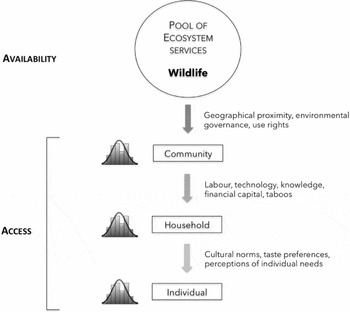
Our conceptual framework begins with the pool of ecosystem services, in this case wildlife, representing the availability dimension of food security (Fig. 1). The first arrow denotes the process leading to variation in community access to these ecosystem services; that is, the observed distribution of wild meat consumption across communities in the MNP. Ecological niche theories (Aarts et al. Reference Aarts, MacKenzie, McConnell, Fedak and Matthiopoulos2008; Patterson et al. Reference Patterson, Thomas, Wilcox, Ovaskainen and Matthiopoulos2008) and the source–sink dynamics of hunted systems (Novaro et al. Reference Novaro, Redford and Bodmer2000) show that the availability of wildlife is heterogeneous within ecosystems (Turner Reference Turner1989). This heterogeneity, both from environmental (i.e., ecological conditions) and social (i.e., varying levels of natural resource dependence, governance regimes, and use rights stemming from law, custom or convention) factors, underpins community variation in the use of wildlife as a food source (Golden et al. Reference Golden, Brashares and Kremen2014). Availability of this provisioning ecosystem service is of course also mediated by the degree of sustainability of wildlife harvest. Without a sustainable harvest, the ecosystem service ceases to provision wild meat to communities at some point in the future – a likely scenario in Madagascar where animals often have slow life history traits and many are unsustainably hunted (Golden Reference Golden2009).
Conceptual framework of the availability of food security related-ecosystem services and factors determining observed variation in access at different levels. Statistics icon from Scarce2 (2008).

The second arrow (Fig. 1) signifies variation in household access to wildlife within a given community, namely the observed distribution of wild meat consumption across households in a single community. Access to a given resource is gained, maintained and controlled by different actors through various mechanisms, and is conditioned by structural and relational mechanisms including access to technology, capital, markets, knowledge and social networks (Ribot & Peluso Reference Ribot and Peluso2003). In this study, we examined in particular the influence of food security status and household income on the distribution of service benefits. These socio–economic variables are associated with reliance on wildlife as a food source (Brashares et al. Reference Brashares, Golden, Weinbaum, Barrett and Okello2011), and they serve as strong proxies for other household characteristics that explain access to ecosystem services.
The third arrow (Fig. 1) denotes the process that produces variation in individual access to wild meat within a household, namely the observed distribution of wild meat consumption across individuals in a single household. Intra-household inequities are the subject of a rich literature in microeconomics and feminist theory (Samuelson Reference Samuelson1956; Becker Reference Becker1981; McElroy & Horney Reference McElroy and Horney1981; Folbre Reference Folbre1986; Rosenhouse Reference Rosenhouse1989). Theory and empirical evidence suggest that gender dynamics and power relations affect the distribution and allocation of services, disproportionately benefiting some individuals at the expense of others (Bourguignon & Chiappori Reference Bourguignon and Chiappori1992; Haddad Reference Haddad1997). In many cases, choices about food distribution are dominated by male heads of household and we tested these dynamics empirically in this study.
Variation in wildlife consumption causes variability in overall food security and nutritional deficiencies of iron, zinc, vitamin A, vitamin B12 and many types of fatty acids (Golden et al. Reference Golden, Fernald, Brashares, Rasolofoniaina and Kremen2011); thus, understanding patterns in nutritional deficiencies requires an understanding of the patterns by which ecosystem services, including wildlife harvest, flow to beneficiaries. Using fine-scale data on wildlife harvesting and consumption, we empirically tested the factors that contribute to intra-household food distribution and we conducted a multilevel analysis, from communities to households to individuals, to determine which scale of variation matters most in targeting interventions to buffer against the potential future loss of ecosystem services.
METHODS
Study site and target community
The MNP is lowland to mid-altitude rainforest covering 371 217 ha (Golden Reference Golden2009). Using past survey data from 2007–2011 (Golden et al. Reference Golden, Brashares and Kremen2014), we calculated the average and variability in amounts of wildlife biomass extracted across 417 households in 26 communities in the study area. Each community ranged in size from three households to 300 households and each surveyed household was selected through systematic random sampling, allowing us to generalize throughout communities (Golden et al. Reference Golden, Brashares and Kremen2014). On average, 39% of households across communities were sampled. These 26 communities represent approximately 20% of the communities in the MNP and were selected non-randomly across trade routes to emphasize geographical, cultural and ecological diversity of the study system. To calculate biomass harvested for consumption, we extrapolated number of animals consumed times the midpoint of the range in adult biomass (Golden et al. Reference Golden, Brashares and Kremen2014). In past work, the hunting arrangements for these communities have been described in detail (Golden et al. Reference Golden, Brashares and Kremen2014). Much of the hunting is conducted individually and is illegal both inside and outside of the MNP, with upwards of 66% of the biomass harvested being illegal capture. The vast majority of hunting was subsistence with only 2% of consumed wildlife being purchased from neighbours within a community.
Within these 26 communities, we selected one community (see Golden et al. Reference Golden, Fernald, Brashares, Rasolofoniaina and Kremen2011 for details) for in-depth investigation of the intra-community (i.e., across households) and intra-household (i.e., across individuals in a household) variation in consumption. This community was selected subjectively because of the long-term relationship that C.D.G. had developed from living there between 2004 and the beginning of the study in 2008. This study was approximately one year of continued observation. Previous qualitative work indicates that the ecological availability of wildlife to households in this community – before the socio–political access factors come into play – is relatively uniform. This targeted community is similar in socio–economic status and cultural identity to others throughout the region. The primary difference between this community as opposed to certain others in this region is that it is not one of the sites of conservation co-management facilitated by Wildlife Conservation Society. We expect that this difference affected community-level variation in wildlife consumption, but did not affect individual-level variation in food consumption behaviours within households. From this community of 105 households, 48 households were randomly sampled from a census list. Surveys gathered information on the annual frequency of wildlife consumption by species as well as on income and self-reported food security. We asked 28 of these 48 households to measure their daily food intake; households without children under the age of 12 were excluded for the purposes of another study (Golden et al. Reference Golden, Wrangham and Brashares2013). Because of this exclusion criterion, we failed to capture data on food allocation behaviours of the elderly, as households with elderly household members tended to not have children in the selected age range.
The 28 households are a representative sample of families with children under the age of 12 in the community. The female head from each of the selected 28 households recorded the weights of all meats consumed in the household over the course of a year. Rice (consumed two to three times a day and the primary source of food for this population) and food items included in the shared stew that is served with rice were only directly measured during times of intra-household food allocation observations. We used these data to compare levels of wildlife consumption among households, disaggregating households by income and food security status. This disaggregation by income and food security status was done post-hoc following household randomization; thus, our results by household typology may not be generalizable to other households or communities.
Finally, we also observed and recorded patterns by which food was allocated to individuals within households. Of the 28 households enrolled in the dietary intake study, we randomly selected 14 households to participate in intra-household food allocation research. From March 2008 until February 2009, a local Malagasy researcher (background in sociology) visited these 14 households once a month and observed eating patterns during dinner (the primary meal) to determine intra-household food allocation. Specifically, we recorded the amount of vegetable stew, rice and meat consumed by each household member. While wildlife consumption is the focus of our study, we measured utilization of all major food group items (vegetable stew, rice and meat) to better contextualize our observations. In Madagascar, rice is the primary staple and rural life revolves around a calendar focused on rice growing. As rice is also used for bartering when money is scarce, it is highly valued within the household, yet rarely lasts the entire year. Stew, as used in this paper, consists of locally available boiled leaves and vegetables that tend not to be limited in quantity. Meat stew is a very limited commodity and is infrequently served.
An enumerator (a male Malagasy sociology student local to the area) counted the number of spoonfuls of stew (each holding ≈15 ml of liquid, although the nutrient consumption differed depending on the composition) consumed by each household member from a communal stew bowl. As the enumerator was not eating and his notes were not visible to the household members, we are assuming that his presence did not unduly influence the results. These observations permitted the calculation of a mean proportion of stew consumed by individuals. The amount of rice (g) given to each household member was separately measured and recorded prior to consumption of the shared stew. Meat consumption was directly calculated by counting the number of pieces selected by individuals. Although we were not able to control for quality of meat pieces, we did control for the variation in the mass of meat pieces by weighing them prior to cooking.
Although wild meat consumption was infrequently observed, participant observation during the study suggested that intra-household allocation of meat is consistent across type (i.e., wild vs. domestic). While the consumption patterns of meat, rice and stew do not provide direct estimates of ecosystem services obtained, they provide a sense of whether intra-household food allocation is equitable, which allows us to infer the distribution of wildlife benefits accruing to individuals. In the statistical models described below, we measured the effects of sex, age and body mass on food consumption, hypothesizing that older, heavier men will preferentially receive allocations.
Analysis of intra-household model
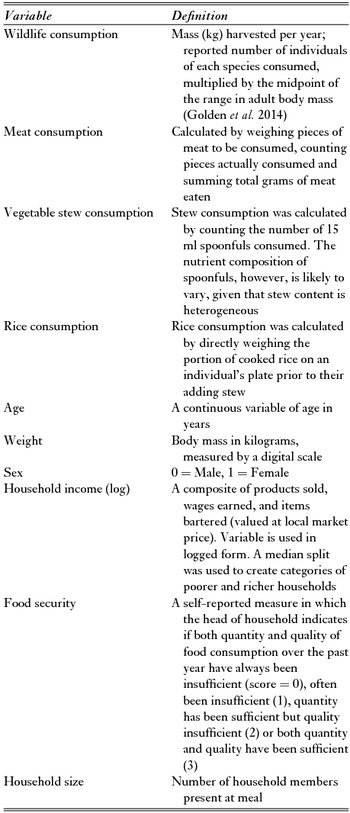
We used a generalized linear model (GLM) regression with maximum likelihood optimization to test the relationship of various individual characteristics, especially age, sex and weight (Table 1), to the amount of rice allocated, the serving order of rice, the consumption of stew and the consumption of meat, controlling for various household characteristics. The model distribution is inverse Gaussian with an identity link function. The general model can be represented as:
 $$\begin{equation*}
{Y_{\it ij}} = \alpha + \beta {X_{\it ij}} + \gamma {Z_{\it ij}} + {\varepsilon _{\it ij}}
\end{equation*}$$
where Yij is the outcome variable of interest (i.e., food allocation) for the ith individual in the jth household, α is a constant, Xij is a vector of individual-specific explanatory variables (Table 1), Zij is a vector of household-specific explanatory variables (Table 1), β and γ capture the marginal effects of these variables, and ε ij is the error term, clustered at the household level to allow for correlation across individuals in the same household. We examined bivariate scatterplots and compared associated linear and quadratic fits for potential non-linearities. We found that age and weight both appeared to have a strong non-linear relationship with stew consumption, though further investigation suggested that age is largely picking up the associated effects of weight; we thus added a quadratic weight term to the stew model. All variables have been described in more detail (Table 1). Although the data partially have a panel structure (up to 12 observations per individual over the survey period for the response variables), we utilized the dataset as cross-sectional only. This is because most of the predictors are time-invariant or change only slightly over the survey time frame. One-year retrospective income and food security information was only gathered once, early in 2009 for income and in December 2009 (10 months after the conclusion of the food allocation data) for food security. These dates are the closest available income and food security data to the food allocation survey time frame. For two households, one-year retrospective food security status was asked in August 2010 and one-year retrospective income data in early 2010; earlier data were not available. For two additional households, one-year retrospective income data collected in early 2008 were used; no other data were available. We thus take a simple mean of the monthly food consumption response variables, thereby also correcting for seasonal fluctuations in food supply; we include only individuals for which there are at least 10 observations (n = 44 across 11 households).
Variable definitions used in multilevel multivariable analysis.

We hypothesize age, sex and weight to be important individual-level predictors of food consumption, including meat consumption. We control for income, self-reported food security status and household size, variables known to be associated with a household's degree of access to wildlife as a food source (Brashares et al. Reference Brashares, Golden, Weinbaum, Barrett and Okello2011). We use long-term ethnographic data to interpret our model results (Golden et al. Reference Golden, Fernald, Brashares, Rasolofoniaina and Kremen2011; Golden et al. Reference Golden, Brashares and Kremen2014; Golden & Comaroff Reference Golden and Comaroff2015). While intra-household variation in meat consumption may be associated in some places with differences in (unobserved) individual preferences, in our field site wildlife is uniformly recognized as a desirable good within a given household that does not have social proscriptions against its consumption (i.e., taboos; Golden and Comaroff Reference Golden and Comaroff2015). Therefore, we assume that preference does not play a strong role in the observed variation within households.
RESULTS
Variation across communities and households
The total annual consumption of wildlife between communities ranged from 57.1 kg to 9642.9 kg (mean ± SE: 2270.4 ± 498) per community per year. The mean (averaged within communities) annual wildlife consumption per household ranged from 1.3 kg to 113.5 kg (mean ± SE: 25.9 ± 5.1) per year and the projected per capita annual wildlife consumption ranged from 0.2 kg to 19.9 kg across communities if we assume an even distribution per capita within households. Because of the high degree of household level variability, the difference in wildlife harvest was not attributable solely to differences in the population size of communities.
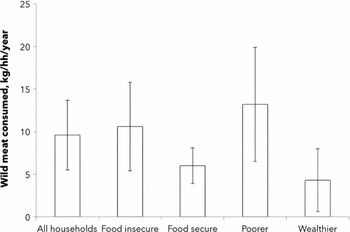
In the target community, wildlife consumption was highly variable among households (n = 48), ranging from 0.7 to 53.7 kg (mean ± SE: 9.6 ± 4.1) per household per year (Fig. 2). Differences between food-insecure and food-secure households were not significant, although the estimates for the mean suggested food-insecure households consumed an average of approximately 4.6 kg more wildlife per year (mean ± SE: 10.6 ± 5.2 vs. 6.0 ± 2.1). Poorer households tended to consume on average 8.9 kg more wildlife per year than richer households (mean ± SE: 13.2 ± 6.7 vs. 4.3 ± 3.7; Fig. 3), although this was not statistically significant. These results did not change when calculating per capita consumption because there were no significant differences in household size between wealthy and poor households (mean ± SE: 6.0 ± 0.2 vs. 5.7 ± 0.2) and food secure and food insecure households (mean ± SE: 5.5 ± 0.3 vs. 5.9 ± 0.2).
Wild meat consumed per household per year (kg) by household typology. hh = Household.

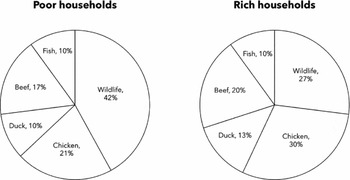
Diet composition biomass of animal-source foods in 28 households in northeastern Madagascar. Wildlife comprises a larger portion of poorer households’ diet (42%; n = 14) than of richer households’ diet (27%; n = 14). This variation in wildlife dependency means that wildlife is of greater health and economic value to poorer households than to richer households.

Variation across individuals in a household
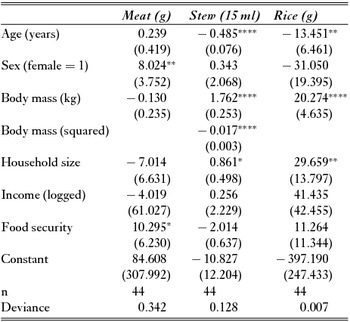
The deviance of the models suggests that the chosen set of explanatory variables perform best in explaining rice consumption, and most poorly in explaining domesticated meat consumption (Table 2). Women consumed 8 g more meat than men. Food security was the only other significant determinant of domesticated meat consumption; a one-unit increase in food security was associated with an individual eating more than 10 g more meat in households of the same size, when meat was consumed.
Results of multivariable analyses of the individual- and household-level determinants of meat, stew and rice consumption. Standard errors in parentheses. Household size is the number of individuals present at a meal, income is a continuous variable that is logged due to its positive skew, and food security is a ranked variable according to quantity and quality of sufficient food (see Table 1). *p < 0.1; **p < 0.05; ***p < 0.01; ****p < 0.001.
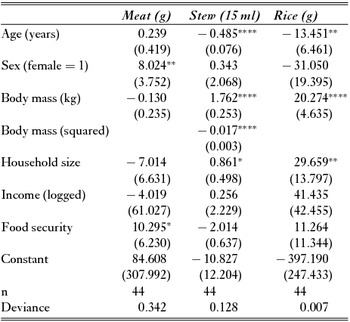
Age and weight were both significantly correlated with stew and rice consumption (Table 2). For every 10 years of age, a family member was likely to consume 4.85 fewer spoonfuls (~72.8 ml) of vegetable stew and 134.5 fewer grams of rice. This may reflect a bias towards younger family members out of generosity for increased growth demand. For every 10 kg of body weight, household members consumed 17.6 more spoonfuls (~264.3 ml) of stew and 202.7 g more rice. Weight also had a non-linear relationship with stew; at high levels of weight, marginal stew consumption tended to decrease slightly. Household size also affected stew and rice consumption; larger households ate more, although not more meat.
DISCUSSION
This study highlights the variation across scales in the distribution of ecosystem service benefits. Our multilevel study suggests that a disaggregated analysis that merges ecosystem services theory and the microeconomics of resource allocation allows for a more accurate valuation approach, and should be included in future ecosystem service assessments and development targeting. The lesson of our study is that variation in ecosystem service benefits at different scales exists and matters. By mapping the distribution of benefits at varying spatial scales, conservationists can not only better incorporate social and economic costs into their plans for protected area placement, but also provide targeted support for particular areas or affected household groups. This is important because, for certain households and individuals, wildlife could be an essential and non-substitutable service (Gowdy Reference Gowdy1997).
This paper and previous work has found tremendous across-community variation in benefit provisioning in the study area (Golden et al. Reference Golden, Brashares and Kremen2014). The monetary value of wildlife as an ecosystem service can vary as much as two orders of magnitude across communities and is likely attributable to variance in forest access, human population size, the feasibility of economic alternatives, and the degree of monitoring and enforcement associated with illegal activities. This tends to also vary by distance to market (i.e., the rural to urban gradient) as evidenced not only in the Makira but also in other locations in sub-Saharan Africa (Brashares et al. Reference Brashares, Golden, Weinbaum, Barrett and Okello2011). In addition, wildlife also has differential value across households of varying socio–economic status. Food secure households are eating more overall meat (domesticated and wild) while food insecure households are eating more wildlife. Over a year, food-insecure households tended to consume 1.5 times more wildlife than did food-secure households, and poorer households consumed three times more wildlife than did wealthier households, although these differences were not statistically significant.
Given the prior microeconomic evidence for the household as a collective rather than a unitary entity, we expected to see variation in the distribution of harvested wildlife among individuals within a given household. Most household models recognize a gendered bias towards males as the recipients of a larger proportion of household resources (Evans Reference Evans1991; FAO/WHO 1992; Agarwal Reference Agarwal1997), especially luxury resources (Gittelsohn & Vastine Reference Gittelsohn and Vastine2003). In Madagascar, however, previous work found that girls and men may be preferentially allocated food, and that boys had poorer anthropometric status than their female counterparts (Hardenbergh Reference Hardenbergh1997). In this study, the consumption of meat within a household was preferential towards women. The finding that dietary variability was far more attributable to inter-household differences than intra-household food distribution (Hardenbergh Reference Hardenbergh1997) may be unique to Madagascar, where long-term observational data suggest that meat, a highly prized and rare food item, tends to be allocated equitably within a household. There is a common Malagasy saying that the ideal family size is 12, as that is the number of ways to split a chicken.
It has been suggested that women tend to be healthy and cared for in societies in which women are highly productive in terms of labour contribution, and this is the case in Madagascar (Friedl Reference Friedl1974). This work also supports a general global review that men contribute greatly to the provision of processed and unprocessed forest products which then benefit the livelihoods and wellbeing of entire households (Sunderland et al. Reference Sunderland, Achdiawan, Angelsen, Babigumira, Ickowitz, Paumgarten, Reyes-García and Shively2014). Our results show that food allocation that supports caloric requirements (regardless of food/nutrient quality) favours heavier individuals in the household – up to high levels of weight, where the relationship reverses – whereas luxury items (such as meat that is rich in micronutrients and fats) are more equally shared by all household members. These behaviours may recognize the increased nutritional need of micronutrients by children and reproductive-aged women who may experience rapid growth and increased nutritional demands. The distribution of rice and stew preferentially towards heavier individuals could either be attributed to someone with more body mass requiring more energy or because the individual took more than his/her share and this led to greater body mass.
The value of wildlife as an ecosystem service therefore varies substantially between households and communities, but appears to remain uniform as a benefit to an individual within a given household. A provisioning service such as wildlife may indeed be allocated preferentially within a household in a different context. In the future, allocation may change as the supply of wildlife diminishes. This provisioning service may have declined in both the MNP (Golden et al. Reference Golden, Brashares and Kremen2014) and other areas of Madagascar (Kari & Korhonen-Kurki Reference Kari and Korhonen-Kurki2013). This specific decline in an ecosystem service that affects dietary diversity and nutrition could likely be solved through poultry interventions (Golden et al. Reference Golden, Brashares and Kremen2014). The drivers of community-level variation in access and use of wildlife are the factors by which targeting should occur.
In conclusion, our study demonstrates that a valuation of ecosystem service provisioning that disaggregates beneficiaries is necessary for more precise assessments of its benefit to humans. This type of analysis is needed to understand the importance of these services to local people and the potential impacts and costs incurred through perturbations in the service. Effective conservation programs that maximize biological benefits and minimize social and economic costs to resource users (Naidoo & Ricketts Reference Naidoo and Ricketts2006) cannot be expected unless attention is paid to variation and scale. Data on geographical variation in ecosystem service provisioning should be used for conservation area placement so as to minimize ecosystem service provisioning disruption for local users, rather than designing protected areas based solely on biodiversity indicators. This specific ecosystem service is particularly important from a broader ethical perspective because it is so influential on human nutrition and an individual's “right to food.” Often, the costs borne from ecosystem protection are felt by people who do not receive the benefits of conservation (Poudyal et al. Reference Poudyal, Ramamonjisoa, Hockley, Rakotonarivo, Gibbons, Mandimbiniaina, Rasoamanana and Jones2016; Wieland et al. Reference Wieland, Ravensbergen, Gregr, Satterfield and Chan2016). Once a protected area is already slated, fine-scale data on variation in the value of an ecosystem service to different households and individuals can be used to target development support to those most affected by new rules and regulations (Golden et al. Reference Golden, Brashares and Kremen2014). This type of targeting has long existed in the field of public health and could be adapted to conservation science (Bigman & Fofack Reference Bigman and Fofack2000; Claeson & Waldman Reference Claeson and Waldman2000; Mkandawire Reference Mkandawire2005; Satcher & Higginbotham Reference Satcher and Higginbotham2008). Lastly, local buy-in for conservation initiatives cannot be expected without knowledge of the mechanisms by which local people receive ecosystem benefits and of the ways in which these benefits vary across user groups.
ACKNOWLEDGEMENTS
This research was funded in part by the National Geographic Society Conservation Trust #C135-08, the Margot Marsh Biodiversity Fund #023815, the Mohamed bin Zayed Species Conservation Fund #1025935, the National Science Foundation pre-doctoral graduate research fellowship (for C.D.G. and A.C.G.) and the NSF doctoral dissertation improvement grant #1011714. The authors are also grateful for the Rockefeller Foundation's support of the Planetary Health Alliance. The authors would like to express their thanks to Profs Louise Fortmann and Claire Kremen and Dr Teevrat Garg for their insight and thoughtful editing of various drafts of this manuscript. Also, C.D.G. would like to thank B.J.R. Rasolofoniaina, C.D. Zafidahy, A. Ayson, Jr, and R. Jayaweera for research assistance.