


Introduction
International humanitarian law (IHL), also known as the law of armed conflict (LOAC), the law of war and the jus in bello, is a vital source of guidance in shaping US national security policies and practices. Although active US military involvement has ended in Iraq and is coming to a close in Afghanistan, new issues have come to the forefront of public attention in recent years, including targeted killings, the use of unmanned aerial vehicles, and cyber-security. Knowledge of this body of law is an essential element in understanding, and even more in contributing to, the vigorous debates on these topics. Given the pre-eminence of the US as a military power, one would expect that familiarity with the rules of war would be a basic requirement for good citizenship, particularly for lawyers. Although most international law and national security law professors, as well as military lawyers, would strongly agree with this statement, there is no comprehensive study detailing the state of IHL integration in US legal academia. Without such a resource, it is difficult to assess the need for, and challenges facing, the expansion of IHL teaching and scholarship. This is the gap that the current study proposes to fill.
This article updates and complements the 2007 report Teaching IHL at U.S. Law Schools (2007 Report),Footnote 1 which surveyed law school professors and deans to assess the extent to which IHL was then taught at US law schools and the level of interest in that body of law, and made recommendations to expand such teaching. The 2007 Report found that the faculty who participated in the survey expressed a strong interest in IHL, and were confident that their students shared this feeling, especially with regard to legal issues related to the “global war on terror”. However, administrative constraints often prevented an effective and appropriate integration of IHL within the curriculum. In addition, the 2007 Report showed that IHL was most often taught as a small portion of another course and not as a stand-alone course, indicating that the lack of casebooks, teaching modules and issue-specific resources on IHL at the time was even more detrimental than general administrative constraints to efforts to expand teaching. Finally, the 2007 Report revealed that faculty interest drove the teaching of IHL: law schools offering multiple IHL options were clearly driven by a community of professors able to effectively channel student interest and negotiate administrative barriers. Based on these findings, the 2007 Report made three key recommendations: that IHL teaching resources be developed, that training opportunities be created, and that a faculty network be cultivated. As the present article shows, these recommendations have largely been implemented.
Seven years later, with new and much more comprehensive data, it is possible to draw solid conclusions on the progress of IHL integration in US legal academia and to chart a course for the future. This article documents tremendous growth in legal scholarship and increased opportunities for student engagement and professional development. It concludes with recommendations for further expanding the community of professors, students and practitioners devoted to exploring this vital area of the law.
The paper presents both quantitative and qualitative data gathered from a variety of sources, compares it to the baseline 2007 Report and analyzes its meaning in the context of today's changing law school environment. The research tools included a lengthy online survey completed by eighty-seven law school professors from eighty-two different law schools, extensive follow-up interviews by phone with twelve of the professors, a database of law school courses and professors, a numerical compilation of journal articles and books published in each of the last seven years, a presentation of new textbooks, teaching modules and other resources, and the International Committee of the Red Cross's (ICRC) own reflections on its prevention policy in the United States.Footnote 2 Together, these sources provide the most comprehensive review and resource to date on the state of IHL teaching and scholarship in US legal academia.
The first part of the paper addresses the continuing importance of teaching IHL, both in the United States and globally, as a matter of treaty adherence and as a precondition for effective implementation of international legal obligations. The second part then explains the methodology used for this research, and the relationship between the 2007 Report and the 2012 ICRC–Berkeley Survey on Teaching IHL at US Law Schools. The core of the article is found in the third part, which presents and analyzes the major survey findings. It identifies trends over the past seven years, and highlights current opportunities and challenges for what the ICRC calls a “prevention” policy, by comparing the research's results with some of the key external factors that might have served to promote or to discourage teaching of IHL in the United States during this period. The paper then presents findings on the growth of scholarship over the past seven years, and introduces the new textbooks and other resources devoted to teaching IHL. This part concludes with findings regarding student opportunities. Finally, the article ends with some recommendations for action on the part of law schools, legal scholars and the ICRC.
Why teach international humanitarian law?
Before delving into the details of this study, it is essential that readers first understand – and, hopefully, agree with – the premise that IHL should indeed be known by the general population. The primary reason – although a legalistic one – is that IHL dissemination is an international obligation. Like every single State in the world, the United States has ratified the four Geneva Conventions of 1949,Footnote 3 which encourage them to promote IHL widely:
The High Contracting Parties undertake, in time of peace as in time of war, to disseminate the text of the present Convention as widely as possible in their respective countries, and, in particular, to include the study thereof in their programmes of military and, if possible, civil instruction, so that the principles thereof may become known to the entire population …Footnote 4
While the obligation to train armed forces in the laws of war is easily understandable,Footnote 5 one may wonder why the drafters of the Conventions also insisted on civil instruction. It should be noted that this provision is linked to Article 1 common to the four Geneva Conventions, according to which States have agreed to “respect and ensure respect” for the Conventions. The drafters were convinced of the positive relationship between knowledge and compliance, and would have agreed with Jean Pictet's statement in the Commentaries that “knowledge of law is an essential condition for its effective application … man should be made familiar from childhood with the great principles of humanity and civilization, so that they may become deeply rooted in his consciousness”.Footnote 6 While one may want to start with general principles of humanity and dignity, which are easier for the layperson to grasp than detailed legal provisions, lawyers are precisely the category of persons who should be familiar with the laws of war. The latter are indeed in a privileged position – and in fact are expected – to apply in good faith and ensure respect for the law.
It may seem at first glance that IHL is a highly specialized field of knowledge that will matter for only a very limited number of law students. However, many lawyers choose careers that touch on national security and armed conflict, whether in the executive, the judicial or the legislative branches of government, or in non-governmental organizations, academia, think tanks or international organizations. Understanding the practical relevance of IHL and its basic principles is essential for these professionals and should motivate the integration of IHL within law schools' curricula. This becomes even more compelling considering the growing number of law students who aspire to join the military as members of the Judge Advocate General's Corps. That said, the purpose is obviously not to create entire generations of IHL specialists – there is certainly no need and no room for that. But as young lawyers move through their careers, the mere knowledge that an entire body of law exists which governs the most extreme situations – where many still think that no law appliesFootnote 7 – would already be a huge achievement and would increase the chances of compliance with the law. And if young lawyers also have some understanding of the content of this body of law, the likelihood will be even higher.Footnote 8
Such familiarity with IHL is even more important in a country like the United States, as the last decade and a half has proven. Beyond a mere treaty recommendation, IHL instruction for civilians should indeed be an integral part of the policy strategy of a country that has been fighting on numerous fronts since late 2001. In other words, IHL instruction should be conceived not merely as an additional discipline for already-overburdened law students, but as an integral part of a national prevention strategy, where “prevention” stands for the creation and maintenance of an environment conducive to respect for the law and for human dignity during armed conflict.Footnote 9
Following 9/11, the United States engaged in several armed conflicts, requiring lawyers, decision-makers in all three branches of government, and scholars to struggle with a large number of IHL issues, including its applicability to a given situation; the classification of the conflict; the definition of “non-international armed conflict”; the designation of “combatant”, and by extension, the question of the existence and legality of the category of so-called unlawful combatants; the right to detain; and the legality of certain interrogation techniques. The post-9/11 armed conflicts and continuing terrorist threats have also led to a redefinition of what national security means, making it all the more difficult to practice national security law without understanding public international law, in particular IHL.
Lawyers in the United States are constantly involved in decision-making: indeed, no foreign policy decision can be made by any administration without extensive preliminary consultations with lawyers from an array of federal agencies and without the ramifications of any such decision being discussed at length by scholarsFootnote 10 and practitioners.Footnote 11 This would not be possible if lawyers did not receive a thorough training in international law. The consequence (or cause) of this is that today's law students cannot avoid studying the Supreme Court opinions in Hamdi, Hamdan and Boumediene,Footnote 12 or discussing the geographical scope of the battlefield and the legality of extraterritorial uses of force. In addition, with the United States being at the forefront of new technologies and ranking as one of the very few leading countries when it comes to the development of drones, robots and cyber-warfare, new realms of knowledge and sophisticated analysis are required from national security lawyers. Current and future generations of lawmakers and opinion-leaders must indeed be familiar with the legal nuances of new means and methods of warfare, and one can already sense a strong interest among law students in such fields of research.Footnote 13
Beyond the impact on US national security interests, one should also consider the consequences of legally informed decisions on other countries. Current and future decision-makers are not only responsible for legal decisions that have an impact on US politics; they are also citizens of a State whose actions, policies, and interpretations influence the way international law is applied. One salient example is that of the law governing internment during non-international armed conflict. As the law of non-international armed conflict is currently silent on the length of detention, among other aspects of internment, several propositions aiming to fill the gap have emerged. One – supported by the United States – argues that norms from the law of international armed conflict (IAC) regulating internment of prisoners of war should be used by analogy, while the second argues in favour of an analogy with IAC law regulating the internment of civilians.Footnote 14 The first proposal implies that detainees may be kept until the end of active hostilities (in the context of the war against Al Qaeda, this has led many to speak about indefinite detention, as the end of hostilities is far from foreseeable at this stage) without the need for the detention authority to regularly review the reasons for detention. The US government may be comfortable with such proposals when it comes to the persons it detains, in particular because as a matter of US constitutional law it is committed to granting habeas corpus to all Guantanamo detainees and is working on implementing the Periodic Review Boards.Footnote 15 Nevertheless, the question arises of whether such a precedent should be created for other countries, which may not necessarily have effective or sufficiently developed legal systems to ensure that detainees receive due process.
To close these introductory comments on the importance of integrating IHL within law schools' curricula, it should be remarked that the United States provides one of the best contexts for a successful strategy on IHL integration: its unique status in global affairs and its involvement in several armed conflicts, combined with its deeply rooted belief in the importance of the law, create the perfect preconditions for effective implementation of international legal obligations. This paper documents progress made in that regard since the 2007 Report and analyzes how challenges to IHL integration can be overcome by a successful prevention strategy.
Background and methodology
The present article is based on multi-pronged research carried out in the United States in 2012–2013. The authors conducted an online survey which was completed by eighty-seven US law professors, and subsequently complemented with in-depth follow-up interviews with twelve of these professors.Footnote 16 In parallel, an exhaustive review of scholarship and legal resource materials published in English since 2007 was also produced. To the extent possible, the findings were compared with those of the 2007 Report.Footnote 17 The aim was not only to update the 2007 Report, but also to expand the scope of inquiry with a number of new questions.
The 2012 survey was available online at www.surveymonkey.com in August and September of that year.Footnote 18 It was publicized by posting announcements on various blogs and listservs, as well as by direct email invitations to a list of 332 US law professors compiled by the ICRC. The direct emails also invited the recipient to forward the survey link to others. There were ninety-six respondents from at least eighty-two US law schools in 2012, compared to 2007, when there were 101 respondents from at least seventy-three law schools.Footnote 19 The focus on civilian legal IHL instruction in 2012 led to a narrowing of the ninety-six responses received down to eighty-seven. Although in theory someone could have taken the survey more than once, thus skewing the results, there would have been no benefit in doing so, as there was no incentive offered for participation. To the contrary, the survey's length and degree of detail would have required an unusual degree of motivation to fill out more than once, with different answers each time.
Survey respondents in both years had the option of anonymity, and some schools had more than one respondent. Anonymous responses, representing 10% of the total in 2007 and 33% in 2012, prevent precise determination of overrepresentation of schools in both years. However, for questions that sought to elicit school characteristics, the study minimized known bias by merging the 2012 responses from non-anonymous professors teaching at the same university and integrating them as one response. Unfortunately, the authors' lack of access to raw 2007 data prevented a similar correction of that year's results, and no insight could be obtained into whether the known double-counting of approximately twenty 2007 schools biases those results upward or downward. Finally, where the available description of 2007 results was ambiguous regarding the counting of responses, comparisons between 2007 and 2012 are not reported.
To conduct the in-depth interviews, twelve out of the thirty-one survey respondents who responded affirmatively to a survey question asking permission to contact the respondent for further detail were selected. These twelve respondents, all of whom were reached and interviewed successfully, were selected with the hope of obtaining a diverse range of viewpoints: the interviewees included both women and men; tenure/tenure-track and contingent faculty; geographic representation from the East Coast and other regions of the country; pure and hybrid backgrounds in academia, the US military, and government or other civilian entities; and a range of primary expertise in international law, national security law and criminal law. The interviews were conducted via phone by one research assistant over a five-week period in March and April 2013 using a set of questions that were provided to respondents in advance. The interviewees were assured of confidentiality.Footnote 20
Finally, as the next sections demonstrate, the findings of the survey and interviews were then used to reflect on the ICRC's legal outreach activities with US academia, as a means to understanding the challenges and opportunities for increased integration of IHL into law school curricula. The rest of this article hence presents the results of the research merged into three main aspects: first, it highlights the main findings with regards to generating the interest of the academic community in the US and compares them with the ICRC's strategy on working with university professors; second, as a complement to the first aspect, the article details the growth in academic materials available to professors willing to teach IHL, one component that was deemed essential in ensuring IHL integration into university curricula; and third, opportunities available for students and recommendations on how to stimulate their interest in the subject matter are also included.
The ICRC's approach
Working with academia: Challenges and opportunities for generating interest in and adherence to IHL in the United States
The ICRC is known mainly for providing humanitarian assistance to and legal protection for victims of armed conflicts and other situations of violence around the world. But the organization also invests in averting (or preventing) human suffering “by fostering an environment conducive to: (1) respect for the life and dignity of persons affected by armed conflict and other situations of violence; and (2) respect for the ICRC's work”.Footnote 21 Prevention in this sense is thus one of the four approaches that guide the ICRC's work, alongside Protection, Assistance and Cooperation. Building an environment of legal compliance is an essential component of the ICRC's prevention approach, and it necessarily means working towards understanding “the complex environmental factors influencing the likelihood that life and dignity or [the ICRC's] own work may be affected, [and] determin[ing] how best to act upon them”.Footnote 22
As far as the United States is concerned, the ICRC is interested inter alia in ensuring adherence to and compliance with international law and in particular with IHL. Working towards creating or strengthening an environment conducive to respect for IHL also means working with “those actors that have a significant capacity to influence the structures or systems” associated with the application of US legal obligations. It is obvious that several categories of actors can be identified in this respect;Footnote 23 however, this article is focused specifically on academic circles and law faculties.
The latter are indeed one of the categories of actors that can influence, even indirectly, decision-making. Law schools are highly regarded in the United States and train a large portion of the next generations of decision-makers, and lawyers generally represent an influential group in US society. However, the last few years have been marked by many changes within the legal profession and legal academia which have to a certain extent rendered integration of IHL more challenging.
The economic downturn and its consequences for law schools
Law schools reflect the society in which they operate. Most notably, the shock waves of the economic downturn since the time of the 2007 Report are still reverberating throughout US legal academia. There is growing criticism of legal education as being too expensive and out of touch with the needs of the profession, which is itself undergoing severe market pressure.Footnote 24 Even President Obama, a former law school professor, has suggested that law school should last for only two years instead of three.Footnote 25 The overall picture of future IHL integration in law schools is discouraging in a number of ways, reinforced by the great sense of uncertainty and insecurity that exists concerning the changes to come in the years ahead. As summarized by the New York Times, “Law school applications are headed for a 30-year low, reflecting increased concern over soaring tuition, crushing student debt and diminishing prospects of lucrative employment upon graduation.”Footnote 26
This sobering view was reflected in the in-depth interviews conducted with professors teaching in the field. Several confirmed that the economy was already having an impact on their schools and that applications for admission were down.Footnote 27 One professor summarized the impact on legal education generally as follows: some law schools will not survive; smaller law schools may have fewer professors and offer fewer courses; lower-ranking schools will cut electives. In this environment of academic retrenchment, one obvious obstacle to greater coverage of IHL is the resource constraints faced by many schools in expanding their curricula. One professor felt that it will be increasingly difficult to have stand-alone IHL courses, and advised that the focus should be on promoting IHL coverage in public international law courses. As will be explained later, IHL integration strategy in general has gradually moved away from promoting stand-alone courses, focusing efforts instead on integrating IHL into other law courses.
Prioritizing practical education
Responding to the economic developments outlined above, today's law students understandably place a greater emphasis on practical, career-related courses, particularly in light of their growing debt burden. One professor pointed out that students are looking for career courses that will help them get jobs. IHL is unfortunately not such a class; only a few positions open every year where IHL is at the centre of the job description. In addition, another professor noted that the general trend is toward skills-based classes, and that law schools will put more emphasis on experiential learning and skills development. However, this professor also observed that IHL is more practical than some other international law courses, and that there are many ways to teach skills development in an IHL course, as will be discussed in more detail in this article.
The place of international law in legal education
Based on the interviews conducted, a third and related factor affecting the teaching of IHL is the place of international law in legal academia. One professor commented on the larger disjunction of US legal education from international law, noting that the subject is not even tested on most professional licensing or “bar” exams, which are administered by the individual States. In that professor's view, international law itself, and certainly an area of public international law such as IHL, is perceived as a narrow specialty. In some quarters, there is even outright hostility toward international law. However, others noted that international law is one of only five subject areas surveyed and separately ranked in the influential U.S. News & World Report annual rankings of law schools,Footnote 28 an indication of its importance to mainstream legal education as well as to prospective students. One professor felt that law schools will not cut their existing international law courses but will refocus them on international business, a reorientation that might easily place a lower priority on coverage of IHL.
This trend may be reinforced by the withdrawal of US forces from military operations in Iraq and Afghanistan. Many professors nevertheless noted that students' interest in armed conflict will always be present: the debates surrounding situations like Syria, Mali and the Central African Republic, the development and use of new technologies and the evolving response to the threat of terrorism show that there will always be an interest in and a need to understand IHL. Several professors confirmed that many students are drawn to learning about IHL precisely because it deals with contemporary situations.
The IHL academic community in the United States
As another obstacle to the expansion of teaching IHL, one of the professors interviewed called attention to the lack of instructors who have expertise both in IHL and in teaching, and noted the difficulty of convincing professors to teach a subject matter in which they may not necessarily have much background. This observation dovetails with another comment made by several professors, who explained that they were not hired to teach IHL but were able to offer it as their own choice in addition to fulfilling obligations to teach more mainstream courses taken by larger numbers of students. The 2007 Report found that faculty interest was a major factor driving the teaching of IHL, and this appears still to be the case.
From this perspective, it is encouraging to note that most schools represented in the online survey which offer a stand-alone IHL course employ tenured or tenure-track professors to teach that course, suggesting that IHL faculty at those schools may be able to pursue their interest more freely than those at schools employing contingent faculty to teach IHL.Footnote 29 As shown in Figure 1, 67% of those teaching stand-alone IHL courses in 2012 were tenured or tenure track, 22% were adjunct or visiting faculty, and 12% fell into other categories, mostly clinical faculty.Footnote 30
Status of faculty teaching a stand-alone IHL course, 2007 and 2012. n = 35 (2007), 42 (2012).

Standing in contrast to a number of the discouraging trends outlined above is the growth of a community of scholars and practitioners. Members of this community can serve as a resource for teaching and scholarship, for mentoring and for showing students the range of professional opportunities available. The existence of a developed academic IHL community in the United States is undeniable. This is felt by IHL professors in general: as shown in Figure 2, the online survey found that 65% of respondents think there is such a community, and also feel that they are part of it.
Perception of a community: Faculty responses to “Is there an academic IHL community?”, 2012. n = 65.
In addition, the online survey asked respondents if there was an IHL expert in their professional circle: 91% said yes, an encouraging finding that suggests a degree of cohesion in the academic community and indicates that the possibilities for mentoring and partnership are very real. A reflection of the maturation of such an IHL network – or a contributor to such development – is the number of professional associations that have committees or interest groups devoted to teaching and/or practicing IHL, such as the American Society of International Law (ASIL), the American Association of Law Schools (AALS) and the American Bar Association (ABA).Footnote 31 These organizations, along with the American Red Cross, are important partners with the ICRC in promoting IHL instruction.
Another particularity of the United States is the high degree of porosity that exists between policy-making and academic circles. There is indeed a two-way flow and continuous interaction between governmental and military circles on the one hand and law faculties on the other, with university professors joining the State Department and other executive agencies, and former policy-makers or military lawyers joining well-respected law schools at the end of their government service.Footnote 32 Not only do many academic experts in the country write, teach and speak on IHL, but some of them also have direct access to the legislative level; a primary example of this influence is the regular invitations to academic experts to testify before congressional committees on a broad range of issues, including detention, the scope of the battlefield, and targeting.
This degree of connection offers a unique opportunity for a successful prevention strategy, and leads to the inference that those interested in IHL should work towards integrating this community of experts, who have a certain degree of leverage over governmental decisions and/or can assist in ensuring compliance with international legal standards. Being a part of this community may serve two purposes: having a degree of influence over policy-making, but also learning about emerging questions and debates in IHL, and hence being able to react quickly to new legal trends.
The ICRC's experience of working on IHL with academia in the United States
Taking into consideration both the findings of the 2007 Report and the challenges and opportunities mentioned above, the ICRC's integration strategy has gradually evolved. When the ICRC's academic outreach in the United States started in the 1990s, it specifically aimed at encouraging the teaching of IHL at the law school level. Promoting a sound teaching and research tradition was then considered a long-term investment towards a unique goal: the next generation of leaders would be trained in IHL.Footnote 33 The 2007 Report was extremely useful in order to refine such outreach and ensure a more strategic approach. One of the main findings showed that student and faculty interest in IHL was already strong and that IHL was somewhat integrated into the law school curriculum. It also indicated that the interest was increasingly shifting towards new opportunities to learn how to teach IHL and to develop resources to support such teaching.
Combined with limited resources and the fact that the ICRC's final objective was never to achieve an exhaustive coverage of US law schools, this led to a strategic change. In general, the ICRC's academic work moved away from pure dissemination of IHL to concentrate efforts on the development of actionable teaching strategies, tools and networks that could support those who teach IHL. In addition, while the ICRC initially promoted semester-long stand-alone courses, it then realized that these were not necessarily the most appropriate format for achieving prevention objectives. As a consequence, a dual approach was favoured, mixing support for semester-long courses with integration of IHL in other law courses. That aspect also evolved over time: while the ICRC traditionally works with professors and students interested in public international law (which is often seen as a natural path, especially in civil law countries), it quickly realized that scholars working in other areas of the law also manifested a strong interest in IHL. This was especially the case with national security law and US constitutional law, where professors themselves realized after 9/11 that they could no longer separate domestic and international law. In addition, the ICRC's prevention approach also heavily relies on developing external partnerships; in that respect, its academic strategy is largely based on collaboration with key institutions and scholars.
Putting this analysis into practice, the ICRC delegation in the United States currently organizes several academic events every year for students, often in partnership with the American Red Cross,Footnote 34 and for faculty. For instance, one of the first results of the 2007 Report was the creation of a Teaching IHL Roundtable for faculty members, in an attempt not only to train faculty on IHL but also to foster discussions and proposals on the teaching and support tools that may need to be developed. This started a tradition of annual Teaching IHL Workshops, where junior and senior professors discuss emerging topics and exchange ideas on methodology and pedagogy as well as on teaching materials.Footnote 35
Nevertheless, because many professors do not have the time or resources to attend such trainings, the ICRC is also developing regional events dedicated to specific themes. Such regional events offer the advantage of reaching out to a higher number of professors and scholars interested in teaching IHL, as well as to professors who may not be IHL experts but are active in IHL-related areas of the law such as national security, public international law, human rights and international criminal law.Footnote 36
To gauge the extent of this outreach, the 2012 online survey queried respondents on whether they had attended an ICRC or an American Red Cross event, or had received funding from the ICRC or the American Red Cross. As shown in the Figure 3, a large majority of respondents had attended either an ICRC event (58%) or an American Red Cross event (22%). Twenty-eight percent of the respondents indicated that they had received support from the ICRC, while 8% had received support from the American Red Cross. The roughly even (60/40) balance of contact/no contact with the ICRC revealed by this question suggests both that the ICRC's collaborative prevention strategy is succeeding in developing external partnerships and that there is a self-sustaining nature to the legal academic community.
Responses to “Have you attended ICRC/American Red Cross events or received ICRC/American Red Cross funding?”, 2012. n = 65.
Another finding of the 2007 Report was the increasing interest in receiving more substantive materials and a greater number of tools to support teaching. As explained in greater detail below, the ICRC partnered with Emory Law School to create a series of IHL Teaching Supplements meant to help law professors integrate IHL into their own courses. Furthermore, in September 2011 the ICRC delegation in Washington launched a blog that focuses on the ICRC's operational activities and its work on IHL that are relevant in the US context; this online resource has already generated in-depth legal discussions on topical issues such as the scope of application of IHL, the legal regime applicable to terrorism, new technologies, and multinational forces.Footnote 37
Also following the 2007 Report, the ICRC increased its support for new scholarship, for instance through collaborating with the increasingly well-known National Security Law Workshop, now in its eighth year, organized annually by South Texas College of Law and the School of Law at the University of Texas at Austin.Footnote 38 At present, the ICRC is also trying to encourage scholarship across borders through transnational workshops aimed at reinforcing academic networks and/or ensuring progress on specific legal issues. For instance, two Workshops on International Law and Armed Conflict were organized at Oxford University in July 2013 and July 2014, bringing US, Canadian and British scholars together to discuss contemporary legal issues. A similar transnational workshop at Duke University in October 2013 and a Teaching IHL Workshop at Laval University in Quebec City in May 2015 were organized with a view to bringing together former participants from two prior Teaching IHL Workshops, hosted respectively in the United States and Canada, and hence capitalizing on and sharing the experiences of teaching IHL gathered by law professors at the national level.Footnote 39
Finally, it is worth noting that the ICRC also believes in the importance of practical learning. IHL is a body of law that cannot remain theoretical or separated from practical considerations; its application is necessarily linked to domestic and international politics, and – even more importantly – to military strategy. For that reason, it is essential that law students interested in IHL, as well as professors who teach it, have a certain degree of understanding of the complexity of military operations. Pursuant to that idea, the ICRC has worked for many years with the US Army Judge Advocate General's Legal Center and School based in Charlottesville, Virginia. This collaboration has resulted in many joint teaching events, where participants – benefiting from the operational and legal experience of both institutions – can truly understand and discuss the practical application of the law and its challenges.
The ICRC's experiences elsewhere
The ICRC's academic strategy is not limited to the United States. The organization is active in academic outreach in at least sixty-six countries around the world today; it has worked towards ensuring global coverage and hence now offers training and organizes IHL-oriented regional training seminars for academics in most regions of the world. To cite just a few examples, in Africa, the Francophone Pan African Course on IHLFootnote 40 and the All Africa Course on IHL in South AfricaFootnote 41 respectively offer French- and English-speaking university teachers and law practitioners, as well as lecturers, government and military officials, international organization staff, national society staff and graduate students, an introduction to IHL. In Asia, delegations organize a South Asian Teaching Session in South Asian countries (and beyond) and a Southeast and East Asian Teaching Session on IHL in Malaysia.Footnote 42 In the Balkans, the Regional IHL Course in Serbia encourages senior-year students of law, political science and the military and police academies to learn and carry out research on IHL. In the Middle East, the delegation in Lebanon offers a Regional Arab Course on IHL in Lebanon, designed for deans and professors of law. And the ICRC Headquarters in Geneva welcomes senior professors from all around the world for a biannual Advanced Training Course in IHL for University Teachers. Many more trainings, courses and competitions are organized by delegations at the national level, all eventually working towards the creation and strengthening of a global network of IHL experts and practitioners.
The authors of this essay are convinced that the web of opportunities related to IHL teaching developed by the ICRC and partner institutions has contributed to maintaining and strengthening the high level of interest in that body of law. One specific sign of this trend that the survey has highlighted is the tremendous growth in scholarship in the last few years.
Growth in scholarship and legal resource materials since 2007
Despite the potential difficulties in expanding IHL instruction discussed earlier in this article, there is no doubt that IHL scholarship has grown dramatically since 2007. The 2007 Report identified the dearth of IHL teaching materials for the US law school market as a significant obstacle to more widespread adoption of IHL courses. Among other problems, it reported that the lack of a textbook was one factor in the challenge faced by some professors in gaining law school approval for offering a new course. That situation has been remedied in a remarkably efficient fashion by the publication of at least five major new textbooks or new editions in the five years from 2009 to 2013.Footnote 43 These volumes have attracted a number of reviews in the literature.Footnote 44 The diversity in focus and perspective among the new textbooks and editions provides ample material for professors designing a course for the first time or revamping an existing course.
In the online survey, professors were asked if they used an IHL textbook. As shown in Figure 4, 44% do not, while 41% do. The 15% who answered “not applicable” presumably do not teach a stand-alone course and would not need a full-length IHL textbook. The percentage of professors who use a textbook may increase now that more choices are available; it should be noted that the survey was administered in the early autumn of 2012, when these five books were either not yet published or were only newly released. Alternatively, the preponderance of professors who do not use a textbook may indicate that given the nature of the subject matter – with many possible topics to cover in a semester, coupled with a fast-changing legal environment – some professors find it preferable to work with their own materials. This possibility is consistent with the choices of several of the professors interviewed to develop their course syllabus on their own, rather than borrowing from the syllabi of other professors.
Responses to “Do you use an IHL textbook?”, 2012. n = 68.
The 2007 Report also noted a related need for supplementary course modules on IHL to facilitate the inclusion of IHL topics in the syllabi of existing courses. There has been impressive progress in this regard as well, with the appearance in the past few years of three IHL Teaching Supplements designed to be integrated, respectively, into courses in national security law, international criminal law and constitutional law.Footnote 45 These courses were among the most frequently cited by respondents in the 2007 Report and the 2012 survey as having an IHL component. Because the supplements are available free of charge and are not linked to any particular textbook, they represent an important resource for both experienced and new professors teaching these courses.
In addition to assessing legal materials aimed specifically at law student instruction within the online survey and in our interviews, trends in scholarship in this area of the law since the time of the 2007 Report were also examined by conducting a structured online database search. To this end, a literature search on IHL topics from 2007 through 2013 was carried out.Footnote 46 As set forth in greater detail below, the number of articles, books and working papers published has increased dramatically over the past seven years.
The number of articles published annually in law reviews increased from 199 in 2007 to 233 in 2013, reflecting a growth of 17% in the past seven years.Footnote 47 While this is a significant increase, it actually represents a very conservative assessment of scholarly interest, focused specifically on IHL topics. For instance, articles on international criminal law, aggression, piracy, transitional justice, trafficking or universal jurisdiction were not examined, unless they were otherwise tied to IHL. In addition to including IHL-specific content, law review articles were classified as search results meeting the following characteristics: comprising more than five pages in length, not being described as a book or publication review, and not being described as an editorial.
Similarly to IHL law review articles, the number of books on IHL issues published annually rose from thirty-six in 2007 to eighty-eight in 2013, a striking increase of 144% over the seven-year period.Footnote 48 The criteria used for including books in the data were similarly restrictive, so this number is again a conservative gauge of scholarship in this field. Furthermore, this figure does not include journals, intergovernmental and non-governmental reports and documents, or government documents.
While the number of working papers made available online on the Legal Scholarship Network (LSN) may contain greater measurement error than publication tallies, this measure is reported here in order to illustrate the direction of developments rather than to establish exact numbers. Even with that caveat, the trend is unmistakable: the number of working papers posted on LSN grew from forty-nine in 2007 to 163 in 2013, an astonishing increase of approximately 232%.Footnote 49
As shown in Figure 5, the findings on law review articles, books and working papers document a flourishing scholarly enterprise and indicate a promising future for IHL in US academia.
IHL literature, 2007–2012.
As in other fields of the law, newer formats for legal scholarship and commentary are gaining in importance in IHL. The online survey asked professors for the sources of their information on news and events in the field of IHL. As shown in Figure 6, 90% of the respondents cited blogs,Footnote 50 68% mentioned the ICRC's website and 60% cited listservs.Footnote 51
Faculty sources of IHL news and events, 2012. n = 62 (2012).
The impressive growth in legal scholarship and dialogue in all its forms is a sign of the strength of the discipline, and is a positive indication that the field of IHL is still growing and attracting professors and students. These are encouraging findings for the ICRC's prevention work in the United States.
Meeting the demand for student engagement inside and outside the classroom
Student interest
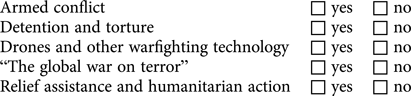
Professors perceive a tremendous interest in current IHL issues on the part of students. Ninety-seven percent of faculty in the survey reported that students in their law school are interested in legal issues related to armed conflict; 97% reported student interest in issues of detention and torture; 97% reported student interest in drones and war-fighting technology; 94% reported student interest in the “global war on terror”; and 67% noted interest in humanitarian assistance. These results, while possibly influenced by the professors' own enthusiasm, are nevertheless remarkably consistent with the findings from 2007. Three of the same topic areas of student interest were asked about in the 2007 Report, with strikingly similar results: faculty perceived that 99% of students were interested in armed conflict, 99% in the “global war on terror” and 88% in relief assistance and humanitarian action.Footnote 52 While student interest does not necessarily translate into student enrolment in a course, these findings suggest that there is great scope for law schools to begin, or expand, instruction and opportunities in IHL. It also provides an encouraging contrast to some of the obstacles noted above.
Availability of course offerings
Bearing in mind the potential for great student interest, a primary goal of the research was to identify whether and how law schools were responding to this demand. It appears that at least seventy-five US law schools offered some instruction in IHL in 2012; this comprises 94% of law schools in the sample analyzed, and approximately 40% of all US law schools. Ninety-four percent of 2007 respondents indicated that IHL was taught at their schools, but this percentage is possibly slightly biased by double-counting professors who self-reported from the same school.Footnote 53 In both surveys, the high percentage of IHL coverage reported is not surprising, given the self-selecting nature of survey respondents.
However, this survey finding is consistent with another element of the research, an examination of the websites of all 199 of the law schools listed on the member and non-member fee-paid page of the American Association of Law Schools.Footnote 54 This analysis revealed seventy-nine law schools that offered IHL either as a stand-alone course or as part of another course, based on course names and descriptions. This count likely underestimates the true number of law schools offering IHL, as course schedules and course catalogues are not available online for all law schools. Additional measurement error could exist for schools whose course schedules were not available, but whose course catalogues contain IHL-related courses that have not been taught in recent years.
Although the authors did not see a significant increase in US law schools offering instruction in IHL between 2007 and 2012, it does appear that the percentage of schools offering stand-alone IHL courses increased significantly. The authors identified stand-alone courses as having names such as IHL, Law of Armed Conflict, Law of War, and Use of Force. In 2007, only 37% of survey respondents' schools where IHL was taught in any form (separately or as part of another course) offered a stand-alone IHL course. This percentage rose to 52%, or forty-two analogous schools, in 2012. This finding is more than double the number – only twenty – found in the examination of AALS law school websites. However, as mentioned above, this latter measure is probably under-inclusive since law school website lists of class names and course descriptions may be incomplete.
In addition to stand-alone IHL courses, law schools may offer non-IHL courses that include some coverage of IHL issues. The IHL content might be quite minimal in broad survey courses such as those on international law or human rights, or it could be a major component in more specialized courses on national security or international criminal law. Despite the inability to measure precisely the coverage of IHL in such courses, it was deemed worthwhile to try to assess the number of schools where students could have at least some exposure to IHL.
Here, the data in 2007 and in 2012 display similar patterns. In 2007, 65% of those schools where IHL was taught in any form (separately or as part of another course) reported that IHL was taught as part of another course. This percentage rose somewhat to 76% of similar schools in 2012, but the difference is statistically negligible. The 2012 survey data thus suggest that, in response to a simple yes/no question as to whether IHL is taught as part of another course, fifty-eight law schools offer at least some coverage of IHL in other courses. In contrast, the examination of AALS law school websites found course descriptions in sixty-nine schools which indicated that coverage of IHL material was included. The disparity in numbers between the survey and the web search is likely due to a survey response rate below 100% for US law professors, but may also be affected by differing perceptions of what constitutes IHL coverage in another class.
Among those classes identified as having some IHL content, Figure 7 shows the most common course titles: International Law/Public International Law; International Criminal Law/War Crimes; Human Rights; and National Security/Terrorism.
Other courses reported as containing IHL content, 2007 and 2012. n = 68 (2007), 50 (2012).
Enrolment
Another way to gauge the integration of IHL into law schools is to estimate the number of students enrolling in IHL courses each year. As demonstrated in Figure 8, in both 2007 and 2012, about 45% of the schools having a stand-alone IHL course had enrolment numbers in the range of twenty-one to forty. In 2012, about 18% of schools had twenty or fewer students in the course; in 15% of schools, the number of students on the course was sixty or more; and in about 12% of schools, the number of students taking a stand-alone course each year ranged from forty-one to sixty. Although the response rate for this question was lower in 2012, we interpret these results as illustrating a likely increase in average class sizes for stand-alone IHL courses.
Annual student exposure to IHL in stand-alone courses, 2007 and 2012. n = 35 (2007), 41 (2012).
Looking at student enrolment in other courses containing some coverage of IHL, Figure 9 indicates that in 24% of schools offering IHL content in other courses in 2012, the number of students taking such courses ranges from twenty-one to forty.Footnote 55 In 17% of schools, there are forty-one to sixty students exposed to IHL material each year, while in 12% of schools, there are more than sixty students each year who receive IHL instruction in a non-IHL course.
Annual student exposure to IHL in non-IHL law courses, 2012. n = 91 (2007), 58 (2012).
Extracurricular opportunities
In addition to quantifying IHL offerings in the curriculum, the survey examined IHL-related extracurricular opportunities available to students, as reported by professors. As illustrated in Figure 10, 61% of schools represented in 2012 had a law review journal, 56% of schools hosted a student organization, and 44% provided opportunities in moot court competitions.Footnote 56 There is a noticeable increase from 2007 to 2012 – from 15% to 33% – in schools offering extracurricular IHL opportunities. According to the 2012 online survey “comment” section for this question, such opportunities include internships, externships, clinical work, research assistance for faculty, outside speakers, the ICRC's student workshops, and writing competitions. The growth in this category, and the wide scope of activities covered, is another indication that IHL is becoming increasingly well-established in legal academia.
Extracurricular opportunities in IHL for students, 2007 and 2012. n = 68 (2007), 61 (2012).
Faculty perceptions of sufficiency of IHL offerings
The survey asked faculty from schools where IHL is taught if they thought coverage should be expanded at their schools. Interestingly, opinion was almost evenly divided on the question, as shown in Figure 11.Footnote 57
Faculty opinion on IHL expansion, 2012. n = 82.
Of those professors who do not think IHL should be expanded at their schools, 96% indicated in response to a follow-up question that existing coverage is sufficient. As shown in Figure 12, a few also noted that IHL is not a priority and that there is low student interest.
Reasons not to expand IHL, 2012. n = 28.
The survey asked professors who think that IHL should be taught in their schools, or that its teaching should be expanded there, to rank the importance, ranging from extremely relevant to not very relevant, of five potential obstacles: lack of interest on the part of any faculty member in teaching IHL, lack of support from other faculty at the school for teaching IHL, lack of student interest, lack of teaching materials, and lack of teaching resources such as a model syllabus and mentors. As shown in Figure 13, the clearest message on this point is that a lack of teaching materials is the least important obstacle. This finding is consistent with the appearance of several new casebooks and teaching supplements in the last few years, as described above. The only potential obstacle ranked as extremely relevant is lack of faculty teaching interest, which is consistent with the 2007 Report's finding that faculty interest drives teaching of this material.
Faculty-identified obstacles to expanding IHL, 2012. n = 38.
Conclusions and recommendations
IHL teaching and scholarship are strong and growing in US legal academia. While the shifting economics of legal education are a cause for concern, the ICRC and other organizations such as ASIL and the American Red Cross have helped to develop and support a dedicated network of professors and a motivated group of students.
The progress made can be assessed against the three main recommendations outlined in the 2007 Report. The first recommendation was that teaching resources should be made available. For the most part, this objective has been met. The 2007 Report called for a textbook, and there are now five available. It called for teaching modules, and there are now three that can be downloaded at no cost. It called for a syllabus bank, which the ICRC is in the process of developing on its website. Finally, it also called for greater dissemination of the ICRC's casebook How Does Law protect in War? The third edition of this resource was published in 2011 and will soon be available online.Footnote 58
The second recommendation in the 2007 Report was that IHL-specific training opportunities should be created for experienced faculty as well as first-time teachers. As detailed in this paper, the ICRC has partnered with a number of law schools and legal organizations, most notably ASIL's Lieber Society on the Law of Armed Conflict, to provide these opportunities, an initiative that continues.
The third and final recommendation in the 2007 Report was that a faculty network should be cultivated to share resources and ideas, support and encouragement. Such a network has been a natural outgrowth of the numerous training opportunities offered in particular by the ICRC and its partners, augmented by social media. The continued growth of the ASIL Lieber Society membership and the number of panels organized across the country in law schools, including the fact that many of the professors interviewed confirmed that they frequently receive invitations to speak at conferences, are other signs not only of the existence but also of the dynamism of such a network.
In addition to the recommendations proposed by the 2007 Report, professors were asked during the interviews whether they had suggestions for the ICRC in particular over the next five years. The following recommendations are informed by theirs, but taking into consideration those already made in the 2007 Report, the authors have chosen to focus on three.
First, it is important to continue efforts toward creating a series of regional thematic events on IHL. As mentioned above, many professors do not necessarily have the time, resources or need to attend multiple-days-long, specialized trainings on IHL. However, many would be interested in learning about specific aspects of IHL without having to travel too far. Such events present several advantages: on the one hand, they facilitate interaction between the current network and professors who may not be IHL experts but are active in IHL-related areas of the law, and on the other, they also allow the ICRC to reach out to regions that may not be considered as geographic IHL strongholds, but which may be home to mid- and top-ranking universities. Regional events also permit a reduction in costs by concentrating networking, awareness-raising and knowledge-generating efforts in one event.
Second, future efforts should also focus on looking beyond the borders: with a currently sustainable and dynamic network in the United States, it would be worth seeking to include other networks abroad in order to reinforce the domestic one or to ensure progress on specific legal issues. As mentioned above, the ICRC organized a number of transnational events in 2013 and 2014. Specific regions of interest should include Latin America, the Middle East and Asia, with events aimed at strengthening the interactions between the academic and legal networks in those regions. Moving forward, it is crucial that experts on IHL across the world are not only aware of legal positions held by other countries, but also know the legal communities abroad and are able to organize truly representative and diverse events. The existence of numerous blogs and listservs followed worldwide is already an essential tool in fostering such interaction; however, nothing can replace the efficiency and productivity of on-site and in-person discussions.
Third, although this study focuses exclusively on IHL integration with legal education, the authors would like to conclude on an expansive note. Now that the integration strategy has proven successful for law schools, it would be interesting to develop a similar but adapted framework for integration of IHL within international studies programmes and master's degree programmes. In particular, faculty specialized in political science, international relations or conflict studies necessarily have to deal with questions related to IHL and could prove to be natural partners for legal scholars and law students working on IHL in the years to come.Footnote 59
Appendices
Appendix 1: Survey questions used for the 2007 Report
1. Is international humanitarian law (IHL) taught at your law school? □ yes □ no (go to question 7)
2. Is a course entirely devoted to IHL? □ yes □ no (go to question 3)
How many IHL courses are in the curriculum? □ 1 □ 2 □ 3 □ over 4
What form does the course take? □ lecture □ seminar □ combination
Are there prerequisites for enrolling in IHL courses? □ yes □ no
How would you describe the staff teaching IHL courses? □ tenured □ adjunct □ visiting
Please list the name(s), email address(es) and telephone number(s) of the staff:
__________________________________________________________
__________________________________________________________
__________________________________________________________
__________________________________________________________
How many students take IHL courses during a year?
□ under 20 □ 21–40 □ 41–60 □ over 61
3. Is IHL taught only within the framework of another course (e.g. public international law)?
□ yes □ no
How many students are exposed to IHL over the course of a year?
□ under 20 □ 21–40 □ 41–60 □ over 61
4. Do you have on staff someone you would characterize as being an expert on IHL? □ yes □ no
5. What extracurricular activities are available to your students related to IHL [check off all that apply]? □ law journals □ student organizations □ moot courts □ other _____________
6. Do your students know about the Pictet International Humanitarian Law Moot Competition? □ yes □ no
7. Do you believe that students in your law school have an interest in the topics related to international humanitarian law?

8. Should international humanitarian law be covered more thoroughly on your campus? □ yes □ no
9. Would you be willing to be contacted by phone for a short (maximum 30 minutes) follow-up conversation? □ yes □ no
If yes, please provide the following information:
Name: ___________________________________________________
University: ________________________________________________
Title: ____________________________________________________
Telephone: ________________________________________________
Appendix 2: Survey questions used for the 2012 online survey
Thank you for agreeing to participate in this survey on the teaching of International Humanitarian Law (IHL, also known as the Law of War and the Law of Armed Conflict) in US law schools. The questionnaire only takes 10 minutes.
This survey was developed by the International Committee of the Red Cross (ICRC) Regional Delegation for the United States and Canada, and UC Berkeley's Miller Institute for Global Challenges and the Law. It is part of a five-year update to an initial survey on the teaching of IHL in US law schools.
This survey represents a critical component for assessing the evolution of IHL teaching in the last five years, as well as the impact of the ICRC's IHL promotional initiatives and strategies, and the remaining challenges to more effective integration in law school curricula.
More specifically, the results of this survey will help us to provide better support to legal scholars and law schools teaching IHL, as well as to identify how best to support a network of those interested in IHL in US law schools. These results will be published as an academic article in the International Review of the Red Cross, and publicly shared.
This questionnaire is organized in three (3) short sections:
1. Teaching IHL in US law schools
2. Challenges encountered
3. Expanding the teaching of IHL
Participation in this survey is strictly voluntary and without financial compensation. All feedback provided is anonymous and will be treated confidentially.
This questionnaire is intended for deans and professors/lecturers of law faculties. Please do not answer it if you are teaching IHL as part of non-legal course. If you would like to share comments and suggestions with us nevertheless, please contact us at aquintin@icrc.org.
***
Section 1: IHL in the curriculum
This section is intended to collect empirical data on the level of implementation of IHL within law schools' curricula.
***
1.1. Is IHL taught, in any form, at your law school?
□ yes, as a stand-alone course (Please specify the name of the course)
□ yes, as part of a course on… (Please specify the name (e.g. national security law, public international law, human rights law, international criminal law, etc.)) (go to question 1.2.2)
□ no (go to question 2.1.2)
1.2.1. How many IHL courses are in the curriculum?
□ 1
□ 2 (Please specify the titles of the courses, if different from above)
□ 3 or more (Please specify the titles of the courses, if different from above)
1.3. How many students take IHL courses during a year?
□ under 20
□ 21–40
□ 41–60
□ over 61
1.4. What form does/do the course(s) take (you may select several answers)?
□ lecture
□ seminar
□ combination
□ clinic
1.5. How would you describe the faculty teaching IHL courses?
□ tenured/tenure track
□ adjunct/non-tenured
□ visiting
□ other (please specify)
***
(Track 2)
1.2.2. In how many courses is IHL incorporated during a year?
□ 1
□ 2 (Please specify the titles of the courses, if different from above)
□ 3 or more (Please specify the titles of the courses, if different from above)
1.2.3. How many students are exposed to IHL over the course of a year?
□ under 20
□ 21–40
□ 41–60
□ over 61
***
(For all)
1.6. What extracurricular IHL-related activities are available to your students [check all that apply]?
□ law journals (please specify)
□ student organizations (please specify)
□ moot courts (please specify)
□ other (please specify)
***
Section 2: Challenges
This section is intended to identify the factors that may impede the further integration of IHL into law schools' curricula, whether institutional, financial or otherwise.
***
2.1.1. Do you think that IHL should be covered more thoroughly at your law school?
□ yes (go to question 2.2.1)
□ no (go to question 2.2.2)
2.1.2. Do you think that IHL should be covered in your law school?
□ yes (go to question 2.2.1)
□ no (go to question 2.2.3)
2.2.1. What obstacles have prevented IHL from being taught more thoroughly or at all (please list in order, with 1 being the greatest obstacle)?
□ Lack of faculty interest/expertise for teaching a course
□ Lack of faculty support for including an IHL course
□ Lack of student interest
□ Lack of IHL casebook/structured IHL course materials
□ Lack of IHL teaching support network for syllabi, mentors, etc.
□ Other (please specify):
2.2.2. Please explain why not (please list in order, with 1 being the most important reason)
□ Not a priority given limited resources
□ Students are not interested
□ Faculty not able/willing to teach a course
□ IHL is already being taught to a satisfactory level
□ Other (please specify):
2.2.3. Please explain why not (please list in order, with 1 being the most important reason)
□ Not a priority given limited resources
□ Students are not interested
□ Faculty not able/willing to teach a course
□ Other (please specify):
2.3. Do you believe that students in your law school have an interest in topics related to IHL?
2.4. Does your library provide any IHL materials in its collection, either print or electronic?
□ yes
□ no
□ I don't know
***
Section 3: Expanding the teaching of IHL
This section seeks to identify means to capitalize on the existing interest in IHL to expand and support the teaching of IHL in law schools.
3.1. Do you use an IHL textbook?
□ yes (please list the title and author)
□ no
□ not applicable (then jump to question 14)
3.2. Are you and your students satisfied with the IHL textbooks that you know?
□ yes
□ no (please explain what type of textbook you would need)
□ no opinion/I don't know
3.3. Would you agree to share your syllabus?
□ yes (then ask for email address in order to be contacted)
□ no
3.4. How do you keep informed of IHL-related news and events?
□ ICRC website
□ I'm a member of the ASIL Lieber Society on the Law of Armed Conflict
□ Other interest groups (please specify):
□ Blogs (specify which blogs you follow):
□ Listservs (specify which listservs you receive):
□ Other (please specify):
□ I do not keep informed of IHL-related news and events
3.5. Is there someone in your professional network whom you consider an expert on IHL, i.e., if you had a question on IHL, is there someone you could contact either on your own faculty or elsewhere?
□ yes (please give name)
□ no
3.6. Do you feel that
□ There is a strong interest in IHL among academia but experts are not well connected with each other
□ There is an IHL community, but I am not part of it
□ There is an IHL community and I feel part of it
□ Other:
3.7. Have you: (please specify)
□ participated in ICRC-led events in the past?
□ received support from the ICRC?
□ participated in American Red Cross-led events in the past?
□ received support from the American Red Cross?
□ none of the above
3.8. Are you aware that “Teaching IHL Workshops” designed for law faculty who teach or plan to teach IHL are offered periodically by the International Committee of the Red Cross and various law schools, including UC-Berkeley Law, Emory University Law, and American University Washington College of Law?
□ yes
□ no
3.9. Have you attended such a workshop?
□ yes (please specify the place and year)
□ no, but I have attended a similar workshop (please specify the name of the host institution, the place and year)
□ no
3.10. Would you be interested in receiving more information about these workshops?
□ yes (please specify your email address)
□ no
3.11. Would you be interested in a regional IHL conference bringing together the persons interested in teaching IHL at your and neighbouring universities?
□ yes
□ no
***
Conclusion
4.1. Are there any comments or suggestions that you would like to share that have not been covered in this questionnaire?
4.2. Please tell us a bit more about yourself.
Name of your law school:
Your position within the law school:
4.3. Would you be willing to be contacted by phone for a short (maximum 20 minutes) follow-up conversation? □ yes □ no
If yes, please provide the following information:
Name: ________________________________________________
University: ________________________________________________
Telephone: ________________________________________________
Appendix 3: Interview questions, April 2013
I. Professor profile
Do you teach a stand-alone IHL/LOAC course? [hereinafter IHL]
Do you cover IHL topics in another course you teach?
For how many semesters or years have you taught/covered IHL?
How long have you been teaching law?
Do you also write on IHL?
How did you become interested in teaching IHL?
Have you ever been a member of the armed forces of any country?
Do you hold an advanced degree (other than a J.D.)? If so, in what subject?
II. Course coverage
If a stand-alone course, is the main focus: conduct of hostilities/jus in bello; resort to force/jus ad bellum; international criminal law; or some other subject?
If you cover IHL in another course you teach, what topic(s) do you include?
If you do not teach a full semester on the conduct of hostilities/jus in bello, what reasons prompted a broader focus?
III. Course materials
How much reading do you assign each week?
From which sources do you draw your IHL readings?
A textbook/casebook? If so, which one(s) have you used?
Your own reader/course materials? Online or in hard copy?
Do you assign, in addition to a published book or as part of your own course materials:
Treaties?
Government (Executive Branch or Congress) documents, speeches?
Judicial opinions from the US? From other national or international jurisdictions?
ICRC publications?
Academic books and articles?
NGO statements and publications?
Media articles and analysis on current events?
What other resources do you assign your students to read?
If you wrote your own textbook or created a course reader: what was the reason? Why did you feel the need to produce your own? What are the differences with other textbooks or available resources?
IV. Course design and format
What, if any, templates did you use to design the course? (E.g., did you have access to other syllabi?) If so, how did you obtain them (e.g., from a colleague at another school)? What other resources did you use?
How many hours per week/credit hours does your IHL class meet? Is it a standard 14-week semester course?
If you cover IHL in another course, how many class hours do you spend on it?
Do you discuss current events that unfold during the course? To what extent? If you use case studies in class, do you use historical or contemporary ones? What are the pluses/minuses of teaching from current events?
Have you used guest lecturers during class?
If so, what are their backgrounds? (E.g., a JAG, an ICRC attorney, someone who's worked at an international tribunal?) Are the students interested?
Do you show videos? On which topics?
Do you use participatory classroom activities, such as simulated treaty negotiations, mock trials, mock legislative debates, or small group breakout sessions?
V. Feedback from students
Does your law school provide students an opportunity to evaluate your IHL teaching? If you know, in teaching your most recent course or classes on IHL, which topics did the students find most engaging? Least engaging?
Have you changed your course structure, content, or materials as a result of student evaluations?
VI. Profile of students
If you know, why are your students interested in IHL? Could you estimate how many of them are intending to go into international law versus domestic law? Public versus private law?
Can non-law students take your course?
If so, what percentage of students are law versus non-law students? What programs or departments do the non-law students come from?
How much familiarity with IHL do students come in with?
What is the typical gender balance in your IHL course? Is this consistent with the gender balance in your law school and/or in the other courses you teach?
Do you see any other demographic trends among your students as compared to your school's student population generally? (E.g., representation of current or former members of military, LL.M. students, or students with personal or family ties to conflict-affected countries.)
VII. IHL in the curriculum
What is the title of the course?
How frequently is your course offered?
In which semester and year did you most recently teach an IHL course?
Since what year has IHL been taught at your school?
How have changes in the world (e.g., US involvement in Iraq, Afghanistan, Libya) changed the way IHL is taught at your school?
If you know, was there resistance on the part of faculty or the administration to offering a course dedicated to IHL? What were the concerns?
Are there any course prerequisites for your school's IHL course?
If your school offers more than one course in IHL, how do they differ? (E.g., a survey course and then a course focused on a more specific IHL topic?)
What other courses related or complementary to IHL are offered at your school? (E.g. International Human Rights Law, International Criminal Law, National Security Law, Military Law?)
Is IHL taught as a doctrinal course or a clinic or both?
Do you find that enrolment for your school's IHL course varies with current events?
If so, can you name specific incidents that contributed positively or negatively to enrolment?
Interest in IHL increased after 9/11 and many classes were added to the curricula in universities and law schools.
What, if any, impacts have you seen of this expansion at your law school, and on US policy and practice more generally?
Do you see that interest decreasing in the near future, especially after 2014 with the withdrawal of US forces from Afghanistan?
What do you think are the biggest obstacles to the growth of IHL courses/coverage of IHL issues in other courses at US law schools?
Do you think the recent criticism of and proposals for restructuring US law schools will have any impact on the IHL course at your school, or at US law schools more generally?
Why do you think it is important to teach IHL? What do you think are the main reasons why students should take an elective course on IHL?
VIII. Student opportunities outside the curriculum
If you know, have any of your students had their IHL-related work published? Have any of your students entered ASIL's Lieber Society writing competition?
Are you aware of any students from your school who have attended the Jean Pictet moot court competition or any similar moot court competition?
If you know, does your law school have speakers (outside of your class) or events such as films or discussions on IHL topics? Are they well-attended?
IX. Wrap-up
Do you have any other thoughts to share on the teaching of IHL in US law schools?
What can the ICRC do over the next 5 years to promote and support teaching of IHL in US law schools?



