Introduction
There is considerable experimental evidence on the cost of reproduction in birds, which includes both short-term costs associated with specific stages of the breeding cycle (e.g. incubation or chick rearing; Monaghan et al. Reference Monaghan, Bolton and Houston1995, Monaghan et al. Reference Monaghan, Nager and Houston1998) and longer term costs that carry over to affect future reproductive investment (Daan et al. Reference Daan, Deerenberg and Dijkstra1996). Carry-over effects have been documented in several bird species and influence traits such as the timing of breeding (Descamps et al. Reference Descamps, Bêty, Love and Gilchrist2011, Harrison et al. Reference Harrison, Blount, Inger, Norris and Bearhop2011), breeding deferral (Ebbinge & Spaans Reference Ebbinge and Spaans1995, Crossin et al. Reference Crossin, Phillips, Trathan, Fox, Dawson, Wynne-Edwards and Williams2012, Reference Crossin, Phillips, Wynne-Edwards and Williams2013a) and breeding output (Ebbinge & Spaans Reference Ebbinge and Spaans1995). However, the physiological mechanisms that underlie these costs and whether they involve limitations in food resource or energy, or some other non-resource-based constraint arising from competing physiological systems, are uncertain (Williams Reference Williams2012). Previous studies have proposed a role for glucocorticoid hormones (Bortolotti et al. Reference Bortolotti, Marchant, Blas and German2008, Crossin et al. Reference Crossin, Phillips, Lattin, Romero and Williams2013b), energy reserves (Harrison et al. Reference Harrison, Blount, Inger, Norris and Bearhop2011) and haematocrit or aerobic capacity (Williams Reference Williams2012, Crossin et al. Reference Crossin, Phillips, Wynne-Edwards and Williams2013a) as potential mediators of cost and carry-over effects.
The role of the glucocorticoid hormones, specifically corticosterone and cortisol (hereafter ‘Cort’), and whether they have a positive or negative relationship with particular life history traits, depends on whether they are expressed at baseline or stress-induced levels (Bonier et al. Reference Bonier, Martin, Moore and Wingfield2009, Crossin et al. Reference Crossin, Love, Cooke and Williams2016). Given its fundamental role in energy acquisition and metabolism, Cort may be the key factor that explains individual variation in energy balance, body condition and the condition dependence of breeding activity (Descamps et al. Reference Descamps, Bêty, Love and Gilchrist2011). In birds and mammals, an effective means of resolving such relationships involves the analysis of Cort in keratin-based structures, including feathers (Bortolotti et al. Reference Bortolotti, Marchant, Blas and German2008, Lattin et al. Reference Lattin, Reed, DesRochers and Romero2011). Cort deposited into these structures from the general circulation is thought to provide an integrated measure of hypothalamo-pituitary-adrenal axis activity over timescales relevant to life history, e.g. transitions between non-breeding and breeding stages of the annual cycle. In birds, measurement of feather Cort levels (fCort) has revealed links between previous breeding activity, migration and future reproductive investment, thus revealing carry-over effects onto key traits including breeding decisions (whether to lay or defer), laying date and egg size (Bortolotti et al. Reference Bortolotti, Marchant, Blas and German2008, Crossin et al. Reference Crossin, Phillips, Lattin, Romero and Williams2013b, Kouwenberg et al. Reference Kouwenberg, Hipfner, McKay and Storey2013).
Other studies have suggested that variation in energy reserves (or condition) might also mediate carry-over effects (see review by Harrison et al. Reference Harrison, Blount, Inger, Norris and Bearhop2011; in this context, condition is presumably linked to Cort as a metabolic regulator, although as noted above the dynamics between Cort and condition in mediating carry-over effects are poorly defined). Links between pre-breeding condition and breeding investment have been demonstrated in birds (Harrison et al. Reference Harrison, Blount, Inger, Norris and Bearhop2011, O’Connor et al. Reference O’Connor, Norris, Crossin and Cooke2014), especially in capital breeders via modifications to laying date or breeding success, via trade-offs between current reproduction and survival (Prop et al. Reference Prop, Black and Shimmings2003), and via clutch size manipulations (Monaghan & Nager Reference Monaghan and Nager1997). Harrison et al. (Reference Harrison, Blount, Inger, Norris and Bearhop2011) note that low rates of pre-breeding energy intake can adversely affect reproductive traits in many birds and other species (Ebbinge & Spaans Reference Ebbinge and Spaans1995, Prop et al. Reference Prop, Black and Shimmings2003). Plasma triglycerides provide one method for assessing individual condition, as these correlate with both energy intake and fattening rate in birds (Guglielmo & Williams Reference Guglielmo and Williams2003). As with body mass, variation in triglyceride levels in pre-breeding birds could signal a carry-over effect with potential implications for subsequent investment decisions (Hennin et al. Reference Hennin, Legagneux, Bêty, Williams, Gilchrist, Baker and Love2015).
Although it seems intuitive that carry-over effects could be generated by energy or nutrient limitation (Harrison et al. Reference Harrison, Blount, Inger, Norris and Bearhop2011), conceivably they could reflect deficiencies in other physiological currencies. In many migratory birds, haematocrit (red blood cell percentage) is up-regulated during migration to increase oxygen-transport capacity (Piersma et al. 1996), which is a key trait for sustaining high aerobic performance for long distance flights. However, haematocrit can be impacted negatively by reproductive processes, specifically by oestradiol (E2) secretion during egg production, which can result in a debilitating reproductive anaemia that can persist for up to a year (Kalmbach et al. Reference Kalmbach, Griffiths, Crane and Furness2004, Crossin et al. Reference Crossin, Phillips, Wynne-Edwards and Williams2013a). Low haematocrit could therefore indicate a potential carry-over effect in the form of reduced migratory performance and increased costs that ultimately constrain future reproductive investment. By extension, variation in testosterone levels could also be important, as androgens are known to stimulate erythropoiesis, and affect breeding decisions in birds (Crossin et al. Reference Crossin, Phillips, Trathan, Fox, Dawson, Wynne-Edwards and Williams2012). Previous work has shown that sex steroid expression (progesterone, testosterone) during the pre-breeding period can predict breeding decisions in albatrosses (Crossin et al. Reference Crossin, Phillips, Trathan, Fox, Dawson, Wynne-Edwards and Williams2012, Reference Crossin, Phillips, Wynne-Edwards and Williams2013a). Sex steroids and Cort also affected breeding output in marine iguanas (Amblyrhynchus cristatus (Bell)) and other reptiles (Vitousek et al. Reference Vitousek, Mitchell, Romero, Awerman and Wikelski2010).
Long-lived seabird species characterized by slow life histories and single egg clutches (Jouventin & Dobson Reference Jouventin and Dobson2002) provide ideal model species for exploring the physiological costs of reproduction and mechanisms involved in carry-over effects. The congeneric black-browed albatross (Thalassarche melanophris (Temminck)) and grey-headed albatross (T. chrysostoma (Forster)) breed sympatrically throughout much of their range in the sub-Antarctic, but display very different reproductive life histories. As in the majority of bird species worldwide, black-browed albatrosses are annual breeders, although a small proportion breed in alternate years. In contrast, grey-headed albatrosses generally breed biennially if successful, as do all the great albatrosses (Diomedea spp.) and sooty albatrosses (Phoebetria spp.) (Tickell Reference Tickell2000). Therefore, sister species, such as the black-browed and grey-headed albatrosses, with markedly different breeding strategies provide a good contrast for exploring the potential physiological mechanisms underlying breeding frequency and links to costs of reproduction and carry-over effects.
Biennial breeding is often associated with life histories characterized by long periods of intensive bi-parental care. In wandering albatrosses and king penguins for example, birds usually take a year or more to fledge their chicks, making it impossible, or at least impractical, for them to initiate another breeding attempt while still rearing young from the previous season (but see Weimerskirch et al. Reference Weimerskirch, Delord, Guitteaud, Phillips and Pinet2015). However, biennial grey-headed albatrosses rear their chicks in a single summer, on a schedule that starts 1 week earlier and ends 2–4 weeks later than that of the sympatric, annually breeding black-browed albatrosses. Despite this, most grey-headed albatrosses will not attempt to breed in the successive year as annual breeders generally do (although some may if they fail breeding early in the previous year; Ryan et al. Reference Ryan, Phillips, Nel and Wood2007), even though parental care is not as prolonged as in some other biennial species. This begs the question: why do grey-headed albatrosses not breed every year? It has been suggested that biennial breeding in grey-headed albatrosses is the result of i) the short time available to adults to recover body condition and replace flight feathers before the start of the following season (Ryan et al. Reference Ryan, Phillips, Nel and Wood2007), which may either be related to or result in ii) a physiological cost of reproduction that carries over to negatively affect future breeding effort (e.g. Crossin et al. Reference Crossin, Phillips, Lattin, Romero and Williams2013b).
In this study, we explore whether physiological costs link current to future reproduction, which would suggest a physiological carry-over effect (Crossin et al. Reference Crossin, Phillips, Lattin, Romero and Williams2013b). We do so by comparing the annual and biennial breeding systems found within the genus Thalassarche. We determined the breeding fate (successful, failed or deferred breeding) of black-browed albatrosses (annual) and grey-headed albatrosses (biennial) at the end of a breeding season, and sampled them for indicators of their energetic (triglycerides), aerobic (haematocrit) and hormonal (testosterone) condition. We then examined correlations between these indicators and Cort levels measured in tail feathers grown during the subsequent non-breeding period. Assuming that variations in fCort indicate the ‘stress state’ of non-breeding individuals after the breeding season, we then predict relationships between fCort and i) previous breeding fate and ii) post-breeding physiological condition of those individuals, as indicated by triglyceride, testosterone and haematocrit levels. For example, if low triglyceride and haematocrit levels correlated with high fCort in breeding birds (successful and failed) but not in non-breeding deferring birds, then this would suggest a cost of reproduction that carries over into winter. Finally, we predict that iii) fCort would itself carry over to affect future reproductive investment, e.g. the decision to breed, with high fCort indicative of deferred breeding in the following season.
Methods
Study site
Fieldwork was conducted during the summers of 2008/09 and 2009/10 at Bird Island, South Georgia (54°01'S, 38°02'W), a sub-Antarctic island group that is one of the most important breeding sites globally for grey-headed and black-browed albatrosses. Individually banded albatrosses of known age and breeding history in long-term monitoring colonies were sampled (grey-headed albatrosses in Colonies B and E, and black-browed albatrosses in Colony J). All birds had bred at least once previously. Research was approved by the Ethics Committee of the British Antarctic Survey and carried out under permits issued by the Government of South Georgia and South Sandwich Islands. Sampling protocols conformed to guidelines established by the Canadian Committee on Animal Care (Simon Fraser University Animal Care Permit 897B-8).
Study species
The breeding and foraging ecology of grey-headed and black-browed albatrosses at Bird Island is well studied (Prince Reference Prince1985, Phillips et al. Reference Phillips, Silk, Phalan, Catry and Croxall2004, Crossin et al. Reference Crossin, Phillips, Trathan, Fox, Dawson, Wynne-Edwards and Williams2012, Reference Crossin, Phillips, Wynne-Edwards and Williams2013a). Both species are monogamous and lay a single egg. After a long incubation period, the single chick is reared by both parents over the next 4–5 months. Grey-headed albatrosses arrive at the breeding colony in spring, usually around mid-September, approximately a fortnight earlier, have a slightly longer incubation period (72 vs 68 days) and a longer chick-rearing period (141 vs 116 days), which makes their breeding season ~45 days longer than black-browed albatrosses. There is a degree of niche divergence partially mediated by differences in flight performance (Phillips et al. Reference Phillips, Silk, Phalan, Catry and Croxall2004), and although the diets overlap, chicks of grey-headed albatrosses are fed more squid, and those of black-browed albatrosses are fed more krill and fish. The lower energy density of squid contributes to the slower growth rate and longer fledging period of grey-headed albatross chicks. At South Georgia,~80% of the breeding population of black-browed albatrosses returns to breed the following year, the absence of the remainder due principally to either natural mortality or loss of partner (Croxall et al. Reference Croxall, Prince, Rothery and Wood1998). In contrast, only ~1% of successfully breeding grey-headed albatrosses will breed again the following year, 25–80% 2 years later, and all but a small minority within 3 or 4 years, whereas those that fail in incubation or early chick rearing in one year will generally breed the next year (Ryan et al. Reference Ryan, Phillips, Nel and Wood2007). However, all of our analyses examined the post-breeding physiology and fCort relative to breeding activity in the very next year, not ≥2 years later.
Sampling design
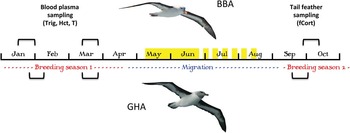
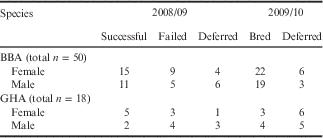
A timeline of the sampling protocol (Fig. 1) shows that from 24 January to 6 February 2009 non-breeding (i.e. deferring) black-browed and grey-headed albatrosses at nests in their respective colonies were sampled. Daily monitoring records of the albatross colonies at Bird Island, maintained by the British Antarctic Survey, allowed us to know the breeding status of all individuals. Deferring albatrosses return to and spend time in the colony each year, despite not breeding, presumably to re-establish pair bonds (Tickell Reference Tickell2000). Deferring black-browed albatrosses typically depart South Georgia for winter migration in early February (Phillips et al. Reference Phillips, Silk, Croxall, Afanasyev and Bennett2005), so the sampling plan aimed to capture these birds and deferring grey-headed albatrosses before their departures (see Table I for numbers of birds sampled). From 30 March to 2 April 2009, successful and failed breeders were sampled before their out-migration in mid-April. Blood samples (2 ml) were collected from the brachial vein using syringes with 25 gauge needles, and the plasma was separated by centrifugation and stored at -20°C. In all cases, blood was collected within 3 min of first approach to the bird. Ultimately, 125 albatrosses were sampled at the end of the 2008/09 season (black-browed albatrosses, n=62; grey-headed albatrosses, n=63), 68 of which were resampled when they subsequently returned to breed in the following season in 2009/10. The analyses for this study were restricted to the 68 birds sampled in both 2008/09 and 2009/10 (black-browed albatrosses, n=50; grey-headed albatrosses, n=18). Upon arrival at breeding colonies in 2009/10, a single rectrix was collected from each bird. Specifically, we collected only the outer-most rectrix from the right side of the bird, by cutting the feather with scissors at the base of the feather shaft (calamus). This was done to ensure that only newly moulted feathers were sampled, as the sequence of rectrix moult is from outer to inner (Prince et al. Reference Prince, Rodwell, Jones and Rothery1993). These were stored in labelled bags and kept in the dark at 4°C until analysis of fCort.
Schematic representing the annual cycle of black-browed (BBA, T. melanophris) and grey-headed (GHA, T. chrysostoma) albatrosses at Bird Island, South Georgia during the summers of 2008/09 (breeding season 1) and 2009/10 (breeding season 2). Brackets indicate times when physiological samples were collected. The yellow bars indicate the period when tail feathers are moulted and regrown; the dashed segment indicates that the duration of the period of tail feather growth is presently unknown. See Table I for sample sizes.

The numbers and fates of black-browed (BBA, T. melanophris) and grey-headed (GHA, T. chrysostoma) albatrosses sampled in two consecutive breeding seasons at Bird Island, South Georgia (summer 2008/09 to summer 2009/10). To link current 2008/09 breeding to future 2009/10 breeding, the data set was restricted to albatrosses sampled for tail feathers in 2009/10 (future breeding).

Physiological assays
Plasma samples and known standards were assayed in duplicate for total triglyceride (Trig) levels using a commercial triglyceride kit (Glycerol Reagents A and B, Sigma) and measured using a Biotek 340i microplate reader. Additionally, multiple duplicates of a domestic hen (Gallus domesticus L.) plasma pool were also assayed to provide a mean intra-assay coefficient of variation of 7.1%. The inter-assay coefficient of variation was 6.7%.
Haematocrit (Hct) was measured in fresh whole blood by centrifugation in microhaematocrit tubes (two per individual) for 5 min at 10 000 g, and is reported as packed cell volume (%).
Testosterone (T) was measured by first extracting plasma samples in dichloromethane and then quantifying hormone levels using a commercially available enzyme-linked immunosorbent assay (Cayman Chemicals Kit 582701). For each species, an extracted plasma pool was found to be parallel to the standard curve, and samples were assayed in triplicate at a 1:10 dilution. Samples were assayed across six plates yielding inter- and intra-assay coefficients of variation of 4.6% and 6.3%, respectively. Extraction efficiency was assessed by spiking four randomly chosen samples for each species with a known amount of testosterone standard immediately before extraction and comparing measured hormone levels to their corresponding normally assayed (unspiked) levels. Average recovery was found to be 76.4% for black-browed albatrosses and 79.7% for grey-headed albatrosses. Statistical analyses were run on values corrected for these extraction efficiencies.
Corticosterone measured in the feathers of the same birds upon their return to Bird Island reflect plasma Cort levels in the weeks/months immediately after their departure from the breeding colony when tail feathers are moulted and regrown (Prince et al. Reference Prince, Rodwell, Jones and Rothery1993, Catry et al. Reference Catry, Poisbleau, Lecoq and Phillips2013, Bugoni et al. Reference Bugoni, Naves and Furness2015). To assay fCort, a standard radioimmunoassay was used as per Bortolotti et al. (Reference Bortolotti, Marchant, Blas and German2008), modified by Lattin et al. (Reference Lattin, Reed, DesRochers and Romero2011), and following the protocol detailed in Crossin et al. (Reference Crossin, Phillips, Lattin, Romero and Williams2013b). The intra-assay coefficient of variation was determined by measuring differences between duplicates, and the inter-assay variation by measuring differences between standard samples (using two standards: a known amount of Cort, and pulverized, homogenized feathers) (Romero & Fairhurst Reference Romero and Fairhurst2016). Intra-assay variation was 4.0% and inter-assay variation was 7.4%.
Statistical analyses
All blood variables were examined for correlations with the time required to collect the blood sample and the date of collection. Due to known differences in life history, behaviour and physiology, models were run for each species separately. To test our first prediction that fCort is related to previous breeding fate, fCort was examined, for each species separately (ANOVAs), by sex and breeding fate (successful, failed, deferred) as categorical factors, along with their interaction (sex x fate). Similar models were then run to describe the species’ post-breeding physiological state (Trig, T and Hct) at the end of the 2008/09 breeding season. To test our second prediction of a relationship between end-of-breeding season physiological indicators and fCort, Pearson’s correlations by species and sex were examined. To test our third prediction that variation in fCort carries over to affect future breeding decisions by each species, backward stepwise generalized linear models with binomial response distributions were used to explore the variables most related to future breeding decision (breed or defer) in the subsequent breeding season only (2009/10 season). Explanatory predictors included fCort, as well as bird sex, previous breeding status (breeder or non-breeder), T, Trig and Hct. This comparison was restricted to the 2009/10 year only so that the physiological links from one season to breeding in the next could be compared between species simultaneously and on identical timescales.
Results
As albatrosses were sampled in two different seasons (end of 2008/09 season for blood and beginning of 2009/10 season for feathers), correlations of any of the physiological variables with sampling time or date were explored. In 2008/09, there were no correlations between sampling time (number of seconds to collect the blood sample) or date with any of the blood parameters (Pearson’s correlations with Trig, T and Hct, all P>0.09).
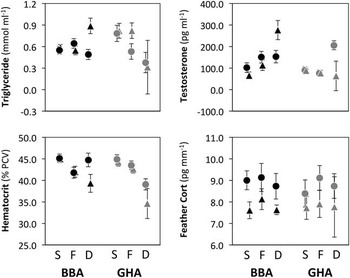
The end-of-season physiological results were determined for each species by ANOVA models examining differences by sex and breeding fate (Fig. 2). In black-browed albatrosses (n=50), Trig and T levels in females, but not in males, were significantly higher in deferring breeders than in successful or failed breeders (Trig: sex x fate interaction ß=0.142, P=0.004; T: sex x fate interaction ß=53.42, P=0.008). Hct levels did not differ by sex, but were generally lower in deferring than in successful or failed breeders (sex ß=-0.886, P=0.126; fate ß=-1.030, P=0.010; sex x fate ß=-0.418, P=0.163). In grey-headed albatrosses (n=18), Trig did not differ between sexes or among breeding fates (sex ß=0.044, P=0.567; fate ß=-0.097, P=0.095; sex x fate ß=0.013, P=0.437). However, T was significantly higher in deferring males than in successful and failed males, while in females did not differ among fates (sex ß=-24.78, P=0.030; fate ß=5.30, P=0.187; sex x fate ß=-9.140, P=0.043). Hct did not differ by sex, but was generally higher in successful and failed breeders than in deferring breeders (sex ß=-0.980, P=0.171; fate ß=-1.540, P=0.001; sex x fate ß=-0.345, P=0.625).
Physiological variables in black-browed (BBA, T. melanophris) and grey-headed (GHA, T. chrysostoma) albatrosses measured at the end of the 2008/09 breeding season. Feather corticosterone levels reflect circulating Cort in the weeks/months after breeding when tail feathers are moulted and replaced. Data are classified according to species and breeding fate (S=successful breeders, F=failed breeders, D=deferred breeders). Females are indicated by triangles and males by circles, while GHA values are in grey and BBA values are in black. Values represent least squares means ± SEM.

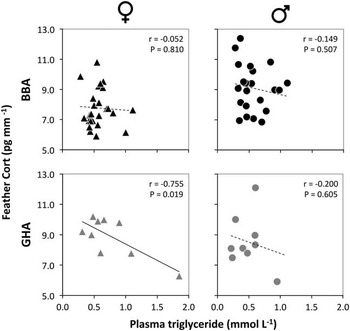
Contrary to our first prediction, fCort did not differ between the sexes or among breeding fates in either species (black-browed albatrosses, n=50: sex ß=-0.584, P=0.070; fate ß=0.034, P=0.778; sex x fate ß=-0.056, P=0.925; and grey-headed albatrosses, n=18: sex ß=-0.476, P=0.151; fate ß=0.109, P=748; sex x fate ß=-0.071, P=0.897). However, we found partial support for our second prediction in that fCort showed a significant negative correlation with Trig levels in female grey-headed albatrosses (r=-0.755, n=9, P=0.019), but not in male grey-headed albatrosses (r=-0.200, n=9, P=0.605) or in either sex in black-browed albatrosses (females, r=-0.052, n=25, P=0.810; males, r=-0.149, n=22, P=0.507) (Fig. 3). The only other significant correlation in this set of analyses was a negative relationship between T and Hct in female black-browed albatrosses (r=-0.577, n=30, P<0.001; data not shown).
Correlations between plasma triglyceride levels and residual feather corticosterone levels (fCort) in black-browed (BBA, T. melanophris) and grey-headed (GHA, T. chrysostoma) albatrosses. Triglyceride levels were measured at the end of breeding in the 2008/09 season, while fCort reflects circulating Cort at the time of feather regrowth in the early to mid-non-breeding season. Females are indicated by triangles and males by circles, while GHA values are in grey and BBA values are in black. All feathers (whether from breeding or deferring albatrosses) were sampled at the beginning of the 2009/10 season.

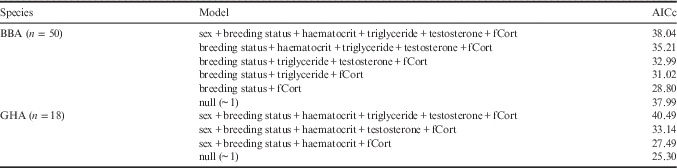
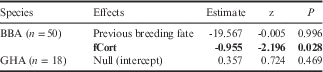
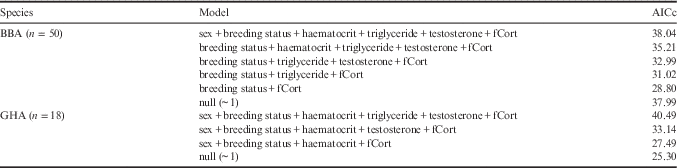
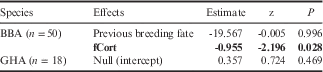
Comparisons of generalized linear models examining future breeding decisions are presented in Table II. The most parsimonious model identified via AICc selection identifies a significant effect of fCort on breeding decision in black-browed albatrosses, such that when fCort is high there is greater tendency to defer breeding (P=0.028; Table III), which supports our third prediction that variation in fCort indicates a carry-over effect to future reproduction. For grey-headed albatrosses, no variables were significant predictors of breeding decision, with the null model receiving the best support (Tables II & III).
Comparison of models exploring the effects of breeding status (successful, failed or deferred) and post-breeding season physiological condition of black-browed (BBA, T. melanophris) and grey-headed (GHA, T. chrysostoma) albatrosses on reproductive decision a year later. Output were generated from a backward stepwise generalized linear model with a binomial response and logit link function. Species were run separately due to known differences in breeding strategy and physiology.
Results of a generalized linear model comparing the binomial breeding decision (breed or defer) of black-browed (BBA, T. melanophris) and grey-headed (GHA, T. chrysostoma) albatrosses. Models are the most parsimonious as determined by AICc model comparisons (Table II). Given differences in breeding strategy (BBA are annual breeders and GHA are biennial breeders), separate models were run for the two species. Significant model effects are indicated by bold text.
Discussion
As the tail feathers of albatrosses are moulted and regrown after their departure from breeding colonies (Prince et al. Reference Prince, Rodwell, Jones and Rothery1993, Catry et al. Reference Catry, Poisbleau, Lecoq and Phillips2013), we predicted that variation in fCort levels would reflect the state or condition of individuals after breeding and suggest a cost of reproduction related to levels of breeding investment (e.g. successful, failed or deferred breeding). Working from the assumption that fCort is a key link between current and future reproduction there was limited evidence of a link between post-breeding physiological state and fCort, and between fCort and future breeding decision. However, these results are very species-specific, which may reflect the contrasting life histories of black-browed and grey-headed albatrosses, e.g. annual versus biennial breeding. For example, in black-browed albatrosses fCort did not correlate with any of the physiological parameters measured at the end of the breeding season, but fCort did predict future breeding decisions. Conversely, in grey-headed albatrosses there was limited evidence for a link between post-breeding physiology and fCort via a negative correlation with circulating Trig levels. But despite this correlation, fCort did not predict future breeding decisions in grey-headed albatrosses.
So what do these results suggest? For black-browed albatrosses, the link between fCort and future breeding investment, in the absence of any clear link to previous breeding investment, might indicate that the more immediate experience of pelagic migration immediately after departure from breeding colonies influences Cort deposition more so than previous breeding activity, and that it is the winter experience itself that generates carry-over effects onto future breeding decisions. Certainly, this and many other recent studies support a role of fCort in carry-over effects and future breeding investment (Crossin et al. Reference Crossin, Phillips, Lattin, Romero and Williams2013b, Kouwenberg et al. Reference Kouwenberg, Hipfner, McKay and Storey2013, Fairhurst et al. Reference Fairhurst, Bond, Hobson and Ronconi2015, Harms et al. Reference Harms, Legagneux, Gilchrist, Bêty, Love, Forbes, Bortolotti and Soos2015). For grey-headed albatrosses, we observed the opposite, post-breeding Trig levels showed a negative correlation with fCort (significant in females and trending in males), but neither variable had any discernible effect on future breeding decisions. Why this might be for the grey-headed albatrosses we do not know, but it may be that genetic programming for biennial breeding provides a buffer against physiological carry-over effects. However, our sample of grey-headed albatrosses was low, which may limit our power to detect physiological links between breeding states, and so interpretation of our results should be made with caution. Furthermore, concerning links to fCort, grey-headed albatrosses that breed successfully do not necessarily complete tail moult within a year (Prince et al. Reference Prince, Rodwell, Jones and Rothery1993), which may have been the case for some of the seven successful breeders resampled the following year. Therefore, our ability to detect a carry-over effect might be low. However, we do not believe that this changes our general conclusions about future breeding decisions by grey-headed albatrosses.
With this caution in mind, we suggest that fundamental differences in breeding life history can explain the patterns observed. Both species undertake long distance migrations during the non-breeding period, lasting 6–16 months (Croxall et al. Reference Croxall, Silk, Phillips, Afanasyev and Briggs2004, Phillips et al. Reference Phillips, Silk, Croxall, Afanasyev and Bennett2005). In both species, there is a degree of condition dependence to breeding investment and decision making, which might reflect altered hypothalamus-pituitary-gonadal axis signalling in response to conditions experienced during migration (Crossin et al. Reference Crossin, Phillips, Trathan, Fox, Dawson, Wynne-Edwards and Williams2012, Reference Crossin, Phillips, Wynne-Edwards and Williams2013a). In a species capable of breeding every year, such as the black-browed albatross, the experiences and conditions encountered during the winter are likely to influence Cort dynamics, and thus carry over to affect pre-breeding condition in the spring. By then, previous breeding activity and its relative costs, if any, might be overshadowed. In contrast to the black-browed albatrosses, a significant negative correlation between end-of-season Trig levels and fCort was observed in the biennial grey-headed albatrosses, which might reflect a physiological or energetic cost of reproduction, although we acknowledge again that our sample size was small. However, it is not uncommon to observe negative correlations between measures of body condition (e.g. body mass, Trig levels) and Cort levels in birds (Love et al. Reference Love, Breuner, Vézina and Williams2004). The correlation between circulating Trig and fCort in our study suggests a cost of reproduction, wherein some individuals were in poorer energetic condition relative to others. But ultimately, neither Trig, fCort or any other post-breeding measure (T or Hct) predicted the decisions of either male or female grey-headed albatrosses to breed in the very next year. This raises intriguing questions about the physiological determinants of biennial breeding strategies.
A previous attempt to explain the biennial breeding pattern in albatrosses took a comparative approach and examined how the duration of the breeding season and distance to foraging grounds predicted the breeding frequency in 12 species (Jouventin & Dobson Reference Jouventin and Dobson2002). The authors hypothesized that the length of the rearing period for some albatrosses is simply too long and energetically demanding for adults to recover sufficient body condition to breed again in a consecutive year. In support of this, the analysis showed that across all 12 species, those species with the longest rearing periods were generally biennial breeders. However, we would argue that it is perhaps less obvious how the comparatively small difference in breeding season duration would lead to energy shortfalls that cannot be restored during the ~4 months of marine foraging before the next breeding attempt, unless there is a significant effect on post-breeding moult dynamics (Rohwer et al. Reference Rohwer, Viggiano and Marzluff2011); a topic that should be explored in future studies.
The second hypothesis addressed by Jouventin & Dobson (Reference Jouventin and Dobson2002) to explain the breeding patterns of albatrosses, predicts that travel to distant foraging areas during the breeding season should reduce reproductive rates, presumably due to increased effort, but also because longer chick feeding intervals could lengthen the breeding season. There was some support for this when comparing across 12 species. However, it is unclear how this might ultimately determine the breeding strategies of black-browed and grey-headed albatrosses, as although grey-headed albatrosses have longer foraging ranges in incubation, there is little difference during chick rearing, which accounts for the last 5 months of the season (Phillips et al. Reference Phillips, Silk, Phalan, Catry and Croxall2004). Moreover, there is some sexual segregation during incubation, which was attributed to differences in wing loading and flight performance, as opposed to competitive exclusion (Phillips et al. Reference Phillips, Silk, Phalan, Catry and Croxall2004). Consequently, the slightly longer distances travelled during this stage by grey-headed albatrosses should not therefore be interpreted as marginalization to poorer foraging areas, with negative consequences for overall condition. Indeed, although we detected physiological differences in the albatrosses at the end of the season that related to their breeding fate (successful, failed, deferred; Fig. 2), there were no significant differences between species or sexes (Fig. 2). Worthy of note was the significantly high T levels in deferring male grey-headed and deferring female black-browed albatrosses. Hector et al. (Reference Hector, Follett and Prince1986) observed significant increases in T levels in both species and sexes at the end of breeding, although the breeding status of those individuals was not known. The functional significance of these increases is not readily apparent. Although T had no bearing on future reproductive activity, high T in deferring individuals could reflect intraspecific interactions (e.g. aggression) prior to out-migration, which might also have relevance for the onset and pattern of winter migrations as seen in some passerines (Silverin et al. Reference Silverin, Viebke and Westin1989).
We did, however, observe a significant negative correlation between plasma Trig at the end of the breeding season and fCort levels in (female) grey-headed albatrosses, but not black-browed albatrosses. This could have functional consequences as grey-headed albatrosses usually migrate considerably longer distances than black-browed albatrosses (Croxall et al. Reference Croxall, Silk, Phillips, Afanasyev and Briggs2004, Phillips et al. Reference Phillips, Silk, Croxall, Afanasyev and Bennett2005). Together, low Trig and high fCort may signal relative need to recover lost body reserves after breeding, and thus indicate a cost (Love et al. Reference Love, Breuner, Vézina and Williams2004, Hennin et al. Reference Hennin, Legagneux, Bêty, Williams, Gilchrist, Baker and Love2015). However, other studies are needed to more fully explore this possibility. Electronic tracking of individual winter migrations and foraging activity would lend insights to this possibility. However, as previously indicated, variation in fCort did not ultimately predict breeding decisions in the next year, as it did in the black-browed albatrosses. We therefore suggest that biennial breeding may have evolved as a bet-hedging strategy in grey-headed albatrosses as a means for buffering the apparent susceptibility of females to negative physiological costs of reproduction (e.g. the negative Trig ~ fCort correlation, Fig. 3). There are very few individual grey-headed albatrosses that attempt to breed in successive years (Ryan et al. Reference Ryan, Phillips, Nel and Wood2007), and presumably only those in the best relative condition are able to do so (Crossin et al. Reference Crossin, Phillips, Wynne-Edwards and Williams2013a).
Previous work with other biennial species lends support to a fundamental role of Cort and body condition in mediating biennial versus annual breeding strategies (Vitousek et al. Reference Vitousek, Mitchell, Romero, Awerman and Wikelski2010). For example, in iguanas that breed biennially (A. cristatus) the females in poor physiological condition at the onset of breeding are likely to produce smaller hatchlings with poor survival prospects and risk their own survival. Iguanas that defer reproduction tend to have higher glucocorticoid levels and sensitivity, which might be a response to some exogenous factor such as local resource availability, thus enhancing survival probability and subsequent fitness.
Although our study provides evidence for both costs of reproduction and carry-over effects, and suggests plausible mechanisms, it is observational by nature. An alternative approach to advance our understanding of physiological control of breeding frequency and glean insights into the evolution of biennial breeding strategies, would be controlled experimental manipulations of glucocorticoid levels at the onset of the non-breeding season, in tandem with electronic tracking (Crossin et al. Reference Crossin, Cooke, Goldbogen and Phillips2014), especially of female albatrosses.
Acknowledgements
We thank Derren Fox and Andrew Wood at the British Antarctic Survey for field and data support. We also thank two anonymous reviewers for their suggestions. Financial support was provided by the Antarctic Science International Bursary awarded to GTC. Additional support was provided by the British Antarctic Survey through a NERC Collaborative Gearing Scheme awarded to RAP and others, a Natural Sciences and Engineering Research Council of Canada (NSERC) post-doctoral fellowship to GTC, NSERC Discovery Grants to TDW, OPL and GTC, and a National Science Foundation (USA) grant IOS-1048529 to LMR. This study represents a contribution to the Ecosystems component of the British Antarctic Survey Polar Science for Planet Earth Programme funded by NERC.
Author contributions
GTC performed the field work, collected the data, performed the triglyceride and haematocrit assays, analysed the data and wrote the manuscript. RAP assisted with the co-ordination of the field plan, provided funding and logistical support through BAS, and contributed to the writing. XB assisted with statistical analysis. CRL and LMR ran the corticosterone assays. CMH and OPL ran the testosterone assays. TDW provided logistical and intellectual guidance with respect to the field plan, the analyses and the framing of the manuscript, as well as providing financial and other support. All authors reviewed and edited the final submitted manuscript.