INTRODUCTION
Monanchora Carter, 1883 is a genus of shallow water marine sponges belonging to the Crambeidae (Myxillina: Poecilosclerida: Demospongiae), defined by the presence of two categories of subtylostyles in combination with unguiferous anchorate isochelae, and by the absence of asterose desmas, which are present in Crambe Vosmaer, 1880 (van Soest, Reference van Soest, Hooper and van Soest2002). Additional microscleres may be present in Monanchora, such as sigmoid anchorate isochelae and characteristic acanthomicrorhabds, unique to Crambeidae (van Soest, Reference van Soest, Hooper and van Soest2002). The genus is represented by thirteen species occurring in the Caribbean Sea (e.g. van Soest, Reference van Soest, Hummelinck and van der Steen1984, Reference van Soest1990; Zea, Reference Zea1987), south-western Atlantic (Lerner et al., Reference Lerner, Mothes and Carraro2005; Muricy & Hajdu, Reference Muricy and Hajdu2006; Muricy et al., Reference Muricy, Esteves, Moraes, Santos, Silva, Klautau and Lanna2008), eastern Atlantic, western Indian Ocean, Indo-Pacific region, Western Australia (van Soest, Reference van Soest1990, Reference van Soest, Hooper and van Soest2002) and in the deep North Pacific (Lehnert et al., Reference Lehnert, Stone and Heimler2006; van Soest et al., Reference van Soest, Boury-Esnault, Hooper, Rützler, de Voogd, Alvarez de Glasby, Hajdu, Pisera, Manconi, Schoenberg, Janussen, Tabachnick, Klautau, Picton, Kelly and Vacelet2011).
Crambe and Monanchora are rich sources of secondary metabolites named crambescidins, polycyclic guanidine alkaloids with antimicrobial (e.g. Muricy et al., Reference Muricy, Hajdu, Araujo and Hagler1993; Tavares et al., Reference Tavares, Daloze, Braekman, Hajdu and van Soest1995; Hua et al., Reference Hua, Peng, Dunbar, Schinazi, Andrews, Cuevas, Garcia-Fernandez, Kelly and Hamann2007; Seleghim et al., Reference Seleghim, Lira, Kossuga, Batista, Berlinck, Hajdu, Muricy, Rocha, da Nascimento, do, Silva, Pimenta, Thiemann, Oliva, Cavalcanti, Pessoa, Moraes, de Galetti, Silva, Souza and Peixinho2007), cytotoxic (Gallimore et al., Reference Gallimore, Kelly and Scheuer2005; Seleghim et al., Reference Seleghim, Lira, Kossuga, Batista, Berlinck, Hajdu, Muricy, Rocha, da Nascimento, do, Silva, Pimenta, Thiemann, Oliva, Cavalcanti, Pessoa, Moraes, de Galetti, Silva, Souza and Peixinho2007), antitumoural (Aron et al., Reference Aron, Pietraszkiewicz, Overman, Valeriote and Cuevas2004; Hua et al., Reference Hua, Peng, Dunbar, Schinazi, Andrews, Cuevas, Garcia-Fernandez, Kelly and Hamann2007) and strong antiviral activities, particularly against HIV (e.g. Patil et al., Reference Patil, Kumar, Kokke, Bean, Freyer, Brosse, de Mai, Truneh, Faulkner, Carte, Breen, Hertzberg, Johnson, Westley and Potts1995). Crambescidin alkaloids were also shown to be active in preventing degenerative diseases in the brain of mice (Suna et al., Reference Suna, Aoki, Setiawan and Kobayashi2007). The strong chemical similarity between C. crambe (Schmidt, 1862) (type of Crambe), from the Mediterranean Sea and Eastern Atlantic, and M. arbuscula (Duchassaing & Michelloti, 1864), from the Tropical Western Atlantic (e.g. Tavares et al., Reference Tavares, Daloze, Braekman, Hajdu, Muricy and van Soest1994, Reference Tavares, Daloze, Braekman, Hajdu and van Soest1995; van Soest et al., Reference van Soest, Braekman, Faulkner, Hajdu, Harper and Vacelet1996), and the remarkable variability in the presence/absence of desmas observed in the first species (e.g. Maldonado et al., Reference Maldonado, Carmona, Uriz and Cruzado1999) have been proposed as arguments for merging Crambe and Monanchora in a single genus Crambe, the senior synonym (van Soest, Reference van Soest1990, Reference van Soest, Hooper and van Soest2002; Hajdu et al., Reference Hajdu, van Soest, Hooper, van Soest, van Kempen and Braekman1994; Tavares et al., Reference Tavares, Daloze, Braekman, Hajdu and van Soest1995; Braekman et al., Reference Braekman, Daloze, Tavares, Hajdu and van Soest2000). Nevertheless, due to the presence of asterose desmas in many species, both genera are currently maintained as separate (van Soest, Reference van Soest, Hooper and van Soest2002).
Monanchora arbuscula was up to now the only species in the genus recognized in the entire Western Atlantic region (van Soest, Reference van Soest1990, Reference van Soest, Hooper and van Soest2002) with a distribution stretching from the Gulf of Florida to Santa Catarina State, Southern Brazil (Lerner et al., Reference Lerner, Mothes and Carraro2005; Muricy et al., Reference Muricy, Esteves, Moraes, Santos, Silva, Klautau and Lanna2008). This is one of the most variable demosponges in regard to its morphology, with a complete spicular complement composed of two categories of subtylostyles, tridentate anchorate isochelae, sigmoid microscleres and acanthomicrorhabds (van Soest, Reference van Soest, Hooper and van Soest2002). Nevertheless, microscleres can be completely absent from this species or present only in the form of unique sigmoid anchorate isochelae (e.g. van Soest, Reference van Soest, Hummelinck and van der Steen1984 as M. barbadensis; Zea, Reference Zea1987 as M. unguifera; van Soest, Reference van Soest, Hooper and van Soest2002). A comprehensive revision of M. arbuscula is under preparation.
In this work we describe an atypical Monanchora endemic from the Brazilian coast with clear-cut diagnostic morphological characters associated with a variable habit as observed for other genera and species of Crambeidae (van Soest, Reference van Soest, Hooper and van Soest2002). Additionally, we discuss the nature of anchorate isochelae and microrhabds, as well as megasclere morphology in defining Monanchora.
MATERIALS AND METHODS
Specimens were collected by snorkelling, SCUBA diving or trawling on the coasts of, or off Rio Grande do Norte, Bahia, Espírito Santo, Rio de Janeiro, São Paulo and Santa Catarina States, between 1974 and 2011. The material examined is deposited in the Porifera collections of the following Brazilian institutions: Universidade Federal de Pernambuco (Recife, PE); Museu Nacional, Universidade Federal do Rio de Janeiro (Rio de Janeiro, RJ); and Museu de Ciências Naturais, Fundação Zoobotânica do Rio Grande do Sul (Porto Alegre, RS). Specimens, especially older materials, were fixed first in formalin and then transferred to 70% ethanol. Newer samples were put straight in ethanol 70–80%. Specimens were identified by examining the external morphology, internal anatomy and the shape and size of spicules following current procedures as described in Rützler (Reference Rützler, Stoddart and Johannes1978). Twenty to thirty spicules were measured for each category per specimen examined. Values are shown as: minimum–mean–maximum (± standard deviation), length/width, unless stated otherwise.
Abbreviations used are: BMNH, The Natural History Museum, London, United Kingdom; MNRJ, Porifera Collection of Museu Nacional, Universidade Federal do Rio de Janeiro; MCNPOR, Porifera Collection of Museu de Ciências Naturais, Fundação Zoobotânica do Rio Grande do Sul; USNM, National Museum of Natural History, Smithsonian Institution, Washington, DC; UFPEPOR, Porifera Collection of Universidade Federal de Pernambuco; ZMA POR, Porifera Collection of Zoölogisch Museum, Universiteit van Amsterdam, Amsterdam, The Netherlands.
SYSTEMATICS
DIAGNOSIS
Crambeidae with a skeleton composed of one or two categories of subtylostyles in combination with spatuliferous or unguiferate anchorate isochelae, reduced sigmoid isochelae and microrhabds in a hymedesmioid to plumose arrangement. Frequently one or more categories of microscleres are completely absent. Pseudoastrose tylostyles or desmas absent. Anchorate isochelae may be mono- or tridentate, usually with a pair of well developed lateral fimbriae along the shaft. Microrhabds are usually pointed and spined, or smooth, strongyloid and centrotylote. Subdermal channels are characteristically white or yellow-lined, or indistinguishable from the rest of the body. Spongin scarce or forming well defined and robust fibres (slightly emended from van Soest, Reference van Soest, Hooper and van Soest2002: 553).
Type species: Monanchora clathrata Carter, 1883. Type locality: Fremantle, Western Australia (van Soest, Reference van Soest, Hooper and van Soest2002).
DIAGNOSIS
Monanchora encrusting or arborescent. Arborescent specimens eventually exhibit tetralobate branches with lobes almost symmetrically disposed in opposition to each other (in a cross-like pattern). Colour carmine red or orange in life and pale beige or dark brown after fixation in ethanol. Ascending spongin fibres with a well defined contour and a honey colour are always evident, cored and echinated by choanosomal subtylostyles ending in tufts of ectosomal subtylostyles at the surface. Ectosomal subtylostyles frequently ending in a cluster of spines at the apex (spines visible only under scanning electron microscopy), anchorate isochelae have a single developed tooth in each extremity, and microrhabds, when present, are smooth, centrotylote and strongyloid. Sigmoid isochelae are absent.
TYPE MATERIAL
Holotype: São Paulo State, Taubaté (Ilhabela) (23°54′39.7″S 45°27′35.4″W): MNRJ 173, 19 m depth, E. Hajdu coll., 16 January 1996.
Paratypes: Rio Grande do Norte State (04°47′17.1″S 36°44′47.8″W): UFPEPOR 223, 15–16 m depth, ‘Martins Filho’ trawler coll., 24 November 2003; (05°01′57.2″S 36°18′18.7″W): UFPEPOR 401, 6–9 m depth, ‘Martins Filho’ trawler coll., 5 June 2004. Bahia State, Nova Viçosa (18°09′S 39°15′W): MNRJ 673, 19 m depth, RV ‘Riobaldo’ coll., 3 April 1974. Espírito Santo State (18°50′S 39°35′W): MNRJ 693, unknown collector, 5 April 1974. Rio de Janeiro State, Cabo Frio, Comprida island (22°52′23.6″S 41°57′17.2″W): MNRJ 14205, 7.5 m depth, E. Hajdu coll., 29 March 2011. São Paulo State, Praia do Perequê (Ilhabela): MNRJ 31, A.L. Castro coll., 12 April 1963; Saco do Frade (Ilhabela) (23°54′58.3″S 45°27′32.8″W): MNRJ 150, 24 m depth, E. Hajdu coll., 16 January 1996; Taubaté (Ilhabela) (23°54′39.7″S 45°27′35.4″W): MNRJ 174, 19 m depth, E. Hajdu coll., 16 January 1996; Saco do Eustáquio (Ilhabela) (23°50′13.7″S 45°14′17.2″W): MNRJ 248, 12 m depth, E. Hajdu coll., 18 January 1996. Santa Catarina State, Deserta Island (27°16′30″S 48°20′00″W): MCNPOR 3424, 14 m depth, C.B. Lerner coll., 14 February 1997.
COMPARATIVE MATERIALS EXAMINED
Monanchora arbuscula (Duchassaing & Michelotti, 1864): microscopic slide of dissociated spicules and thick sections of the lectotype of Pandaros arbusculum Duchassaing & Michelotti, 1864 (ZMA POR 1728), US Virgin Islands, St Thomas, unknown collector and date of collection.
Monanchora clathrata Carter, 1883: microscopic slide of a thick section of the holotype BMNH 1973.12.5.1, western coast of Australia, Fremantle, G. Clifton coll., unknown date of collection.
Monanchora dianchora (Bergquist, Reference Bergquist1965): Neofolitispa dianchora sensu Bergquist, Reference Bergquist1965 (USNM 24009), Micronesia, Republic of Palau, Iwayama Bay, western coast of Kogai Hanto, 2.5–7.6 m depth, unknown coll., 16 August 1955. Holotype of Folitispa pingens de Laubenfels, Reference Laubenfels1954 (USNM 22924), Iwayama Bay, near Koror, 2 m depth, collected by divers, 1 September 1949.
Monanchora laevissima (Dendy, 1922): microscopic slides of dissociated spicules and thick sections of the holotype of Hymedesmia laevissima Dendy, 1922 (BMNH 1931.1.7.69a, slides labelled as R.N. CXXV. 6), Republic of Mauricio, Mauricio's Islands, western Indian Ocean, 180 m depth, unknown coll., 23 August 1905. Paratype of Hymedesmia laevissima (BMNH 25.11.1.277, labelled as R.N. CXXVII. 5) from the same locality, >180 m depth, Gardiner coll., 23 August 1905.
Monanchora unguiculata (Dendy, 1922): microscopic slides of dissociated spicules and thick section of the holotype (BMNH 1921.11.7.47a, slides labelled as Amphilectus (?) unguiculatus Dendy, 1922 – Sealark sponges, R.N. CXIII. 10), British Territory of the Indian Ocean, Egmont Island, collector and date of collection unknown.
DESCRIPTION
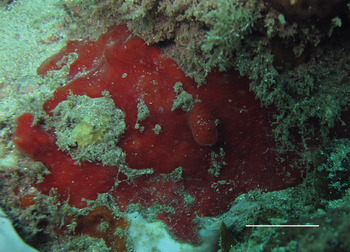
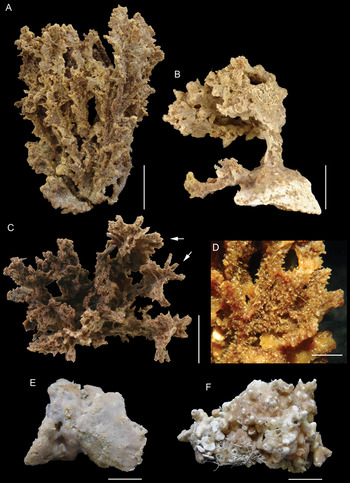
Thinly encrusting or arborescent sponge with various branches emitted from a short peduncle less than 1 cm in width, or projected directly from a thinly encrusting base (Figures 1, 2A–F). Branches are normally irregular or eventually tetralobate, with lobes projected as longitudinally disposed ridges in opposition to each other, with numerous small blunt projections at the margins (Figure 2A–C). Encrusting specimens less than 1 cm thick and up to 5 cm wide. The holotype is thinly encrusting on a fragmented shell, measuring 1.9 × 1.3 cm in area and approximately 1 mm thick. Arborescent specimens up to 8 cm tall and 6 cm wide, each branch measuring 1–1.8 cm in diameter. Lobes are 3 mm wide. Oscules circular 0.9–1.8 mm wide in encrusting specimens. Subdermal channels are not evident. Colour carmine red (Figure 1) or orange in life and pale beige or dark brown after fixation in ethanol (Figure 2A–F). Surface even and smooth between branches, to irregular and rugose at the extremities of arborescent specimens (Figure 2D); and smooth, even and microhispid in encrusting specimens (Figure 2E, F). Arborescent specimens are soft and elastic at the distal portion of the branches; tough, less compressible near the base of the branches; and almost hard at the peduncle, when present. Encrusting specimens are soft and elastic.
Monanchora brasiliensis sp. nov. in situ (Paratype MNRJ 14205), Comprida Island, Cabo Frio, Rio de Janeiro State. Scale bar = 2 cm.

Monanchora brasiliensis sp. nov., preserved specimens: (A, B) arborescent specimens; (C) upper view of the Paratype MNRJ 693 (arrows point to tetralobate branches); (D) hispid surface in detail; (E, F) encrusting specimens; (A, C, D) Paratype MNRJ 693; (B) Paratype MNRJ 673; (E) Paratype UFPEPOR 401; (F) Paratype UFPEPOR 223. Scale bars: A–C = 2 cm; D = 5 mm; E, F = 1 cm.

Skeleton
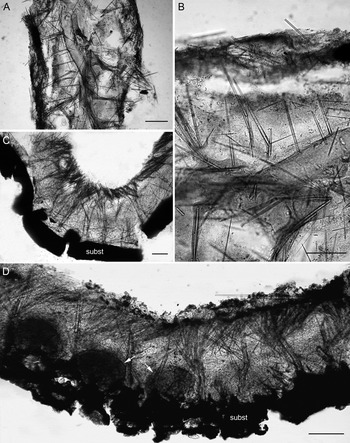
Plumose skeleton in arborescent specimens (Figure 3A, B), or hymedesmioid in thinly encrusting specimens (Figure 3C, D). Plumose skeleton formed by ascending spongin fibres, 40–125 µm thick, cored by unispicular or paucispicular tracts of choanosomal subtylostyles ending in tufts of ectosomal subtylostyles near the sponge surface (Figure 3A, B). Hymedesmioid skeleton formed by ascending spongin fibres cored by a single choanosomal subtylostyle, ending in tufts of ectosomal subtylostyles near the sponge surface (Figure 3C, D). Ectosomal and choanosomal subtylostyles are also echinating the fibres (Figure 3B), and ectosomal subtylostyles are tangentially disposed at the base and at the surface of the sponge (Figure 3C, D). Spongin is always evident in the form of a thin sheet at the sponge base arising as clearly delineated and robust fibers of a honey color (Figure 3B, D). Anchorate isochelae scattered or concentrated in the ectosome, and scattered in the choanosome (Figure 3B). Microrhabds, when present, scattered in the ectosome and in the choanosome.
Internal anatomy of Monanchora brasiliensis sp. nov.: (A) plumose skeleton in cross-section of a branch; (B) fibre echinated by choanosomal subtylostyles and anchorate isochelae scattered in the choanosome in detail; (C, D) hymedesmioid skeleton, arrows point to eggs or embryos. Note the well marked fibres, even in the hymedesmioid skeleton; (A, B) Paratype MNRJ 693; (C) Paratype UFPEPOR 223; (D) Paratype UFPEPOR 401; subst, substrate. Scale bars: A, C = 300 µm; B, D = 200 µm.

Spicules
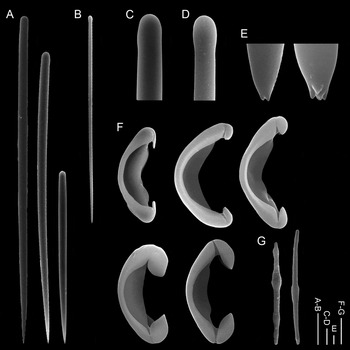
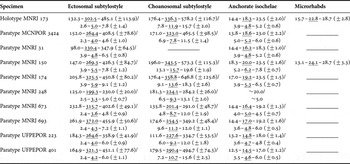
Megascleres in two categories (Table 1): choanosomal subtylostyles, almost styles, thick, fusiform, straight or slightly curved, with an elongate tyle defined by a slight constriction near the base and a pointed apex (Figure 4A, C). Ectosomal subtylostyles thin, straight or slightly curved (Figure 4B, D) sharply pointed or ending in a cluster of spines at the apex (Figure 4E). Microscleres (Table 1): anchorate isochelae spatuliferous, monodentate, with a single well developed tooth in each extremity, without lateral teeth, and with a pair of lateral fimbriae along the entire length of its shaft (Figure 4F). Microrhabds smooth, straight, strongylote and centrotylote, normally bearing one or two tyles along the axis (Figure 4G). Anchorate isochelae are always present and are normally abundant, but may also be rare and the microrhabds are relatively rare and may be absent.
Spicules of Monanchora brasiliensis sp. nov. (holotype): (A) choanosomal subtylostyles; (B) ectosomal subtylostyle; (C) detail of the base of a choanosomal subtylostyle; (D) detail of the base of an ectosomal subtylostyle; (E) detail of the apex of ectosomal subtylostyles; (F) monodentate anchorate isochelae; (G) strongyloid smooth centrotylote microrhabds. Scale bars: A, B = 50 µm; C, D, F & G = 5 µm; E = 1 µm.

Spicule dimensions of Monanchora brasiliensis sp. nov. Values: minimum–mean–maximum (± SD) in micrometres. Ectosomal and choanosomal subtylostyles: length/width; anchorate isochelae: total length/claw length. N = 30, except for the width of subtylostyles: N = 20.

ECOLOGY
Monanchora brasiliensis sp. nov. is a rare species on the north-east and southern Brazilian coast, but is relatively common on the south-eastern coast of Brazil, particularly in Rio de Janeiro and São Paulo States. It is distributed in tropical and subtropical waters, attached to calcareous algae in coral reef regions, encrusting rocky overhangs, or bivalve shells in muddy bottom sediments. Bathymetric distribution: 6 m (Rio Grande do Norte) to 24 m depth (Saco do Frade, Ilhabela, São Paulo).
ETYMOLOGY
The specific epithet brasiliensis is derived from the new species' distribution along a vast sector of the Brazilian coast.
GEOGRAPHICAL DISTRIBUTION
Brazil, off Mossoró (Rio Grande do Norte), Nova Viçosa (Bahia), Barra Nova (Espírito Santo), Ilhabela (São Paulo) and Deserta island (Santa Catarina).
DISCUSSION
Monanchora brasiliensis sp. nov. is the only species in Crambeidae with monodentate anchorate isochelae and smooth microrhabds. Technically speaking these chelae might be described as palmate due to their single frontal tooth in each termination, sided by two lateral alae completely fused to the shaft, albeit rudimentary in shape (Hajdu et al., Reference Hajdu, van Soest, Hooper, van Soest, van Kempen and Braekman1994). Nevertheless, the observed co-occurrence in the new species of two categories of subtylostyles and microrhabds with the atypical chelae in a plumose arrangement suggests its appropriate placement in Monanchora (van Soest, Reference van Soest1990, Reference van Soest, Hooper and van Soest2002). As a consequence, the monodentate anchorate chelae are more likely a regression from the tridentate transformation series proposed by Hajdu et al. (Reference Hajdu, van Soest, Hooper, van Soest, van Kempen and Braekman1994), which postulates arcuate and anchorate chelae to have at least three clearly formed alae on each side of the chela. The lateral fused alae observed in the atypical chelae described here are henceforth interpreted as well developed fimbriae of a typical anchorate isochelae as observed for other Myxillina species.
The microrhabs observed in the new species show some affinities with the ones observed in Discorhabdella spp. (Crambeidae) also; i.e. a possible homology between the two concentrations of spines observed near the extremities or in the middle part of the shaft of microrhabds in some Discorhabdella spp. (i.e. D. incrustans; Maldonado & Uriz, Reference Maldonado and Uriz1996, figure 6D; and D. urizae; Maldonado et al., Reference Maldonado, Carmona, van Soest and Pomponi2001, figure 2n–p) and the tyles in the microrhabds of M. brasiliensis sp. nov. Furthermore, the presence of ectosomal subtylostyles spined at the apex in the new species strenghtens the argument by van Soest (Reference van Soest, Hooper and van Soest2002) of a possible homology of these crambeid ectosomal subtylostyles and the terminally spined tornotes of some myxillid species (Uriz & Maldonado, Reference Uriz and Maldonado1995; Maldonado & Uriz, Reference Maldonado and Uriz1996; van Soest, Reference van Soest, Hooper and van Soest2002; Esteves et al., Reference Esteves, Lôbo-Hajdu and Hajdu2007). Other species of Crambe and Monanchora possessing the same character are C. tuberosa Maldonado & Benito, 1991 and M. laevissima Dendy, 1922 (van Soest, Reference van Soest, Hooper and van Soest2002), and to a lesser degree, Crambe chilensis Esteves et al., Reference Esteves, Lôbo-Hajdu and Hajdu2007, C. panamensis Maldonado et al., Reference Maldonado, Carmona, van Soest and Pomponi2001 (Esteves et al., Reference Esteves, Lôbo-Hajdu and Hajdu2007) and the four known recent Discorhabdella spp. (e.g. Maldonado & Uriz, Reference Maldonado and Uriz1996; Maldonado et al., Reference Maldonado, Carmona, van Soest and Pomponi2001; Esteves et al., Reference Esteves, Lôbo-Hajdu and Hajdu2007).
Van Soest (Reference van Soest, Hooper and van Soest2002) defined Monanchora as ‘Crambeidae without pseudoastrose spicules or desmas; microscleres spatulate or unguiferate anchorate isochelae (may be absent), reduced sigmoid chelae (may be absent), and spined microxeas (may be absent). In life, the surface has characteristic white- or yellow-lined veinal channel pattern.' Comparison of the new species with the types or additional material of M. clathrata (type species of Monanchora), M. arbuscula, M. dianchora, M. laevissima and M. unguiculata has confirmed the morphological variability observed in the genus and revised by van Soest (Reference van Soest, Hooper and van Soest2002). Their skeletal elements include two categories of subtylostyles with distinct shape and dimensions, one or two categories of tridentate anchorate isochelae, sigmoid anchorate isochelae (like sigmas) and spined microrhabds (acanthomicrorhabds) (cf. van Soest, Reference van Soest1990, Reference van Soest, Hooper and van Soest2002), but no monodentate anchorate isochelae and smooth microrhabds.
We propose here a slightly modified definition for the genus, to include the new species with monodentate chelae, smooth microrhabds and no whitish or yellowish coloured subdermal channels. The latter character is not mandatory for the identification of a Monanchora, as it was only precisely described for M. arbuscula (e.g. Zea, Reference Zea1987 as M. unguifera; van Soest, Reference van Soest, Hummelinck and van der Steen1984 as M. barbadensis; van Soest, Reference van Soest, Hooper and van Soest2002) and M. dianchora (Bensemhoun et al., Reference Bensemhoun, Bombarda, Aknin, Vacelet and Gaydou2007), and this character is known to be quite variable (e.g. Muricy et al., Reference Muricy, Esteves, Moraes, Santos, Silva, Klautau and Lanna2008) and of subjective interpretation in the former species. The variation in the shape of anchorate isochelae and microrhabds are herein admitted in Monanchora, justified by the combination of these microscleres with the two categories of subtylostyles present in M. brasiliensis sp. nov., unique to Monanchora (van Soest, Reference van Soest1990, Reference van Soest, Hooper and van Soest2002).
The new species can be compared to M. arbuscula (Zea, Reference Zea1987 as M. unguifera; van Soest, Reference van Soest, Hummelinck and van der Steen1984 as M. barbadensis; van Soest, Reference van Soest, Hooper and van Soest2002) and M. dianchora (de Laubenfels, Reference Laubenfels1935; de Laubenfels, Reference Laubenfels1954 as Folitispa pingens; Bergquist, Reference Bergquist1965 as Neofolitispa dianchora; van Soest, Reference van Soest, Hooper and van Soest2002) in the variability of its growth form, from encrusting to arborescent, and in the frequently marked similarity of ectosomal and choanosomal subtylostyles' overall morphology. The variability in the presence/absence of microrhabds shown by the new species (Table 1) is also observed in other species of Monanchora (M. arbuscula; van Soest, Reference van Soest1990), Crambe and Discorhabdella (e.g. Uriz & Maldonado, Reference Uriz and Maldonado1995; Maldonado & Uriz, Reference Maldonado and Uriz1996; van Soest, Reference van Soest, Hooper and van Soest2002; Esteves et al., Reference Esteves, Lôbo-Hajdu and Hajdu2007). Nevertheless, the characteristic monodentate anchorate isochelae are usually common in the new species, and the variability in the number of categories of subtylostyles and presence/absence of microrhabds are not related to its different growth forms, which might suggest we were dealing with a species complex instead.
Monanchora brasiliensis sp. nov. in its arborescent growth form can eventually be differentiated from other erect crambeid species (e.g. Crambe erecta Pulitzer-Finali, 1993, M. arbuscula and M. dianchora) in showing tetralobate branches, each branch composed of four lobes almost symmetrically disposed in a cross-like pattern in transverse section. The overall shape of the new species in its branching growth form resembles a Ptilocaulis species with its scopiform branches and hispid texture, as described by Alvarez et al. (Reference Alvarez, van Soest and Rützler1998). The new species can be distinguished also from other Atlantic species in the genus, i.e. M. arbuscula and M. stocki van Soest, Reference van Soest1990, in presenting a robust skeleton made up of well defined honey coloured spongin fibres (even in encrusting specimens with a hymedesmioid skeleton) and associated tough consistency and fibrous texture. In life M. brasiliensis sp. nov. can be differentiated by its constant lack of white or yellow-lined subdermal channels, a common feature in M. arbuscula (e.g. van Soest et al., Reference van Soest, Hooper and van Soest2002; Hajdu et al., Reference Hajdu, Peixinho and Fernandes2011). Regarding its spicule assemblage, in addition to the presence of monodentate anchorate isochelae and smooth microrhabds, M. brasiliensis sp. nov. can be differentiated from M. arbuscula and M. stocki by showing ectosomal subtylostyles spined at the apex and by the absence of sigmoid anchorate isochelae (usually present in M. arbuscula; e.g. van Soest, Reference van Soest, Hummelinck and van der Steen1984, Reference van Soest1990, Reference van Soest, Hooper and van Soest2002).
Monanchora brasiliensis sp. nov. is the third species of the genus recognized in the Atlantic Ocean, but as exemplified in this work, the biodiversity of Monanchora on the Brazilian coast is probably underestimated and likely to be enhanced with accurate morphological studies of encrusting as well as larger specimens deposited in museum collections housed in Brazil and other countries.
ACKNOWLEDGEMENTS
The authors thank Drs Claire Valentine (The Natural History Museum, United Kingdom), Klaus Rützler and Paul Greenhall (National Museum of Natural History, Smithsonian Institution, USA), and Rob van Soest (Zoölogisch Museum, Universiteit van Amsterdam, the Netherlands) for the loan of comparative materials. Thanks to João Luís Carraro from Universidade Federal de Santa Catarina (Brazil) for providing information on the specimen collected in Santa Catarina State; Dr Márcia Attias and Noêmia Rodrigues (Instituto de Biofísica Carlos Chagas Filho, UFRJ, Rio de Janeiro, Brazil), as well as Elivaldo de Lima (Museu Nacional, UFRJ) for scanning electron microscopy (SEM). E.L.E. thanks CAPES (Coordenação de Aperfeiçoamento de Pessoal de Nível Superior) for PhD and Postdoctoral fellowships. This study is a result of projects ‘Capacitação para Estudos Taxonômicos de Poríferos Marinhos Sulamericanos: Faunística e Revisões' of Programa de Capacitação em Taxonomia (PROTAX/CNPq, 561782/2010-5); and ‘Desenvolvimento da Taxonomia de Esponjas Marinhas (Porifera) do Brasil' (SAP 4600177470-ANPETRO 9784) of CENPES/PETROBRAS Thematic Network ‘Monitoramento Ambiental Marinho'. It has also been supported by a grant from FAPERJ (Fundação Carlos Chagas Filho de Apoio à Pesquisa do Estado do Rio de Janeiro), for the Project ‘Biodiversidade e Bioprospecção de Poríferos Sulamericanos e Antárticos'.