Introduction
Over the last few decades, the population of older people choosing to live in retirement villages (RVs) has expanded rapidly, while at the same time, those with lower levels of dependency living in residential aged care facilities have decreased significantly (Alders & Schut, Reference Alders and Schut2019; Petersen et al., Reference Petersen, Tilse and Cockburn2017). RVs offer a continuum of supported living options ranging from increased social support for those living independently to assisted living that includes personal care maintenance and healthcare oversight (also known as continuing care retirement communities) (Jenkins et al., Reference Jenkins, Pienta and Horgas2002; Roy et al., Reference Roy, Dubé, Després, Freitas and Légaré2018). Between 1988 and 2008 in Auckland, New Zealand (NZ), the population of those over 85 years more than doubled, yet the lowest dependency long-term care beds decreased by almost half (Broad et al., Reference Broad2011). This was in part due to increased “ageing in place” interventions promoting the ability to live in the community with higher levels of frailty for longer (Wiles et al., Reference Wiles, Leibing, Guberman, Reeve and Allen2012). As these changes were occurring, the population of people living in RVs grew, increasing from almost none in 1988 to the present population comprising 13% of people over 75 years old. A similar proportion of people now live in RVs in NZ as those living in long-term care facilities (Ernest & Young, New Zealand, 2019). Older people are attracted to RVs for many reasons, including the increased level of support, access to amenities, activities, and security as they age, while still living independently. Some with increased frailty see it as an alternative to long-term care (Roy et al., Reference Roy, Dubé, Després, Freitas and Légaré2018; Yeung et al., Reference Yeung, Good, O’Donoghue, Spence and Ros2017). One of the main reasons for relocation to RVs is for social connection and companionship (Roy et al., Reference Roy, Dubé, Després, Freitas and Légaré2018).
Although decreasing social isolation has been found to be a significant motivator for RV living, little is known about the levels of loneliness among RV residents nor factors associated with feelings of loneliness. We do know that RV residents in NZ and elsewhere are older, more educated, and have more financial resources but have significantly greater dependency than those in private dwellings, though little else is known about their health and social needs (Bhandal et al., Reference Bhandal, Siew, Broad and Boyd2012; Gardner et al., Reference Gardner, Browning and Kendig2005). A 2004 NZ study examined loneliness in an RV population and found that loneliness was not specifically associated with older age or more health issues, although depression was (Adams et al., Reference Adams, Sanders and Auth2004).
In recent years, there has been a growing awareness of the impact of loneliness on people as they age, and loneliness is now recognized as a significant risk factor and predictor of physical, functional, and mental health decline and increased risk of mortality (Holt-Lunstad et al., Reference Holt-Lunstad, Smith, Baker, Harris and Stephenson2015; Patel et al., Reference Patel, Wardle and Parikh2019). Loneliness is often exacerbated by disability due to multimorbidity and increasing frailty, aging, death of spouses, and families that no longer live in close proximity to the older person (Courtin & Knapp, Reference Courtin and Knapp2017).
Interestingly, contrary to common perception, studies have found that the overall rate of loneliness in older people has changed little over the last several decades, although the prevalence of loneliness has increased in younger age groups (Dahlberg et al., Reference Dahlberg, Agahi and Lennartsson2018; Honigh-de Vlaming et al., Reference Honigh-de Vlaming, Haveman-Nies, Bos-Oude Groeniger, de Groot and van ’t Veer2014). Nonetheless, in one recent NZ report, 21% of older people assessed for care in the home experienced loneliness (Jamieson et al., Reference Jamieson, Gibson, Abey-Nesbit, Ahuriri-Driscoll, Keeling and Schluter2018). Identification of contributing factors for loneliness has the potential to promote interventions to improve overall health and possibly reduce decline (Poscia et al., Reference Poscia2018). The aim of this work is to describe loneliness identified in RV residents and to identify factors that may contribute to loneliness.
Methods
Participant data were collected through a comprehensive geriatric assessment and a resident survey administered during phase one of the “Older People in Retirement Villages Study” conducted in Auckland, NZ (protocol and recruitment articles submitted). The study was approved by the New Zealand Health and Disability Ethics Committee (Ref 16/CEN/34) and registered with ANZ Clinical Trials Registry: ACTRN12616000685415.
A list of all RVs in the Auckland and Waitematā District Health Boards was compiled from a variety of sources. To obtain a representative sample, the management of 53 of the 65 RVs in the region was approached between July 2016 and June 2018 to participate in the study. Of these, 34 agreed to participate, though not all agreed to randomization of residents due to RV managerʼs resident privacy concerns. Participants were not able to be recruited from one RV that had agreed to participate. Randomization occurred where possible, or non-randomized convenience sampling occurred. Exclusion criteria included resident refusal; inability to provide written, informed consent (using Addenbrookes Cognitive Examination Revised, inability to consent was deemed for those with a score of <65) (Mioshi et al., Reference Mioshi, Dawson, Mitchell, Arnold and Hodges2006); or any resident that the research gerontology nurse specialists (GNSs) or the RV manager felt lacked capacity to consent in compliance with NZ legislation.
The GNS contacted RV managers, and after obtaining verbal consent in person or via e-mail, managers participated in an RV Management Survey to determine size, facilities and on-site services provided, and the number of independent living units and “serviced apartments” (providing increased services ranging from household help to personal care at additional cost privately paid or through government subsidy). The convenience sample of resident volunteers was accessed through letter drop, RV newsletter, noticeboards, knocking on residents’ doors, and resident meetings. In smaller RVs (n ≤ 60 units/apartments), all units were approached, and in larger villages, lists of RV units were obtained from RV managers for random selection.
Written, informed consent was completed by all participants. Completion of the international Resident Assessment Instrument (interRAI) community health assessment (CHA) and a resident survey questionnaire was facilitated by the GNS. If participants had completed an interRAI Home Care (HC) or interRAI Long-Term Care Facility (LTCF) assessment in the previous 6 months, these data were used instead (all interRAI suite of tools are comparable) (Hirdes et al., Reference Hirdes2008). The interRAI assessment utilized for the comprehensive geriatric assessment includes domains of function, health, social support, and service use. Clinical assessment protocols (CAPs) are generated to identify areas of potential high need (Hirdes et al., Reference Hirdes2008; Morris, Reference Morris2010; Morris et al., Reference Morris, Berg, Bjorkgren and Declereq2010). Additional survey questions included demographics, social engagement, physical and functional health, and medical history. Information was also obtained from residents about RV relocation influencing factors, previous home ownership, home-based support services, satisfaction with RV living, social and physical activities, use of dental/health care services, Internet usage, loneliness, spiritual well-being, and planned surgery or medical interventions.
The dependent variable of “loneliness” was identified in two ways: firstly, through the “yes/no” interRAI question “Says or indicates that he/she feels lonely” and secondly through the resident survey categorical variable “Would you say you: ‘Always feel lonely,’ ‘Often feel lonely,’ ‘Sometimes feel lonely,’ ‘Never feel lonely’” (“sometimes feel lonely” or more often were categorized to loneliness group for statistical modeling). Pre-specified independent variables based on loneliness literature and research team consensus included demographic and social factors, functional status, mood, medication use, falls, memory, informal support, pain, sensory loss, quality of life, and pet ownership (Holt-Lunstad et al., Reference Holt-Lunstad, Smith, Baker, Harris and Stephenson2015).
Statistical analysis
T-test or chi-square tests detected differences in the proportions feeling lonely between participants by baseline characteristics separately. Across all the variables that we used in the analyses, the missing data proportions ranged between 0% and 2.9%. Single imputation methods (modes for categorical variables and median for continuous variables) were used to hand the missing values before analysis (Schafer, Reference Schafer1999; Bennett, Reference Bennett2001; Dong & Peng, Reference Dong and Peng2013; Jakobsen et al., Reference Jakobsen, Gluud, Wetterslev and Winkel2017). Supplementary Table S1 gives the missing data rates for each of the variables and Table S2 gives multivariable analysis after multiple imputation. Two multivariable logistic regressions were completed, one with the interRAI and one with resident survey loneliness questions with odds ratios (ORs) and 95% confidence intervals (CIs) were used to test which factors were independently associated with loneliness. Pre-specified covariables in multivariable regression included age, gender, ethnicity, marital status, family relationships, driving, RV length of stay, village size, sampling method, owning a pet, quality of life, short-term memory, physical activity, mood (depression risk), informal support, pain, sensory loss, falls, depression medications – selective serotonin reuptake inhibitors (SSRIs), and moving to an RV in order to gain more social connections. Mood (depression risk) was based on the personʼs depression rating scale (DRS), 0 was not triggered, 1–2 was trigged medium risk, and 3–14 was trigged high risk. Living arrangement was not included in the multivariable model due to the high correlation with marital status. All analyses were performed with SAS version 9.4 (SAS Institute Inc, Cary, NC, USA), and a two-sided p value ≤0.05 was considered statistically significant.
Results
Participants were recruited from 33 RVs. Eleven RVs (32.4%) agreed to random assignment (n = 217 randomly selected, n = 21 volunteered after hearing about the study from neighbors), and 22 (67.6%) had non-randomized voluntary resident participation (n = 340). Five hundred and seventy-eight participants consented and completed both the resident survey and the interRAI CHA (n = 565) or HC (n = 11) or LTCF (n = 1). One participant withdrew interRAI CHA data consent, and applicable interRAI Contact Assessment data were utilized instead (Kim et al., Reference Kim, Jung, Sung, Lee, Yoon and Yoon2015; Morris et al., Reference Morris, Berg, Bjorkgren and Declereq2010).
Participant demographics
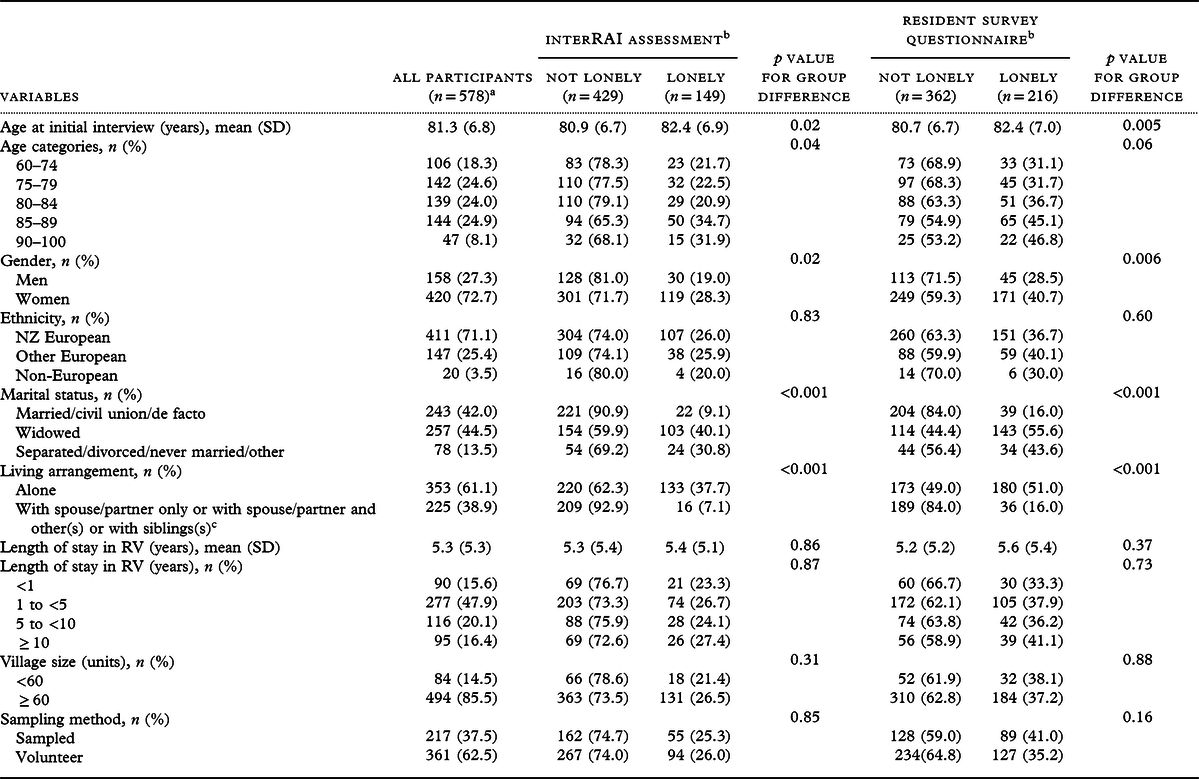
Most participants were women (72.2%, n = 420) and of European ethnicity (96.5%, n = 558). Non-European participants identified as Asian (n = 8), Maori (n = 7), Pacific Island (n = 1), or other (n = 4). Mean (standard deviation [SD]) age was 81.3 (6.8) years. 42.0% (n = 243) were in a married/civil unioned/de facto married relationship, and 44.5% were widowed (n = 257), 10.0% (n = 58) were separated or divorced, and 3.5% (n = 20) were never married or other and 61.1% (n = 353) lived alone. See Table 1 for further details.
Sociodemographic characteristics

aColumn percentage, brow percentage, and interRAI, cwith spouse/partner and other(s) or with siblings(s) were combined with spouse/partner only due to small numbers. Percentages may not total 100 because of rounding.
Loneliness
Loneliness was reported by 25.8% (n = 149) of participants from InterRAI assessments. The resident survey showed 37.4% (n = 216) reported to at least “sometimes feel lonely,” with 7.1% (n = 41) always feel lonely, 2.6% (n = 15) often feel lonely, and 27.7% (n = 160) sometimes feel lonely. A large proportion of participants (38.6%, n = 223) moved into an RV in order to gain more social connections.
Loneliness-associated factors (unadjusted analyses)
The interRAI assessment found those over 85 years most lonely. Women reported loneliness more than men (28.3% vs 19.0%, p = 0.02). Marital status was significantly associated with loneliness (p < 0.001); of all those widowed (n = 257), 40.1% (n = 103) reported loneliness. Of all those who were separated, divorced, or never married, or other (n = 78), 30.8% (n = 24) reported feeling lonely. For those with available length of widowed years (n = 241), 41.1% (n = 99) reported loneliness, with those widowed 2 to <5 years (58.7%, n = 27) most lonely, followed by those widowed <2 years (45.0%, n = 18) and ≥5 years (34.8%, n = 54). Living alone was also significantly associated with loneliness (p < 0.001). Due to the small non-European sample, ethnicity effect on loneliness could not be determined. Length of stay in RV or village size was not associated with loneliness. Similar results were reported in models of loneliness from the resident survey. See Table 1 for details.
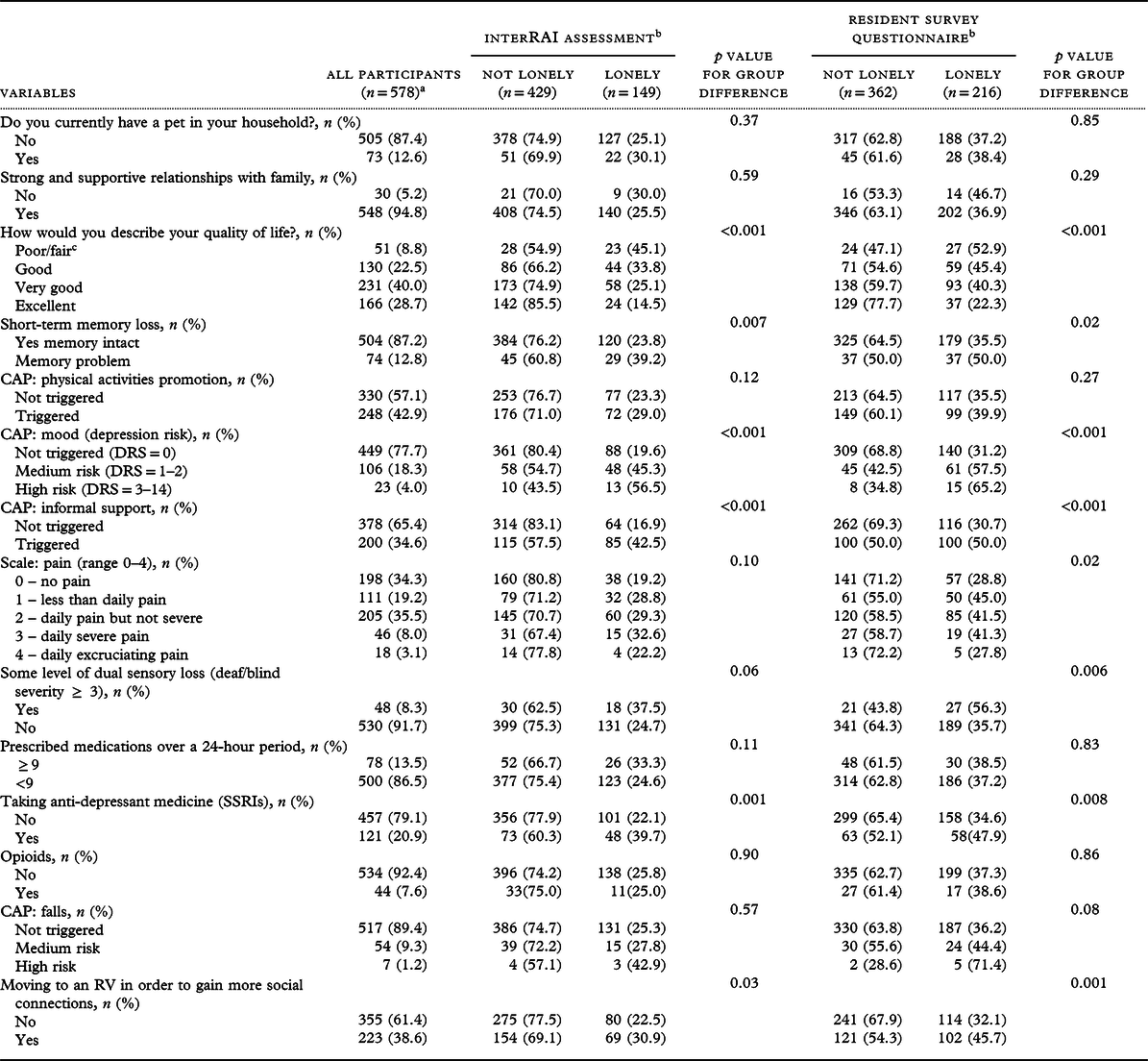
Just under half of those reporting a “poor or fair” quality of life also reported loneliness (45.1%, n = 23). Loneliness was reported in 45.3% (n = 48) for those with a medium risk for depression and 56.5% (n = 13) for those at high risk for depression. Of those taking anti-depressant medication (SSRIs = yes), 39.7% (n = 48) reported loneliness. Of those with less informal support, 42.5% (n = 85) reported loneliness. There were no significant associations with loneliness and strong and supportive relationships with family, driving in last 90 days, opioid use, pain, owning a pet, or number of medications prescribed (Table 2). Those reporting pain (p = 0.02) and sensory loss (deaf/blind) (p = 0.006) had a significant association with loneliness on the resident survey but not on interRAI assessment (Table 2).
Social and health factors associated with loneliness

aColumn percentage, brow percentage, and cresidents with poor quality of life were combined with fair quality of life due to small numbers. Percentages may not total 100 because of rounding.
Loneliness-associated factors (adjusted analyses)
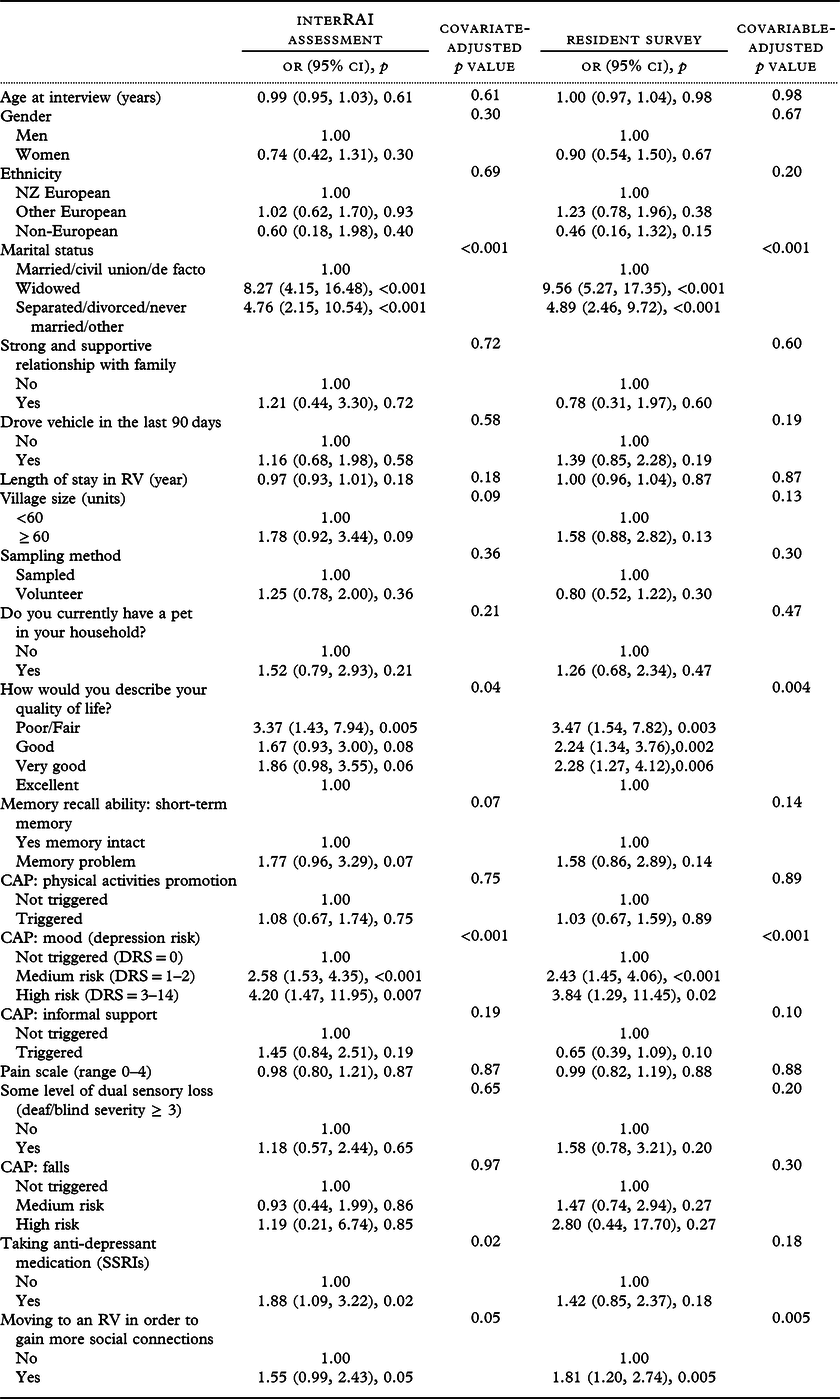
The multivariable logistic regression analysis of factors associated with interRAI-assessed loneliness found that those who were widowed were more than eight times more likely to report loneliness than those who were married, even after adjustment for known potential confounders (OR 8.27; 95% CI 4.15–16.48; p < 0.001). Those separated, divorced, or never married were over four times more likely to report loneliness than those who were married (OR 4.76; 95% CI 2.15–10.54; p < 0.001). In widowed residents with available length of widowed years (n = 241), significant lower adjusted odds of loneliness were found in those widowed <2 years (OR 0.30; 95% CI 0.10–0.90; p = 0.03) and those widowed ≥5 years (OR 0.24; 95% CI 0.11–0.57; p = 0.001) compared with those widowed 2-<5 years. Those reporting a “poor/fair” quality of life were over three times more likely to be lonely (OR 3.37; 95% CI 1.43–7.94; p = 0.005) than those reporting an “excellent” quality of life. Moving to an RV in order to gain more social connections was an independently associated factor for loneliness (OR 1.55; 95% CI 0.99–2.43; p = 0.05). Those at medium risk for depression were over twice as likely to report loneliness (OR 2.58; 95% CI 1.53–4.35; p < 0.001), and four times more likely for those at high risk of depression (OR 4.20; 95% CI 1.47–11.95; p = 0.007) compared to no depression risk. In addition, those taking anti-depressant medication (SSRIs = yes) were more likely to report loneliness (OR 1.88; 95% CI 1.09–3.22; p = 0.02). Similar significantly associated factors were found in the resident survey, except taking anti-depressant medications (Table 3).
Multivariable analyses of loneliness factors

Discussion
The results of this study showed that loneliness affected a significant proportion of people living in RVs in Auckland, NZ. Over one in four RV study participants reported feeling lonely on the interRAI assessment, and over a third of participants of the resident survey which had four categories of loneliness. Not surprisingly, there was a strong association between loneliness and marital status, with those who were widowed over eight times more likely to report loneliness, although the association was almost half as strong for those who were separated, divorced, or never married. Self-reported quality of life was significantly associated with loneliness, with those reporting a “poor or fair” quality of life over three times more likely to be lonely than those reporting an “excellent” quality of life. Mood (depression risk) and moving to an RV in order to gain more social connections were also associated factors for loneliness in this study. It is difficult to know whether those who are depressed feel lonelier, or loneliness results in depression. However, one study explored loneliness factors for those living in RVs, and similar to this study, found that chronic conditions and functional status were not independently associated with loneliness, but depression was (Bekhet & Zauszniewski, Reference Bekhet and Zauszniewski2012). The results clearly indicate that loneliness is a significant issue for RV residents, despite the fact that increasing social connectedness is often a reason for relocation to RVs (Roy et al., Reference Roy, Dubé, Després, Freitas and Légaré2018). Contrary to other reports, once adjusted for confounder variables, this study found no significant excess risk of loneliness with the following factors: gender, family relationships, informal support, or pain levels (Alpass & Neville, Reference Alpass and Neville2003; Bekhet & Zauszniewski, Reference Bekhet and Zauszniewski2012; Cornwell & Waite, Reference Cornwell and Waite2009; Dykstra et al., Reference Dykstra, van Tilburg and de Gierveld2005; Jamieson et al., Reference Jamieson, Gibson, Abey-Nesbit, Ahuriri-Driscoll, Keeling and Schluter2018; Wright-St Clair et al., Reference Wright-St Clair, Neville, Forsyth, White and Napier2017). Similar to other studies, this study did not find age was associated with loneliness in the adjusted multivariable analysis (Mund et al., Reference Mund, Freuding, Möbius, Horn and Neyer2019). However, differences from this studyʼs results and other reports are likely due to the heterogeneity among studies in terms of population studied, tools used to assess loneliness, and the degree that other health information was captured. This highlights the importance of ongoing research exploring loneliness in specific populations.
Loneliness is prevalent throughout society for all ages. For example, a 2018 NZ national well-being survey found that 17% of the adult population reported feeling lonely all, most, or some of the time during the last 4 weeks (StatsNZ, 2019). International reports of loneliness prevalence in older populations vary widely, ranging from 7% to as high as 49% (Savikko et al., Reference Savikko, Routasalo, Tilvis, Strandberg and Pitkälä2005). Other studies have found similar levels of loneliness in older people as this study. A 2018 Australian survey found a quarter of older adults identified as being lonely, and in NZ, 21% of community-dwelling older people referred for HC services reported loneliness (Jamieson et al., Reference Jamieson, Gibson, Abey-Nesbit, Ahuriri-Driscoll, Keeling and Schluter2018; Lim & Australian Psychological Society, Reference Lim2018), a similar figure to that found in the current RV sample. The current study also found differences in reported loneliness between the two types of questions asked of participants. The interRAI loneliness assessment is a binary, yes/no question compared to the resident survey that was a categorical question specifically using the term “lonely.” A higher proportion of participants reported loneliness (37%) with the categorical question compared with the binary question (26%). It may be the concrete nature of a yes/no question misses subjective nuances of self-reported loneliness (Jamieson et al., Reference Jamieson, Gibson, Abey-Nesbit, Ahuriri-Driscoll, Keeling and Schluter2018). This study asked respondents specifically about “loneliness.” However, this may have resulted in an underreporting due to the stigma associated with loneliness. Several other loneliness studies using commonly used instruments (i.e. UCLA Loneliness Scale and the dJG Loneliness Scale) did not specifically use the term “lonely” but asked about subjective feelings of loneliness and the social and emotional dimensions of loneliness to avoid the possible stigma of identifying as lonely (Ong et al., Reference Ong, Uchino and Wethington2016).
Decreasing social isolation by moving into an RV may not necessarily lessen loneliness (Lee & Ko, Reference Lee and Ko2017). Social disconnectedness, perceived social isolation, and loneliness are related but different entities which have separate and distinct associations with physical and mental health (Cornwell & Waite, Reference Cornwell and Waite2009). In this study, nearly 40% of participants said they moved into an RV to gain more social connections (e.g. for improved social life/access to activities or for social and/or emotional support). This was a retrospective study, and no inference can be made that expectations may not have been met for those who move to RVs to ameliorate social disconnectedness (and thus possibly loneliness). This is, however, an important question which merits further prospective study.
Research suggests that up to 90% of RV residents are satisfied with their decision to move (Crisp et al., Reference Crisp, Windsor, Butterworth and Anstey2013; Kennedy & Coates, Reference Kennedy and Coates2008). RV residents report higher levels of general/mental health than community dwellers and a high quality of life (Kennedy & Coates, Reference Kennedy and Coates2008). However, negative perceptions that age-segregated communities cultivate dependence and concerns about privacy, social isolation, and affordability can result in negative attitudes toward RV living (Crisp et al., Reference Crisp, Windsor, Butterworth and Anstey2013). Therefore, it is notable that RV participants in this study reported similar but somewhat higher proportions of feeling lonely as those living independently in the community when assessed with the same interRAI (26% and 21%–22%, respectively) (Central Regions Technical Advisory Services, 2018; Jamieson et al., Reference Jamieson, Gibson, Abey-Nesbit, Ahuriri-Driscoll, Keeling and Schluter2018). These results suggest that relocating to an RV may not necessarily mitigate loneliness as much as might be anticipated by potential RV residents (Crisp et al., Reference Crisp, Windsor, Butterworth and Anstey2013; Roy et al., Reference Roy, Dubé, Després, Freitas and Légaré2018).
Moving to a new community, establishing a new routine in an unfamiliar environment, and often following a significant health or life event, for example, for those recently widowed, can be very difficult for older people (Hodgson et al., Reference Hodgson, Freedman, Granger and Erno2004). The availability and perceived ease of accessibility to social contact within the RV and expectation that residents will be able to make close social and emotional connections may not be realistic for many and may potentially provoke increased levels of anxiety and feelings of loneliness (Bekhet & Zauszniewski, Reference Bekhet and Zauszniewski2012). Established personal relationships and social connections outside the RV has been found to be an important factor in deterring loneliness (Adams et al., Reference Adams, Sanders and Auth2004). However, people living in RVs have smaller social networks, are more likely to be grieving a loss, and receive fewer visitors, especially from long-term friends (Adams et al., Reference Adams, Sanders and Auth2004). In the current study, widowhood was the most significant associated factor for loneliness. However, time since a spouseʼs death was a factor in reported loneliness, with those widowed 2–5 years reporting more loneliness than those widowed less than 2 years or more than 5 years. Although those who are single due to divorce/separation or because they never married were also found to be at increased risk of loneliness, the additional risk was much less than those who were widowed. Other investigations have found that those who are single have wider social networks than those who are married which may be a factor in these results (Sarkisian & Gerstel, Reference Sarkisian and Gerstel2016). For those who are widowed, increased loneliness is most intuitively due to missing the quality of the intimate relationship, often established over many years and which is difficult to replace late in life. Contributing factors may be the multiple other losses experienced as people age, including losses associated with relocation, attrition of long-term friendships, and death of those close to them (Courtin & Knapp, Reference Courtin and Knapp2017).
Exploring interventions that could potentially ameliorate loneliness for older people living in RVs provides a pragmatic application of this studyʼs findings. There are a wide variety of interventions that have been trialed to support those who are lonely. These include individual and group activities that incorporate aspects of counseling, education, or social engagement, delivered through either in person or via electronic and telephone contact (Cohen-Mansfield & Perach, Reference Cohen-Mansfield and Perach2015; Poscia et al., Reference Poscia2018). Complex programs aiming to decrease loneliness, incorporating various approaches, achieved the most successful outcomes (Poscia et al., Reference Poscia2018). One example is a study by Saito et al. who found that a group-based facilitated educational, cognitive, social support program to increase community connectedness for recently relocated older people resulted in decreased loneliness and increased informal support (Saito et al., Reference Saito, Kai and Takizawa2012). In another successful model, university student volunteers provided a variety of techniques and one-to-one interventions such as reminiscence, exercise, and social engagement-directed discussions to decrease older adult loneliness (Nicholson & Shellman, Reference Nicholson and Shellman2013). There is currently a paucity of robust studies about interventions most effective in reducing loneliness for older people in RVs, and much more research is needed in this area (Poscia et al., Reference Poscia2018).
Strengths and limitations
To our knowledge, this study is one of a few studies exploring loneliness in the RV population, and the largest for NZ. A strength of this paper is the large sample size and the extensiveness of the data obtained from RV residents. However, as with all studies it has its limitations. Due to legal and ethical constraints, those with cognitive impairment were not included in the sample. Another limitation was the lack of ethnic diversity of the sample, with the vast majority of residents identifying as European/NZ European; however, this is likely to reflect the actual RV population. Access to RVs may be lower in those of non-European ethnicities due to the financial means required to reside in RV and the “Western” approach to design, management, and governance of RVs, which may deviate from other sociocultural norms, making RVs a less “attractive” option (Bhandal et al., Reference Bhandal, Siew, Broad and Boyd2012). Other studies have found significant differences in loneliness across ethnic groups in larger samples of community-dwelling older people (Jamieson et al., Reference Jamieson, Gibson, Abey-Nesbit, Ahuriri-Driscoll, Keeling and Schluter2018). This research utilized a cross section of the RV population at one point in time. Other longitudinal studies have found risk factors for loneliness change over the life of the older person (Dykstra et al., Reference Dykstra, van Tilburg and de Gierveld2005). A large number of tests were utilized because of the exploratory nature of the analyses, and a liberal p value (0.05) increases the chance of a type I error. Lastly, random selection of residents was not possible for the full sample, although there were no differences found between responses of “sampled” vs. “volunteer” samples.
Conclusion
Aging brings with it many losses. At times, this can result in feelings of loneliness, and it is well known that loneliness impacts the health and well-being of older people. This study found a significant proportion of the older people living in RVs experience loneliness, although increasing social contact is a common reason for relocating to an RV. Those who are widowed or single, those who report a lower quality of life, and those who are at high risk for depression, and those moving to an RV in order to gain more social connections are at greater risk for loneliness. Healthcare providers, social care agencies, and RV organizations have the opportunity to develop interventions that could possibly support older people who are lonely as a means of improving their experience of aging.
Conflict of interest
The authors declare no financial or personal conflicts of interest.
Source of funding
This work was supported by two main funders, National Science Challenge Ageing Well and Waitematā District Health Board. Support from The Hope Foundation and University of Auckland (summer studentships) and Freemasons New Zealand that made preparatory work possible is also appreciated.
Description of authors’ roles
MJC (Principal Investigator), MB, JBB, and KB were all named investigators on the wider project and helped plan the study. For this substudy, MB, CC, and AT planned and drafted the paper, ZW conducted all statistical analyses, and KB, JH, MB, CC, and AT provided clinical expertise. AT and CC contributed to data collection, A-MH provided administrative support, and MJC was the principal investigator. All authors contributed to critically reviewing and revising the manuscript.
Impact statement
We certify that this work is novel. In recent years, the population of people living in retirement villages (RVs) (aka continuing care retirement communities) has grown rapidly in New Zealand and internationally, though the health and social care needs of this population are poorly understood. This choice is often seen as a way to decrease social isolation while still living independently as one ages. Loneliness for older people is a significant health issue and contributes to overall frailty, yet little is known about the proportion of loneliness and associated factors among RV residents. This research provides a novel investigation of loneliness in RV residents and associated risk factors. Few studies of this type exist, and none to our knowledge in the New Zealand population.
Acknowledgments
We would like to extend our gratitude to the participating RV management for accepting participation in this study and also the RV residents that willingly participated in this study. We would also like to thank Gabrielle Peters for her support of this project.
Supplementary material
To view supplementary material for this article, please visit https://doi.org/10.1017/S1041610220000393