Introduction
The city of Flint is the urban center of Genesee County, Michigan, USA with a population of over 95000 according to 2018 estimates and accounting for 25% of Genesee County’s population. 1 On April 25, 2014, Flint changed its municipal water supply source from Lake Huron to the Flint River as a cost-saving measure. Reference Adams2 However, the Flint River water was not treated with corrosion control chemicals to ensure the more acidic river water did not cause corrosion of water distribution pipes. By summer 2014, Flint residents had begun reporting changes in the smell, taste, and appearance of their water as well as health effects such as skin rashes and hair loss. However, officials insisted the water was safe and dismissed the idea of a link between water quality and health problems, and residents continued to use tap water. Meanwhile, the supply pipes continued corroding, leaching lead into the water. Reference Kennedy3
In September 2015, water experts discovered very high levels of lead in the tap water of some Flint homes, Reference Edwards4 and a local pediatrician found increases in children’s blood lead levels corresponding with the time of the switch in water sources. Reference Hanna-Attisha, LaChance, Sadler and Champney Schnepp5 The state re-evaluated its water-testing data, discovering elevated levels of contaminants including bacteria and lead in Flint’s drinking water, and concluded that the water was, in fact, unsafe. Reference Kennedy3,Reference Seville, Rappleye and Connor6 Although the water source was switched back to the Lake Huron source in October 2015, a state of emergency was declared at both the state and federal level in January 2016 which was in effect until August 2016. Despite the state of emergency having been lifted, according to media reports many residents remain fearful of Flint’s water, as they have not received any explanation for why the crisis was allowed to happen, and still lack trust in public health officials. Reference Renwick7
Naturally, the crisis has raised concerns about the physical health of Flint residents. Lead exposure can lead to high blood pressure, heart disease, damage to the brain and kidneys, and infertility. 8 Lead exposure is particularly harmful for children, putting them at greater risk of brain and nervous system damage, slowed development and behavioral problems. Reference Grandjean and Landrigan9 In addition to physical health concerns, there are also potential mental health consequences of the crisis which cannot be overlooked. Previous research suggests that experiencing a disaster or public health emergency (particularly 1 that is human-induced) can lead to mental health disorders and substantial negative effects on levels of stress. Reference Makwana10 Psychological consequences can occur not only during and in the short-term aftermath of a disaster or crisis but can also affect both adults and children for years after. Reference Bland, O’Leary, Farinaro, Jossa and Trevisan11,Reference Bolton, O’Ryan, Udwin, Boyle and Yule12
Residents of Flint may be particularly at risk of adverse mental health consequences due to the city’s long-standing social and economic vulnerabilities. Almost half of Flint’s residents live below the federal poverty level, 1 and Flint has consistently been rated 1 of the most violent cities in the US. Reference Harris13,Reference Warner, Fuchs and Lubin14 Flint also has a long history of racial segregation, with environmental racism believed to be a contributor to the water crisis. 15 Disadvantaged communities are more likely to be vulnerable to adverse mental health outcomes especially after a disaster and have more barriers to treatment. 16 Therefore, the mental health of Flint residents is of particular concern.
Despite the risk to Flint residents in terms of their mental health, the psychological impact of the crisis has received little attention in the literature, and human-focused recovery efforts have been minimal in comparison to the recovery of physical infrastructure. Reference Kruger, Cupal, Franzen, Kodjebacheva, Bailey, Key and Kaufman17 However, the mental health impact from the Flint Water Crisis may be a long-lasting legacy for generations to come in the community, as has been seen in other post-disaster communities: for example, the fallout of the Chernobyl Nuclear Power Plant in Pripyat, Ukraine led to gaps in providing mental health care and the impact of this has been labelled as the largest public health problem caused by the accident. 18 In fact, the media have frequently compared the Flint situation with the Chernobyl disaster, Reference Al-Sibai19,Reference McFarland20 while researchers have labelled the Flint Water Crisis more ‘insidious’ than Chernobyl, Reference Campbell, Greenberg, Mankikar and Ross21 which causes concern as to the potential long-lasting impact of the crisis. Past disasters in other communities have shown the importance of resilience, which includes the ability to return to self-sufficiency and sustain relatively stable psychological and physical functioning, after a traumatic event. Reference Abir, Cunningham and Zimmerman22 This highlights the importance of considering the level of resilience in Flint’s community and how this can be improved. It is important that the psychological consequences of the crisis are not overlooked particularly now, with the ongoing coronavirus (COVID-19) pandemic. Flint has the highest number of COVID-19 cases in Genesee County: As at May 4, 2020, Flint had recorded 644 cases (representing 39.5% of Genesee County cases), followed by Flint Township with 125 (7.6% of Genesee County’s cases), despite Flint only making up 25% of Genesee County’s total population. 23 The psychological consequences of the unprecedented lockdown of communities in order to reduce transmission is likely to be substantial, Reference Brooks, Webster and Smith24 and may be particularly so for communities which have yet to fully recover from a past crisis and are now faced with another 1. Taking account of the lessons learned from the fallout from the Chernobyl disaster and with the current situation with the COVID-19 pandemic, applying such learnings of past crises are important for responding and serving the populations affected by COVID-19 and prior disasters.
We aimed to systematically review the published literature on the psychological impact of the Flint water crisis, specifically focusing on characterizing the mental health impact of the crisis and the factors associated with this impact.
Methods
Search Strategy
On March 27, 2020, the following search strategy was used to search titles and abstracts in 5 databases (Medline [Northfield, IL], PsycInfo [American Psychological Association, Washington, DC], Embase [Elsevier, Amsterdam, Netherlands], Global Health [EBSCO, Ipswich, MA], and Web of Science [Thomson Reuters, New York, NY]) from inception to the 12th week of 2020:
-
1. Flint
-
2. Water
-
3. Mental health
-
4. Behavioural health
-
5. Behavioral health
-
6. Psycholog*
-
7. Consequence*
-
8. Impact*
-
9. 3 OR 4 OR 5 OR 6 OR 7 OR 8
-
10. 1 AND 2 AND 9
The asterisk symbol is used as a truncation command on the Ovid databases – so for example, ‘psycholog*’ would search for ‘psycholog’ as a root term with any ending, thus would capture both ‘psychology’ and ‘psychological’; ‘consequence*’ would capture both ‘consequence’ and ‘consequences’.
Inclusion Criteria
In order to be included in the review, studies had to: (i) include primary data; (ii) be published in peer-reviewed journals; (iii) be written in English; and (iv) report on either the psychological consequences of the Flint water crisis or factors associated with psychological outcomes as a result of the crisis.
Screening
Out of both authors, 1 author ran the search strategy on all databases and downloaded resulting citations to EndNote version X9 (Thomson Reuters, New York, NY) where duplicates were automatically removed. Both authors then independently screened all titles for relevance to the review, excluding any which were clearly not relevant. This was followed by screening of abstracts. The full texts of all citations still remaining were obtained and screened for relevance against the inclusion criteria. Finally, the reference lists of included papers were hand-searched for additional relevant studies. Any discrepancies in included papers between authors were resolved through discussion.
Data Extraction and Synthesis
A spreadsheet was designed in order to systematically extract data from the literature. The following data was extracted: year of study, design and measures used number of participants, demographic information of participants, and key results. Data extraction was carried out by both authors independently and then their results were compared, to ensure accuracy. Thematic analysis was used to synthesize the data by coding it and organizing it into themes. Reference Braun and Clarke25
Results
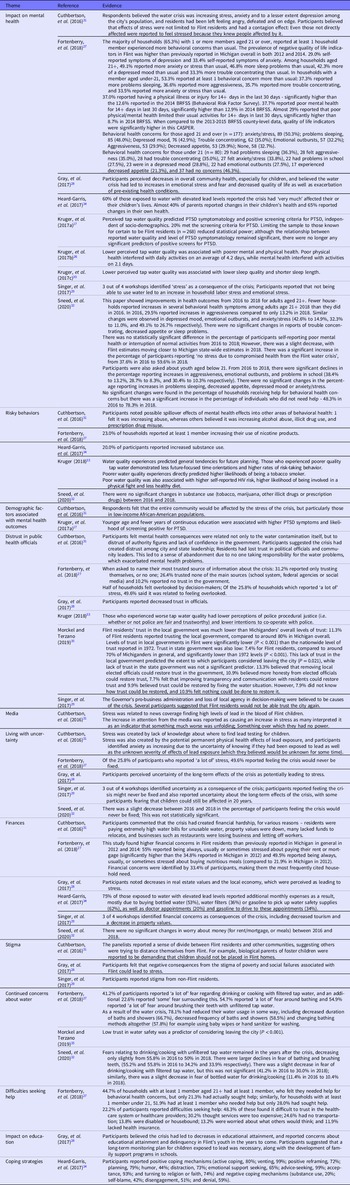
Database searches yielded 216 articles. After 84 duplicates were removed, 132 articles remained for screening. Title screening removed 101 of these; Abstract screening removed another 15 and 16 full texts were reviewed. Of these, 5 were excluded, leaving 11 included in the review (Figure 1). Table 1 summarizes the design and participant information for each study and Table 2 summarizes the evidence for each of the themes found in the literature.
Flow diagram of search strategy.

Characteristics of studies included in the review

Themes emerging from included studies

Impact on Mental Health
Participants directly affected by the water crisis reported symptoms of poor mental health in general, Reference Kruger, Cupal, Kodjebacheva and Fockler26 post-traumatic stress disorder, Reference Kruger, Cupal, Franzen, Kodjebacheva, Bailey, Key and Kaufman17 depression, Reference Fortenberry, Reynolds and Burrer27 anxiety or stress, Reference Fortenberry, Reynolds and Burrer27-Reference Singer, Gray, Sadler and Schmitt-Olabisi29 sleep problems, Reference Fortenberry, Reynolds and Burrer27,Reference Kruger, Kodjebacheva and Cupal30 fear, Reference Gray, Singer, Schmitt-Olabisi, Introne and Henderson28 aggressiveness, Reference Fortenberry, Reynolds and Burrer27 trouble concentrating, Reference Fortenberry, Reynolds and Burrer27 emotional outbursts, Reference Fortenberry, Reynolds and Burrer27 decreased appetite, Reference Fortenberry, Reynolds and Burrer27 and exacerbation of pre-existing health conditions. Reference Gray, Singer, Schmitt-Olabisi, Introne and Henderson28 A longitudinal study of 30 expert panelists (from health services, schools and researchers in Genesee County) believed the water crisis was increasing stress, anxiety and to a lesser extent depression among Flint’s population, Reference Cuthbertson, Newkirk, Ilardo, Loveridge and Skidmore31 and that residents had been left feeling angry, defeated and on edge. They also believed that effects of stress were not limited to Flint residents and that those outside of Flint could also be stressed due to knowing people affected by the crisis.
A cross-sectional study of 180 Flint residents comparing indicators of psychological wellbeing in Flint after the water crisis with similar indicators in Michigan before the crisis, Reference Fortenberry, Reynolds and Burrer27 found higher negative quality of life indicators in Flint after the crisis than in both 2012 and 2014, as well as significantly higher poor mental health and a significantly higher number of people reporting that physical or mental health had limited their usual activities than in 2013-2015.
However, a longitudinal study (looking at data for almost 200 residents over 3 years) published in 2020, Reference Sneed, Dotson, Brewer, Pugh and Johnson-Lawrence32 showed some improvements in health outcomes over the years post-crisis: for adults aged 21 and over, aggressiveness, depressed mood, emotional outbursts, and anxiety/stress were lower in 2018 than they were in 2016, and for those aged under 21, there were significant declines in aggressiveness, emotional outbursts and problems in school. However, there were no significant changes in reports of trouble concentrating, decreased appetite or sleep problems for those of age 21 and over; or sleep problems, decreased appetite, depressed mood or anxiety/stress for those under 21 years.
Risky Behaviors
Kruger, Reference Kruger33 in a cross-sectional study of over 700 people found that those who experienced poorer quality tap water demonstrated higher rates of risk-taking behavior: In particular, poorer water quality experiences were associated with higher likelihood of tobacco smoking, higher self-reported HIV risk, higher likelihood of being involved in a physical fight and less likelihood of partaking in a healthy diet. Increased substance use and nicotine use were also noted in 2 other studies Reference Fortenberry, Reynolds and Burrer27,Reference Heard-Garris, Roche and Carter34 ; While the longitudinal study by Sneed, et al., Reference Sneed, Dotson, Brewer, Pugh and Johnson-Lawrence32 found no significant decrease in substance use over the years after the crisis between 2016 and 2018. Cuthbertson, et al.’s participants believed that the mental health effects of the crisis could spill over into other areas of behavioral health, and could increase abuse, alcohol misuse, illicit drug use, and prescription drug misuse. Reference Cuthbertson, Newkirk, Ilardo, Loveridge and Skidmore31
Demographic Factors Associated With Mental Health Outcomes
Participants felt that the entire community would be affected by the stress of the crisis, but particularly those in low-income African-American populations. Reference Cuthbertson, Newkirk, Ilardo, Loveridge and Skidmore31 Kruger, et al., Reference Kruger, Cupal, Franzen, Kodjebacheva, Bailey, Key and Kaufman17 found that younger age and fewer years of continuous education were associated with higher PTSD symptoms and likelihood of screening positive for PTSD.
Distrust in Public Health Officials
Cuthbertson, et al.’s participants (30 expert panelists from health and education services in Genesee County) felt mental health consequences were related not only to the water contamination itself but to distrust of authority figures and lack of confidence in the government. Reference Cuthbertson, Newkirk, Ilardo, Loveridge and Skidmore31 Participants suggested the crisis had created distrust among city and state leadership; Residents had lost trust in political officials and community leaders. This led to a perception of abandonment, since no one took responsibility for the water problems, which exacerbated mental health problems. Decreased trust in officials was also noted in other studies. Reference Fortenberry, Reynolds and Burrer27-Reference Singer, Gray, Sadler and Schmitt-Olabisi29,Reference Kruger33,Reference Morckel and Terzano35 This decrease in trust may be due to feeling overlooked by decision-makers. Reference Fortenberry, Reynolds and Burrer27 In terms of what could be done to restore trust in the government, participants suggested removing local elected officials, more honesty from elected officials, improving transparency and communication with residents, and fixing the water situation. Reference Morckel and Terzano35 Furthermore, 7.9% of participants in this study did not know how trust could be restored, and 10.9% felt nothing could be done to restore it.
Media
Stress was related to news coverage finding high levels of lead in the blood of Flint children. Reference Cuthbertson, Newkirk, Ilardo, Loveridge and Skidmore31 In the same study, the increase in attention from the media was reported as causing an increase in stress as many interpreted it as an indicator that something much worse was unfolding; Something over which they had no power.
Living with Uncertainty
Participants cited various sources of uncertainty leading to stress: lack of knowledge about where to find lead testing for children in order to assess the potential impact of the crisis on their children Reference Cuthbertson, Newkirk, Ilardo, Loveridge and Skidmore31 ; Uncertainty of knowing if they had been exposed to lead as well as the unknown severity of effects of lead exposure Reference Cuthbertson, Newkirk, Ilardo, Loveridge and Skidmore31 ; Feeling that the crisis was not over and would never be fixed Reference Fortenberry, Reynolds and Burrer27,Reference Singer, Gray, Sadler and Schmitt-Olabisi29 ; And the uncertainty of the long-term effects of the crisis. Reference Gray, Singer, Schmitt-Olabisi, Introne and Henderson28,Reference Singer, Gray, Sadler and Schmitt-Olabisi29 Sneed et al. discovered a slight decrease between 2016 and 2018 in the percentage of participants feeling the crisis would never be fixed; However, this was not statistically significant.
Finances
Participants frequently reported financial concerns and hardships. Reference Fortenberry, Reynolds and Burrer27-Reference Singer, Gray, Sadler and Schmitt-Olabisi29,Reference Cuthbertson, Newkirk, Ilardo, Loveridge and Skidmore31,Reference Heard-Garris, Roche and Carter34 Financial concerns appeared to be higher among Flint residents after the crisis than previously reported in Michigan in 2012 and 2014. Reference Fortenberry, Reynolds and Burrer27 These increased concerns were due to Flint residents paying extremely high water bills for unusable water Reference Cuthbertson, Newkirk, Ilardo, Loveridge and Skidmore31 ; decreased property values Reference Gray, Singer, Schmitt-Olabisi, Introne and Henderson28,Reference Singer, Gray, Sadler and Schmitt-Olabisi29,Reference Cuthbertson, Newkirk, Ilardo, Loveridge and Skidmore31 ; lacking funds to relocate Reference Cuthbertson, Newkirk, Ilardo, Loveridge and Skidmore31 ; decreases in the local economy Reference Gray, Singer, Schmitt-Olabisi, Introne and Henderson28,Reference Cuthbertson, Newkirk, Ilardo, Loveridge and Skidmore31 ; decreases in tourism Reference Singer, Gray, Sadler and Schmitt-Olabisi29 ; and additional monthly expenses such as buying bottled water and water filters, doctor appointments, and buying gasoline to travel to appointments or to pick up water safety supplies. Reference Heard-Garris, Roche and Carter34 Sneed, et al.’s study showed no significant change in financial concern in the years post-crisis, between 2016 and 2018. Reference Sneed, Dotson, Brewer, Pugh and Johnson-Lawrence32
Stigma
Participants in 1 study (30 expert panelists from Genesee County) reported a sense of divide between Flint residents and other communities, Reference Cuthbertson, Newkirk, Ilardo, Loveridge and Skidmore31 suggesting others were trying to distance themselves from Flint. For example, it was reported that biological parents of foster children demanded that children should not be placed in Flint homes. Similarly, Flint-based community partners and university researchers in another study using both workshops and surveys to assess Flint residents’ views, Reference Gray, Singer, Schmitt-Olabisi, Introne and Henderson28 found that negative consequences from the stigma of poverty and social failures associated with Flint could lead to stress and participants in a third study, Reference Singer, Gray, Sadler and Schmitt-Olabisi29 also reported experiencing stigma from non-Flint residents.
Continued concerns about water
In 1 cross-sectional study of 180 Flint residents, Reference Fortenberry, Reynolds and Burrer27 over 60% of participants reported fear regarding drinking or cooking with filtered tap water, and over half reported “a lot of” fear around bathing and brushing teeth with unfiltered tap water. As a result of the water crisis, more than 75% had reduced their water usage in some way, including decreased duration and frequency of baths and showers and changing bathing methods altogether, for example using baby wipes or hand sanitizer for washing. Participants in another study (a cross-sectional study of 405 Flint residents) also reported low trust in water safety, Reference Morckel and Terzano35 which was a significant predictor of considering leaving the city (P < 0.001). Sneed, et al.’s longitudinal study, Reference Sneed, Dotson, Brewer, Pugh and Johnson-Lawrence32 found that fears related to drinking and cooking with tap water did not significantly decrease between 2016 and 2018. However, there were much larger decreases in fears of bathing and brushing teeth.
Difficulties seeking help
A study of 180 adults living in Flint found that only approximately half of those participants who felt they needed help for behavioral health concerns actually sought help. Reference Fortenberry, Reynolds and Burrer27 They reported barriers to seeking help such as finding it difficult to trust in the healthcare system or healthcare providers; finding services too expensive; having no transportation; being disabled or housebound; concerns about what others would think; and lack of health insurance.
Impact on Education
Participants believed the crisis had led to a decrease in educational attainment, and reported concerns about educational attainment and delinquency in Flint’s youth in the years to come. Reference Gray, Singer, Schmitt-Olabisi, Introne and Henderson28 Participants in this study suggested that a long-term monitoring plan for children exposed to lead was necessary, along with the development of family support programs in schools.
Coping strategies
The majority of Heard-Garris, et al.’s participants (consisting of 133 drug-using Flint residents), Reference Kruger33 reported using positive coping mechanisms such as active coping, venting, positive reframing, planning, humor, distraction, emotional support seeking, advice-seeking, acceptance, and turning to religion or faith. Negative coping mechanisms such as denial and disengagement were also reported by more than half of the participants, and over 40% reported self-blame.
Discussion
The negative effects caused by the water crisis on Flint’s residents have created a variety of mental health issues in the affected population. Studies found in this review suggest various degrees of anxiety, depression, post-traumatic stress, sleep problems and worries about physical health existing in the affected population. Additionally, negative coping strategies such as smoking and alcohol misuse, and risky health behaviors appeared to be the response reactions of those affected by the crisis. Although more research into risky behaviors in Flint pre-crisis is needed in order to ascertain the extent to which these behaviors are related to the crisis, it is highly possible that they are exacerbated by worsening mental health due to the crisis, which participants themselves believed to be the case. Reference Cuthbertson, Newkirk, Ilardo, Loveridge and Skidmore31 The negative mental health consequences of the crisis may have been exacerbated by lowered trust in public health and government officials, heightened uncertainty about the long-term impacts of the crisis and the appropriate course of action to resolve emerging issues, and increased amount of financial hardships caused by the crisis. The results of this review also suggest that perceived stigma from others in the community and in the population at large, along with difficulties seeking help, could prevent those affected from improving their respective situations. This review also found evidence that concerns and doubt about the tap water in Flint, Michigan continued even after the state of emergency was lifted.
However, there are some positive implications from this review, as the major stressors identified can be targeted with interventions and consequently their impact lessened. For example, negative coping strategies such as smoking and alcohol misuse and risky health behaviors can be addressed in the Flint community through public health interventions and programs. Programs that enable peer and group support have been effective in establishing and enabling changes in these behaviors. Reference Ford, Clifford, Gussy and Gartner36,Reference Tracy and Wallace37 Additionally, in a longitudinal study of the first 3 years after the crisis, improvements in mental health outcomes as well as a decline in fears of using tap water for bathing and brushing teeth were seen, which suggest public health messages surrounding water usage for these purposes were well-received. Reference Sneed, Dotson, Brewer, Pugh and Johnson-Lawrence32 However, other concerns related to the crisis remain unchanged, such as financial worries and an overall concern that the crisis will never be fixed. Use of evidence-informed interventions can reduce these concerns, enhance wellbeing, and improve functioning for affected individuals. Reference Morganstein and Ursano38 Despite the progression in some beliefs, community efforts to reduce psychological distress are still warranted.
The psychological consequences of the Flint water crisis may generalize to other disasters, and support findings from similar incidents involving environmental contamination based on past disasters. For example, studies that examined the long-term mental health consequences of the Chernobyl nuclear power plant disaster showed the affected populations developed an exaggerated sense of presumed exposure and danger due to Chernobyl over time, which fueled an increased level of anxiety and perpetual stigmatization through the generations. Reference Bromet, Havenaar and Guey39-Reference Samet and Patel42 Besides, similar results found in this review with impact on mental health and stigmatization, the themes of distrust in government officials and risky behaviors were also seen among populations affected by Chernobyl. Reference Samet and Patel42,Reference Bolt, Helming and Tintle43 There were more depression, anxiety, and overall concerns specifically about children’s well-being among the affected populations even decades after the incident this brings heightened urgency for further investigations and longitudinal studies related to the Flint Water Crisis, to inform interventions to address any long-term mental health identified.
Additionally, the COVID-19 pandemic creates a possible compound effect to those affected by the Flint Water Crisis, as they now face coping with another emergency while still recovering from another. Despite being over 3 years since the crisis was considered to be over, the communities, as seen in this review, are still reeling from the mental health impact which could be exposed further with the pandemic. Although coronavirus infects people regardless of income, the low-income communities in Michigan have been deeply affected, especially in Genesee County. 23 This highlights the issue of how Michigan is segregated by income and race, which have previously been cited as factors responsible for the Water Crisis and may also be crucial factors in the high caseload of confirmed COVID-19 patients in Flint Reference Muhammad, De Loney, Brooks, Assari, Robinson and Caldwell44,Reference Pulido45 ; It has been reported that racial capitalism in Flint is shaping health inequalities in the pandemic. Reference Laster Pirtle46 To our knowledge there is not yet any peer-reviewed published research specifically focused on the mental health impact of COVID-19 on Flint residents; However, the mental health impacts of lockdown are likely to be felt across the globe, Reference Brooks, Webster and Smith24 and there have been media reports that the pandemic has had a particularly negative impact on Flint residents. Reference Fleming47
There are several implications for policy and practice based on the findings of this review. First, rebuilding trust in official communication and science within the Flint community will enhance ongoing efforts to resolve the gaps that were caused by the initial crisis. Local government and public health officials need to ensure they regain the trust of residents along with engaging and involving the Flint community and its members in recovery efforts. For example, ensuring transparency, seeking community input, and enabling 2-way communication with the public on resolving issues will allow trust to be built institutionally. Having government and public health officials being held accountable, demonstrating integrity by admitting to mistakes, and seeking input from respected outside experts will bridge their past leadership woes and connect with the communities they are serving. Reference Boufides, Gable and Jacobson48
In Flint, efforts are being made to provide urgent mental health services. Psychological first aid training for people interested in helping others cope with the water emergency has been provided by the Flint Community Resilience Group, Reference Cuthbertson, Newkirk, Ilardo, Loveridge and Skidmore31 and the Flint RECAST program educates residents about trauma. Reference Ahmad49 However, there are concerns about whether enough is being done and whether people would actually seek psychological help. Reference Goodnough and Atkinson50 Mental health services need to be readily available and ramped up in the Flint community. Government and public health officials should identify and strengthen resources for mental health services for affected residents, and conduct follow-up mental health assessments to evaluate change over time. Additional mental health interventions should also occur in Flint, especially to address the current COVID-19 pandemic as this may have a profound mental health impact. Reference Brooks, Webster and Smith24,Reference Rajkumar51,Reference Sneed, Key, Bailey and Johnson-Lawrence52 However, economic factors, such as access and costs, need to be considered when implementing mental health interventions. An increase of educational media campaigns and handouts can also enhance the mental health interventions by emphasizing the potential long-term mental health implications of the crisis, providing contact information for support groups and readily available mental health services. All trust-building and mental health services done in the Flint community will build infrastructure and enhance the efforts if future crises arise.
Future research in Flint should go beyond the profound societal effects caused by the crisis and create opportunities to resolve the disadvantages for the Flint community to become an example of a community that can bounce back and be resilient from future public health emergencies. Despite the concept of community resilience having been variously defined by researchers, government officials, and public health practitioners without a unifying meaning, several themes found across the definitions align with the results found in this review and help to prioritize future research. Reference Patel, Rogers, Amlôt and Rubin53 Community participatory research examining crisis communication, leadership and resources can help build trust, evidence-based infrastructure and working relationships between officials and Flint community members. With a compound effect of the current impact caused by the COVID-19 pandemic, maladaptive coping strategies and risky health behaviors may need urgent attention to manage the distressing emotions and community memory of compounded crises. Reference Morganstein and Ursano38 Facing multiple public health emergencies can cause inherent challenges for communities but establishing evidence-based mental health interventions can help to enhance their resilience.
Limitations
Most studies reviewed were cross-sectional, and thus indicate associations, rather than causal relationships; Very few studies were longitudinal, so the long-term effects of the Flint Water Crisis are unclear. Much of the included research was conducted while the crisis was ongoing: the full impact of the crisis may therefore be under-estimated, due to the speed with which data was collected. The majority of studies did not compare rates of mental health problems between Flint and other populations, or pre-Water Crisis rates in Flint, making it difficult to truly ascertain the impact of the crisis on mental health; 1 study which did compare rates of psychological distress in Flint with pre-crisis rates of psychological distress in Michigan suggested mental health significantly worsened during the crisis and it would be useful to know if other studies could replicate this finding. Reference Fortenberry, Reynolds and Burrer27 Other factors, such as the economic recession or personal circumstances, could also have affected mental health. Additionally, much of the data in the included papers was obtained via self-reports, which may not necessarily be reliable. In terms of the review process itself, the decision to include only peer-reviewed literature and not grey literature may mean that the data reviewed in this article is subject to publication bias.
Conclusion
Literature on the impact of the Flint Water Crisis suggests considerable psychological consequences to Flint residents, exacerbated by mistrust in officials and financial difficulties. While Flint struggles to recover from this crisis, the city has also seen a much higher rate of COVID-19 than other parts of Genesee County, meaning Flint residents now have 2 disasters to cope with. Our review highlights the urgent need for more mental health resources for the people of Flint, such as services providing help for anxiety, depression and post-traumatic stress disorder, mental health assessments, and support groups.
Funding Statement
Samantha K Brooks was funded by the National Institute for Health Research Health Protection Research Unit (NIHR HPRU) in Emergency Preparedness and Response, a partnership between Public Health England, King’s College London and the University of East Anglia. Sonny S Patel was supported by the Fogarty International Center and National Institute of Mental Health, of the National Institutes of Health under Award Number D43 TW010543. The views expressed are those of the author(s) and not necessarily those of the NIHR, Public Health England, the Department of Health and Social Care, National Institutes of Health, or any other institution.