1. Introduction
The domain of motion has served as a fruitful venue for exploring bilingual cognition and language use where key questions have revolved around whether bilinguals construe motion events in language-specific ways, or to what extent there is crosslinguistic influence (CLI) and the conditions that give rise to it (e.g., Filipović, Reference Filipović2022; Hohenstein et al., Reference Hohenstein, Eisenberg and Naigles2006; Wang & Wei, Reference Wang and Wei2022). The present study extends this line of inquiry to the context of Uyghur–ChineseFootnote 1 bilingualism and aims to contribute to current knowledge in at least two ways. First of all, as we shall see, most of the existing studies have focused on Indo-European languages, and in relation to motion expression, those that contrast typologically (i.e., satellite-framed vs. verb-framed). Therefore, we need fresh data from language pairs that are more distant in their general typological profile and are varied in the degree to which there is structural/typological overlap within a particular functional domain (e.g., motion) so that we can better delineate whether these factors differentially impact on the occurrence or the lack thereof of CLI (cf. Yip & Matthews, Reference Yip and Matthews2022). The combination of Uyghur and Chinese fills this gap well as the two languages are genetically distant (Turkic vs. Sino-Tibetan) and typologically distinct (e.g., agglutinative vs. analytical) but at the same time exhibit structural overlap in encoding motion events. Moreover, the lion’s share of available research has concerned voluntary motion (e.g., Aveledo & Athanasopoulos, Reference Aveledo and Athanasopoulos2016; Daller et al., Reference Daller, Treffers-Daller and Furman2011; Hohenstein et al., Reference Hohenstein, Eisenberg and Naigles2006) and we are yet to establish whether and to what extent the hitherto observed patterns also replicate in other types of motion. This study hopes to contribute to filling these gaps by focusing on an under-studied type of motion, i.e., caused motion. Importantly, with the benefit of a previous study on Uyghur–Chinese adult bilinguals’ construal of voluntary motion (Tusun, Reference Tusun2022a), it seeks to ascertain whether bilingual construal of motion varies as a function of event type, and to shed light on the dynamics of bilingual language use more generally.
2. Motion event typology and language use
Although motion is a universal experiential domain, its expression varies across languages. Typically, a motion event can involve an agent moving along a Path in a particular Manner, known as voluntary motion (VM), as in (1–2), or it can involve an agent displacing an object in a particular Manner such that the object moves along a particular Path, known as caused motion (CM), as in (3–4). While the semantic components constituting these events (e.g., Cause, Manner, Path) are presumed to be universal, languages differ in how the components are expressed lexically and syntactically, and Talmy (Reference Talmy2000) is an attempt to capture this variability. According to him, such events consist of a framing event Path and a co-event Cause/Manner and depending on whether Path is expressed in the main verb or a satellite (e.g., verb particles) within a sentence, he classified the world’s languages into verb-framed languages (V-languages, e.g., Spanish) and satellite-framed languages (S-languages, e.g., English). Thus, English expresses Path in the satellite and Cause/Manner in the verb in a single clause whereas Spanish expresses Path in the main verb and Cause/Manner in the gerund across two clauses via subordination.

The seemingly superficial structural differences across languages outlined above have been found to have implications for habitual language use, particularly in terms of what aspects of motion events speakers typically profile and how often. Numerous crosslinguistic studies on motion expression have repeatedly demonstrated that S-language speakers show greater tendency to encode the framing event and the coevent simultaneously than their V-language counterparts, thereby rendering their motion descriptions semantically denser compared to those of the latter (e.g., Hendriks et al., Reference Hendriks, Hickmann and Pastorino-Campos2021; Hickmann et al., Reference Hickmann, Bonnet and Taranne2009; Montero-Melis, Reference Montero-Melis2021; Özçalışkan, Reference Özçalışkan2015; Slobin, Reference Slobin, Strömqvist and Verhoven2004; Tusun, Reference Tusun, Shei and Li2022b; Tusun & Hendriks, Reference Tusun and Hendriks2019, Reference Tusun and Hendriks2022). The difference in semantic density has been attributed to different syntactic packaging constraints that S- versus V-languages impose on the speaker. S-language speakers have at their disposal compact (mono-clausal) constructions that facilitate the jointly expression of both framing and coevents. V-language speakers, on the other hand, typically have to employ syntactically complex (bi-clausal) constructions to encode both event components (for an example of within-language variation in this respect, see Brown & Gullberg, Reference Brown and Gullberg2012), and given that such constructions incur greater processing costs (e.g., Özçalışkan, Reference Özçalışkan2015; Slobin, Reference Slobin, Strömqvist and Verhoven2004, Reference Slobin, Hickmann and Robert2006), V-language speakers typically focus on the framing event, and consequently, produce semantically less dense motion descriptions.
However, much of the above insight comes from VM where the coevent, i.e., Manner, is essentially optional, which gives V-language speakers the choice of not expressing it. As such, it may not be the best type of motion to gauge the effect of the above-mentioned syntactic packaging constraints on semantic density. CM is, in a sense, better suited here because the coevent Cause, typically conflated with Manner, is not optional, but is an obligatory component of CM. That is, CM is a domain where V-language speakers have to confront the language-specific syntactic packaging constraints. Although CM is relatively unexplored, available evidence suggests that V-language speakers can indeed be on a par with their S-language counterparts in terms of semantic density. For example, Hickmann et al. (Reference Hickmann, Hendriks and Harr2018) examined how French and English speakers expressed CM (e.g., ‘he pulled the box down the hill’) and found no difference in adult speakers’ semantic density. Similar observations have been made in comparisons between Spanish and Swedish speakers (Montero-Melis, Reference Montero-Melis2021). However, these studies showed that it is also in encoding CM that speakers display more variability in their syntactic packaging strategies. Recall that the predicted syntactic packaging for V-languages is bi-clausal wherein the framing event is encoded in the main clause and the coevent in the subordinate clause. Hickmann and colleagues reported that, although French speakers did follow this prediction (59%), they also used packaging strategies characteristic of S-languages (17%) or those where event components were loosely distributed over multiple clauses via coordination or/and subordination (23%). Likewise, Montero-Melis (Reference Montero-Melis2021) showed that, while Spanish speakers followed the prediction for V-languages (59%), they also employed strategies typical of S-languages (35%).
Interestingly, variability in syntactic packaging strategies in V-languages is not always observed. In a recent study, Tusun and Hendriks (Reference Tusun and Hendriks2022) showed that speakers of Turkic languages are highly systematic in their syntactic packaging when expressing CM. They explained the lack of variability in Turkic in terms of word order effects. Specifically, both French and Spanish are SVO languages while Turkic is canonically SOV, and this difference in word order, Tusun and Hendriks surmised, had consequences for speakers’ syntactic packaging strategies. In Turkic, the element carrying the framing event, i.e., Path, comes at the very end of the sentence. Given the salience and centrality of the coevent Cause/Manner in CM (see Talmy, Reference Talmy2000: 219 for relevant discussion), and from the perspective of speech production, speakers can and typically do encode the coevent in the subordinate clause before reaching the main clause where the framing event is encoded (see Ibarretxe-Antuñano, Reference Ibarretxe-Antuñano, Guo, Lieven, Budwig, Ervin-Tripp, Nakamura and Özcaliskan2009; Tajima & Duffield, Reference Tajima and Duffield2012 for word order effects on motion expression). For speakers of verb-initial V-languages, in contrast, the first event component they typically express is the framing event in the main verb, followed by the coevent. If, due to the centrality of the coevent in CM, they encode it in the main verb, they are already half-way down the satellite-framing lane. In this case, they are left with two choices as to where to encode Path: either in satellite devices depending on to what extent such structures are felicitous in the language, or in a separate clause appended via coordination/subordination. This seems to be what happened with the French and Spanish speakers mentioned above.
The discussion highlights the distinct status of CM, and in terms of the implication of motion event typology for language use, as reflected in semantic density and syntactic packaging, CM is arguably a better test case where V-language speakers have to maximally push the boundaries of their language in striking a balance between conforming to language-specific syntactic packaging constraints and encoding multiple event components dictated by the semantic structure of a denoted event. This is also what makes CM a particularly interesting case in bilingualism research because it potentially presents the motion domain where bilingual speakers can maximally negotiate the boundaries across two languages in the form of CLI, particularly in syntactic packaging. As we shall see in Section 4, empirical evidence from adult L2 acquisition (cf. Hendriks et al., Reference Hendriks, Hickmann and Demagny2008 vs.Hendriks & Hickmann, Reference Hendriks, Hickmann, Cook and Bassetti2011) and simultaneous bilingualism (cf. Engemann, Reference Engemann2016 vs. Reference Engemann2022a) does point in this direction. Uyghur–Chinese bilingualism promises to shed further light on this observation because, as is shown in the next section, Uyghur is a systematic V-language while Chinese has a strong verb-framing tendency in the CM domain, and therefore Uyghur–Chinese bilinguals need to confront, in both their languages, the constraints of syntactic packaging strategies that V-language speakers have more generally. As such, the possibility of bilinguals’ pushing crosslinguistic boundaries maybe more prominent in such a language pair and this study aims to establish whether and to what extent this is the case, concentrating on bilinguals’ semantic density and syntactic packaging strategies in L1 Uyghur and L2 Chinese.
3. Motion expressions in Uyghur and Chinese
Before focusing on motion expression in Uyghur, some general remarks on the language itself are in order. Uyghur belongs to the south-eastern branch of the Turkic language family, and alongside Uzbek, it is the direct continuation of Chaghatay Turkic, the transregional literary language of Islamic Central Asia until early 20th century (cf. Boeschoten, Reference Boeschoten, Johanson and Csató2022). It is primarily spoken in China’s Xinjiang Uyghur Autonomous Region (XUAR) by more than 11 million Uyghurs (cf. Memtimin, Reference Memtimin2016) and is co-official with Chinese. As a general typological profile, Uyghur is an agglutinative SOV language with primarily suffix-based morphology and left-branching syntax (see Yakup, Reference Yakup, Robbeets and Savelyev2020 for a recent overview). Examples (5) through (7) illustrate CM in Uyghur, and as is clear, the framing event Path is encoded in the verb, a hallmark of V-languages; on the other hand, the coevent Cause/Manner is primarily expressed in a converb, the functional equivalent of gerunds in European languages (cf. Johanson, Reference Johanson, Haspelmath and König1995), as in (5) and (6), but it can also be expressed (without the Manner dimension) via a causative marker suffixed to the verb, as in (7). Recent empirical studies on the typological status of Uyghur have shown that it is indeed a typical V-language (Tusun, Reference Tusun, Shei and Li2022b; Tusun & Hendriks, Reference Tusun and Hendriks2019), and of relevance is Tusun and Hendriks’ (Reference Tusun and Hendriks2022) finding that, when asked to verbalize CM events (e.g., ‘A man pushed a table into the cave’), Uyghur speakers consistently expressed Cause/Manner and Path jointly in verb-framed constructions.


Regarding Chinese, (8) illustrates a CM event expressed in a ‘BA construction’ where the semantic components are expressed in a resultative verb compound (RVC): the first verbal element, i.e., V1, encodes Cause+Manner, and the second verbal element, i.e., V2, encodes Path. The typological status of Chinese has been a topic of much debate, primarily due to the challenge with ascertaining whether the V2 element in an RVC is a verb or a satellite. Talmy (Reference Talmy2000) categorized it as an S-language, likening the Path-encoding V2 to Path satellites in Germanic languages (e.g., being part of a closed class). But others (e.g., Slobin, Reference Slobin, Strömqvist and Verhoven2004) maintained that the V2 morphemes can function as full verbs, as in (9), which is fundamentally different from Germanic Path satellites. Therefore, they argued that V1 and V2 in an RVC share equal grammatical status and that Chinese be considered an equipollently-framed language (E-language) (see also Fu et al., Reference Fu, Vanek and Robertsin press; Vanek & Fu, Reference Vanek and Fu2023). However, beyond the issue of the grammatical status of V1 and V2 in an RVC, Chinese also allows verb-framed constructions as in (9) where Path is expressed in the main verb, and Cause/Manner in the subordinate ZHE clause (marked with the durative aspectual marker zhe1). In fact, experimental studies have repeatedly found that Chinese speakers use the verb-framed ZHE construction as frequently as the equipollently-framed BA construction (cf. Ji et al., Reference Ji, Hendriks and Hickmann2011; Ji & Hohenstein, Reference Ji and Hohenstein2014, Reference Ji and Hohenstein2018).


On these grounds, we consider Chinese an E-language in the sense that a) the V1 and V2 in an RVC are verbs, and that b) equipollent-framing and verb-framing constructions are equally characteristic means of encoding CM in Chinese. It is based on the second assumption that we claim structural/typological overlap between Uyghur and Chinese, i.e., verb-framing. Table 1 below gives a summary of the similarities and differences between Uyghur and Chinese.
A summary of structural similarities and differences between Uyghur and Chinese

4. Motion expressions in bilingual language use
Some key questions in the study of bilingual motion expression have been whether and to what extent the bilingual encodes motion events according to language-specific lexicalization patterns, as well as whether and why there is CLI. Studies addressing these questions have involved child or adult bilinguals speaking typologically contrasting (English/German vs. French/Spanish/Turkish, e.g., Aktan-Erciyes et al., Reference Aktan-Erciyes, Göksun, Tekcan and Aksu-Koç2021; Aveledo & Athanasopoulos, Reference Aveledo and Athanasopoulos2016; Daller et al., Reference Daller, Treffers-Daller and Furman2011; Engemann, Reference Engemann2016; Hohenstein et al., Reference Hohenstein, Eisenberg and Naigles2006; Miller et al., Reference Miller, Furman and Nicoladis2018) and typologically overlapping languages (English vs. Cantonese, e.g., Wang & Wei, Reference Wang and Wei2021, Reference Wang and Wei2022). A recurrent finding has been that, while bilinguals generally describe motion in language-specific ways, they also show CLI: they encode Path more frequently in the verb in their S-language, and Manner in the verb more frequently in their V-language; likewise, they use satellite-like devices more frequently in their V-language but less frequently in their S-language.
In terms of factors underlying CLI, crosslinguistic structural overlap has been considered highly relevant, but language-external factors such as language dominance and relative language proficiency are found to underpin CLI in some cases. For example, bilinguals’ lexicalization patterns in their L2 seem to correlate with whether that language is societally dominant (e.g., Daller et al., Reference Daller, Treffers-Daller and Furman2011; Hohenstein et al., Reference Hohenstein, Eisenberg and Naigles2006). Meanwhile, some developmental studies report that CLI is amplified in older bilinguals compared to younger ones (cf. Aveledo & Athanasopoulos, Reference Aveledo and Athanasopoulos2016; Engemann, Reference Engemann2022a; Miller et al., Reference Miller, Furman and Nicoladis2018), presumably due to the former’s more developed proficiency over time. There is also some initial evidence that patterns of CLI interact with the semantic properties of the denoted event in a more dynamic fashion. For example, the same English–French bilingual children have been found to show much stronger and persistent CLI when verbalizing CM (Engemann, Reference Engemann2016, Reference Engemann2022b) than VM (Engemann, Reference Engemann2022a), and similar patterns have been observed for advanced English learners of L2 French (cf. Hendriks et al., Reference Hendriks, Hickmann and Demagny2008 vs. Hendriks & Hickmann, Reference Hendriks, Hickmann, Cook and Bassetti2011). Notably, in all these cases, it is the bilinguals’ V-language that is more susceptible to CLI such that they would show a preference for packaging event components of CM in mono-clausal constructions (a pattern characteristic of their S-language). This outcome is perhaps clear evidence of bilinguals’ attempt to overcome the syntactic packaging constraints imposed by their V-language when they have multiple obligatory event components to encode (see also Filipović, Reference Filipović2022 for related observations for English learners of L2 Spanish).
Finally, there is preliminary evidence that CLI is more pronounced in events that involve the crossing of a physical boundary. For instance, regardless of VM or CM, English–French bilingual children have been found to show greater degrees of CLI with boundary-crossing events (ACROSS) than other events (UP/DOWN) (cf. Engemann, Reference Engemann2022a vs. Reference Engemann2016). The same tendencies have been noted for advanced English learners of L2 French (cf. Hendriks & Hickmann, Reference Hendriks, Hickmann, Cook and Bassetti2011 vs. Hendriks & Hickmann, Reference Hendriks and Hickmann2015). This pattern may be explained in terms of the different types of events’ relative conceptual complexity and its implication for form-function mapping during language production. For example, it has been argued that boundary-crossing events are conceptually more complex than nonboundary-crossing events because the former involve categorical change of location whereas the latter involve gradual change of location. So it stands to reason that the verbalization of the former entails a more complex process of form-function mapping, which becomes further complicated in bilinguals because, in addition to the inherent challenges in dual language processing and production (Filipović & Hawkins, Reference Filipović and Hawkins2019; Runnqvist et al., Reference Runnqvist, Fitzpatrick, Strijkers, Costa, Bhatia and Ritchie2018), bilinguals have to tackle the additional issue of syntactic packaging constraint if one or both of their languages are verb-framed. It is little wonder then that in the empirical studies mentioned above, it is only bilinguals’ French that is influenced by English, particularly in syntactic packaging.
5. Crosslinguistic influence in Uyghur–Chinese adult bilinguals’ construal of motion events
This study aims to further the discussions around CLI by investigating how structural overlap between Uyghur and Chinese shapes adult bilinguals’ CM construal. It is significant for several reasons. Firstly, with its focus on a pair of genetically and typologically distant languages that nonetheless have structural overlap, the study not only enriches the current research landscape dominated by European languages, but also helps us to better delineate how structural overlap in terms of a particular functional domain (e.g., motion), and the relative genetic/typological distance (or the lack thereof) across languages contribute to CLI (cf. Yip & Matthews, Reference Yip and Matthews2022). Secondly, by considering a more complex event type, i.e., CM, it complements previous studies which have mostly involved VM. Particularly in the context of Uyghur–Chinese bilingualism, an earlier study examined the same adult bilinguals’ VM expressions (Tusun, Reference Tusun2022a) and found little evidence for CLI. By establishing whether and to what extent Tusun’s findings hold for adult bilinguals’ construal of CM, our findings will illuminate the dynamics of CLI more generally. Thirdly, by looking at adult bilinguals, the study offers an ‘end-state’ perspective to a previous study on Uyghur–Chinese child bilinguals’ expression of CM (Tusun, Reference Tusun2019), and thus, its findings promise to shed light, albeit indirectly, on the issue of the longevity of CLI in the context of early successive bilingualism (cf. Hulk, Reference Hulk, Blom, Cornips and Schaeffer2017; van Dijk et al., Reference van Dijk, van Wonderen, Koutamanis, Kootstra, Dijkstra and Unsworth2022). In light of these objectives, we focus on two accounts of CLI that not only acknowledge the importance of structural overlap, but allow making developmental predictions, i.e., structural overlap and co-activation.
The structural overlap hypothesis (Hulk, Reference Hulk, Blom, Cornips and Schaeffer2017; Hulk & Müller, Reference Hulk and Müller2000) proposes two specific conditions for CLI to occur. First, language A licenses only one option for a particular structure that (partially) overlaps one of the multiple options available in language B. Second, the structure is at the interface between various modules of grammar, particularly between syntax and pragmatics. The two conditions are said to be necessary but not sufficient, and when they are met, CLI is expected to occur in the form of an overuse or overreliance on the shared structure in language B for an extended period. CLI is thus expected to be quantitative and unidirectional (from language A to language B), and developmental in that it will eventually phase out.Footnote 3 Subsequent studies extended the second condition to phenomena at the syntax-semantic interface (e.g., Liceras et al., Reference Liceras, Fuertes and de la Fuente2012; Serratrice et al., Reference Serratrice, Sorace, Filiaci and Baldo2009), but a growing body of research testing the hypothesis on noninterface phenomena showed that the second condition is not necessary for CLI to occur (e.g., Bosch & Unsworth, Reference Bosch and Unsworth2021; Foroodi-Nejad & Paradis, Reference Foroodi-Nejad and Paradis2009; Nicoladis et al., Reference Nicoladis, Rose and Foursha-Stevenson2010).
The coactivation hypothesis (e.g., Miller et al., Reference Miller, Furman and Nicoladis2018; Nicoladis, Reference Nicoladis2006) essentially sees CLI as an epiphenomenon of the simultaneous activation of two languages during online production. Assuming that a bilingual’s two languages are always active (cf. Michael & Gollan, Reference Michael, Gollan, Kroll and de Groot2005), the argument is that the relevant structures in both languages compete for realization during speech production, and occasionally, due to recent exposure or language use, the structure in the nonselected language wins out, giving rise to CLI. Several predictions arise from this processing account. CLI can be bidirectional, depending on which structure is coactivated to a greater degree and eventually selected. CLI can be quantitative when there is structural overlap (i.e., more frequent use of shared structures), but qualitative in the absence thereof (i.e., suboptimal or target-deviant structures). Recently, proposals have been made to reconceptualize coactivation within the framework of crosslinguistic priming such that CLI is seen as an outcome of priming across languages (cf. Hervé at al. Reference Hervé, Serratrice and Corley2016; Engemann, Reference Engemann2022a; Serratrice, Reference Serratrice2016, Reference Serratrice and Messenger2022). One implication of this idea for our discussion concerns the issue of the longevity of CLI. Specifically, research on crosslinguistic priming has revealed a positive correlation between priming and language proficiency (e.g., Bernolet & Hartsuiker, Reference Bernolet, Hartsuiker, Miller, Bayram, Rothman and Serratrice2018; van Gompel & Arai, Reference Van Gompel and Arai2018). The proposed explanation is that identical or sufficiently similar syntactic constructions in the bilingual’s two languages become connected or shared representationally as a function of increased proficiency, and consequently, the regular processing and use of a given construction in language A increases the activation level of the relevant construction for selection in language B. Indeed, taking age as a proxy for language proficiency, recent bilingual developmental studies have documented stronger CLI in older children than younger children (e.g., Engemann, Reference Engemann2022a; Hervé & Serratrice, Reference Hervé, Serratrice and Corley2018; Nicoladis & Gavrila, Reference Nicoladis and Gavrila2015). That is, CLI can increase with age.
6. The present study
6.1. Research questions and predictions
This study addressed the following two questions: (1) How do Uyghur–Chinese adult bilinguals verbalize CM in their L1 and L2 compared to monolinguals? (2) To what extent does CLI due to structural overlap account for observed differences (if any)? We focused on two aspects of motion descriptions: (1) ‘utterance density’ (i.e., the number of semantic components speakers typically express within a motion construction, and (2) ‘syntactic packaging’ (i.e., whether semantic components are packaged within a single clause or two clauses via subordination). Since the bilinguals, like the monolinguals, were mature adults who presumably had a good conceptual grasp of CM, we did not expect any between-group differences in utterance density in either language. Rather, we expected such differences to manifest in how semantic components were syntactically packaged. If the structural overlap hypothesis is correct, especially its prediction that CLI is a developmental phenomenon, then we would expect no CLI in adult bilinguals (since the child bilinguals in Tusun, Reference Tusun2019 did not show CLI). This outcome would be in line with Tusun (Reference Tusun2022a) who found the same adult bilinguals to show no CLI when encoding VM. Specifically, their frequency of use of the BA and ZHE constructions would be the same as that of Chinese monolinguals. However, if the coactivation is correct, i.e., CLI may increase over time, then we would see an L1 to L2 influence such that bilinguals would use the ZHE construction more frequently and the BA construction less frequently than the monolinguals. Finally, we expected CLI to be stronger with boundary-crossing events such that bilinguals would use the ZHE construction more frequently with these events than with others.
6.2. Participants
The participants consisted of 30 Uyghur–Chinese adult bilinguals, 24 monolingual Uyghur speakers, and 12 monolingual Chinese speakers. The bilinguals were first-year university students in China. Their selection was based a language background questionnaire where they had to meet the following essential criteria: they were born to Uyghur parents, spoke Uyghur at home, had their first exposure to Chinese from the age of 3–4 as they went to Chinese immersion kindergartens and subsequently attended Chinese-medium schools throughout their education up to the university. They used Chinese at school and Uyghur outside school daily and the difference between their self-rated proficiency in the two languages did not diverge (on a scale of 1 to 10) by more than two points (see Tusun, Reference Tusun2022a). The monolingual Uyghurs were first-year university students in XUAR. Note that these speakers had some formal learning of Chinese since middle school but reported rather low proficiency in the language. As such, they were not ‘pure monolinguals’ but ‘pure monolinguals’ are hard to come by in XUAR due to its widespread bilingualism. Rather, their language profiles were reflective of Uyghurs living in the region (cf. Li, Reference Li, Shei, Zikpi and Chao2020; Yakup, Reference Yakup, Robbeets and Savelyev2020) and were considered monolingual for our purposes. The Chinese monolinguals were university students in Beijing.Footnote 4
6.3. Experimental stimuli and procedure
The experimental stimuli were short cartoons that involved a human agent moving along a certain path (i.e., UP, DOWN, ACROSS, INTO) whilst displacing an object in a certain manner (pushing or pulling it, C-Manner) such that the object moves in a certain manner (rolling, sliding, O-Manner) along the same path as the agent. The crossing of these features yielded 16 combinations, i.e., Path (4) × C-Manner (2) × O-Manner (2) and each combination was presented twice, with altered objects, backgrounds, and grounds, resulting in a total of 32 test items (see Supplementary Material for an illustration and a summary).Footnote 5 Two further features were held constant in the stimuli: the causal relationship between the agent and the object (Cause) and the agent’s manner of motion (i.e., walking, A-Manner). Table 2 provides a list of all the semantic components that can be selected for expression. The test items were randomized into four fixed orders and were assigned to the participants randomly. To familiarize the participants with the task, each session started with a training item. And to divert participants’ attention from the goal of the study, the test items were interspersed with seven distractor items (one every block of four test items), which also depicted CM, but unlike the test items, the agent and the patient entities in the distractor items were inanimate (e.g., a ball rolls into a vase, as a result of which the vase falls and breaks). The distractor items are not analyzed here.
Types of semantic components that can be selected for expression

The monolinguals performed the task either in Uyghur or in Chinese. The bilinguals performed the task twice, once in Uyghur and once in Chinese. To mitigate task repetition effects, half of the bilinguals performed the task first in Uyghur and the other half first in Chinese. The interval between the two sessions was about 1–2 weeks. To maximally induce a monolingual mode, the bilinguals were interviewed by a Uyghur interlocutor for the Uyghur session and a Chinese interlocutor for the Chinese session. Participants were met individually in a quiet room where the stimuli were shown on a computer screen. To encourage maximal reliance on linguistic means (rather than pointing or other gestures), they were instructed to describe what they saw to an imaginary figure who had no access to the stimuli but who would have to reconstruct their content based on the participants’ descriptions. Participants began with the training item where they would almost always mention the key components. However, when they occasionally did’, not, probes were made so that they would notice the manipulated components. No probes were offered for the experimental items.
6.4. Coding
Examples (10–18) represent typical responses given in Uyghur and Chinese. Each response was first segmented into clauses where a clause was defined as a unit containing one verb and its arguments and adjuncts. Thus, in Uyghur, (11) and (12) were segmented into two clauses, the converbial clause [c1] and the matrix clause [c2]. Responses such as (13) were segmented into three clauses: two converbial clauses [c1] and [c2] and the matrix clause [c3]. Responses like (10) consisted of one single clause. In Chinese, responses using the ZHE construction, as in (15–17) were segmented into two clauses while those using the BA construction, as in (14) and (18), needed no segmentation since they were mono-clausal. Each clause was then coded in terms of (1) the number and types of semantic components expressed, and (2) how they are encoded within a clause (i.e., main verb vs. satellite) or across clauses (i.e., with or without subordination). Consistent with Ji and Hohenstein (Reference Ji and Hohenstein2018) and Talmy (Reference Talmy2016), both V1 and V2 elements of the RVC in Chinese were treated as verbs and coded as such. Following Croft et al. (Reference Croft, Barðdal, Hollmann, Sotirova, Taoka and Boas2010), the notion of satellite was expanded to include all devices except the verb that expressed spatial information. Thus, case markers, postpositions, and converbs in Uyghur and nominal phrases, prepositions, and adverbials in Chinese were considered satellites.
We focus here on two dimensions of our coded data: (1) ‘utterance density’, i.e., the number of semantic components speakers expressed within a motion construction, and (2) ‘syntactic packaging’, i.e., how the clauses within the construction relate to one other syntactically. Two levels were distinguished for utterance density: Utterance Density 2 (UD2) if only two semantic components were expressed and Utterance Density 3 (UD3) if three or more semantic components were expressed. Responses like (10) in Uyghur and (14) in Chinese were coded as UD2 because they expressed two components (Path and Cause without Manner). Responses such as (11) were also coded as UD2 in which the semantically general él-ip ‘to take’ converb was coded as encoding Cause (without Manner) and the main verb encoding Path. This decision was based on typological work on Uyghur (cf. Tusun & Hendriks, Reference Tusun and Hendriks2022) arguing that, in Turkic motion constructions of this kind, the converbial clause and the main clause tend to have a single actancy where there is a strong semantic fusion, i.e., representation of one single event and a tendency toward lexicalization (cf. Johanson, Reference Johanson, Haspelmath and König1995). However, when the verb na2 ‘to hold/take’ was used in the ZHE construction, as in (15), it denotes accompanying action (not Cause) and was coded as such.Footnote 6 One the other hand, if this verb appeared in the V1 slot of an RVC in a BA construction, as in (14), it was taken as encoding Cause and the relevant response was categorized as UD2. As for the UD3 category, responses like (12) in Uyghur and (16) and (17) in Chinese expressed three semantic components (Path, and Cause conflated with some sort of Manner). Note, however, that descriptions like (13) where Cause was doubly encoded, once in the converb él-ip ‘to take’ and once in the Manner converb ittir-ip ‘to push’, were counted as expressing Cause once only. Furthermore, Chinese descriptions like (16) wherein technically four components were expressed, i.e., Cause conflated with O-Manner in the adverbial and A-Manner and Path in the RVC, were categorized as UD3. With respect to the measure of syntactic packaging, two categories were distinguished: TIGHT-SIMPLE if all semantic components were packaged within a single clause, as in (10), (14), and (18) and TIGHT-COMPLEX if they were distributed across two or three clauses (in the case of Uyghur) via subordination within a motion construction, as in (11–13) and (15–17).


6.5. Analysis
For the quantitative analyses, speaker group and path type were considered the independent variables whereas the different categories of the continuous dependent variables were (1) UD2 responses, UD3 responses and (2) TIGHT-SIMPLE responses, TIGHT-COMPLEX responses. The count data were analyzed by fitting generalized linear mixed-effect models with Poisson distribution, using R (R Core Team, 2017, glmer() function). For all models fitted, we included random intercepts for participant and path type. We first fitted a model including the main factors of interest and then fitted a reduced model excluding one of the factors to the same data. We followed this by comparing the relative goodness of fit of the two models using a likelihood ratio test via the anova() command, which revealed relative fits (expressed as log likelihood) of the two models to test the statistical significance of the factor removed from the reduced model. We report the Chi-square statistics, degrees of freedom, and p-value for the tests.
7. Results
7.1. Utterance density
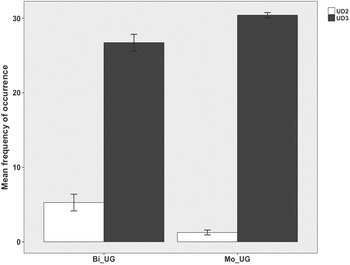
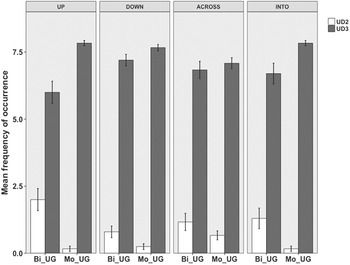
Fig. 1 shows utterance density in Uyghur.Footnote 7 As can be seen, across the two speaker groups, UD3 was the predominant pattern while UD2 responses were rather infrequent. Statistical tests revealed that the difference between the two patterns were significant for both bilinguals (X 2(1) = 427.23, p < 0.001) and monolinguals (X 2(1) = 800.86, p < 0.001). A comparison between the two groups showed that the bilinguals produced more UD2 utterances (X 2(1) = 7.25, p < 0.001) but less UD3 utterances (X 2(1) = 4.31, p < 0.001) than the monolinguals. Fig. 2 presents utterance density in Uyghur as a function of path type. As with the overall analysis, UD2 and UD3 descriptions were produced in relation to all path types, with the former being much less frequent than the latter. A three-way density (UD2, UD3) × group (Bi_UG, Mo_UG) × path (UP, DOWN, ACROSS, INTO) analysis revealed a significant interaction (X 2(10) = 108.55, p < 0.001), suggesting that the general distribution of UD2 and UD3 responses across the two speaker groups varied as a function of path type. A series of two-way density (UD2, UD3) × group (Bi_UG, Mo_UG) analyses on the four path types showed significant interaction for UP (X 2(1) = 53.62, p < 0.001), DOWN (X 2(1) = 8.30, p = 0.003) and INTO (X 2(1) = 28.08, p < 0.001) events because, the bilinguals produced significantly more UD2 descriptions than monolinguals for UP (X 2(1) = 7.81, p = 0.005), DOWN (X 2(1) = 4.97, p = 0.025) and INTO events (X 2(1) = 6.66, p = 0.009) but fewer UD3 descriptions for UP events (X 2(1) = 4.36, p = 0.036). That is, the bilinguals’ significantly fewer UD3 descriptions observed in the overall analysis stemmed from their descriptions for UP events only.
Utterance density in Uyghur.

Utterance density in Uyghur as a function of path type.

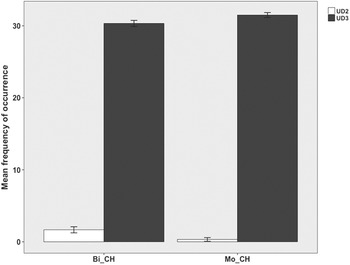
Fig. 3 shows the overall utterance density in Chinese. As we can see, across speaker groups, UD3 was the predominant pattern while UD2 was infrequent. Statistical analyses revealed that the difference between UD2 and UD3 response types was significant for both bilinguals (X 2(1) = 8.30, p = 0.003) and monolinguals (X 2(1) = 485.13, p < 0.001). Comparing bilinguals with monolinguals, we found that the bilinguals produced UD2 utterances more than monolinguals (X 2(1) = 5.91, p < 0.001) while no group difference was found for UD3 utterances. Fig. 4 illustrates utterance density in Chinese as a function of path type. It is clear that, as with the overall analysis, both groups overwhelmingly produced UD3 descriptions. While the bilinguals produced UD2 utterances for all path types, the monolinguals did so only with UP and INTO events. Given the absence of monolingual speakers’ UD2 utterances for DOWN and ACROSS events, two-way density (UD2, UD3) × group (Bi_CH, Mo_CH) analyses were performed in relation to UP and INTO events. A significant interaction was identified only for UP events (X 2(1) = 4.74, p = 0.029), indicating a potential group difference in utterance density. However, follow-up group effect analyses on UD2 and UD3 responses respectively did not reveal any significant difference. Therefore, the bilinguals’ significantly more frequent expression of UD2 utterances observed in the overall analysis may be attributable to their UD2 utterances for DOWN and ACROSS events, where such responses were totally absent for the monolinguals.
Utterance density in Chinese.

Utterance density in Chinese as a function of path type.

7.2. Syntactic packaging
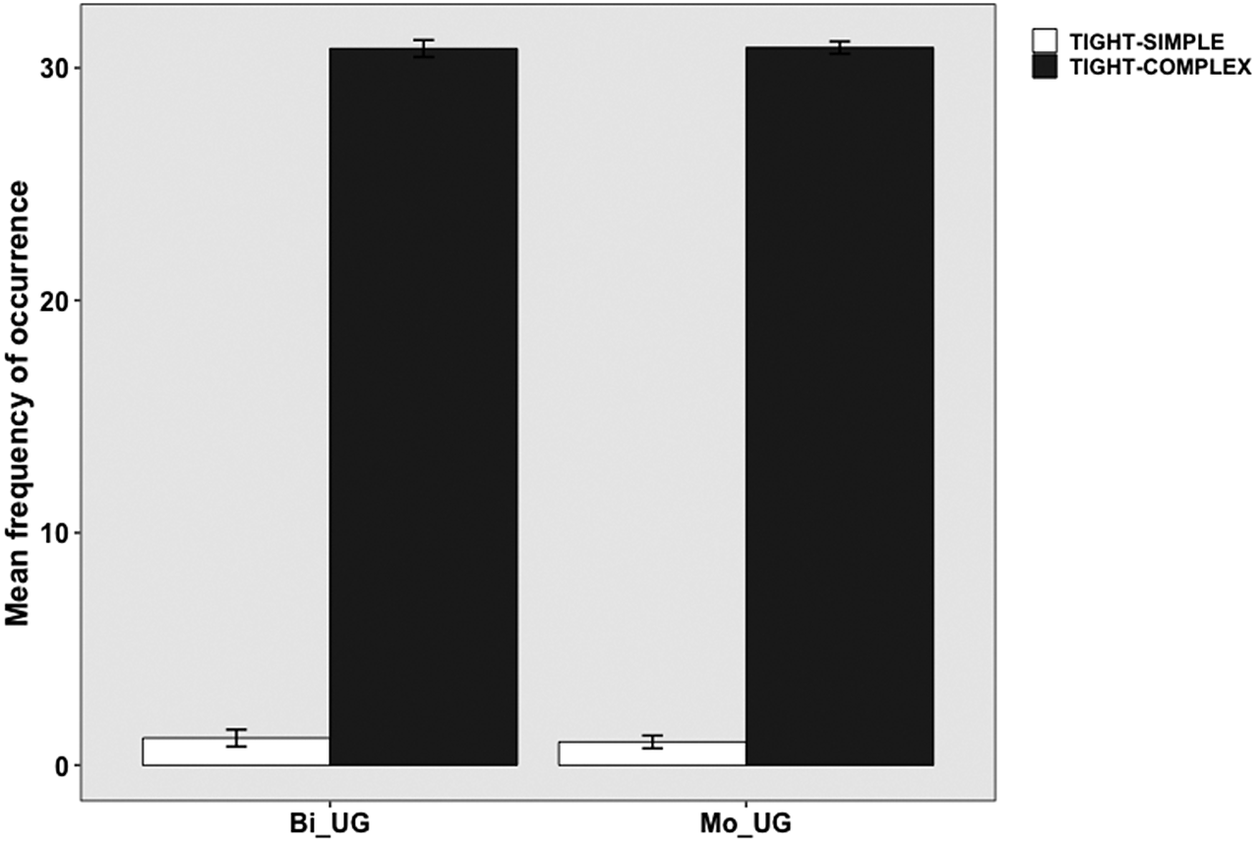
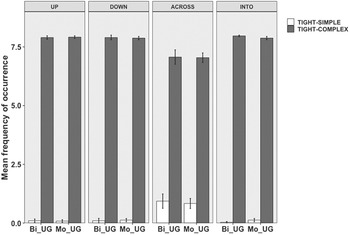
Fig. 5 displays syntactic packaging in Uyghur. We see that, across speaker groups, TIGHT-COMPLEX was the predominant strategy while TIGHT-SIMPLE was seldom used. Statistical analyses revealed that the difference between the two strategies was significant for both the bilinguals (X 2(1) = 1,030.3, p < 0.001) and the monolinguals (X 2(1) = 847.11, p < 0.001). Further analyses testing group effects on TIGHT-COMPLEX and TIGHT-SIMPLE strategies did not find any significance, meaning that there was no difference between the two speaker groups in their use of the two packaging strategies. Fig. 6 shows syntactic packaging in Uyghur as a function of path type. As with the overall analysis, we see a predominance of the TIGHT-COMPLEX strategy while the TIGHT-SIMPLE strategy occurred rather infrequently. To establish the overall effect of boundary crossing on syntactic packaging in Uyghur, we first collapsed all ACROSS and INTO events into the BC category and UP and DOWN into the NBC category. We then ran a three-way packaging (TIGHT-COMPLEX, TIGHT-SIMPLE) × group (Bi_UG, Mo_UG) × path (BC, NBC) analysis. A significant interaction was found (X 2(4) = 30.15, p < 0.001), meaning that the packaging strategy across speaker groups varied by path type. But follow-up two-way group (Bi_UG, Mo_UG) × packaging (TIGHT-SIMPLE, TIGHT-COMPLEX) analyses on the BC events and the NBC events respectively revealed no significant interaction. It seems then that the significant interaction in the three-way analysis was triggered by the more frequent occurrence of the TIGHT-SIMPLE strategy with the ACROSS events.
Syntactic packaging in Uyghur.

Syntactic packaging in Uyghur as a function of path type.

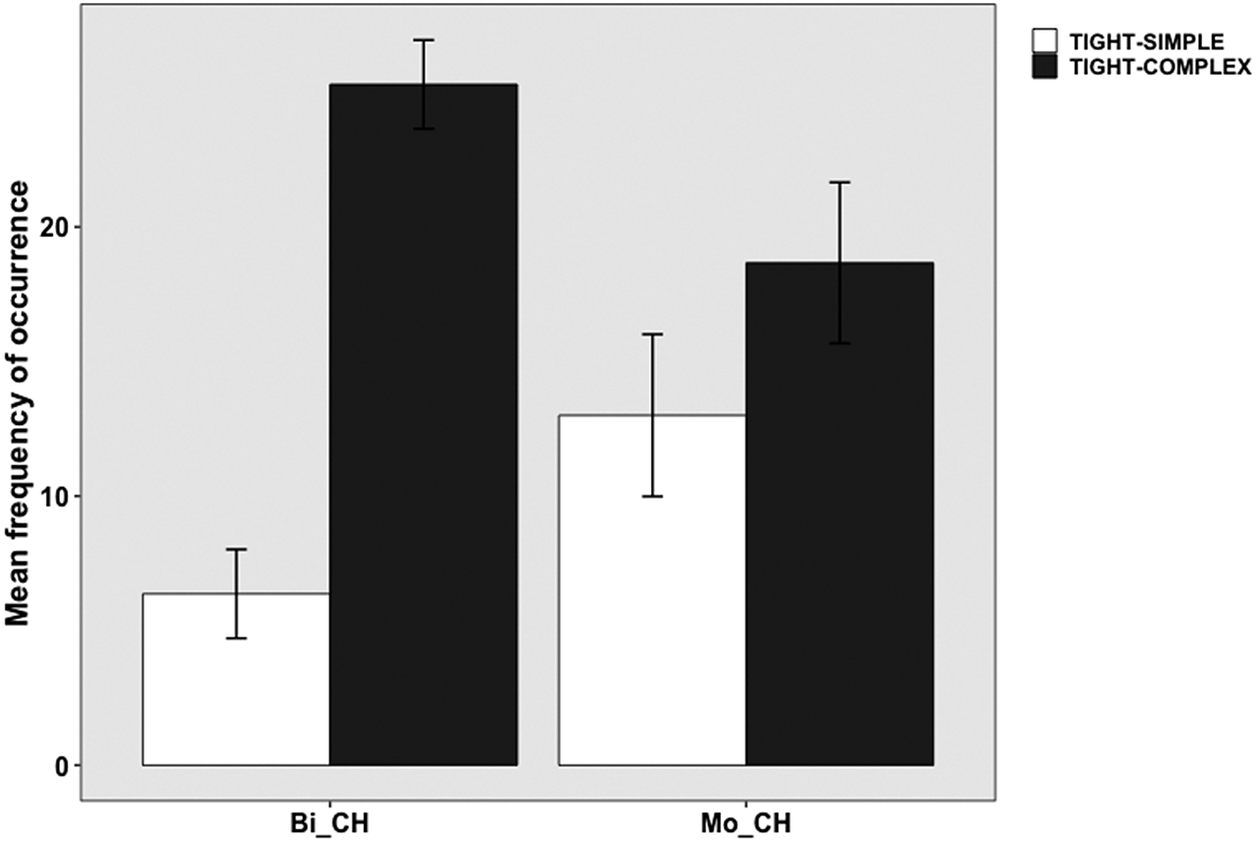
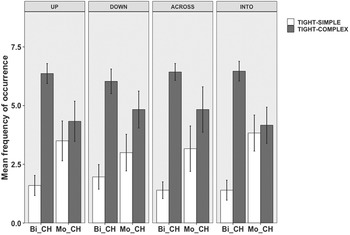
Fig. 7 below presents syntactic packaging in Chinese. On first inspection, we see that, across speaker groups, the more dominant strategy was TIGHT-COMPLEX while TIGHT-SIMPLE was used less frequently. Statistical analyses revealed that the difference between the two strategies was significant for both the bilinguals (X 2(1) = 363.45, p < 0.001) and the monolinguals (X 2(1) = 12.23, p < 0.001). Further analyses testing for group effects on the use of these two strategies found that the bilinguals used the TIGHT-SIMPLE strategy less frequently (X 2(1) = 5.96, p = 0.014) but the TIGHT-COMPLEX strategy more frequently than the monolinguals (X 2(1) = 5.13, p = 0.023). Fig. 8 shows syntactic packaging in Chinese as a function of path type. It is clear that, across the four path types, speakers across groups use the TIGHT-COMPLEX strategy more frequently than the TIGHT-SIMPLE one. To assess the effect of boundary crossing on syntactic packaging in Chinese, all ACROSS and INTO events were collapsed into the BC category and UP and DOWN into the NBC category. A three-way packaging (TIGHT-SIMPLE, TIGHT-COMPLEX) × group (Bi_CH, Mo_CH) × path (BC, NBC) analysis found a significant interaction (X 2(4) = 70.45, p < 0.001), indicating that the distribution of syntactic packaging strategies across speaker groups varied by path type. Further two-way group (Bi_CH, Mo_CH) × packaging (TIGHT-SIMPLE, TIGHT-COMPLEX) analyses on the BC and NBC events respectively revealed significant interactions for both (BC: X 2(1) = 45.72, p < 0.001; NBC: X 2(1) = 23.655, p < 0.001) due to the bilinguals’ consistently less frequent use of the TIGHT-SIMPLE strategy (BC: X 2(1) = 6.39, p = 0.011; NBC: X 2(1) = 4.69, p = 0.030) and more frequent use of the TIGHT-COMPLEX strategy for both (BC: X 2(1) = 5.31, p = 0.021; NBC: X 2(1) = 4.34, p = 0.037). Otherwise said, boundary crossing did not affect the bilinguals’ general preference for the TIGHT-COMPLEX strategy.
Syntactic packaging in Chinese.

Syntactic packaging in Chinese as a function of path type.

Our results can be summarized as follows. In Uyghur, the bilinguals generally followed the monolingual pattern in that they predominantly produced UD3 descriptions and much less frequently UD2 descriptions. However, they differed from the monolinguals in that they overall produced UD2 descriptions more frequently but UD3 descriptions less frequently than the monolinguals. A similar pattern was observed in Chinese for the measure of utterance density in that, while both speaker groups predominantly produced UD3 utterances, the bilinguals produced UD2 utterances more frequently than the monolinguals. As regards the measure of syntactic packaging, starting with Uyghur, the bilinguals exhibited the identical pattern with their monolingual counterparts in that they predominantly used the TIGHT-COMPLEX strategy while employing the TIGHT-SIMPLE strategy rather sparingly. With respect to Chinese, both speaker groups used TIGHT-SIMPLE and TIGHT-COMPLEX strategies. However, the bilinguals diverged from the monolinguals significantly as they used the TIGHT-SIMPLE strategy less frequently but the TIGHT-COMPLEX strategy more frequently than the monolinguals. Finally, boundary-crossing events did not engender greater degrees of CLI in the bilinguals’ syntactic packaging strategy compared to nonboundary-crossing events.
8. Discussion
This study set out to investigate how structural overlap, i.e., verb-framing, between two genetically/typologically distant languages, i.e., Uyghur and Chinese, shapes bilingual verbalization of an understudied type of motion event, i.e., CM. Specifically, we asked Uyghur–Chinese adult bilinguals, monolingual Uyghur, and monolingual Chinese speakers to describe a set of CM events, and our analyses focused on two aspects of the elicited data: (1) the number of semantic components speakers typically express (utterance density), and (2) the ways in which the components are syntactically packaged (syntactic packaging). We did not expect any difference between bilinguals and monolinguals in terms of utterance density, but in light of two general accounts of CLI, i.e., the structural overlap hypothesis (Hulk, Reference Hulk, Blom, Cornips and Schaeffer2017; Hulk & Müller, Reference Hulk and Müller2000) and the coactivation hypothesis (Nicoladis, Reference Nicoladis2006; Nicoladis & Gavrila, Reference Nicoladis and Gavrila2015), we predicted CLI to occur at the level of syntactic packaging due to structural overlap. Specifically, we predicted a unidirectional CLI from Uyghur to Chinese such that the bilinguals would employ the TIGHT-COMPLEX strategy (i.e., Manner/Cause in converbial/adverbial clause + Path in matrix clause) more frequently in their L2 Chinese than monolingual speakers. We further predicted, considering some previous findings that CLI is more noticeable with boundary-crossing events, that our bilinguals would use the TIGHT-COMPLEX strategy more frequently in their L2 Chinese with ACROSS/INTO events than with UP/DOWN events.
Our predictions were partly confirmed. First, although we did not predict any difference between bilingual and monolingual speakers in terms of utterance density, we found that the bilinguals produced semantically less dense descriptions (i.e., mentioning only two semantic components-UD2) in both L1 and L2 significantly more frequently than the monolingual controls. This was due to their more frequent use of semantically general causative verbs in both languages (i.e., al ‘to take’ in Uyghur, na2 ‘to hold/take’ in Chinese). This finding echoes previous studies documenting that bilinguals have a preference for semantically general motion verbs that can be readily applied to a wide range of contexts (e.g., Hijazo-Gascón, Reference Hijazo-Gascón2021; Tusun, Reference Tusun2022a; Woerfel, Reference Woerfel2018), which may indicate a general bilingual simplification strategy to reduce processing costs (cf. Filipović, Reference Filipović2019; Silva-Corvalán, Reference Silva-Corvalán2014). Our prediction regarding CLI was borne out in that the bilinguals employed the crosslinguistically shared TIGHT-COMPLEX strategy (i.e., the ZHE construction) significantly more frequently than monolingual controls. Our finding, therefore, lends support to earlier studies which have argued for the role of structural overlap in the occurrence of CLI in the motion domain (e.g., Aktan-Erciyes et al., Reference Aktan-Erciyes, Göksun, Tekcan and Aksu-Koç2021; Hohenstein et al., Reference Hohenstein, Eisenberg and Naigles2006; Wang & Wei, Reference Wang and Wei2019, Reference Wang and Wei2022).
Our last prediction, that boundary-crossing events would trigger stronger degrees of CLI, was not borne out, as bilingual speakers consistently preferred the TIGHT-COMPLEX strategy of syntactic packaging for all path types. This contradicts some previous studies (cf. Engemann, Reference Engemann2016, Reference Engemann2022a; Hendriks & Hickmann, Reference Hendriks, Hickmann, Cook and Bassetti2011, 2015), and a couple of reasons may be advanced. It could be that boundary-crossing effects are a developmental phenomenon. For example, Engemann (Reference Engemann2016, Reference Engemann2022a) examined simultaneous bilingual children while Hendriks and Hickmann (Reference Hendriks, Hickmann, Cook and Bassetti2011, Reference Hendriks and Hickmann2015) focused on adult L2 learners, and in both cases, it is possible that such effects would phase out further down the developmental path. After all, our Uyghur–Chinese bilinguals were adult speakers highly proficient in both languages. However, it is conceivable that boundary-crossing effects are modulated by the relative systematicity of target language system. Recall that in these bilinguals, it is their French verbalizations that were affected by English patterns. And it has been argued that the French motion system is highly opaque in that speakers display great variability in encoding motion, which creates ‘noise’ in the input for (monolingual and bilingual) child and adult learners alike (e.g., Engemann, Reference Engemann2022b; Hendriks et al., Reference Hendriks, Hickmann and Pastorino-Campos2021; Hickmann et al., Reference Hickmann, Hendriks and Harr2018). In contrast, our bilinguals dealt with two highly transparent motion systems, i.e., Uyghur systematically verb-framed and Chinese equipollently-framed. So it is likely that boundary-crossing effects on CLI are more detectable when one of the bilingual’s languages presents a variable motion system.
Keeping in mind the different learning trajectories of our Uyghur–Chinese bilinguals and the English–French bilinguals mentioned above, and to the extent that one could generalize across bilingual situations, our findings also underscore how the relative transparency of the target motion system may be related to whether CLI manifests itself qualitatively and/or quantitatively. Recall that the English–French child and adult bilinguals mentioned above displayed a preference for syntactically packaging CM event components within a single clause in their L2 French, which reflects their L1 English pattern but is emphatically target-deviant. Uyghur–Chinese bilinguals, in contrast, strictly followed the verb-framed syntactic packaging strategy where the framing event is expressed in the matrix clause and the coevent in the subordinate clause. It seems that, when reconciling the challenges in syntactic packaging constraints imposed by verb-framed constructions for expressing CM, the variable French motion system has given bilinguals leeway in pushing the boundaries between English and French, the outcome of which was CLI in both qualitative and quantitative terms. On the other hand, our bilinguals did not have such space, or perhaps even the incentive, to negotiate crosslinguistic boundaries as Chinese presented a transparent motion system. They simply capitalized on the (verb-framed) syntactic packaging strategy shared between Uyghur and Chinese, thereby manifesting CLI quantitatively only.
We mentioned that this study offers an ‘end-state’ perspective to Tusun (Reference Tusun2019) who examined Uyghur–Chinese early successive child bilinguals’ expression of CM and therefore can shed light on the question of the longevity of CLI in the context of early successive bilingualism (cf. Hulk, Reference Hulk, Blom, Cornips and Schaeffer2017; van Dijk et al., Reference van Dijk, van Wonderen, Koutamanis, Kootstra, Dijkstra and Unsworth2022). Specifically, Tusun invited 4-, 6-, 8- and 10-year-old bilinguals’ (with an age of onset of 3;4) to verbalize the same set of CM stimuli as this study. One of his key findings was that, up until age 8, the child bilinguals circumvented the overlapping verb-framed syntactic packaging strategy (i.e., the ZHE construction) and relied predominantly on the equipollently-framed option (the BA construction). It was only at age 10 that the child bilinguals reached the Chinese monolinguals’ frequency of ZHE construction use. If we combine this with our finding for adult bilinguals, we see a clear increase in bilingual use of the ZHE construction over time, i.e., there is increased CLI across the developmental span. As such, while our findings support the two accounts of CLI as far as structural overlap is concerned, they are more consistent with the coactivation account both in terms of its emphasis on the role of structural overlap in CLI and its predictions for CLI from a developmental perspective (see Engemann, Reference Engemann2022a for a similar observation in the context of simultaneous bilingualism).
Additionally, we mentioned that this study hopes to offer more general remarks on the nature of CLI by comparing its findings with those of an earlier study (Tusun, Reference Tusun2022a) where the same adult bilinguals followed the same experimental procedure as this study but verbalized a set of VM events. Specifically, Tusun found that the bilinguals followed the monolingual Chinese pattern of predominantly using the equipollently-framed strategy, and thus showed no CLI. He interpreted this finding as supporting the structural overlap hypothesis, but not the coactivation hypothesis. On the other hand, our CM data showed that the bilinguals predominantly used the verb-framing strategy and did so significantly more frequently than monolingual controls. That is, there was a strong L1 to L2 influence, which is consistent with the coactivation hypothesis but not the structural overlap hypothesis. Now, the asymmetry of CLI in Uyghur–Chinese adult bilinguals’ motion descriptions across VM versus CM events echoes previous research showing that bilingual children and adults alike display greater degrees of CLI when verbalizing CM than VM (cf. Engemann, Reference Engemann2016, Reference Engemann2022a, Reference Engemann2022b; Filipović, Reference Filipović2022; see also Hendriks et al., Reference Hendriks, Hickmann and Demagny2008 and Hendriks & Hickmann, Reference Hendriks, Hickmann, Cook and Bassetti2011 for similar observations on English L2 learners of French). But what is clear is that neither the structural overlap hypothesis nor the coactivation hypothesis can offer a principled account of the rather dynamic patterns of CLI that characterize Uyghur–Chinese adult bilinguals’ motion construal. Rather, the picture seems more in line with recent calls for a multi-factor approach to bilingual acquisition and use of motion expressions (cf. Filipović, Reference Filipović2022).
In an attempt to offer a unified account of bilingual language processing, particularly of CLI, Filipović and colleagues proposed the so-called Complex Adaptive System Principles (CASP) model for bilingualism (Filipović, Reference Filipović2022; Filipović & Hawkins, Reference Filipović and Hawkins2019). According to this model, bilingual language processing and use is underpinned by such general principles as ‘minimize processing effort’, ‘maximize expressive power’, ‘maximize efficiency in communication,’ and ‘maximize common ground’. While ‘maximize common ground’ is central to both structural overlap and coactivation hypotheses, the CASP model postulates that the bilingual speaker has to strike a balance between the need for maximizing crosslinguistic structural overlap and other key factors such as communicative efficiency and ease of processing. In the context of our discussion, the bilinguals had been instructed to describe what they saw to a naïve audience who would have to reconstruct the events based on the former’s descriptions. That is, they had been placed in a communicative situation where they had to be maximally informative in their descriptions. This meant that, in the case of CM, they had to provide at least three semantic components (Cause, Manner, Path) for the events to be understood as CM. In this situation, the principle of ‘maximize common ground’ seemed to have trumped other principles and led the bilinguals to employ the shared verb-framed syntactic packaging strategy. With VM (Tusun, Reference Tusun2022a), as per ‘maximize common ground’, the bilinguals would have to employ the verb-framed pattern, which is syntactically complex, and incurs greater processing costs (cf. Özçalışkan, Reference Özçalışkan2015; Tusun & Hendriks, Reference Tusun and Hendriks2019). Meanwhile, the L2 offered a readily accessible RVC construction (equipollently-framed) wherein key semantic components (Manner, Path) could be expressed compactly. And since the bilinguals had only used this pattern, it seems that, on this occasion, the principles of ‘minimize processing effort’, ‘maximize expressive power,’ and ‘maximize efficiency in communication’ trumped the ‘maximize common ground’ principle.
We should highlight that even discussions around the longevity of CLI in motion expression can benefit by taking account of general principles of bilingual language processing and use. Recall that in Tusun (Reference Tusun2019), the child bilinguals consistently bypassed the shared verb-framing option in their L2 Chinese and used the Chinese-specific equipollently-framed pattern as the predominant strategy until age 10 when they started using the verb-framed strategy at adult frequency. That is, there was no L1–L2 CLI that was observed in the case of adult bilinguals. Now, both the child bilinguals and the adult bilinguals had been given the same instructions, and as such, they had been placed in the same communicative situation where they had to be maximally informative in their verbalizations (see Section 6.3). With respect to CLI, in principle, we could expect the child bilinguals to employ the overlapping verb-framed strategy, just as the adult bilinguals did. But this was not the case, and it seems that other issues were at play. For instance, using the verb-framed option would entail syntactically complex constructions that present greater processing load (cf. Hickmann et al., Reference Hickmann, Hendriks and Harr2018; Özçalışkan, Reference Özçalışkan2015), and we know from child language research that the acquisition and productive use of such constructions are closely linked to children’s cognitive and processing capacities that develop over time (cf. Delage & Frauenfelder, Reference Delage and Frauenfelder2019; Hendriks et al., Reference Hendriks, Hickmann and Pastorino-Campos2021). Added to these is the insight from psycholinguistic research that bilingualism imposes greater cognitive demands on the speaker (cf. Michael & Gollan, Reference Michael, Gollan, Kroll and de Groot2005; Runnqvist et al., Reference Runnqvist, Fitzpatrick, Strijkers, Costa, Bhatia and Ritchie2018). Meanwhile, the L2-specific equipollently-framed pattern offers a compact and cost-efficient strategy to achieve maximal expressive power (i.e., expressing all the key event components). Assuming that the child bilinguals were still developing their processing capacities and since they indeed predominantly used the L2-specific equipollently-framed strategy, it seems that, for them, minimizing processing effort while achieving maximal expressive power was more important than maximizing common ground. The rather different pattern we see for adult bilinguals who, despite the potential processing costs, opted for the verb-framed pattern that works for both languages, indicates that the bilinguals maximize common ground when they can ‘afford’ it, i.e., when they have the processing resources implicated by the communicative situation at hand.
9. Conclusion
In this study, we explored how Uyghur–Chinese adult bilinguals express CM in their L1 and L2 compared to monolingual controls and how structural overlap shapes CLI (if there is any). More specifically, we examined two accounts of CLI, i.e., the structural overlap hypothesis (cf. Hulk, Reference Hulk, Blom, Cornips and Schaeffer2017), and the coactivation account (Nicoladis, Reference Nicoladis2006) as reconceptualized within the framework of crosslinguistic priming (e.g., Engemann, Reference Engemann2022a; Serratrice, Reference Serratrice and Messenger2022). We analyzed two aspects of our data: (1) the number of semantic components speakers typically express within a motion construction, and (2) how the components are syntactically packaged. We found that the bilinguals diverged from the monolingual controls only in quantitative terms. First, the bilinguals used semantically general causative verbs more frequently than monolingual controls, thereby rendering their verbalizations semantically less informative. Second, due to an L1–L2 influence, the bilinguals used the verb-framed syntactic packaging strategy in Chinese significantly more frequently than monolingual controls. The unique language combination enabled us to demonstrate that CLI can happen in languages that are genetically distant (Turkic vs. Sino-Tibetan) and typologically distinct (agglutinative vs. analytical), and that when there is a clear structural overlap between languages, CLI can be largely quantitative (i.e., more frequent use of a particular structure), not qualitative (i.e., use of suboptimal or target-deviant structures). A comparison with Tusun’s (Reference Tusun2019) study on Uyghur–Chinese child bilinguals’ expression of CM noted an increase of this CLI from child to adult bilinguals, which we interpreted as supporting the coactivation account. However, further comparisons of our findings with those of an earlier study on Uyghur–Chinese adult bilinguals’ VM expression (Tusun, Reference Tusun2022a) revealed that, while structural overlap is a key motivating factor for CLI, neither of the two hypotheses can comprehensively explain patterns of CLI we see across event types (CM vs. VM) and age groups in Uyghur–Chinese bilingualism. Although our observations regarding CLI and its underlying mechanisms necessarily require corroboration from future research involving more varied bilingual populations, more diverse language pairs and a wider range of motion situations, our findings have made it clear that a coherent account of CLI in the domain of motion expression must also take account of more general principles of bilingual language processing and use (Filipović, Reference Filipović2022; Filipović & Hawkins, Reference Filipović and Hawkins2019).
Supplementary material
To view supplementary materials for this article, please visit https://doi.org/10.1017/langcog.2023.7.
Data availability statement
The data will be made available by the author without undue reservation.
Competing interest
The author declares none.