

Introduction
Since the early stages of his attempt to build a scholarly enterprise to re-spatialise ‘areas’ and area studies, Willem van Schendel gave particular prominence to questions concerning weapons (Van Schendel, Reference van Schendel2002, 663–664). Understanding spatial categories not as ontologically given, static and timeless containers, but as produced by and productive of social processes, he aimed to illuminate the geographies of knowing and geographies of ignorance that are consolidated through the particular metaphor and scale of analysis deployed by Area Studies. The sorts of questions he posed – questions that still remain at the heart of the dialectics and overlaps between Area Studies and International Relations (IR) this special issue disentangles – were above all ontological and epistemological in nature: how are areas, including states, imagined? How are they lived? How are specific grids of knowledge and practice structured in a way that shapes areas into supposed ‘heartlands’ and ‘borderlands’, cores and peripheries, which are then accordingly studied, marginalised, or ignored? To deal with these questions, van Schendel's work first and foremost disputed the idea that border areas of states or ‘world regions’ would necessarily hold stronger links to their putative cores than to adjoining ‘peripheral’ zones (2002). The aspiration to move analytically across and beyond borders, although without painting them as transparent entities, transpired in his distinct conceptualisation of borderlands as ‘process geographies’ traversed by a boundary line, rather than as areas of one nation-state adjoining it (Baud and van Schendel, Reference Baud and Van Schendel1997, 216). Weapon transfers from the Myanmar-Thai border to the bustling port-town of Cox's Bazar and further into the Indian-Myanmar-Bangladeshi tri-border areas, with their longstanding armed rebellions and politico-economic complexes, were taken as clear examples of academic ignorance concerning how flows (of things and people) reshape localities; how they re-territorialise the state and other geographical scales of authority, empowering some and disempowering others (van Schendel, Reference van Schendel2002, 664). Albeit mostly for exemplificatory purposes, in his 2002 article ‘Geographies of knowing, geographies of ignorance’, Willem van Schendel foregrounded a central question: how do weapons, weapon flows, and regulatory practices associated with them reshape the geometries of authority and power in borderlands (ibid)?
This paper focuses on that question. In the last decades, a rich transdisciplinary literature has approached borderlands both as heuristic devices to explore the (un)making of political configurations at the supposed state margins and as spatial formations with specific features. Borderlands can be seen as material spaces with no particular heartland, that are constantly constructed, shifting, unstable, incomplete, and that vary across geographical scales (Abraham and van Schendel, Reference Abraham and van Schendel2005; Scott, Reference Scott2009; Sadan, Reference Sadan2013). In fact, borderlands can simultaneously be borderlines with space adjoining them; vast territories on both sides of borderlines characterised by different regulatory systems; spatial mechanisms and resources centred around the border that at once divide and unite political entities; marginal spaces and sites that nonetheless remain central to the reproduction of state (b)orders; or territorialised nodes of trans-national connection and flows (Goodhand, Reference Goodhand, Pugh, Cooper and Turner2011; Korf and Raeymaekers, Reference Korf and Raeymaekers2013; Watts, Reference Watts2018). They are spaces on the edge of the state that are territorialised via struggles over geography at different scales and where states' political authority and monopoly of the means of violence and arms are finite and contested (Korf and Raeymaekers, Reference Korf and Raeymaekers2013).
Yet, the literature on borderlands has devoted scant attention to weapons-related questions notwithstanding their centrality. The few contributions that look at weapons in this ambit do so through two main, at times concomitant, frameworks. First, as technological factors that determine social orders and power relations (Simala and Amutabi, Reference Simala, Amutabi, Abraham and Van Schendel2005; Mkutu, Reference Mkutu2008). Second, as subordinate objects that can contribute to determining social authority and power but that remain at the service of human agencies and relations, whether in constructivist or more positivist terms (Sagawa, Reference Sagawa2010, Reference Sagawa2018). By focusing on the weapon in a deterministic manner and/or privileging human actors, both views tend to flatten the geographical resolutions at which weapons are materially and discursively made and controlled, often risking to reify or dichotomise scales of action and actors, while also overdetermining or neglecting the role of arms in shaping the geometries of authority and power in borderlands.
Through empirical case study research and a transdisciplinary stance in between IR and political geography, I provide a different view. I contribute to the literature on borderlands by describing how weapons become a battlefield for the regulation of authority over violence and make a difference in shaping a politics of scale. The article's central argument is that weapon-assemblages made of human and non-human entities reproduce scales of territorial authority over violence and struggles over scale in borderlands. Drawing on new materialist approaches developed in IR (e.g. Graham, Reference Graham2005; Gregory, Reference Gregory2011; Bourne, Reference Bourne2012; De Larrinaga, Reference De Larrinaga2016), and the concept of scale in political geography (Swyngedouw, Reference Swyngedouw and Cox1997), I unpack this argument into the following points.
First, weapon-assemblages – made of humans, technical objects, and non-human entities – are stabilised into specific configurations via weapons' technical properties, rationalities, and techniques of control. Inserted in such assemblages, weapons are to be seen as technical objects that come from somewhere and show a proclivity to act in unforeseen manners. Second, processes and practices of controlling weapons generate a politics of scale. In political geography, scale is understood as a socio-political territorial arena, both discursive and material, in which socio-spatial relations of power and authority are contested, negotiated, and regulated (Swyngedouw, Reference Swyngedouw and Cox1997, 140–141). Processes and practices of stabilising and controlling weapon-assemblages that are performed by a myriad of human and non-human actors constantly re-scale authority over arms and violence in the borderlands. On the one hand, they produce and operate at multiple encompassed (but hierarchically not determined) territorial spaces at which authority over weapons and violence is contested, negotiated, regulated. On the other hand, processes and practices of control re-produce struggles over scaled modes of governing weapons. Third, these struggles of scales and about scale constantly rearticulate the geometries of territorial authority over violence in the borderlands. Rather than looking at borderlands as fixed spatial formations, I delve into the ways that territorial resolutions of authority over violence are rescaled at the borderlands as areas on the edge of the state without any monopoly of violence.
The article develops an ethnographically situated analysis of encounters between explosive items, the participants to action linked to them, and the subjects and spaces involved. To this end, it deploys a double embedded case study since it looks at a specific weapon – that is, explosive devices – in Ta'ang areas of the extended borderlands of Shan State, Myanmar.Footnote 1 Here I find that dwellers, village heads, ethnic Civil Society Organisations (CSOs), rebel Ethnic Armed Organisations (EAOs) and their units, transnational movements, the Tatmadaw (Myanmar Armed Forces), and International Non-Governmental Organisations (INGOs) perform the explosive-device assemblage in different configurations at different territorial scales. They attempt to stabilise it especially via rationalities and techniques of humanitarian arms control. That is to say, discursive and practical fields concerning the protection of a supposed social body made of ‘civilians’ from the effects of weapons proliferation via the regulation or elimination of ‘inhumane’ and ‘uncivilised’ weapons and/or ‘inhumane’ and ‘uncivilised’ weapon-holders. Harnessing rationalities and techniques of humanitarian arms control, they mobilise multi-scalar alliances, navigate and jump across scales, or forge different ones. Nonetheless, the explosive device often defies practices of re-scaling authority over violence by acting at the scale of its socio-technical ecologies of violence.
In the remainder of the paper, I invite the reader to bear with me while I unfold what may appear as an unconventional structure. The first part will recount the events and multiple realities of a ‘landmine’ accident. Approaching the device's explosion from different angles, this part will both (a) introduce the main sets of actors and the various scales at which they operate; and (b) suggest the inadequacy of the conceptual approaches adopted by weapons-related contributions in the borderlands literature. The second part instead will foreground a different viewpoint concerning the accident: that of the explosive device itself. It will dive into the processes of making and controlling the ‘landmine’, stressing how material and ideational flows and associated regulatory practices have contributed to shape the borderlands into specific localities and territorial configurations at different scales. Lastly, this section will explore techniques and practices of controlling the explosive device and the ensuing politics of scale.
Explosive realities of the borderlands
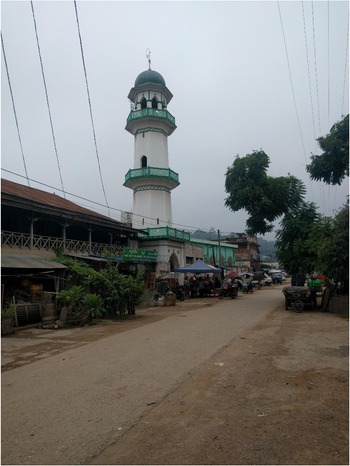
Kyaukme is a bustling trading town in Northern Shan State, Myanmar (Figure 1). The homonymous township and district state administrative territories straddle the Mandalay-Muse Road which carries the bulk of the overland trade of the country and connects it to China. The town is located near the strongholds of the Ta'ang rebel movement PSLF/TNLA – just south of the Myanmar-China border, in the mountains between Namhkan, Namhsan, and Namtu townships. It is populated by various armed actors: the Tatmadaw maintains several important garrisons here; people's militia forces are also present in some villages; and many other rebel movements operate at these latitudes – such as the two Shan ethno-national organisations of the Revolutionary Council of Shan State/Shan State Army-South (RCSS/SSA-S) and SSPP/SSA-N. Especially since 2011–14, Kyaukme township and district have been seriously affected by increased landmine contamination in connection to the reignition of longstanding armed conflicts.
Kyaukme town (all photographs in this article © the author).

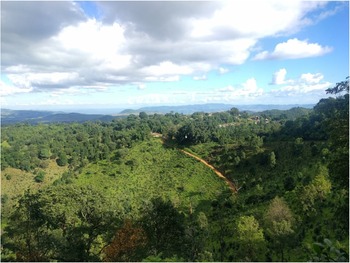
During fieldwork in these areas in October 2019, an informant recounted the story of a landmine explosion occurred north of the town.Footnote 2 Walking on the path that she used every day to reach the local market, a woman had been hit by a landmine. After the explosion, it was quite a while before anybody found her lying on the ground. A local CSO with connections in the village had been alarmed and had arranged her transportation to the nearest hospital, a clinic about 4 hours away from the explosion site. Next to the path was a tea plantation (Figure 2). Reaching altitudes of 1200/1500 m, in fact, the slopes of the mountains north of Kyaukme are dotted with tea bushes – an ecological trait they share with the broader region. The portions of the Northern Shan State borderlands west/north-west of the highway are often referred to as ‘Tea Land’: an expression that Ta'ang socio-political movements have used to draw connections between the historic role of their communities in cultivating and trading tea and aspirations for increased politico-territorial autonomy in these mountainous areas. The expression though is at times rejected by the PSLF/TNLA. Spatially speaking, ‘Tea Land’ is seen as a territorially reductive scale that, by metaphorically referring only to Ta'ang areas where tea is cultivated in Shan north, could negatively impact PSLF/TNLA's broader ethnoterritorial claims and territorialisation attempts in Shan State. As news about the explosion spread in the following days, work in the tea fields dropped. Some workers left or lost their jobs, and people stopped using that path to go to the market. Another more circuitous path started to be used, although it would take an additional hour and a half to reach the market from the woman's village. In order to pay medical expenses, a CSO active in northern Shan State launched a fundraiser. Yet, the circumstances of the explosion were hazy. Most probably the landmine had been freshly laid, since other people used to take the very same path on a daily basis and had used it shortly before, but no incident had occurred. Nobody knew of military activity in the area of her village and across that path, so nobody could really tell whether one of the EAOs operating there or the Tatmadaw had laid the mine. What kind of landmine or explosive device was that? Why had it been emplaced on a walking path so often used by dwellers and workers? To what aim? These and other aspects of the explosion had remained unclear.
Tea bushes on the hills north to Kyaukme.

Landmines or explosive devices with their components and mechanisms, walking paths, local markets, medical clinics, tea fields on hilly slopes, livelihood means and everyday life practices, local and regional CSOs, voluntary fundraisings, units of different armed rebel movements, Tatmadaw military troops, their camps, posts, or bases: the scenery that unfolds hand-in-hand with the story of the explosion tells us something about what weapons in the borderlands of Northern Shan State are and how they are (un)controlled. Disparate materials and entities are included or associated among the elements of the story: some of which may be more evident, closer, and more immediate in time and space, some of which may be farther away although no less relevant indeed. The landmine accident illustrates a ‘local’ composition in which multiple scales are being re-produced, drawn together by the mine explosion. But how is this ‘local’ (dis)order being shaped and distributed?
Paraphrasing Cresswell, as we seek to understand the landmine accident in the mountainous areas of Kyaukme and the borderlands' geometries of authority on violence, the questions we ask must show us the paths in and out of them, the connections between these places and ‘the rest of the world(s)’ (Cresswell, Reference Cresswell2004, 41). To gain some initial clues, I will decompose and recompose how different configurations of the weapon-assemblage come to be enacted by different sets of actors operating at different scales (Law, Reference Law and Turner2008). Drawing a parallel between the different realities of the explosion and predominant conceptual approaches in the borderlands literature's niche on weapons, I will subsequently touch upon the inadequacies of the latter.
Explosive reality one
Civilians are greatly affected by the use of landmines by multiple ethnonational rebel movements or the Myanmar army. Landmine victims and community-based CSOs often point to the Tatmadaw and rebel movements as those responsible, but the ways that civilian actors cope with landmine contamination and blame EAOs are contingent upon different dynamics.
EAOs hardly have extended, full-blown control on self-designated ethnonational territories but maintain areas of influence and articulate their territory in brigade, battalion, and unit tiers. Some keep nodes of fixed bases, camps, and posts on top of the hills and inside/proximate to villages, others instead remain territorially mobile. In village areas, landmines are to be found in the tea fields or on the top of the hills. In fact, tea fields are usually located on the mountain slopes and provide direct access to the top, where most units' positions are located. Two main kinds of paths run across and connect villages, fields, and other places on these mountains: primary roads, some of which are dirt and others paved; and so-called ‘farmers’ paths’, that is, the secondary, more hidden, tracks through which farmers move or access tea fields. The latter offer also more cover for roaming armed units, in turn heightening the likelihood of hosting explosive devices, even though EAOs battalion and brigade commands impose a ban on use in civilian areas.
Civilians' positionalities and everyday lives are a changing kaleidoscope of experiences. Tatmadaw or EAO authorities at different tiers may order villagers not to venture into certain areas, yet their livelihoods depend on access to specific locations – the forest, the market, the tea field or paths. Some dwellers in affected villages have coped with landmine contamination through occasional and non-standardised practices, by demarcating some spots or areas with informal techniques and signs, circulating information, or instructing each other among villages. Heads of villages – non-state local authorities normally elected by village communities – play a delicate role as mediators between different actors entangled in the use and control of landmines (like Tatmadaw and EAOs local commands, CSOs and NGOs, or other villagers). They thus come under great pressure. Furthermore, following the 2011 instalment of president Thein Sein's government in Naypyidaw, the initiation of a wave of state-level ceasefire negotiations, and the semi-democratic opening that followed, ethnic CSOs and NGOs have consolidated their role as first responders or as subnational implementers of INGOs' national humanitarian mine action programs.
The term ‘civilians’ cannot be taken as a reference to any monolithic group. Many different ethnonational communities live across these borderlands, and villages are often inhabited by families of Shan, Ta'ang, or Bamar nationality each with their imaginative geographies (Gregory, Reference Gregory1995). Communities can often be connected to ethnonational rebel movements, due to active involvement or because relatives or acquaintances take part in them. This does not necessarily mean they fully support the conduct of EAOs though. On the one hand, in village areas, livelihoods are indisputably affected by armed actors and EAOs' decades-long wars. On the other hand, rebel movements or local militias have emerged out of long historical socio-political processes and may provide a modicum of security throughout ethno-territorial geographies (or may be deemed as the lesser of two evils). Blaming one armed actor or another for landmines explosions may depend on individuals or CSOs' affiliations and experiences, as well as on the specific territorial scales at which they operate.
Explosive reality two
Confronted with accusations of landmine use and contamination, ethno-national rebel movements' leaderships and commanders declare EAOs neither possess nor use landmines, and that the mines they have were captured from the Tatmadaw military-state. They reiterate that throughout ethnonational territories, their troops use ‘remote control’ or ‘battery’ landmines only.Footnote 3 ‘Our mines have batteries and unless we activate them, they do not explode’ and in any case ‘we do not plant mines where civilians move’, the leaders of EAOs say talking about mined sites and ‘civilian’ areas in their territories.Footnote 4 In some circumstances however, mines use is acknowledged. In EAOs' ethnonational territories, landmines are planted around their posts, camps, bases, and ‘frontline’ positions, especially in so-called EAOs' ‘border areas’ but, as they note, set up at night and removed in the morning; or emplaced but without locating the battery that would be inserted only in case of ongoing military operations in the surrounding areas; or set up for offensive tactical/strategic reasons only. Rebel movements' leaderships argue that their men are trained and instructed to make sure landmines are removed in case they do not go off – when used offensively – or in case units leave their positions – when used defensively.
Yet, long-distance control is not always ideal: EAOs' policies and practices unfold in very different manners throughout territorial tiers and village areas. In this sense, the vantage point of combatants and single units illuminates further elements explaining why landmines are deployed and affect communities. Recruitment and induction are often far from being linear and adequate because resources are missing, for instance, or because it is not feasible to undertake training if rebel control areas are too far away or if recruitment is carried out while units are on the move. At the same time, equipment, materiel, and weapons are not always so well-functioning and reliable and this may result in unexpected or unplanned performances and outcomes at landmines' local ecologies.
Although seemingly contradictory, rebel movements' declarations should not be taken as pure façade statements. They should be better understood as fragments of rationalities and techniques of humanitarian arms control harnessed to mould relations of authority and scaled modes of governing vis-à-vis populations across EAOs territories as well as international mine action practice across the borderlands. Around the second half of the 2000s, in concomitance with the slow opening up of the country, several armed movements signed unilateral deeds of commitment for a total ban on mines and cooperation on international mine action as part of the Swiss-based INGO Geneva Call's global programs. Consonantly, often EAOs point to their efforts in clearing certain contaminated areas and stress their responsibility and entitlement concerning demining in their ethnonational territories once the conflict will end.
Explosive reality three
While EAOs blame the Tatmadaw or each other, the Naypyidaw military-state apparatuses blame rebel movements for explosive devices contamination in Myanmar. EAOs' use of improvised landmines feeds into Tatmadaw-centric official narratives depicting some rebels as ‘terrorists’: by its very nature the weapon-assemblage is improvised, one does not know when or how it will go off, and it is even less predictable and more indiscriminate than industrially-manufactured mines. Though, behind the condemnation of rebel movements' use of improvised landmines, or their depiction as terroristic technologically backward weapons, stands the black-boxing of processes and practices of institutionalisation of political authority and territories different from state-sanctioned ones in the borderlands (Bourne, Reference Bourne2012).
From a historical perspective, the political and socio-technical possibility for the Tatmadaw's Directorate of Defence Industries (Ka-Pa-SaFootnote 5) and military-state to build and legitimise weapon manufacturing capacities – and, conversely, the impossibility to do so for rebel movements, at least beyond ethnonational scales – undoubtedly speaks of historical processes shaping spatialities of rule and authority (Callahan, Reference Callahan2003, 176–179). Weapons production – negotiated, contested, and regulated at national, regional, and international scales – may be seen as one of the various modular tools of army building that since decolonisation provided the Tatmadaw also with institutional bases for coercion-intensive political integration and state-building throughout the socially and politically heterogeneous spaces of the borderlands (Ibid). Rebel movements on their part argue that Ka-Pa-Sa industrially-manufactured landmines have been systematically used by the Tatmadaw to grab resourceful or commercially profitable land throughout Myanmar, while negating customary tenure systems and preventing the institutionalisation of territories by authorities other than state ones in the borderlands.Footnote 6
Explosive reality four
Humanitarian mine action CSOs and NGOs active in Myanmar instead usually refrain from blaming anyone in particular. Locally, nationally, and internationally operating, they issue indistinct calls upon ‘all parties’ to end the use of landmines.
Since 2011/2, different humanitarian mine action INGOs have been accredited to start operating in the country. Mine-clearance operations entailing direct involvement of international humanitarian assets, knowledges, and organisations have not been allowed due to a lack of political agreement both in Naypyidaw and the borderlands. INGOs, however, have been employing an array of mine risk education and awareness-raising activities ‘managing land, resources, and populations at a distance to reduce the risks landmine (pose)’ (MacLean, Reference MacLean2016, 85). While some non-technical survey activity – that is, general surveying of baseline contamination – has been carried out in Northern Shan, Kayin/Karen, Kayah/Karenni, and Kachin State, this has been tangled-up in underlying political and conflict dynamics at subnational, national, and state levels. Institutional capacity building has engaged mostly (if not only) state authorities and some competition has emerged among development and humanitarian organisations trying to secure the driving seat should the door be opened to actual mine-clearance operations/assistance.
On the basis of a humanitarian stance to arms control, humanitarian mine action actors tend to construct landmines as inherently disruptive ‘things’ generating social crises to be managed. They argue for their removal and call for immediate humanitarian mine action. Yet, this vision often conflicts with different framings of humanitarian mine action as a potential security threat to local, subnational, and national territorial authority, more radical disarmament rationales, or EAOs' arguments calling for a necessary re-arrangement of Myanmar's security and defence sector along the logics of federalism.
Explosive realities and borderlands beyond substantivist and instrumentalist approaches
Running through these complex, heterogeneous, explosive realities, one may glimpse three main conceptual moments and issues that characterise the few contributions dealing explicitly with weapons in the literature on borderlands (for a review in the ambit of security studies and IR, see Bousquet et al., Reference Bousquet, Grove and Shah2017, Reference Bousquet, Grove and Shah2020). First, the problem of conceiving actors' agencies and their social relations as autonomous from and unaffected by technologies of violence (Sagawa, Reference Sagawa2010, Reference Sagawa2018). A so-called ‘instrumentalist’ approach posits the analytical invisibility and neutrality of weapons and implies that what they entail in one place/time they entail in another (Bourne, Reference Bourne2012). Second, the problem of seeing the tools of violence as objects with a technological autonomous capacity to shape socio-political relations and orders (Simala and Amutabi, Reference Simala, Amutabi, Abraham and Van Schendel2005; Mkutu, Reference Mkutu2008) – what has been termed as a ‘substantivist’ approach to weapons (Bourne, Reference Bourne2012). And third, the ontological question of what we should understand as ‘weapon’ or ‘means of violence’ in the first place, and how these become ‘one’ (Kuletz, Reference Kuletz, Peluso and Watts2001).
Through instrumentalist and substantivist approaches, some aspects are made visible while others instead remain overshadowed; none of them, and none of the recounted explosive realities alone, help to explore how weapons, flows, and struggles over their regulation contribute to shape socio-spatial orders, empowering some and disempowering others in the borderlands. Both substantivist and instrumentalist positions in fact tend to draw a neat line between the world of material objects and the world of socio-political and spatial relations, seeing one as determining the other, and thus placing material things outside politics and space (Law, Reference Law and Turner2008; Bourne, Reference Bourne2012). They are underpinned by a Cartesian dualism between politics/society and technology/materiality (Bourne, Reference Bourne2012). Here power is seen as a substance located at times in the weapon technology and the possibilities endowed by it; at times in the agencies of human actors and/or in the interactions among them. Power becomes a property that travels and is projected from cores to peripheries – from the technological core of weapons, or from that of centres of socio-political power, to the ‘outside’ world. Sticking to the prism of these visions only, one risks losing sight of the fact that, in each of the explosive realities, power is constituted, distributed, and performed via the joint contributions of human and non-human actors that produce and regulate the mine.
In the last decades, a transdisciplinary body of literature – often referred to as ‘new materialism’ – has consolidated different approaches to materiality in order to conceptualise the linkages between weapons and socio-political phenomena beyond dualist and deterministic positions (Graham, Reference Graham2005; Gregory, Reference Gregory2011; Bourne, Reference Bourne2012; De Larrinaga, Reference De Larrinaga2016; Bousquet et al., Reference Bousquet, Grove and Shah2020). Among these, I draw from Michael Bourne's work on arms control underpinned by material-semiotic's conceptual approaches (Bourne, Reference Bourne2012). Bourne looked at arms control as the bundle of relationships between technology/weapons and society in toto. He thus proposed an understanding of materiality as the material dimensions/relations of social and political life (Bourne, Reference Bourne2012, 153–155). In other words, how the material – that is, both the natural and man-made – matters within the constitution and character of socio-political relations. Accordingly, one can conceptualise weapons as a collective of relations among different heterogeneous entities, spanning across time and space and all making a difference, that produces violence as an effect. This collective of relations emerges out of – and is constantly performed, hence re-produced, through – a continuous process of composition. Rationalities, techniques, and practices of control deployed to compose and stabilise into a collective the different entities involved become mutually constitutive dimensions of weapons.
Relations of power and authority over the material and ideational production and control of weapons are diffused throughout the processes of composition of weapon-assemblages. At the same time, they are contested, negotiated, and regulated at and across different scales. Here scale can be conceived as the gradient of geographical resolution at which the weapon-assemblage is performed, thought, and regulated by different participants to action (Agnew, Reference Agnew1997, 100). Since scales are never fixed pre-given entities but processes of scaling social processes (Brenner, Reference Brenner2004, 8), the explosive device and the rationalities and techniques of control associated with it become terrains to rearticulate scalar arrangements of authority in the borderlands. They become terrains to negotiate authority and shift it so as to be exercised at and across various territorial scales (Ibid; Hong, Reference Hong2017, 7). The explosive realities illustrated above point to the fact that in making and controlling the mine, multiple territorial scales are articulated: heterogeneous local scales; ethnoterritorial scales; military-state territorial scales; subnational, national, and international scales of mine action; as well as landmine territorial ecologies. They also suggest that the changing geographical sets of resolutions into which authority over the device and violence is organised have to do with historically contingent processes and practices of making and controlling landmines. Thus, let us now attend to the ways in which the disparate elements that compose the explosive devices and their governing are complicit in the making, un-making, and re-making of this borderland's scalar arrangements of authority over violence.
…And the landmine…? What would it say in rebuttal?
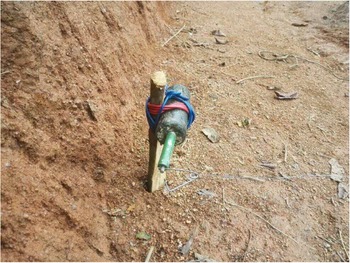
What is this? A cylindric item, with what looks like a green lever attached to a metal cable. Red and blue plastic wires that fasten the cylinder and the lever to a wooden stick planted into the ground to the side of a road leading to a village on a mountaintop. At first glance, to me this seemed like a craft manufactured mine…wait…or perhaps an Improvised Explosive Device (IED)? In doubt I asked:
What is this? During an interview, talking about the heavy burden landmines pose for civilians in Myanmar, one of PSLF/TNLA's general secretaries had replied showing the picture above (Figure 3) – empirical evidence of what he now defined instead as a ‘bomb-mining’ that RCSS/SSA-S set up on a road leading to a Ta'ang village in Namhkan township.Footnote 7
‘Persistent’ explosive device manufactured through factory grade machining.

With three different possible answers – (1) a craft manufactured mine; (2) an IED; (3) a ‘bomb-mining’ that RCSS/SSA-S set up on a road – some months later I turned the same question to a weapons expert:
What is this? This is something very interesting and it is something very strange, he replied. It is what we would call a ‘persistent’ mine that does not use battery power but instead relies on a strike detonator only. It has most probably been manufactured through factory-grade process rather than craft assemblage or mere handcraft production and shows ‘an increase in sophistication of mine manufacture which I am now seeing for the first time (among non-state armed forces in Myanmar)’.Footnote 8
Another answer. Four by now. All different, but all about the same thing apparently. A thing that starts to emerge as something that is not reducible to anything else (Law, Reference Law2002). So again then, what is this? One could say, as Jairus Grove would reply, that this is ‘the weaponisation of the throbbing refuse, commerce, surplus, violence, rage, instant communication, population density, and accelerating innovation of contemporary global life’ drawing on ‘(s)urplus weapons, postcolonial injustice, e-waste, nationalist identification, or just rage (…) all drawn into amplification to create the IED and unleash its explosive potentiality’ (Grove, Reference Grove2016, 342, 348). It is not ‘just’ a landmine, but it is also a landmine in a sense. It is not just an IED – because its various components stick together in a different manner than IED's elements would do – but it is also not an apparent unicum like industrial landmines. It is an explosive fractal coherence, an entity that cannot be reduced to a single determined identity or unit but at the same time maintains a certain coherence.
The borderlands of Myanmar are one of the few areas on earth where mines are still produced and also actively used by both state and non-state armed forces (Landmine Monitor, 2019). Those most commonly encountered are industrially manufactured landmines; and craft manufactured ones, assembled through a cacophony of commercially available and/or military surplus hi-(and less hi-)tech objects. A third category can also be found though, that is mines manufactured through factory-grade processes although not on an industrial scale, that is, produced through machining and tools rather than merely assembling commercially available pieces together. Each of these types of explosive device offers a window onto flows of materials and ideas, as well as associated regulatory practices. A window onto how such flows and practices have shaped the borderlands into specific localities and territories at different scales and how rationalities and techniques of control are harnessed to rescale authority.
Messy, laborious processes and techniques of mines production, flow, and acquisition
Industrially manufactured landmines have been produced partly in Myanmar and partly in other countries. Although until 1988/9, the Tatmadaw relied mostly on imports and military assistance programs in order to acquire landmines, since the 1950s the Armed Forces also progressively developed an import-substitution program that led the Ka-Pa-Sa to produce copies of landmines manufactured in other countries through technical assistance, technology, and design transfers (Selth, Reference Selth2000; Callahan, Reference Callahan2003; Landmine Monitor, 2004, 2019). Such activities accelerated after the European Community and the US imposed an arms embargo on Myanmar in the aftermath of the 8888 uprisings (Picard et al., Reference Picard, Holtom and Mangan2019, 47). Eventually, this process led to the consolidation of a state territorial ‘heartland’ of landmine production – with factories located at Pyay, Magwe, Pegu, Meiktila (Selth, Reference Selth2000) – and territorial borderlands without any consistent industrial hub but where mines have been deployed.
For non-government armed forces at the borderlands instead the diversion of US, Soviet, and Chinese-manufactured landmines – as well as copies made in Vietnam and Thailand – constituted the major channel of acquisition. While only the Communist Party of Burma (CPB) could rely on direct provisions from China, rebel movements sourced these mines from weapon holdings and transfers in armed conflicts in Vietnam, Laos, and Cambodia that were diverted to the Thai-Burma border before the 1990s. Seizures from Tatmadaw supplies to/in frontline areas represented the other main mechanism to obtain a weapon system that was otherwise unusual for many armed actors, particularly for those that lacked territorialised authority in the borderlands and could not easily partake in or manage transboundary flows of consumer goods and narcotics trading. Throughout the ‘Cold War’, such flows (including arms flows) shaped the borderlands between Myanmar, Thailand, Laos, and China, as territorial arenas more connected to what lay across the border than to what stood at its putative centres.
Politico-armed movements and militias have also manufactured landmines through factory-grade mechanical machining and craft-manufacture assemblage. Two major rebel movements, Khun Sa's Mong Tai Army (MTA) and the CPB, held some form of factory-grade production capacity. The MTA maintained furnaces and lathes, machining tools, and explosive stockpiles at its base in Ho Mong and other locations at the Thai-Myanmar border, where copies of industrially manufactured landmines were reproduced (Selth, Reference Selth2000, 17).Footnote 9 With the demise of MTA in 1996, part of the production assets and stockpiles were seized by the Tatmadaw. Yet, another part – including weapon specialists and manufacture technicians – further circulated to a faction that rejected the Tatmadaw forced disarmament of MTA and slowly re-territorialised in southern Shan State.Footnote 10 A similar trajectory was followed by the Wa faction of CPB that at the crumbling of the communist organisation in 1989 inherited its stocks and assets, and in the aftermaths territorialised the two de-facto autonomous areas of Wa State under the United Wa State Party/Army's (UWSP/A).
Many other rebel movements have not been able to produce factory-grade landmines but throughout the decades-long armed conflicts have managed to consolidate craft-manufacturing expertise. Workshops for weapons repair and repurpose have been established alongside arms stockpiles in different EAO territories. The major politico-armed movements have acquired craft-production capacity through a mixture of longstanding experience in gunsmithing; knowledge diffusion through exchanges with other armed actors about explosives management; engineering assistance and cooperation sourced in Yunnan and Thai border provinces (Tak, Mae Hong Son, Chiang Mai, Chiang Rai); and trainings by foreign former or active military personnel, mercenaries, or volunteers. For example, before the fall of Manerplaw in 1995, the main Karen rebel movement maintained workshops for weapons craft-manufacture and stockpiles in the compounds of the headquarters (Selth, Reference Selth2000). Later transferred to Mae Sot and other locations in Thai border provinces when Manerplaw was swept away by Tatmadaw operations, such bases served as hubs for the ethnic armed movements that are part of the inter-ethnic umbrella organisation National Democratic Front (NDF). EAOs' contingents were based there and could share knowledge and practices of landmines craft-manufacture among revolutionary groups familiar with different kinds of military and civil explosives. More recently, this has occurred in Laiza, the headquarters of the Kachin Independence Organisation/Army's (KIO/A) territory on the Myanmar-China border, where different rebel movements have been hosted and trained, or in areas of the constitutionally recognised Wa Self-Administered Division (SAD), inside territories of the UWSP/A east of the Salween river.Footnote 11
Throughout the second half of the 1990s, as it became more difficult to access and acquire industrially-manufactured landmines in the Shan borderlands, reliance on craft-manufactured explosive items by politico-armed movements increased (Weng, Reference Weng2008). Hampered access was tied to particular developments. First, in Thailand and Cambodia, state authorities and international organisations initiated a series of efforts to decontaminate, destruct landmine stocks, and enhance stockpile security (McCracken, Reference McCracken2001). Second, the production of landmines decreased worldwide in the same years and the stigmatisation of such arms as pariah weapons was gaining momentum through the campaign to ban landmines and the consolidation of the mine ban treaty (Beier, Reference Beier2011, 171). Third, industrial landmines acquisition became more difficult due to state/non-state counterinsurgency territorialisation processes spurred by the Tatmadaw which altered the geographies of the borderlands. Beside military operations, these processes included the distribution of formal and informal business concessions to ethnic rebel movements' entourages based along main arteries or nodal places in borderland areas. Concessions were granted in order to forge partnerships between the Tatmadaw, business companies, and rebels turned para-militaries, while generating indirect state territorial authority and control in the borderlands (Woods, Reference Woods2011, Reference Woods2018; Brenner, Reference Brenner2017). Thus, armed movements without industrial landmines or factory-grade production capacity have shifted decidedly towards the craft-manufacture of explosive devices in the last two decades.
The devices assembled by EAOs are usually varied and unstandardised, although they present certain shared dimensions. They combine together a triggering mechanism with a sensitive explosive chemical (priming compound) that provides the flame to ignite an explosive propellant; a shrapnel made of different waste material; and a container to waterproof the assemblage and manage the encounter of these ‘elements’ with the (natural) elements. Every element makes a difference in relation to the other and engages in mutually constitutive relations, illuminating how the resulting explosive entity is at one time more than one but less than many (Law, Reference Law2002, 3).
Craft landmines are usually either victim-activated or radio-controlled. Most craft-mines manufactured by EAOs require the use of a battery since they deploy commercially available electric detonators. Electromagnetic tributaries such as cell phones, car/motorcycle locks, flashlights, or other remote controllers transmitting and monitoring signals are used as triggering devices. Through the electromagnetic spectrum and battery power, these provide current to the detonator by electronically closing a switch. Electric detonators and batteries may be sourced from the construction industry or the metals and mining sector; bought on the civilian market; provided by movements' supporters; or extracted from different kinds of vehicles. The same goes for the required assortment of copper and metal wires required. Similarly, the explosive propellant is also self-manufactured through commercially available components such as agricultural chemicals used in agribusiness or TNT and other explosives used in large-scale construction and minerals extraction. EAOs buy them from legally operating businesses, directly or at times setting up dummy companies that can import such goods from abroad or purchase them on the Myanmar market. Otherwise, explosives may also be acquired through theft from industrial construction sites or mining complexes, or by arranging informal transactions with third parties willing to steal and resell them. At times smugglers have bargained commercial explosives or detonators to be delivered to rebel movements in exchange for informal agreements allowing them to freely operate throughout EAOs' territories. The shrapnel exploded by the device is usually composed of different materials like nails or bolts, shotgun pellets, fragments of metal waste. A great heterogeneity of things has been used to provide to such conglomerates of matter some sort of fractional coherence (Law, Reference Law2002, 2), from metal food carriers typical in Myanmar and Thailand to plastic pipes, bamboo pieces, glass or plastic drinking bottles and wraps/casings. Mortar rounds, buried or not-so-buried landmines, and other kinds of unexploded ordonnances or remnants also emerge as further recycled materials engrafted in the ecologies of the borderlands and used to encase craft-mines.
This ‘insurgency of things’ (Grove, Reference Grove2016) – in particular electric detonators, batteries, primer compounds, and propellants – has been closely connected to the re-territorialisation processes that characterised the borderlands during the 90s and 2000s as recalled above (Woods, Reference Woods2011). On the one hand, the Tatmadaw generated what Meehan has called a ‘limited access order’ by ‘buying’ armed actors' collaboration through offers of preferential access to the drug economy (Meehan, Reference Meehan2011). This in turn regulated the system of rents tied to narcotic flows and hampered the financial means of some rebel movements, thus also regulating access to cross-border flows of goods, corridors, and territorial arrangements (Ibid, 389). Yet, on the other hand, the granting of business concessions to rebels turned into paramilitaries/militias and the development of economic partnerships with large agribusiness and construction companies allowed the proliferation of sites, localities, and complexes to source the technical objects needed to manufacture explosive items. This also consolidated access networks across subnational and regional scales that would have the possibility to channel imported goods of different nature from the extended Chinese and Thai borderlands.
Ecologies of ‘dead’ and ‘alive’ mines: technical objects, rationalities of humanitarian arms control, and changing socio-spatial relations of scale
Discursive as well as material techniques and practices are deployed by a variety of actors at and across different scales to stabilise and control the heterogeneous collective of the explosive device. It is to the contestations and negotiations emerging through (and over) such techniques and practices that this section turns. The different entities that compose the explosive assemblages organise at different scales and jump from one to another while struggling to assert different territorial arenas and scaled modes of defining and controlling the mines.
In the borderlands of Myanmar, craft-produced mines are seldom referred to as IEDs, even by humanitarian mine workers. The ontological identification of craft-mines' explosive fractional coherences as ‘Improvised-Explosive-Devices’ has been primarily consolidated through categorisation efforts begun by the US army in 2006 amid the wars in Afghanistan and Iraq for the purpose of identifying, tracing, and recording the use of craft-manufactured bombs (Beier, Reference Beier2011; Grove, Reference Grove2016). Starting from the 2000s, the presence of various organisations set up at the Thai-Myanmar border by former military personnel (especially from the US army but not only) or militant political movements has contributed to the circulation of military expertise among rebel movements in the Shan State borderlands.Footnote 12 It is interesting to note that these movements or associations have often included former army personnel with previous active duty in Afghanistan, Iraq, and northern Syria. Based mostly in northern Thailand but operating at larger transboundary scales – from the Myanmar-India border and Kachin to Karen areas – these volunteer organisations understand themselves as humanitarian service movements. While acting in different manners, at times also with direct armed involvement in self-defined humanitarian relief operations, many of them have delivered trainings to rebel movements. The humanitarian character of such services has been blurred by an instrumentalist understanding of arms and armed violence which underpins the inclusion of weapons handling-and-use, as well as military, trainings to members of EAOs. Training participants would then act as humanitarian relief agents and/or trainers-of-trainers back in their respective EAO territories or across the borderlands. Weapons recognition trainings and manuals have been part of these humanitarian assistance activities, in a view to provide EAOs' members with skills to produce human rights-violations documentation. Education activities and materials that are part of these trainings have tended to consolidate terminology defining craft-manufactured bombs as IEDs.Footnote 13 Nonetheless, EAOs resist the definition of ‘IEDs’ and normally refer to explosive devices laid in their territories as ‘landmines’Footnote 14, most often ‘battery’-mines.
The case of PSLF/TNLA is illustrative in this sense. In 2007, with the former Ta'ang rebel movement officially disarmed in northern Shan and its restyled political front gradually initiating a re-armament process at the Thai-Myanmar border (Buscemi, Reference Buscemi2021), PSLF's leadership voluntarily adhered to an international ban on landmines by signing a deed of commitment with the Swiss INGO Geneva Call. In the same years, other EAOs throughout Myanmar were doing the same, in an attempt to boost international recognition amidst the harbingers of the national democratisation process initiated by the military regime with the roadmap to ‘discipline-flourishing democracy’ in 2003.Footnote 15 The deeds consisted of a unilateral declaration – signed by both the political and armed wings of EAOs and undersigned by Geneva Call's executive president in Geneva (as witness) and the Government of the Republic and Canton of Geneva (as custodian) – via which the rebel movements decided to abide by international mine action standards and to place themselves under Geneva Call's international monitoring activities. Clauses of the document made direct reference to a prohibition to use any victim-activated explosive device, drawing from the definition of ‘landmines’ by article 2.1 of the Ottawa treaty. When PSLF eventually reconstituted a Ta'ang armed force (TNLA) and conflict surged due to its gradual re-territorialisation in northern Shan after 2011, a problem arose, as TNLA's general secretaries clearly recall:
‘At that time we told them (Geneva Call) that for the landmines we could not avoid (to use) them, right…? …because we are still fighting (…) to attack the army, so we use landmines, we cannot avoid. However, we had already committed ourselves that we would not use landmines so that is why we (…) use just the “active landmines”, not the “dead landmines”. We just use the remote landmines – if you put the battery, it is alive…if you do not put the battery then it is not alive; even (if) you put the battery, if you do not chip the remote, nothing happens. But sometimes, at first (there) was something that got a little bit problem(atic)…like if near the landmine you called with phone, when the phone is ringing it could become a problem, or maybe if one went with the car or motorbike and stood nearby the landmine, when you start the engine sometimes it can go wrong.’Footnote 16
EAOs leaderships jump up to the international arena to legitimise themselves by banning mines in their ethnoterritorial entities at the borderlands and shift down in order to take distance from and consolidate territorial autonomy at the scale of the military-state, which instead notoriously refuses the application of international mine action standards in the country. The international stigmatisation of landmines as barbarous weapons has been crafted through a set of technological deterministic and essentialist logics that worked to parcel off an entity called ‘landmine’ from broader discussions about radical non-violence and total disarmament (Beier, Reference Beier2011). This occurred by defining mines as technologically backward because of – one – their technical incapacity to discriminate humans and – two – the difficulty to separate landmines from their environments. The anthropocentric stance of such views, which deny the machinic character of the mine and its capacity to unpredictably change (Grove, Reference Grove2016), de-politicised landmines use and extracted such pariah weapon from a larger pool of legitimate ‘technologically advanced’ arms (Enomoto Reference Enomoto2020). Over the years, the Tatmadaw has refused to access the mine ban treaty adopting a different instrumentalist approach and arguing that it is the indiscriminate use throughout state territory by terrorists and insurgents described as subhuman that constitutes the real problem when it comes to landmines, not landmines use per se. EAOs instead operate to re-parcel off the battery-mine from the category of landmines. Using the term ‘battery’-mines, EAOs try to distinguish the entities of battery-powered craft-manufactured mines from the category of industrial landmines, and victim-activated bombs more in general, in order to legitimise their use, their users, and their users' territorial authority.
This is not a purely discursive strategy, rather a continuous attempt unfolding by the very practice of manufacturing and deploying the devices. They appropriate the deterministic logics of humanitarian arms control vis à vis victim-activated arms but mould it to argue for the discriminatory capacity and non-persistent character of ‘battery-mines’. The insertion/extraction of batteries and techniques of remote control, as integral dimensions of the explosive device, are argued to unfold the slippery residual ontological space at the interface between industrial landmines, factory-grade ones and victim-activated IEDs (‘dead mines’) on the one hand, and legitimate weapons on the other. In other words, ‘active’ battery-mines are argued to be discriminatory and not environmentally embedded, unlike victim-activated landmines. In EAOs' ethnoterritorial entities, it is argued, there are no ‘landmines’ as such other than those laid by the Tatmadaw military-state trying to assert an illegitimate, broader but not hierarchically higher, territorial authority over the borderlands.
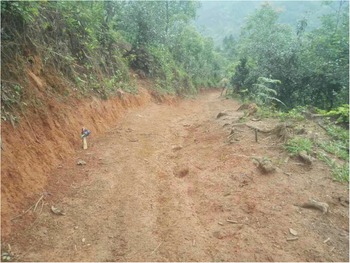
Yet, shifting down to the territorial ecologies of the device, it is not so simple to insert/extract batteries, remove emplaced mines, or remotely control them. Like any other weapon technology, ‘active mines’ combine into fluid entities that do more than it was expected by EAOs. In this sense, they are as indiscriminate and environmentally embedded as industrial landmines. Due to the very process of composition and how the elements come to co-constitute each other, they become inherently integrated more than one but less than many (Law, Reference Law2002). Removing and re-inserting batteries at ease, once craft-mines have been laid, would intervene on the ecological niche of the arm. They cannot be hibernated and then exhumed at will as EAOs claim. Likewise, radio or other kinds of interferences can alter the environment and trigger them. Battery-mines' persistency becomes contingent upon different compositions. Depending on how the terrain, elements, or the tree canopy combine, the battery can last shorter or longer. Equally, if it sits in water, it is cheap, or poorly assembled, it may stop functioning. Charges could be eaten by ants. Persistent or so-called ‘dead’ mines instead integrate differently (Figure 4). Manufactured through machining and factory-grade techniques, they do not need battery power and employ a strike detonator. However, whatever the type, wooden sticks used to set them up deteriorate and fall, heavy rainfalls and landslides move mines around. Such mixed vibrant combinations are both generated by and generative of ecological niches. In this sense, landmines in Myanmar are the quintessence bomb-mine, because one does not know with precision what they are, how many, and where they are: a largely unknown and dispersed contamination of largely unknown and dispersed technical objects.
‘Persistent’ explosive device set up on a road leading to a Ta'ang village in Namhkan township.

Explosive devices are inherently geographical, and a certain resonance exists between them and the environment. They appear to be produced by environments and, at the same time, productive of environments. On the one hand, explosive devices are built and distributed throughout the very architecture of the milieus of Myanmar's borderlands. Discursively they are made to resonate with the environments of unavailability of industrially-produced landmines, humanitarian mine action, and landmine bans across ethnonational and international scales; while materially they resonate with those of ‘ceasefire capitalism’ (Woods, Reference Woods2011) and socio-economic relations of arms production and control between the ‘centre’ and ‘margins’. On the other hand, compositions of mines as technical objects and human agency re-shape the environments emerging with them in non-standardised ways. They can alter the configurations of a familiar geography and re-formulate it in mutual relation with their own internal coherence (Grove, Reference Grove2016, 8). The ways in which these weapons are set, or the ways they act, are not always the same and combine in unpredictable manners. Mines emerge as telluric elements that cannot be easily governed and that defy scaled arrangements of territorial authority over violence acting at the scale of their ecological niches.
Conclusion
This article has addressed the substantivist and instrumentalist frames embraced by contributions dealing with weapons-related questions in the literature on borderlands. Drawing on ‘new materialist’ approaches in IR and the concept of scale in political geography, it has shown how in spaces literally at the edge of the state, where the latter's monopoly of violence is finite, authority over weapons is always contested and rescaled. Weapon-assemblages of human and non-human entities reproduce scales of territorial authority at the borderlands. Processes and practices of stabilising and controlling explosive devices constantly shape scalar arrangements of territorial authority over violence and, in so doing, mould the territorial configurations of borderlands as process geographies that are different at different scales.
In the Shan State borderlands, competing systems of territorial authority over violence articulate themselves through practices of combining together and managing technical objects, rationalities, and techniques of control. The landmine becomes a field of struggle for different orders – those of humanitarian INGOs, ethnic- and community-based CSOs, networked ‘volunteer humanitarian’ movements, various EAOs, the Tatmadaw, and civilian communities – that reproduce heterogeneous local scales, ethnonational and military-state territories, trans-borderland scales, and international ones. Acting across scales, they re-arrange the relative importance of such arenas of authority over violence by deploying rationalities of humanitarian arms control that revolve around logics and practices of discrimination/indiscrimination, precision, and preservation of civilian populations and their environments.
The power effects of these struggles are not located in the actors themselves, in their interactions, or in the technical objects they mobilise, but diffused throughout heterogeneous entities and their combinations. Describing encounters between explosive items, entities that compose them, and the subjects and spaces they target, landmines have appeared as technical objects with a proclivity to act in unforeseen manners. They are the result of historical comings together of designs, techniques of manufacture, technical characteristics, materials, and defining narratives from different elsewheres. They contribute to profile political and armed actors as backward or ‘modern’, inform the legitimacy of their struggles, or the status of their spaces through a scalar politics of authority and rule. EAOs try to subvert the technologically deterministic logics that condemn landmines as arms incapable of discriminating. They do so by embracing this very same logic but navigating it with an argument and a practice of technological ‘advancement’. In fact, practicing the manufacture of battery-powered mines represents an attempt to distance the explosive device from other categories of pariah weapons so as to be able to both harness international mine action processes to legitimise ethnonational territorial scales and continue using explosive devices. Nonetheless, this does not always work out as expected. Keeping the battery-mine, a discriminate weapon not environmentally embedded is costly, laborious, and not even possible at times. At its territorial scale, the mine acts in unforeseen manners, due to the ways the elements that compose it associate with one another and to how it is integrated with its environments. The explosive device defies discourses and techniques of territorial control projected onto it from other territorial scales.
Funding
The research has been funded by Sant'Anna School of Advanced Studies as part of the author's PhD research.
Acknowledgements
The author is particularly grateful to all the interlocutors that, by granting their time and knowledge, made the research for this paper possible, as well as to the interpreters that assisted me in some fieldwork phases. I also wish to thank the two anonymous reviewers of the article who provided invaluable feedback. Lastly, a major thanks to Darya Alikhani and Rhea Lazarides whose technical support was key to the completion of this article.