INTRODUCTION
Ichthyofauna of the seas of Oman (Arabian Gulf, Oman Sea and Arabian Sea) has been studied by several workers (Boulenger, Reference Boulenger1887; Steindachner, Reference Steindachner1902; Regan, Reference Regan1905; Norman, Reference Norman1939; White & Barwani, Reference White and Barwani1971; Al-Abdessalaam, Reference Al-Abdessalaam1995; Randall, Reference Randall1995; Fouda et al., Reference Fouda, Hermosa and Al-Harthi1997). However, new records of species are reported from subsequent studies from Omani waters (Jawad & Al-Mamry, 2009). As earlier investigations have not given a complete list of species available in the area (Jawad & Al-Mamry, 2009), there is scope for inclusion of new species and new records of fish from the seas of Oman.
Fish of the family Leiognathidae, popularly called ponyfish, are small-to-moderate sized fish occurring in shallow coastal waters in the Indo-Pacific region (Randall, Reference Randall1995). These fish are represented by seven genera and 46 species (Froese & Pauly, Reference Froese and Pauly2010). From the Omani waters, Randall (Reference Randall1995) reported eight species of leiognathids under the genera Leiognathus, Gazza and Secutor. However, Al-Abdessalaam (Reference Al-Abdessalaam1995) mentioned nine species of leiognathids that occurred in Omani waters, but provided a description of only L. fasciatus. Subsequently, Fouda et al. (Reference Fouda, Hermosa and Al-Harthi1997) listed ten species from Oman, without any description and just mentioned the occurrence of Equuilites elongatus (Günther, 1874) (=Leiognathus elongatus) as a new record to the Oman Sea. The species E. elongatus has a distribution in the Indo-Pacific region ranging from the east coast of Africa and off the south-west coast of India, eastward to the Philippines, north to Japan and south to Australia (Kühlmorgen-Hille, Reference Kühlmorgen-Hille, Fischer and Whitehead1974; James, Reference James, Fischer and Bianchi1984; Jones, Reference Jones1985; Smith & Heemstra, Reference Smith and Heemstra1986). Six specimens of E. elongatus were collected from bottom trawl catches during a survey conducted between latitudes 17°28.86′N and 21°54.85′N, and longitudes 55°17.14′E and 59°45.82′E in the Arabian Sea off Oman by the RV ‘Al-Mustaqila 1’ during August and September 2008. As there is no record of collection of this species from the 1200 km long Arabian Sea coast of Oman, the occurrence and description of E. elongatus are reported in this paper.
SYSTEMATICS
Equuilites elongatus (Günther).

MATERIAL EXAMINED
Six specimens, OMMSFC 1069 (6), 54 mm to 64 mm of total length (TL), (47 mm to 53 mm of standard length (SL) and 51.5 mm to 60 mm of fork length (FL)); 17°28.86′ –21°54.85′N 55°17.14′–59°45.82′E, Arabian Sea; bottom trawl net; August–September 2008.
DESCRIPTION
D VIII, 16; A III, 14; P 15–16; V I, 5; C 16; GR (5–6 + 14–15) 19–21.
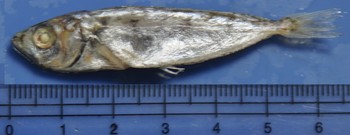
Body very much elongated and moderately compressed. Dorsal and ventral profiles evenly curved and tapered to slender caudal peduncle. Second dorsal and second anal spines longest. Small teeth on jaws, protractile mouth points downward. Eyes moderate; interorbital space bordered by two bony ridges end as nuchal spine posteriorly. Premaxillary shaft slides up to tip of bony ridge just in front of nuchal spine. Scales small, present all over body and no scale on head. Lateral line prominent, gently convex, extends beyond dorsal and anal fins till end of its course. Caudal fin forked.
Body silvery, upper half with irregular brown to black spots and wavy lines; margins of fins orange; a dark spot at base of each dorsal and anal fin ray.
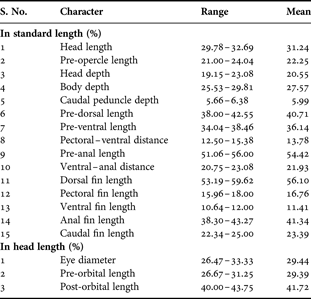
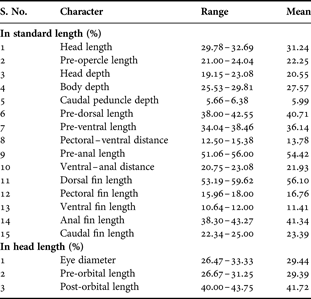
Table 1 shows the morphometric characters of fish. The range of SL in TL was 81.25–87.04% and FL in TL was 91.80%–94.44%.
Important body proportions of Equuilites elongatus.
Structure of light organ
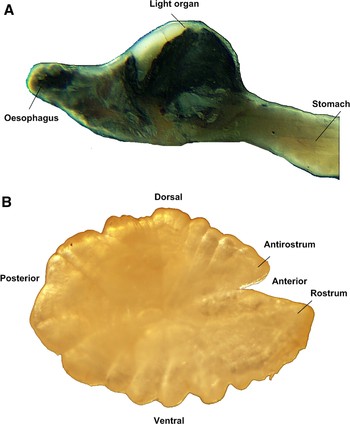
The light organ in a female fish (64 mm TL) is situated in the distal end of the oesophagus (Figure 2A) as a ring of tissue. Most light organ tissue is dorsally placed as a lobe and embedded in the air bladder.
(A) Light organ; (B) sagittal otolith of Equuilites elongatus.

Structure of otolith
The sagittal otolith of E. elongatus (Figure 2B) is laterally compressed and is longer than wide. The margin is wavy and lobed, and often different sized round lobes are separated by deep notches. The sulcus runs along the mid-longitudinal line of the otolith.
REMARKS
The description of Equuilites elongatus by Günther does not mention scales on suborbital region. Kühlmorgen-Hille (Reference Kühlmorgen-Hille, Fischer and Whitehead1974) described the species with naked head and scaly cheek. Similarly, no scales or scale pockets were observed on orbital region from freshly caught and museum specimens (Jones, Reference Jones1985). However, Srinivasarengan et al. (Reference Srinivasarengan, Balakumar and Badrudeen1995), while recording the occurrence of E. elongatus (L. elongatus) from the Bay of Bengal off the Indian coast, indicated absence of scales on cheeks. They opined that as the scales are extremely deciduous and do not leave any evidence of scale pockets on the specimens, these characters need not be distinctive to identify this species. In the present specimens, scales were also absent on cheeks.
While there is no report of E. elongatus from the 1200 km long Arabian Sea coast of Oman, its occurrence in the south off Yemen in the Arabian Sea (Al-Sakaff & Esseen, Reference Al-Sakaff and Esseen1999) and in the north in the Oman Sea bordering Oman (Fouda et al., Reference Fouda, Hermosa and Al-Harthi1997) and United Arab Emirates (Anon, 1999) has been reported. The species occurrence in the Arabian Sea off Oman shows that the distributional range of E. elongatus extends up to the northern Arabian Sea and Oman Sea.
The distribution of E. elongatus in the eastern Indian Ocean and the western central Pacific was reported by Kühlmorgen-Hille (Reference Kühlmorgen-Hille, Fischer and Whitehead1974) and from the western Indian Ocean region by James (Reference James, Fischer and Bianchi1984). However, there was no published evidence on its occurrence until it was reported from the Indian coast of Bay of Bengal (Srinivasarengan et al., Reference Srinivasarengan, Balakumar and Badrudeen1995) and subsequently, from the Oman Sea (Fouda et al., Reference Fouda, Hermosa and Al-Harthi1997; Anon., 1999) and from the coast off Yemen (Al-Sakaff & Esseen, Reference Al-Sakaff and Esseen1999).
Barring the present report, as above records on the occurrence of E. elongatus fall in line chronologically almost from south to north, it would be interesting to know whether the extension of the species distribution is very recent or already established populations are available in the northern Arabian Sea and the Oman Sea.
The structure and size of light organs of leioganathids are species specific and in certain cases are sexually dimorphic (Haneda & Tsuji, Reference Haneda and Tsuji1976; Jayabalan, Reference Jayabalan1980, Reference Jayabalan1989; Dunlap & McFall-Ngai, Reference Dunlap and McFall-Ngai1984; Jayabalan & Ramamoorthi, Reference Jayabalan and Ramamoorthi1985). The light organ of the female E. elongatus is comparatively several times smaller than males, thus exhibiting sexual dimorphism in the species (Haneda & Tsuji, Reference Haneda and Tsuji1976; Dunlap & McFall-Ngai, Reference Dunlap and McFall-Ngai1984), which is also confirmed in the present study. Similarly, as the morphology and size of the sagittal otolith varies with species and geographical locations (Tuset et al., Reference Tuset, Lombarte and Assis2008), the morphology of otolith described would be helpful in clarifying the systematic position of the species.
ACKNOWLEDGEMENTS
The authors are thankful to H.E. Dr Hamed Al-Oufi, the Undersecretary and Dr Saoud Al-Habsi, the Director General of Fisheries Research, Ministry of Fisheries Wealth, Sultanate of Oman, for permitting us to use the sample collected by the RV ‘Al-Mustaqila 1’. Our thanks are also due to the Agriculture and Fisheries Development Fund, Oman, for the financial support.