Introduction
Mortality risk factors have attracted great research interest in recent years. There seems to be an increased number of elderly people who do not die due to terminal illness but suffer a slow decline characterized by comorbid conditions and progressive functional and cognitive impairment, a process known as progressive frailty (Carey et al., Reference Carey, Covinsky, Lui, Eng, Sands and Walter2008). Investigators have noted difficulty in diagnosing depression in the context of comorbid medical conditions. Anxiety and depression are common in older people, but are often missed. Even at the earliest stage of pre-frailty, there is an association, which increased symptoms of emotional distress, having a higher likelihood of clinically significant depression and anxiety (Ní Mhaoláin et al., Reference Ní Mhaoláin, Fan, Romero-Ortuno, Cogan, Cunningham, Kenny and Lawlor2012)
Physical illness is strongly associated with mortality risk in elderly people living in the community. Self-rated health was observed to be a better predictor of mortality than physical illness (Korten et al., Reference Korten1999). Similarly, previous studies have shown that dependence on basic activities of daily living is related to increased mortality, which is closely related to physical problems and self-rated health (Carey et al., Reference Carey, Covinsky, Lui, Eng, Sands and Walter2008).
Regarding psychosocial factors, previous studies have reported contradictory results. Social support is one of the psychosocial factors that has generated a higher number of studies. Some studies have observed that social support is associated with health status, functional disability, and mortality risk in the elderly people. On the other hand, other studies did not find such associations and criticized studies that did, claiming that they had methodological problems, and expressed doubts about the nature of the associations (Korten et al., Reference Korten1999; Avlund et al., Reference Avlund2004). Socioeconomic status has also been related to mortality risk, although this variable seems to be mediated by other variables; that is, a less healthy lifestyle and restricted access to medical care are probably explained by effects of socioeconomic status (Korten et al., Reference Korten1999; Mackenbach et al., Reference Mackenbach2008).
Furthermore, some studies reported high prevalence of psychiatric symptomatology in the older people (aged 65 years and over) who reside in the community, with figures that may reach almost 50% for this group (Olivera et al., Reference Olivera2011). This may explain why the relationship between mortality risk and psychiatric disease in the elderly people has gained research interest (Cerveira et al., Reference Cerveira, Franz, Camozzato and Fagundes2008; Kane et al., Reference Kane, Yochim and Lichtenberg2010). Specifically, cognitive impairment and depression have been associated with greater disability and mortality in people aged over 60 years even after controlling for physical problems (Saz et al., Reference Saz, Launer, Dia, De La Camara and Marcos1999; Kane et al., Reference Kane, Yochim and Lichtenberg2010). However, other reports did not find a statistical association between these factors (Cole, Reference Cole2007; Carey et al., Reference Carey, Covinsky, Lui, Eng, Sands and Walter2008; Cerveira et al., Reference Cerveira, Franz, Camozzato and Fagundes2008). This lack of consensus about an association between mortality risk and cognitive impairment or depression may be explained by differences between studies in the evaluation of somatic problems, or the fact that psychiatric disorders may predict mortality risk only for short periods of time (Huppert and Whittington, Reference Huppert and Whittington1995). Therefore, several authors have expressed the need to replicate studies, increase methodological accuracy, and control for the effects of multiple factors that may modulate the effect of psychopathology on mortality risk in the elderly (Cole, Reference Cole2007).
The aim of our study was to investigate the association between mortality risk and several factors (physical, psychosocial, and psychiatric) in a longitudinal study in a sample of people aged 65 years and older, living in the community. We hypothesized that the relationship between mortality and psychiatric symptoms in the elderly people would be explained by functional status and physical condition. That is, physical condition may be more related with the risk of mortality in the elderly people than psychiatric symptoms.
Methods
We conducted a prospective longitudinal multicenter study in a cohort of 293 participants for five years. Participants were selected as a representative sample of community members aged 65 years and older and living in the province of Huesca (Spain).
A random stratified sampling procedure was used to select the sample from several community health centers in proportion to the population of each center. The data source for sample selection was the registry of health cards.
In order to estimate sample size, we considered our desire to include ten to 12 covariates and predictive variables, and estimated the mortality rate of our sample with a precision of 5%, expecting an approximate mortality rate of 25% and a reliability of 95% (Kleimbaum and Klein, Reference Kleimbaum and Klein2010). The estimated sample size needed was of 289 participants, taking into account all aforementioned considerations and a multivariate analysis using a Cox regression model (at least ten participants per variable). We planned to recruit a final sample of 324 participants, foreseeing sample loss and subsample analyses.
The sample inclusion criteria was 65 years of age and older and registration in the health card database. There were no exclusion criteria. All who agreed to participate in our study provided written or oral informed consent.
Results of screening tests, socio-demographic information, and clinical history relevant to the study were recorded in a logbook. A procedure guide was designed, including instructions for the implementation of all tests and clinical diagnostic criteria according to the Diagnostic and Statistical Manual of Mental Disorders, Fourth Edition (DSM-IV), for each pathology (cognitive impairment, depression, anxiety, and psychosis). Data regarding affiliation and physical condition were collected from participants’ clinical histories at their respective primary healthcare centers. Twenty-eight family doctors collected the dataset by means of individual face-to-face interviews (30 to 45-min long depending on the participant) or careful evaluation of personal clinical histories. Interviews were conducted with an appropriate proxy or caregiver whenever there were communication problems with the participant. Moreover, participants who could not go to one of the primary healthcare centers were interviewed in their homes if signed written consent was obtained.
The following information was collected from all the participants:
-
• Demographic data: Full name, date of birth, address, phone number, and primary healthcare center.
-
• Physical factors: Height, body mass index, severity of physical illness assessed with the Cumulative Illness Rating Scale (Linn et al., Reference Linn, Linn and Gurel1968), and clinical history, including high blood pressure, ischemic heart disease or other heart disease, peripheral artery disease, peripheral venous insufficiency, stroke, liver disease, diabetes, hypercholesterolemia, visual or auditory deficits, liver disease, thyroid disease, serious head injury, polypharmacy (more than six drugs), neurological disease, and high alcohol and tobacco consumption.
-
• Psychosocial factors: Sex, age, years of education, marital status, live-in family members, social relationships, stressful life events in the past year, and dependency on activities of daily living assessed with the Barthel Index (Mahoney et al., Reference Mahoney and Barthel1965).
-
• Psychiatric factors and cognitive dysfunction: Cognitive dysfunction, depression, anxiety, and psychotic symptoms assessed with the Spanish version of Mini-Mental State Examination (MMSE; cut-off score ≤24; sensitivity 84.6%, and specificity 82%; Lobo et al., Reference Lobo, Ezquerra, Gómez-Burgada, Sala and Seva-Díaz1978), short Spanish form of the Yesavage Geriatric Depression Scale (cut-off score 5 points; sensitivity 76.7%, and specificity 76.7%; Martinez de la Iglesia et al., Reference Martinez de la Iglesia, Onis, Dueñas, Albert, Aguado and Luque2002), anxiety subscale of the Spanish version of the Goldberg Anxiety and Depression Scale (cut-off score 4 points; sensitivity 83.1%, and specificity 81.3%; Montón et al., Reference Montón, Pérez-Echeverría, Campos, García-Campayo and Lobo1993), and Geriatric Mental State Examination (sensitivity 98.4% and specificity 76.5%; Saz et al., Reference Saz, Dia, De La Cámara, Carreras, Marcos and Lobo1996).
All these assessment tools were selected because they have Spanish normative data and were fast and easy in application, which make them ideal for assessment and primary healthcare services.
Statistical analyses were conducted using Statistical Product and Services Solutions version 10.1 (SPSS) in the following three different sequential procedures:
-
1. A univariate descriptive analysis of the frequency distribution of collected variables, calculating central tendency and dispersion. Mortality and prevalence of each late-onset psychopathological risk factor were estimated with 95% Confidence Intervals (95% CI).
-
2. A bivariate analysis in order to test association between elderly mortality and each variable. χ 2 and Fisher's exact tests were applied for qualitative analyses. Student's t-test, Mann–Whitney U test, and analyses of variance were applied for quantitative analyses. In addition, logrank tests were applied to analyze survival distributions. For all analyses, a statistical threshold of p < 0.05 was used. The strength of association was quantified by hazard ratios (HR).
-
3. A multivariate analysis. The effect of each factor on elderly mortality was analyzed by Cox regression model with explanatory variables. Cox regression allows discrimination of the effect of each factor adjusted for all the other factors, and quantification of the effect size in terms of an HR and its corresponding 95% CI.
Results
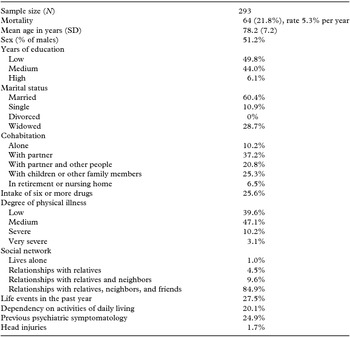
Of the initially selected sample of 324 people, 13 (4.0%) rejected participation, and 18 could not be located (5.5%). The final sample comprised 293 participants (90.4%). People selected for the study (aged 65 to 101 years) were monitored during five-year follow-up study. Sixty-four people of this group died (21.8%, 95% CI [16.9%, 26.7%]), translating to a 5.3% annual rate. General characteristics of the final sample analyzed in the study are described in Table 1.
Socio-demographic characteristics of the sample

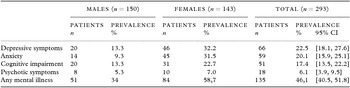
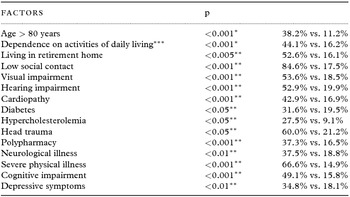
The prevalence of psychiatric symptoms in the study is shown in Table 2. Importantly, 46.1% of the sample showed symptomatology of mental disorders. Furthermore, we analyzed the relationship between mortality and every factor in the study with a bivariate statistical test, such as the χ 2, Student's t-test, and logrank test (Mantel–Cox test). Table 3 summarizes factors that showed significant associations with mortality.
Prevalence of psychiatric symptoms in the sample

Note. 95% CI = 95% Confidence Interval.
Factors associated with mortality in the bivariate analysis

Note: *Logrank test (Mantel–Cox test).
**χ 2 test.
***Barthel Index for assessing activities of daily living.
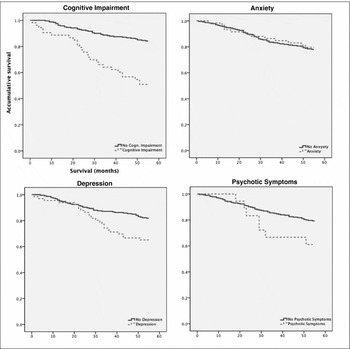
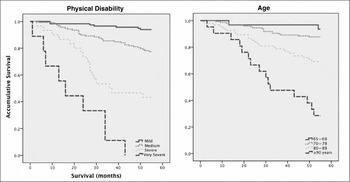
Figure 1 shows the unadjusted survival distribution of each psychopathology. Survival distributions of patients with symptoms of cognitive dysfunction, depression, or psychosis (psychotic symptoms) seem to decrease significantly compared with patients without these symptoms. In fact, there was a significant association between mortality and these factors. Survival curves were significantly different depending on the severity of physical illness and age (Figure 2).
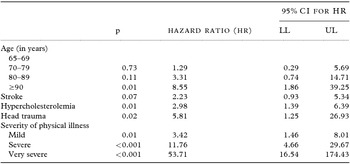
Factors related to mortality (adjusted by a Cox model)

Note. 95% CI = 95% Confidence Interval; LL = lower limit; UL = upper limit.
Survival curve of patiens with psycopathology. The curves show statistically significant differences in cognitive impariment and depression symptoms, p < 0.05 (logrank).

Survival curve depending on the grade of physical disability and age. In both cases p < 0.05 (logrank).

We did not find significant associations between mortality and body mass index, alcohol consumption, tobacco use, high blood pressure, peripheral artery disease, venous insufficiency, stroke, liver disease, thyroid disease, sex, years of education, marital status, stressful life events in the past year, anxiety, and psychotic symptoms.
To design the Cox regression model, variables having some relation to mortality were introduced (p < 0.1). After confirming the complete saturate model with each variable that could be a predictor of mortality, we proceeded to the extraction of variables that did not reach statistical threshold one by one by a backward procedure. We confirm by this procedure that significant alterations in the coefficient of those variables that were still in the model did not exist. The presence of collinearity between variables in the final model was dismissed by the study of R2 coefficient, variance inflation factor, and tolerance. In addition, in the case of categorical predictor variables, high association between these was dismissed by adjusting different logistic regression models using each of the predictor variables as dependent variables. The final predictor variables of the model were used as dependent variables
Taking into account the confounding effects of some variables, we analyzed the relationship between mortality and the studied factors using a multivariate model of Cox proportional hazards survival analysis. This way we could analyze the effects of each factor adjusted for every other factor.
The association between some predictive factors and mortality that appear in the bivariate analysis was nullified after adjusting with a multivariate statistical model. That is the case for depression (HR: 1.1, p = 0.7), cognitive dysfunction (HR: 1.3, p = 0.3), anxiety (HR: 1.2, p = 0.5), dependence on activities of daily living (HR: 1.3, p = 0.9), etc. Only the following five factors demonstrating significant associations in the bivariate analysis maintained their associations with mortality after multivariate adjustment: physical problems reflecting the severity of organic diseases, history of stroke, elevated cholesterol levels, head injury, and age.
Hazard ratio values were particularly high for increased severity of physical illness. The mortality risk was 11.7 and 53.7 times higher in patients with severe and very severe physical illnesses respectively than in elderly people with mild physical illness (Table 4).
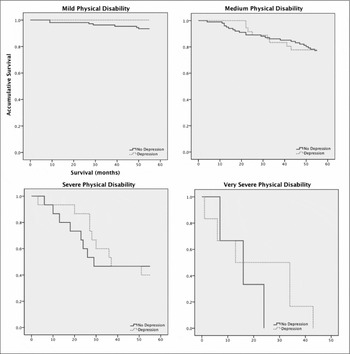
Similarly, it is remarkable that after adjusting for all other variables, particularly physical condition and age, the association between mortality and cognitive dysfunction or depressive symptomatology disappeared. In fact, physical condition was associated with depression, and the percentage of participants with depressive symptoms increased according to the severity of physical illness. The group with mild physical illness included 7.8% patients with depressive symptoms. The proportion rose to 26.3% in the moderate group, 50% in the severe group, and 66.7% in the very severe group (χ 2 = 38.5, p < 0.01). This phenomenon can be observed in Figure 3, in which survival distributions of patients with and without depressive symptoms are classified according to the degree of physical illness. The figure demonstrates that there are no differences among the survival curves. The suppression of the apparent association between depression and mortality, after adjusting with physical illness and age, was also shown with the rest of psychopathology and cognitive dysfunction.
Relationship between the presence of depression symptoms and mortality, stratified by physical disability. No statistically significant differences in mortality in patients with depression symptoms were found.

Discussion
The 5.3% annual mortality rate in elderly people who live in the community and are older than 65 years is similar to the results shown in previous studies whose samples had similar characteristics (Saz et al., Reference Saz, Launer, Dia, De La Camara and Marcos1999). Our results showed a strong association between mortality and age. Thus, the older the person, the higher the mortality rate, as was shown in previous studies. This association was evident even after controlling variables such as severity of physical illness and cognitive dysfunction.
We did not find a significant association between mortality and sex, which is in disagreement with previous reports (Saz et al., Reference Saz, Launer, Dia, De La Camara and Marcos1999; Ganguli et al., Reference Ganguli, Dodge and Mulsant2002; Carey et al., Reference Carey, Covinsky, Lui, Eng, Sands and Walter2008; Ravaglia et al. Reference Ravaglia, Forti, Lucicesare, Pisacane, Rietti and Patterson2008; Pijpers et al., Reference Pijpers, Ferreira, Van de Laar, Stehouwer and Nieuwenhuijzen Kruseman2009) but in agreement with other studies (Cerveira et al., Reference Cerveira, Franz, Camozzato and Fagundes2008; Obisesan and Gillum, Reference Obisesan and Gillum2009). Controlling for risk factors, such as severity of physical illness or vascular risk factors, may eliminate such effects.
Analyzing psychosocial variables showed that the loss or lack of social relationships was related to mortality in the bivariate analysis. A similar result was observed in a previous study that assessed social integration, although the authors of the study conducted a more extensive assessment than our study in which we uniquely evaluated the number of social contacts (Obisesan and Gillum, Reference Obisesan and Gillum2009). However, this association was eliminated when confounding variables were taken into account in a multivariate analysis (Korten et al., Reference Korten1999) similar to our study.
Our bivariate analysis of the dataset on physical illness and functional impairment revealed associations between mortality and physical condition, elevated cholesterol levels, sensory deficiencies, polypharmacy, neurological disease, and dependency on activities of daily living.
The association between mortality and sensory impairment was observed in some studies where it is considered when assessing the fragility of elderly people (Ravaglia et al., Reference Ravaglia, Forti, Lucicesare, Pisacane, Rietti and Patterson2008). However, this association, although significant in the bivariate analysis, was not presented when we adjusted for the confounding effects of other variables, similar to several previous studies (Korten et al., Reference Korten1999; Carey et al., Reference Carey, Covinsky, Lui, Eng, Sands and Walter2008; Pijpers et al., Reference Pijpers, Ferreira, Van de Laar, Stehouwer and Nieuwenhuijzen Kruseman2009).
Regarding the use of drugs (polypharmacy), previous studies have shown an independent association between mortality and this variable in the elderly people. The use of drugs among elderly people is an important variable because it can be used as a predictor of adverse health consequences without the need to identify specific medical conditions (Ganguli et al., Reference Ganguli, Dodge and Mulsant2002; Ravaglia et al., Reference Ravaglia, Forti, Lucicesare, Pisacane, Rietti and Patterson2008). In our study, the association between mortality and the use of drugs was significant in the bivariate analysis, but did not become an independent predictor of mortality. A possible reason for the lack of consensus among studies may be the use not only of different definitions of polypharmacy but also of diverse variables in multivariate analyses. In our study, the effect of polypharmacy was canceled out by the severity of physical illness, which has not been considered in previous studies. Polypharmacy may be an indirect marker of severity of physical illness, but the two variables do not always coincide.
Somatic comorbidity is strongly related to drug use and polypharmacy. Elevated cholesterol levels and neurological diseases were two pathologies significantly related to mortality in our study. Previous studies have shown the association between mortality and cholesterol levels due to coronary disorders (Casiglia et al., Reference Casiglia, Mazz, Tikhonoff, Scarpa, Schiavon and Pessina2003; Lewington et al., Reference Lewington2007). Nevertheless, this association disappeared after multivariate analysis.
Furthermore, degree of severity of physical illness and impairment in activities of daily living were related to mortality in the bivariate analysis. These relationships were also observed in previous studies (Korten et al., Reference Korten1999; Ganguli et al., Reference Ganguli, Dodge and Mulsant2002; Carey et al., Reference Carey, Covinsky, Lui, Eng, Sands and Walter2008; Pijpers et al., Reference Pijpers, Ferreira, Van de Laar, Stehouwer and Nieuwenhuijzen Kruseman2009). However, only severity of physical illness remained significantly associated with mortality after multivariate analysis. Previous research also showed the same results (Ganguli et al., Reference Ganguli, Dodge and Mulsant2002). In sum, severity of physical illness in people older than 65 years seemed to show a higher association with mortality; that is, people with greater severity of physical illness tended to show greater dependency on activities of daily living, but the evolution and survival of these variables depended on their medical comorbidity.
An issue of major relevance in the scientific literature has been the association between mortality and psychopathology and cognitive dysfunction in elderly people, particularly depression and cognitive dysfunction. However, there has been a lack of consensus between studies (Ganguli et al., Reference Ganguli, Dodge and Mulsant2002; Cole, Reference Cole2007). In most of these studies, there is a significant association between mortality and psychiatric symptomatology in elderly people (Ganguli et al., Reference Ganguli, Dodge and Mulsant2002; Cole, Reference Cole2007). Cognitive dysfunction and depressive symptoms were related to mortality in our bivariate analysis. Our results are similar to those of previous reports, particularly those related to cognitive dysfunction and depression (Korten et al., Reference Korten1999; Ganguli et al., Reference Ganguli, Dodge and Mulsant2002; Gallo et al., Reference Gallo, Bogner, Morales, Post, Ten Have and Bruce2005; Baldwin et al., Reference Baldwin, Gallagley, Gourlay, Jackson and Burns2006; Kane et al., Reference Kane, Yochim and Lichtenberg2010). However, the association between mortality and psychiatric symptomatology and cognitive dysfunction in elderly people disappeared in our multivariate analysis. In this sense, our results on mortality risk and depression contradict those published in other studies (Saz et al., Reference Saz, Launer, Dia, De La Camara and Marcos1999; Ganguli et al., Reference Ganguli, Dodge and Mulsant2002) but are similar to those reported in a systematic review of several of the aforementioned studies, which questioned the association, and concluded that the relationship between mortality and depression remains an open issue (Schulz et al., Reference Schulz, Drayer and Rollman2002; Cole, Reference Cole2007; Cerveira et al., Reference Cerveira, Franz, Camozzato and Fagundes2008; Wong et al., Reference Wong, Leung and Woo2011). We must point that the incidence of cognitive impairment increased with age regardless of definition. In the same way, the severity of cognitive dysfunction has a different impact on incident loss of activities of daily living abilities, and comorbidity could affect disabilities differently (Dodge et al., Reference Dodge, Kadowaki, Hayakawa, Yamakawa, Sekikawa and Veshima2005; Ganguli et al., Reference Ganguli, Fu, Snitz, Hughes and Chang2013). There seems to be greater consensus on the association between mortality and cognitive impairment (Kane et al., Reference Kane, Yochim and Lichtenberg2010). This relationship is not observed in the multivariate analysis of our study.
It is important to note some limitations of our study. Sample size may have affected the statistical power of our analysis, although we had a relatively large sample of population older than 65 years in our community. Moreover, the full sample was evaluated by primary healthcare doctors using instruments that allow an in-depth geriatric assessment compared with most of the reviewed studies.
Conclusions
We may conclude that severity of physical illness and age are the variables independently and directly associated with mortality in the elderly people. The older people have higher mortality rates than they show. This risk of mortality increases due to physical illness, this risk being higher when physical illness is more severe. Severity of physical illness seems to nullify the effect of other variables, such as depressive symptomatology, on mortality. In this sense, we may confirm that people with more severe physical illness (somatic comorbidity) and also more depressive symptoms present shorter lifetime. So there seems to be a strong association between severity of physical illness and depressive symptoms. Therefore, severity of physical illness seems to be a crucial factor in the bi-directional association between mortality and depression, acting as a risk factor independently for both. So the relationship between depression and mortality can be severity of physical illness.
Conflict of interest
None.
Description of authors’ roles
S. Benabarre supervised the data collection and wrote the paper. J. Olivera designed the study and supervised the data collection. T. Lorente was responsible for the statistical design of the study and for carrying out statistical analysis. M. Rodriguez supervised the data collection and coordinated the study. A. Barros assisted with writing the paper. C. Pelegrín supervised the data collection. P. Claver, I. Galindo, M. Labarta, and J. Rodriguez collected the data.