Introduction
Supervisor incivility is defined as ‘low intensity deviant behavior with ambiguous intent to harm the target, in violation of workplace norms for mutual respect’ (Andersson & Pearson, Reference Andersson and Pearson1999: 457). The target of supervisor incivility tends to be their subordinates (Abubakar & Arasli, Reference Abubakar and Arasli2016). Plethora of studies on supervisor incivility focus on its detrimental effects on subordinates (e.g., Cho, Bonn, Han, & Lee, Reference Cho, Bonn, Han and Lee2016; Ghosh, Reio, & Bang, Reference Ghosh, Reio and Bang2013; Giumetti, McKibben, Hatfield, Schroeder, & Kowalski, Reference Giumetti, McKibben, Hatfield, Schroeder and Kowalski2012; Jawahar & Schreurs, Reference Jawahar and Schreurs2018; Meier & Gross, Reference Meier and Gross2015; Shin & Hur, Reference Shin and Hur2020). Literature is rich in terms of the possible consequences of supervisor incivility; however, the same cannot be said about its antecedent factors (Oyet, Reference Oyet2019). While, we do have some understandings regarding its antecedents (for review see Schilpzand, De Pater, & Erez, Reference Schilpzand, De Pater and Erez2016), this insight is based on behavioral antecedents (Lanzo, Aziz, & Wuensch, Reference Lanzo, Aziz and Wuensch2016; Trudel & Reio, Reference Trudel and Reio2011), organizational antecedents (Meier & Semmer, Reference Meier and Semmer2013; Torkelson, Holm, Bäckström, & Schad, Reference Torkelson, Holm, Bäckström and Schad2016), work-related antecedents (Jensen, Cole, & Rubin, Reference Jensen, Cole and Rubin2019; Taylor & Kluemper, Reference Taylor and Kluemper2012; Van Jaarsveld, Walker, & Skarlicki, Reference Van Jaarsveld, Walker and Skarlicki2010), and subordinate level antecedents (Oyet, Reference Oyet2019). Consequently, the gap remains unclear about supervisor level factors that instigate supervisor incivility; therefore, the current study is trying to fill this gap by examining supervisor level factors that make their behavior uncivil toward their subordinates. Researchers argued that studies on antecedents of incivility are somewhat limited and there is a need to explore the root causes of such behavior (Dhanani, Wolcott, & Pueschel, Reference Dhanani, Wolcott and Pueschel2019; Koon & Pun, Reference Koon and Pun2018). Additionally, several calls have been made to examine the causes and instigating factors of incivility (Schilpzand, De Pater, & Erez, Reference Schilpzand, De Pater and Erez2016; Torkelson, Holm, Bäckström, & Schad, Reference Torkelson, Holm, Bäckström and Schad2016; Yao, Lim, Guo, Ou, & Ng, Reference Yao, Lim, Guo, Ou and Ng2021), because investigating antecedents of incivility can help identify remedies to reduce it (Meier & Semmer, Reference Meier and Semmer2013). Similarly, there is lack of research on its possible mediators (Holm, Torkelson, & Bäckström, Reference Holm, Torkelson and Bäckström2015; Torkelson, Holm, Bäckström, & Schad, Reference Torkelson, Holm, Bäckström and Schad2016). That is why there is a need to investigate mediators as mechanism of how incivility arises in the workplace (Schilpzand, De Pater, & Erez, Reference Schilpzand, De Pater and Erez2016). Studies found emotional exhaustion to be a significant mediator on the link between employee incivility and customer incivility (Van Jaarsveld, Walker, & Skarlicki, Reference Van Jaarsveld, Walker and Skarlicki2010). Therefore, drawing on affective event theory (AET; Weiss & Cropanzano, Reference Weiss and Cropanzano1996), this study pursues three objectives: (1) investigating the link between role overload and supervisor incivility, (2) exploring the mediating role of emotional exhaustion between role overload and supervisor incivility, and (3) examining the moderating role of supervisor time consciousness.
Role overload is a significant hindrance stressor and job demand (Crawford, LePine, & Rich, Reference Crawford, LePine and Rich2010). It has the potential to induce unethical behavior (Yeşiltaş & Gürlek, Reference Yeşiltaş and Gürlek2020), as studies have found positive association between overload and deviant behaviors (Bayram, Gursakal, & Bilgel, Reference Bayram, Gursakal and Bilgel2009) and abusive supervision (Eissa & Lester, Reference Eissa and Lester2017). We propose that supervisor role overload may serve as an instigating factor of supervisor incivility. Specifically, we posit that supervisors who experience emotional exhaustion due to abundant responsibilities in project environment are more vulnerable to exhibit uncivil behavior toward their subordinates, as research is evident that emotional exhaustion is positively associated with deviant behavior (Golparvar, Reference Golparvar2016; Kong, Ho, & Garg, Reference Kong, Ho and Garg2020). We conceptualize emotional exhaustion as the result of emotional and physical energy depletion experienced by overloaded supervisors in order to meet their role demands in a complex project environment. Exhausted supervisors' motivation to employ valuable resources to maintain normal behavior is low in the presence of role overload; hence, they are less willing to make an effort to hamper their aggressive impulses (Stucke & Baumeister, Reference Stucke and Baumeister2006; Thau & Mitchell, Reference Thau and Mitchell2010). Thus, such supervisors may be inclined to follow hostile behavioral tendencies and are more likely to act rudely toward others in their social surroundings (Lam, Walter, & Huang, Reference Lam, Walter and Huang2017; Wheeler, Halbesleben, & Whitman, Reference Wheeler, Halbesleben and Whitman2013). We conceptualize that overloaded supervisors may be unable to prevent emotional exhaustion and thus eventually engage in behaviors that their subordinates perceive as uncivil.
Although we posit that emotional exhaustion due to role overload may lead to supervisor incivility, not all overloaded supervisors may indulge in uncivil behaviors. It is more likely that certain factors, such as supervisor time consciousness may act as a boundary condition for the proposed link between role overload and emotional exhaustion, eventually lessening or negating the chances of engaging in uncivil behavior. Here, we explore this proposition by testing that whether supervisor time consciousness have the potential to influence supervisor emotional exhaustion in the presence of role overload and impaired the proposed relationship. We apply propositions from AET (Weiss & Cropanzano, Reference Weiss and Cropanzano1996) to explain the proposed mediated and moderated mediation links through which role overload relates to supervisor incivility.
Essentially, this study contributes to the literature in several ways. First, the present study broadens the literature on antecedents of supervisor incivility. Since past studies on supervisor incivility investigated outcomes of such uncivil behavior, there is a need to assess its causes as well (Schilpzand, De Pater, & Erez, Reference Schilpzand, De Pater and Erez2016). Second, this study integrates AET (Weiss & Cropanzano, Reference Weiss and Cropanzano1996) with supervisor incivility to identify instigating elements of this behavior in projects. Studies on incivility have covered range of industry, including healthcare, engineering, manufacturing, financial services, educational institutions, and customer services (see Schilpzand, De Pater, & Erez, Reference Schilpzand, De Pater and Erez2016), while largely omitting project-based organizations. According to Sunindijo, Hadikusumo, and Ogunlana (Reference Sunindijo, Hadikusumo and Ogunlana2007) project managers are the individuals responsible for the project success and failure. Studies showed that in projects, leader interaction with subordinates is administered by his/her leadership behavior, which is considered significant to increase performance (Rehman, Shahzad, Farooq, & Javaid, Reference Rehman, Shahzad, Farooq and Javaid2020), however, till date no study has investigated supervisor incivility in project settings. Tepper (Reference Tepper2007) asserted that stressful work environments (characterized by job ambiguity, job insecurity, inability to fulfil job demands, lack of top management support, and pressure to perform) could instigate abusive and uncivil management practices. Therefore, this study will enhance the literature of project managers about the factors that instigate supervisor incivility in project settings. Furthermore, the external validity or generalizability of incivility findings is important, as industry and organization culture possibly influence reactions and perceptions toward incivility (Schilpzand, De Pater, & Erez, Reference Schilpzand, De Pater and Erez2016).
Third, despite the universal applicability of supervisor incivility, there is a lack of managerial and academic focus on this issue in the Asian context (Loh, Thorsteinsson, & Loi, Reference Loh, Thorsteinsson and Loi2021; Tsuno, Kawakami, Shimazu, Shimada, Inoue, & Leiter, Reference Tsuno, Kawakami, Shimazu, Shimada, Inoue and Leiter2017; Yeung & Griffin, Reference Yeung and Griffin2008). Schilpzand, De Pater, and Erez (Reference Schilpzand, De Pater and Erez2016) noted that majority of incivility studies are based on Western culture, making it inappropriate to generalize the findings in other cultures due to cultural variance (Abid, Khan, Rafiq, & Ahmed, Reference Abid, Khan, Rafiq and Ahmed2015). Particularly, looking into the studies in Pakistani context, research showed that Pakistan is considered as understudied context regarding studies on incivility and previous research on incivility in Pakistan showed high prevalence of incivility across insurance, banking, education, and health care sectors (Young, Hassan, & Hatmaker, Reference Young, Hassan and Hatmaker2021). Furthermore, data delineated that incivility is gaining attention slowly in Pakistan, China, Sweden, and South Korea (Vasconcelos, Reference Vasconcelos2020). Pakistan is a majority Muslim population country, which has a strong patriarchal society where the head of the organization has a supreme authority; therefore, it is inappropriate to generalize the findings from western cultures that believe on equality and where preference is given to independence and individuality (Abid, Khan, Rafiq, & Ahmed, Reference Abid, Khan, Rafiq and Ahmed2015). Thus, the findings of this research will complement the literature on the dark side of leadership behavior in the Asian and more particularly in Pakistani context (Liu, Yu, Chen, & He, Reference Liu, Yu, Chen and He2020; Zhan, Li, & Luo, Reference Zhan, Li and Luo2019).
Theory and hypothesis
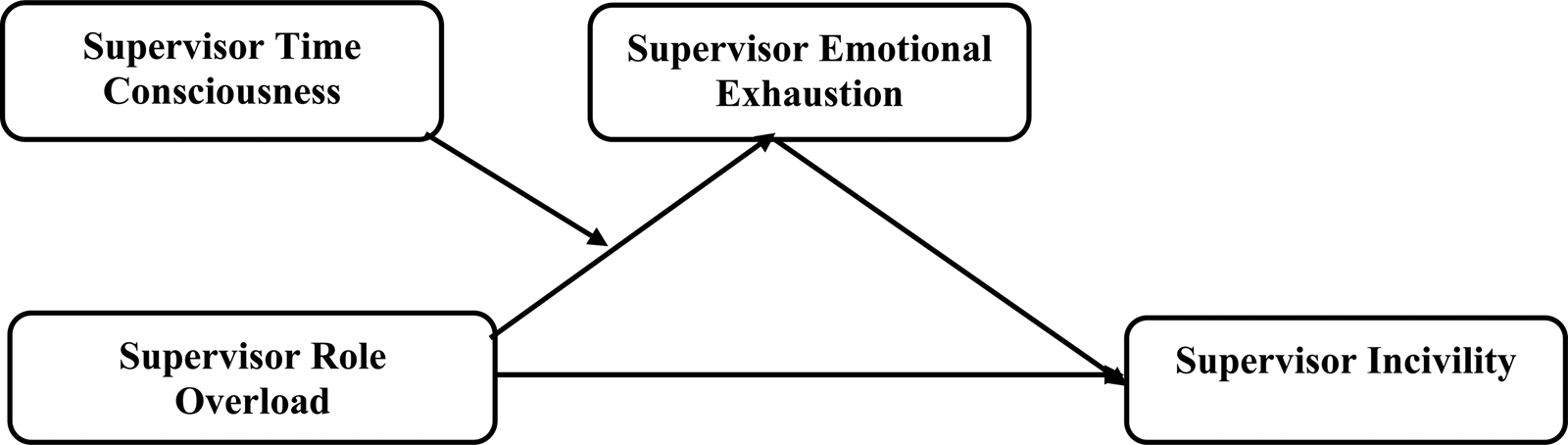
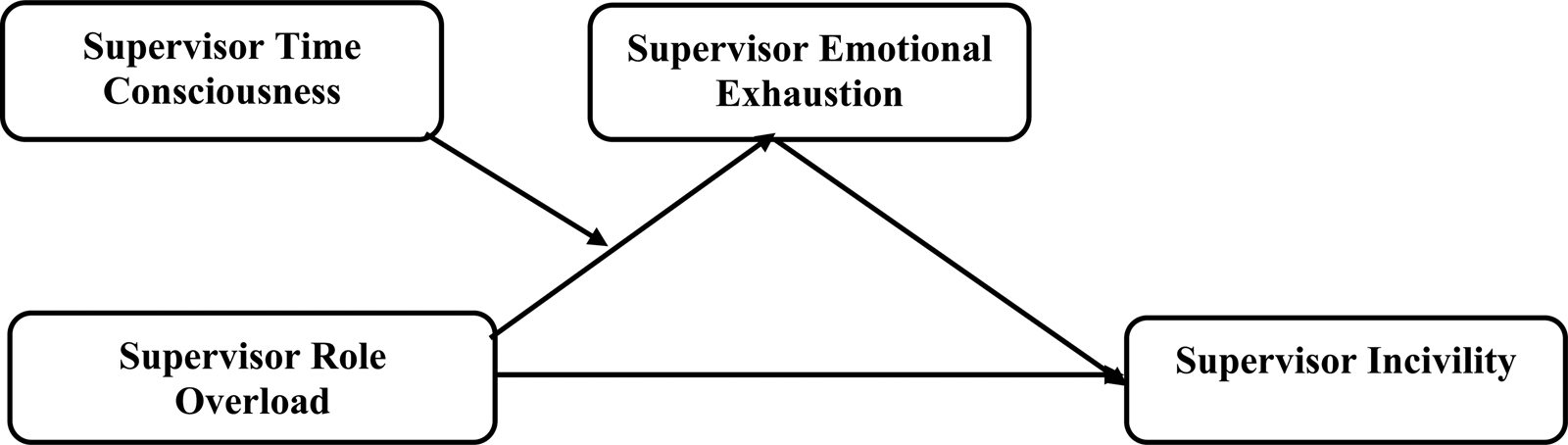
Figure 1 represents theoretical framework of the current study. As the current study is conducted in the context of project management, so a clarification regarding basic terminology is necessary. Supervisors act as project managers in the project settings (Xu, Qin, Dust, & DiRenzo, Reference Xu, Qin, Dust and DiRenzo2019), who prioritize and coordinate tasks (Walker, Reference Walker2015). In this whole article, the term supervisors and project managers are used interchangeably to represent individuals who are leading subordinates to achieve project objectives.
Affective event theory
Johnson (Reference Johnson2009) contended that AET is considered a better conceptual tool for understanding leadership. AET highlights the particular role of work events (uplifts, hassles, or both) and affect (positive or negative) in predicting the behavioral reactions to both events and affect (Judge, Hulin, & Dalal, Reference Judge, Hulin and Dalal2012; Weiss & Cropanzano, Reference Weiss and Cropanzano1996). The main focus of AET is the causes, structures, and possible consequences of affective experiences, which exist as discrete emotions (affective reactions to a specific cause or event). ‘Things happen to people in work settings and people often react emotionally to these events. These affective experiences have direct influences on behaviors and attitudes’ (Weiss & Cropanzano, Reference Weiss and Cropanzano1996: 11). Work events instigate emotional reactions on the basis of how emotion is perceived (Roseman, Spindel, & Jose, Reference Roseman, Spindel and Jose1990). Events such as experiencing something stressful induce strong emotional reactions and less significant events elicit momentary emotional reactions (Michel, Tews, & Allen, Reference Michel, Tews and Allen2019). AET and other theories of emotion (e.g., Frijda, Reference Frijda, Lewis and Haviland1993) postulate that emotional responses to specific events redirect behaviors. When individuals experience positive or negative emotions, behaviors are designed to manage with the emotions. Literature acknowledges the idea that things happen at workplace to people and their reactions are often emotional which leads to certain attitudes and behaviors. The difference is how to elucidate the events. Therefore, AET propounds personality or disposition that operates at various points in the process through which events effect reactions and reactions influence behaviors (Weiss & Cropanzano, Reference Weiss and Cropanzano1996). Theory advocates that personality also impacts the way in which affective states unfold over time, sometimes waxing and sometimes waning (Weiss & Beal, Reference Weiss, Beal, Ashkanasy, Zerbe and Härtel2005; Weiss & Cropanzano, Reference Weiss and Cropanzano1996).
Since its inception, empirical research has acknowledged the basic principles of AET. Several studies have delineated how positive and negative emotional experiences elucidate the impact of work events on behaviors such as abusive supervision (Eissa & Lester, Reference Eissa and Lester2017), withdrawal behaviors (Kiefer, Reference Kiefer2005), counterproductive work behaviors (Reynolds Kueny, Francka, Shoss, Headrick, & Erb, Reference Reynolds Kueny, Francka, Shoss, Headrick and Erb2020), and organizational citizenship behavior (Rodell & Judge, Reference Rodell and Judge2009). Consistent with these findings, the present study extends AET to supervisor incivility literature. We contend that supervisor role overload (event) instigates emotional exhaustion (affective reaction), which provokes supervisor incivility (behavioral reaction), and this whole process depends on supervisor personality.
Supervisor role overload and supervisor incivility
According to Rizzo, House, and Lirtzman (Reference Rizzo, House and Lirtzman1970), ‘role overload is a condition characterized by an excessive amount of work demands which individuals are expected to fulfill.’ Role overload arises when people feel that demands put on them are difficult to accomplish in the time available (quantitative overload) or they do not have the skills to complete the task satisfactorily (qualitative overload). Interestingly, there are distinct arguments about individual responses to role overload (Zhang, Crant, & Weng, Reference Zhang, Crant and Weng2019). For instance, Cavanaugh, Boswell, Roehling, and Boudreau (Reference Cavanaugh, Boswell, Roehling and Boudreau2000) argue that role overload is a challenge-related stressor that induces positive outcomes. Taking on challenging tasks and multiple responsibilities can lead to growth and development (Gilboa, Shirom, Fried, & Cooper, Reference Gilboa, Shirom, Fried and Cooper2008). However, overload can also involve staggering demand that exceeds one's individual coping resources and abilities (Eatough, Chang, Miloslavic, & Johnson, Reference Eatough, Chang, Miloslavic and Johnson2011). Role overload sometimes emerges from the role structure (Peterson et al., Reference Peterson, Smith, Akande, Ayestaran, Bochner, Callan and Hofmann1995) or job responsibilities, suggesting that individuals may have less control over role overload (Zhang, Crant, & Weng, Reference Zhang, Crant and Weng2019). Richmond and Skitmore (Reference Richmond and Skitmore2006) argue that project-based work should be considered high-pressure work with respect to job demands like role overload. Project managers juggle multiple requirements and put in commitment and effort, while having no control over project processes. This lack of control and high level of requirements represent stressors. Moreover, projects greatly rely on project managers, and these demands sometimes result in work overload on them (An, Qiang, Wen, Jiang, & Xia, Reference An, Qiang, Wen, Jiang and Xia2019). Research often considers role overload to be an affective event (Ohly & Schmitt, Reference Ohly and Schmitt2015), and commonly views it as a job stressor (Eissa & Lester, Reference Eissa and Lester2017). Therefore, research has linked role overload to various unpleasant consequences in the workplace (Baer, Dhensa-Kahlon, Colquitt, Rodell, Outlaw, & Long, Reference Baer, Dhensa-Kahlon, Colquitt, Rodell, Outlaw and Long2015). According to Ilies, Dimotakis, and De Pater (Reference Ilies, Dimotakis and De Pater2010), project-related demands are likely to result in project managers experiencing strain and thus negative personal and work outcomes. Extant research indicates that work stress is detrimental, increasing accidents (Steffy, Jones, Murphy, & Kunz, Reference Steffy, Jones, Murphy and Kunz1986) and decreasing employee productivity. Similarly, Taylor and Kluemper (Reference Taylor and Kluemper2012) identified a link between role stress and greater incivility in individuals. Studies relate role overload to aggressive behavior (Barclay & Aquino, Reference Barclay and Aquino2011) and incivility (Maxwell, Cole, & Mitchell, Reference Maxwell, Cole and Mitchell2011). Furthermore, empirical research indicates that role overload (Salin, Reference Salin2003), role conflict (Skogstad, Einarsen, Torsheim, Aasland, & Hetland, Reference Skogstad, Einarsen, Torsheim, Aasland and Hetland2007), and role ambiguity (Jennifer, Cowie, & Ananiadou, Reference Jennifer, Cowie and Ananiadou2003) are linked with a substantial degree of mistreatment in the workplace. Environments with greater demands such as role overload may increase individuals' vulnerability to incivility by encouraging an environment that fosters negative interpersonal behaviors (Dhanani, Wolcott, & Pueschel, Reference Dhanani, Wolcott and Pueschel2019). Moreover, Hendy, Can, and Black (Reference Hendy, Can and Black2019) argue that workplace stressors may induce individuals to exhibit deviant behavior, such as rudeness and discourteousness toward others. A study by Eissa and Lester (Reference Eissa and Lester2017) found that role overload instigates abusive supervision. Based on this, we argue that supervisors experiencing role overload may be unable to show acceptable behavior due to the overwhelming responsibilities and tasks to accomplish, therefore, they engross in incivility.
Hypothesis 1: Supervisor role overload is positively associated with supervisor incivility.
Supervisor emotional exhaustion and supervisor incivility
Researchers characterized emotional exhaustion as feeling of being worn out, loss of energy, chronic fatigue and debilitation (Schwarzer, Schmitz, & Tang, Reference Schwarzer, Schmitz and Tang2000). Emotional exhaustion research was originally conceptualized based on Maslach's powerful model of burnout. According to Maslach and Leiter (Reference Maslach and Leiter2008: 498), emotional exhaustion refers to feelings of being strained and depleted of one's physical and emotional resources. According to AET (Weiss & Cropanzano, Reference Weiss and Cropanzano1996), certain emotions instigate certain behaviors in response. Therefore, it would be rational to assume that emotional exhaustion might possibly contribute to an increase in supervisor incivility. This is because emotionally exhausted individuals may be less inclined to expend more resources (Hobfoll, Reference Hobfoll1989), increasing the possibility of showing hostile and aggressive behavior (Thau & Mitchell, Reference Thau and Mitchell2010). As Jahanzeb and Fatima (Reference Jahanzeb and Fatima2018) found that emotionally exhausted individuals have less cognitive, psychological, and emotional resources that compel them to engage in interpersonal deviant behavior. Similarly, studies opined that individuals experiencing emotional exhaustion have insufficient resources to control their hostile urges and are more inclined to behave abusively toward their subordinates (Fan, Wang, Liu, Liu, & Cai, Reference Fan, Wang, Liu, Liu and Cai2020; Yam, Fehr, Keng-Highberger, Klotz, & Reynolds, Reference Yam, Fehr, Keng-Highberger, Klotz and Reynolds2016).
Indeed, research has shown that emotional exhaustion is related to various detrimental behaviors, including abusive supervision (Lam, Walter, & Huang, Reference Lam, Walter and Huang2017) and deviant behavior (He, Wang, Wu, & Estay, Reference He, Wang, Wu and Estay2018; Jahanzeb & Fatima, Reference Jahanzeb and Fatima2018). According to Van Jaarsveld, Walker, and Skarlicki (Reference Van Jaarsveld, Walker and Skarlicki2010), individuals with an increased level of emotional exhaustion engage in organizational deviance, incivility, and other counterproductive work behaviors in order to alleviate negative emotions (Sakurai & Jex, Reference Sakurai and Jex2012). Therefore, consistent with Spector and Fox's (Reference Spector and Fox2005) research on emotional aggression and with AET, emotional exhaustion is expected to drive supervisor incivility in project-based work. That is, emotionally exhausted supervisors are more vulnerable to engage in incivility as a process of coping with negative emotions and therefore are greatly disposed to act in a way that their subordinates and team members perceive and report as uncivil. Hence, we hypothesize that:
Hypothesis 2: Supervisor emotional exhaustion is positively associated with supervisor incivility
Mediating role of emotional exhaustion
Studies indicated that emotional exhaustion is the individual stress response to stressors (Lu & Gursoy, Reference Lu and Gursoy2016; Maslach, Schaufeli, & Leiter, Reference Maslach, Schaufeli and Leiter2001). Previous research delineated that when individuals confront stressors such as role overload, they encounter negative feelings such as emotional exhaustion which ultimately leads to counterproductive work behaviors like incivility in order to minimize emotionally displeasing situations (Penney & Spector, Reference Penney and Spector2005). The reason might be that due to resources depletion, emotionally exhausted individuals are incapable of engaging in behaviors that are acceptable (Trougakos, Beal, Cheng, Hideg, & Zweig, Reference Trougakos, Beal, Cheng, Hideg and Zweig2015), so they engross in certain behaviors that are not acceptable to both organizations and individuals (Zhu, Lian, Hao, & Ding, Reference Zhu, Lian, Hao and Ding2015). Moreover, stressors such as role overload can increase incivility (Dhanani, Wolcott, & Pueschel, Reference Dhanani, Wolcott and Pueschel2019), because stressors has the potential to drain regulatory resources and self-control and this state of drained self-control is related to the instigation of incivility (Rosen, Koopman, Gabriel, & Johnson, Reference Rosen, Koopman, Gabriel and Johnson2016). Thus environment with higher demands such as project environment characterized by taxing demands may have the possibility to deplete the emotional and physical energy of supervisors which ultimately leads to incivility. Pearson, Andersson, and Porath (Reference Pearson, Andersson and Porath2000) contended that work overload puts individuals under time pressure, which lessen their propensity to act politely at work. Similarly the findings of Koon and Pun (Reference Koon and Pun2018) showed that extravagant job demands induce emotional exhaustion which leads to instigated workplace incivility.
Theories of work-related stress and AET suggest that persistent exposure to job stressors such as role overload induces negative emotional responses such as emotional exhaustion, which adversely influences individual attitudes and behaviors (Spector, Reference Spector1998; Spector & Fox, Reference Spector and Fox2005; Weiss & Cropanzano, Reference Weiss and Cropanzano1996). Therefore, in order to complete our hypothesized model, we predict that the relationship between supervisor role overload and supervisor incivility is mediated by supervisor emotional exhaustion. According to AET (Weiss & Cropanzano, Reference Weiss and Cropanzano1996), certain events elicit certain affective reactions, leading to different behaviors. Therefore, the enactment of affective theory begins with the influence of supervisor role overload (event) on supervisor emotional exhaustion (affective reaction). Eventually, emotional exhaustion instigates supervisor incivility (behavior). Hence, we hypothesize that:
Hypothesis 3: Supervisor emotional exhaustion will mediate the relationship between supervisor role overload and supervisor's incivility.
Moderating role of time consciousness
Time consciousness is defined as a person's tendency to consider time a scarce resource and to utilize it vigilantly (Kleijnen, De Ruyter, & Wetzels, Reference Kleijnen, De Ruyter and Wetzels2007). Researchers across several scientific disciplines have investigated the way people perceive, experience, and value their time by examining their time perceptions with respect to valued behavior and outcomes. According to Kleijnen, De Ruyter, and Wetzels (Reference Kleijnen, De Ruyter and Wetzels2007), the experience of time may be an inherent personality characteristic. Similarly, George and Jones (Reference George and Jones2000: 659) conceptualize it as ‘an intrinsic property of consciousness.’ Thus, humans' consciousness of time is a familiarity that emerges from within. According to Kaufman, Lane, and Lindquist (Reference Kaufman, Lane and Lindquist1991), time personality or time consciousness refers to individuals who are aware of passage of time, have a need to meet deadlines, plan their activities, do multiple things at the same time, and generally attempt to complete more in less time. Based on these arguments, we acknowledged time consciousness as a dispositional characteristic that emerges from within due to which some individuals are more conscious toward time and some are less conscious; because individual temporal propensities reflect the way individuals inherently track and account for time and differ in their sensitivity toward time-sensitive issues (Francis-Smythe & Robertson, Reference Francis-Smythe and Robertson1999), such that higher time consciousness is linked with adherence to schedules and deadlines and consciousness of the rate at which tasks must be carried out (Kleijnen, De Ruyter, & Wetzels, Reference Kleijnen, De Ruyter and Wetzels2007). Roles determine what tasks must be fulfilled and usually involve schedules and priorities for executing important activities. Therefore, roles can put demands on the available information, time, money, skills, and goods leading to role overload. McGrath and Kelly (Reference McGrath and Kelly1986: 112) defined the temporal facet of role overload as experiencing more to be done according to one's role than can be completed in the available time, or less time assigned to a fixed set of role activities. Applying role overload to traditional resource theory suggests that individuals divide a given set of role expectations into distinct time blocks and endeavor to assign some tasks to others, and increase productivity. According to Crawford (Reference Crawford2015), individual time consciousness varies with respect to context. Research by Freedman and Edwards (Reference Freedman, Edwards and McGrath1988) stated that time-conscious individuals who are used to working under time constraints might be in a position to combat a higher level of time pressure when required by their work.
Matthews (Reference Matthews1982) contended that time consciousness is manifestations of individuals' cognitive style in which they scrutinize ways to manage time efficiently. Similarly, other research shows that successful project managers adjust their own time orientations to complement the time-related demands and dynamic conditions they are responsible for handling (Thoms & Pinto, Reference Thoms and Pinto1999). When a large number of activities must be completed, deadlines are used to prioritize tasks (Rastegary & Landy, Reference Rastegary and Landy1993). In fact, time-conscious people seem to devise deadlines very frequently (Glass, Snyder, & Hollis, Reference Glass, Snyder and Hollis1974). Time-conscious individuals often indicate that exposure to continuous deadlines makes them better able to perform well under time pressure (Rastegary & Landy, Reference Rastegary and Landy1993). We expect that highly time-conscious supervisors will be more sensitive to role overload and will try to adopt such strategies in order to manage their tasks and responsibilities efficiently and effectively, resulting in less emotional exhaustion. Therefore, less time consciousness may lead supervisors to experience more emotional exhaustion when they encounter role overload. On the contrary, highly time-conscious supervisors are calm and have plans and strategies when encountering role overload; they are thus less emotionally exhausted. Based on the above discussion, we hypothesized:
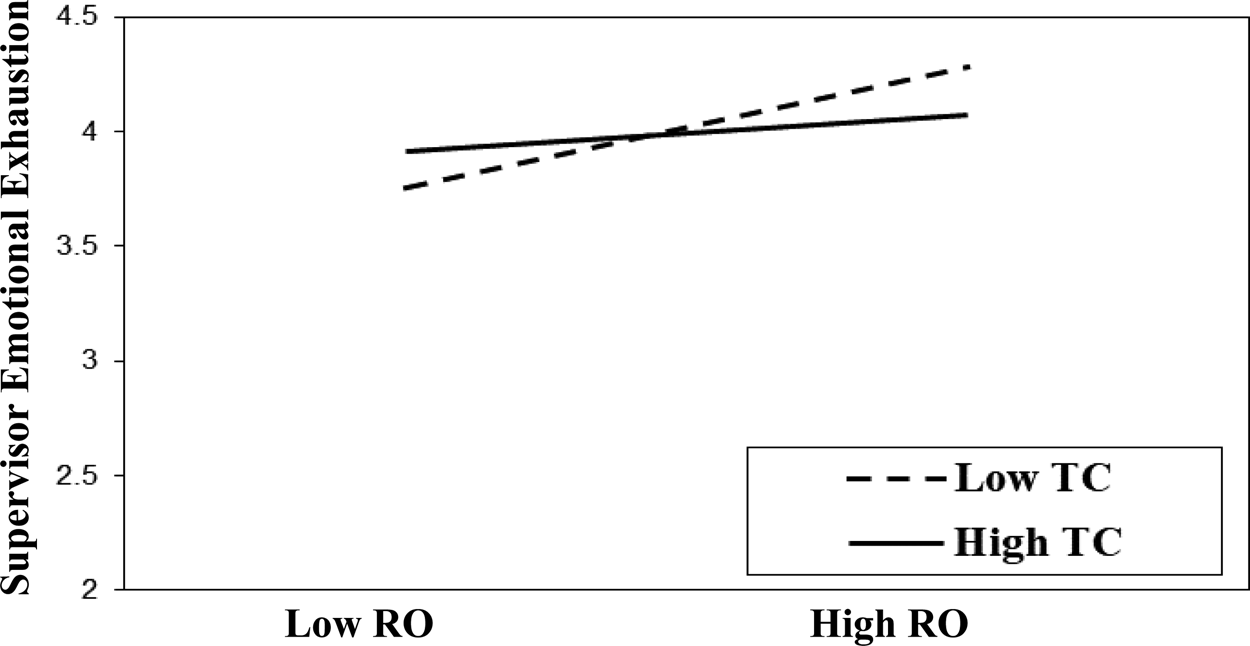
Hypothesis 4: Time consciousness moderates the relationship between supervisor role overload and supervisor emotional exhaustion; such that supervisor role overload will have weaker relationship with emotional exhaustion for supervisors who are highly time conscious than those who are low time conscious
Method
Sample and procedure
The proposed hypotheses were tested in field study by collecting data from supervisors and their subordinates working in various project-based organizations in Islamabad and Rawalpindi regions of Pakistan. According to Ismail, Richard, and Taylor (Reference Ismail, Richard and Taylor2012), collecting data from dyads within various organizations maximizes variance, and thus represents good research design. English-language surveys were administered to 400 supervisor and subordinates in different public- and private-sector project-based organizations operating in Pakistan. Following the lead of prior research, we administered our questionnaire in English because the language is spoken widely in Pakistan (Khan, Moss, Quratulain, & Hameed, Reference Khan, Moss, Quratulain and Hameed2018; Khan, Quratulain, & Bell, Reference Khan, Quratulain and Bell2014). The participating project-based organizations belonged to different industries and were undertaking projects in fields such as construction, information technology and software, nongovernmental organizations (NGOs), educational, and health. The sample encompassed different industries and occupations in order to enhance external validity by generating results that are generalizable across individuals, settings, and time (Scandura & Williams, Reference Scandura and Williams2000).
Contacts were identified in selected organizations to help with data collection. These contacts referred us to supervisors. The author explained research objective of the present study to these supervisors and request them to provide support in data collection. Afterwards, we asked them for contact information of their direct subordinates. In the next phase, we administered a supervisor questionnaire (labelled S-1) consisting of information related to demographics, supervisor role overload, supervisor emotional exhaustion, and time consciousness. Finally, we approached each subordinate separately with a different questionnaire (labelled E-1) that contained information related to their demographics and supervisor incivility. The reason for this was to avoid common method bias (CMB). The supervisors and subordinates were invited to take part in data collection on a voluntary basis. Moreover, the respondents were informed about the confidentiality and anonymity of their responses. A cover page was attached to each questionnaire describing the study's purpose and procedure. Moreover, an identification code was generated to match the supervisor and subordinate surveys (Miller, Richard, & Ford, Reference Miller, Richard and Ford2019; Tepper & Taylor, Reference Tepper and Taylor2003). In the current study, we collected data from supervisors and their immediate subordinates. Supervisors rated role overload, emotional exhaustion, and time consciousness and subordinates rated their supervisors on incivility. In our data, we examine the supervisor–subordinate pairs and not group of multiple subordinates with one supervisor, therefore our data are not multilevel. Our approach is consistent with previous research of Eissa and Lester (Reference Eissa and Lester2017) and Eissa, Lester, and Gupta, (Reference Eissa, Lester and Gupta2019). For data collection approximately, 400 project supervisors and subordinates were approached. However, 320 responses were obtained from supervisor's respondent and 350 from subordinates, which were complete. The final sample for the current study was 296 workable responses resulting in total response rate of 74%.
The final sample involved supervisors and subordinates from different projects involving construction and civil engineering projects (38%), NGO projects (30%), information technology projects (16%), education and health projects (12%), and other projects (4%). The subordinate participants were 67.2% male and 32.8% female. Majority of subordinate participants had an age of 26–33 constituted for 44.3%. Moreover, majority respondents had education of bachelor comprised of 44.9% and most of the respondents had an experience between 5 and 10 represented 85.1%. The supervisor respondents were 63.2% male and 36.8% female. More respondents had an age among ranges 34–41 composed of 51.4%. Furthermore, majority of supervisor respondents had education of master constituted for 63.2% and large number of supervisor respondents had an experience between ranges of 5 and 10 represented 70.6%.
Measures
Supervisor role overload
Supervisor role overload was assessed with a scale based on three items from Schaubroeck, Cotton, and Jennings (Reference Schaubroeck, Cotton and Jennings1989) and Beehr, Walsh, and Taber (Reference Beehr, Walsh and Taber1976) used by Bolino and Turnley (Reference Bolino and Turnley2005). The items included in this scale were ‘The amount of work I am expected to do is too great.’ The responses were made on 5-point Likert scale ranging from 1 (strongly disagree) to 5 (strongly agree). The Cronbach's α for this scale is reported as.75 and.84 (Beehr, Walsh, & Taber, Reference Beehr, Walsh and Taber1976; Schaubroeck, Cotton, & Jennings, Reference Schaubroeck, Cotton and Jennings1989). The reliability of role overload in the current study was.781.
Time consciousness
The nine-item scale developed by Kleijnen, De Ruyter, and Wetzels (Reference Kleijnen, De Ruyter and Wetzels2007) was utilized for assessing time consciousness. The sample items included in this scale were ‘I rarely think about how I am using my time,’ ‘I prefer to be able to plan in advance what tasks I need to do.’ The responses were made on 5-point Likert scale. In the study of Kleijnen, De Ruyter, and Wetzels (Reference Kleijnen, De Ruyter and Wetzels2007) the reliability of time consciousness was.95. The Cronbach's α of the scale in the current study was.919.
Supervisor emotional exhaustion
For measuring supervisor emotional exhaustion nine-item scale was adopted from Maslach and Jackson (Reference Maslach and Jackson1981) emotional exhaustion scale (Maslach Burnout Inventory). The items included in this were ‘I feel fatigued when I get up in the morning and have to face another day on the job.’ The responses were made on 5-point Likert scale ranging from 1 (strongly disagree) to 5 (strongly agree). In literature the Cronbach's α of emotional exhaustion was .96 (Khan, Khan, Soomro, & Khan, Reference Khan, Khan, Soomro and Khan2020), .93 (Chen, Richard, Boncoeur, & Ford, Reference Chen, Richard, Boncoeur and Ford2020), .99 (Chen, Chang, & Wang, Reference Chen, Chang and Wang2019), .92 (Cropanzano, Rupp, & Byrne, Reference Cropanzano, Rupp and Byrne2003; Dust, Resick, Margolis, Mawritz, & Greenbaum, Reference Dust, Resick, Margolis, Mawritz and Greenbaum2018). Consistent with this, the current study established the reliability of .918.
Supervisor incivility
Supervisor incivility was measured by using Cortina, Magley, Williams, and Langhout (Reference Cortina, Magley, Williams and Langhout2001) seven-item scale. Majority of the studies on incivility have adopted this scale (Schilpzand, De Pater, & Erez, Reference Schilpzand, De Pater and Erez2016). The modification was made according to the purpose of the research. The changes were made in the description; for example, in the original scale the description was ‘In the past, while employed by the English Circuit courts, have you been in a situation where any of your supervisors’ and for the current research we have modified it in such a way ‘In the project, have you been in a situation where your supervisor’ as such modifications are evident in the previous research of Reio (Reference Reio2011). The items included in this scale were ‘Made mean or derogatory remarks about you.’ The items were measured on a 5-point Likert-type scale with responses ranging from 1 (never) to 5 (most of the time). Internal consistency exhibited in prior studies ranged from .84 to .89 (Cortina, Magley, Williams, & Langhout, Reference Cortina, Magley, Williams and Langhout2001; Spence Laschinger, Leiter, Day, & Gilin, Reference Spence Laschinger, Leiter, Day and Gilin2009) and Cronbach's α .94 (Reio, Reference Reio2011). The present study α reliability was .896.
Control variables
One-way ANOVA analysis was conducted to check the impact of demographic variables (such as age, gender, qualification, etc.) on supervisor incivility. The results revealed that not a single demographic variable significantly influences the study-dependent variable. Therefore, in further analysis, there is no need to incorporate demographics.
Results
Analytical strategy
The current study collected data from both supervisors and their immediate subordinates. After data matching, the final usable sample was 296 supervisor–subordinate dyads which is evident in Eissa and Lester, (Reference Eissa and Lester2017) and Liu, Wang, Zhao, Xia, and Guo (Reference Liu, Wang, Zhao, Xia and Guo2020). First, we conducted confirmatory factor analysis to validate our model. For hypothesis testing, we utilized PROCESS macros developed by Hayes (Reference Hayes2013). For hypotheses 1–3, we ran model 4 of the PROCESS macro to test simple and mediation hypothesis. For moderation, first the independent variable and moderator variable were mean centered to resolve the issue of multicollinearity (Cohen, Cohen, West, & Aiken, Reference Cohen, Cohen, West and Aiken2003), and then we checked the interaction effect. In the last for moderated mediation model, we utilized model 7 of PROCESS macro, to test the full model.
Common method bias
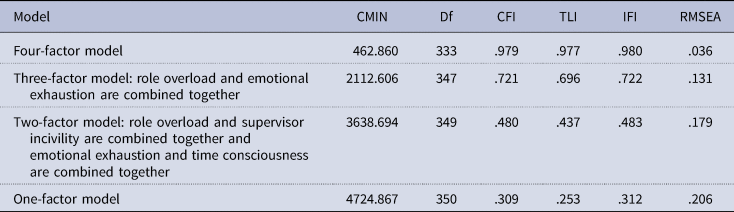
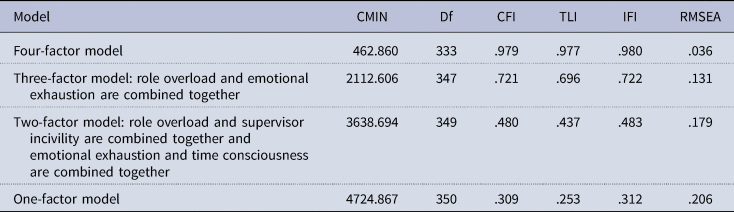
CMB is the spurious ‘variance attributable to the measurement method rather than to the constructs the measures represent’ (Podsakoff, MacKenzie, Lee, & Podsakoff, Reference Podsakoff, MacKenzie, Lee and Podsakoff2003). To resolve the issue of CMB, we utilized different ways. First we conducted Harman single factor test (Harman, Reference Harman1976; Podsakoff & Organ, Reference Podsakoff and Organ1986) to check whether a single factor accounts for maximum variance. The first factor explained 28% of total variance which was below the threshold of 50. Secondly, we conducted single-factor CFA in which all the items were loaded on a single factor which is evident in Mercier et al. (Reference Mercier, Vinchon, Pichot, Bonetto, Bonnardel, Girandola and Lubart2021). The results are CMIN/DF = 4724.876, CFI = .309, TLI = 253, IFI = .312, and RMSEA = .206. These results revealed that there is no issue of biasness in our data.
Measurement model
For validating the measurement model, confirmatory factor analysis was conducted following Anderson and Gerbing (Reference Anderson and Gerbing1988) suggestions that composed of four latent variables, supervisor role overload, supervisor emotional exhaustion, time consciousness, and supervisor incivility. The fusion of different fit indices such as model χ2, incremental fit index (IFI), Tucker–Lewis Index (TLI), comparative fit index (CFI), and root mean square of approximation (RMSEA) was utilized to assess model fitness. According to Hu and Bentler (Reference Hu and Bentler1999), values close to.95 for CFI, IFI, and TLI is considered as good model fit. Moreover, Kline (Reference Kline2005) suggested that value below.05 for root mean square error of approximation is considered as good model fit. Table 1 revealed the results for model fit. Table 1 depicts that all values meet the threshold values as suggested. The values for model fit was CMIN/DF = 1.389, IFI = .980, CFI = .979, TLI = .977, RMSEA = 036, which represent excellent model fit. Overall, CFA results exhibited that four-factor model had satisfactory discriminate validity. Moreover, alternate models were also investigated and the results are provided in Table 1. Furthermore, all the items significantly loaded on their respective latent factors.
Confirmatory factor analysis
Composite reliability and average variance extracted
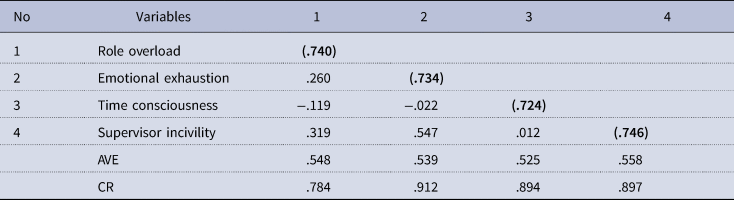
For convergent and discriminant validity, we computed composite reliability (CR) and average variance extracted (AVE) (Fornell & Larcker, Reference Fornell and Larcker1981). For establishing convergent validity, the value of CR should be greater than.6 and AVE should be greater than.5. Results provided in Table 2 delineated that composite reliabilities of four latent variables role overload, emotional exhaustion, time consciousness, and supervisor incivility ranged from.784 to.912, while the AVE for these constructs ranged from.525 to.558, provided evidence that all constructs have adequate convergent validity. Furthermore, for discriminant validity, the square root of AVE should be greater than the correlation among the constructs. Table 2 shows that the square root of AVE of each construct is greater than the correlations among the construct delineating discriminant validity.
Correlations among latent variables, average variance extracted (AVE), and composite reliability (CR)
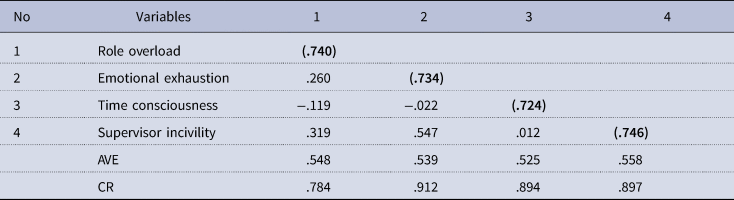
N = 296; AVE, average variance extracted; CR, composite reliabilities; square root of AVE are represented in bold in parenthesis.
Off-diagonal elements are the squared correlations among latent variables.
Descriptive statistics
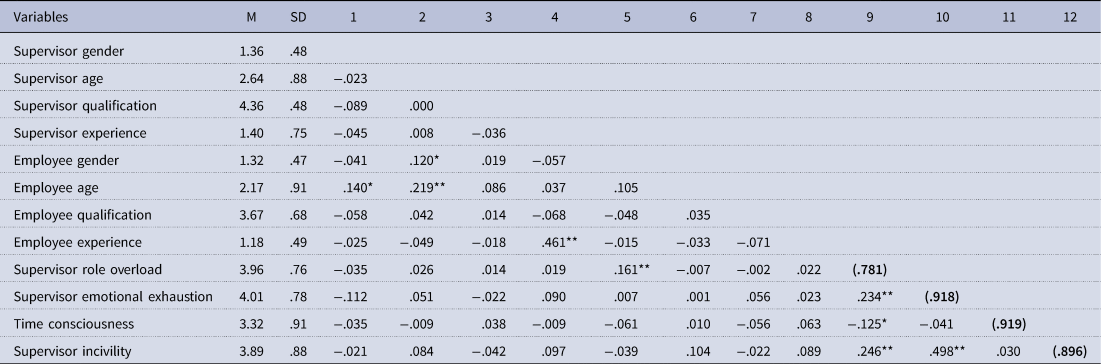
The means, standard deviations, correlations, and reliabilities of the variables are presented in Table 3.
Descriptive statistics, reliability and correlation
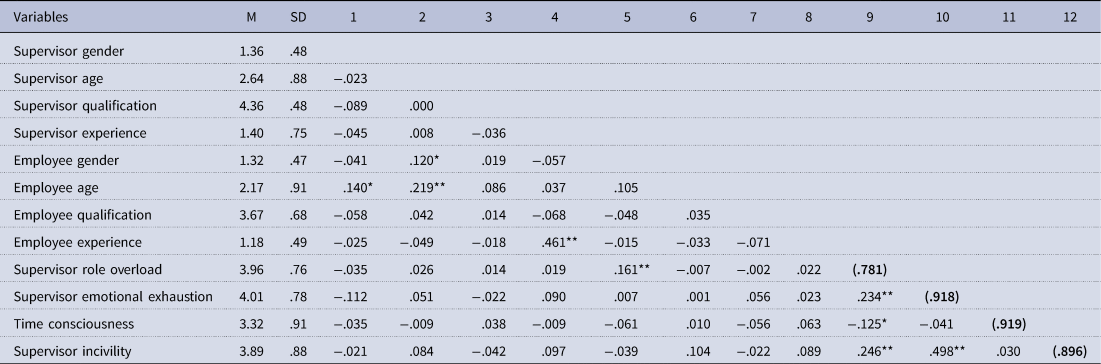
N = 296; reliabilities are shown in the diagonal; *p < .05, ***p < .000.
Hypothesis testing
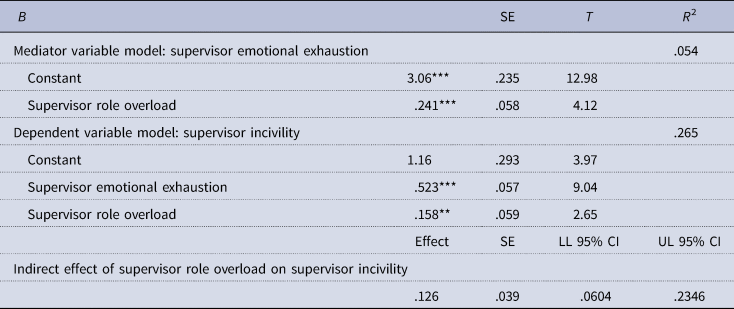
Following the suggestions of Hayes (Reference Hayes2013) and Preacher, Rucker, and Hayes (Reference Preacher, Rucker and Hayes2007), the complete hypothesized model was tested. SPSS Process Macros were utilized to test main hypothesis. In the first phase, hypotheses 1–3 were tested by applying model 4 to calculate the indirect effect of independent variable on dependent through mediator. In the second phase, following the recommendations of Cohen, Cohen, West and Aiken (Reference Cohen, Cohen, West and Aiken2003) we tested the moderation of time consciousness by centering the independent and moderator variables. The results of model 4 are depicted in Table 4 and the results of moderation are presented in Table 5.
Regression results for hypotheses (1–3)
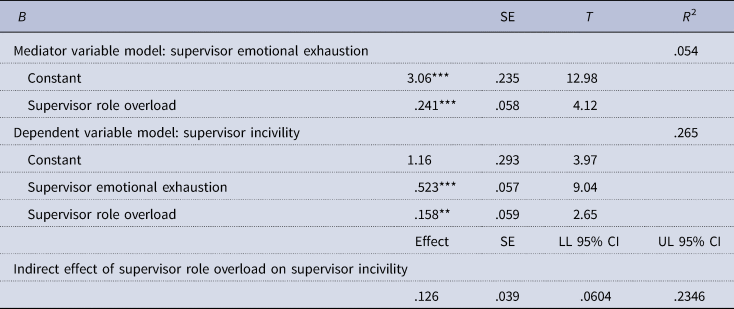
N = 296; bootstrap sample size = 5000; CI, confidence interval; UL, upper limit; LL, lower limit; ***p < .000.
Moderation analysis
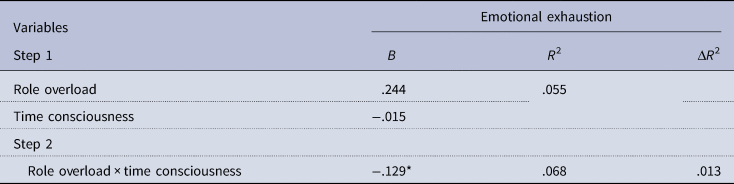
N = 296, *p < .05.
Tests of main prediction (hypotheses 1–3)
The results of the proposed relationship are showed in Table 3. Consistent with the predictions that supervisor role overload had a significant positive link with supervisor incivility (β = .158, t = 4.36, p < .01) and supervisor emotional exhaustion had a positive and significant association with supervisor incivility (β = .523, t = 5.94, p < .01). The results indicated in Table 4 confer justification for the support of both hypotheses 1 and 2. Moreover, the results exhibited that supervisor role overload had a significant indirect effect on supervisor incivility via supervisor emotional exhaustion (indirect effect = .126) with bootstrapped 95% confidence interval and have no zero between lower and upper level confidence interval (.0604,.2147). These results provide justification for the support of partial mediation. Overall the analyses and results in the first step provide support for hypotheses 1, 2, and 3.
Moderation
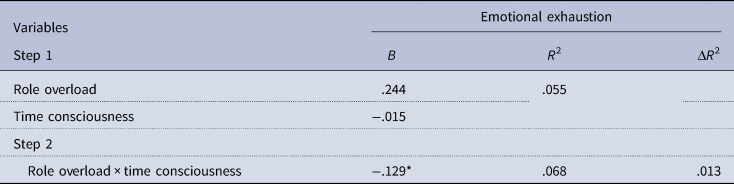
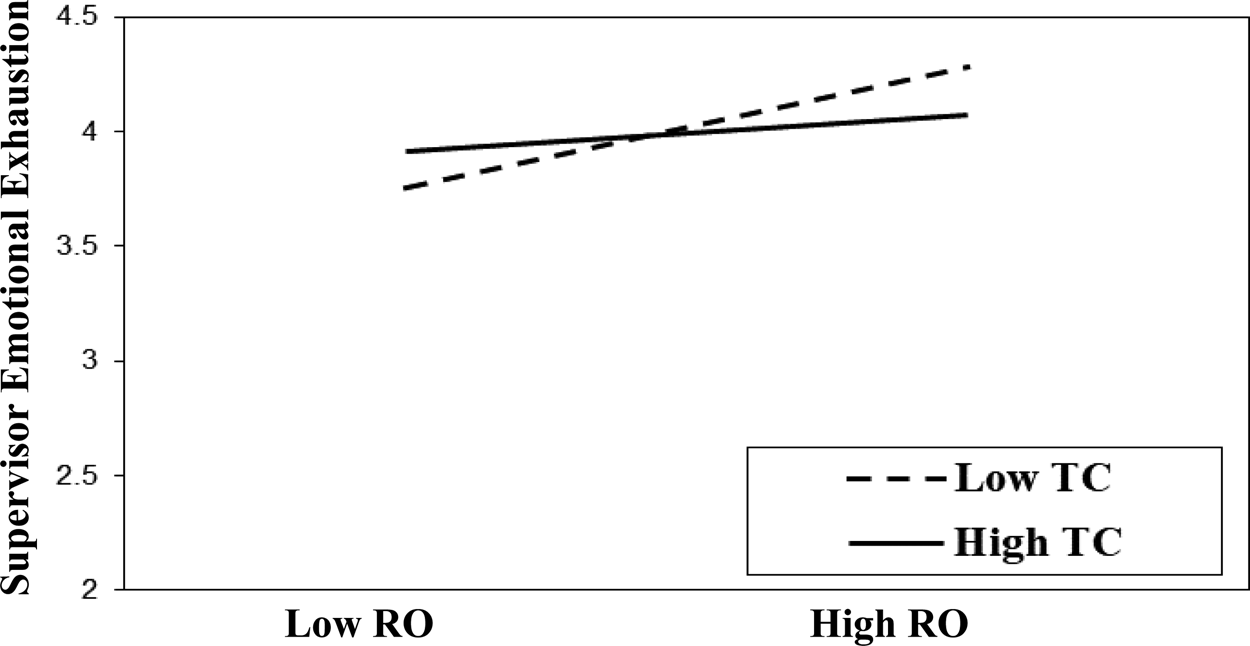
For moderation analysis, we followed Cohen, Cohen, West and Aiken (Reference Cohen, Cohen, West and Aiken2003) to check the moderating role of supervisor time consciousness on the relationship between role overload and emotional exhaustion, such that high time conscious supervisors will be less emotionally exhausted and vice versa. We did not include any demographic variables due to insignificant variations of demographics in dependent variable. We mean centered independent and moderator variables for moderated regression analysis. In the first step, we entered supervisor role overload and time consciousness, and in the second step, we entered the interaction term. The results provided in Table 5 indicated that supervisor time consciousness significantly moderated the relationship between role overload and emotional exhaustion as shown by the interaction effect (β = −.129, p < .05), which shows that highly time consciousness supervisor is less emotionally exhausted and vice versa. Figure 2 shows the plot for the interaction. Furthermore, the results for conditional indirect effect to check the moderated mediation path are provided in Table 6.
Research model: Supervisor role overload and emotional exhaustion as antecedents of supervisor incivility: The role of time consciousness.
Interaction graph.
Moderated mediation: testing the indirect effect

N = 296; bootstrap sample size = 5000; ULCI, upper limit confidence interval; LLCI, lower limit confidence interval.
Discussion
Based on AET (Weiss & Cropanzano, Reference Weiss and Cropanzano1996), this study investigated the proposed model of supervisor-level antecedents of supervisor incivility in project-based organizations. As anticipated, the study results are in line with the hypothesized model. Supervisor role overload exhibited a positive influence on supervisor incivility. These results are consistent with AET and previous studies finding that role overload is linked with workplace mistreatment (Salin, Reference Salin2003). Similarly, our findings are in congruence with Taylor and Kluemper (Reference Taylor and Kluemper2012), who found a relation between role stress and high amount of incivility. In light of our findings and previous studies, we argue that every project has certain constraints, such as time, cost, and scope, which is also called iron triangle (Atkinson, Reference Atkinson1999; Pinto & Cleland, Reference Pinto and Cleland2004). Fernie, Leiringer, and Thorpe (Reference Fernie, Leiringer and Thorpe2006) argued that for a long time the project industry is failed to complete the project within time, cost, and quality. The difference between traditional and project-based organization is that in projects cost, time and scope is pre-specified and in traditional it is related more to operations, so it is important for a project to be completed in these pre-specified constraints. The project supervisor is responsible for completing the project within these specified constraints. Sometimes situations do not turn out as expected, with project deadlines looming and a great deal of work still need to be completed. Thus, the issue of role overload may arise in project work and these extra responsibilities and tasks lead supervisors to behave uncivilly toward their subordinates. Similarly, we also found that supervisor emotional exhaustion positively influences supervisor incivility. According to Thau and Mitchell (Reference Thau and Mitchell2010), exhausted supervisors are less likely to utilize valuable resources to exhibit standardized behavior; thus, they may act rudely toward their subordinates. Similarly, Weiss and Cropanzano (Reference Weiss and Cropanzano1996) considered emotional exhaustion as a driver of supervisor incivility. Exhausted supervisors are more vulnerable to engaging in incivility as a means of coping with negative emotions and therefore more disposed to act in such a manner that subordinates experience as uncivil.
Furthermore, we found support that supervisor emotional exhaustion mediates the relationship between supervisor role overload and supervisor incivility. The findings are consistent with AET, as the indirect effects of supervisor role overload on supervisor incivility occur via the emotional response of supervisor emotional exhaustion. Jensen, Patel, and Messersmith (Reference Jensen, Patel and Messersmith2013) argued that role overload triggers negative emotions that influence organizational outcomes. Furthermore, Gardner, Fischer, and Hunt (Reference Gardner, Fischer and Hunt2009) contended that supervisory positions intrinsically contain considerable stressors and demands. The supervisory position in project-based work is particularly demanding because supervisors are expected to juggle different activities at the same time, which depletes their emotional and physical energy and can consequently lead to rude and discourteous behavior toward their subordinates.
Last but not the least, we investigated the role of time consciousness as a moderator of this relationship. The results showed that time consciousness moderates the relationship between role overload and emotional exhaustion, weakening this relationship. We argue that time-conscious supervisors are aware of the passage of time and therefore try to find ways to handle their overload efficiently and effectively. Rastegary and Landy (Reference Rastegary and Landy1993) argue that time-conscious individuals are bestowed with self-monitoring propensities, which are less affected by time pressure. They further contend that trying to accomplish many goals in less time drives individuals to become more efficient helping them to handle time overload. Consequently, individuals who are conscious about the passage of time will try to manage their activities and tasks in a way that it will not lead to emotional exhaustion. Projects are unique and composed of uncertainty, complexity, and unknown; therefore, the role of project manager is more challenging than that of a typical functional manager (Anantatmula, Reference Anantatmula2010). In projects, supervisors are expected to play versatile role, which involves completing the project within the deadline, supervising their subordinates without any direct control, and communicating with top management and other stakeholders (Cleland, Reference Cleland1995). We argue that these responsibilities place heavy burden on supervisors, which depletes their physical and emotional energy and ultimately leads them to behave uncivilly toward their subordinates. However, as results suggested that highly time conscious individuals try to manage the workload efficiently and are less exhausted.
Theoretical implications
The current study advances the relevant literature in multiple ways. On theoretical perspective, this research bestows empirical evidence for the theoretical underpinning of AET, particularly regarding the basic principle that work events trigger affective reactions which ultimately lead to behavioral response that has been rarely investigated empirically in project management domain. Second, majority of research on supervisor incivility has focused on the consequences of uncivil behaviors (Oyet, Reference Oyet2019; Schilpzand, De Pater, & Erez, Reference Schilpzand, De Pater and Erez2016), therefore in response to different calls for more studies on the factors that instigate supervisor incivility (Dhanani, Wolcott, & Pueschel, Reference Dhanani, Wolcott and Pueschel2019; Torkelson, Holm, Bäckström, & Schad, Reference Torkelson, Holm, Bäckström and Schad2016), this study developed a model that is linking work events, affective reactions, and supervisor incivility. In doing so, this study makes several advancements in the existing literature. For instance, our findings showed that supervisor role overload and emotional exhaustion are the possible inducing factors of supervisor incivility and emotional exhaustion mediates this relationship which are consistent with the proposition of AET that affect mediates the relationship between events and behavior (Weiss & Cropanzano, Reference Weiss and Cropanzano1996). These findings enrich the literature of supervisor incivility regarding the supervisor level antecedents and possible mediating mechanism (Holm, Torkelson, & Bäckström, Reference Holm, Torkelson and Bäckström2015; Schilpzand, De Pater, & Erez, Reference Schilpzand, De Pater and Erez2016). Moreover, in the current study we considered time consciousness as a supervisor personality factor (Kleijnen, De Ruyter, & Wetzels, Reference Kleijnen, De Ruyter and Wetzels2007) that helps supervisors and project managers to experience less emotional exhaustion when encountering role overload. In line with current reflections on the AET process (Weiss & Beal, Reference Weiss, Beal, Ashkanasy, Zerbe and Härtel2005; Weiss & Kurek, Reference Weiss and Kurek2003), our study found that time conscious individuals are less emotionally exhausted when they face role overload. Notably, these findings enhanced research on the antecedents of supervisor incivility which is less researched arena compared to the research on consequences of supervisor incivility.
Finally, we are also contributing to an overlooked region and cultural context, Pakistan (Young, Hassan, & Hatmaker, Reference Young, Hassan and Hatmaker2021). In the past, majority of the incivility research has focused on organizations in western countries (Schilpzand, De Pater, & Erez, Reference Schilpzand, De Pater and Erez2016). It is more unlikely to generalize the findings in cultures where power holders due to imbalance of power between supervisors and subordinates delineate more uncivil behaviors (Günsoy, Reference Günsoy2019; Moon & Sánchez-Rodríguez, Reference Moon and Sánchez-Rodríguez2020). Previously, researchers studied incivility in diverse samples (e.g., financial, health, education, and hospitality); however, this empirical research is first of its kind to study a sample from project-based organizations of Pakistan. In doing so, this study tries to balance both the geographical and industrial representation in supervisor incivility research. We anticipate that the understanding developed by this research will enhance the knowledge of international readers about the implications of supervisor incivility in the collectivistic culture and help them to contrast and compare the findings in different cultures (Young, Hassan, & Hatmaker, Reference Young, Hassan and Hatmaker2021).
Practical implications
It is generally accepted that workplace incivility is harmful and that supervisor incivility is more harmful than other forms of incivility (Schilpzand, De Pater, & Erez, Reference Schilpzand, De Pater and Erez2016) due to high cost for both individual and organization. The project environment is dynamic and constantly changing, every project has certain constraints within which the project must be completed, and it is the sole responsibility of project supervisor to meet the objectives of the project. Therefore, it is indispensable for project-based organizations to understand the factors that induce project supervisors to act in a manner that is perceived as uncivil by their subordinates. The reason is leader behavior has the potential to contribute to project success (Müller & Turner, Reference Müller and Turner2007), and improvement in leader behavior could have favorable influence on project outcomes (Robinson, Hearne, & Lawlor-Wright, Reference Robinson, Hearne and Lawlor-Wright2020). While supervisor incivility may be triggered by various factors, the present study's findings provide added value by identifying supervisor role overload and supervisor emotional exhaustion as potential instigators of supervisor incivility. We contend that it is important for project-based organizations to mitigate such behaviors, as if incivility is not dealt properly, it may become embedded in and come to dominate the organizational culture (Anjum, Liang, Durrani, & Ahmed, Reference Anjum, Liang, Durrani and Ahmed2019).
Consequently, project-based organizations must keep track of the workload allocated to supervisors and carefully observe any subsequent negative emotional reactions. It is essential that the organization's top management unequivocally and explicitly communicate how the allotment of work took place and how that process involves deliberate efforts to make sure that each person is served equally regarding responsibilities. If supervisors understand that they are not alone in encountering role overload, they will be less likely to take things out on their colleagues. Moreover, project-based organizations should offer training programs to supervisors on successful coping with unpleasant work experiences in order to circumvent possible outcomes such as supervisor incivility. Similarly, decision-makers should acknowledge and clarify the interpretations subordinates develop in response to such treatment in the project environment and then attempt to diminish them via various approaches (De Clercq, Haq, & Azeem, Reference De Clercq, Haq and Azeem2020). Furthermore, the present study's findings indicate that project-based organizations may benefit from recruiting highly time-conscious individuals. For example, as uncovered in this study, supervisors with such a personality more effectively handle negative emotions and work events. Highly time-conscious individuals can better adapt their emotions to certain events and avoid acting in such a manner that could be perceived as uncivil by their subordinates. Lastly, to develop effective leadership in project, organizations are required to provide conducive environment by augmenting the factors that favorably contribute to effective leadership development and performance. For instance, top management should build and maintain strong ties with project manager to provide full organizational support in uncertain and dynamic situations (Toor & Ogunlana, Reference Toor and Ogunlana2009). In line with this, the organizational role in enabling subordinates to manage challenging leadership behavior like supervisor incivility should not be underestimated. To manage challenging leadership behavior, followers embrace certain coping strategies, specifically, practical support-seeking strategies (Robinson, Hearne, & Lawlor-Wright, Reference Robinson, Hearne and Lawlor-Wright2020). The organizations are required to make sure that pertinent support is available and are at subordinate disposal (May, Wesche, Heinitz, & Kerschreiter, Reference May, Wesche, Heinitz and Kerschreiter2015)
Limitations and future research direction
Our research also has some limitations and future research directions that should be considered. The current study was based on AET, which provides theoretical underpinning for the series of links tested. However, this does not exclude the possibility of alternative explanations for the theorized links. Future research would benefit from examining other well-documented and credible theories like transactional stress theory (Lazarus & Folkman, Reference Lazarus and Folkman1984) and conservation of resources theory (Hobfoll, Reference Hobfoll1989) in order to further support the hypothesized model or unearth alternative mechanisms or explanations for the links between variables found in the current study. Secondly, the data collection for the current study was cross-sectional, which does not permit causal statements about the studied variables. Future research should utilize longitudinal designs that could bestow predictive validity (Cook, Campbell, & Shadish Reference Cook, Cambell and Shadish2002). Third, as some leadership research explores leadership on the group level rather than the individual level, the supervisor–subordinate dyad examined in the current research might be seen as a limitation. Though, such kind of supervisor–subordinate dyad is evident in the previous studies (e.g., Eissa & Lester, Reference Eissa and Lester2017; Eissa, Lester, & Gupta, Reference Eissa, Lester and Gupta2019; Liu, Yu, Chen & He, Reference Liu, Wang, Zhao, Xia and Guo2020; Xu, Luo, & Hsu, Reference Xu, Luo and Hsu2020). However, according to Mawritz, Folger, and Latham (Reference Mawritz, Folger and Latham2014: 328), ‘subordinates working in the same group are likely to be influenced by similar leadership behaviors, suggesting that leadership behaviors operate at the group level.’ Therefore, future research on supervisor incivility should investigate these links at the group level for greater generalizability. Furthermore, the current study indicates that supervisor role overload and supervisor emotional exhaustion are the antecedents of supervisor incivility. As supervisor incivility is the negative leadership behavior displayed by the supervisor, it would be worthwhile to investigate all those factors from the supervisor perspective that has the potential to compel supervisors to delineate incivility toward subordinates, then it would be easy for organizations and practitioners to lessen the occurrence of incivility. We urge future researchers to explore additional supervisor-level antecedents (Oyet, Reference Oyet2019; Schilpzand, De Pater, & Erez, Reference Schilpzand, De Pater and Erez2016) by examining other affective events such as autonomy, supervisor role conflict, and supervisor role ambiguity, and other negative emotions such as frustration, which might likewise instigate supervisor incivility in the project environment.
Conclusion
Due to its costly impact on individuals and entire organization, it is essential for researchers to comprehensively examine and identify the causes of supervisors' uncivil behavior, particularly in project-based organizations. This research investigated antecedents of supervisor incivility via the lens of AET in project-based organizations of Pakistan. We are hopeful that the present examination of processes related to supervisor incivility will stimulate further theorizing and testing of this model in this particular field. It is easy to guide an individual who is satisfied, but it is difficult to direct an individual who is emotionally exhausted. The better we understand what makes supervisors behavior uncivil and how such behaviors can be eliminated, the more effective and efficient project organizations will be.
Acknowledgement
The author thanks all those respected people who provide their guidance and support in the preparation of this manuscript. Moreover, the author acknowledges the participants who provided their precious time to participate in the data collection of this research.
Muhammad Rafique is currently a PhD Scholar at the School of Housing, Building and Planning, Universiti Sains Malaysia. Previously he did his Master of Science in Project Management from Capital University of Science and Technology. Worked as a faculty member in the Department of Management and Social Sciences in the same institution. Recently, he joined Air University School of Management as a Lecturer and Program Manager (MS Project Management). His research areas include human resource in projects, project supervisor incivility, project manager abusive supervision, megaprojects success, and project supervisor negative behavior at large. He can be contacted at khanfr353t@gmail.com.