Context
Child abuse is not a new phenomenon and is familiar to social service professionals who spend their entire careers protecting the interests of vulnerable populations, such as abused or neglected children. Despite the attention given to this issue, child abuse continues to persist in countries, globally. In Singapore, the national definition of child abuse is ‘any act of commission or omission by a parent or guardian which would endanger or impair the child’s physical or emotional well-being or that are judged by a mixture of community values and professionals to be inappropriate’ (Ministry of Social and Family Development, 2019). This is the definition that we have adopted in our centre and therefore, this research.
In 2017, United Nations Children’s Fund (known by the acronym UNICEF) reported that 75% of children aged 2–4 years are regularly disciplined through physical punishment or psychological aggression by their caregivers (UNICEF, 2017). In Singapore, the rates of reported child abuse needing statutory intervention increased by 62% from 2015 to 2017 (Tang, Reference Tang2018).
In 2016, our Family Service Centre (FSC) noticed the trend of increasing child abuse cases in the clients of the agency. FSCs in Singapore are localised community social service agencies and primarily serve vulnerable and low-income clients (Ministry of Social and Family Development, 2018). A management-appointed review of the agency’s clients in 2016 showed that about 20% of the cases had child abuse issues, including children witnessing violence between their parents. In 2018, we ran another review, which indicated that the numbers had increased to 34% of cases. While issues of child abuse are expected in our agency’s work with vulnerable clients, we were unable to account for the reasons behind the increase in numbers. The centre director of our FSC, who was the main driver of the change, was deeply concerned about the way practitioners collected information, assessed and intervened in families with child abuse concerns. She noticed that practitioners were defining child abuse differently and struggled to understand the impact of abuse on the child. Some were also unable to identify counter-transference issues that arose in their interactions with the children and their parents.
Research process
These trends prompted our FSC to begin the standardisation of practices in managing child abuse cases, given the risk and complexity that often accompanied these issues. From 2016 to 2018, a child welfare practice model was developed after conducting a literature review and carrying out research on the best existing practices in the agency. To better understand current practices within the agency locations, qualitative interviews were conducted with selected practitioners to understand the interventions they had used for clients with child abuse issues. With the data from the literature review and qualitative interviews, a preliminary child welfare practice model was developed and piloted with a process evaluation to test for gaps in its implementation and structure. The finalised child welfare practice model was rolled out to the whole agency in 2018, for workers to use as a guide in managing cases in which child abuse was a concern.
The research was approved by the FSC management, and the research team was made up of practitioners from within the FSC. There were no independent interviewers. As the research team wanted to reflect responses across different types of child abuse, quota sampling was used to identify staff for the interviews. The practitioners selected did not raise any concerns about being interviewed, and responses from their interviews were consolidated and made anonymous before being shared with all staff employed by FSC.
Practice model
The practice orientation of the model is focused on preserving children in their natural families, as far as safety permits. It is a set of guidelines reflecting best practices for child abuse. It defines the agency’s position on child welfare; helps practitioners reflect on their use of self in child welfare work; identifies different assessment frameworks to use during case assessment; and provides suggestions on possible therapeutic interventions when stability and safety have been established.
The practice model is made up of six modules, namely:
(1) Principles and values of case management in child welfare cases
(2) Reflections on the practitioner’s attachment history and its impact on casework
(3) Consolidation of current knowledge on child development and child welfare work
(4) Framework for case assessment
(5) Case interventions
(6) Guidelines for escalation to statutory intervention
Each module serves as a guide for a specific area of work in managing child abuse cases. In the following section, the focus is on three aspects that have been pivotal in centring practitioners for trauma-informed practice.
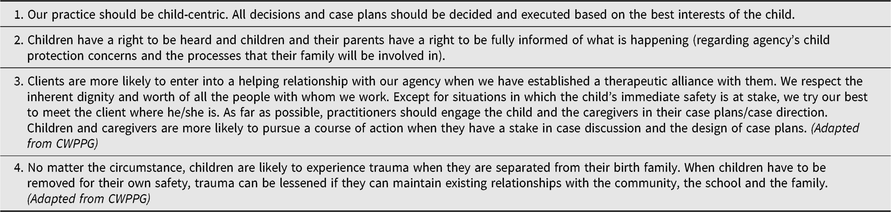
Firstly, a crucial aspect in anchoring the trauma-informed approach is the module on principles and values that underpin the management of child welfare issues. In line with the research from the Chadwick Center for Children and Families, we saw that ‘maximizing physical and psychological safety for children is the first essential element of a trauma-informed child welfare system’ (Chadwick Trauma-Informed Systems Project, 2013, p. 15). On top of building safety for the children, there was an understanding that the families facing child welfare issues still had the right to maintain some control and share in decisions together with the professionals (Chadwick Trauma-Informed Systems Project, 2013). This was another key area that was highlighted and adopted in our principles. We also took information from the Child Welfare Policy and Practice Group (CWPPG)’s research on factors in child welfare interventions that gave rise to positive outcomes, incorporating some aspects that were seen as ‘a foundation for any practice model’ ((CWPPG), n.d.). Table 1 shows the principles in our practice model that encapsulate our beliefs about building safety for a child and sharing autonomy with families, while working in the best interests of the child.
Key principles and values encapsulating trauma-informed approaches

These principles and values now form a core component of the training that every practitioner goes through when they enter our centre. Supervisors were equipped and encouraged to use the principles and values in case discussions, and practitioners have made intentional efforts to practice the principles in their casework.
Our practitioners found that these principles increased their awareness of the voices of the children and thus the need to engage them. They felt that their sensitivity to the children’s needs was heightened, and there was an intentionality in being child-centric in their work with the families. There was also a shift in perspective about engaging all members of the families, including the perpetrators, through the lens of building a therapeutic alliance with them.
The second area that anchored the trauma-informed approach in the model is the module on reflections of the practitioner’s attachment history and personhood and how these factors might impact on their casework. This module was developed with the understanding that practitioners can be affected by vicarious trauma through their work with traumatised individuals (Figley, Reference Figley and Stramm1995), which can produce issues of countertransference (Saakvitne & Pearlman, Reference Saakvitne and Pearlman1996) and blocked empathy (Trippany, Kress, & Wilcoxon, Reference Trippany, Kress and Wilcoxon2004). In order to sustain the difficult work of journeying with these clients, who would often be members of families facing child welfare issues, Danylchuk (Reference Danylchuk2015, p. 2) wrote that a constant goal of a trauma therapist is to be aware of his ‘own self, history, patterns, emotional triggers and reactions, and levels of comfort or discomfort with emotions’. The decision to incorporate the module on reflections stemmed from our belief that it would develop practitioners with a greater capacity for self-awareness and resilience, therefore having higher effectiveness and carrying more empathy with these families (Houston, Reference Houston2015). This would not only yield benefits for the practitioner’s relationship with the clients, but also for his emotional health (Danylchuk, Reference Danylchuk2015).
When the model was first rolled out, all practitioners in the centre went through this process of reflection in small groups, facilitated by supervisors. Subsequent practitioners who joined the centre were encouraged to go through the reflective module in their individual supervision sessions. As practitioners reflected on their attachment history and the use of self in their work, they found that the process enabled them to increase their reflective capacity, identifying triggers that had arisen from their childhood experiences and understanding how these experiences affected the way they perceived the cases. They felt that it made them keenly aware of how they were affected by their own social environment and they tried to use this awareness to prevent countertransference and bias in their assessment of families.
The third aspect that focuses the work in terms of being trauma-informed is the assessment tool that is used in the model. This assessment tool captures pertinent information about the adults in the family and their caregiving function, such as their moral commitment, their attunement to the children and their commitment to change and safety plans. It was developed based on various research studies, such as the Parenting Interactions with Children: Checklist of Observations Linked to Outcomes (PICCOLO) instrument (Roggman, Cook, Innocenti, Norman, & Christiansen, Reference Roggman, Cook, Innocenti, Norman and Christiansen2013), Sonja Parker’s Circles of Support and Safety (Parker, Reference Parker2015) and training by Dr Pauline Ann Meemeduma in her Child Rearing Systems Framework in 2012. This training, titled Child Centred Practice-Generic Workshop, was held by the Singapore government for social service practitioners. During the training, it was stated that the adult characteristics, such as the willingness, capacity and competency of the adult to undertake the care, safety and protection of a child, were the most important aspects of child rearing systems (Meemeduma, Reference Meemeduma2012). The resulting assessment tool focused on these adult characteristics in order to identify the areas that resulted in harm to the children.
Practitioners were trained in using the assessment tool and are encouraged to use it whenever they are faced with child welfare issues. In using this assessment tool, the practitioners have found that it helps them to have assessments of the family that are concrete and have depth. The practitioners found the components of adult characteristics beneficial in enabling them to know what areas to observe in a systematic and clear manner and they also felt that the assessment allowed them to present clear risk assessments of the harm to the child. These findings were drawn from qualitative interviews with practitioners. The interviews were held every 2 months for a period of 6 months and were conducted by the research team.
The trauma-informed principles, knowledge and practices implemented through the adoption of this framework, despite being largely taken from international literature, deepened the team’s understanding of the impact of trauma on children. The principles also guided the team to respect the rights of the child and their parents, regardless of the situation. However, the execution of the framework brings with it some challenges. In Singapore, it is culturally acceptable to inflict some physical punishment and shame on children during discipline. The use of such punishment does not result in an immediate report to Child Protective Services. As a result, practitioners struggle to bridge the expectations of the framework and the cultural ideology of discipline and punishment. Our FSC understands this to be a knowledge gap in our society, where the rights of a child are commonly undermined, and the use of punitive punishment acceptable. It is therefore of paramount importance for the agency to continue to use the framework and explain to parents and stakeholders the impact of punitive punishment and shaming on children. The agency will also need to develop other interventions to work with parents to use alternative parenting strategies.
Conclusion
The implementation of the child welfare practice model led to a centre-wide shift towards trauma-informed practice, through which the holistic safety of the children, building of a therapeutic alliance and awareness of the practitioner’s self in practice became cornerstones of our work with our clients. While the practice model is targeted at managing child welfare cases, these principles transcend child abuse issues and are reflected in our work with other clients as well. In this work, during which practitioners are faced with ambiguity in cases and a tension between good and harm, this trauma-informed approach enables us to hold on to hope for progress in these complex families and allows us to maintain the energy to stay out the journey with them.
Author ORCIDs
Ng Yi Ying, 0000-0002-8603-023X
Acknowledgements
We would like to acknowledge the support given by Dr Irene Ng and Dr Neo Yu Wei for her guidance and advice in the beginning phase of our practice model. We thank Caleb Wong for his contributions throughout the research journey. We also want to appreciate our colleagues, past and present, who contributed to the research in one way or another.