Implications
Meat consumers in developed countries, such as Spain, increasingly value nutritional quality. Obtaining a healthier lipid profile by means of grazing might contribute to increasing lamb meat consumption. Sheep grazing is subjected to seasonal restrictions in Mediterranean areas, in particular, during the lambing periods, when pasture shortages oblige weaned lambs to be fed on concentrates. However, indoor rearing with feed often has negative nutritional repercussions for lamb meat because it results in high levels of SFA and n-6 PUFA. In contrast, allowing pregnant and lactating ewes to graze local stubble and pastures may contribute to improving meat quality.
Introduction
The nutritional quality of lamb meat is often associated with its fatty acid (FA) profile. Ruminant meat fat contains relatively high proportions of saturated fatty acids (SFAs) and is considered less healthy than other meats due to the relation between the consumption of saturated fats and cardiovascular risk (Popova et al., Reference Popova, Gonzales-Barron and Cadavez2015). Moreover, the profiles of monounsaturated and polyunsaturated fatty acids (MUFA and PUFA) have nutritional relevance for lamb meat. In recent years, increasing attention has been paid to the n-6/n-3 PUFA ratio and to conjugated linoleic acids (CLAs) because of their nutritional implications for humans. Excessive amounts of n-6 PUFAs and a high n-6/n-3 ratio, both increasingly found in western diets, promote the pathogenesis of many non-communicable diseases, including cardiovascular, cancer, and inflammatory and autoimmune diseases (Simopoulos, Reference Simopoulos2002). For this reason, an n-6/n-3 ratio of up to 4 is recommended in the human diet for to help maintain good cardiovascular health (Molendi-Coste et al., Reference Molendi-Coste, Legry and Leclercq2011). Ruminant meat is a dietary source of CLA for humans and its consumption has been related with potential beneficial effects on health, including modification of body composition, with a reduction in fat mass, and because of its antiatherogenic, lipid-lowering, antidiabetogenic and immunomodulatory properties (Haro et al., Reference Haro, Artacho and Cabrera-Vique2006). In addition, the FA profile is used to calculate different nutritional indexes (saturation, atherogenic and thrombogenic) for application in human nutrition for the prevention of certain diseases (Ulbricht and Southgate, Reference Ulbricht and Southgate1991).
The composition of lamb meat fat depends on a large number of factors related with animal genetic and rearing practices. Among them, the diet given to ewes and lambs is commonly considered as the main factor influencing the resulting meat lipid profiles. Sheep diets may include graze plants, cereals and mixed diets from crops, natural pastures and agro-food by-products, and their lipid profile may vary considerably as a consequence. Graze plants are rich in triacylglycerols with linolenic acid, while cereal grains contain triacylglycerols with high levels of linoleic and oleic acids, which are widely hydrogenated by rumen bacteria to form oleic acid and stearic acid, the most abundant FAs, together with palmitic acid, in lamb meat (Cividini et al., Reference Cividini, Levart, Žgur and Kompan2014; Popova et al., Reference Popova, Gonzales-Barron and Cadavez2015). Thus, graze-based diets are suitable for obtaining lamb meat with a healthier lipid profile (Santé-Lhoutellier et al., Reference Santé-Lhoutellier, Engel and Gatellier2008). However, grazing zones are scarce in many Spanish regions and are often reserved for adult sheep, so that weaned lambs are reared indoors with grain-based feeds before being slaughtered at around 25 kg live weight (light lambs) to obtain meat with a weak mutton flavour, in accordance with consumer preferences in European Mediterranean countries. Despite this, recent studies advise that indoor rearing practices may have negative repercussions for the FA profile because of the higher n-6/n-3 ratio achieved in light lamb fat (Blanco et al., Reference Blanco, Giráldez, Prieto, Morán, Andrés, Tejido and Bodas2015; Urrutia et al., Reference Urrutia, Mendizabal, Insausti, Soret, Purroy and Arana2015; Campo et al., Reference Campo, Muela, Resconi, Barahona and Sañudo2016).
Segureña sheep farmers aim to exploit local agro resources to improve meat quality as part of an ecological and sustainable production process. Segureña sheep reared in southern Spain suffer pasture shortages during the lambing seasons and ewe grazing may be considered an alternative strategy to using PUFA-enriched feeds containing oils, seeds, cakes or coated fats. The use of graze-based diets in pregnant and lactating ewes may contribute to reducing the n-6/n-3 ratio of lamb meat, particularly in young lambs fattened for short periods, as in the case of Segureña light lambs. During pregnancy and lactation, Segureña ewes traditionally graze on cereal stubble and fallow land (from June to September) and mountain pastures, including shrubs, herbs and trees (from October to May). Depending on the climatology, ewes may occasionally be fed with straw, grain or feed in winter. However, there is limited information about the effect of ewe grazing on the meat lipid profile in this type of Mediterranean lambs, although dietary studies performed with suckling lambs reported increased meat levels of C18toC22n-3 PUFA and/or CLA when cereal grains were replaced by graze plants in the maternal diet (Mazzone et al., Reference Mazzone, Giammarco, Vignola, Sardi and Lambertini2010; Joy et al., Reference Joy, Ripoll, Molino, Dervishi and Álvarez-Rodriguez2012). So, ewe grazing might result in a greater accumulation of these PUFAs in suckling lamb muscle, which may, in turn, contribute to a more favourable lipid profile in weaned lamb meat. The objective of this trial was to determine the effect of traditional Segureña ewe grazing (stubble and Mediterranean shrubland) during pregnancy and lactation on the FA composition of the meat obtained from light lambs fed on concentrate.
Material and methods
Animals and diets
The research project was approved by the 145/2015 report of the Ethical Committee on Animal Research of the University of Murcia, Spain. The experiment was conducted in a farm located in the Segura mountain range, north-west Murcia, Spain, between August 2015 and July 2016. The farm (with an extension of 960 ha in total) had two types of grazing/browsing zones: (i) cereal stubble and fallow land, and (ii) Mediterranean shrubland (see identified plants in Table 1). The cereal stubble zone (652 ha) included crop areas with barley (60.2%), wheat (20.1%) and oats (19.7%). The Mediterranean shrubland zone (308 ha) included mountain areas with strong slopes (11.2%) which reduced the useful area for grazing. The study of the grazing area by aerial photography and visual surveys of the vegetal cover in situ showed that the soil surface 37.5% bare, while the useful grazing surface was composed of trees (26.0%), herbaceous plants (8.3%) and shrubs (29.2%) species (average values obtained from two seasonal measurements).
Plants identified in the grazing zones

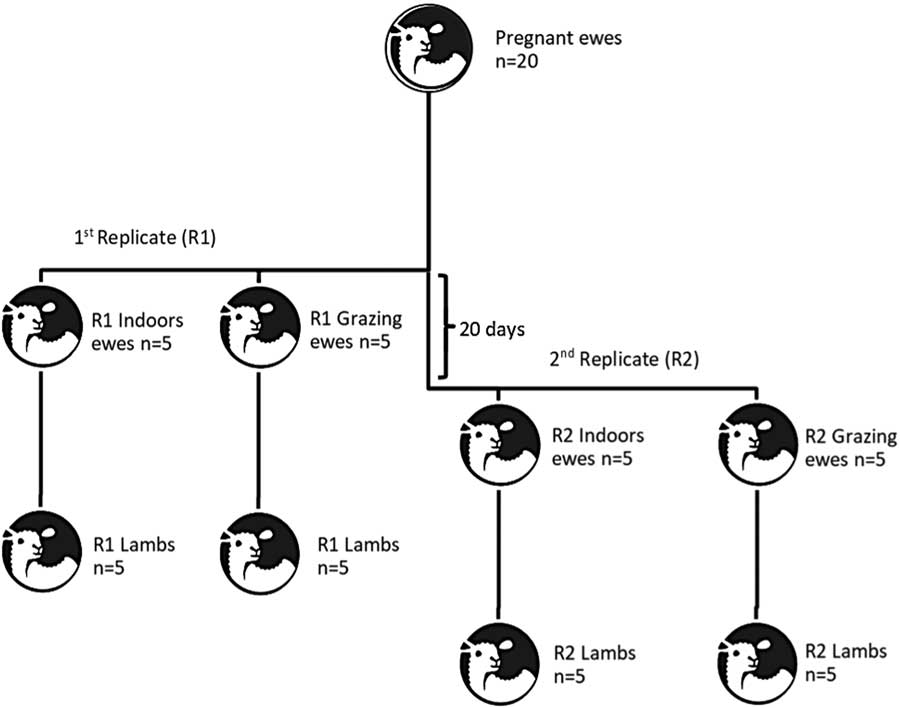
Seasonal sampling (autumn or spring) of ewes and lambs is summarized in Figure 1. Pregnant ewes (Segureña breed) were randomly assigned to two different rearing systems during pregnancy (150 days) and lactation (45 days): (i) indoor-feeding on barley grain and lucerne pellets at 1 : 1 (w : w); or (ii) grazing about 8 h daily. Basically, the ewes grazed on stubble and fallow land during pregnancy and shrubland during lactation (autumn season), or on straw forage during pregnancy and shrubland during lactation (spring season). Grazing ewes went out in the morning without their lambs and were confined in the afternoon together with the lambs in a collective pen, where they had a small amount of cereal straw (about 200 g per ewe and day) for bedding and in the feeders. For their part, the indoors ewes were raised in individual pens along with their lambs to control feed intake. Each ewe received 1.2 kg barley grain plus alfalfa pellets, and 200 g cereal straw daily. Two ewe groups were separately reared with a lag time of 20 days in each season, in total, two spring groups plus another other two autumn groups (two replications per each season). For the first replication, two groups of 10 pregnant ewes were randomly allocated to their respective grazing/indoor locations. Twenty days later, another two groups of 10 pregnant ewes were randomly allocated for the second replication. Spring and autumn lambs began to be born in April 2015 and October 2015, respectively, and 45 days elapsed between the first and the last births. The lactation periods ran from April to May in 2015 (spring lambs) and from October to November in 2015 (autumn lambs).
Seasonal sampling (autumn or spring) of ewes and lambs.

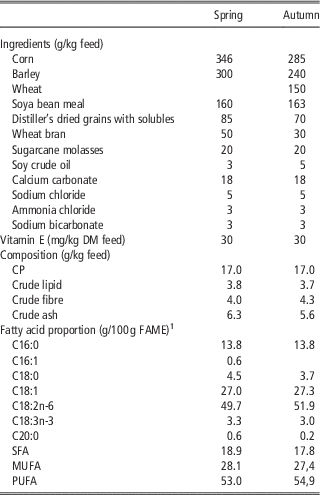
All the lambs were weaned when they reached the weight of 13.1±0.9 kg. A total of 40 weaned lambs (5 lambs×2 rearing systems×2 seasons×2 replication groups) were given a commercial concentrate feed manufactured by a local company. Two different concentrates made with the same ingredients were used in each season (one per replication group). The ingredients and average compositional data of the feeds for lambs are shown in Table 2. All the lambs were fed ad libitum for 80 days (the last 17 transition days from lactation to weaning plus 53 post-weaning days), coinciding with their post-weaning stage, until they reached a live weight of 25±2 kg (at 98.3±3.6 days of age), following the practices recommended by Segureña farmers. During the days of transition from lactation to weaning, the lambs were fed in creep feeders. The lambs were reared in individual pens from May 2015 to July 2015 (spring lambs) and from November 2015 to February 2016 (autumn lambs). All the lambs were weighed weekly during post-weaning and twice a week in the last week. The average values of live weight and daily gain (ADG) during the lactation stage (45 days from birth to weaning) increased from 3.4±0.4 kg to 13.1±0.9 kg, with an ADG of 215.5±21.2 g. Live weight increased from 13.1±0.9 kg to 24.8±2.1 kg, with an ADG of 219.5±17.1 g during the post-weaning stage. The average daily feed intake (ADFI) for weaned lambs was 693.6±54.0 g per animal and day. There were no significant differences (P>0.05) in the ADG and ADFI between lamb groups. All handling practices followed the recommendations of the European Council Directive (2010) for the protection of animals used for experimental and other scientific purposes, and all of the animals were able to see and hear other lambs. Two slaughtering periods (5 lambs×2 rearing systems×2 replication groups) were programmed for the spring (from 12 June to 2 July 2015) and autumn (from 18 to 27 February 2016) lambs. The same number of male and female lambs was sampled.
Basal diet for weaned lambs

SFA=saturated fatty acids; UFA=unsaturated fatty acids; PUFA=polyunsaturated fatty acids.
1 Fatty acids quantification limit: 0.05 g/100 g FAME.
Meat sampling
The lambs were slaughtered in a local slaughterhouse according to European Union regulations and the carcasses were chilled at 2°C for 48 h in a cooling room. The average values for carcass weight and dressing percentage (expressed as the ratio between carcass weight at 48 h post mortem and slaughter lamb weight, multiplied by 100) were 13.0±1.1 kg and 52.0±3.8%, respectively. There were no significant differences (P>0.05) in the carcass weight and dressing percentage between lamb groups. Then, the loins (Longissimus thoracis et lumborum muscles) were removed from the carcasses and filleted (1.5 cm thick) by a professional butcher in a cutting room at 6°C. Meat samples were vacuum packed using bags (170×250 mm) of plastic barrier film (three layers of coextruded PA/PE 20/70, oxygen transmission rate 30 to 50 cm3/m2 per 24 h (Bolsera Murciana S.L., Murcia, Spain) and then frozen at −18°C (total lipids) or −80°C (FA) for up to 3 months.
Total lipids and fatty acid analyses
Intramuscular fat (expressed as g fat per 100 g meat) was determined by the Soxlhet method (ISO 1443., 1973), using a Det-Gras N2 extraction unit (Selecta, Madrid, Spain). Lipids were extracted according to a modified version of the Folch method. Briefly, the lipid fraction was extracted using a chloroform : methanol solution (1 : 1, v/v), followed by the addition of only chloroform. After mixing with 1 M KCl, the organic phase containing the lipid fraction was separated and taken to dryness. Two lipid extractions were performed for each sample. Methyl ester undecanoate (CAS 1731-86-8; Sigma-Aldrich, St. Louis, USA) was used as internal standard for the quantification, and the mixture was transmethylated with 40 μl of 2 N KOH in methanol, vortexed for 1 min, left to stand for 5 min, and centrifuged at 1800×g for 5 min. The supernatant was transferred to a vial before being injected into a 6890N series gas chromatograph (Agilent Technologies, Madrid, Spain) coupled to a flame ionization detector. An Agilent HP-88 capillary column (60 m×250 μm×0.20 μm) and a flow rate of 1.4 ml/min of He, and split 1 : 1 were used. The sample injection volume was 1 μl. The working temperatures of the injector and FID detector were 250°C and 260°C, respectively. The oven temperature ramp used was: 125°C initial temperature; 125°C to 145°C at 8°C/min; 145°C for 26 min; 145°C to 220°C at 2°C/min; and 220°C for 1 min. The identification and quantification of FA were carried out as described in (Cardenia et al., Reference Cardenia, Massimini, Poerio, Ventrurini, Rodríguez–Estrada, Vecchia and Lercker2015) using two standard mixes: (i) FAME mix C4 to C24 (Supelco, Bellefonte, PA, USA); and (ii) No. 05632 mix linoleic acid methyl ester, cis/trans-isomers (Sigma-Aldrich). Fatty acids were expressed as a proportion of identified total FAME (g/100 g).
Statistical analysis
A total of 40 lamb loin pairs from the respective treatments (grazing-spring, indoors-spring, grazing-autumn and indoors-autumn) were sampled. Average values of the dependent variables for individual lamb loins were analysed using the Statistix 8.0 for Windows software (Analytical Software, Tallahassee, FL, USA). Intramuscular fat data were analysed using a simple ANOVA in a randomized design with two rearing system levels (grazing and indoors) (fixed factors). The loins from different seasons were not compared between them because of the seasonal differences in the feed ingredients used. The replication group (ewes and lambs) and slaughtering session were considered as random factors. A Tukey test was used to compare the least square means, which were considered to be statistically different when P<0.05.
Results
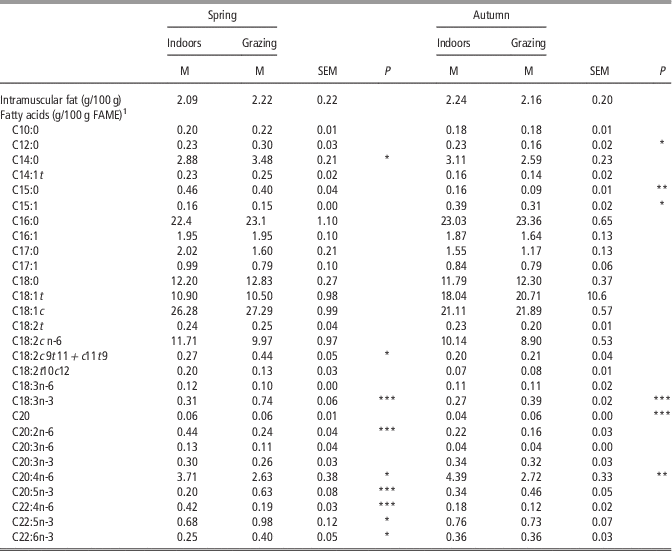
The effects of ewe rearing system on the total fat content and FA profile of lamb meat are shown in Table 3. The average content of intramuscular loin fat (2.2±0.2 g/100 g meat) was similar in the samples from all the dietary groups. Lamb meat mainly contained C18:1, C16:0, C18:2 and C20:4 FAs, while its proportion of highly unsaturated C18 to C25 FAs and CLA was quantitatively of little relevance. Neither seasonal grazing method had any relevant effect on the levels of the main lamb FAs, including C18:1c, C16:0, C18:1t and C18:2c n-6, and so their effects on the FA profile were quantitatively unimportant, except for the C20:4n-6. Spring ewe grazing clearly increased the C18:3 n-3 and most of its n-3 metabolites, including C20:5n-3, C22:5n-3 and C22:6n-3 and CLA (C18:2c9t11+c11t9). This fact was associated with a lesser proportion of some n-6 PUFAs, particularly C20:4n-6, C20:2n-6 and C22:4n-6, which are metabolites formed from C18:2c n-6. Autumn ewe grazing also increased the C18:3n-3 and C18:3n-6 proportions, decreased the C20:4n-6 proportion, but did not modify the proportion of other PUFAs, including CLA.
Effect of ewe rearing system (indoors v. grazing) on the total content and the lipid profile in intramuscular lamb fat

c andt :cis and trans specific isomers.
Ewe diet effects: *P<0.05, **P<0.01, ***P<0.001.
1 Fatty acids (g/100 g FAME); average FAME content: 0.664 mg FAME/g fat. Quantification limit: 0.01 g/100 g FAME.
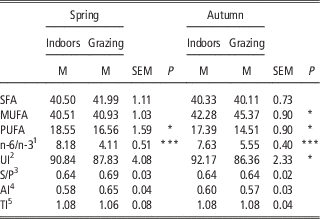
Overall values for the different FA categories and indexes are shown in Table 4. Segureño lamb loin contained about 40% SFA. Ewe grazing did not involve any reduction in SFA proportions with respect to the diet based on barley and lucerne. Autumn and spring FA data confirmed that the maternal rearing system modulated the PUFA profile in concentrate-fed lamb meat. Regardless of the season, ewe grazing resulted in a reduction of the PUFA proportion and the n-6/n-3 ratio of intramuscular lamb fat, which was mainly reflected in the proportions of C20:4n-6. In contrast, ewe grazing only increased the MUFA content in the autumn but not in the spring lamb meat. Compared with the diet based on barley and lucerne, the consumption of graze plants by ewes improved the proportion of n-3 PUFA in weaned lamb meat, with the subsequent nutritional benefit for meat consumers. However, this did not affect the saturation, atherogenic and thrombogenic indexes calculated for the lamb meat. In contrast, the unsaturation index, a value potentially affecting meat fat oxidative stability, was higher in the lamb meat samples from indoor-fed ewes because of their higher levels of PUFA.
Effect of ewe rearing system (indoors v. grazing) on the nutritional indexes of intramuscular lamb fat

SFA=saturated fatty acid; UFA=unsaturated fatty acid; PUFA=polyunsaturated fatty acid.
Ewe diet effects: *P<0.05, **P<0.01, ***P<0.001.
Fatty acids (g/100 g FAME); average FAME content: 0.664 mg FAME/g fat. Quantification limit: 0.01 g/100 g FAME.
1
 $${\rm n{\hbox-}6}/{\rm n{\hbox-}3}{\equals}\Sigma {\rm n{\hbox-}6}\,{\rm PUFA}/\Sigma {\rm n{\hbox-}3}\,{\rm PUFA}$$
2 UI: Unsaturation Index calculated as the sum of the percentage of UFAs multiplied by their number of double bonds.
3
 $${{\rm S} \over {\rm P}}\left( {{\rm Saturation}\,{\rm Index}} \right){\rm \,{\equals}}\,{{{\rm C}{\rm 14\colon0{\plus}C}{\rm 16\colon0{\plus}C}{\rm 18\colon0}} \over \mathop{\Sigma}\!{{\rm MUFA{\plus}}\mathop{\Sigma}\!{{\rm PUFA}} } }}$$
4
 $${\rm AI }\left( {{\rm Atherogenic}\,{\rm Index}} \right){\rm \,{\equals}}\,{{{\rm C}{\rm 12\colon0{\plus}4}{\times}\,{\rm C}{\rm 14\colon0{\plus}C}{\rm 16\colon0}} \over {{\Sigma}{{\rm MUFA{\plus}}{\Sigma}{\left( {{\rm n {\vskip 1pt {\hbox -}} {\vskip 0.2pt 6}}} \right){\rm {\plus}}} {\Sigma}{\left( {{\rm {\rm n {\vskip 1pt {\hbox -}} {\vskip 0.2pt 3}} \right)} } }}$$
5
 $${\rm TI (Trombogenic}\,{\rm Index)\,{\equals}}\,{{{\rm C}{\rm 14\colon0{\plus}C}{\rm 16\colon0{\plus}C}{\rm 18\colon0}} \over {{\rm 5}{\times}\mathop{\Sigma}\!{{\rm MUFA{\plus}5}{\times}\mathop{\Sigma}\!{\left( {{\rm n {\vskip 1pt {\hbox -}} {\vskip 0.2pt 6}}} \right){\rm {\plus}3}{\times}} \mathop{\Sigma}\!{\left( {\rm n {\vskip 1pt {\hbox -}} {\vskip 0.2pt 3}} \right){\rm {\plus}}{{\mathop{\Sigma}\!{{\rm (n {\vskip 1.6pt {\hbox -}} {\vskip 0.2pt 3)}} } \over {\mathop{\Sigma}\!{{\rm (n {\vskip 1.6pt {\hbox -}} {\vskip 0.2pt 6)}} }}} } }}$$
Discussion
Previous studies have also seen that Segureña light lambs provide a meat with low fat infiltration. The percentages of intramuscular fat reported for lamb loin do not reach 2.5 g/100 g (Nieto, Reference Nieto2013; Ortuño et al., Reference Ortuño, Serrano and Bañón2015). Regardless of the diet, the levels of intramuscular lamb fat can be affected by other factors (sex, breed, individuals, slaughter age, rearing, etc.), which were controlled in our study, as homogeneous lamb groups from the same flock (with the same number of males and females and similar average slaughter weight), were compared. Moreover, lamb meat fattening mainly occurs at the end of the post-weaning stage, so that individual differences in fatness are usually more evident among heavy lambs than among light lambs. The predominance of oleic, palmitic and linolenic acids observed in intramuscular lamb fat is coherent with the typical FA profiles reported for ruminant meat (Popova et al., Reference Popova, Gonzales-Barron and Cadavez2015). However, the proportion of SFA obtained in our study was slightly lower than those reported for light lamb loin in other studies (43% to 49%) (Sañudo et al., Reference Sañudo, Enser, Campo, Nute, María, Sierra and Wood2000; Nieto, Reference Nieto2013; Urrutia et al., Reference Urrutia, Mendizabal, Insausti, Soret, Purroy and Arana2015; Campo et al., Reference Campo, Muela, Resconi, Barahona and Sañudo2016), which suggests that the diet given to both indoor-fed (with a high level of lucerne pellets) and grazing ewes might have contained low levels of cereal grains compared with other basal diets used in Segureña ewes (Nieto, Reference Nieto2013; Ortuño et al., Reference Ortuño, Serrano and Bañón2015). Nieto (Reference Nieto2013) found 47% SFA in lamb loin intramuscular fat when both Segureña ewes and light lambs were given a commercial grain-based concentrate. On the other hand, the low proportion of highly unsaturated C18-C25 FAs and CLA found in the lamb loin agrees with the data reported in recent studies with light lambs fed on concentrate (Blanco et al., Reference Blanco, Giráldez, Prieto, Morán, Andrés, Tejido and Bodas2015; Urrutia et al., Reference Urrutia, Mendizabal, Insausti, Soret, Purroy and Arana2015; Campo et al., Reference Campo, Muela, Resconi, Barahona and Sañudo2016).
In general, ewe grazing improved the lamb FA nutritional profile in the two seasons studied, despite the fact that there were some seasonal differences for grazing effects, particularly on total MUFA, which might also be related with the slight variations in the PUFA level of the lamb concentrates used. The results obtained in our study reveal the importance of the fat background in lamb muscle. Grazing by ewes is often associated with an improved lipid profile in lamb meat (Popova et al., Reference Popova, Gonzales-Barron and Cadavez2015) because graze-fed ewes produce milk with a high concentration of linolenic acid, which may increase the proportion of n-3 PUFA, vaccenic acid and CLA in suckling lamb meat (Scerra et al., Reference Scerra, Caparra, Foti, Galofaro and Scerra2007; Mel´uchova et al., Reference Mel´uchova, Blasko, Kubinec, Górová, Dubrasvská, Margetín and Soják2008; Serra et al., Reference Serra, Mele, La Comba, Conte, Buccioni and Secchiari2009; Manso et al., Reference Manso, Bodas, Vieira, Mantecón and Castro2011). An increase in dietary n-3 PUFA is often accompanied by a lower n-6 PUFA content in the intramuscular lamb fat, due to a lower n-6 dietary supply (Raes et al., Reference Raes, De Smet and Demeyer2004), while arachidonic acid synthesis is promoted by increased dietary level of C18:2c n-6 (Urrutia et al., Reference Urrutia, Mendizabal, Insausti, Soret, Purroy and Arana2015). Moreover, phenolic secondary compounds from grazed plants may also inhibit FA hydrogenation processes in the rumen, which might also favour PUFA assimilation by the pregnant and lactating ewes and the subsequent transmission to lambs (Lourenço et al., Reference Lourenço, Van Ranst, Vlaeminck, De Smet and Fievez2008; Vasta and Luciano, Reference Vasta and Luciano2011). Thus, the accumulation of FAs before weaning can modify the final FA profile of lamb meat.
The reduction in the n-6/n-3 ratio obtained in our study did not bring it to the value of 4, which is the ratio recommended in the human diet for a good cardiovascular health (Molendi-Coste et al., Reference Molendi-Coste, Legry and Leclercq2011). Reductions in the n-6/n-3 ratio reported for grazing light lambs varied from 13.1 to 1.3 (Santé-Lhoutellier et al., Reference Santé-Lhoutellier, Engel and Gatellier2008), 6.1 to 5.0 (Joy et al., Reference Joy, Ripoll and Delfa2008), 5.5 to 1.9 (Santos-Silva et al., Reference Santos-Silva, Bessa and Santos-Silva2002), 4.5 to 3.2 (Díaz et al., Reference Díaz, Cañeque, Sánchez, Lauzurica, Pérez, Fernández, Álvarez and De la Fuente2011), 15.0 to 3.4 (Luciano et al., Reference Luciano, Biondi, Scerra, Serra, Mele, Lanza and Priolo2013). The increase in the proportion of CLA was another relevant finding, as it has been seen that CLA accumulation is less efficient in young lamb meat (Santos-Silva et al., Reference Santos-Silva, Bessa and Santos-Silva2002). The CLA level in milk and intramuscular fat of ruminants fed forage is associated with an increased forestomach outflow of vaccenic acid (C18:1 t11), whose precursor is linolenic acid (Lourenço et al., Reference Lourenço, Van Ranst, Vlaeminck, De Smet and Fievez2008). In suckling lambs raised by graze-fed ewes, the level of CLA in muscle is higher as the animal age increases, although it depends on muscle metabolism (Serra et al., Reference Serra, Mele, La Comba, Conte, Buccioni and Secchiari2009). Other studies have seen that light lambs allowed to graze provide meat with higher proportions of CLA that those fed on grain concentrate (Santé-Lhoutellier et al., Reference Santé-Lhoutellier, Engel and Gatellier2008; Santos-Silva et al., Reference Santos-Silva, Bessa and Santos-Silva2002; Cividini et al., Reference Cividini, Levart, Žgur and Kompan2014). De La Fuente et al. (Reference De La Fuente, Barbosa, Carriedo, Gonzalo, Arenas, Fresno and San Primitivo2009) studied the seasonal variations related with sheep production and found that the CLA and C18:2 contents increased in ewe milk during spring-summer compared with autumn-winter, which is coherent with the results obtained in our study.
Whatever the case, the traditional rearing practices used by Segureña sheep farmers, based on a rotating pattern of grazing, did not allow a full control of the maternal diet, which limits any possible comparison with the FA data obtained for other lambs reared with maternal grazing. In our study, pregnant and lactating ewes mainly grazed on stubble (summer and early autumn) or on shrubland (late winter and spring). The grazing zone was composed of wide areas of heterogeneous vegetation, including many wild plant species, whose composition might be highly variable (genetic varieties, location in sunny area or not, degree of maturation, seasonal differences, etc.). Other studies with the same handicap also estimated the relative frequency of the floristic composition of pasture to calculate the maternal diet composition (Joy et al., Reference Joy, Ripoll and Delfa2008; Majdoub-Mathlouthi et al., Reference Majdoub-Mathlouthi, Saïd and Kraiem2015). Comparison of the reduction attained in our study for the n-6/n-3 PUFA ratio (from 7.9 to 4.8) and that obtained by Joy et al. (Reference Joy, Ripoll and Delfa2008) (6.1 to 5.0) in light lambs raised with ewes in wet pastures in northern Spain (Pyrenean Mountains), suggests that ‘Mediterranean grazing’ is more effective for reducing this ratio, although there is still a wide margin for improvement with respect the ratio reported for pasture-fed lamb (Cividini et al., Reference Cividini, Levart, Žgur and Kompan2014). Although the description of grazing zones only gives a general idea of the predominant plant FAs eaten by ewes, it can be stated that the consumption of cereal stubble and graze plants by ewes in the present study contributed to the increase in linolenic acid and its n-3 metabolites in lamb meat. This suggests that both graze-based seasonal diets provided more dietary linolenic than the barley and lucerne-based diet. Spanish barley contains around 2 g total lipids per 100 g grain, including unsaturated FAs, such as C18:1 (13%), C18:2 (56%) and C18:3 (6%), while lucerne contains around 2.2 g total lipids per 100 g pellet, including unsaturated FAs, such as C16:1 (1%), C18:1 (8.5%), C18:2 (22%), C18:3 (33%) and C⩾20 (5.5%) (FEDNA, 2016; data expressed as g FA per 100 g fat). Thus, the higher intake of C18:2-triacylglycerols associated with barley grain consumption by indoor-fed ewes may be responsible for the increased levels of C20:4 n-6 and total PUFA found in the corresponding lamb meat. The chemical composition of cereal stubble is affected by the cultivar and climate, as well as the amount of the grains not collected at harvest. The quality of stubble from early maturing cultivars is lower than that from late maturing cultivars, and stubble contains more protein in years of lower rainfall (Landau et al., Reference Landau, Perevolotsky, Bonfil, Barkai and Silanikove2000). On the other hand, some of the identified shrubs, including, rosemary, juniper and sage, among others, are plants rich in n-3 PUFA (Güvenç et al., Reference Güvenç, Küçükboyaci and Gören2012; Dallali et al., Reference Dallali, Llovera, Eras Joli, Houcine and Canela-Garayoa2015; Bakoglu et al., Reference Bakoglu, Kilic and Kokten2016) and secondary phenolic compounds with a potential to modify FA biohydrogenation in the rumen (Moñino, Reference Moñino2010; Rota et al., Reference Rota, Herrera, Martínez, Sotomayor and Jordán2008; Martins et al., Reference Martins, Barros, Santos-Buelga, Henriques, Silva and Ferreira2015; Sánchez-Camargo and Herrero, Reference Sánchez-Camargo and Herrero2017). For example, the C18 n-6/n-3 PUFA average ratio (0.42) estimated in Slovenian mountain pasture by Cividini et al. (Reference Cividini, Levart, Žgur and Kompan2014) was quite similar to that determined (0.36) in samples of Salvia lavandulifolia (sage) collected in our farm (unpublished data). Whatever the case, linolenic acid, being one of the main FAs in the typical diets given to sheep, has a low deposition rate in sheep muscle because C18-PUFA triacylglycerols are widely hydrogenated by rumen bacteria and only around 10% dietary FA passes to the small intestine, avoiding the biohydrogenation process (Raes et al., Reference Raes, De Smet and Demeyer2004). In turn, the linoleic acid assimilated by the animals is also transformed into different metabolites, which, as has been seen, appeared in the lamb meat.
Conclusions
Ewe grazing during pregnancy and lactation basically modulates the PUFA profile of Segureña light lamb fed on concentrate. Ewe grazing acts as an n-3 PUFA-promoting diet, which results in lamb meat with a lower n-6/n-3 ratio due to its lower content of arachidonic acid. In contrast, ewe grazing did not provide any additional reduction in fat saturation with respect to the diet based on barley grain and lucerne pellets. The nutritional profile of lamb fat was improved when ewes grazed on stubble and Mediterranean shrubland. However, the level of CLA in lamb meat was only increased by autumn grazing, which suggests little seasonal differences. Our research confirms that ewe grazing, an ecological rearing practice involving local agro resources, contributes to weaned lamb meat having a more favourable lipid profile and, so, can be recommend to Mediterranean sheep farmers. Future research on new dietary strategies (e.g. the inclusion of antioxidants in concentrates) is necessary to find ways of preserving the level of PUFAs achieved in weaned lamb meat through maternal grazing diets.
Acknowledgements
The authors thank the Instituto Nacional de Investigación y Tecnología Agraria y Alimentaria for project RTA2013-00104-C02-00, under which this work was carried out.