


In the aging world, the predominant form of care and support for older people is non-formal care by family and friends. This care has its costs; there is overwhelming evidence regarding the serious health and psychosocial risks related to long-term caregiving (Pinquart & Sörensen, Reference Pinquart and Sörensen2003). Among the most studied variables are psychological distress, depression, anxiety, and negative emotions (La Fontaine, Read, Brooker, Evans, & Jutlla, Reference La Fontaine, Read, Brooker, Evans and Jutlla2016; Mosquera et al., Reference Mosquera, Vergara, Larrañaga, Machón, del Rio and Calderón2016; Schulz & Sherwood, Reference Schulz and Sherwood2008). Research concerning these variables consistently show the presence of emotional symptomatology and psychiatric morbidity in informal caregivers (Mahoney, Regan, Katona, & Livingston, Reference Mahoney, Regan, Katona and Livingston2005, Pinquart & Sörensen, Reference Pinquart and Sörensen2003; Vaingankar et al., Reference Vaingankar, Chong, Abdin, Picco, Shafie, Seow and Subramaniam2016). Caregivers often experience emotional problems, such as low mood, strain, burden, and feelings of guilt and frustration (Rogero-García, Reference Rogero-García2010). Some studies have also focused on the relationship between positive and negative affect of caregivers. Thus, Robertson, Zarit, Duncan, Rovine and Femia (Reference Robertson, Zarit, Duncan, Rovine and Femia2007) found that caregivers who reported high positive affect do not necessarily reported negative affect, and vice versa. This seems to indicate that the presence of negative feelings derived from the experience of care can coexist with the feelings of growth and satisfaction.
According to the caregiving stress process models (Pearlin, Mullan, Semple, & Skaff, Reference Pearlin, Mullan, Semple and Skaff1990), three interrelated main components should be considered when understanding the experience of stress for family caregivers: (a) Background and contextual factors, mainly referred to sociodemographic characteristics of the caregiver and the care recipient; (b) primary stressors, which can be can be divided into objective primary stressors (i.e., those demands and needs derived from the situation of the care recipient) and subjective primary stressors (i.e., the subjective assessment made by the caregiver of the primary stressors); and (c) secondary stressors, which are produced by primary stressors and include difficulties resulting from caregiving in other areas of life. Moreover, caregiving stress could proliferate through its repercussions on other areas and roles of caregiver’s life
In this framework, caregivers often face conflicts caused by their attempts to balance the demands of their caregiver role and other social roles (e.g., Aneshensel, Pearlin, Mullan, Zarit, & Whitlatch, Reference Aneshensel, Pearlin, Mullan, Zarit and Whitlatch1995). The conflict between the caregiver and employee roles is taking increasing preeminence, partially due to the growing presence of women, usually predominant among caregivers, in the workplace. In the literature, there are two paradigms regarding the balance of care and work. According to scarcity theory (Goode, Reference Goode1960), the demands of elderly care and work compete for a person’s time and energy, ending in a zero-sum game where one role impinges on the other. In contrast, enhancement or enrichment theory (Sieber, Reference Sieber1974) suggests that people with dual roles are better off because the benefits of each role positively spill over into the other. To date, studies have supported both theories and the empirical evidence is, therefore, inconclusive (Trukeschitz, Schneider, Mühlmann, & Ponocny, Reference Trukeschitz, Schneider, Mühlmann and Ponocny2013).
These contradictory results can be explained by the differential experience of work; having a job could be an additional load, primarily when it implies high stress in itself, however, it could also provide time and space for non-care and opportunities for achievement and self-realization. Consequently, there is growing interest in understanding the effects of employment variables and job experience on the emotional state of family caregivers, especially referred to psychological strain, depression, anxiety, and negative affective reactions (Amstad, Meier, Fasel, Elfering, & Semmer, Reference Amstad, Meier, Fasel, Elfering and Semmer2011; Clancy et al., Reference Clancy, Fisher, Daigle, Henle, McCarthy and Fruhauf2019; Duxbury, Higgins, & Smart, Reference Duxbury, Higgins and Smart2011; Hansen & Slagsvold, Reference Hansen and Slagsvold2015). These employment variables would refer to objective work features (i.e., full/part time dedication, work status, type of employment or difficulties at work due to caregiving), while job experience would include subjective issues (e.g., job satisfaction, perceived workplace support or perceived experience of job-caregiving conflict).
Regarding objective variables, the study by Longacre, Valdmanis, Handorf, & Fang (Reference Longacre, Valdmanis, Handorf and Fang2017) found that caregivers who experienced a change in work status due to caregiving (i.e., quitting or retiring early) were more likely to report higher levels of emotional stress. Wang, Shyu, Chen, & Yang (Reference Wang, Shyu, Chen and Yang2011) showed that working full-time and having more difficulty reconciling work and caregiving roles predicted role strain in the family caregivers of older people with dementia. But Edwards, Zarit, Stephens, & Townsend (Reference Edwards, Zarit, Stephens and Townsend2002) did not observe any differences between employed and non-employed caregivers on role overload, worry and strain, and depression.
Characteristics of work settings have also relevant effects on emotional state of employed caregivers. Provision of actual organizational support through policies, practices and procedures (for example, provision of information, psychosocial education, eldercare management programs, referral services, etc.) can reduce caregiver strain among employees (Bohlmann & Zacher, Reference Bohlmann, Zacher, Burke and Richardsen2019). Furthermore, different studies have pointed that workplace flexibility, such as flextime, reduced working hour, or telecommuting, is associated with lower interrole conflict and better psychological outcomes in worker-caregivers (Brown & Pitt-Catsouphes, Reference Brown and Pitt-Catsouphes2016; Wang et al., Reference Wang, Shyu, Chen and Yang2011). Consistently with these findings, Zuba & Schneider (Reference Zuba and Schneider2013) showed that flexible work schedules reduced perceived work-family conflict in family caregivers.
Nonetheless, Reid, Stajduhar, & Chappell (Reference Reid, Stajduhar and Chappell2010) found that subjective appraisal of work interferences played a more important role in emotional outcomes than does objective variables as employment status (i.e., being employed or not). Other subjective factors, such as job motivation (Trukeschitz et al., Reference Trukeschitz, Schneider, Mühlmann and Ponocny2013) or perceived control at work (Fredriksen-Goldsen & Scharlach, Reference Fredriksen-Goldsen and Scharlach2006; Halinski, Duxbury, & Higgins, Reference Halinski, Duxbury and Higgins2018) seem to reduce overload and caregiver strain. Perceived organizational support play also a key role (Bohlmann & Zacher, Reference Bohlmann, Zacher, Burke and Richardsen2019). For instance, Zacher & Schulz (Reference Zacher and Schulz2015) found that perceived organizational eldercare support, as well as perceived supervisor and coworker support, were negatively related to caregiver strain.
The present study aimed to further know the influence of work experience variables on worker-caregivers’ emotional state by considering both objective and subjective work issues and positive and negative job experiences. The factors here considered stem from Pearlin et al.’s (Reference Pearlin, Mullan, Semple and Skaff1990) stress process model of caregiving and include background and context (e.g., the caregiver’s age or gender), objective indicators of primary stressors (e.g., care recipient’s diagnosis, cognitive impairment, dependence, and behavior problems); subjective indicators of primary stressors (e.g., burden, reaction to behavior problems); and secondary role strains that incorporate work experience variables (role captivity, caregiving interferences at work, job-caregiving conflict, and positive job experience). Moreover, we will consider emotional symptoms and negative affect, but also positive affect. Consequently, our specific objectives are (a) to establish the specific work variables associated with worker-caregivers’ emotional state (i.e., depression, negative and positive affect, and worry-strain) and (b) to examine the contribution of work variables (secondary role strains) to emotional state after controlling the effect of background and contextual variables, and objective and subjective primary stressors, which have been demonstrated to affect caregiver’s emotional state.
Methods
Participants
The sample consisted of caregivers recruited from different family associations and gerontology services in Spain. It was a convenience sample that included the worker-caregivers that were users of any of the services along the assessment period (i.e. April 2014 to June 2015). To be eligible for this study, caregivers had to meet the following criteria: between 18 and 65 years, caring for a dependent person aged 60 or older who had a score equal to or exceeding 1 on the Katz Index of Activities of Daily Living (ADL) (Katz, Ford, Moskowitz, Jackson, & Jaffe, Reference Katz, Ford, Moskowitz, Jackson and Jaffe1963), be the sole or primary person responsible for the person’s care for at least 6 months, and be an active worker.
Caregivers were individually assessed. Their participation in the study was voluntary and was always performed after the caregiver was informed of the goals of the study, guaranteed the confidentiality of the information provided, and provided their signed consent. The final sample consisted of 83 caregivers.
Design and measures
Caregivers’ emotional state
Regarding emotional state, depression was assessed by the Center for Epidemiologic Studies Depression Scale (CES-D) (Radloff, Reference Radloff1977; Spanish adaptation by Soler et al., Reference Soler, Pérez-Sola, Puigdemont, Pérez-Blanco, Figueres and Alvarez1997); the scores ranged 0–60, and those over 15 indicate a high risk of depression. Cronbach’s alpha reached 0.93.
The Positive and Negative Affect Schedule (PANAS) (Watson, Clark, & Tellegen, Reference Watson, Clark and Tellegen1988; Spanish adaptation by Sandín et al., Reference Sandín, Chorot, Lostao, Joiner, Santed and Valiente1999) was used to measure positive (PA) and negative affect (NA) experiences (higher scores meaning greater PA or NA). Cronbach’s alphas were 0.89 for PA and 0.85 for NA.
The Worry and Strain Scale (WS) (Zarit, Stephens, Townsend, & Greene, Reference Zarit, Stephens, Townsend and Greene1998; ad hoc Spanish adaptation) provides information about the worries, tension and physical strain due to care. Higher scores reflect higher affectation in caregiver’s state. Cronbach’s alpha here was 0.79.
Predictor variables
Sociodemographic information and history of caregiving were obtained through a structured personal interview designed ad hoc to assess important variables regarding the caregiver (age, gender, marital status, kinship with care recipient -CR), the patient (diagnosis), and their care context characteristics (duration, hours of care per day, use of formal services and non-formal help, and care of more than one elderly person).
Moreover, the interviewed inquired about the secondary role strains, including family strains (care of children under and over 18 years) and work strains. Specifically, work strains assessed were employment features (e.g., work daily hours, experience, difficulties in reconciling work and caregiving, months as worker…), and the impact of caregiving on work. To assess impact of caregiving on work situation, 11 dichotomous (yes/no) items were elaborated based on Reid et al. (Reference Reid, Stajduhar and Chappell2010) and Gillen & Chung (Reference Gillen and Chung2005) referring to difficulties in job compliance (absenteeism, to arrive late, phone calls about care issues while working, and to leave unexpectedly), changes in work dedication (decrease in work hours, decrease in salary and shift change), and difficulties in professional career (refusal of formation, temporary leave, and refusal of promotion). Additionally, the sum of impacts reported (0–11) was considered. The Kuder-Richardson reliability index for these 11 items in this study was 0.70.
This Katz Index of ADL (Katz et al., Reference Katz, Ford, Moskowitz, Jackson and Jaffe1963; Spanish adaptation by Cruz, Reference Cruz1991), which measures the patient’s disability in self-care activities. Higher scores on the scale indicate greater functional impairment. Cronbach’s alpha for our sample was 0.69.
The Global Deterioration Scale (GDS) (Reisberg, Ferris, de Leon, & Crook, Reference Reisberg, Ferris, De Leon and Crook1982; Spanish adaptation by Cacabelos, Reference Cacabelos1990) measures the level of cognitive impairment and severity of dementia, ranging from 1 (no cognitive impairment) to 7 (severe cognitive impairment).
The care recipient problems were evaluated by the Revised Memory and Behavior Problems Checklist (RMBPC) (Teri et al., Reference Teri, Truax, Logsdon, Uomoto, Zarit and Vitaliano1992; ad hoc Spanish adaptation), which focuses both on their frequency and on the caregiver’s reaction to them. Higher scores in both scales indicate greater frequency and greater caregivers’ reaction. The RMBPC had adequate psychometric properties, with alphas of 0.83 for frequency and 0.89 for reaction.
Caregiver burden was assessed with the Caregiver Burden Interview (CBI) (Zarit, Reever, & Bach-Peterson, Reference Zarit, Reever and Bach-Peterson1980; Spanish adaptation by Martín et al., Reference Martín, Salvadó, Nadal, Mijí, Rico, Lanz and Taussing1996). Higher scores indicate greater subjective burden. Cronbach’s alpha for our sample was also 0.90.
The Role Overload and Captivity Scale (ROC) (Pearlin et al., Reference Pearlin, Mullan, Semple and Skaff1990; ad hoc Spanish adaptation) assesses the time and effort dedicated to care and the perception of captivity being a caregiver. Higher scores indicate more overload and more role captivity, respectively. In this sample, Cronbach’s alpha for both scales were 0.83 and 0.81.
The Work-Caregiving Role Conflict (WCRC) (adapted ad hoc from Pearlin et al., Reference Pearlin, Mullan, Semple and Skaff1990, and Zarit, Stephens, Townsend, & Greene, Reference Zarit, Stephens, Townsend and Greene1998) was applied to obtain additional information about the extent to which the caregiver and worker roles conflict with or complement one another. It offers two scores: Positive work experiences and negative experiences related to job-caregiving conflict (higher scores meaning more positive or negative experiences respectively); the Cronbach’s alphas here were 0.79 and 0.61.
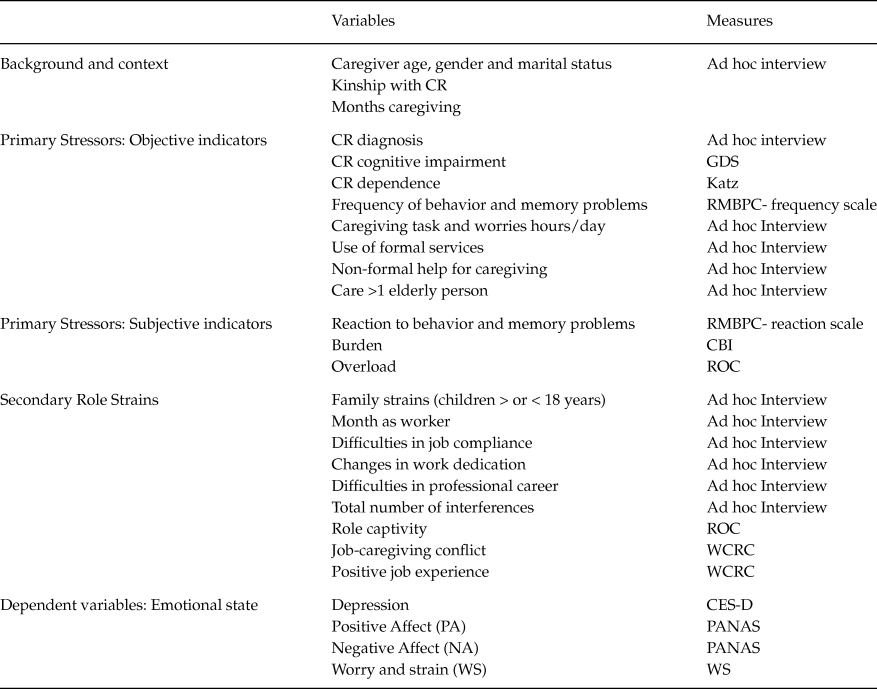
Variables and measures are summarized in Table 1, including dependent variables (emotional state: Depression, positive and negative affect and worry and strain), and predictor variables classified in four blocks according to the stress process model: 1) Background and context (i.e. caregiver and caregiving features), 2) objective indicators of primary stressors (i.e. caregiving load related to caregiving tasks and CR status), 3) subjective indicators of primary stressors (i.e. caregiver’s appraisal of objective primary stressors), and 4) secondary role strains (i.e. family role strains and work strains).
Variables and Measures
Procedure
After providing written consent, caregivers were individually interviewed through a structured protocol that included the ad hoc structured interview, the ADL and GDS. Interviews lasted approximately 30 minutes and were performed by trained psychologists. Afterwards, the caregivers self-administered the remaining instruments under the psychologists’ supervision. Approval for the study was obtained from the center’s Research Ethics Board.
Data analysis
Descriptive statistics (means, standard deviations and percentages) were used to characterize the sample.
Correlations between variables were calculated using Pearson’s correlation coefficients for the quantitative variables and point biserial correlation coefficients for the dichotomous variables. Qualitative variables with more than two possible values were dichotomized.
Predictor variables with significant correlations with each dependent variable (p < .01 taking a conservative approach) were then introduced in the correspondent hierarchical multiple linear regression analyses (one for each dependent variable), considering the four aforementioned blocks according to the stress process model: 1) Background and context, 2) objective indicators of primary stressors, 3) subjective indicators of primary stressors, and 4) secondary role strains. To avoid multicollinearity problems, predictor variables with inter-correlations higher than .70 were excluded from the analysis. Moreover, the mean and standard deviations of residual were examined to ensure accuracy of the model (expected value 0). Furthermore, the Durbin and Watson (Reference Durbin and Watson1951) test was applied to examine the independence of the residuals (value 2 for completely independent).
Results
Characteristics of participants
As can be seen in Table 2, most caregivers in the sample were women (74.7%), the older relative’s children (86.7%) or spouse (13.3%), were married or living with their partner (66.3%) and had university (50.6%) or secondary (34.9%) studies. Their ages ranged between 30 and 64 years (M = 52.35; SD = 6.87). Women also predominated among the care recipients (66.3%). The receivers of informal help had a mean age of 80.71 years (SD = 9.50), with a range between 60 and 96. Most presented with a diagnosis of dementia (90.4%), usually Alzheimer’s type (71.1%).
Features of Participants
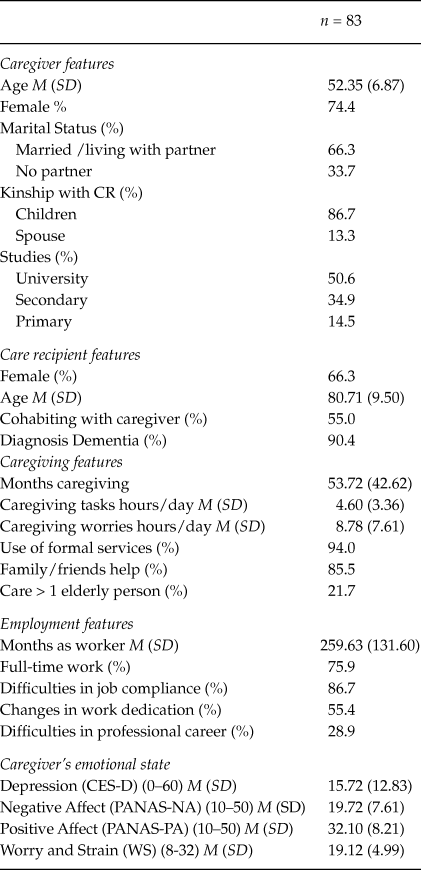
About the half of the caregivers (55%) lived in the same residence as the care recipient. Caregivers spent an average of 8.78 hours per day (SD = 7.61) worrying about care and dedicated an average of 4.60 hours per day (SD = 3.36) to care tasks. They had played this role for an average of 53.72 months (SD = 42.62) (approximately 4.5 years). Most used some kind of formal service (94%), usually day-care centers (68.7%), as well as non-formal help from family or friends (85.5%).
Employment features
Main employment features are summarized in Table 2. Caregivers have been employed for an average of 259.63 months (SD = 131.60) (approximately 21.5 years), and most were employed full-time (75.9%). Part-time work implied a mean of 23.5 hours per week (SD = 10.01). Most caregivers (61.4%) reported that they had none or only some difficulties in reconciling work and caregiving, however, 22.9% reported having many reconciliation difficulties. Moreover, 94% had experienced at least one impact to their employment situation as a result of caregiving, most frequently difficulties with job compliance (86.7%) and changes in work dedication (55.4%). Difficulties in professional career were less frequent (28.9%)
Caregivers’ emotional state
As showed in Table 2, the participants showed an average depression level of 15.72 (SD = 12.83), which was under the cut-off point for the CES-D (16); specifically, 59% of the participants were below that cut-off point (i.e., 41% were over the point for depression symptoms). According to the PANAS (scoring range 10–50), the participants showed high positive affect (PA), M = 32.10; SD = 8.21, and mid negative affect (NA), M =19.72; SD = 7.61, taking as reference the data reported by Sandín et al. (Reference Sandín, Chorot, Lostao, Joiner, Santed and Valiente1999) with Spanish university students, who found an average 30.23 for male and 30.37 for female in PA scores and 20.61 for male and 22.69 for female in NA scores; their emotional balance tended to have a positive affect. Finally, the WS scores (ranging 8–32) reached an average of 19.12 (SD = 4.99). Note that 24.1% used psychotropic drugs.
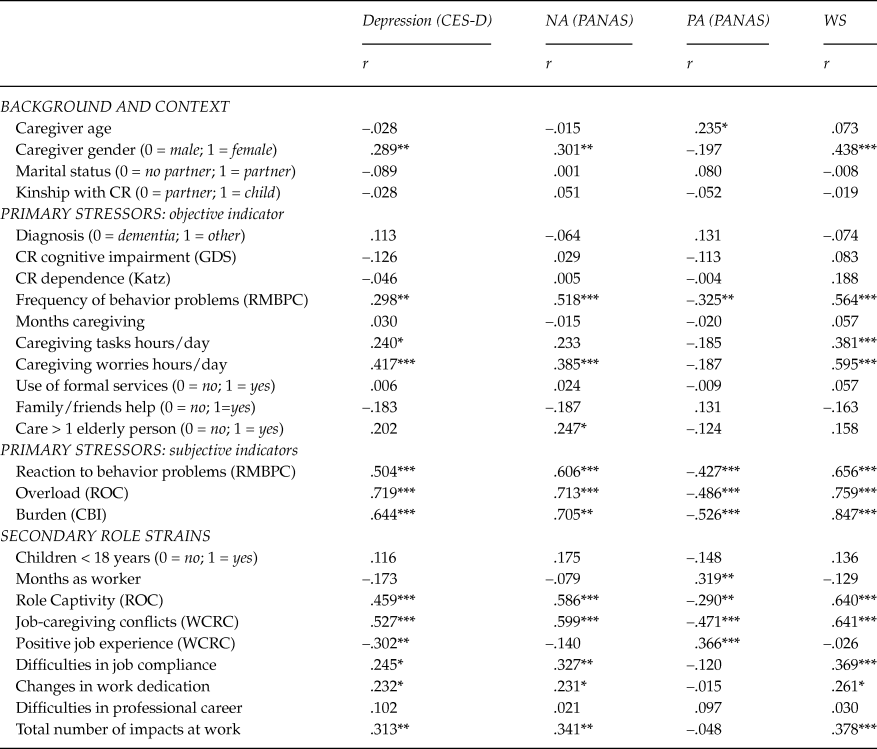
Intercorrelation between the emotional variables was high and significant in all cases (p < .001); depression had a direct significant correlation with NA (r = .762) and WS (r = .635), and inverse significant correlation with PA (r = –.662); PA were also inversely correlated with NA (r = –.475) and WS (r = –.498); and finally, NA and WS had direct correlation (r = .752).
Work experience features associated with caregivers’ emotional state
For each emotional variable (i.e., depression, NA, PA and WS), the correlations with caregiver and care recipient variables, primary stressors (both objective and subjective), and secondary role strains were calculated (Table 3). Hence, significantly correlated variables (p < .01) went into the correspondent regression analysis (Table 4).
Correlations between Stressors and Emotional Variables (n = 83)
* p ≤ .05. ** p ≤ .010. *** p ≤ .001.
Hierarchical Multiple Linear Regression Analysis for Depression, Negative and Positive Affects and Worry-strain (n = 83)
* p < .05. ** p < .010. *** p < .001.
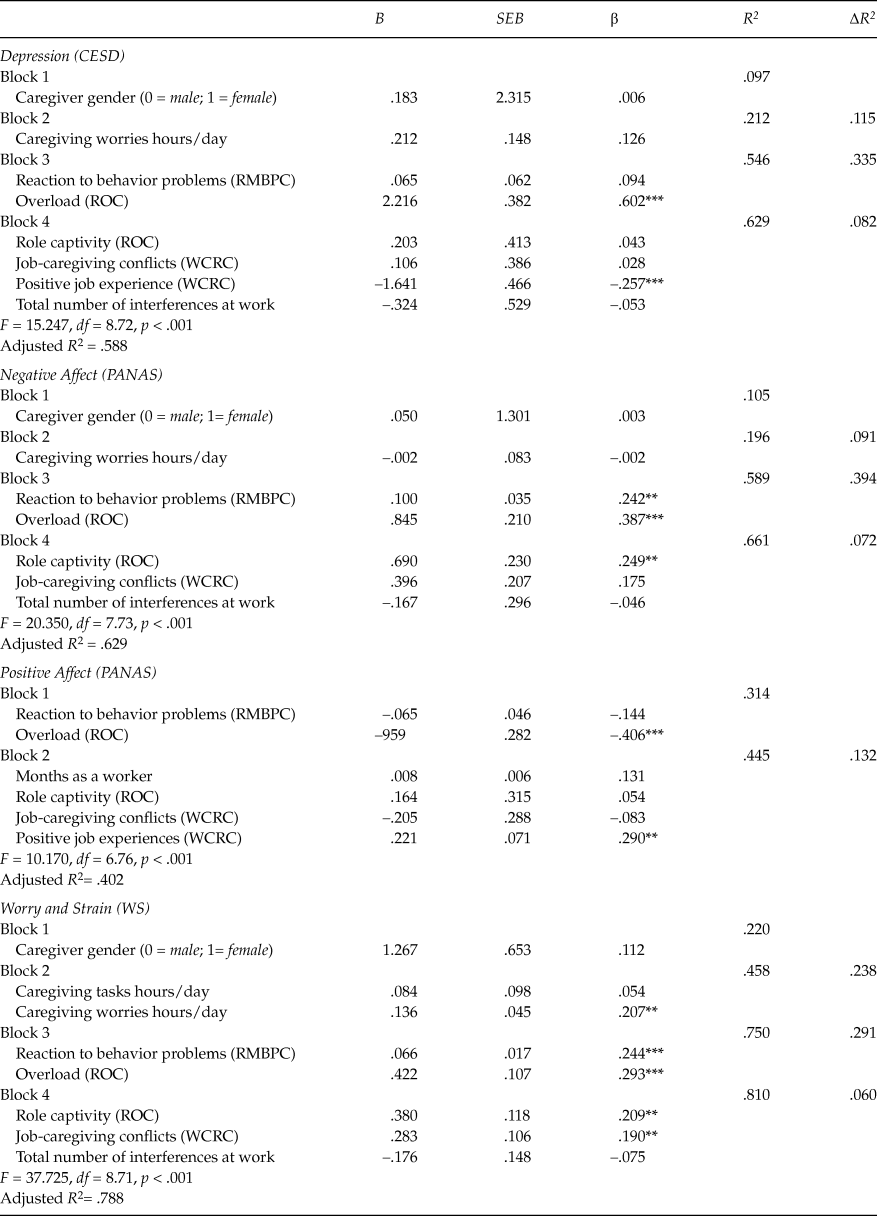
Hierarchical multiple regression analysis performed on variables significantly correlated with depression, showed good residual values (M = 0.00; SD = 1.00), and the Durbin-Watson test value (2.232) was close to 2. The model accounted for 58.8% of the variance with good generalizability (R 2– adjusted R 2 difference = .04). The primary contribution to the explained variance (33.5%) corresponded to subjective indicators of primary stress, and specifically to overload that was the only statistically significant variable (β = .60). The contribution of secondary role strains to the explained variance, after controlling for variables in Blocks 1, 2 and 3, was modest (8.2%), with only one work-related significant variable: positive job experience (β = –.26, p < .001).
Similarly, the regression analysis for NA also offered good residual indices (M = 0.00; SD = 1.00) and Durbin-Watson test value (1.882). The model as a whole accounted for 62.8% of the variance, with good generalizability (R 2– adjusted R 2 difference = .03). The primary contribution to the explained variance (39.4%) corresponded also here to subjective indicators of primary stress, being significant the contribution of both overload and reaction to care recipient’s memory and behavior problems (β = .39 and β = .24, respectively). The contribution of secondary role strains to the explained variance was also modest (7.2%) and, in this case, was only related to role captivity (β = .25, p < .01).
Alternatively, regression analysis for PA showed good residual indices (M = 0.00; SD = 1.00) and Durbin-Watson test value (1.889). This model accounted for 40.2% of the variance with good generalizability (R 2– adjusted R 2 difference = .04). None background-context variables and objective indicators of primary stress were significantly associated with PA; consequently, these blocks were omitted in the model. Nonetheless, the primary contribution to the explained variance (31.4%) corresponded to subjective indicators of primary stress, specifically, overload (β = –.41). The contribution of secondary role strains to the explained variance reached 13.2% and were significantly related only to positive job experience (β = .29, p < .01).
Finally, the WS analysis showed good residual indices (M = 0.00; SD = 1.00) and Durbin-Watson test value (2.337). The model accounted for 78.8% of the variance, with good generalizability (R 2– adjusted R 2 difference = .02). The primary contribution to the explained variance (29.1%) corresponded to subjective indicators of primary stress, being significant the contribution of both overload (β = .29) and reaction to memory and behavior problems (β = .24). Nevertheless, the contributions of the objective indicators of primary stress were high here (23.8%) and were related to the daily hours that the caregivers spent worrying about caregiving (β = .21) but not to the daily hours that the caregivers spent on caregiving tasks. The contribution of secondary role strains to the explained variance was modest (6%) and was related with role captivity (β = .21, p < .01) and job-caregiving conflict (β = .19, p < .01).
Discussion
The present study includes a global and theoretically founded analysis of the work experience variables that affect caregiver’s emotional estate. Because our sample consisted of active worker-caregivers under retirement age, the participant profiles are slightly different from those of other studies that have analyzed caregivers in general, in which the non-worker caregivers tended to be predominant (e.g., 68.5% in Crespo & Fernández-Lansac, Reference Crespo and Fernández-Lansac2014, with a similar sampling procedure). Consequently, the caregivers in the present study are younger and show an over-representation of adult children; nonetheless, the female preeminence is similar to that of previous studies in Spain, as are the care recipient features (Instituto de Mayores y Servicios Sociales, IMSERSO, 2005).
The data show that a good proportion of worker caregivers succeed in reconciling job and caregiving; only 23% report having many reconciliation difficulties. Nonetheless, some impact of caregiving on the caregivers’ employment situations occurred very frequently (94%), in line with previous studies (Gillen & Chung, Reference Gillen and Chung2005; Jenson & Jacobzone, Reference Jenson and Jacobzone2000; Reid et al., Reference Reid, Stajduhar and Chappell2010; Wilson, van Houtven, Stearns, & Clipp, Reference Wilson, van Houtven, Stearns and Clipp2007), which have primarily reported difficulties in job compliance (i.e., phone interruptions, having to leave unexpectedly, arriving late) and, less frequently, changes in job dedication (i.e., decreased work hours or shift changes).
Here, caregivers showed better emotional state compared with previous studies: so that, Crespo & López (Reference Crespo and López2007) reported depression above cut-off point for 55.2% of caregivers vs. 41% here; moreover, PA predominated over NA. This result could be accounted for by the inclusion here of caregivers that do live and do not live with the care recipient, since the last (45% of the participants) could show lower levels of burden and less time in caregiving tasks than those living at the same residence as the care recipient (Heitmueller, Reference Heitmueller2007).
As expected, the multivariate analysis showed that subjective indicators of primary stressor were the primary predictors of caregivers’ emotional state, accounting for most of the variance (33.5% for depression, 39.4% for NA, 31.4% for PA and 29.1% for WS). The significant predictors were overload and reaction to memory and behavior problems. These data align with the repeated evidence of the dominant effect of subjective caregiving stressor over objective stress on the emotional state of caregivers (e.g., Edwards et al., Reference Edwards, Zarit, Stephens and Townsend2002; Stephens, Townsend, Martire, & Druley, Reference Stephens, Townsend, Martire and Druley2001; Wang et al., Reference Wang, Shyu, Chen and Yang2011). Objective stressors (daily hours spent worrying about caregiving) only become significant in predicting worry and strain, not when affect or mood were considered.
Note that some aspects of caregiver’s background and context, namely gender and kinship, which are traditionally associated with the emotional state, did not reach statistical significance in the multivariate analysis here. It could be due to the sampling criteria that precluded the appearance of the usual different dominant gender profiles among the caregivers (i.e., older spouse males vs younger adult child females), which are related to the gender effects on caregiver’s state (Crespo & López, Reference Crespo and López2008).
Based on the proliferation of stress model, more interesting results show a modest contribution of work-related variables in explaining caregivers’ emotional state, particularly for WS, after controlling for the effect of background and primary stressors. These variables only accounted for 8.2%, 7.2%, 13.2% and 6% of the variance for depression, NA, PA and WS. Even more, other potential role strains, such as living with children, do not relate to emotional state. As with the primary stressors, significant work-related predictors referred to subjective rather than objective indicators; the perception and experience of the stressors and conflicts as well as the sense of role captivity seem to have a stronger effect on emotional state than their presence and frequency, as reported by Longacre et al. (Reference Longacre, Valdmanis, Handorf and Fang2017) and Reid et al. (Reference Reid, Stajduhar and Chappell2010). In addition, in line with Edwards et al. (Reference Edwards, Zarit, Stephens and Townsend2002), the results confirm the effect of positive job experience, which has a significant effect on depression and PA. Positive job experience could have a moderating effect on how caregiving stressors affect depression and enhance PA. The data show the importance of considering positive job experiences and positive emotions when analyzing job-caregiving reconciliation.
As a convenience sample that only consisted of worker caregivers in a specific employment context (Spain), the extent to which our findings are generalizable to caregivers in other locations may be limited; even more, the sample size was small, which may have impacted the ability to detect significant results. Moreover, further studies that consider only caregivers cohabiting with the care recipient would be enlightening. Finally, the transversal character of the study does not allow for causal links among the variables.
This study highlights several practical implications related to improving the emotional state of worker caregivers and to enhancing both roles reconciliation: (a) attention should be directed toward positive job experiences because these experiences could moderate the conflicting negative effects on caregiver mood, as well as enhance positive affect; (b) the experience of job-caregiving conflict should be prevented to attenuate worry, strain and stress in worker caregivers; and (c) personal subjective job experience should be a priority in research and interventions with active worker-caregivers.



