Introduction
Episodic memory impairment is known as a core symptom in Alzheimer’s disease (AD; Dubois et al., Reference Dubois, Feldman, Jacova, Dekosky, Barberger-Gateau, Cummings and Scheltens2007). Recent studies proposed that the associative aspects of episodic memory, referring to the processes that combine the different units of an episode into a cohesive whole (Howard, Fotedar, Datey, & Hasselmo, Reference Howard, Fotedar, Datey and Hasselmo2005; Naveh-Benjamin, Reference Naveh-Benjamin2000), are particularly impaired since the prodromal stages (Atienza et al., Reference Atienza, Atalaia-Silva, Gonzalez-Escamilla, Gil-Neciga, Suarez-Gonzalez and Cantero2011; Hanseeuw et al., Reference Hanseeuw, Dricot, Kavec, Grandin, Seron and Ivanoiu2011; Sperling, Reference Sperling2007; Troyer et al., Reference Troyer, Murphy, Anderson, Craik, Moscovitch, Maione and Gao2012, Reference Troyer, Murphy, Anderson, Hayman-Abello, Craik and Moscovitch2008). These studies consistently showed that patients with prodromal AD (prAD) demonstrate significantly greater difficulties than older controls to learn new associations, including word pairs (Hanseeuw et al., Reference Hanseeuw, Dricot, Kavec, Grandin, Seron and Ivanoiu2011; Troyer et al., Reference Troyer, Murphy, Anderson, Craik, Moscovitch, Maione and Gao2012), face-name (Sperling, Reference Sperling2007; Troyer et al., Reference Troyer, Murphy, Anderson, Craik, Moscovitch, Maione and Gao2012), face-location (Atienza et al., Reference Atienza, Atalaia-Silva, Gonzalez-Escamilla, Gil-Neciga, Suarez-Gonzalez and Cantero2011), object-location (Hampstead, Stringer, Stilla, Amaraneni, & Sathian, Reference Hampstead, Stringer, Stilla, Amaraneni and Sathian2011), and symbol–symbol associations (Troyer et al., Reference Troyer, Murphy, Anderson, Hayman-Abello, Craik and Moscovitch2008). This associative learning impairment has been suggested to result from the morpho-functional damage occurring in the hippocampus and related medio-temporal lobe (MTL) structures in prAD (Atienza et al., Reference Atienza, Atalaia-Silva, Gonzalez-Escamilla, Gil-Neciga, Suarez-Gonzalez and Cantero2011; Hanseeuw et al., Reference Hanseeuw, Dricot, Kavec, Grandin, Seron and Ivanoiu2011; Sperling, Reference Sperling2007; Troyer et al., Reference Troyer, Murphy, Anderson, Craik, Moscovitch, Maione and Gao2012). It has indeed been shown that MTL structures, including the hippocampus, play a crucial role in associative memory in normal individuals (Davachi & Wagner, Reference Davachi and Wagner2002; Giovanello, Schnyer, & Verfaellie, Reference Giovanello, Schnyer and Verfaellie2004).
Attempts to clarify the nature of this associative learning deficit have so far been limited to descriptions of its clinical manifestations. Few studies have further explored these deficiencies in the light of theoretical frameworks to enhance the understanding of its underlying cognitive mechanisms. In the current study, we used the Temporal Context Model (TCM; Howard et al., Reference Howard, Fotedar, Datey and Hasselmo2005, Reference Howard, Jing, Rao, Provyn and Datey2009; Sederberg, Howard, & Kahana, Reference Sederberg, Howard and Kahana2008) to investigate cognitive mechanisms that may underlie the associative learning impairment occurring in prAD.
TCM postulates the existence of several cognitive processes acting during episodic encoding and retrieval. In this framework, the cue for episodic retrieval is the current contextual state (Provyn, Sliwinski, & Howard, Reference Provyn, Sliwinski and Howard2007). At encoding, the item representation is bidirectionally linked to the current contextual state representation, which gradually evolves over time. At retrieval, the context retrieved by a recalled item cues for subsequent recalls provided it overlaps with the encoding context of other items (Howard & Kahana, Reference Howard and Kahana1999). The item ability to be bound to and recover contextual states is used in TCM to describe fundamental effects observed in free and cued-recall paradigms (Howard et al., Reference Howard, Fotedar, Datey and Hasselmo2005; Howard & Kahana, Reference Howard and Kahana2002).
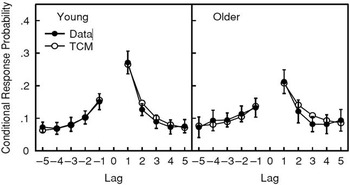
One of these effects, termed the “contiguity effect,” refers to the fact that subjects tend to transition between words that were close together in the list (Howard & Kahana, Reference Howard and Kahana1999; Howard, Kahana, & Wingfield, Reference Howard, Kahana and Wingfield2006; Kahana, Reference Kahana1996). TCM explains this effect by the fact that the context retrieved by the just-recalled item overlaps more with the encoding context of nearby items in the list, which favors the subsequent recall of these nearby items over the recall of remote items in the list (Howard et al., Reference Howard, Fotedar, Datey and Hasselmo2005; Sederberg et al., Reference Sederberg, Howard and Kahana2008). The contiguity effect can be illustrated with the Conditional Response Probability as a function of the lag between items in the list (lag-CRP; Kahana, Reference Kahana1996). This measure estimates the probability of transitioning from a just-recalled word to another word as a function of their distance in the list. In Figure 1, the contiguity effect is reflected by the fact that the lag-CRP curves peak at lags +1 and −1, meaning that the transitions from a just-recalled word to the following or preceding word in the list are the most likely.
Observed and predicted lag-CRP functions for young and older adults in delayed free recall. Error bars are 95% confidence intervals. Figure reproduced from Howard et al. (Reference Howard, Kahana and Wingfield2006), with kind permission from Springer.

Moreover, the item-context binding process is used in TCM to account for the formation of backward (i.e., B-A) and transitive associations (i.e., A-C) between the items of a previously studied list of overlapping word pairs (i.e., A-B, B-C, C-D; Howard et al., Reference Howard, Fotedar, Datey and Hasselmo2005; Provyn et al., Reference Provyn, Sliwinski and Howard2007).
TCM interest resides in the fact that the disruption of its processes may be associated to specific behavioral patterns in free and cued-recall tasks. Using TCM, previous studies have for instance identified that the effect of aging on associative learning results from an inability to form new item-context associations (Howard et al., Reference Howard, Kahana and Wingfield2006; Provyn et al., Reference Provyn, Sliwinski and Howard2007). This item-context binding deficit was manifest as flattened lag-CRP curves in older individuals compared to young adults, which suggested a reduced contiguity effect in healthy elderly (Figure 1; Golomb, Peelle, Addis, Kahana, & Wingfield, Reference Golomb, Peelle, Addis, Kahana and Wingfield2008; Kahana, Howard, Zaromb, & Wingfield, Reference Kahana, Howard, Zaromb and Wingfield2002). This deficit was moreover reflected by smaller proportions of backward (e.g., B in response to A) and transitive intrusions (i.e., words at |lag|=2; e.g., C in response to A) in older adults when performing a paired-associate learning task involving overlapping word pairs (Provyn et al., Reference Provyn, Sliwinski and Howard2007).
To the best of our knowledge, the associative memory deficit in prAD patients has never been examined using TCM. The mapping hypothesis proposed by Howard et al. (Reference Howard, Fotedar, Datey and Hasselmo2005), however, suggests that the cognitive mechanisms involved in TCM could be affected in prAD. This mapping hypothesis assumes that: (1) item representations rely on cortical associative areas, (2) contextual state representations depend on parahippocampal regions, and (3) item-to-context binding and retrieval are enabled by the hippocampus. As hippocampal and parahippocampal regions are more affected in AD than in aging since the early stages of the disease (Dickerson et al., Reference Dickerson, Goncharova, Sullivan, Forchetti, Wilson, Bennett and deToledo-Morrell2001; Dickerson et al., Reference Dickerson, Salat, Bates, Atiya, Killiany, Greve and Sperling2004; Ries et al., Reference Ries, Carlsson, Rowley, Sager, Gleason, Asthana and Johnson2008), one may expect a disruption of the contextual representation, binding and/or retrieval processes in prAD patients, that would be manifest as a reduced contiguity effect in free-recall and fewer backward and transitive associations in free and cued-recall compared to older controls.
The goal of this study was, therefore, to examine the cued-recall intrusions and the free-recall transitions in prAD patients in comparison to older controls, by using a design inspired by Howard et al. (Reference Howard, Jing, Rao, Provyn and Datey2009) that coupled a cued-recall task involving overlapping word pairs and a final free-recall (FFR) task. This method constitutes a powerful tool to examine the associative memory performance to an unprecedented degree of precision. Contrary to the classical behavioral approaches which evaluate the number of correctly and explicitly recalled pairs, this method probes the recall transitions that are incidentally produced, which is supposed to better reflect the underlying associative structure of memory (Howard, Addis, Jing, & Kahana, Reference Howard, Addis, Jing and Kahana2007). We anticipated that, compared to older controls, prAD patients would demonstrate: (1) less backward and transitive intrusions in the cued-recall of overlapping pairs, and (2) a reduction of the contiguity effect, as well as fewer backward and transitive associations in the FFR.
Method
Participants
This study received approval from the Ethical Committee of Saint-Luc University Hospital in Brussels (2012/28FEV/085) and was conducted in accordance with the Helsinki Declaration.
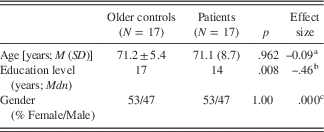
Seventeen older controls and 17 prAD patients participated in this study. They were recruited from a registry established by our research group (Ivanoiu et al., Reference Ivanoiu, Dricot, Gilis, Grandin, Lhommel, Quenon and Hanseeuw2015). There were no significant differences between the two groups in age or gender but the educational level significantly differed between groups (Table 1).
Demographic characteristics of the older controls and patients’ groups.

Note. a Cohen’s d, b r, c Cramer’s V.
The diagnostic of prAD was established using the revised research criteria (Dubois et al., Reference Dubois, Feldman, Jacova, Dekosky, Barberger-Gateau, Cummings and Scheltens2007) which require the presence of early and significant episodic memory impairment in isolation or in association to other cognitive impairment, as well as the presence of at least one biological supportive feature, including hippocampal atrophy, abnormal amyloid deposition, and temporo-parietal hypometabolism. Every participant underwent under neuropsychological, biomarker, and clinical assessments.
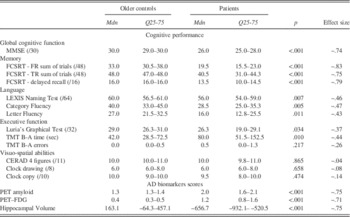
The neuropsychological assessment evaluated: (1) global cognitive function using the Mini Mental State Evaluation (MMSE; Folstein, Folstein, & McHugh, Reference Folstein, Folstein and McHugh1975); (2) episodic memory with the Free and Cued Selective Reminding Test (FCSRT, French version; van der Linden et al., Reference van der Linden, Coyette, Poitrenaud, Kalafat, Calicis and Wyns2004); (3) language using the LEXIS Naming Test (de Partz, Bilocq, De Wilde, Seron, & Pillon, Reference de Partz, Bilocq, De Wilde, Seron and Pillon2001), the Category Fluency Test, and the Letter Fluency Test (Cardebat, Doyon, Puel, Goulet, & Joanette, Reference Cardebat, Doyon, Puel, Goulet and Joanette1990); (4) executive functions with the Trail Making Test (Reitan, Reference Reitan1955) and Luria’s Graphic Sequences (adaptations in French; Bianconi & Reference Bianconi and BusignyBusigny, Personal communication); and (5) visuo-spatial processing using the Clock Drawing Test (Rouleau, Salmon, Butters, Kennedy, & McGuire, Reference Rouleau, Salmon, Butters, Kennedy and McGuire1992) and the Praxis part of the CERAD battery (Morris, Mohs, Rogers, Fillenbaum, & Heyman, Reference Morris, Mohs, Rogers, Fillenbaum and Heyman1988). Scores were considered as impaired if they were inferior to −1.3 SD for the corresponding age and educational level. As required by the revised research criteria (Dubois et al., Reference Dubois, Feldman, Jacova, Dekosky, Barberger-Gateau, Cummings and Scheltens2007), every patient demonstrated significant episodic memory impairment for their age and educational level. Older controls had normal memory scores. The neuropsychological scores for each group are detailed in Table 2.
Cognitive performance and AD biomarker scores for the older controls and patients’ groups

Note. Biomarkers values represent the [F18]-flutemetamol Standard Uptake Value score for PET amyloid, the [F18]-FDG PALZAD score for PET-FDG and the mean hippocampal volume normalized to the intracranial volume (Ivanoiu et al., Reference Ivanoiu, Dricot, Gilis, Grandin, Lhommel, Quenon and Hanseeuw2015).
MMSE=Mini Mental State Examination; FCSRT=Free and Cued Selective Reminding Test; FR=Free Recall; TR=Total Recall; TMT B-A=difference between performances in parts B and A of the Trail Making Test; CERAD=Consortium to Establish a Registry for Alzheimer’s Disease.
The AD biomarker assessment evaluated: (1) amyloid-beta protein deposition using brain [F18]-Flutemetamol positron emission tomography, (2) hypometabolism using brain [F18]-Fluorodeoxyglucose PET (FDG-PET), and (3) hippocampal atrophy using 3 Tesla volumetric brain magnetic resonance (Albert et al., Reference Albert, DeKosky, Dickson, Dubois, Feldman, Fox and Phelps2011; Dubois et al., Reference Dubois, Feldman, Jacova, Dekosky, Barberger-Gateau, Cummings and Scheltens2007; Ivanoiu et al., Reference Ivanoiu, Dricot, Gilis, Grandin, Lhommel, Quenon and Hanseeuw2015). Corresponding results were considered as abnormal when the [F18]-Flutemetamol Standard Uptake Value, the [F18]-FDG PALZAD score, or the mean (from left and right) hippocampal volume normalized to the intracranial volume was less than percentile 10 compared to a control group (Ivanoiu et al., Reference Ivanoiu, Dricot, Gilis, Grandin, Lhommel, Quenon and Hanseeuw2015). As required by the revised research criteria (Dubois et al., Reference Dubois, Feldman, Jacova, Dekosky, Barberger-Gateau, Cummings and Scheltens2007), every patient had at least one positive biomarker (3/3 positive biomarkers in 47% of patients, 2/3 positive biomarkers in 35% of patients, 1/3 positive biomarker in 18% of patients). Older controls were selected to have all the biomarkers negative. Table 2 reports the biomarker median, quartiles 25 and 75 for each group.
The clinical assessment excluded any participant suffering from a known neurological condition, psychiatric disease, or substance abuse. Dementia according to the DSM-IV-TR criteria (American Psychiatric Association, 2000) was excluded via clinical interviews with experienced clinicians (I.A., H.B.) and the diagnosis was supported by functional standardized scales.
Materials
The material and procedure were adapted from the Howard et al. (Reference Howard, Jing, Rao, Provyn and Datey2009) study which was conducted in young adults. Pilot experiments were carried out to calibrate the task and avoid floor effects in older participants. The definitive task version was tested in a group of 30 young adults (15 women/15 men; M age=21.7 years; SD age=2.1) and an independent group of 9 healthy older adults (5 women/4 men; M age=68.3 years; SD age=4.0) before testing the current participants. In this final task version, the number of to-be-memorized word pairs was reduced from 36 to 27. Twenty-seven French nouns were selected to form these pairs from the Brulex (Content, Mousty, & Radeaux, Reference Content, Mousty and Radeaux1990) and Lexique 3.80 computerized lexical databases (www.lexique.org; Lexique 3 version; New, Pallier, Ferrand, & Matos, Reference New, Pallier, Ferrand and Matos2001) by controlling the word frequency (M=21.68; SD=30), the imageability (M=4.26; SD=0.79), the word length (M=6.77 letters; SD=1.68), and the word monosemy/polysemy. Semantic and phonological relationships among words were also controlled to limit the influence of a semantic or phonological proximity effect that could affect the recall order (Howard & Kahana, Reference Howard and Kahana2002).
Words were the same for all subjects but each participant learned a different set of 27 pairs. The word list was randomized for each participant. Each word was then used twice to create overlapping pairs, once in the first and once in the second position (e.g., parcel–cherry; cherry–samba, samba–barn). The last word of the list was paired with the first word to create an underlying circular linked-list.
Procedure
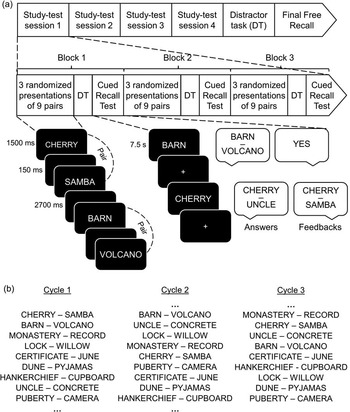
Participants learned the 27 pairs during four study–test sessions each divided in three blocks (Figure 2a). Each block contained nine pairs displayed three times continuously in three randomized cycles before being tested. The pairs composing each block were selected pseudo-randomly as a constraint prevented pairs sharing one identical word (e.g., parcel–cherry; cherry–samba) to be displayed in the same block to maximally limit the conscious detection of the underlying linked-list (Figure 2b). Words composing pairs were presented vocally and visually on a black computer screen one at a time in white uppercase font for 1500 ms. A black screen was shown for 150 ms between words within pairs, and for 2700 ms between pairs. These durations were longer (×1.5) than in Howard et al. (Reference Howard, Jing, Rao, Provyn and Datey2009). Subjects were required to remember word pairs for a subsequent cued-recall test. After a 30-s distractor task involving arithmetic problems (i.e., A+B=?, with A and B being integers from 0 to 9), participants underwent a cued-recall test. The first word of the nine pairs was individually presented as a cue for a response with the second word. Cueing words were displayed in random order for 7.5 s each. Subjects were asked to read aloud each probing word and vocally recall the associated word. Feedbacks were orally provided by the experimenter after each cued-recall trial and were of two types: (1) positive feedback when the answer was correct, (2) corrective feedback (i.e., the correct word pair) when the answer was wrong or the subject did not give any answer. A black screen with a fixation cross was shown for 1800 ms between each cued-recall trial. Responses were recorded with a graphical interface designed in MATLAB. This entire block procedure was applied for every block in each study–test session. Each pair was shown 12 times in total. A short break was allowed after each of the first three study–test sessions. After the fourth study–test session, participants were given a final 30-s distractor task and underwent an unexpected FFR test. They were encouraged to vocally recall a maximum of single words from the task during 5 min. An individual session lasted 1.25 to 1.5 hr.
The experimental design inspired from Howard et al. (Reference Howard, Jing, Rao, Provyn and Datey2009). a: Temporal organization of the design. b: Example of pair presentation order in one block. In each block, pairs were presented three times continuously in three randomized cycles. A constraint prevented pairs sharing one identical word (e.g., parcel–cherry; cherry–samba) to be displayed in the same block. DT=distractor task.

Data Analyses
Statistical analyses were performed using IBM SPSS Statistics software (Version 20.0). We first analyzed the performance in the study–test sessions by examining the learning curves in each group. In addition, we analyzed the mean percentage of correctly recalled pairs over the four study–test sessions, the percentage of correctly recalled pairs at the end of the learning phase (i.e., in the 4th study–test session), as well as omission errors made over the four study–test sessions. Omission errors occurred when participants did not give the correct answers. We reported the ratio of four omission error types: (1) no answer, (2) backward intrusions (i.e., words at lag −1 in the underlying linked-list), (3) transitive intrusions (i.e., words at |lag|=2), and (4) remote intrusions (i.e., words at |lag| >2). These ratios were calculated by dividing the number of each omission error type by the total number of omission errors (i.e., number of times that the subject did not give the correct answer). This calculation method led to the loss of one older control as the denominator was equal to 0, meaning that this subject did not make any omission error.
Next, we reported the total number of correctly recalled words in the FFR. We examined the recall transitions in the FFR by computing an alternate measure to the lag-CRP measures used in previous studies (Howard et al., Reference Howard, Jing, Rao, Provyn and Datey2009; Kahana et al., Reference Kahana, Howard, Zaromb and Wingfield2002). Lag-CRPs are calculated by dividing the number of times transitions at each lag were made by the number of times these transitions could have occurred (Howard et al., Reference Howard, Addis, Jing and Kahana2007). This approach requires fairly large datasets to provide reliable data (e.g., 1200 free-recall trials; Kahana, Reference Kahana1996). In this study, as there was one FFR trial per participant, we computed, instead of the lag-CRP measures, the proportion of each possible transition during the FFR as a function of the lag between the items in the underlying linked-list. Here, the number of transitions at each lag was divided by the total number of transitions that the participant made during the FFR. Importantly, the denominator of transition proportions, therefore, remained the same for each lag in the same participant, while in the lag-CRP measures a denominator is computed for each lag. It is, furthermore, noteworthy that this calculation method should make indices of interest (described below) relatively insensitive to potential group differences in overall performance.
In the current study, lags ranged from −13 to −1 and +1 to +13, as there were from each recalled word 13 possible forward and 13 possible backward transitions in the circular underlying linked-list of 27 words. Three kinds of transition were ignored in the calculation of the transition proportions: (1) transitions between immediately repeated words (e.g., volcano–cupboard–cupboard…), (2) transitions from and toward intrusions (i.e., words that did not belong to the list), and (3) repeated transitions (e.g., volcano–cupboard–barn–volcano–cupboard…). In the latter case, only the first transition was taken into account to prevent an artificial inflation of the number of any transition.
Statistical analyses were performed on the proportion of nearby forward and backward transitions in the FFR (i.e., +1 and −1 transitions). In addition, we created a “Transitive Associations Index” to measure the proportion of transitions at |lag|=2, which mirrors transitive associations between words, in comparison to transitions to remote lags (i.e., >4):
 $\scriptstyle {{{\left[ {F({\minus}2){\plus}{\rm F(}{\plus}2{\rm )}} \right]{\minus}\left[ {\sum_{{\rm i}={\rm }{\minus}13}^{{\minus}5} {\rm F i }{\plus}{\rm }\sum_{{\rm j}={\rm }{\plus}5}^{{\plus}13} {\rm F\, j}} \right]} \over [{F({\minus}2){\plus}{\rm F(}{\plus}2{\rm )]}{\plus} {\left[\sum_{{\rm i}={\rm }{\minus}13}^{{\minus}5} {\rm F i}{\plus} \sum_{{\rm j}={\rm }{\plus}5}^{{\plus}13} {\rm F\, j}} \right]}}$
. This index is unitless and comprised between +1 and −1.
Non-parametric tests were computed when parametric test assumptions were not met. As the educational level significantly differed between groups, this parameter was entered as covariate in analyses of covariance (ANCOVAs). Moreover, given that the current memory task solicited other cognitive abilities than associative learning processes, such as processing speed, we also introduced as covariate the available corresponding cognitive measure (i.e., “TMT B-A time” index) to verify that the significant group effects were not attributable to group differences in more basic abilities. It is effectively noteworthy that the “TMT B-A time” index (Table 2) was significantly higher in patients than in older controls, U=65.5, z=−2.54, p=.010, r=−.44, which suggests that patients may present a lower processing speed than older controls.
Two-tailed statistical tests were performed for every measure, except for the measures of interest (i.e., backward and transitive intrusions in cued-recalls, proportions of nearby forward and backward transitions in the FFR, and Transitive Associations Index) as the hypotheses relative to these measures were directional (i.e., one-tailed tests).
Results
Study–Test Sessions Performance
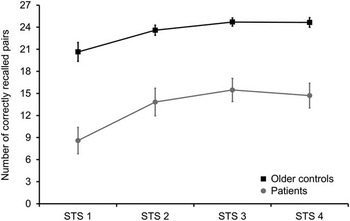
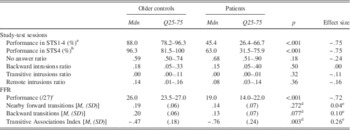
Figure 3 displays the learning curves across the study–test sessions for each group. The shape of the learning curves appeared similar in both groups while the performance at each time point appeared to differ between groups. Analyses highlighted that the percentage of correctly recalled pairs across the four study–test sessions was significantly lower in prAD patients compared to older controls, U=17.5, z=−4.38, p<.001, r=−.75 (Table 3). Similarly, the percentage of correctly recalled pairs at the end of the learning (i.e., in the 4th study–test session) was significantly lower in patients than in older controls, U=19.0, z=−4.35, p<.001, r=−.75.
Learning curves in the study–test sessions. The error bars represent the standard error of the mean. STS=study–test session.

Performance in the study–test sessions and the FFR

a Mean percentage of correctly recalled pairs over the four study-test sessions.
b Percentage of correctly recalled pairs at the end of the learning phase (i.e., the 4th study-test session).
c Total number of correctly recalled words in the FFR.
d ANCOVA p-value.
e partial η 2.
STS=study-test session.
However, the analyses relative to omission error ratios did not reveal any significant difference between the two groups (i.e., no answer ratio, U=98.00; z=−1.37; p=.18; r=−.24; backward intrusions, U=136.00, z=0.00, p=.50, r=.00; transitive intrusions, U=122.00, z=−0.62, p=.32, r=−.11; remote intrusions, U=110.50, z=−0.92, p=.36, r=−.16).
FFR Performance and Recall Transition Analysis
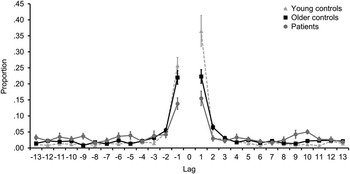
PrAD patients recalled significantly fewer words than older controls in the FFR, U=24.00, z=−4.18, p<.001, r=−.72 (Table 3). Figure 4 represents the mean proportion of each possible transition between items during the FFR as a function of the lag between items in the underlying linked-list.
Transition proportions as a function of lag. The error bars represent the standard error of the mean. Light grey dashed lines represent the curves observed in the young adult group (N=30) who was tested using the final task version before conducting the current study (see Materials).

Participants in both groups more frequently transitioned between items that were very close in the underlying linked-list, as evidenced by their curves peaking at lags +1 and −1. However, the transition pattern appeared flattened in prAD patients, as suggested by their lower proportions of +1 and −1 transitions compared to older controls.
Statistical analyses accordingly showed that the proportion of nearby forward transitions (i.e., +1 transitions; Figure 4) was significantly lower in prAD patients than in older controls, t(32)=2.44, p=.010, d=−0.89. As the educational level and the “TMT B-A time” index (i.e., processing speed estimate) significantly differed between the two groups, these parameters were entered as covariates in an ANCOVA with the group as the between factor. This ANCOVA did not reveal any significant relationship between the two factors entered as covariates and the nearby forward transition proportion, F(1,29)=0.88, p=.356, partial η 2=0.03; F(1,29)=0.98, p=.330, partial η 2=0.03, respectively. However, after controlling for these variables, the group effect on the nearby forward transition proportion was not significant anymore, F(1,29)=1.26, p=.272, partial η 2=0.04 (Table 3).
The backward transition proportion (i.e., −1 transitions; Figure 4) was significantly lower in prAD patients than in older controls, t(32)=3.11, p=.002, d=−1.18. The ANCOVA with the group as the between factor, the educational level and the “TMT B-A time” index as covariates indicated that the effect of these two latter variables on the backward transition proportion was not statistically significant, F(1,29)=1.52, p=.228, partial η 2=0.05; F(1,29)=0.03, p=.874, partial η 2=0.00, respectively. After controlling for these variables, the group effect on the backward transition proportion was of medium size but not statistically significant, F(1,29)=3.37, p=.077, partial η 2=0.10 (Table 3).
Finally, the Transitive Associations Index was significantly lower in prAD patients than in older controls, t(32)=3.95, p=<.001, d=−1.60. The ANCOVA with the group as the between factor, the educational level and the “TMT B-A time” index as covariates indicated that these two latter variables were not significantly related to the Transitive Associations Index, F(1,29)=0.41, p=.529, partial η 2=0.01; F(1,29)=1.09, p=.306, partial η 2=0.04, respectively. Importantly, the group effect on the Transitive Associations Index remained significant after performing this control, F(1,29)=10.34, p=.003, partial η 2=0.26 (Table 3).
Discussion
The current study referred to the Temporal Context Model (TCM; Howard et al., Reference Howard, Fotedar, Datey and Hasselmo2005, Reference Howard, Jing, Rao, Provyn and Datey2009; Sederberg et al., Reference Sederberg, Howard and Kahana2008) to examine associative learning effects in prAD patients in an attempt to enhance the understanding of the associative memory deficit occurring in prAD. Based on TCM, it was reasonable to expect that, compared to older controls, prAD patients demonstrate reduced proportions of backward and transitive associations in free and cued-recall as well as a reduced contiguity effect in free-recall, given that the hippocampal and parahippocampal alterations occurring in prAD may disrupt the contextual representation, binding and/or retrieval processes. We tested this hypothesis by submitting prAD patients and healthy older adults to a memory task inspired by Howard et al. (Reference Howard, Jing, Rao, Provyn and Datey2009) that coupled a cued-recall task involving overlapping word pairs and a FFR task.
Results revealed that the mean percentage of correctly recalled pairs over the cued-recalls in the study–test sessions as well as the performance at the end of the learning phase (i.e., in the 4th study–test session) were significantly lower in prAD patients than in older controls. These findings are in accordance with the previous studies that highlighted poorer associative memory performance in prAD patients than in older controls (Atienza et al., Reference Atienza, Atalaia-Silva, Gonzalez-Escamilla, Gil-Neciga, Suarez-Gonzalez and Cantero2011; Hampstead et al., Reference Hampstead, Stringer, Stilla, Amaraneni and Sathian2011; Hanseeuw et al., Reference Hanseeuw, Dricot, Kavec, Grandin, Seron and Ivanoiu2011; Sperling, Reference Sperling2007; Troyer et al., Reference Troyer, Murphy, Anderson, Craik, Moscovitch, Maione and Gao2012, Reference Troyer, Murphy, Anderson, Hayman-Abello, Craik and Moscovitch2008). However, contrary to our hypothesis, prAD patients did not significantly produce fewer backward and transitive intrusions in cued-recall over the four study–test sessions. This finding may be linked to two factors. First, in the current paradigm, participants were asked to answer to the cueing word with the correct word pair, without any supplemental encouragement in case of doubt. However, in previous studies using TCM (e.g., Provyn et al., Reference Provyn, Sliwinski and Howard2007), participants were instructed to respond to the probing word even when they were not completely certain of the correct response. Consequently, as suggested by the high no answer ratio found in both groups of the current study (Table 3), participants may have preferred not to respond when they were not certain of the correct response, which may have prevented any group difference to emerge for the proportions of backward and transitive intrusions over the four study–test sessions. Second, it is possible that, contrary to our expectation, the processes that underlie the production of backward and transitive intrusions in TCM are not affected in prAD patients compared to older controls. However, given the results detailed in the next paragraphs, we tend to favor the first explanation.
The examination of the transition proportions in the FFR as a function of lag actually showed that the curves were flattened in prAD patients compared to older controls (Figure 4), suggesting a reduction of the contiguity effect in prAD patients compared to older controls. It is noteworthy that the shape of the transition proportion curves in older controls appeared similar to the shape of the lag-CRP curves evidenced in previous studies (Figure 1; Golomb et al., Reference Golomb, Peelle, Addis, Kahana and Wingfield2008; Howard et al., Reference Howard, Kahana and Wingfield2006; Kahana et al., Reference Kahana, Howard, Zaromb and Wingfield2002). After controlling for the educational level and the current processing speed estimate (i.e., TMT B-A time), the nearby forward and backward transition proportions in the FFR were numerically but not significantly lower in prAD patients than in older adults. Nevertheless, while it was not statistically significant, the group effect on the backward transition proportion was of medium size. The sample size may be responsible of this lack of power as the two groups were relatively small. However, this was linked to the participant selection procedure which included an extensive neuropsychological and biomarker assessment. Finally and overall, the current study highlighted that prAD patients obtained a Transitive Associations Index that was significantly lower than in older controls, even after controlling for the educational level and the processing speed estimate. This robust finding may be linked to the equation used for calculating the Transitive Associations Index, which encompassed a considerable proportion of lags and, therefore, probably better characterized than the other indices the associative structure that was developed in memory for the studied list.
Within TCM, contextual learning is especially required for the formation of backward and transitive associations between the items of an overlapping word pair list (Howard et al., Reference Howard, Jing, Rao, Provyn and Datey2009). Interestingly, the current results showed that two proxies of contextual learning processes (i.e., the backward transition proportion and Transitive Associations Index in the FFR) were lower in patients compared to older controls. Our findings may, therefore, suggest that the item-context binding is disrupted in prAD patients compared to older controls. This is in accordance with the postulated anatomical substrate for this process, which is the hippocampus (Howard et al., Reference Howard, Fotedar, Datey and Hasselmo2005), and the fact that prAD patients demonstrated in the present study clear hippocampal atrophy compared to older controls (Table 2). The mapping hypothesis of Howard et al. (Reference Howard, Fotedar, Datey and Hasselmo2005) proposes that the contextual representation rely on parahippocampal regions. It is, therefore, possible that the reduced proportions of backward and transitive associations in patients also reflect, at least partly, a disruption of the contextual representation process, as parahippocampal regions are also affected since the early stages of AD (Ries et al., Reference Ries, Carlsson, Rowley, Sager, Gleason, Asthana and Johnson2008). Future studies should attempt to disentangle the disrupted processes in prAD by fitting the TCM on the experimental data and examining which parameter among the parameter weighting the contextual retrieval process and/or the parameter weighting the contextual representation is particularly affected in prAD.
Another interesting research avenue could be to compare the transition patterns in different patient subgroups. In the current study, one patient group was constituted by referring to the revised research criteria for “prodromal AD” (Dubois et al., Reference Dubois, Feldman, Jacova, Dekosky, Barberger-Gateau, Cummings and Scheltens2007). The comparison between patients with both positive amyloid and neurodegeneration biomarkers and patients with negative amyloid biomarker but positive neurodegeneration biomarkers could make a major contribution given that there are debates regarding the effects of amyloid deposition on cognitive functioning.
The current study has limitations. It should be first emphasized that the high educational level and the relatively small size of our samples may limit our finding generalizability. Moreover, the current design solicited processing speed and working memory abilities, in addition to associative learning processes. In this article, the potential confound linked to processing speed differences between groups was controlled by entering the available processing speed measure (i.e., TMT B-A time) in ANCOVAs. These analyses revealed that this processing speed estimate was not significantly related to the measures of interest. Nevertheless, as this processing speed estimate is limited, future work should more formally ascertain that the current findings are not attributable to group differences in more basic abilities than associative learning processes.
In conclusion, the current study aimed at investigating associative learning effects using TCM in an attempt to clarify the mechanisms that may underlie the associative memory impairment in prAD. The apparent reduction of the contiguity effect coupled with reduced proportions of backward and transitive associations in the free-recall of prAD patients in comparison to older controls suggest that the contextual representation, binding and/or retrieval processes are more affected in prAD than in aging, which may contribute to the general episodic memory impairment observed in prAD. The current study suggests that the examination of the recall transitions may be an interesting method for further research as it may increase the understanding of the episodic memory impairment in prAD. The present research moreover reinforces the relevance of including associative memory tasks in the diagnosis procedure.
Acknowledgments
This research was supported by the National Fund for Scientific Research (L.Q., FNRS grant number A 2/5 - MCF/DM); and the Brains Back to Brussels program from the Brussels Region in Belgium (J.J.O.). We are grateful to the firm GE Healthcare Ltd. for having supplied with [18F]flutemetamol for the PET scan imaging according to a convention with our Clinic. We also thank Andrea Conte for the programming of the task used in this study, Eloïse Delval for helping us with the data collection, Laurence Dricot and Renaud Lhommel for having provided us the structural and PET data, respectively. The authors do not have any potential conflict of interest to declare.