


During the 1997 Irish general election campaign the Labour Party (LP) declared that regardless of the election result, they would not coalesce with the Fianna Fáil (FF), and they would only consider the Progressive Democrats (PD) to be an acceptable coalition partner. Eventually, FF formed a minority coalition with PD, even though an FF–LP coalition would have had a parliamentary majority and by some accounts (Klingemann et al. Reference Klingemann, Volkens, Bara, Budge and McDonald2006), FF was ideologically closer to LP than to PD. This suboptimal coalition occurred because the previous LP–FF coalition formed in 1992 imploded after only two years in power. The resulting mutual loss of trust and credibility hindered subsequent cooperation between these parties (Mitchell Reference Mitchell, Marsh and Mitchell1999). Similarly, in 2004 the Estonian Center Party left its former coalition partner—the Reform Party—in opposition in the Tallinn city government, explaining that there was “a lot of betrayal” when the Reform Party broke their previous coalition and that traitors should get what traitors deserve (Keskerakond Reference Keskerakond2006).
For existing theories of coalition formation, which focus mostly on the relative size of parties and their ideological compatibility, these outcomes are anomalous. At the same time, the examples highlight the relevance of parties' past behavior as an important factor in coalition politics. Analyzing actors’ past behavior, specifically the consequences of defecting from prior cooperation, helps scholars understand the actors’ likely future behavior in a wide variety of settings (Sharman Reference Sharman2007). Since government coalitions are a form of cooperation between political parties, studying parties' past behavior in a coalition is likely to help us understand future coalition formation as well.
This study argues that parties are likely to care not only about the spoils of office and policy when selecting their coalition partners, but also about the likelihood of their partners cooperating. In order to sustain cooperation in the long run and avoid future defections, parties reward cooperation with inclusion in future coalitions, and punish defection with exclusion. Empirical analysis, based on data from European countries from 1950 to 2006, confirms that parties are likely to exclude a defector—a party that withdrew from their previous coalition—from the next government they form. Additional analyses demonstrate that this outcome most likely results from an effort to punish defectors, not because of an ongoing conflict between the former coalition partners. Furthermore, defectors lose credibility only in the eyes of their former coalition partners. They do not become pariah parties.
The results of this paper are important for understanding real-world coalition politics. The actual coalition bargaining takes place not necessarily among all parties in parliament, but rather within groups of parties with closer affinities and prior common experience in a coalition. Ideological proximity and compatible size—the central concepts in the existing theories of coalition formation—help to explain the origins of these affinities. Parties' past behavior, in turn, helps in understanding the relationships among parties with common experience.
PREVIOUS LITERATURE ON COALITION FORMATION: SIZE, IDEOLOGY, AND INSTITUTIONS
Numerous studies explore government formation in parliamentary democracies. Analytical models guide much of this research. However, scholars have also conducted rigorous empirical studies to explain and predict real-world coalitions (Franklin and Mackie Reference Franklin and Mackie1984; Martin and Stevenson Reference Martin and Stevenson2001; Mattila and Raunio Reference Mattila and Raunio2004; Warwick Reference Warwick1996, to name a few; see also Ansolabehere et al. Reference Ansolabehere, Snyder, Strauss and Ting2005; Volden and Carrubba Reference Volden and Carrubba2004). Previous research explains the logic of coalition formation as mostly based on parties' size, ideology, and institutional constraints (Laver Reference Laver1998).
The earliest theories focused on the relative size of parties and predicted that minimum winning coalitions—which ensure that the spoils of office are shared with as few other parties as possible—would emerge (Riker Reference Riker1962). The size principle was soon revised to include parties' policy preferences also. Parties want to keep coalitions ideologically coherent to decrease transaction costs in coalition bargaining (Axelrod Reference Axelrod1970). The size and ideology principles together suggest that the most likely coalitions to form are minimum connected winning coalitions (DeSwaan Reference DeSwaan1973). Following the assumptions of the size and ideology theories, more complex hypotheses have been developed, based on concepts such as median party, central party, dominant party, very strong party, core party, and the heart (Laver and Schofield Reference Laver and Schofield1990; Schofield and Sened Reference Schofield and Sened2006; van Roozenthal Reference Van Roozenthal1992; see also Ansolabehere et al. Reference Ansolabehere, Snyder, Strauss and Ting2005). The underlying propositions—that size and ideology determine the process of multiparty government formation—have found some support in large-N empirical studies (Martin and Stevenson Reference Martin and Stevenson2001; Mattila and Raunio Reference Mattila and Raunio2004; Warwick Reference Warwick1996).
More recently, scholars have complemented the theories of size and ideology with a focus on institutional constraints in the process of coalition formation (Martin and Stevenson Reference Martin and Stevenson2001). Strøm, Budge, and Laver (Reference Strøm, Budge and Laver1994) consider rules governing investiture, cabinet operation, legislative process, and political parties. Druckman and Thies (Reference Druckman and Thies2002) examine the importance of the partisan composition of the second chamber. Studies in the institutional tradition also stress the importance of formateurs—parties that have the power to propose alternative coalitions (Ansolabehere et al. Reference Ansolabehere, Snyder, Strauss and Ting2005; Austen-Smith and Banks Reference Austen-Smith and Banks1988; Baron Reference Baron1991, Reference Baron1993). Other studies have argued that incumbent prime ministers can manipulate the timing of elections and thereby influence future coalition negotiations and composition (Diermeier and Stevenson Reference Diermeier and Stevenson1999; Lupia and Strøm Reference Lupia and Strøm1995; Strøm and Swindle Reference Strøm and Swindle2002).
In sum, the existing literature explains coalition composition by stressing the importance of parties' attributes and their institutional environment, but neglecting the history and nature of their interactions. At the same time, scholars examining coalition bargaining and formation in one specific European democracy at a time argue that the existing formal theories of coalition politics are not able to explain real-world coalitions in those countries. At least 11 different country studies have led to such a conclusion (Laver and Schofield Reference Laver and Schofield1990). Critics question the assumptions that parties can freely pick any coalition partner, and that coalition formation is an isolated single event. To be sure, some studies have referred to informal constraints such as declarations to coalesce or avoid coalescing with certain other parties to explain coalition formation (Martin and Stevenson Reference Martin and Stevenson2001; Strøm, Budge, and Laver Reference Strøm, Budge and Laver1994). However, it is important to understand why parties would make such statements in the first place. Studying the role of parties' past behavior has the potential to shed some light on this specific question, as well as on coalition politics as a whole.
THE INFLUENCE OF PAST BEHAVIOR ON COALITION PARTNERSHIP
Why would parties not coalesce with their former partners, who are likely to be ideologically close to them, and who could join them in a minimum winning coalition? Parties' past behavior offers a potential answer. Each party in the coalition can enjoy the benefits of office only as long as everybody cooperates. However, it is possible that other considerations such as electoral success, personal animosities, or disagreement over an issue motivate a party to withdraw from the coalition. If a party withdraws, its coalition partners suffer, because they lose office or are relegated to minority government status. Parties can discourage withdrawals by threatening future punishment. They can make that threat credible by actually punishing defecting parties in the future. One way to punish defecting parties is to exclude them from a future coalition.
The punishment argument predicts a clear pattern of behavior: parties reciprocate their partners’ past behavior. If a party cooperates with its partners until the end of the government's term, the partners will likely reciprocate this cooperation next time they negotiate a coalition by including the reliable party. If a party defects from a coalition and brings down the government, then its former partners are likely to reciprocate this defection next time they negotiate a coalition by excluding the defector.
In sum, parties' past behavior in a coalition matters for explaining interparty cooperation and conflict. This argument complements, but does not replace, prior theories of coalition formation: coalitions still usually need to be of a certain size; parties are constrained by concerns about votes, which reinforce ideological and programmatic considerations; and not all political parties have a say about the composition of government in each round of coalition formation. However, introducing information on parties' past behavior into their coalition bargaining strategies helps to build a dynamic and thus a more realistic picture of the coalition formation process, which scholars often treat as a static, one-off interaction (Laver Reference Laver1998).
Identifying a Defector
A defector is a party that has not adhered to the coalition agreement, which is understood to include a promise to cooperate and to seek compromise until the end of the term. A defector will be blamed by other parties in government for breaking the coalition. Coalitions can end prematurely for reasons other than defection: defeat by opposition, early elections, security crises or other external shocks (Laver and Shepsle Reference Laver and Shepsle1996; Müller and Strøm Reference Müller and Strøm2000). In such cases, however, there is no defector, as no partner has betrayed the coalition agreement.
For the purposes of this paper, defectors are parties that withdraw from government before the end of the term. Withdrawal is the clearest signal of defection, indicating that the party is no longer willing to cooperate. The withdrawing party can argue that it was forced out of office by other coalition partners. However, when disagreeing parties do not exit, cooperation is still theoretically possible. Exiting, on the other hand, puts an effective end to any possibility of further cooperation. Therefore, it is appropriate to consider the act of withdrawal as defection.
This definition allows empirical clarity. It is often impossible to determine which party started the events that led to the breakdown of cooperation. For one thing, the reasons and intentions behind coalition terminations, like those behind coalition negotiations, are often secret and ambiguous. Consider, for example, Luxemburg in 1959, when Socialists withdrew from the coalition with Christian Democrats because the latter voted together with the opposition in favor of the dismissal of a Socialist minister. Socialists could claim that Christian Democrats had defected. But the minister in question had failed to report a corruption case in his ministry, and even further in the past, Socialists had disagreed with Christian Democrats over the issue of traffic regulation (Dumont and De Winter Reference Dumont, DeWinter, Müller and Strøm2000). Consider as well the actions and statements between these parties behind the scenes, and there is no way of knowing who started the disagreement. It is clear, however, that the Socialists ended any potential search for compromise by withdrawing.
Withdrawal is not always unilateral. Coalitions can break as a result of mutual defection. Former partners will blame each other for not cooperating and each will have a reason to punish the other(s) for this defection by not coalescing with them in the next round.
At the time when the coalition breaks, the parties may even be in agreement that, given the circumstances at that point, the best course of action is to terminate the coalition. This agreement, however, is different from a situation where parties all voluntarily agree to terminate the coalition (perhaps to opportunistically call early elections). In such a case, government ends because of cooperation (not defection) between parties. One crucial difference is that such strategic and mutually beneficial agreement does not create blame. The situation of mutual defection described above, however, is different. Here, parties are forced to terminate the coalition because they no longer cooperate, and each blames the other for what happened. Therefore, it is not just the early termination that defines mutual defection, but the reasons behind the early termination.
Examples of Defections
Specific cases help to elucidate the theoretical argument and the definition of a defection. The Irish example described in the introduction is one illustration of how mutual retaliation to punish mutual defection can trump concerns about size and ideology. Denmark in the 1990s provides an example of a formateur retaliating after a unilateral defection by a former partner. After the 1994 Danish national elections, three parties—the Social Democrats (SD), the Social Liberals (RV), and the Center Democrats (CD)—formed the governing coalition. In 1996, CD abandoned its partners due to some mutual tension and CD's decreasing popularity among the public, leaving SD and RV in a minority government (Bille 1997). SD received the most seats in the 1998 elections and continued to compose a minority government with RV. SD excluded CD because it had not been “faithful” (Nielsen Reference Nielsen1999, 68), even though CD was ideologically the closest party to the SD. For the formateur SD, punishing the defection was more important than concerns over coalition size and ideology.
Estonia provides an example of how not only formateurs but also their preferred partners can punish defectors. After the 1999 elections, the liberal Reform Party (RE), the conservative Pro Patria (IL), and the Social Democratic Party (SDE) formed the government. During the third year into the tenure of the coalition, tension began to surface between RE and IL over presidential candidates and local politics in the capital city (Pettai Reference Pettai2002). This tension culminated with the resignation of the IL prime minister and the termination of the government. After the next parliamentary election in 2003, RE was not a formateur but was invited to form a coalition with a new right-wing party, Res Publica (RP) (Reformierakond Reference Reformierakond2003a). At least one other coalition partner was necessary for a majority. RP, attempting to form an ideologically cohesive coalition, wanted to include IL in the coalition, but abandoned the idea after pressure from RE (Reformierakond Reference Reformierakond2003b). RE's choice to punish IL led to an ideologically suboptimal coalition between RP, RE, and the agrarian People's Union (ERL). Unsurprisingly, the coalition already experienced its first significant signs of tension over the next year's budget (Pettai Reference Pettai2004).
RESEARCH DESIGN, DATA, AND MEASURES
Parties that defected from a coalition and thereby betrayed their partners are likely to be excluded from the next coalition that those partners form. In order to test this hypothesis, one needs to trace parties' behavior (1) as coalition partners and (2) at the time when a coalition is formed. Most European countries, both eastern and western, are frequently governed by coalitions and, therefore, provide the best context for observing parties' coalition behavior across time. I have assembled data on all coalitions formed in western and eastern Europe from 1950 until 2006.Footnote 1 First, I identified all cabinets formed after any general parliamentary election or after any change (except for voluntary enlargement) in the set of parties holding cabinet membership (Müller and Strøm Reference Müller and Strøm2000, 12).Footnote 2 Single-party majority,Footnote 3 technical, and caretaker cabinets are excluded.Footnote 4 This leaves altogether 157 coalitions (and coalition forming situations). The unit of analysis is a party in a given coalition-forming situation.Footnote 5 This yields 969 cases for analysis, subject to data availability. The dependent variable is dichotomous, labeled Coalition partner and coded “1” for those parties that were eventually included in the coalition formed at a given time.
Independent Variable: Defector
The main independent variable—Defector—is also dichotomous. The coding of this variable requires some explanation. For each country included in their study, Müller and Strøm (Reference Müller and Strøm2000)Footnote 6 provide a table that identifies for each cabinet the mechanism of termination, one of which is interparty conflict. They also provide a brief explanation of the events causing the termination. Using this information, I applied the following coding rules: If a coalition broke because a party withdrew from the coalition, then that party becomes a defector against other parties in the coalition. If a coalition broke because of disagreements between all partners, every party who belonged to that coalition becomes a defector against every other party in that coalition. If a coalition broke because of a disagreement between a subset of coalition partners, then only those conflicting parties become defectors against each other.
Not all parties have a say in coalition formation process. Defectors can be punished only if the party against which they defected is included in the coalition that is formed. Therefore, I code as defectors in each coalition formation situation only those parties that defected from a coalition where any of the members of the newly formed coalition was a member. The membership of other parties in the nascent coalition that has not yet formed is inferred from the coalition that actually formed.Footnote 7
To reiterate, for each party and each coalition-forming situation, the basic coding rule is the answer to the question, “Did this party defect against any of the current coalition members last time this party was in coalition with any of the current coalition members?” This last time may have been the previous coalition (before the latest election) but may also have been several coalitions (and electoral cycles) back. For example, in Germany in 1980, the Social Democratic Party (SPD) formed a coalition with the Free Democratic Party (FDP). In 1982, FDP withdrew from that coalition. This makes FDP a defector against SPD. However, SPD had no opportunity to punish FDP for the next 15 years because SPD itself was not included in any coalition during that time and had therefore no say over coalition composition. Therefore, FDP is coded as a defector against SPD only in 1998 when SPD and the Green Party were the governing parties with SPD being the formateur.
A party remains a defector for one coalition formation situation only.Footnote 8 For example, in Austria in 1994, the Austrian Socialist Party (SPÖ) and the Austrian People's Party (ÖVP) were in a government that broke a year later due to a conflict over the budget. Since neither withdrew unilaterally, but both decided to stop cooperating, both parties became defectors against each other. After the next election in 1995, a new coalition was formed between SPÖ and ÖVP in 1996. Since SPÖ defected against a party in the current coalition when it last shared the coalition responsibility with that party (ÖVP), it gets a value of “1” on the defector variable for 1996. Similarly, since ÖVP defected against a party in the current coalition when it last shared the coalition responsibility with that party (SPÖ), it too is coded as “1” on the defector variable for 1996. Since this coalition did not end with a defection and both parties had a chance to punish the other for the previous defection, both are coded as “0” on the defector variable for the next coalition formation situation.Footnote 9
Altogether, 61 of the 157 coalitions included in the dataset resulted in at least one party becoming a defector. In total, 145 parties (of the 969 cases included in the dataset) were coded as defectors.
Control Variables
As the previous literature asserts, various other factors including size, ideology, and institutions influence the likelihood that a given party is included in a coalition. The goal here is not to test all of those other arguments, which is excellently done elsewhere (Martin and Stevenson Reference Martin and Stevenson2001; Warwick Reference Warwick1996), but to provide a model that is fully specified. Specifically, the analysis includes the following control variables:
The effect of size can be captured in several ways. Previous literature argues that the Largest Party has a higher likelihood of being included in the coalition than other parties (Martin and Stevenson Reference Martin and Stevenson2001; Warwick Reference Warwick1996). A dummy variable coded “1” for the party with the largest seat share captures this effect. However, the largest party has a higher likelihood of being included in a coalition mostly because it has a higher likelihood of being the formateur. This party is obviously included in the coalition and therefore cannot be controlled for in the normal sense. In order to account for the fact that a formateur has the most say as to who is included in a coalition with it, I have estimated an alternative model, which excludes all formateur parties. This technique produces a unit of analysis equivalent to a formateur dyad with each of the other parties in parliament at a given time.
Following previous studies, I have also controlled for Party size in terms of seat share, because one can argue that the smallest parties are the least likely to be included in any coalition, and Change in party size in terms of seat share, because parties that have gained (as opposed to lost) seats can more credibly claim that they ought to be governing parties (Mattila and Raunio Reference Mattila and Raunio2004; Warwick Reference Warwick1996).
Further, because the size principle suggests that most coalitions are minimum winning, parties belonging to many theoretically possible minimum winning coalitions should have a higher likelihood of ending up as coalition partners than those who belong to only a few or none. Furthermore, the variable not only affects that party's coalition prospects (the dependent variable), but also can influence the relationship between the dependent variable and the independent variable of interest (see Warwick Reference Warwick1994). Specifically, if a given party is indispensable as a coalition partner, in that no coalition can be formed without it, then it should also be relatively costless for that party to defect. To account for how indispensable a party is, I calculated for each party the Banzhaf power index, which is the share of all possible minimum winning coalitions (MWC) in which a party participates (Share of MWC membership).Footnote 10 For the analysis that excludes formateurs, I calculated for each party its Share of MWC with the formateur.
Party ideology is another factor that needs to be taken into consideration. Following Laver and Schofield (Reference Laver and Schofield1990), median parties are likely to enter government. Median party is coded “1” for those parties that occupy the median position on the left–right scale in a given election, using data from Klingemann et al. (Reference Klingemann, Volkens, Bara, Budge and McDonald2006).Footnote 11 Further, because coalitions tend to form between ideologically proximal parties, the closer a party is to the median, the more likely it is to be included in the coalition (Warwick Reference Warwick1996). In the model that includes all parties, that is, where the formateur has not been identified, I control for the Distance from the median measured as the absolute difference between a given party and the median party on the left–right spectrum. In the model that excludes formateurs, i.e., the model that considers formateurs’ decisions as to whom to include in their coalition, I control for Distance from the formateur by measuring it in a similar manner. The data for the distance measures were obtained from the Comparative Manifesto Project (Klingemann et al. Reference Klingemann, Volkens, Bara, Budge and McDonald2006).
Previous studies have also controlled for whether a party is a “very strong party” or a “merely strong party” (Laver and Shepsle Reference Laver and Shepsle1996). However, as Martin and Stevenson (Reference Martin and Stevenson2001) note, in practice, these concepts are effectively captured by Median and the Largest party, which is why I have not included them in the models (see also Warwick Reference Warwick1996).
Party system also constrains parties' choices in coalition bargaining. The fewer parliamentary parties there are, the higher the likelihood that any of them will be included in a coalition, regardless of whether they have been faithful partners in the past. I have therefore controlled for the Number of parties in parliament.Footnote 12
Additionally, I control for whether a party has ever before been in coalition with any of the members of the newly formed coalition (variable label Former partner). Substantively, Former partner captures the long-term affinities between parties, most likely stemming from compatibilities of size and ideology. Warwick (Reference Warwick1996) further argues that a party that was in the previous government is, in general, more likely to be in the current government as well. Modeling techniques suggested by Beck, Katz, and Tucker (Reference Beck, Katz and Tucker1998) and described below account for this autocorrelation. These techniques also allow controlling for coalition experience of a party, including the fact that some (mostly, but not only, extremist) parties are always excluded from coalitions (Strøm, Budge, and Laver Reference Strøm, Budge and Laver1994).
ANALYSIS AND RESULTS
Models are estimated using probit regression. The data are organized across time and countries into party panels. Beck, Katz, and Tucker (Reference Beck, Katz and Tucker1998) argue that the appropriate way to address the temporal dependence between observations in time-series–cross-section data with a binary dependent variable is to include, together with the independent and control variables, counter and cubic splines, or time dummies in an ordinary logit or probit model. Although their function is equivalent, counter and cubic splines are preferred over time dummies, because they require fewer degrees of freedom. The counter is the number of time periods (years) since the last event (the coalition in which a given party participated).
To deal with cross-sectional dependence and heteroskedasticity, I have used robust standard errors clustered according to party (Woodridge Reference Woodridge2002) and country fixed effects. The latter will help to account for any country-level variables influencing coalition membership, such as investiture or supermajority voting requirements (Warwick Reference Warwick1996). Additional analyses performed, all of which produced results substantively similar to the ones presented below, include the following: (1) using party rather than country dummies, (2) using party and year dummies simultaneously, (3) (only Model 2) adding a variable measuring whether a given party belonged to a minimum winning connected coalition with the formateur, and (4) (only Model 2) adding the largest party. Excluding the time variables, the country dummies, and/or the clustering of standard errors leaves the theoretically relevant relationship intact. Additionally, I calculated standardized Pearson residuals for each case to detect influential observations. The overall performance of the models improves slightly and the substantive results do not change when all observations with standardized residuals smaller than −2.5 and larger than 2.5 are excluded. These various tests suggest that the results presented below are robust.
Are Defectors Punished?
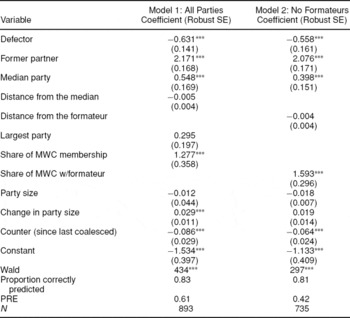
Table 1 presents two alternative analyses: Model 1 includes all parties, while Model 2 excludes formateurs. The results provide considerable support for the hypothesized relationship. The variable capturing whether a given party has defected with regards to any of the current coalition partners—defector—is negatively and significantly related to the probability of that party being included in the coalition. The inference from Model 2 is similar: formateurs are less likely to include those parties in their coalition who have defected from a coalition with them before.Footnote 13
Probit Estimation of the Effect of a Past Defection on the Probability of Coalescing With Same Partner(s) Again

Note: Dependent variable is whether a given party was included in a given coalition (Coalition partner). Cubic splines and country dummies are included in the models.
* Significant at 10% level.
** Significant at 5% level.
*** Significant at 1% level.
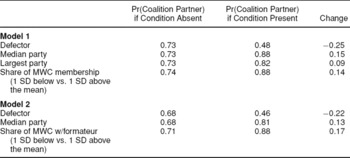
Table 2 provides information on the substantive magnitude of the effects. For each of the categorical variables, the table reports the probability of being included in a coalition if a given condition is absent (i.e., the variable is at its minimum value), the probability of inclusion if a given condition is present (i.e., the variable is at its maximum value), and the difference between these probabilities. For the continuous MWC variable, predicted probabilities are calculated for values at one standard deviation above versus below the mean, because the extremes of 0 and 1 are not realistic. The probabilities have been estimated for describing relationships between former partners and holding all other categorical variables at their medians and continuous variables at their means.
Predicted Probabilities That a Party Will Be Included in a Coalition

As the results show, under both Models 1 and 2, the marginal effect of the defector variable is significantly stronger than the effects of the size and ideology variables. Another fact underlines the substantive strength of the defector variable. Because the dependent variable represents a binary outcome, one can interpret predicted probabilities above 0.5 as predictions of inclusion and those below 0.5 as predictions of exclusion from the new coalition formed. In both models, the outcome predicted for nondefectors is different from the one predicted for defectors—the former should be included in a future coalition with former partners, while the latter should not. For other variables, the prediction about the outcome is the same, regardless of whether the condition is present or absent. A median party is more likely to be included in a coalition than a nonmedian party, but because the predicted probabilities for both scenarios are above 0.5, both are more likely to be included than excluded. The same is true about the effect of the largest party and the share of minimum winning coalition membership.Footnote 14
In sum, the findings suggest that past behavior plays a significant role in coalition politics. Parties are less likely to cooperate with their former partners if the latter have defected from coalition agreements and brought down the government. Defections are reciprocated with defections. It is also likely that many coalitions have survived their term due to the threat of retaliation if one partner decided to defect. For example, in Germany, FDP cooperated in the government with SPD for 13 years throughout the 1970s and early 1980s. In the early 1980s, after the emergence of the Greens, the threat that SPD would retaliate if FDP betrayed its commitment to cooperation kept the latter in the coalition despite recurring disagreements with their partner (Søe Reference Søe, Wallach and Romoser1985). Reliable systematic data on nonevents (coalitions that could have broken but did not because of the threat of retaliation) are hard to gather; the evidence presented here, however, suggests that the basic logic of reciprocity is at work in coalition politics.
Do Defectors Become Pariah Parties?
The analysis above looked at relationships among past coalition partners. However, it is possible that defectors acquire a reputation of being unreliable in the eyes of all parties, and are less likely to be included in any future coalition.
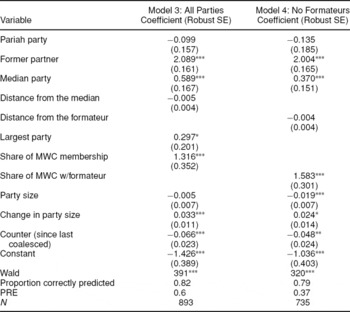
I test this hypothesis by recoding the independent variable so that each party that caused a breakdown of a coalition is coded as a defector (i.e., “1”) for the next coalition formation situation, whether the conflict occurred with a party in the new coalition or not. I have labeled the recoded independent variable as Pariah party. All other variables in the model remain the same, and as above, two alternative estimations are performed: Model 3 includes all parties and Model 4 excludes formateurs.
The results of these additional analyses are presented in Table 3. The coefficient for the new independent variable remains statistically insignificant in both models, indicating that defections do not significantly decrease defectors’ trustworthiness in the eyes of parties other than their former coalition partners. This observation suggests that parties with many potential coalition partners (given their size and ideology) are less constrained by the fear of punishment than those that are only able to coalesce with the same partner. The former type can defect and still count on being included at least in some future coalitions, because there are other potential coalition partners against which it has not defected and who do not consider it untrustworthy. An example from German politics illustrates this argument. Before the emergence of the Greens in the early 1980s, FDP could form a coalition with either SPD or CDU. Throughout the 1960s, and 1970s, FDP defected from a coalition with CDU several times, knowing that even if the latter refused to coalesce with them again next time around, SPD would still take them on board.
Probit Estimation of the Effect of a Past Defection on the Probability of Being Included in Any Future Coalition

Note: Dependent variable is whether a given party was included in a given coalition (Coalition partner). Cubic splines and country dummies are included in the models.
* Significant at 10% level.
** Significant at 5% level.
*** Significant at 1% level.
Additional Tests: Punishment or Conflict?
The analysis so far has demonstrated that a past defection, unilateral or mutual, significantly decreases the likelihood that the defector is included in the next coalition with its former partners. I argued that this occurs because the former partners punish defectors in order to prevent any future defections. While the argument provides a plausible explanation of the empirical results, these results are also consistent with an alternative argument. Namely, the defector and its former partner(s) may not coalesce the next time because these parties could still be involved in the same conflict that led to the breakdown of their previous coalition. Instead of punishment, there may simply be lower expectations among all parties involved in the broken coalition that a future coalition between them will succeed.Footnote 15
Parsing out these alternative arguments is challenging because the punishment-based argument (“punishment story”) and the alternative (“conflict story”) are not necessarily mutually exclusive or always empirically distinguishable. However, empirical tests discriminating between the two arguments provide evidence in favor of the punishment story.
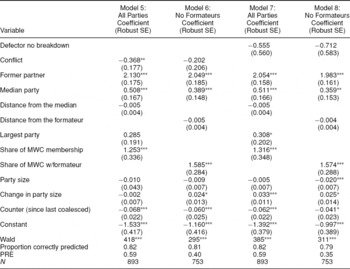
The first test is based on distinguishing between the incentives of defectors and those against whom they defected. According to the conflict story, both the defector and those who were betrayed want to avoid each other in the future, while according to the punishment story, only those who were betrayed have a reason to avoid the defector. In order to test for the expectation of the conflict story, I used an alternative coding technique for the independent variable (relabeled as Conflict) where not only those that exited, but all parties that participated in a given coalition are coded as “1.”Footnote 16
Table 4, Models 5 and 6 present the results of the re-estimations of Models 1 and 2, respectively, using the alternative coding. The effect of the conflict variable is weaker than that of the defector variable in both models, indicating that the punishment story offers a better fit for the empirical data than the conflict story. In Model 6, the conflict variable is not statistically significant, and in Model 5, the coefficient is significantly smaller (at a 2% level using a generalized Hausman specification test) than the coefficient for the defector variable in Model 1 (which represents a test of the punishment story).
Probit Estimation of the Effect of a Past Defection on the Probability of Coalescing With Same Partner(s) Again: Alternative Measures of the Independent Variable

Note: Dependent variable is whether a given party was included in a given coalition (Coalition partner). Cubic splines and country dummies are included in the models.
* Significant at 10% level.
** Significant at 5% level.
*** Significant at 1% level.
Another possibility for distinguishing between the two stories is to compare defectors that did not lead to the breakdown of the government to defectors that did. According to the conflict story, all defectors should be excluded from future coalitions because an exit is a sign of conflict. According to the theoretical arguments underlying the punishment story, it is the exiting and bringing down the government that drives the need to punish.
To test for whether inconsequential defections are more easily forgiven, I recoded as defectors only those parties whose exit did not bring down the government (variable label Defector no breakdown). The results of the new analyses are presented in Table 4, Models 7 and 8. The Defector no breakdown variable is statistically insignificant in both models. The result is at odds with the conflict story, which predicts that the defectors that did not bring down governments are likely to be excluded from future coalitions with their former partners.
Still another way to discriminate between the two alternative arguments is to consider the time-frame of breakdown and punishment or conflict. The punishment story argues that defectors are excluded from the next coalition formed by those that the defector betrayed. Punishment is not conditional upon when this next time occurs: it may be within a couple of years or only after several rounds of elections (e.g., a decade) after the defection. The conflict story, however, relates to time differently. Subsequent exclusion can be explained by conflict if conditions that caused the conflict are still present. It is likely that these conditions fade over time, at least for some types of causes, such as personal animosity or disagreement over specific policy issues. Therefore, the likelihood of being excluded from a coalition should decrease the more time has elapsed since the conflict (coalition breakdown) occurred.
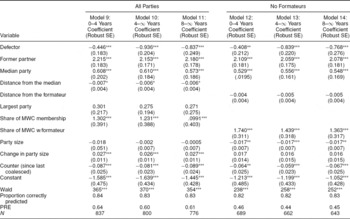
In order to test these time effects, Table 5 presents the results of three alternative estimations of both Models 1 and 2 (Models 9–11 and 12–14, respectively). The first estimation includes only those defections that are younger than four years, the second includes only defections that are four or more (4–∞) years old (i.e., roughly one electoral cycle has elapsed since the defection), and the third only those defections that are eight or more (8–∞) years old (roughly two electoral cycles have elapsed). The results show that time does not influence events according to the expectations of the conflict story. The effect of defection remains statistically significant regardless of time, and is even weaker for those cases where the defection occurred within the past four years than for defections that occurred more than four years ago. Therefore, the evidence from this analysis again favors the punishment story.
Probit Models of the Effect of a Past Defection on the Probability of Coalescing With Same Partner(s) Again: Time Effects

Note: Dependent variable is whether a given party was included in a given coalition (Coalition partner). Cubic splines and country dummies are included in the models. * Significant at 10% level.
** Significant at 5% level.
*** Significant at 1% level.
Another way to compare the two alternative arguments is to observe in more detail the process of coalition bargaining between potential partners. Müller and Strøm (Reference Müller and Strøm2000), in addition to providing data on the actual coalitions formed, also document the names of parties involved in previous bargaining rounds. From this information, it is possible to observe which other parties the formateur (and its preferred partners) have invited to participate in their coalition. Comparing the information about invitations to form coalitions with the actual coalitions formed enables us to see when and by whom such invitations were accepted or rejected.Footnote 17 According to both the conflict and punishment stories, there should be fewer invitations to defectors than to nondefectors. However, the punishment story predicts that once an invitation has been extended, there should be no difference between defectors and nondefectors in acceptance rate. The conflict story, however, predicts that due to the ongoing conflict, neither side wants to deal with the other, and defectors should therefore reject invitations more often than nondefectors.
The acceptance rate among all parties receiving an invitation is 81%. The acceptance rate among defectors is 83%. These proportions are not significantly different from each other. A test of proportions produces a z-score of −0.42. According to the z-test, the null hypotheses of no difference between the acceptance rates cannot be rejected: Pr(difference < 0) = 0.34, Pr(difference ≠ 0) = 0.68, Pr(difference > 0) = 0.66. Defectors are as likely to accept invitations as other parties—a finding that supports the punishment story but is at odds with the conflict story.
Finally, one could examine the conflict story's assumption that the condition that led to the coalition-breaking conflict is still present at the time of the subsequent coalition formation situation. One way to test this assumption independent of the outcome (i.e., from simply observing whether or not the party is included in the subsequent coalition) is to consider whether the defectors have in fact moved ideologically farther away from their former partners. Ideological dispersion is a clear signal about a long-term rift between parties. If the conflict story were true, we would expect most defectors to have distanced themselves from their former partners. At the same time, the punishment story is not necessarily undermined by the ideological movement of parties—defectors can (or even should) be punished regardless of whether they have moved closer to or farther away from their former partners. While parties can have conflicts for other reasons, such as personal disagreements or single issues, these other reasons are less likely to be present over an extended period of time and should not significantly affect the subsequent coalition formation process (see also Laver and Shepsle Reference Laver and Shepsle1996).
To measure ideological dispersion, I used party positions on the left–right dimension provided in the Comparative Manifesto Project (Klingemann et al. Reference Klingemann, Volkens, Bara, Budge and McDonald2006). If the defector had been in conflict with only one of the current coalition parties, I compared the absolute difference in the left–right position between these parties at the time of the formation of the coalition that was eventually broken with the difference at the time of the next election following coalition break-up. If the defector had been in conflict with more than one of the current coalition partners, I used the average position of all of these current coalition parties. Using this measure, 38% of the 145 defectors had moved ideologically farther away from their former partners while 39% had moved closer and 22% had stayed put. Thus, almost two-thirds—61%—of defectors had not moved apart, ideologically, posing a challenge to the conflict story.
In sum, I have performed five different tests indicating that defectors are excluded from subsequent coalitions with their former partners because they are being punished, not because they are still in conflict with those former partners. First, the hypothesized effect weakens significantly, or disappears altogether, when the independent variable is recoded to directly measure conflict rather than defection. Second, the hypothesized effect disappears when the independent variable is recoded so that only defections that did not bring down the government are considered. Third, the hypothesized effect does not weaken over time. Rather, it is weakest during the first three years since the defection—at a time when according to the conflict story, the effect should be the strongest. Fourth, defectors are not more likely to refuse invitations to coalesce than nondefectors. Fifth, two-thirds of defectors show no measurable sign of ideological movement away from their former partners. These tests are not able to provide conclusive evidence that a defector has never been excluded because of a continuing conflict. However, the cumulative evidence from all tests is in favor of the punishment story.
CONCLUSION
This study has shown that parties' past actions significantly influence coalition formation. A party that has defected from cooperating and brought down the government is likely to be punished (i.e., its defection is reciprocated) and not included in future coalitions by its former partners. Reciprocity conditions cooperation at least to the same extent, if not more, than size and ideology. The evidence also shows that defecting parties do not necessarily become pariah parties; they lose credibility only in the eyes of their former partners.
By drawing attention to parties' past behavior, this paper has provided a dynamic account of coalition politics. Coalition formation is not only about strategic choices at present, driven by concerns over coalition size and policy. It is equally important to take into account parties' considerations about the reliability of partners and the incentives to punish or reward past behavior. Acknowledging this fact helps to understand a variety of phenomena in coalition politics. First, the fact that parties reciprocate past cooperation and defection explains why coalitions are sometimes not ideologically coherent and do not always form a majority. Second, the logic of reciprocity can also explain why a specific coalition is formed out of several possible ones, given the size and ideology of parties and the institutional constraints. For example, it explains why parties may prefer their former partners even if other realistic options are available. Third, the logic of reciprocity provides a rationale to explain why coalitions endure. Fourth, as reputation effects do not extend beyond parties directly involved, the study provides an explanation for why parties with several potential coalition partners are likely to be the least reliable partners to any of them.
Applying the logic of reciprocity to coalition politics and looking more closely at the actual interaction between parties opens up a potentially fruitful avenue for future research in the study of coalition governments, where the need to move beyond counting the types of actual and potential coalitions and fixating on size and ideology has become increasingly clear (Laver Reference Laver1998). Future studies could investigate the extent to which other forms of punishment, for example, denying certain ministerial positions, are used in addition to, or instead of, exclusions from future cooperation. Another important avenue for future research would involve studying whether and how voters punish parties that have brought down a government.



Comments
No Comments have been published for this article.