Introduction
Unmet need for healthcare utilisation among disadvantaged social groups imposes a critical challenge to achieve universal health coverage (UHC) globally. Moreover, certain subgroups face compound vulnerabilities in accessing healthcare. Compared to the general population, people with disabilities often have limited access to healthcare and higher healthcare costs, which results in unmet needs for healthcare (World Health Organization, 2023). Older adults with disabilities face compounded challenges arising from both ageing and disability, making them particularly disadvantaged in healthcare utilisation. According to the United Nations, more than 46 per cent of older adults live with disabilities around the world (United Nations, 2024b). The unmet need for health services leads to their health disadvantages such as increased chronic disease risks associated with and mental health issues (Su et al., Reference Su, Ding, Zhang, Duan, Yang, Chen, Duan, Du, Xie, Jin, Hu, Sun, Long, Gong and Tian2016; Feng et al., Reference Feng2021). Within this group, certain subpopulations with disadvantaged socioeconomic status experience even more pronounced barriers to healthcare, contributing to greater barriers to UHC. For example, older people with disabilities who have higher education or health insurance have advantaged access to healthcare compared to their counterparts with lower education or lacking health insurance (Jin et al., Reference Jin2024). Therefore, it is essential to address the healthcare inequalities across older people with disabilities and the general population, as well as inequalities within this population, to achieve the UHC goal globally.
Healthcare inequalities at the individual level such as higher-income or urban-residence advantages are commonly observed, meaning that individuals with higher incomes or those living in urban areas tend to have better access to healthcare compared to their lower-income or rural-dwelling counterparts (Su et al., Reference Su, Ding, Zhang, Duan, Yang, Chen, Duan, Du, Xie, Jin, Hu, Sun, Long, Gong and Tian2016; Fang et al., Reference Fang2024). For individuals with disabilities, the inequalities in healthcare utilisation among them are further shaped by intersecting social determinants and disabilities (Swenor, Reference Swenor2021). Prior studies highlight that people with disabilities with lower incomes (Jeon et al., Reference Jeon2017; Fu et al., Reference Fu2018; Wong et al., Reference Wong2019), less education (Taylor and Hoenig, Reference Taylor and Hoenig2006), and minority ethnic backgrounds (Miller et al., Reference Miller, Kirk, Kaiser and Glos2014; Castro et al., Reference Castro2023) are less likely to use healthcare services, which further deepens health inequalities among subgroups of people with disabilities (Rowland et al., Reference Rowland, Peterson-Besse, Dobbertin, Walsh, Horner-Johnson, Andresen, Drum, Fujiura, Iezzoni and Krahn2014; King et al., Reference King2019; Mitra et al., Reference Mitra2022). Moreover, the intersectional inequality in healthcare utilisation can lead to health inequalities among people with disabilities in terms of ethnical, gender, and disability type categories (Rowland et al., Reference Rowland, Peterson-Besse, Dobbertin, Walsh, Horner-Johnson, Andresen, Drum, Fujiura, Iezzoni and Krahn2014; King et al., Reference King2019; Homan et al., Reference Homan, Brown and King2021; Mitra et al., Reference Mitra2022). However, determinants of healthcare utilisation for the aging population with disabilities have been less studied.
Regional economic development, as a development goal commonly used by local developing states, affects individuals’ healthcare utilisation (Schneider and Devitt, Reference Schneider and Devitt2018). Achieving Sustainable Development Goals (SDGs) 3: ‘ensure healthy lives and promote well-being for all at all ages’ is a common goal for both developing and developed countries along with Goal 8: ‘Promote sustained, inclusive and sustainable economic growth’ (United Nations, 2024c). The impact of economic development on population health has been extensively documented (Patterson, Reference Patterson2023), for example, studies indicate that economic development, which is commonly measured by gross domestic product (GDP) per capita, is negatively associated with mortality (Brenner, Reference Brenner2005; Cutler et al., Reference Cutler, Deaton and Lleras-Muney2006; Birchenall, Reference Birchenall2007; Baird et al., Reference Baird, Friedman and Schady2011), and positively associated with life expectancy (Brady et al., Reference Brady, Kaya and Beckfield2007; Cole, Reference Cole2019; Jetter et al., Reference Jetter, Laudage and Stadelmann2019). However, research on the effect of economic development on healthcare utilisation, which is a key determinant of health outcomes (Galvani-Townsend et al., Reference Galvani-Townsend, Martinez and Pandey2022), is limited. Notably, the impact of economic development on healthcare utilisation for older adults with disabilities has not been studied in existing literature.
Ronald Andersen’s Behavioural Model provides a comprehensive framework for understanding healthcare utilisation determinants. Over recent years, this model has been applied across diverse social groups including older adults and people with disabilities (Suntai et al., Reference Suntai, Noh and Won2022; Yang et al., Reference Yang2022). In this model, Andersen divides these determinants into predisposing, enabling, and need characteristics at both individual and contextual levels (Andersen and Davidson, Reference Andersen and Davidson2007). At the individual level, financial resources and residence status are key enabling factors of healthcare utilisation (Jiang et al., Reference Jiang2013; Fu et al., Reference Fu2018; Song and Smith, Reference Song and Smith2019; Wong et al., Reference Wong2019). At the contextual level, regional economic and financing abilities shape healthcare utilisation for individuals (Muramatsu and Campbell, Reference Muramatsu and Campbell2002; Kim, Reference Kim2019; Li et al., Reference Li, Tang and Wang2020). Despite this, although few studies have applied Andersen’s model to investigating healthcare utilisation for older adults with disabilities (Miller et al., Reference Miller, Kirk, Kaiser and Glos2014; Yang et al., Reference Yang2022), the interactions between individual and contextual determinants within Andersen’s model remain largely unexplored (Terraneo, Reference Terraneo2015).
Utilising Andersen’s Behavioural Model of healthcare access, this study explores the determinants of healthcare utilisation for older adults with disabilities in China. We leverage data from a survey in Chinese mainland. In our multilevel models, we include the effects of poverty and household status at the individual level and regional economic development at the contextual level. To expand Andersen’s model, we further include the interaction between individual and contextual determinants of healthcare utilisation. Our findings reveal income-based and urban-rural inequalities in healthcare utilisation for older adults with disabilities in China, and show that regional economic development improves healthcare utilisation at the individual level. In addition, we find that regional economic development mitigates the urban-rural inequality in healthcare utilisation, but its effect on income-based inequality is not significant. This study underscores the inequalities in healthcare utilisation among subgroups of older adults and people with disabilities. It contributes to the application and expansion of Anderson’s Behavioural Model of healthcare utilisation.
Healthcare inequality among older adults with disabilities: A global perspective
This study chooses China as a good case to explore the inequalities of healthcare utilisation for two reasons. First, China has the largest aging population in the world. As of 2023, there are more than 200 million people aged 65 and above (Liu et al., Reference Liu, Cadilhac, Kilkenny and Liang2020; Ministry of Civil Affairs, 2023), and it is estimated that nearly a quarter of older adults in China, around 50 million, are living with disabilities (Fan et al., Reference Fan, Wang and Zheng2022). Second, although China has experienced significant overall economic growth in the past decades, there still exist notable disparities in economic development across different regions (Chen, Reference Chen2010), which makes it feasible to investigate the effect of regional economic development on healthcare across the country.
People with disabilities often face intersecting disadvantages coupled with their disabilities, such as barriers related to transport, discrimination, and financial resources that can prevent them from meeting healthcare needs (Harrison et al., Reference Harrison2020; Hashemi et al., Reference Hashemi2022). This intersectionality contributes to healthcare utilisation inequalities among people with disabilities. Empirical evidence on healthcare utilisation disparities for people with disabilities in limited. For example, using the China Health and Retirement Longitudinal Study (CHARLS) database from 2011 to 2018, Jin et al. (Reference Jin2024) find that individuals with a higher education level or basic medical insurance are more likely to use healthcare services among middle-aged and older Chinese adults with disabilities.
Beyond China, there are few studies on the inequalities of healthcare utilisation in other countries. Jeon et al. (Reference Jeon2017) use the Korea Welfare Panel Study data 2005–2014 focusing on older adults aged 65 years and older, and they find that low-income older adults with disabilities have reduced inpatient days compared to their middle-and high-income peers. Miller et al. (Reference Miller, Kirk, Kaiser and Glos2014) use Medical Expenditure Panel Survey data in the United States focusing on middle-aged and older adults with disabilities, and they find that the minorities or less-educated individuals with disabilities experience lower levels of healthcare resources compared to their white or highly educated counterparts. Castro et al. (Reference Castro2023) find that African adults with disabilities have lower influenza vaccination rates compared to their White and Asian counterparts in the United States. However, there still lacks a holistic investigation on the socioeconomic inequalities of healthcare utilisation for older adults with disabilities. And the contextual impact on such inequalities at the individual level remains unknown for this vulnerable population.
Applying the Anderson Model and research hypotheses
Theoretical framework: determinants of healthcare utilisation
Ronald Andersen’s Behavioural Model is one of the most used frameworks to explain the determinants of healthcare utilisation at different levels. In his model, Andersen categorises individual and contextual determinants of healthcare utilisation into predisposing, enabling, and need characteristics. Predisposing characteristics include existing factors that predetermine individuals’ healthcare utilisation both directly and indirectly; enabling characteristics include factors that either facilitate or hinder healthcare utilisation; need characteristics include immediate conditions directly leading to healthcare utilisation (Andersen and Davidson, Reference Andersen and Davidson2007).
Andersen’s Behavioural Model was initially developed to explain the determinants of family healthcare utilisation (Andersen, Reference Andersen1995). Over recent years, this model has been applied across diverse social groups and different types of healthcare services. For example, researchers have used Andersen’s model to examine the determinants and inequalities in healthcare utilisation among older adults and people with disabilities (Suntai et al., Reference Suntai, Noh and Won2022; Yang et al., Reference Yang2022), and to analyse health services utilisation during the COVID-19 pandemic (Pengid et al., Reference Pengid, Peltzer, De Moura Villela, Fodjo, Siau, Chen, Bono, Jayasvasti, Hasan, Wanyenze, Hosseinipour, Dolo, Sessou, Ditekemena and Colebunders2022).
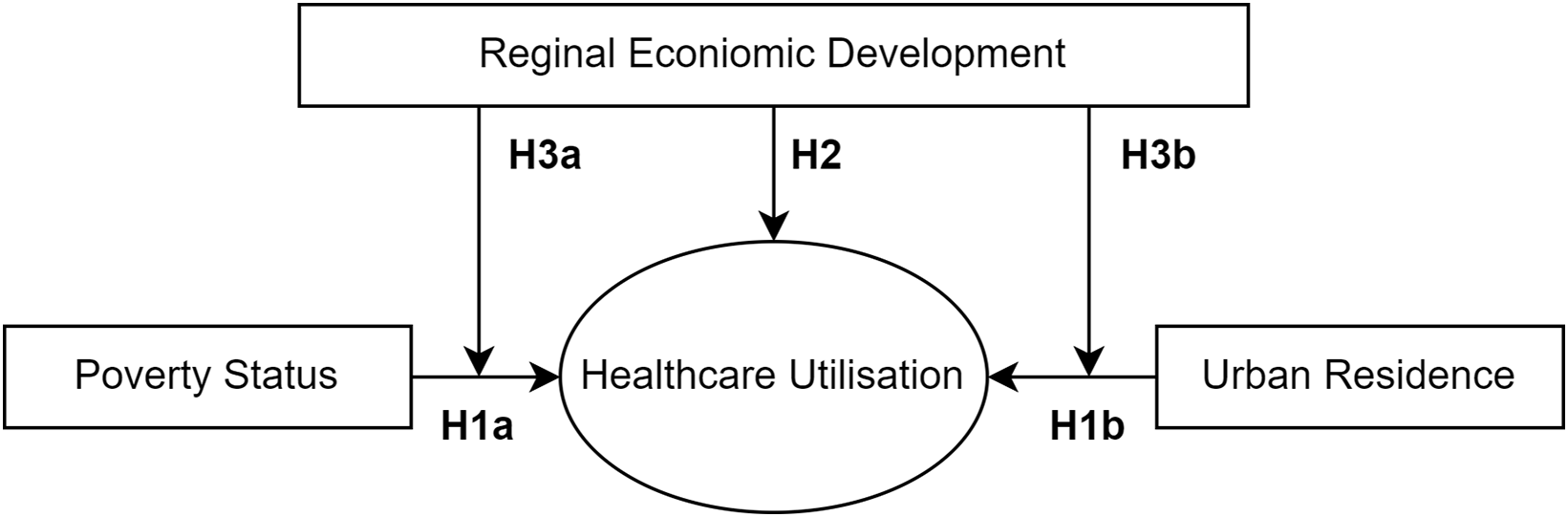
This study applies Andersen’s Behavioural Model as the theoretical framework to analyse the inequalities of healthcare utilisation among older adults with disabilities. Specifically, we investigate three areas: first, individual-level determinants, with a focus on income and household status; second, contextual-level determinants, centring on regional economic development; third, the potential interactions between individual and contextual-level determinants. Figure 1 displays our analytical framework.
Analytical framework.

Socioeconomic inequalities in healthcare utilisation among people with disabilities
In Andersen’s model, predisposing characteristics include individuals’ demographic, socioeconomic, and health belief factors that predetermine the likelihood to utilise healthcare; enabling characteristics include financing and organisational factors that enable individuals to obtain health services; need characteristics include the perceived and evaluated healthcare need which is most direct and immediate factors determining healthcare utilisation (Andersen, Reference Andersen1995; Andersen and Davidson, Reference Andersen and Davidson2007; Zhang et al., Reference Zhang, Chen and Zhang2019).
Financial resources are a crucial enabling factor of healthcare utilisation in Andersen’s Behaviour Model (Andersen and Davidson, Reference Andersen and Davidson2007). For example, Wong et al. (Reference Wong2019) investigate the barriers to healthcare services among individuals with long-term physical disabilities in the United States, and they find that the inability to afford out-of-pocket expenses is the most frequently reported reason for delaying healthcare. Likely, Fu et al. (Reference Fu2018) find a higher-income advantage in accessing health services among older adults in China.
Moreover, residence status is another important enabling factor of healthcare utilisation (Andersen and Davidson, Reference Andersen and Davidson2007), particularly in China, where the household registration (hukou) system creates barriers for rural residents in accessing healthcare resources compared to urban residents (Song and Smith, Reference Song and Smith2019). Jiang et al. (Reference Jiang2013) use national survey data focusing on middle-aged and older adults aged 45 and above in China, and they find that rural residents are less likely to use both inpatient and outpatient care in tertiary hospitals compared to their urban counterparts. Thus, we expect that healthcare utilisation is high-income and urban-residence advantaged among older adults with disabilities in China:
Hypothesis 1a: Poverty status is negatively associated with healthcare utilisation at the individual level for older adults with disabilities
Hypothesis 1b: Urban residence is positively associated with healthcare utilisation at the individual level for older adults with disabilities
Contextual economic determinants of healthcare utilisation
Compared to the extensively examined individual determinants of healthcare utilisation, contextual determinants have been less studied, particularly for older adults and people with disabilities. In Andersen’s Behavioural Model, predisposing characteristics at the contextual level include demographic compositions, socioeconomic development, and community or organisational beliefs; enabling characteristics include health policy, financing, and organisation that provide or distribute healthcare resources; need characteristics include environmental and population health indices that directly affect disease and mortality levels (Phillips et al., Reference Phillips, Morrison, Andersen and Aday1998; Andersen and Davidson, Reference Andersen and Davidson2007).
Among these determinants, financing factors are critical enabling characteristics at the contextual level that affect healthcare utilisation (Andersen and Davidson, Reference Andersen and Davidson2007). Li et al. (Reference Li, Tang and Wang2020) use national data from the 2015 China Health and Retirement Longitudinal Study and find that provincial GDP per capita is positively associated with both inpatient and outpatient care utilisation among middle-aged and older adults. In wealthier regions, higher levels of healthcare expenditures often enhance healthcare utilisation at the individual level (Muramatsu and Campbell, Reference Muramatsu and Campbell2002). And economically developed regions can financially support more healthcare facilities compared to less developed regions, and thus promote healthcare utilisation among disadvantaged social groups. For example, Kim (Reference Kim2019) reveals that the existence of community mental health centres is positively associated with mental health services utilisation among older Hispanics in the United States, and Li et al. (Reference Li, Tang and Wang2020) find that an increase in the density of hospital beds at the provincial level is positively associated with inpatient care utilisation for middle-aged and older adults in China. Thus, we expect that regional economic development can promote healthcare utilisation for older adults with disabilities.
Hypothesis 2: Regional economic development is positively associated with healthcare utilisation at the individual level for older adults with disabilities
Contextual economic development and inequality in healthcare utilisation
Although Andersen’s model includes individual and contextual characteristics that influence healthcare utilisation (Andersen and Davidson, Reference Andersen and Davidson2007), the interaction between contextual and individual characteristics has received little attention in existing literature (Terraneo, Reference Terraneo2015). Emerging studies have shown that contextual economic characteristics (for example, health expenditure) moderate health inequalities for older adults (Jutz, Reference Jutz2015; Högberg et al., Reference Högberg2018; McAllister et al., Reference McAllister, Fritzell, Almroth, Harber-Aschan, Larsson and Burström2018; Gómez-Costilla et al., Reference Gómez-Costilla, García-Prieto and Somarriba-Arechavala2022). However, less is known about how these characteristics influence healthcare utilisation inequality (Quayyum et al., Reference Quayyum, Khan, Quayyum, Nasreen, Chowdhury and Ensor2013). For example, Terraneo (Reference Terraneo2015) uses the Survey of Health, Ageing and Retirement in Europe (SHARE) data in twelve European countries, and finds that health expenditure at the national level mitigates the education-related inequality in healthcare utilisation for adults aged 50 and above. The classical Kuznets Curve theory posits a quadratic association between income development and economic inequality. Specifically, as an economy develops, the economic inequality will first increase and then decrease over time (Kuznets, Reference Kuznets1955). As income is a key social determinant of health outcomes, the Kuznets Curve theory has been subsequently extended to health research. For example, it has been found that economic development contributes to a decrease in health inequalities when the GDP per capita reaches a certain threshold (Costa-Font et al., Reference Costa-Font, Hernandez-Quevedo and Sato2018). Besides, cross-national research shows that the obesity rate rises as income level increases in low-income countries, but it eventually falls as income level increases in high-income countries (Windarti et al., Reference Windarti, Hlaing and Kakinaka2019). A provincial-level panel data analysis during 1949–2010 in China also finds that the increase in GDP per capita at the province level over time leads to a narrower healthcare resources disparities across provinces (Qin and Hsieh, Reference Qin and Hsieh2014). Therefore, we assume that economically developed regions can have a higher level of health expenditure, which enhances the accessibility and inclusivity of healthcare services (Gupta et al., Reference Gupta, Verhoeven and Tiongson2003), and thus promotes healthcare utilisation for disadvantaged subgroups of older adults with disabilities. Thus, we expect that regional economic development moderates the income-based and urban-rural inequalities in healthcare utilisation among older adults with disabilities.
Hypothesis 3a: Regional economic development mitigates the income-based inequality in healthcare utilisation for older adults with disabilities
Hypothesis 3b: Regional economic development mitigates the urban-rural inequality in healthcare utilisation for older adults with disabilities
Methods
Data
We use data from a national survey dataset. The survey collected detailed information about the respondents’ socioeconomic status, demographic characteristics, disability status, and healthcare utilisation. The survey adheres to the Chinese National Standard GB/T 26341-2010, which defines disability as impairments in body structure or function, activity limitations, and participation restrictions, while individuals with disabilities are defined as those who experience a complete or partial loss or impairment in mental, physiological, or anatomical structure or function, resulting in a full or partial limitation in their capacity to perform specific activities (Chen, Reference Chen2011). These definitions align with the International Classification of Functioning, Disability and Health (ICF) established by the World Health Organization, which defines disability as all impairments, activity limitations, and participation restrictions in multiple life areas including simply seeing, walking, taking a bath, working, going to school, accessing social services, and many such domains (World Health Organization, 2025).
We followed the United Nations’ definition of older adults as individuals aged 65 or above (United Nations, 2024a). Based on this criterion, we extracted a sub-sample of 11,321,061 older adults with disabilities, excluding those without disabilities. To examine the role of poverty in healthcare utilisation, we excluded 209,310 observations that lacked information on poverty status. Additionally, 391,096 observations were removed due to missing prefectural-level location data, which was necessary for matching with regional variables. Regarding the dependent variable, 10,086,210 observations with missing data on healthcare access in the past two weeks are excluded. The final analytic sample consisted of 634,445 individuals with complete and valid information.
The proportion of missing data for these variables is relatively small, which is 1.85 per cent for poverty status and 3.45 per cent for location. Given the comprehensive coverage of our dataset, which includes all 31 provinces and 319 out of 339 prefectures in China, the risk of systematic bias from these exclusions is minimal. Regarding the variable on healthcare access, it is only collected for individuals who reported illness in the past two weeks. This skip pattern reflects the survey design rather than nonresponse, and we assume the occurrence of recent illness is random with respect to socioeconomic factors. Therefore, we do not expect this to introduce selection bias. Finally, there are no missing values for gender, age, education, region, or urban/rural status in our final analytic sample of 634,445 observations.
Dependent variable
In the survey, respondents were asked if they had used any healthcare services following a question about whether they had been ill in the past year before the survey. Similar questions have been used to measure healthcare utilisation in existing literature (Macinko and Lima-Costa, Reference Macinko and Lima-Costa2012; NoorAni et al., Reference NoorAni, Rajini, Balkish, Noraida, SMaria, Fadhli, Jabrullah and Tahir2018; Zeng et al., Reference Zeng, Xu and Tao2022). These services include visiting a health facility or obtaining treatment from other sources but excluding informal care. The binary answer is recorded as ‘Yes’ or ‘No’.
Key explanatory variables
We focus on two enabling factors in Andersen’s model as key explanatory variables in this study: income and residence status at the individual level. Income is measured by individuals’ poverty status, of which the threshold is an annual income of 3218 yuan (around 466 US$) in 2019 as set by the Chinese government (National Bureau of Statistics, 2023). Residence status is measured by household status (hukou). Individuals either had a rural household or an urban household based on their household register.
To assess the direct and moderating effect of contextual enabling factors, we use GDP per capita (logarithm form) and urbanisation ratio as indicators of regional economic development, which are commonly used in existing literature (Chen et al., Reference Chen2014; Li and Wei, Reference Li and Wei2014). In our analysis, individual-level data from the national survey are merged with prefectural data from the statistical yearbooks of national and local bureaus of statistics in China, ensuring that individuals from the same prefecture are matched with the same prefectural economic indicators.
Control variables
Furthermore, we control for other variables in Andersen’s model as determinants of healthcare utilisation. Predisposing factors include gender (male/female), age (years), education (illiterate, primary school, middle school, senior school, and college and above), and marital status (married or single/divorced/widow); enabling factors include medical insurance (have medical insurance or not); need factors include respondents’ disability level (mild/severe) and disability type (physical/mental and intellectual/visual, hearing, and speech/multiple), which is shown to influence healthcare needs.
Analytical strategies
First, we perform a descriptive analysis of our study variables. For interval variables, mean values and standard deviations are reported. For nominal variables, frequencies and percentages are reported. Then, we conduct our statistical models in two steps:
In step 1, we use linear probability regression models to test the association between individual characteristics (poverty status and household status) and healthcare utilisation, both with and without adjusting for covariates. The linear regression model is more straightforward to report ‘a one-unit change in X changes the probability of Y by β per cent’ than logistic regression, which is highly interpretable for policy implications. Besides, the linear probability model is more feasible with inter-level interactional terms especially continuous variables in multilevel models, while the non-linear model requires nontraditional approaches for interpreting such interactional effects (McCabe et al., Reference McCabe, Halvorson, King, Cao and Kim2022).
The linear probability models can be represented by:
 $$\ Y = {\beta _0} + {\beta _1}SES + {\beta _2}Sex + {\beta _3}Age + {\beta _4}Marriage + {\beta _5}Insurance + {\beta _6}Education \\+ {\beta _7}Level + {\beta _8}Type + \varepsilon $$
Y is the probability of healthcare utilisation; SES is the individual’s poverty status and household status (urban or rural); and ϵ is the error term.
A multilevel model has been commonly used for data where units of analysis are grouped within higher-level units (Shi et al., Reference Shi, Chongsuvivatwong, Geater, Zhang, Zhang and Brombal2011; Webb et al., Reference Webb, Bennett and Bywaters2022). In step 2, we use multilevel regression models to explore the association between the respondent’s socioeconomic status, prefectural economic indicators, and healthcare utilisation. Moreover, we include between-level interactions to investigate the moderating effect of prefectural economic development on the association between the individual’s socioeconomic status and healthcare utilisation. All models include fixed effects of individual covariates and prefectural economic indicators, as well as random effects. The multilevel regression models can be represented by:
Layer 1:
 $$ {Y_{ij}} = {\beta _{0j}} + {\beta _{1j}}SE{S_{ij}} + {\beta _{2j}}Se{x_{ij}} + {\beta _{3j}}Ag{e_{ij}} + {\beta _{4j}}Marriag{e_{ij}} + {\beta _{5j}}Insuranc{e_{ij}} \\+ {\beta _{6j}}Educatio{n_{ij}} + {\beta _{7j\;}}Leve{l_{ij}} + {\beta _{8j}}Typ{e_{ij}} + {\varepsilon _{ij}}$$
Layer 2:
 $${\beta _{0j}} = {\alpha _0} + {\lambda _1}EC{O_j} + {\mu _{0j}}$$
 $${\beta _{1j}} = {\alpha _1} + {\lambda _2}EC{O_j} + {\mu _{1j}}$$
 $${\beta _{2j}} = {\alpha _2} + {\mu _{2j}}$$
 $${\beta _{3j}} = {\alpha _3} + {\mu _{3j}}$$
 $${\beta _{4j}} ={\alpha _4} + {\mu _{4j}}$$
 $${\beta _{5j}} = {\alpha _4} + {\mu _{5j}}$$
 $${\beta _{6j}} = {\alpha _6} + {\mu _{6j}}$$
 $${\beta _{7j}} = {\alpha _7} + {\mu _{7j}}$$
 $${\beta _{8j}} = {\alpha _8} + {\mu _{8j}}$$
In these models, i denotes respondent, j denotes the prefecture where respondent i lives in, and Y is the probability of healthcare utilisation for respondent i; SES ij is the respondent i’s poverty status and household status (urban or rural) in prefecture j; ECO j is the prefectural indicator of economic development (GDP per capita or urbanisation ratio); and ϵ is the error term. The multiple equations in Layer 2 represent how each Level 1 coefficient may vary across districts. Specifically, β 0j and β 1j include cross-level interactions with the district-level variable (ECOj), while the others are random slopes without ECOj.
We use Stata (version 17.0) for data analysis. We used the ‘mixed’ package to conduct our multilevel mixed-effects linear regression. Especially, we include individual socioeconomic status (poverty status and household registration), sex, age, marriage, insurance, education, disability level, and disability type as fixed effects at Level 1, and prefectural indicator of economic development (GDP per capita or urbanisation ratio) as fixed effects at Level 2. Detailed technical information can be found in the Multilevel Mixed-Effects Reference Manual released by Stata (StataCorp, 2025). In the above linear probability models, the dependent variable is scaled as a probability ranging from 0 to 100 per cent. All statistical tests are two-sided with a significance level of p < 0.05.
Results
Descriptive results
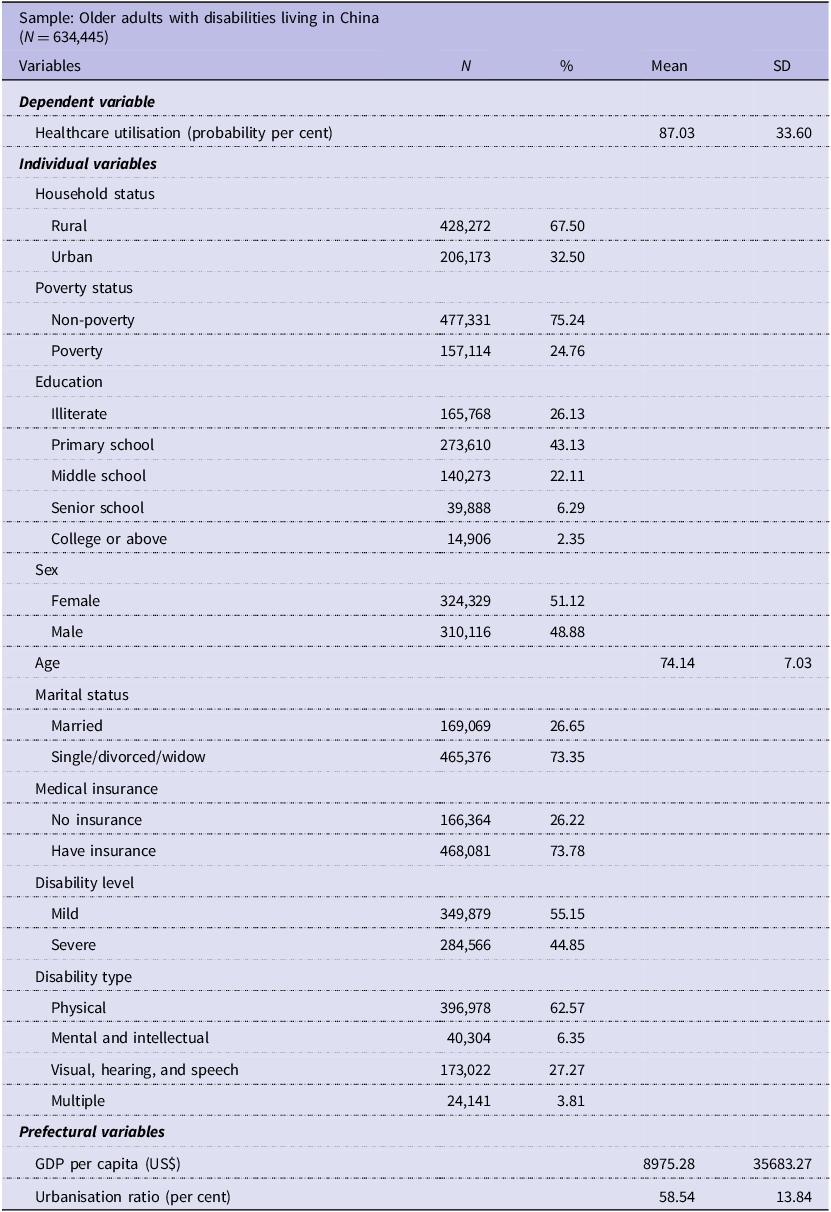
The final dataset includes 634,445 older adults (aged 65 and above) with disabilities covered in the 2019 survey. As Table 1 shows, the mean probability of accessing healthcare when ill is 87.03 per cent. The average age is 74.14 years. For individual socioeconomic variables, 67.50 per cent of individuals have rural households and 32.50 per cent have urban households. 24.76 per cent of respondents are identified as living in poverty, while 75.24 per cent are not. For prefectural variables among 319 prefectures in the Chinese Mainland, the mean value of GDP per capita is equivalent to 8975.28 US dollars, and the average urbanisation ratio is 58.54 per cent.
Descriptive statistics

Note: SD, Standard Deviation.
Individual determinants of healthcare utilisation for older adults with disabilities
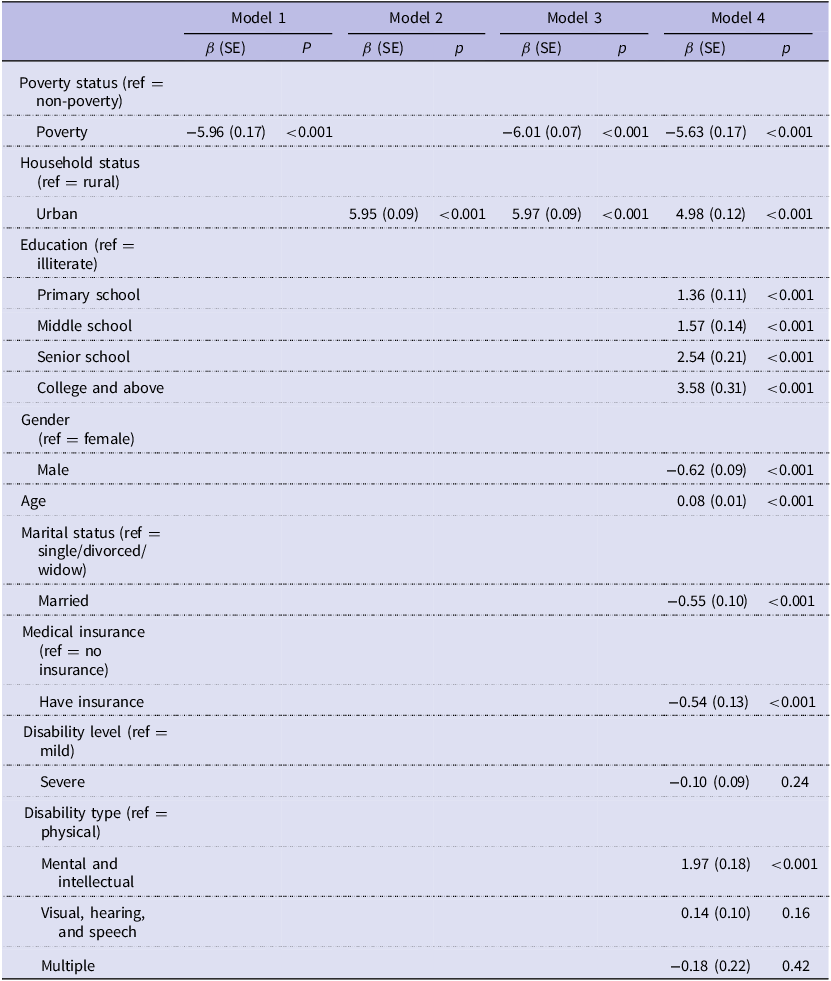
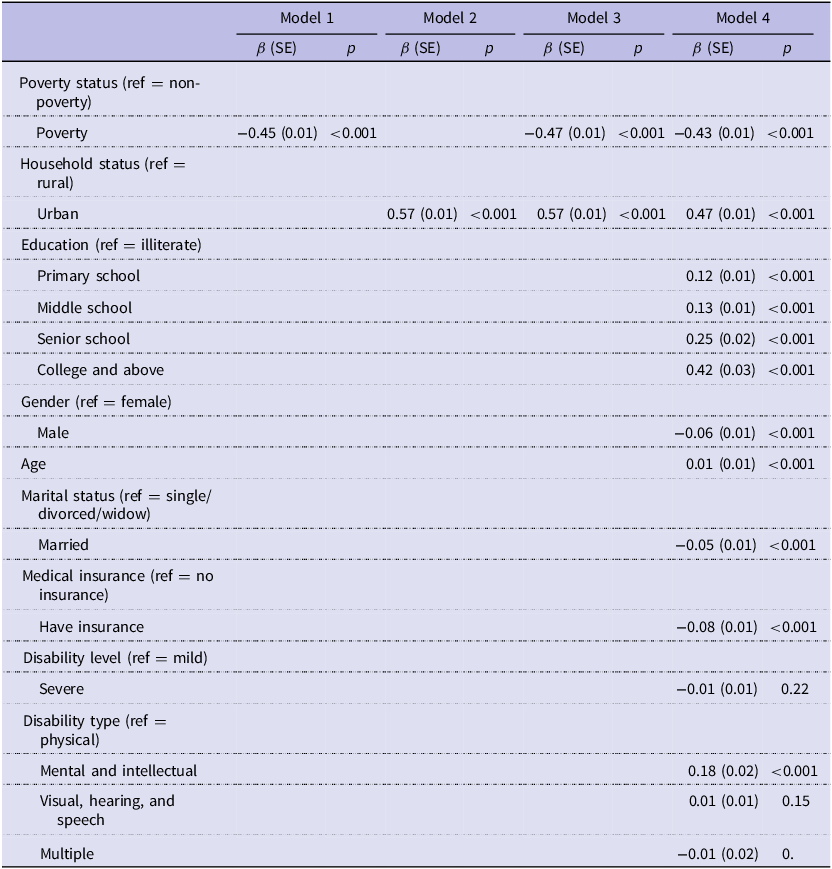
In step 1, we use linear regression models to test the association between respondents’ poverty status/household status and healthcare utilisation, as demonstrated in Table 2. Model 4 shows that when adjusting for control variables, poverty status is significantly and negatively associated with healthcare utilisation among older adults with disabilities (p < 0.001), while urban residence is significantly and positively associated with healthcare utilisation (p < 0.001). Moreover, we conduct a logistic regression analysis and present the results in Appendix Table A1, which are consistent with the main findings reported in Table 2. Thus, our Hypothesis 1a and Hypothesis 1b are supported.
Associations between individual socioeconomic status and healthcare utilisation for older adults with disabilities (OLS)

Note: SE, Standard Error. Model 1 and Model 2 test the association between residence/poverty status and individual healthcare utilisation respectively. Model 3 includes residence and poverty status at the same time. Model 4 adjusts all other covariates.
Contextual determinants of healthcare utilisation for older adults with disabilities
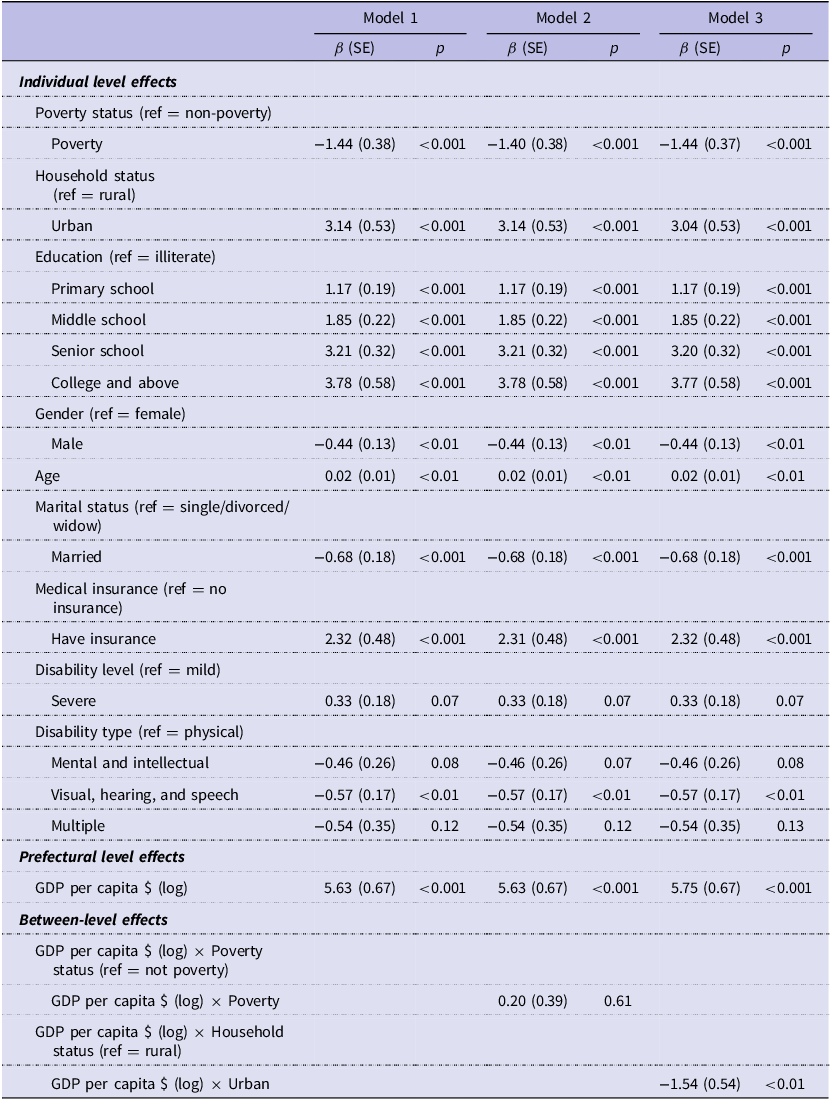
In step 2, we conduct multilevel linear regression models to test the association between prefectural economic indicators and individual healthcare utilisation, and the moderating effect of contextual characteristics on the association between individual socioeconomic status and healthcare utilisation. As Model 1 in Table 3 shows, prefectural GDP per capita (log) is significantly and positively associated with healthcare utilisation for older adults with disabilities (p < 0.001). Similarly, Model 1 in Table 4 demonstrates that the urbanisation ratio is significantly and positively associated with healthcare utilisation at the individual level. Thus, Hypothesis 2 is supported.
Associations between individual socioeconomic status, prefectural GDP per capita, and healthcare utilisation for older adults with disabilities

Note: SE, Standard Error. Model 1 tests the association between prefectural GDP per capita (log) and individual healthcare utilisation with adjusting for individual independent variables and covariates. Model 2 and Model 3 test the moderating effect of prefectural GDP per capita (log) in the association between individual residence/poverty status healthcare utilisation respectively with adjusting for all other variables.
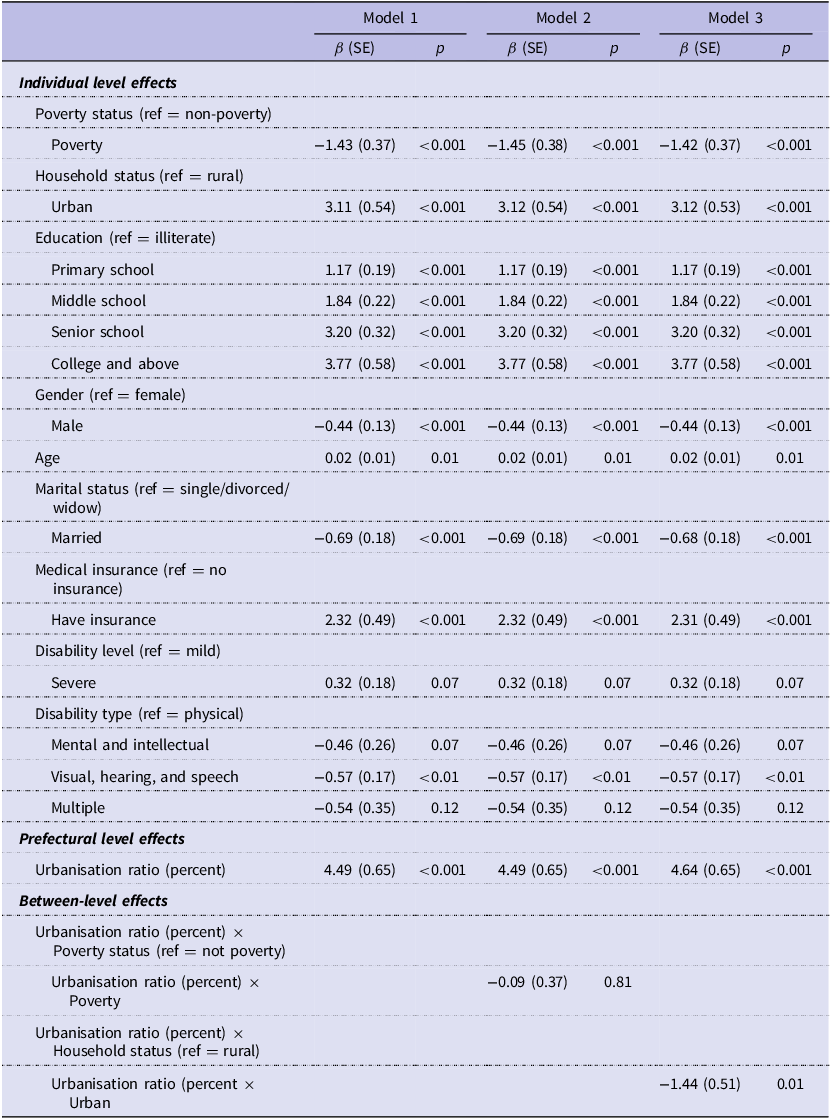
Associations between individual socioeconomic status, prefectural urbanisation ratio, and healthcare utilisation for older adults with disabilities

Note: SE, Standard Error. Model 1 tests the association between prefectural urbanisation ratio and individual healthcare utilisation with adjusting for individual independent variables and covariates. Model 2 and Model 3 test the moderating effect of prefectural urbanisation ratio in the association between individual residence/poverty status healthcare access respectively with adjusting for all other variables.
Moreover, Model 2 in Table 3 shows that the interaction between prefecture’s GDP per capita and the individual’s poverty status is not significant (p = 0.61), and Model 2 in Table 4 also demonstrates that the interactional effect between prefecture’s urbanisation ratio and poverty status is not significant (p = 0.81). Thus, Hypothesis 3a is not supported. However, Model 3 in Table 3 shows that prefecture’s GDP per capita (log) negatively moderates the effect of urban household on healthcare utilisation (p < 0.01). Similarly, Model 3 in Table 4 shows that prefecture’s urbanisation ratio negatively moderates the effect of urban household on healthcare utilisation as well (p < 0.01). Therefore, Hypothesis 3b is supported.
In sum, our results reveal income-based and urban-rural inequalities in healthcare utilisation among older adults with disabilities, which are consistent with Hypothesis 1a and Hypothesis 1b. In terms of contextual determinants, our results show that regional economic development, measured by GDP per capita (log) and urbanisation ratio, is positively associated with healthcare utilisation at the individual level, supporting Hypothesis 2. In terms of between-level interactions, our results show that regional economic development mitigates the urban-rural inequality in healthcare utilisation, which is consistent with Hypothesis 3b. However, the moderation effect of regional economic development on income-based inequality is not significant, thus our Hypothesis 3a has not been supported.
Discussion
Based on a representative dataset in China and utilising multilevel models, this study investigates individual and contextual level determinants of healthcare utilisation for older adults with disabilities, as well as the interactions between individual and contextual determinants of healthcare utilisation. Our results reveal high-income and urban-residence advantages in healthcare utilisation among older adults with disabilities in China, while regional economic development, measured by GDP per capita (log) and urbanisation ratio, is positively associated with healthcare utilisation at the individual level. Additionally, regional economic development mitigates the urban-rural inequality in healthcare utilisation, but the moderating effect of regional economic development on income-based inequality is not significant.
Our findings contribute to the discussion on intersectionality in healthcare inequalities, taking an example of the compounded health disadvantages arising from intersections between disabilities and other forms of marginalisation (Mitra et al., Reference Mitra2022). Our results reveal the inequalities of healthcare utilisation among subgroups of older adults and people with disabilities (Gréaux et al., Reference Gréaux, Moro, Kamenov, Russell, Barrett and Cieza2023). These are consistent with prior studies on people with disabilities showing individuals with better economic status or with urban households are more likely to use healthcare services compared to those with worse economic status or rural households (Jiang et al., Reference Jiang2013; Fu et al., Reference Fu2018; Wong et al., Reference Wong2019). This highlights the importance of addressing healthcare disparities within people with disabilities to promote their overall healthcare utilisation and health status (Krahn et al., Reference Krahn, Walker and Correa-De-Araujo2015), which further leads to achieving UHC and overall health equity.
Furthermore, this study contributes to the application and expansion of Andersen’s Behavioural Model of healthcare utilisation. Financial resources and residence status are important enabling factors of healthcare utilisation at the individual level within Andersen’s framework (Andersen and Davidson, Reference Andersen and Davidson2007). Our findings demonstrate that wealthy and urban respondents are more likely to use healthcare services among older adults with disabilities in China. Moreover, financing factors at the contextual level play a significant role in influencing healthcare utilisation (Andersen and Davidson, Reference Andersen and Davidson2007). Our results show that regional economic development, as indicated by GDP per capita and urbanisation ratio, is positively associated with healthcare utilisation at the individual level. Notably, our results indicate that regional economic development at the contextual level mitigates the effect of residence status on healthcare utilisation at the individual level, which expands Andersen’s framework by emphasising the importance of interactions between contextual and individual characteristics (Terraneo, Lombi and Bradby, Reference Terraneo, Lombi and Bradby2021).
Our analysis also contributes to the literature on the impact of economic development on population health. Prior research has demonstrated that economic development, typically measured by the GDP per capita, reduces mortality rates (Brenner, Reference Brenner2005; Cutler et al., Reference Cutler, Deaton and Lleras-Muney2006; Birchenall, Reference Birchenall2007; Baird et al., Reference Baird, Friedman and Schady2011) and extends life expectancies across many countries in history. However, the mechanisms behind these health improvements remain less explored (Schneider and Devitt, Reference Schneider and Devitt2018). Healthcare utilisation, a key determinant of health outcomes, is associated with life expectancies across countries (Galvani-Townsend et al., Reference Galvani-Townsend, Martinez and Pandey2022), emerges from our study as a potential pathway through which economic development promotes population health outcomes. This underscores the critical role of healthcare in achieving Sustainable Development Goals (SDGs) 3: ‘ensure healthy lives and promote well-being for all at all ages’ (United Nations, 2024c). Additionally, this study enriches the discussion on economic development’s impact on social inequality. The classical Kuznets Curve theory predicts that economic inequalities will eventually decrease as the economy keeps growing (Kuznets, Reference Kuznets1955). This study contributes to the application of Kuznets Curve theory to emerging literature in the health field by linking Kuznets Curve theory to Andersen’s Behavioural Model. While previous literature demonstrates the quadratic relationship between economic development and health outcomes (Costa-Font et al., Reference Costa-Font, Hernandez-Quevedo and Sato2018; Windarti et al., Reference Windarti, Hlaing and Kakinaka2019), this study provides an underlying mechanism with novel evidence of the effect of economic development on reducing healthcare inequality. Moreover, our findings underscore the need for taking targeted interventions, such as health insurance assistance and universal primary care, along with economic development to accelerate the downward part of the Kuznets Curve in order to mitigate health inequities especially for emerging economies and middle-income countries.
Two potential channels could explain the negative association between regional economic development and the inequality related to household status in healthcare utilisation found in this study. First, economic development may provide more public expenditures on social services (Anand and Ravallion, Reference Anand and Ravallion1993), which leads to more inclusive healthcare provision for both rural and urban residents. For example, prior evidence shows that regional healthcare provision is positively associated with healthcare utilisation among disadvantaged groups (Kim, Reference Kim2019). Second, economic development may enhance the relative income levels of disadvantaged subgroups, increasing their affordance for healthcare services (Ranis and Stewart, Reference Ranis and Stewart2000). For example, evidence shows that economic slowdown causes difficulties with the financial costs of healthcare services in Ireland (Schneider and Devitt, Reference Schneider and Devitt2018). Notably, urban expansion narrows the income gap between rural and urban residents in China in recent years (Zhong et al., Reference Zhong2022), while targeted poverty alleviation also reduced household-related income inequalities (Zhou et al., Reference Zhou2023), with these effects largely dependent on local economic capacities (Wang et al., Reference Wang2023). We therefore hypothesise that the rising relative income levels among rural residents serve as a mediator between regional economic development and healthcare utilisation. However, further empirical research is needed to corroborate these hypothesised potential channels with evidence from the real world.
Our results indicate that the effect of regional economic development on income-related inequality of healthcare utilisation is limited. It suggests that economic development alone cannot address all forms of social and health inequalities (Brady et al., Reference Brady, Kaya and Beckfield2007; Patterson, Reference Patterson2023). To improve healthcare utilisation and advance social equity, targeted interventions to empower low-income groups are necessary. For example, evidence shows that the expansion of national health insurance reduces the high-income advantage in healthcare utilisation in Indonesia (Johar et al., Reference Johar2018). Emerging evidence demonstrates the effectiveness of cash transfer programmes on improving healthcare utilisation across countries (Brydon et al., Reference Brydon2024).
There are several limitations in this study that need to be acknowledged. First, the inequality between rural and urban older persons with disabilities in accessing healthcare services may be unique to the Chinese context and difficult to generalise internationally. Urban-rural inequality in healthcare utilisation is commonly observed among middle-aged and older adults in China (Jiang et al., Reference Jiang2013), which is largely due to the household registration (hukou) system established by the government since the 1950s. But in other countries where household registration systems do not exist, the urban-rural inequality in healthcare utilisation may be less pronounced. Second, we use a single dichotomy indicator (‘poverty’ vs. ‘non-poverty’) to measure the economic status rather than direct income, which is restricted by our data source. This could introduce biased estimation of the impact of individuals’ economic status on healthcare utilisation (Nicoletti et al., Reference Nicoletti, Peracchi and Foliano2011). Third, our dataset lacks broader confounders often relevant to older adults with disabilities. For example, prior studies reveal the relatively high prevalence of depressive symptoms and multimorbidity among older adults living in China (Su et al., Reference Su, Ding, Zhang, Duan, Yang, Chen, Duan, Du, Xie, Jin, Hu, Sun, Long, Gong and Tian2016; Feng et al., Reference Feng2021), which could affect healthcare utilisation among this population. Fourth, although we adjusted for individuals’ age and sex in our analysis, the absence of age- and sex-specific criteria in the survey’s definition of disability may introduce measurement bias in the assessment of disability status (Fehrmann et al., Reference Fehrmann2023). In future studies, these limitations could be addressed by using more comprehensive or cross-national datasets.
Conclusion
Using multilevel regression models, this study reveals income-based and urban-rural inequalities in healthcare utilisation among older adults with disabilities in China. Regional economic development, measured by GDP per capita (log) and urbanisation ratio, is positively associated with healthcare utilisation at the individual level. Regional economic development mitigates the urban-residence advantage in healthcare utilisation. This study highlights the inequalities of healthcare utilisation among subgroups of older adults and people with disabilities. It contributes to the application and expansion of Andersen’s Behavioural Model of healthcare utilisation. Additionally, our findings underscore the need for targeted interventions, such as cash transfers or health insurance expansions for low-income groups, to advance universal health coverage and social equity.
Author contributions: CrediT taxonomy
Hongchuan Wang: writing – review and editing (lead); conceptualisation (lead); writing – original draft preparation (equal); supervision (equal).
Zhe Chen: formal analysis (lead); software (lead); writing – original draft preparation (equal); writing – review and editing (supporting).
Funding statement
This research was supported by China National Natural Science Foundation (Grant Number: 72274104,72522004).
Competing interests
The authors declare none.
Appendix 1
Associations between individual socioeconomic status and healthcare utilisation for older adults with disabilities (logit)

Note: SE, Standard Error. Model 1 and Model 2 test the association between residence/poverty status and individual healthcare utilisation, respectively. Model 3 includes residence and poverty status at the same time. Model 4 adjusts all other covariates.