Introduction
Weevils (Coleoptera: Curculionidae) are a very large group of beetles, containing more than 60,000 species, and are worldwide in occurrence, equally well distributed throughout the tropics and temperate regions, and many of them are pests of cultivated crops and forest trees (Hill, Reference Hill2008).
Food security in sub-Saharan Africa depends largely on improved food productivity through the use of sustainable good agricultural practices and the reduction of post-harvest losses caused by pests and diseases. For decades, the pest control policy in developing countries has been dependent upon the use of synthetic pesticides. Although synthetic pesticides are known to have undoubted benefits, their adoption rate and use for insect control in grain storage has remained remarkably low in resource-poor farming environments (Ogendo et al., Reference Ogendo, Deng, Belmain, Walker and Musandu2004).
The subsistence nature of agriculture in developing countries coupled with the high cost, poor access to information and erratic supply of synthetic pesticides have emerged as reasons for the reluctance of farmers to adopt pesticides. Furthermore, synthetic insecticides can penetrate into stored grain and may be toxic, and, additionally, pests have become more resistant to synthetic compounds (Ogendo et al., Reference Ogendo, Deng, Belmain, Walker and Musandu2004). Therefore, affordable and effective methods for reducing pest damage are required.
Different types of aromatic plant preparations such as powders, solvent extracts, essential oils and whole plants are being investigated for their insecticidal activity, including their action as repellents, anti-feedants and insect growth regulators (Prakash et al., Reference Prakash, Rao and Nandagopal2008). Among them, essential oils and their constituents have potential as alternative compounds to currently used fumigants (Ahmed, Reference Ahmed2010). Major constituents from aromatic plants, mainly monoterpenes, are of special interest to industrial marketers because of other potent biological activities in addition to their toxicity to insects (Isman, Reference Isman2006). Plant essential oils have important benefits. Due to their rapid volatilization, there is a much lower risk to the environment than with current synthetic pesticides. Furthermore, while resistance development continues to be an issue for many synthetic pesticides, it is likely that resistance will develop more slowly to essential oil-based pesticides owing to the complex mixtures of constituents that characterize these oils (Rai and Carpinella, 2006).
The repellent activity of a number of essential oils and their constituents has been evaluated against the maize weevil Sitophilus zeamais (Motsch.). The essential oils of Cleome monophylla L. (Cleomaceae) (Ndung'u et al., 1993), Ocimum gratissimum L. (Lamiaceae) (Asawalam et al., Reference Asawalam, Emosairue and Hassanali2008), Melaleuca cajuputi Powell (Myrtaceae) (Ko et al., Reference Ko, Juntarajumnong and Chandrapatya2009) and Hyptis spicigera Lamarck (Lamiaceae) (Wekesa et al., Reference Wekesa, Onek, Deng, Hassanali and Othira2011) all have repellent activity against S. zeamais.
Eucalyptus is a diverse genus of flowering trees and a few shrubs in the myrtle family. Eucalyptus has attracted attention from global development researchers and environmentalists because it is a fast-growing wood, its oil can be used for cleaning functions as a natural insecticide and sometimes it is used to drain swamps and thereby reduce the risk of malaria. Traditional societies in Africa have always used plants such as eucalyptus to promote healing as traditional medicine is still the predominant means of health care in developing countries. An infusion or decoction of the leaves of eucalyptus is taken, or applied externally in baths, lotions or enemas, against asthma, bronchitis, tonsillitis, colds, urinary problems and haemorrhages. The vapour of boiled dried leaves is inhaled against asthma, cough, flu, croup and diphtheria, or fine leaf powder is inhaled (Louppe et al., 2008). The trees are also useful in farms as a preventive measure against storage pests such as weevils. The fresh eucalyptus leaves are burnt and used along with cow dung to keep away pests from granaries before storage of maize (Kamau, 2006).
This study evaluated the repellent activity of the essential oils extracted from selected eucalyptus species and their major constituents against S. zeamais in an effort to rationalize their use as grain protectants.
Materials and methods
Extraction of the essential oils
Fresh leaves of E. citriodora, Eucalyptus camaldulensis, E. globulus and Eucalyptus saligna were harvested at the Jomo Kenyatta University of Agriculture and Technology, Juja, Kenya (1 °11′S, 37 °7′E; 1416 m altitude) in June 2011 and taken to the laboratory immediately to avoid the loss of essential oils through evaporation. The fresh plant material was cut into small pieces and the oil extracted by steam distillation using a Clevenger-type apparatus. The steam distillate was collected every hour and extracted with hexane. This prevented possible decomposition of the oil due to heat and exposure to light. The combined oil and solvent extract was dried with anhydrous sodium sulphate. The solvent was then removed using a microdistillation apparatus to produce the essential oils. The essential oils were then stored in sealed amber-coloured vials at about 4 °C (Ndung'u et al., 1993).
Repellency tests
Essential oils
The maize weevils were reared in an insectary on untreated maize obtained from a smallholding in Kahawa Sukari, Kenya. Adult S. zeamais were introduced into the maize and placed in jars covered with a nylon mesh. A laboratory colony was reared under ambient conditions (25 ± 3 °C and 65–80% humidity). Four concentrations of the essential oils were used for the bioassays. The stock solution was made by dissolving 100 μl of the essential oil in 1000 μl hexane to obtain a concentration of 0.1 μl/μl. Subsequent lower concentrations (0.01, 0.001 and 0.0001 μl/μl) were made by diluting the stock solution 10-, 100- and 1000-fold, respectively. Essential oil in hexane (20 μl) was taken for the S. zeamais bioassay, hence the concentrations 2, 0.2, 0.02 and 0.002 μl/μl. The repellent activity of the essential oils against the maize weevils was assessed using a Y-shape olfactometer. The test sample was applied onto a filter paper disc (Whatman no. 1, 1.8 cm in diameter), while hexane alone was applied onto a similar filter paper disc. The solvent was allowed to evaporate and the resulting treated and control discs were placed in the arms of the olfactometer. For each assay, 30 randomly selected adult maize weevils of mixed sex and age were introduced into the olfactometer. Prior to the introduction of the test material, air suction was applied at the Y junction by means of an aspirator pump (Barnant Air Cadet, model no. 420-1902, 230V 60Hz, dual head pump manufactured by Barnant Company). This ensured that the olfactometer did not become saturated with the test material (volatile oil), which was confined to the treated arm of the olfactometer. All bioassays were conducted at 25 ± 5 °C and 70 ± 5% humidity. The assay was left to run for 30 min and then the number of weevils in the control arm (N C) and that in the treated arm (N T) were counted. After each test, the olfactometer was thoroughly cleaned and dried. The assay for each dose of the test material was replicated five times and the same procedure was followed for the standard N, N-diethyl-m-toluamide (DEET). Percentage repellency (PR) values were computed using the following formula given by Ndung'u et al. (1993):
 $$\begin{eqnarray} \end{eqnarray}$$
A positive PR value indicated repellency by the essential oils against S. zeamais, while a negative PR value indicated attractance.
Pure essential oil compounds
In light of the results, the oils with a PR value greater than 50 were analysed by gas chromatography (GC) and GC–mass spectrometry (GC–MS). This analysis was conducted to determine which compounds were responsible for high repellent activity. The compounds identified from the essential oils were then assayed for their repellent activity against S. zeamais following the same procedure used for the essential oils.
GC and GC–MS analysis
GC analysis of the oils was performed using a Shimadzu Gas Chromatograph Model GC-14B fitted with a flame ionization detector and a Shimadzu C-R8A integrator. The instrument was equipped with a 60 m carbowax column of internal diameter 0.25 mm and film thickness 0.25 micrometres. The nitrogen carrier gas had a flow rate of 2 ml/min. The temperature program used was 70 °C (held for 2 min), with a subsequent increase to 10 °C/min every 3 min, to 230 °C (held for 2 to 5 min).
GC–MS analysis was performed on an Agilent 7890A (GC System)/5975C inert XL Electron Impact/Chemical Ionization Mass Selective Detector (MSD) equipped with a triple-axis detector (MS compartment). The instrument was equipped with a 30 m methyl silicone capillary column (HP-5MS) of internal diameter 250 μm and film thickness 0.25 μm. The helium carrier gas had a delivery rate of 4 ml/min. The automatic sampling injector (Model 7683 B) was operated in the splitless mode and the sample concentration was 250 mg/μl. The column temperature programme was 40 °C which then rose at a rate of 10 °C/min to 140 °C and maintained for 15 min, and again the temperature rose at a rate of 10 °C/min to 280 °C and then maintained for 1 min. For MS analysis, the electron impact was 70 eV and a quadrupole mass analyser was used.
The chemical constituents of the essential oils were identified by comparison of their GC retention times using the program Agilent 5975C MSD Data Analysis and by comparison of their mass spectra with the National Institute for Standard Technology (NIST), CHEMECOL and Adams2 mass spectral databases.
The identity of the constituents was established by comparison with retention times of the authentic samples and with peak enhancement of the components by co-injection of the essential oils with the standards.
Data analysis
Due to the nature of the sampling technique, repeated measures of analysis of variance were applied to test the effects of different doses and repellents, and their interactions, on the response variable against S. zeamais. PR was transformed using angular transformation to normalize the data and minimize the correlation between the mean and variance of the data. Since the level of dosages represents the quantitative factor whose effect can often be explained through polynomial relations, orthogonal polynomial contrasts were used to investigate repellency trends with concentrations. Mean comparison was performed using adjusted treatment means computed by the least square method. Statistical Analysis Software (SAS; Version 9) was used for data analysis.
Results
Essential oil composition
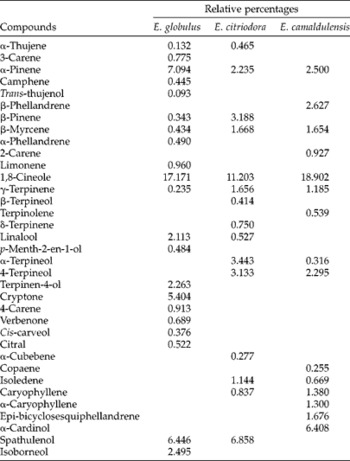
The chemical compositions, as elucidated by GC and GC–MS, of the essential oils extracted from E. globulus, E. camaldulensis and E. citriodora are shown in Table 1. The major constituents (relative percentages) of the essential oil extracted from E. globulus were 1,8-cineole (17.2%), α-pinene (7.1%), spathulenol (6.5%), cryptone (5.4%), isoborneol (2.5%), terpinen-4-ol (2.3%) and linalool (2.1%). The major constituents of the essential oil derived from E. camaldulensis were 1,8-cineole (18.9%), α-cardinol (6.4%), β-phellandrene (2.6%), α-pinene (2.5%), 4-terpineol (2.3%) and β-myrcene (1.7%). The major constituents of the essential oil extracted from E. citriodora were 1,8-cineole (11.2%), spathulenol (6.9%), α-terpineol (3.4%), β-pinene (3.2%), 4-terpineol (3.1%) and α-pinene (2.2%).
Constituents of the essential oils extracted from Eucalyptus camaldulensis, Eucalyptus citriodora and Eucalyptus globulus

Repellency bioassays
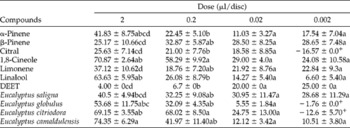
The mean repellency values of the individual compounds, the essential oils and the standard DEET at the four dose levels against S. zeamais are provided in Table 2. All the dosages were repellent to S. zeamais in a dose–response manner. Analysis of variance showed significant differences (P< 0.05) in weevil responses to the four dosages tested and revealed that the repellent activity increased with increasing doses.
Repellent activities of the individual compounds, the essential oils and the standard N, N-diethyl-m-toluamide (DEET) against Sitophilus zeamais

Values are the mean repellency (%) ( ± SE) of five replicates of 30 maize weevils each. Mean values within a column followed by the same lower case letters are not significantly different (P< 0.05; ANOVA and Tukey's tests).
+ Negative percentage repellency value indicates attractance.
The essential oil of E. camaldulensis had the highest activity, being more active than the standard DEET or any other oil tested at the highest 2 μl dose. The essential oil of E. citriodora had the highest activity at the 0.2 μl dose followed by E. camaldulensis, E. saligna and E. globulus. The essential oils were more active than the standard DEET, except at the 0.02 μl dose where the oil of E. globulus was less active than the standard DEET and at the 0.002 μl where the oils of E. globulus and E. citriodora behaved as attractants. This means that there were more maize weevils in the test arm than in the control arm of the olfactometer. The formula PR = [(N C− N T)/(N C+N T)] × 100 was reversed to become PR = [(N T− N C)/(N C+N T)] × 100. The transformed mean thus calculated for the two doses was called attractance, hence the negative sign indicating negative repellency.
1,8-Cineole, the major constituent of the essential oils, had the highest repellency and hence is responsible for the repellency of the oils. Generally, all the constituents identified from the essential oils showed consistently higher repellent activity than the standard DEET at all the doses tested except for citral at the 0.002 μl dose, which had a negative PR value. The different dosages had a definite significant effect (P< 0.05) on the PR of the different compounds.
Discussion
The results obtained from this study provide a scientific rationale for the use of the essential oils extracted from E. citriodora, E. camaldulensis and E. globulus in the protection of maize against weevil attack. Eucalyptus oils and many other essential plant oils are environmentally non-persistent, as they readily volatilize from plants and other surfaces (Miresmailli et al., Reference Miresmailli, Bradburry and Isman2006). Furthermore, eucalyptus oils are safe for humans and other mammals, and are used for their therapeutic, perfumed, flavouring, antimicrobial and biopesticidal properties. The repellent effect of these essential oils may have important implications on post-harvest protection systems. Since the repellent effect of the essential oils is immediate, the oils could be functional in a system that allows maize weevils to depart from the treated grain.
The major constituent of the essential oils extracted from E. citriodora, E. camaldulensis and E. globulus was 1,8-cineole, which exhibited high repellent activity when tested individually against S. zeamais, contributing significantly to the high repellent activity of the oils. Likewise, α-pinene, also a major constituent, had significant repellent activity in isolation and hence may have also contributed to the repellent activity of the essential oils. The higher repellent activity of the essential oils extracted from E. camaldulensis and E. citriodora may also have been due to the presence of ‘minor’ constituents (Table 2) since the role of any individual compound is mixture-specific and depends on the interaction between the constituents of the mixture (Akhtar et al., Reference Akhtar, Pages, Stevens, Bradbury, da Camara and Isman2012).
The essential oil extracted from E. globulus had lower repellent activity compared with E. camaldulensis and E. citriodora oils despite its major constituents, 1,8-cineole, α-pinene and linalool, having individually higher repellent activities against S. zeamais. This indicates that for E. globulus, the repellent activities of the individual constituents tested and their contributions to the overall activity of the ‘full mixture’ were not correlated (Akhtar et al., Reference Akhtar, Pages, Stevens, Bradbury, da Camara and Isman2012). The three active constituents may have had a slightly antagonistic effect on each other since their PR values were higher when tested individually than as a mixture in the oil.
Bioassays with the individual constituents of the essential oils showed that different constituents exhibited some repellent activity against S. zeamais. 1,8-Cineole had the strongest repellent activity and thus contributed significantly to the repellent activity of E. citriodora and E. camaldulensis oils against S. zeamais. This finding is consistent with the study on the repellent activity of Ocimum kenyense Ayob. ex. A.J. Patton against S. zeamais, for which strong repellence was observed due to the presence of 1,8-cineole (Knight, 2009). α-Pinene, which has been shown to possess repellent activity against many insects such as the American cockroach Periplaneta americana (L.), mosquitoes and the common tick (Liu et al., Reference Liu, Yu, Li, Wan and Chu2011), also exhibited significant repellent activity against S. zeamais. Linalool also had significant repellent activity at the highest dose, showing insecticidal activity in the essential oil extracted from the flower buds of Lonicera japonica Thunb. (Caprifoliaceae) against S. zeamais (Zhou et al., Reference Zhou, Zhao, Du S., Yang, Wang, Liu and Qiao2012).
Conclusion
Although this study has demonstrated the scientific rationale for the use of the essential oils extracted from E. citriodora, E. camaldulensis and E. globulus as repellents against S. zeamais, further research on the chemistry of the active constituents in the oils as well as on the contribution of each of the constituents to the overall repellent activity of the oils is necessary. Understanding the role of each constituent in the efficacy of the oil renders an opportunity to create artificial blends of different constituents on the basis of their activity and efficacy against S. zeamais. Artificial blends that are more effective than individual compounds in terms of forestalling and diluting resistance for long-term use (Miresmailli et al., Reference Miresmailli, Bradburry and Isman2006; Jiang et al., Reference Jiang, Aktar, Bradbury, Zhang and Isman2009; Akhtar et al., Reference Akhtar, Pages, Stevens, Bradbury, da Camara and Isman2012) should be prepared and tested with individual compounds missing from the mixture to corroborate the role of each constituent towards the overall repellent activity of each oil (Akhtar et al., Reference Akhtar, Pages, Stevens, Bradbury, da Camara and Isman2012).
Acknowledgements
The authors wish to thank the International Centre of Insect Physiology and Ecology (icipe), the World Federation of Scientists (WFS) and the Higher Education Loans Board (HELB) for the scholarship awarded, and the Jomo Kenyatta University of Agriculture and Technology (JKUAT).