


Introduction
Innovation – the invention, adoption, and diffusion of new products, ideas, processes, or procedures – plays a crucial role in enhancing healthcare by improving treatment outcomes and optimizing resource utilization (Reference West and Farr1;Reference Kelly and Young2). To successfully realize these outcomes, engaging in continuous “innovation activities” is essential. Innovation activities are defined as all developmental, financial, and commercial activities, including basic and applied R&D, technology transfer, and ecosystem collaboration, undertaken by an organization that are intended to result in an innovation (3). Healthcare innovation encompasses a range of advancements, including novel drugs, medical devices new surgical techniques, and organizational processes that optimize healthcare management (Reference Flessa and Huebner4;Reference Länsisalmi, Kivimäki, Aalto and Ruoranen5). As populations grow and aging accelerates, healthcare systems face increasing pressure to meet rising demands, making healthcare innovation essential for sustainability (Reference Flessa and Huebner4;Reference Sukkird and Shirahada6). However, the development and adoption of health innovations are often hindered by high failure rates, limited financial and human resources, and lengthy research and development cycles (Reference Sebastianski, Juzwishin and Wolfaardt7). Effective policies and regulatory frameworks are therefore critical in shaping the health innovation landscape. Governments play a key role in fostering innovation through initiatives such as public funding programs and industry–public sector collaborations, seeking to ensure that promising technologies are successfully developed and implemented (Reference Farchi and Salge8).
Health innovation is a complex system involving multiple stakeholders and interactions. To describe these dynamics, the concept of an “innovation ecosystem” has been widely explored. Moore (1993) introduced the idea of a “business ecosystem,” drawing parallels with natural ecosystems (Reference Moore9), while Adner (Reference Adner10) later explicitly defined the “innovation ecosystem,” focusing on its structure, collaboration mechanisms, and the role of strategic alignment in fostering innovation. In healthcare, discussions on innovation ecosystems have intensified, particularly in the context of digital health (Reference Iyawa, Herselman and Botha11;Reference Iyawa, Botha and Herselman12). However, existing frameworks often pay limited attention to the role of policy in shaping innovation pathways (Reference Adner10–Reference Iyawa, Botha and Herselman12).
Early Health Technology Assessment (early HTA) refers to the use of Health Technology Assessment (HTA) to support decisions about the future development, research, or investment of conceptual or emerging health technologies by assessing their potential value at an early stage (Reference Grutters, Bouttell and Abrishami13). Unlike conventional HTA, which is often applied closer to adoption, pricing, or reimbursement decisions, early HTA aims to inform innovation development and prioritization before evidence is fully established (Reference Teerawattananon, Wang, Kc, Turner, Ong and Isaranuwatchai14). Early HTA is increasingly recognized for its role in assessing the potential value of new technologies, guiding strategic R&D decisions, optimizing clinical trial design, supporting market access and pricing strategies, managing portfolios, and refining innovation processes (Reference Hartz and John15–Reference IJzerman, Koffijberg, Fenwick and Krahn18). By incorporating horizon scanning, literature review, landscape analysis, health economic modeling, and stakeholder consultation, early HTA can evaluate both the health and commercial potential of emerging technologies and support decision-making under uncertainty. It helps innovators determine whether further investment in a technology is justified, optimizes clinical trial design by identifying evidence gaps, aligns innovation profiles with market demands and stakeholder expectations, and informs pricing and reimbursement strategies to facilitate market adoption (Reference Ijzerman and Steuten16–Reference IJzerman, Koffijberg, Fenwick and Krahn18). Despite its growing importance, the role of early HTA within the broader health innovation landscape remains underexplored, particularly in relation to other innovation-supporting policies.
To address this gap, this review identifies and synthesizes the major challenges and policy instruments across the health innovation process and examines the potential role of Early HTA in addressing these challenges within the broader innovation ecosystem. The proposed framework may support policymakers, HTA agencies, regulators, funders, and innovators in addressing stage-specific barriers and aligning innovation pathways with policy requirements.
Methods
Search strategy and selection criteria
This study was conducted as an umbrella review of review-level evidence (Reference Choi and Kang19). Given the conceptual and mapping-oriented purpose of the review, PRISMA-ScR was used to guide transparent reporting of the search, selection, and charting processes (Reference Tricco, Lillie and Zarin20). A comprehensive literature search was conducted in November 2024 across five databases: PubMed, Web of Science, Embase, Scopus, and CINAHL Complete. The search was limited to review articles published in English between January 2010 and November 2024. The 2010 cut-off was selected to capture contemporary developments in health innovation policy, innovation ecosystems, and early HTA. Although early HTA originated in the 1990s, its application and scholarly attention expanded substantially during the 2010s (Reference IJzerman, Koffijberg, Fenwick and Krahn18). The English-language restriction was applied to ensure consistency in data extraction and interpretation and because of the practical challenges associated with multilingual review processes. Key search terms included: health, healthcare, health technology, pharmaceutical, innovation, diffusion of innovation, policy, regulation, reimbursement, subsidy, legislation, governance, and R&D. The detailed search strategy can be found in Supplementary Material 1.
Two independent reviewers conducted the initial screening of identified articles based on titles and abstracts, resolving any disagreements through discussion. Shortlisted articles then underwent a full-text assessment by a single reviewer, applying the following criteria: inclusion required that the article be a review study and that it focus on health-related innovation policies, while exclusion applied if the full-text article was not available in English or if the article did not address policy and health innovation.
Data extraction and synthesis
For each included article, the following information was extracted: title, author, year of publication, journal, countries or regions covered, type of review research, time period of the literature search, number of studies or projects included in the review, guidelines used, article topic, objectives, types of innovation discussed, whether HTA was involved, policies addressed (including their stages and stakeholders), challenges to innovation development, and proposed solutions. A standardized data extraction form was developed to systematically chart this information. All included studies were peer-reviewed publications. Publications were classified by review types according to the typology proposed by Maria J. Grant and Andrew Booth (Reference Grant and Booth21). Benefits of early HTA reported in the included reviews were extracted and subsequently mapped to identified innovation challenges through thematic synthesis. This mapping represents an author-derived conceptual synthesis.
Conceptual framework and analysis
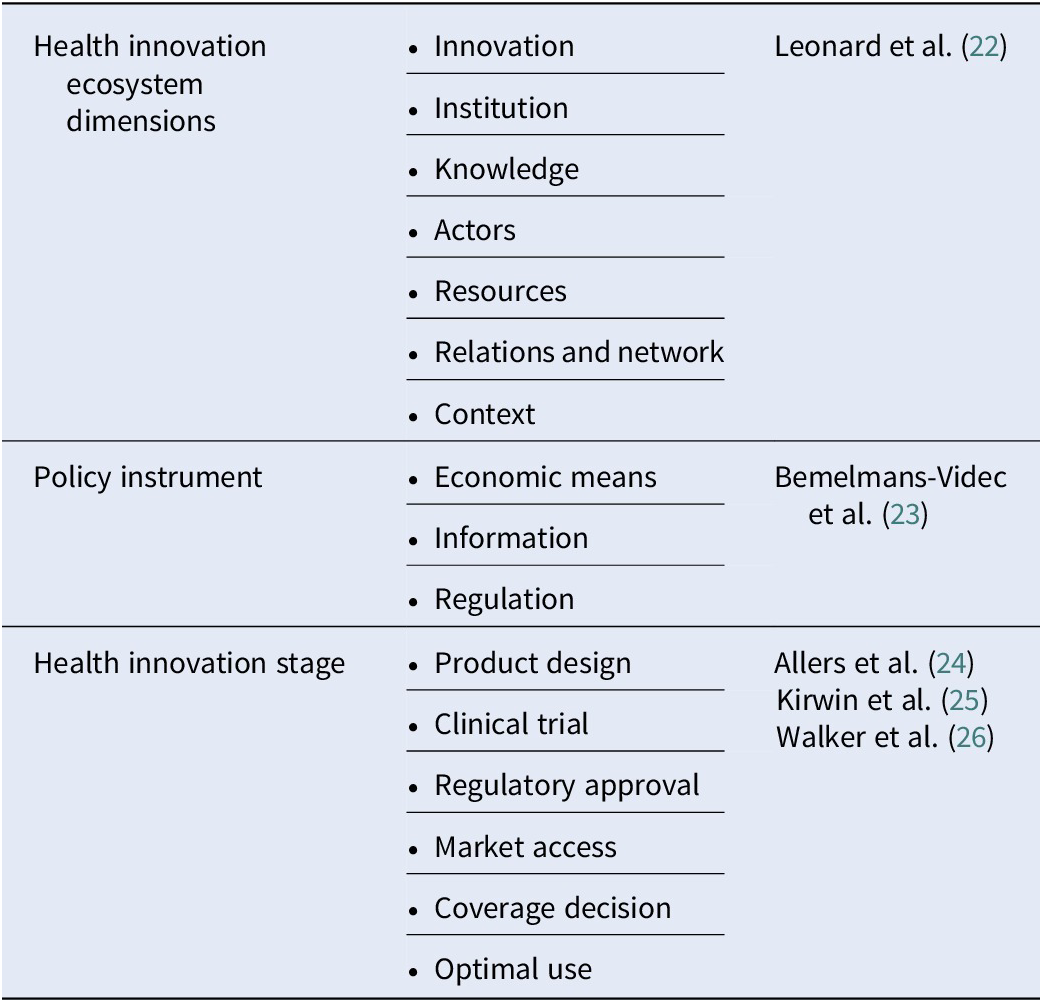
This review conceptualized health innovation development as a multi-stage process occurring within a broader innovation ecosystem. The conceptual framework used in this review (Table 1) integrates innovation development stages, frameworks for classifying innovation challenges and policy instruments, and the role of Early HTA as a decision-support approach across these stages.
Conceptual framework

Table 1. Long description
The table is organized into three main sections based on the first column.
1. Health innovation ecosystem dimensions. This section lists seven sub-items: Innovation, Institution, Knowledge, Actors, Resources, Relations and network, and Context. The source cited is Leonard et al. 17.
2. Policy instrument. This section lists three sub-items: Economic means, Information, and Regulation. The source cited is Bemelmans-Videc et al. 18.
3. Health innovation stage. This section lists six sub-items: Product design, Clinical trial, Regulatory approval, Market access, Coverage decision, and Optimal use. The sources cited are Allers et al. 19, Kirwin et al. 20, and Walker et al. 21.
Challenges were classified using the framework proposed by Leonard and De Kock, comprising seven dimensions: Innovation, Institution, Knowledge, Actors, Resources, Relations and Networks, and Context (Reference Leonard, De Kock and Bam22).
Policy instruments identified in the literature were categorized, guided by the “Carrots, Sticks, and Sermons” policy instrument framework, into three types: Economic means, Regulations, and Information (Reference Bemelmans-Videc, Rist and Vedung23). This classification provides a structured approach to analyze policy mechanisms. Economic means (Carrots) involve the provision or withdrawal of material resources, either in cash or in kind, to influence behavior by altering the cost of money, time, effort, or other valuable resources, making certain actions more affordable or costly. Regulations (Sticks) were defined as government-imposed rules and directives that mandate compliance with specified requirements. Lastly, policies on information (Sermons) encompass knowledge dissemination, provision of technical support, and education to guide and influence decision-making. Similar policy instruments were grouped into broader categories to facilitate comparisons.
Drawing on the health innovation lifecycle literature, the innovation process was categorized into three overarching phases: development, translation, and implementation (Reference Allers, Eijkenaar, van Raaij and Schut24). For analytical purposes, these phases were further operationalized into six stages: product design, clinical trials, regulatory approval, market access, coverage decision, and optimal use (Reference Kirwin, Round, Bond and McCabe25–Reference Henshall, Schuller and Mardhani-Bayne27). These stages were selected to capture both pre-market and post-market phases of health innovation development and to identify where innovation challenges, policy responses, and HTA-related activities emerge across the innovation pathway.
Results
Literature search results
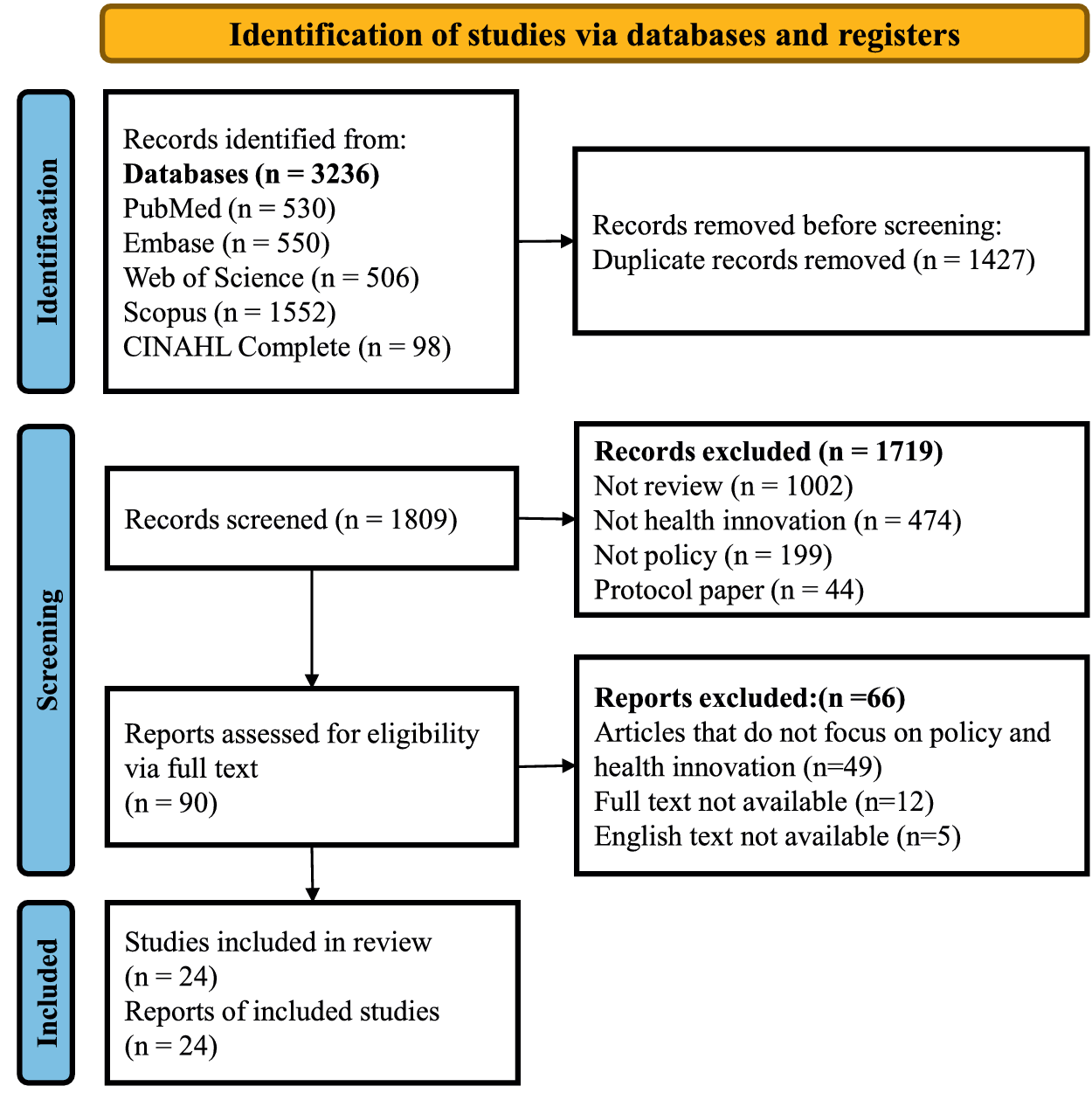
3,236 articles were retrieved from the five databases in the initial literature search. After the removal of duplicate articles, 1,809 articles underwent the first round of title and abstract screening, of which 1,719 articles were excluded. Eighty-one full-text articles were then subjected to a full-text review, ultimately resulting in the inclusion of twenty-four articles in the study. The PRISMA flow chart illustrating the study selection process is presented in Figure 1.
PRISMA flow diagram documenting literature search results.

Figure 1. Long description
The flowchart is organized into three vertical phases labeled on the left: Identification, Screening, and Included.
1. Identification Phase:
- Top-left box: Records identified from Databases (n = 3236). Breakdown includes PubMed (n = 530), Embase (n = 550), Web of Science (n = 506), Scopus (n = 1552), and C I N A H L Complete (n = 98).
- An arrow points right to a box: Records removed before screening: Duplicate records removed (n = 1427).
2. Screening Phase:
- Central box: Records screened (n = 1809).
- An arrow points right to a box: Records excluded (n = 1719). Reasons include Not review (n = 1002), Not health innovation (n = 474), Not policy (n = 199), and Protocol paper (n = 44).
- A vertical arrow leads to the next central box: Reports assessed for eligibility via full text (n = 90).
- An arrow points right to a box: Reports excluded (n = 66). Reasons include Articles that do not focus on policy and health innovation (n = 49), Full text not available (n = 12), and English text not available (n = 5).
3. Included Phase:
- Final central box: Studies included in review (n = 24) and Reports of included studies (n = 24).
The number of published reviews on health innovation-related policies ranged from one to five articles per year. Out of the review types, Critical Reviews were the most common (7 publications), followed by Systematic Reviews (5 publications) (see Supplementary Material 2). Most articles documented policies related to general health innovation (n = 17), with eight articles focused on innovations in specific areas, such as rare diseases, surgery, severe or life-threatening diseases, laboratory medicine, antibiotics, cancer, and biological drugs. The full list of selected articles is available in Supplementary Material 3, and the excluded papers are listed in Supplementary Material 4.
Innovation activities and challenges
Analysis of the twenty-four selected papers showed that innovation activities were predominantly concentrated in the early to mid-stages of health innovation development, including product design, clinical trials, and regulatory approval. Stakeholders in healthcare innovation are classified into six categories: innovators, suppliers, healthcare providers, regulators, investors, and payers. The category of suppliers encompasses manufacturing, delivery, and sales functions. Stakeholders were identified from the included reviews and categorized inductively by the authors into six stakeholder groups based on their primary role in the innovation process. The analysis revealed that regulators were the most actively involved stakeholders in the included reviews. Innovators and healthcare providers likewise demonstrated substantial engagement, underscoring their active roles in the innovation process (Supplementary Material 5).
This review identified several challenges impacting health innovation development within the broader health innovation ecosystem (Supplementary Material 6). Stakeholder engagement in decision-making is often insufficient, and mechanisms to retire outdated technologies are lacking (Reference MacNeil, Koch, Kuspinar, Juzwishin, Lehoux and Stolee28;Reference Price and John29). Limited cooperation among academia, industry, policymakers, and clinicians leads to a lack of integration that delays translating innovation into practice (Reference Sebastianski, Juzwishin and Wolfaardt7;Reference Ma, Augustijn, de Esch and Bossink30–Reference Duenas-Gonzalez and Gonzalez-Fierro32). Resource constraints, including inadequate funding, workforce shortages, and infrastructure gaps, particularly affect low-income settings and small enterprises. Public institutions also struggle with managing intellectual property and commercialization, hindering innovation impact (Reference Sebastianski, Juzwishin and Wolfaardt7;Reference Price and John29–Reference Ruiz, Large, Moon and Vieira38). Policy barriers, such as complex regulations and inconsistent global incentives, reduce support for innovation. Procurement policies focused on short-term cost control overlook the long-term value of new technologies. While expedited approval pathways aim to speed up access, they can introduce safety concerns due to limited post-market monitoring (Reference MacNeil, Koch, Kuspinar, Juzwishin, Lehoux and Stolee28–Reference Duenas-Gonzalez and Gonzalez-Fierro32;Reference Ruiz, Large, Moon and Vieira38–Reference Verghese, Barrenetxea, Bhargava, Agrawal and Finkelstein46). Market challenges include low R&D incentives in certain regions, lengthy development timelines, and weak knowledge transfer (Reference Price and John29;Reference Esmailzadeh, Mehralhasani, Dehnavieh, Ibrahimipour, Hekmat and Sirizi35;Reference Baran-Kooiker, Czech and Kooiker40;Reference Kwok, Foster and Steinberg41). A disconnect between innovation policies and procurement systems further complicates the environment, emphasizing the need for systemic reforms to promote sustainable health innovation (Reference Sebastianski, Juzwishin and Wolfaardt7;Reference Duenas-Gonzalez and Gonzalez-Fierro32;Reference Basant and Srinivasan34;Reference Esmailzadeh, Mehralhasani, Dehnavieh, Ibrahimipour, Hekmat and Sirizi35;Reference Patterson and Carroll37;Reference Baran-Kooiker, Czech and Kooiker40;Reference Cole, Trolle and Edwards47;Reference Wakutsu, Hirose, Yonemoto and Demiya48).
Innovation policy
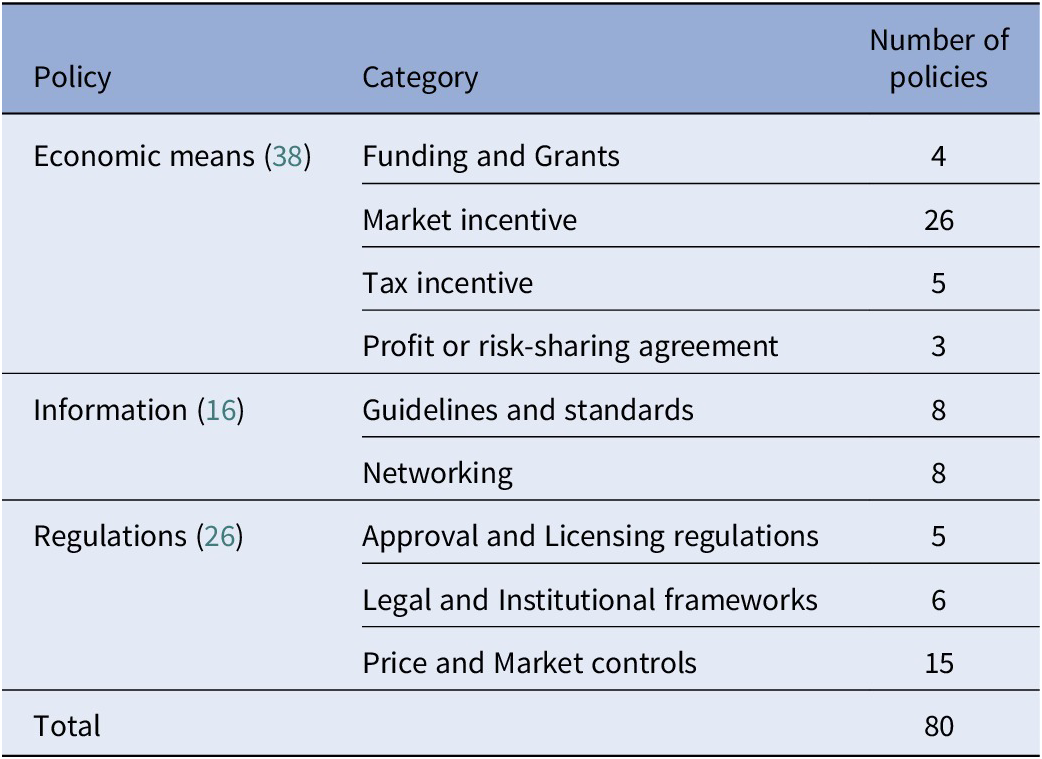
The eighty policies identified from the literature were classified according to policy type, as shown in Table 2. Policy types are categorized into economic means, regulation, and information. Among these, economic means policies emerged as the most common policy type. These include market incentives, such as preferential reimbursement rates for innovative treatments (Reference Mensa Sorato, Davari, Abdollahi Asl, Soleymani and Kebriaeezadeh36;Reference Verghese, Barrenetxea, Bhargava, Agrawal and Finkelstein46;Reference Wakutsu, Hirose, Yonemoto and Demiya48). For innovations that represent significant breakthroughs, target significant diseases, or address orphan drug needs, many institutions also offer accelerated or priority approval (Reference Renwick, Brogan and Mossialos33;Reference Ruiz, Large, Moon and Vieira38;Reference Baran-Kooiker, Czech and Kooiker40;Reference Kwok, Foster and Steinberg41;Reference Oriana, Patrizio, Roberta, Marianna, Claudio and Rosanna43;Reference Wakutsu, Hirose, Yonemoto and Demiya48;Reference Michaeli, Michaeli, Albers, Boch and Michaeli49). Some policies also emphasize public funding to provide financial support for innovation development and tax incentives for investing in healthcare R&D or clinical testing cost. The final category of economic instruments comprises profit- or risk-sharing agreements, which aim to ensure the availability of resources needed to drive innovation in the health sector (Reference Esmailzadeh, Mehralhasani, Dehnavieh, Ibrahimipour, Hekmat and Sirizi35;Reference Patterson and Carroll37). Regulation policies set rules and criteria to guide the innovation development process. Legal and Institutional Frameworks refer to regulatory systems applied across the healthcare sector, including establishing legal frameworks for health-related activities, classifying innovation activities, and general provisions related to intellectual property (Reference Duenas-Gonzalez and Gonzalez-Fierro32;Reference Basant and Srinivasan34;Reference Patterson and Carroll37;Reference Roberts, Zygun and Ball39). Approval and Licensing Regulations concern the procedures and timelines for authorizing the use of medical technologies (Reference Renwick, Brogan and Mossialos33;Reference Baran-Kooiker, Czech and Kooiker40;Reference Kwok, Foster and Steinberg41;Reference Soleimani and Zenios45), while Price and Market Controls regulate product pricing at market entry and represent the largest share among the three categories. Pricing-related policies include cost-plus pricing, differential pricing, and reference pricing (Reference Mensa Sorato, Davari, Abdollahi Asl, Soleymani and Kebriaeezadeh36;Reference Patterson and Carroll37;Reference Verghese, Barrenetxea, Bhargava, Agrawal and Finkelstein46), while reimbursement policies are also included in this category (Reference Oriana, Patrizio, Roberta, Marianna, Claudio and Rosanna43–Reference Soleimani and Zenios45;Reference Rejon-Parrilla, Espin and Epstein50). Information policies aim to support health innovation through the dissemination of guidelines and standards or boosting networking among stakeholders. Networking policy initiatives include fostering stronger collaborations between universities and industry (Reference Ma, Augustijn, de Esch and Bossink30;Reference Esmailzadeh, Mehralhasani, Dehnavieh, Ibrahimipour, Hekmat and Sirizi35;Reference Baran-Kooiker, Czech and Kooiker40), establishing technology transfer offices to facilitate the exchange of knowledge and technology between institutions and the private sector (Reference MacNeil, Koch, Kuspinar, Juzwishin, Lehoux and Stolee28;Reference Baran-Kooiker, Czech and Kooiker40), and encouraging partnerships between HTA agencies and innovator companies to support innovation development (Reference Sebastianski, Juzwishin and Wolfaardt7;Reference Baran-Kooiker, Czech and Kooiker40). Additionally, the application of HTA consultancy during the pre-market phase was highlighted as a way to help innovators streamline their development processes (Reference Sebastianski, Juzwishin and Wolfaardt7), A complete list of the classified policies is provided in Supplementary Material 7.
Number of policies by category

Table 2. Long description
The table consists of three columns: Policy, Category, and Number of policies.
* Economic means (44 total):
- Funding and Grants: 4
- Market incentive: 26
- Tax incentive: 5
- Profit or risk-sharing agreement: 3
* Information (7 total):
- Guidelines and standards: 8
- Networking: 8
* Regulations (21 total):
- Approval and Licensing regulations: 5
- Legal and Institutional frameworks: 6
- Price and Market controls: 15
At the bottom, the total number of policies across all categories is listed as 80.
Health innovation challenges and policy by innovation development stages
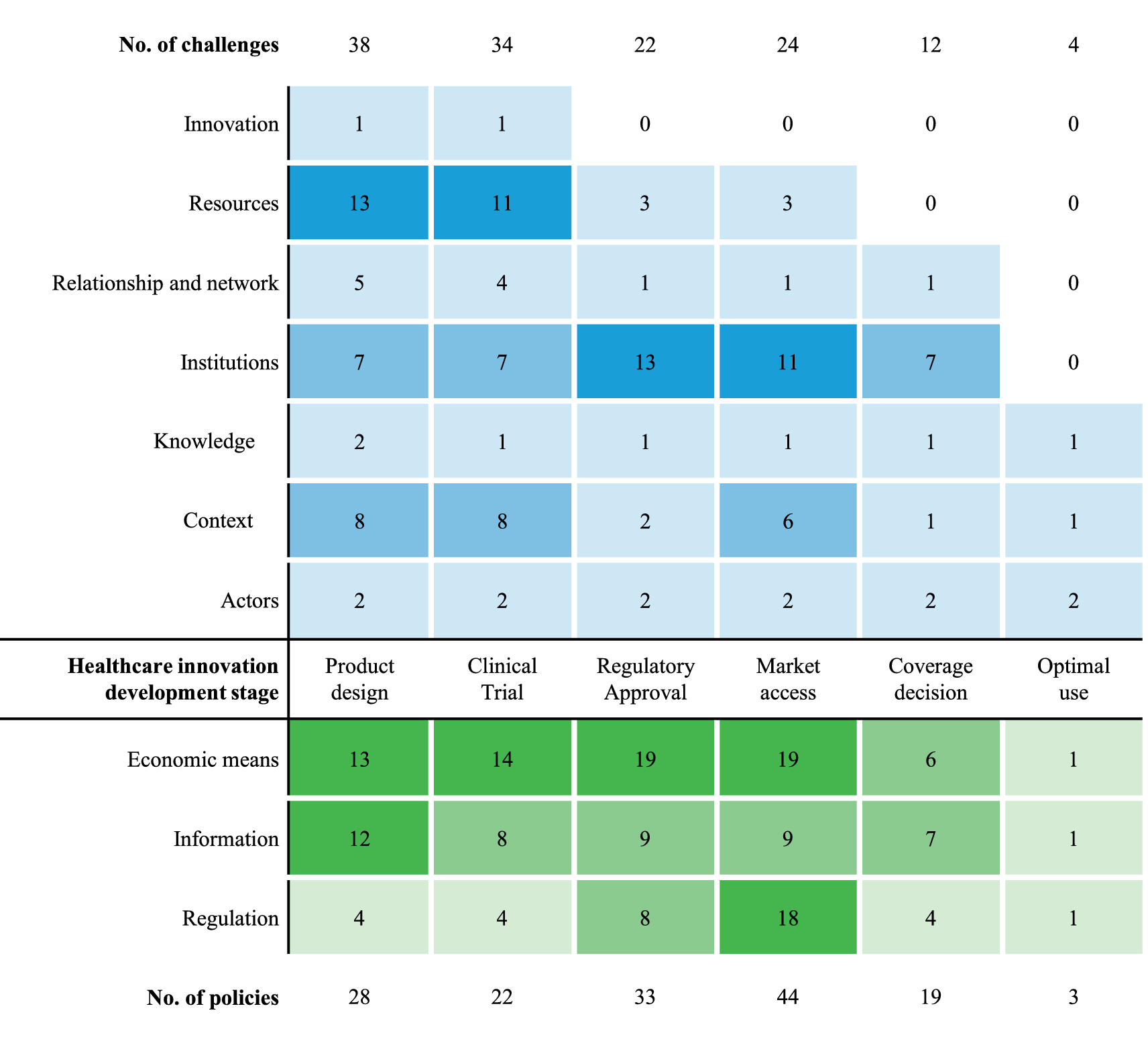
Figure 2 presents a heatmap summarizing the number of challenges and policies across different stages of the innovation development process. Many challenges were observed in the product design and clinical trials, with resource-related and context-related issues being dominant at these stages. Institutional issues were reported throughout the development stages but were most prevalent during the regulatory approval and market access phases. Policies related to economic means appeared mainly in the product design, clinical trial, regulatory approval, and market access phases, taking the form of public funding and grants in the early phase (Reference Esmailzadeh, Mehralhasani, Dehnavieh, Ibrahimipour, Hekmat and Sirizi35;Reference Ruiz, Large, Moon and Vieira38;Reference Michaeli, Michaeli, Albers, Boch and Michaeli49), and market exclusivity (Reference Renwick, Brogan and Mossialos33;Reference Ruiz, Large, Moon and Vieira38;Reference Baran-Kooiker, Czech and Kooiker40;Reference Wakutsu, Hirose, Yonemoto and Demiya48;Reference Michaeli, Michaeli, Albers, Boch and Michaeli49) or preferential pricing (Reference Sebastianski, Juzwishin and Wolfaardt7;Reference MacNeil, Koch, Kuspinar, Juzwishin, Lehoux and Stolee28;Reference Renwick, Brogan and Mossialos33) in the regulatory approval and market access stages to facilitate market access. Information policies were evenly distributed across stages, with a strong focus on strengthening stakeholder networks (Reference Sebastianski, Juzwishin and Wolfaardt7;Reference MacNeil, Koch, Kuspinar, Juzwishin, Lehoux and Stolee28;Reference Ma, Augustijn, de Esch and Bossink30;Reference Baran-Kooiker, Czech and Kooiker40) in the product design and clinical trial stages. Regulation policies were concentrated in the approval and market access stages, particularly those concerning price and market control (Reference Esmailzadeh, Mehralhasani, Dehnavieh, Ibrahimipour, Hekmat and Sirizi35–Reference Patterson and Carroll37;Reference Oriana, Patrizio, Roberta, Marianna, Claudio and Rosanna43–Reference Verghese, Barrenetxea, Bhargava, Agrawal and Finkelstein46).
Number of challenges and policies by healthcare innovation development stages.

Figure 2. Long description
The diagram is structured around a central horizontal axis labeled Healthcare innovation development stage, with six columns: Product design, Clinical Trial, Regulatory Approval, Market access, Coverage decision, and Optimal use.
Top Section (Challenges in Blue):
A row at the very top lists the total No. of challenges per stage: 38, 34, 22, 24, 12, and 4. Below this, seven rows of challenges are mapped against the stages:
* Innovation: 1, 1, 0, 0, 0, 0.
* Resources: 13, 11, 3, 3, 0, 0.
* Relationship and network: 5, 4, 1, 1, 1, 0.
* Institutions: 7, 7, 13, 11, 7, 0.
* Knowledge: 2, 1, 1, 1, 1, 1.
* Context: 8, 8, 2, 6, 1, 1.
* Actors: 2, 2, 2, 2, 2, 2.
Darker blue indicates higher frequency, notably in Resources for early stages and Institutions for middle stages.
Bottom Section (Policies in Green):
Three rows of policies are mapped against the same six stages:
* Economic means: 13, 14, 19, 19, 6, 1.
* Information: 12, 8, 9, 9, 7, 1.
* Regulation: 4, 4, 8, 18, 4, 1.
A final row at the bottom lists the total No. of policies per stage: 28, 22, 33, 44, 19, and 3.
Darker green indicates higher frequency, peaking at Market access for Regulation and Economic means.
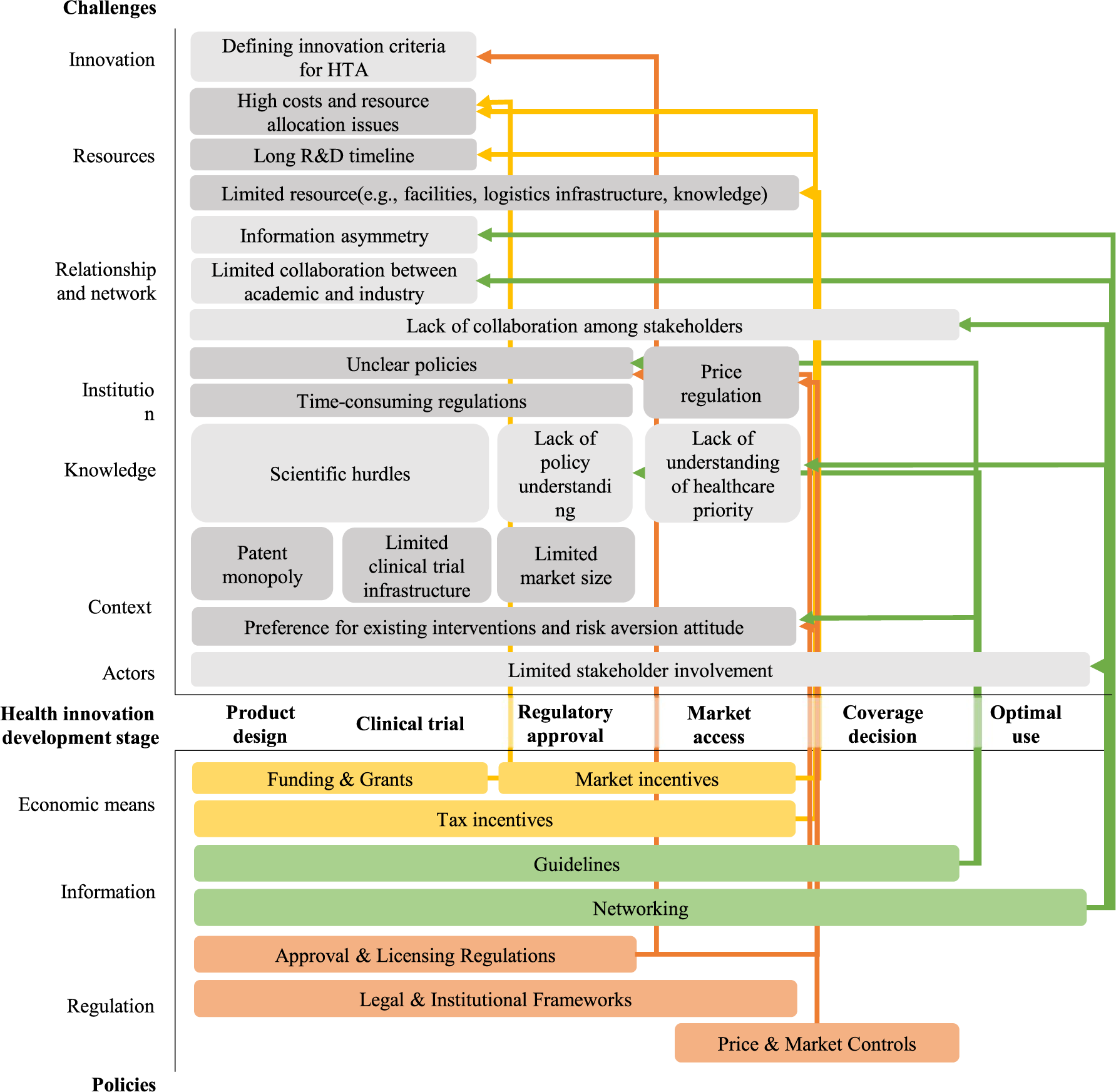
Figure 3 illustrates the mapping of major challenges encountered across different stages of the innovation development process and the policy instruments that may help mitigate them. At the product design and clinical trial stages, economic means policies, such as public funding, grants, and tax incentives, primarily address challenges related to resource constraints, including limited facilities, infrastructure, and financial support. Information policies play a complementary role: networking initiatives mitigate issues of limited collaboration, asymmetric information, and weak links between academia and industry by strengthening relationships among actors, while guidelines help overcome knowledge and institutional challenges, such as unclear policies on the adoption of new technologies and lack of understanding of healthcare priorities. Clear guidance may reduce uncertainty regarding evidence requirements and help developers design studies that meet regulatory and HTA expectations. However, it cannot directly address limited market size or insufficient clinical trial infrastructure. These challenges may instead require targeted financial support, cross-institutional research networks, and investment in shared clinical trial capacity. Regulatory instruments may address institutional barriers by establishing transparent approval pathways, clarifying evidence requirements, and defining institutional responsibilities. In contrast, informational instruments, including stakeholder engagement, professional education, and clinical guidance, may help reduce attitudinal resistance among potential adopters.
Mapping of challenges and policy responses across innovation development stages.
The six innovation stages represent the chronological innovation pathway. Challenges and policy instruments were classified using established analytical frameworks. Connecting lines represent relationships explicitly identified in the included reviews. The absence of a connecting line indicates that no direct relationship was identified in the reviewed literature.

Figure 3. Long description
The diagram is structured around a central horizontal axis representing the Health innovation development stage, divided into six phases: Product design, Clinical trial, Regulatory approval, Market access, Coverage decision, and Optimal use.
Top Section: Challenges
Categorized by Innovation, Resources, Relationship and network, Institution, Knowledge, Context, and Actors. Key challenges include:
• Defining innovation criteria for H T A (Innovation stage).
• High costs, Long R and D timeline, and Limited resources (Resources stage).
• Information asymmetry and Limited collaboration (Relationship and network stage).
• Unclear policies and Time-consuming regulations (Institution stage).
• Scientific hurdles, Lack of policy understanding, and Lack of understanding of healthcare priority (Knowledge stage).
• Patent monopoly, Limited clinical trial infrastructure, and Limited market size (Context stage).
• Limited stakeholder involvement (Actors stage).
Bottom Section: Policies
Categorized by Economic means, Information, and Regulation. Key instruments include:
• Funding and Grants, Tax incentives, and Market incentives (Economic means).
• Guidelines and Networking (Information).
• Approval and Licensing Regulations, Legal and Institutional Frameworks, and Price and Market Controls (Regulation).
Connecting Relationships:
• Orange lines connect Approval and Licensing Regulations to challenges like Defining innovation criteria for H T A and Unclear policies.
• Yellow lines connect Economic means (Funding, Tax, Market incentives) to Resource challenges like High costs and Long R and D timelines.
• Green lines connect Information policies (Guidelines, Networking) to Relationship and Knowledge challenges, including Information asymmetry, Lack of collaboration, and Lack of understanding of healthcare priority.
HTA and early HTA
The review identified eight studies that explored concepts related to HTA and early HTA (Supplementary Material 8; Reference Sebastianski, Juzwishin and Wolfaardt7;Reference MacNeil, Koch, Kuspinar, Juzwishin, Lehoux and Stolee28;Reference Lee Mendoza31;Reference Baran-Kooiker, Czech and Kooiker40;Reference Zhen, Sun and Dong42;Reference Hofmann, Branner, Misra and Lintener44;Reference Verghese, Barrenetxea, Bhargava, Agrawal and Finkelstein46;Reference Rejon-Parrilla, Espin and Epstein50). Six studies highlighted the implementation of HTA policies in various countries, particularly focusing on their role in reimbursement and pricing decisions. The regions discussed include Europe, Canada, Australia, Japan, and China (Reference MacNeil, Koch, Kuspinar, Juzwishin, Lehoux and Stolee28;Reference Lee Mendoza31;Reference Zhen, Sun and Dong42;Reference Hofmann, Branner, Misra and Lintener44;Reference Verghese, Barrenetxea, Bhargava, Agrawal and Finkelstein46;Reference Rejon-Parrilla, Espin and Epstein50). Additionally, two studies emphasized the advisory role of HTA agencies in providing expert guidance to support health innovation (Reference Sebastianski, Juzwishin and Wolfaardt7;Reference Baran-Kooiker, Czech and Kooiker40).
The HTA policies identified in the studies can be categorized into two main policy types: regulation and information. Regulation policies are government-mandated rules that define reimbursement and pricing frameworks for health innovations. These include specific methods for pricing, value evaluation, and value-based pricing strategies. In contrast, informational policies focus on using HTA or early HTA as a consultancy tool to support and guide the development of health innovations. For example, Baran-Kooiker et al. (Reference Baran-Kooiker, Czech and Kooiker40) highlighted two notable information policies: the Parallel Consultation policy and the Medicines Adaptive Pathways to Patients (MAPPs) initiative. The Parallel Consultation policy encourages collaboration between HTA agencies and companies, with HTA agencies providing scientific advice to innovators during the development process. Sebastianski et al. highlighted the MaRS Excellence in Clinical Innovation and Technology Evaluation (EXCITE) Program in Ontario, a policy that incorporates HTA thresholds in the early stages of innovation development. This initiative seeks to mitigate risks and enhance the probability of success, offering further evidence for the implementation of early HTA in fostering innovation (Reference Sebastianski, Juzwishin and Wolfaardt7).
Supplementary Material 9 maps the benefits of Early Dialogue and Early HTA to identified health innovation challenges. Early Dialogue focuses on helping innovators clarify regulatory and reimbursement evidence requirements through engagement with regulators and HTA agencies. Although early dialogue is generally considered a distinct activity from early HTA, some overlap may occur, particularly during the early stages of evidence planning (Reference Wiwatpanit, Teerawattananon and Wang51). By facilitating early consultation among innovators, patients, and healthcare professionals, Early HTA helps align technologies with healthcare system needs and supports product design and clinical trials through the early incorporation of stakeholder perspectives and evidence requirements. By engaging clinicians and patient groups early, innovators can refine technologies to better fit healthcare system priorities and improve usability, thereby addressing knowledge gaps such as the lack of clarity on health priorities or policies (Reference MacNeil, Koch, Kuspinar, Juzwishin, Lehoux and Stolee28).
Early HTA helps overcome network-related challenges, such as negotiation conflicts and misaligned timelines between academia and industry (Reference Ma, Augustijn, de Esch and Bossink30) by encouraging and managing partnerships among stakeholders (Reference MacNeil, Koch, Kuspinar, Juzwishin, Lehoux and Stolee28). This aligns actors early in the pathway and reduces a lack of coordination in operations that otherwise slow the translation of research into practice (Reference Sebastianski, Juzwishin and Wolfaardt7). Involving patients and clinicians in early testing of assistive technologies has been shown to increase the quality, utility, and adoption of innovations (Reference Esmailzadeh, Mehralhasani, Dehnavieh, Ibrahimipour, Hekmat and Sirizi35).
Finally, by introducing HTA-related decision-making criteria early in the product development process (Reference Sebastianski, Juzwishin and Wolfaardt7), innovators can mitigate risk aversion among payers and providers, reducing reluctance to adopt new technologies due to financial and clinical uncertainties. This early alignment helps ensure that limited resources invested in R&D are more effectively translated into technologies that reach patients.
Discussion
This umbrella review synthesized evidence from twenty-four studies to examine health innovation activities, associated challenges, and policy responses, with particular attention to the role of Early HTA. This study identifies major innovation challenges and related policy responses across the innovation pathway, highlighting the potential role of Early HTA in addressing early-stage uncertainties and supporting innovation adoption.
Innovation activities were predominantly concentrated at the product design, clinical trials, and regulatory approval stages (Supplementary Material 5). The analysis of challenges showed that product design and clinical trials faced the highest number of barriers, with resource- and context-related issues dominating the early phases, and institutional barriers, such as lengthy regulatory procedures, emerging more prominently during approval and market access (Figure 2).
Our analysis of policy instruments (Table 2) indicated that economic means policies were most prevalent across the innovation pathway. These included public funding and grants that provided essential resources to overcome resource issues yet often risked creating dependency without ensuring long-term sustainability. For instance, value-based pricing for innovative treatments (Reference Sebastianski, Juzwishin and Wolfaardt7;Reference MacNeil, Koch, Kuspinar, Juzwishin, Lehoux and Stolee28;Reference Renwick, Brogan and Mossialos33), market exclusivity (Reference Ruiz, Large, Moon and Vieira38;Reference Baran-Kooiker, Czech and Kooiker40;Reference Verghese, Barrenetxea, Bhargava, Agrawal and Finkelstein46;Reference Wakutsu, Hirose, Yonemoto and Demiya48;Reference Michaeli, Michaeli, Albers, Boch and Michaeli49), and accelerated approval for breakthrough or orphan drugs (Reference Baran-Kooiker, Czech and Kooiker40;Reference Kwok, Foster and Steinberg41;Reference Michaeli, Michaeli, Albers, Boch and Michaeli49) illustrate how governments attempt to incentivize innovation. Information-oriented policies were more evenly distributed across development stages, with early initiatives focusing on networking, such as fostering collaborations between universities and industry (Reference Sebastianski, Juzwishin and Wolfaardt7;Reference Esmailzadeh, Mehralhasani, Dehnavieh, Ibrahimipour, Hekmat and Sirizi35;Reference Baran-Kooiker, Czech and Kooiker40), and establishing technology transfer offices (Reference MacNeil, Koch, Kuspinar, Juzwishin, Lehoux and Stolee28;Reference Ma, Augustijn, de Esch and Bossink30), to address weak stakeholder collaboration. Regulatory measures, in contrast, were concentrated in the approval and market access phases, particularly in relation to price and market controls, such as cost-plus pricing and internal reference pricing (Supplementary Material 7).
Early HTA emerged as a promising yet underutilized tool that directly addresses many of these challenges (Supplementary Material 8). For example, creating opportunities for innovators to consult with clients and healthcare professionals early in the development phase has been shown to mitigate the lack of stakeholder involvement in introducing new diagnostics (Reference Price and John29). Similarly, early engagement reduces negotiation conflicts and misaligned timelines between academia and industry (Reference Ma, Augustijn, de Esch and Bossink30), while improving coordination across actors that would otherwise remain fragmented (Reference Sebastianski, Juzwishin and Wolfaardt7). Involving patients and clinicians in early testing of assistive technologies further enhances quality, utility, and ease of adoption (Reference Esmailzadeh, Mehralhasani, Dehnavieh, Ibrahimipour, Hekmat and Sirizi35). Supplementary Material 9 presents a mapping of reported Early HTA benefits to identified health innovation challenges. The EMA PRIME initiative, for instance, optimized development plans, clinical trial designs, and regulatory strategies, thereby shortening evaluation timelines (Reference Baran-Kooiker, Czech and Kooiker40). Adaptive pathways also illustrate the contribution of Early HTA by enabling iterative development, early benefit–risk assessments, and the use of real-world data to support decision-making (Reference Baran-Kooiker, Czech and Kooiker40). Furthermore, introducing HTA evidence thresholds during the early stages of product development has been shown to mitigate risk aversion among payers, reducing reluctance to adopt innovations due to financial and clinical uncertainties (Reference Sebastianski, Juzwishin and Wolfaardt7).
Early HTA enables stakeholders to clarify the value proposition of new technologies, align on relevant evidence requirements, and design clinical and cost-effectiveness studies at an early stage. By fostering collaboration among regulators, HTA agencies, innovators, clinicians, and payers, Early HTA facilitates managed entry schemes and promotes a shift from a “first-innovate-then-evaluate” model to an “innovate-and-evaluate” approach (Reference Tummers, Kværner and Sampietro-Colom17). From an innovation ecosystem perspective, these findings highlight the importance of coordination among innovators, regulators, HTA agencies, healthcare providers, investors, and payers across different stages of the innovation pathway. Effective innovation development depends not only on individual policy instruments but also on the interactions and alignment among stakeholders within the broader ecosystem.
Taken together, these findings highlight three major implications. First, governments should integrate Early HTA more systematically into innovation policy frameworks, moving beyond resource-based incentives toward mechanisms that align innovations with healthcare priorities and accelerate regulatory clarity. Second, healthcare payers and healthcare providers can leverage Early HTA to reduce uncertainties in cost-effectiveness, improve clinical evidence generation, and enhance trust in novel technologies. Third, innovators can benefit from Early HTA approaches that align product development with system needs, ultimately increasing the likelihood of successful adoption and market access.
This study has several limitations. First, some degree of interpretive subjectivity was unavoidable when classifying policies and challenges and mapping reported Early HTA benefits to innovation challenges. Second, differences in healthcare systems and institutional contexts across countries limit the comparability of findings, and the transferability of policy implications should therefore be interpreted with caution. Third, restricting the search to English-language publications may have excluded relevant evidence from non-English literature. Similarly, limiting the review to publications from 2010 onwards may have resulted in the omission of earlier policy frameworks or innovation initiatives. Fourth, the included studies varied in focus and scope, with many originating from high-income countries, particularly Europe, North America, and Australia. Consequently, the identified policy instruments and innovation challenges may reflect institutional arrangements specific to these settings and may limit the generalizability of findings to low- and middle-income settings. Lastly, no formal methodological quality assessment was conducted because of the heterogeneity of review types (e.g., systematic, scoping, narrative, and critical reviews) included in this umbrella review. Despite these limitations, the mapping of challenges, policies, and the contributions of Early HTA provides a novel framework that links innovation development barriers to specific policy responses and demonstrates the added value of Early HTA in overcoming systemic obstacles in health innovation.
Conclusion
This review shows that health innovation challenges are concentrated at the product design, clinical trial, and regulatory approval stages of development, while policy responses vary across stages. Early HTA offers a valuable complement to existing decision-support approaches by fostering stakeholder engagement, aligning innovations with health system priorities, and reducing uncertainty. Its systematic integration into policy frameworks may accelerate the adoption of innovations and strengthen the sustainability of healthcare systems.
Supplementary material
The supplementary material for this article can be found at http://doi.org/10.1017/S0266462326104243.
Acknowledgments
We would like to express our sincere gratitude to the librarians from the National University of Singapore Medicine+Science Library for their valuable assistance and guidance in refining the literature search strategy. Artificial intelligence (ChatGPT, GPT-5.6 Sol; OpenAI) was used solely for language editing purposes, including improving readability and correcting grammatical errors. All content was carefully reviewed and verified by the authors, who take full responsibility for the final manuscript.
Author contribution
Conceptualization: M.H., L.M., W.Y.; Data curation: L.M., C.H.; Data verification: M.H., C.H.; Funding acquisition: W.Y.; Methodology: L.M., C.H.; Review and editing: M.H.; Supervision: W.Y.; Visualization: M.H.; Writing-original draft: M.H., L.M.; Writing – review and editing: W.Y. All authors read and approved the final version of the manuscript.
Competing interest
All authors declare no conflict of interest.
Data sharing statement
Data are available upon request to the corresponding author.
Funding statement
This work was supported by the MOE Academic Research Fund Tier 1 (24-0089-A0001) and partially supported by Thailand Science Research and Innovation (TSRI). The funders had no role in the study design, data collection, data analysis, data interpretation, or writing of the report.


 Open access

