The currently available treatment options for patients with Eisenmenger's syndrome are few and provide only limited benefits. The only definitive treatment is either heart–lung transplantation or lung transplantation with cardiac repair. This therapy is neither available nor feasible for all patients. Even after heart–lung transplantation, morbidity and mortality remain substantially high.Reference Waddell, Bennett, Kennedy, Todd and Keshavjee1, Reference Curran, Akindipe, Staples and Baz2 Thus, newer oral agents effective in pulmonary arterial hypertension are being evaluated for the management of these patients.Reference Agapito, Sousa and Oliveira3–Reference Adriaenssens, Delcroix and Van Deyk9
Sildenafil is a highly specific phosphodiesterase-5 inhibitorReference Corbin and Francis10 which is widely used in the treatment of erectile dysfunction and is shown to be effective in a wide variety of pulmonary hypertension conditions including idiopathic pulmonary arterial hypertension,Reference Sastry, Narasimhan and Reddy11–Reference Kataoka, Satoh and Manabe13 Eisenmenger's syndromeReference Agapito, Sousa and Oliveira3, Reference Lim, Salmon and Vettukattil5–Reference Okyay, Cemri and Boyact7, Reference Gupta and Kerkar14 as well as a mixed population of pulmonary arterial hypertension.Reference Garg, Sharma and Sinha15–Reference Singh, Rohit and Grover17 We planned this study to evaluate the efficacy and safety of oral sildenafil in patients with Eisenmenger's syndrome, with special emphasis on evaluating its comparative efficacy in Eisenmenger's syndrome secondary to atrial septal defect versus ventricular septal defect by assessing its effect on clinical status, exercise capacity, and cardiac haemodynamic parameters.
Materials and methods
Selection of patients
Consecutive symptomatic patients with Eisenmenger's syndrome secondary to atrial septal defect or ventricular septal defect were included. The diagnosis was based on the clinical and echocardiographic examination and was confirmed by cardiac catheterisation in all the cases. All patients had resting systemic arterial saturations less than 90% in room air. One of the main objectives of this study was to document the haemodynamic effects of sildenafil in Eisenmenger's syndrome. Therefore, patients with patent ductus arteriosus and complex congenital cardiac diseases were excluded because of the possibility of fallacious data due to a complex mixing of blood and selective streaming of blood in these patients. Baseline cardiac catheterisation was required to include patients in the study, and therefore only stable patients were included and patients who were in the World Health Organization functional class IV and in congestive cardiac failure were excluded. Patients with atrial fibrillation were also excluded because of the possibility of missing some minor changes in the haemodynamic parameters. The experimental nature of the drug was explained and informed consent was obtained from all the patients. The study protocol was approved by the Institutional Ethics Committee.
Baseline evaluation
All the patients underwent a detailed clinical evaluation, electrocardiogram, chest X-ray, haemoglobin concentration test, renal function tests, liver function tests, peripheral oxygen saturation by systemic pulse oximetry echocardiogram, a baseline 6-minute walk test, and cardiac catheterisation. Other investigations were carried out as and when required.
A six-minute walk test
A six-minute walk test was performed to evaluate the exercise capacity.Reference Miyamoto, Nagaya and Satoh18 It was performed in a measured enclosed hospital corridor. Patients were instructed to walk at their usual pace without encouragement. The total distance walked in 6 minutes was measured in metres.
Cardiac catheterisation
Haemodynamic assessment was performed at baseline and after 6 months of sildenafil therapy. Patients were studied under local anaesthesia. Vascular accesses were taken from the femoral vein and femoral artery. Heart rate was recorded. Oxygen saturations in the different cardiac chambers, aorta, pulmonary artery, and vena cavae were obtained. Pressures in the different cardiac chambers, pulmonary artery, pulmonary capillary wedge, and aorta were measured using fluid-filled catheters. All pressure measurements were performed during end expiration and the average pressure over 10 cycles was taken for the calculations. In ventricular septal defect patients, pulmonary vein saturation was assumed at 98%. Systemic blood flow (Qs) and pulmonary blood flow (Qp) were calculated by Fick's oxygen method using table-derived oxygen consumption values and calculated oxygen contents at correspondent different sites.Reference Grossman19 Vascular resistances – pulmonary vascular resistance and systemic vascular resistance – were calculated from standard equations.Reference Grossman19
Oral sildenafil therapy
This was an open-label, single-arm prospective study. Following baseline assessment and confirmation of diagnosis by cardiac catheterisation, oral sildenafil therapy was started on the day following cardiac catheterisation. Initially, the test dose of sildenafil (12.5 milligrams) was administered and patients were monitored for symptoms, if any, heart rate, and blood pressure – by electrocardiogram and non-invasive blood pressure monitoring – for 2 hours. Thereafter, sildenafil was started at a dose of 12.5 milligrams thrice daily. Patients were followed up at monthly intervals for 6 months. The dose of sildenafil was increased to 25 milligrams thrice a day on the first follow-up visit at 1 month from baseline. No other drugs effective in pulmonary hypertension were used during the study period. Patients using any adjunctive therapy at the time of enrolment were advised to continue the same throughout the study duration.
Follow-up
All patients were followed up at monthly intervals for 6 months. Clinical assessment in each visit included functional class assessment, measurement of systemic arterial pressure by sphygmomanometer, measurement of resting peripheral oxygen saturation, and assessment of exercise tolerance by the six-minute walk test. At each visit, all patients were questioned about any side effect of sildenafil, that is, headache, dizziness, flushing, gastric intolerance, epistaxis, and any visual symptoms such as change in colour vision or increased sensitivity to light. Complete blood count and hepatic and renal function tests were also performed during each visit. Repeat cardiac catheterisation was performed at the 6-month follow-up evaluations.
Statistical analysis
Drug efficacy was assessed by the change in the World Health Organization functional class, change in exercise tolerance as assessed by the six-minute walk test distance, change in peripheral oxygen saturation, and change in cardiac catheterisation parameters. Continuous variables were presented as the mean plus/minus standard deviation. Categorical variables were presented as percentages. Continuous variables were compared using paired t-test. Independent sample t-test was performed to compare means between the atrial septal defect and ventricular septal defect subgroups. Statistical significance was set at a two-tailed probability level less than 0.05. Statistical analysis was performed using the SPSS 15.0 statistical package.
Results
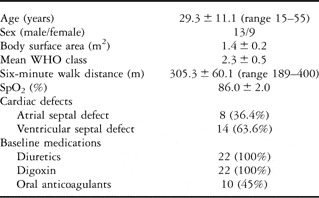
A total of 22 patients were studied. Their baseline clinical characteristics are summarised in Table 1. All had severe pulmonary arterial hypertension – mean pulmonary arterial pressure of 69.6 plus/minus 10.0 millimetres of mercury and pulmonary vascular resistance of 21.4 plus/minus 3.9 Wood units. Dyspnoea was the predominant symptom with 71.4% of patients in the World Health Organization functional class II, and 28.6% in class III. There were three patients who complained of chest pain and one who had haemoptysis. Adjunctive medical therapy, shown in Table 1, was kept constant throughout the study period. None of the patients was treated by any other drug than sildenafil for the control of pulmonary arterial hypertension throughout the study period.
Baseline clinical characteristics (n = 22).

SpO2 = oxygen saturation by systemic pulse oxymetry; WHO = World Health Organization
Clinical efficacy
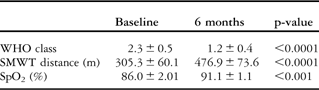
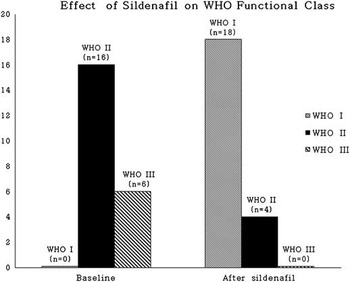
Clinical efficacy is shown in Table 2 and Figures 1 and 2. All patients showed subjective improvement in the form of better overall well-being. There was a significant improvement in the World Health Organization functional class from 2.3 plus/minus 0.5 at baseline to 1.2 plus/minus 0.4 (p ⩽ 0.0001) at 6 months follow-up. Individually, all patients improved by at least one functional class (Fig 1). All the 22 patients showed a remarkable improvement in the six-minute walk distance. The distance covered in the six-minute walk test was significantly improved from 305.3 plus/minus 60.1 metres at baseline to 476.9 plus/minus 73.6 metres (p ⩽ 0.0001) at 6 months follow-up. There were three patients with severe chest pain who reported significant improvement within 2 weeks of starting sildenafil therapy and whose chest pain was completely relieved by the end of 3 months. The patient with haemoptysis reported a significant improvement soon after starting sildenafil, which was completely stopped within 2 weeks. Resting peripheral oxygen saturation was also significantly improved from 86% plus/minus 2% to 91.1 plus/minus 1.1% (p ⩽ 0.001).
Clinical efficacy of oral sildenafil therapy (n = 22).
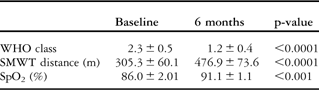
SMWT = six-minute walk test; SpO2 = oxygen saturation by systemic pulse oxymetry; WHO = World Health Organization
Effect of sildenafil on WHO functional class. WHO = World Health Organization.

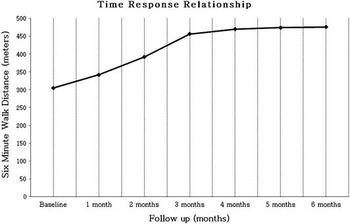
Time–response relationships of sildenafil on six-minute walk distance.

After starting sildenafil, all patients reported clinical improvement within 2 weeks and showed further improvement until 3 months after starting therapy. No further improvement in the World Health Organization class or six-minute walk distance was noticed after 3 months (Fig 2).
Haemodynamic efficacy
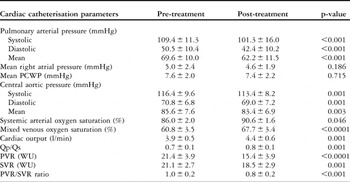
The haemodynamic effects are shown in Table 3. Follow-up cardiac catheterisation was performed in all patients after 6 months of follow-up. Significant decreases were noted in the mean pulmonary arterial pressure from 69.6 plus/minus 10.0 to 62.2 plus/minus 11.5 millimetres of mercury (p ⩽ 0.001) and in the pulmonary vascular resistance from 21.4 plus/minus 3.9 to 15.4 plus/minus 3.9 Wood units (p ⩽ 0.0001). The magnitude of the decrease in pulmonary vascular resistance was much more than the magnitude of the decrease in pulmonary arterial pressures. The pulmonary vascular resistance/systemic vascular resistance ratio was also significantly decreased (from 1.0 plus/minus 0.2 to 0.8 plus/minus 0.2, p ⩽ 0.001). Systemic arterial saturations (86.0 plus/minus 2.0 versus 90.6 plus/minus 1.6%, p = 0.046) as well as mixed venous oxygen saturations (60.8 plus/minus 3.5 versus 67.7 plus/minus 3.4%, p ⩽ 0.0001) showed significant improvement. Cardiac output and pulmonary blood flow/systemic blood flow ratio (Qp/Qs) were also improved significantly. However, there were no significant changes in right atrial pressure and pulmonary capillary wedge pressure. The decrease in systemic vascular resistance was also significant (from 21.1 plus/minus 2.7 to 18.5 plus/minus 2.9 Wood units, p = 0.001), but it was less than the decrease in pulmonary vascular resistance. None of the patients showed any worsening in the systemic arterial saturation.
Effects of sildenafil on cardiac catheterisation parameters (n = 22).

PCWP = pulmonary capillary wedge pressure; PVR = pulmonary vascular resistance; Qp = pulmonary blood flow; Qs = systemic blood flow; SVR = systemic vascular resistance
Comparative efficacy of sildenafil in Eisenmenger's syndrome secondary to atrial septal defect versus ventricular septal defect
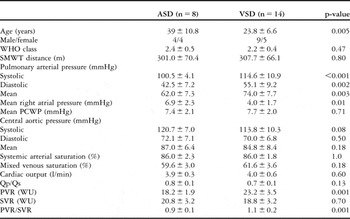
Differences in the baseline characteristics of Eisenmenger's syndrome secondary to atrial septal defect versus ventricular septal defect and comparative efficacy of sildenafil in these groups are shown in Tables 4 and 5, respectively. At baseline, patients with ventricular septal defect were relatively young and have higher pulmonary arterial pressures, pulmonary vascular resistance, and pulmonary vascular resistance/systemic vascular resistance ratio. However, right atrial pressures were significantly higher in patients with atrial septal defect. No significant difference was noted in cardiac output, systemic arterial saturation, pulmonary blood flow/systemic blood flow ratio, pulmonary capillary wedge pressure, and systemic vascular resistance. Functional capacity – World Health Organization functional class and six-minute walk test distance – was also similar in both the groups.
Comparative baseline characteristics of atrial septal defect versus ventricular septal defect patients.

ASD = atrial septal defect; PCWP = pulmonary capillary wedge pressure; PVR = pulmonary vascular resistance; Qp = pulmonary blood flow; Qs = systemic blood flow; SMWT = six-minute walk test; SVR = systemic vascular resistance; VSD = ventricular septal defect; WHO = World Health Organization
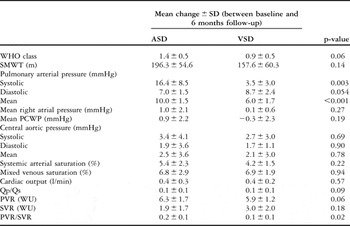
Clinical and haemodynamic efficacy of sildenafil in atrial septal defect versus ventricular septal defect patients.

ASD = atrial septal defect; PCWP = pulmonary capillary wedge pressure; PVR = pulmonary vascular resistance; Qp = pulmonary blood flow; Qs = systemic blood flow; SMWT = six-minute walk test; SVR = systemic vascular resistance; VSD = ventricular septal defect; WHO = World Health Organization
Despite the improvement in functional capacity – World Health Organization functional class and six-minute walk test distance – in both the groups, there was a trend towards better improvement in the atrial septal defect group. Improvement in pulmonary haemodynamics was significantly greater in the atrial septal defect group. The decline in pulmonary arterial pressures was significantly more in the atrial septal defect group and this decline was most marked in pulmonary arterial systolic pressures. The fall in the pulmonary vascular resistance/systemic vascular resistance ratio was significantly more in the atrial septal defect group than in the ventricular septal defect group (0.2 plus/minus 0.1 versus 0.1 plus/minus 0.1, p = 0.02). The fall in pulmonary vascular resistance was also higher in the atrial septal defect group, but this does not reach statistical significance (6.3 plus/minus 1.7 versus 5.9 plus/minus 1.2 Wood units, p = 0.06). Despite an increase in cardiac output to a similar degree in both subgroups, there was a trend towards better improvement in the pulmonary blood flow/systemic blood flow ratio in the atrial septal defect group than in the ventricular septal defect group.
Safety and tolerability
All the patients tolerated sildenafil well and achieved the target dose. None had any significant fall in blood pressure with the initial dose. There were three patients who complained of headache and flushing, which was mild and self-limiting. No patient complained of any visual symptom. No change in visual acuity and fundus examination was noted. None of the adult patients reported any inconvenience related to the effect of the drug on erectile function. No change in haematological parameters and renal and hepatic functions was noted. Drug withdrawal was not necessitated in any patient and there was no death during the study period.
Discussion
This study revealed some important differences in Eisenmenger's syndrome secondary to an atrial septal defect and ventricular septal defect, besides revealing a differential effect of sildenafil in these subgroups of patients.
Patients with Eisenmenger's syndrome secondary to ventricular septal defects were relatively young and had relatively advanced pulmonary vascular disease at the time of presentation. This effect may partly be explained by the difference in pulmonary vascular resistance development in both subgroups. In an atrial septal defect, there is an isolated rise in pulmonary blood flow initially and the rise in pulmonary vascular resistance occurs later in the course of natural history. The haemodynamic situation in ventricular septal defects, however, involves both an increase in pulmonary artery pressure to systemic levels as well as increased pulmonary blood flow. This combination is more detrimental to the pulmonary vascular bed and results in the early development of advanced pulmonary vascular disease in ventricular septal defect patients. Furthermore, differences in natural history between patients with atrial septal defects and ventricular septal defects may also be a factor.Reference Diller and Gatzoulis20, Reference Van Albada and Berger21 A substudy analysis from BREATHE-5 has also reported less advanced pulmonary vascular disease in patients with atrial septal defect than ventricular septal defect.Reference Berger, Beghetti and Galie22
Patients with atrial septal defects showed significantly better improvement in pulmonary haemodynamics by sildenafil than patients with ventricular septal defects. This may be related to less advanced pulmonary vascular disease. Another reason could be that in patients with atrial septal defects, the systemic circuit is not directly connected with the pulmonary circuit – the interventricular septum is intact. Therefore, haemodynamic changes in the pulmonary circuit are not much influenced by systemic circuit haemodynamics. In addition, they more or less behave like those with idiopathic pulmonary hypertension, in whom the administration of sildenafil has already been documented to have very good clinical as well as haemodynamic effects with improvement in prognosis.Reference Sastry, Narasimhan and Reddy11–Reference Kataoka, Satoh and Manabe13 However, a substudy analysis from the BREATHE-5 study showed a similar magnitude of benefit in atrial septal defect and ventricular septal defect patients when treated with the endothelin receptor antagonist Bosentan.Reference Berger, Beghetti and Galie22 This disparity from our results may be due to the different drug used in that study – Bosentan – or the small number of patients in our study.
Interestingly, the BREATHE-5 substudy has shown a significant worsening in the placebo arm of Eisenmenger's syndrome secondary to atrial septal defect than ventricular septal defect.Reference Berger, Beghetti and Galie22 This further affirms our assumption that patients with Eisenmenger's syndrome due to atrial septal defects behave like those with idiopathic pulmonary arterial hypertension. Both idiopathic pulmonary arterial hypertension and atrial septal defect with Eisenmenger's syndrome have pulmonary arterial hypertension with intact ventricular septum and do not have potential sites for unloading of the pressure overloaded right ventricle. Any increase in right ventricular afterload – pulmonary vascular resistance in Eisenmenger's syndrome – in atrial septal defects will ultimately result in right ventricular failure and a decrease in cardiac output, whereas in ventricular septal defects this will result in an increase in right-to-left shunt with maintenance of cardiac output without right ventricular failure, which is relatively better tolerated. All these not only suggest a worse prognosis for atrial septal defect patients once Eisenmenger's syndrome is established but also suggest that these patients are probably more benefited by aggressive management of pulmonary arterial hypertension as shown in our study.
This study confirmed that the long-term oral sildenafil therapy is effective, safe, and well tolerated. No change in systemic blood pressure, visual parameters, and biochemical parameters was noted. Improvement in the six-minute walk distance was noticed up until 3 months only and no further improvement was noticed. This is most probably because of the vasodilatory effect of sildenafil on the vasoreactive component of elevated pulmonary vascular resistance. In patients with Eisenmenger's syndrome, this component is only minor in comparison to the obliterative component. The effect of sildenafil on the vasoreactive component quickly reaches a plateau and leads to maximum benefit in the first 3 months of the start of therapy.
Study limitations
In the first place, the size of our study was small. In the second place, it was a non-randomised and non-placebo controlled prospective study that has its own limitations, but the benefits were documented subjectively – by change in functional class – as well as objectively – by six-minute walk test and cardiac catheterisation. This response is unlikely to be a placebo effect. In the third place, we have assumed oxygen consumption for different haemodynamic calculations, which can be fallacious. However, a significant decrease was noticed in the pulmonary vascular resistance/systemic vascular resistance ratio, which is independent of the oxygen consumption parameter. Hence, this limitation is unlikely to change the study results significantly. In the fourth place, colour vision was not formally tested. Despite no change in visual parameters being noticed, no conclusion regarding the effect of sildenafil on colour vision could be made. Finally, only stable patients with Eisenmenger's syndrome secondary to atrial septal defect or ventricular septal defect were included, and therefore our results cannot be extrapolated to other patients with Eisenmenger's syndrome or otherwise unstable patients.
Conclusions
Oral sildenafil is a safe and very effective medication for patients with Eisenmenger's syndrome. It not only improves symptoms but also improves their haemodynamics. The benefits are much greater in patients with atrial septal defect compared to patients with ventricular septal defect. Sildenafil, being very effective, widely available, relatively inexpensive, easy to use, and very well tolerated without any major side effects, may qualify as a first-line medication for these patients. Further studies are required to evaluate their long-term efficacy and safety, survival benefit, and the relative effect of other dosing regimens and its additive effects with other drugs effective in pulmonary arterial hypertension. Further studies are also warranted to evaluate its effects in unstable patients with Eisenmenger's syndrome
Acknowledgements
This work was supported by an Intramural Research Grant from Sanjay Gandhi PGIMS, Lucknow, India.