INTRODUCTION
Zooxanthellate corals are organisms restricted to shallow tropical seas that require very particular environmental and oceanographic conditions to subsist. Those conditions are oligotrophic warm waters with an optimal range of temperature between 26°C and 28°C (with some species tolerating temperatures down to 12°C and up to 40°C) and salinities in a narrow range of 33–36, with low turbidity (i.e. minimum depth of light penetration between 9 and 15 m) and little sedimentation (Hubbard, Reference Hubbard and Birkeland1997; Kleypas et al., Reference Kleypas, McManus and Menez1999; Sheppard et al., Reference Sheppard, Davy and Pilling2009). Habitats outside these conditions may be detrimental to most corals. The eastern tropical Pacific region is characterized by environmental conditions considered as suboptimal for coral reef development (i.e. low temperatures, low salinity and high nutrient loads; Cortés, Reference Cortés1997; Glynn & Ault, Reference Glynn and Ault2000). However, recent studies have demonstrated that some corals can survive in such challenging environments (Perry et al., Reference Perry, Smithers, Gulliver and Browne2012) and that they might be better adapted for survival in an future scenario of harsh environmental conditions (Halfar et al., Reference Halfar, Godinez-Orta, Rieg, Valdez-Holguin and Borges2005).
Porites panamensis (Verrill, Reference Verrill1866) is a small, encrusting or nodular coral species with the broadest latitudinal distribution of any zooxanthellate scleractinian coral on the American Pacific coast, extending from the Colorado River outfall (31°N) in the Gulf of California, Mexico, to Gorgona Island, Colombia (3°N; Glynn & Ault, Reference Glynn and Ault2000; Veron, Reference Veron2000). In the Colombian Pacific, Porites panamensis has been reported, as an uncommon species, only at localities with well-developed coral reefs such as Gorgona Island (2°58′N 78°11′W) and Ensenada de Utría (6°01′N 77°21′W; Glynn & Ault, Reference Glynn and Ault2000; Zapata & Vargas, Reference Zapata, Vargas-Ángel and Cortés2003), and has not been seen in estuarine environments. Although Porites panamensis was considered as an eastern Pacific endemic for a long time (Glynn et al., Reference Glynn, Colley, Eakin, Smith, Cortés, Gassman, Guzmán, Del Rosario and Feingold1994), it has been reported in the western Indian Ocean (as Porites nodulosa Verrill, 1870 in Sheppard, Reference Sheppard1987) and in a fossil assemblage in Papua New Guinea in the western Pacific Ocean (as Porites californica Verrill, 1868 in Veron & Kelley, Reference Veron and Kelley1988). Nonetheless, the validity of these reports is still uncertain as a consequence of the high morphological plasticity in Porites (Forsman et al., Reference Forsman, Barshis, Hunter and Toonen2009). In this paper, we report the occurrence of Porites panamensis at Los Negritos, a rocky reef located 137 km from Gorgona Island and 212 km from Ensenada de Utría, in an estuarine environment of the central Pacific coast of Colombia, an area characterized by unfavourable conditions for scleractinian corals.
MATERIALS AND METHODS
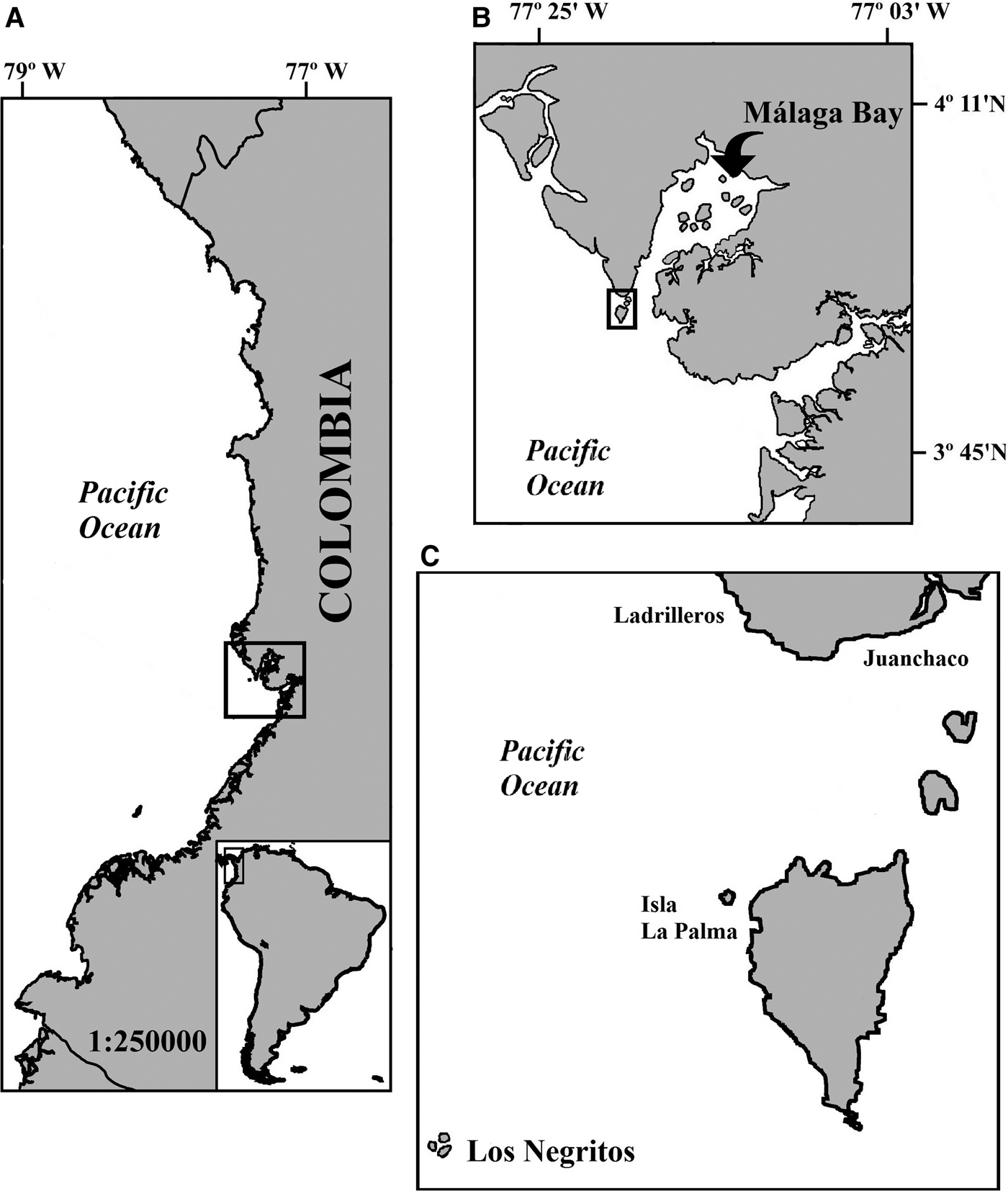
Málaga Bay (3.93–4°08′N 77.32–77°35′W; Figure 1A, B) is one of the largest estuaries in the Colombian Pacific coast (Díaz, Reference Díaz2007). It is a tectonic estuary with a semidiurnal tidal regime of large amplitude (average tidal range of 4.1 m), which creates strong tidal currents (≤2.0 m s−1; Cantera, Reference Cantera1991; Correa & Morton, Reference Correa, Morton and Bird2010). The coastal area surrounding the bay receives high precipitation (>7000 mm annually), so numerous streams and creeks flow into it, providing much sediment input. However, no major river flows into the bay, so salinity (19–28 ppt) is relatively elevated for an estuary, and temperatures vary between 25.2°C and 29.7°C (Guevara-Fletcher et al., Reference Guevara-Fletcher, Cantera, Mejía-Ladino and Cortés2011). Most of the shoreline within the bay is fringed by low hills made of soft sedimentary rock, mudflats and mangroves (Lazarus-Agudelo & Cantera, Reference Lazarus-Agudelo and Cantera2007; Correa & Morton, Reference Correa, Morton and Bird2010; Lopéz de Mesa & Cantera, Reference López de Mesa and Cantera2015). Los Negritos (3°53′N 77°24′W), the sampling location, is located at the outer part of the bay, ~6 km south-west of the village of Juanchaco, at the mouth of Málaga Bay, and ~5 km west of the southern tip of Isla La Palma (Figure 1C). Los Negritos consist of a group of prominent basaltic outcrops that emerge during low tide. The largest outcrop provides protection from wave action to an 8 ha area, where we unexpectedly found Porites panamensis colonies during a different study (Lozano-Cortés et al., Reference Lozano-Cortés, Londoño-Cruz and Zapata2011).
Location of Málaga Bay (A, B) and of the rocky reef of Los Negritos (C) in the Colombian Pacific coast.

This first observation of P. panamensis colonies was made while skin diving at Los Negritos rocky reef on 23 April 2008. At this time, two specimens (length 81.0 and 59.8 mm; width 63.8 and 58.3 mm, respectively) were collected at 3 m depth (Figure 2) and later deposited in the Marine Biology Reference Collection of Universidad del Valle (CRBMUV), in Cali, Colombia (catalogue numbers CRBMUV-2008-001 and CRBMUV-2008-002). All the live tissue was removed from one collected colony to examine corallite arrangement and characteristics for species diagnosis. Additionally, the abundance of colonies was estimated using a 1 × 1 m quadrat made of PVC tubing. The quadrat was placed at an initial point and the number of colonies within the quadrat was counted. Then the quadrat was rotated from the initial position four times, once on each side (north, south, east and west), in order to also sample the adjacent areas until a total of five counts had been made. This procedure was carried out at four haphazardly chosen points in the study site, separated approximately 20 m from each other, to obtain a total of 20 counts. In addition, a single 10 × 2 m belt transect haphazardly positioned at the study site was also used to estimate colony density. Additional observations were made, but no quantitative data were collected on 6 May 2009 while SCUBA diving to collect data on the marine invertebrate community of the study area (Lozano-Cortés et al., Reference Lozano-Cortés, Londoño-Cruz, Izquierdo, Arias, Barona and Zambrano2012; Lozano-Cortés & Londoño-Cruz, Reference Lozano-Cortés and Londoño-Cruz2013).
Colonies of Porites panamensis found at Los Negritos rocky reef (Málaga Bay, Colombia) in April 2008. (A) Specimen CRBMUV-2008-001; (B) Specimen CRBMUV-2008-002. The colonies are growing on basaltic cobbles overgrown by calcareous algae and bryozoans.
RESULTS AND DISCUSSION
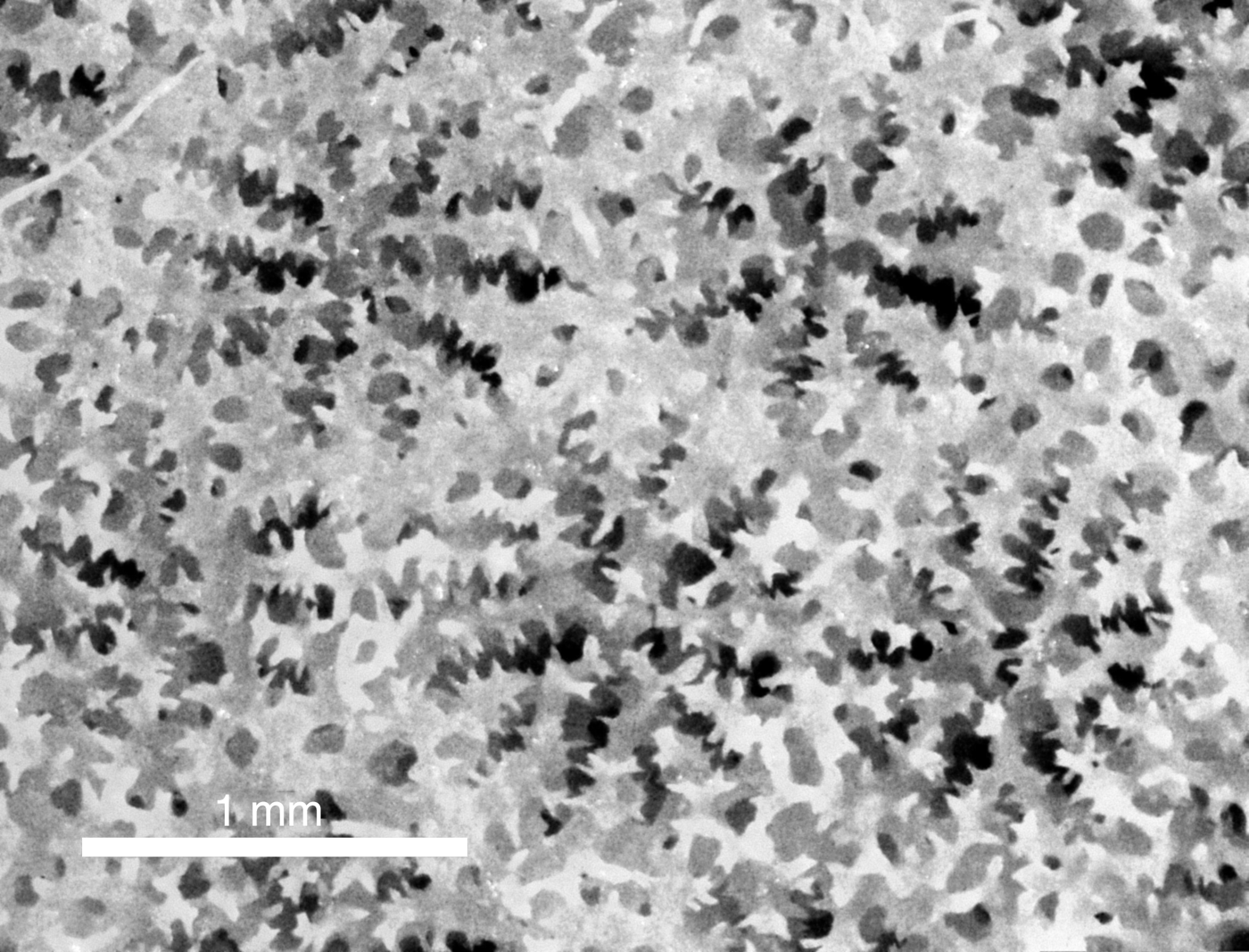
The colonies observed in 2008 were small (10 cm largest diameter) and uniformly encrusting cobbles (10–20 cm in diameter) that were partially covered with turf algae. The two specimens collected in 2008 were identified as Porites panamensis (Verrill, Reference Verrill1866), given their corallum morphology (Figure 2) and corallite structure (Figure 3), following Veron (Reference Veron2000) and López-Pérez et al. (Reference López-Pérez, Reyes-Bonilla, Budd and Correa-Sandoval2003).
Close-up view of corallite structure in specimen CRBMUV-2008-002 of Porites panamensis.
In 2008, a total of ten colonies were found in the 20 quadrats, obtaining a mean density of 0.5 colonies m−2, while 20 colonies were found in the transect for a density estimate of 1.0 colony m−2. Most colonies were approximately 10 cm in largest diameter. In 2009, at 7–12 m depth, we observed only a few small colonies (~5.0 cm diameter), which were separated >2 m from each other.
Medina-Rosas (Reference Medina-Rosas2006) reported, in a locality with similar environmental conditions (estuarine waters with high suspended sediments and rocky substrate) in Mexico, colonies of Porites panamensis of similar size (~10 cm) to those found in this study and a maximum density of 2.0 colonies m−2 (mean 0.8 ± 0.15 colonies m−2). Medina-Rosas (Reference Medina-Rosas2006) suggested that the unstable conditions in the study area prevented attaining greater coral development and greater coral coverage. Similarly, Saavedra-Sotelo et al. (Reference Saavedra-Sotelo, Calderon-Aguilera, Reyes-Bonilla, Paz-García, López-Pérez, Cupul-Magaña, Cruz-Barraza and Rocha-Olivares2013) suggested that variables such as temperature, water clarity and hard substrate availability play a key role in determining the presence of Porites panamensis in a given area. However, this is not the first coral species that has been reported at Málaga Bay. Zapata & Escobar (Reference Zapata and Escobar1991) observed dead fragments of Pocillopora damicornis, but they never found live colonies and the origin of the fragments was unclear. They suggested that fragments were transported by currents or were part of isolated colonies living nearby that had died due to unfavourable conditions. Later, Escobar & Neira (Reference Escobar and Neira1992) found a single live colony of Pocillopora capitata at this locality. These authors argued that the occurrence of this branching coral was due not only to its tolerance to poor habitat conditions but also to the presence of symbiont decapod crustaceans that help to remove sediment from coral tissue.
The occurrence of Porites panamesis in the estuarine environment of Málaga Bay indicates that this species is able to tolerate unfavourable conditions such as changes in water temperature, salinity and turbidity (see Kleyplas et al., Reference Kleypas, McManus and Menez1999 for threshold values for favourable coral reef development and Halfar et al., Reference Halfar, Godinez-Orta, Rieg, Valdez-Holguin and Borges2005 for values reported for Porites panamensis). In the Gulf of California, Porites panamensis is able to tolerate harsh conditions such as low temperature and high-turbidity (Halfar et al., Reference Halfar, Godinez-Orta, Rieg, Valdez-Holguin and Borges2005). The relatively high salinity of Málaga Bay due to low fresh water input in comparison with most estuaries in the Colombian Pacific (Guevara-Fletcher et al., Reference Guevara-Fletcher, Cantera, Mejía-Ladino and Cortés2011) could make this environment more suitable for Porites panamesis. In addition, Porites panamesis has a high genetic diversity and reproductive potential – characteristics that could promote the continuous production of new variants leading to populations with wide tolerance to limiting factors such as temperature, water clarity and substrate availability (Reyes-Bonilla & Calderón-Aguilera, Reference Reyes-Bonilla and Calderón-Aguilera1994; Chávez-Romo et al., Reference Chávez-Romo, Paz-García, Correa-Sandoval, Reyes-Bonilla, López-Pérez and Medina-Rosas2013; Saavedra-Sotelo et al., Reference Saavedra-Sotelo, Calderon-Aguilera, Reyes-Bonilla, Paz-García, López-Pérez, Cupul-Magaña, Cruz-Barraza and Rocha-Olivares2013). These characteristics seem to have allowed Porites panamesis to successfully populate areas that are usually considered to be inadequate for coral survival and growth, including estuarine and high latitude environments.
ACKNOWLEDGEMENTS
The authors wish to thank the Department of Biology at Universidad del Valle for supporting the fieldwork carried out during the Marine Ecology (2008) and Marine Invertebrates (2009) courses that led to this report, the CRBMUV staff (Angelica Prado, Andrés Carmona and Jun Ishida) for their help with the specimens and Valentina Zambrano for the photograph used in Figure 3. Finally, we thank three anonymous reviewers for their comments, which helped improve the content of this paper.