

For persons with disabilities (PWDs), one of the primary obstacles in participating in a broad variety of activities and in receiving equal, quality services and care as other without disabilities, in education, employment, and other settings, is negative attitudes from others. Changing attitudes toward PWDs is, therefore, crucial as this can limit or eliminate barriers to a broad variety of activities. In the area of disabilities studies, programs for attitude change are ubiquitous. The vast majority of them utilize informational/cognitive, contact, protests (Au & Man, Reference Au and Man2006; Chung, Chen, & Liu, Reference Chung, Chen and Liu2001; Corrigan, et al., Reference Corrigan, River, Lundin, Penn, Uphoff-Wasowski and Campion2001; Hampton & Xiao, Reference Hampton and Xiao2007; Hunt & Hunt, Reference Hunt and Hunt2004; Okoye, Reference Okoye2004), and media (Ferrara, Burns, & Mills, Reference Ferrara, Burns and Mills2015; Reinhardt, Pennycott, & Fellinghauer, Reference Reinhardt, Pennycott and Fellinghauer2014; Suggs & Guthrie, Reference Suggs and Guthrie2017) with variable levels of success. Preservice rehabilitation professionals often need some level of exploration with disability populations for a working knowledge of disabilities. Many programs utilize community engaged learning or service learning to achieve appropriate attitudinal awareness among preservice rehabilitation professionals who may be undergraduate or graduate students. Live theatre is known to be effective for social attitude (Greene, Hitt, Kraybill, & Bogulski, Reference Greene, Hitt, Kraybill and Bogulski2015; Jonas-Simpson et al., Reference Jonas-Simpson, Mitchell, Carson, Whyte, Dupuis and Gillies2012; Price, Gean, & Barnes, Reference Price, Gean and Barnes2015), and yet understudied in the context of disability attitude change. This study sought to use a live theater performance to improve the attitudes of Latinos/as preservice rehabilitation counseling students toward PWDs.
It is worth noting that Latinos/as are the fastest growing racial group in the US and thus, there is likely to be an increase in the number of Hispanic students in the US. In the US, the 2013 college enrollment rate for White 18- to 24-year-olds (42%) was higher than the rates for Latinos/as (34%); however, the gap narrowed (from 18% to 8%) between 2003 and 2013 (National Center for Educational Statistics, 2016). Between 2010 and 2015, the number of Latino/a students, who are mostly undergraduate, grew, unlike for Whites; in the Universities under the Texas systems, while the percentage of Whites fall from 33% to 26%, the percentage of Latino/a students’ grew from 44% to 50% (National Center for Education Statistics, 2018).
Latinos/as students (the population of focus in this study) are not immune to having negative attitudes toward PWDs. While there is kindness and respectful of PWDs in the Latinos/as culture, there is also the belief that PWDs are less likely to succeed or have a successful future. Studies have shown that Latinos/as students, in particular, do have negative attitudes toward PWDs (Graf, Blankenship, Sanchez, & Carlson, Reference Graf, Blankenship, Sanchez and Carlson2007; Marini, Wang, Etzback, & Del Castillo, Reference Marini, Wang, Etzback and Del Castillo2013). In a study measuring the attitudes of sighted college students toward blindness, Rowland and Bell (Reference Rowland and Bell2012) found that in the attitudes scale toward blindness, ranging from 20 to 100, Latino/a students scored 56.54 and Whites scored 57.23. Marini et al. (Reference Marini, Wang, Etzback and Del Castillo2013) found Latino/a students were less likely to befriend students with physical disabilities who use wheelchairs.
Latinos/as already face tremendous barriers in general and in educational settings due to language, cultural, and other barriers. Negative attitudes of students toward students with disabilities present additional barriers that directly impact social and academic interactions, crucial for students’ academic and other developments.
Targets for attitudinal change are often positive emotions and cognition. The importance of positive emotion in improving attitudes toward PWDs is well supported in the helping field. Currently, the rehabilitation counseling field is philosophically committed to emphasizing strengths rather than weaknesses of PWDs. In contrast to pity-oriented approaches (e.g., traditional medical model), positive psychology focuses on positive emotion. Positive emotions, in general, can be inwardly focused (e.g., feeling glad for ourselves because of an accomplishment) or outwardly focused, as when we feel glad about another person’s success or positive result (Princeton WordNet, 2019).
Positive emotion of PWDs can impact attitudes toward PWDs (Suggs & Guthrie, Reference Suggs and Guthrie2017). Some studies (Chebat & Slusarczyk, Reference Chebat and Slusarczyk2005; Donada & Nogatchewsky, Reference Donada and Nogatchewsky2009) have shown that an intervention that evoked positive emotions resulted in positive attitudes toward PWDs. In a study evoking positive feelings intended to change the attitudes of Taiwanese students toward the employability of persons with hearing impairments, Ju (Reference Ju2005) found the students’ attitudes toward the persons with hearing impairments improved. Studies on positive emotion, focusing on the positive portrayal of PWDs in the media, have also shown promising results. In a study on positive portrayals of people with disabilities in movies and television, Farnall and Smith (Reference Farnall and Smith1999) found that positive portrayals of people with disabilities on television related to more positive perceptions and feelings toward disabilities. Reinhardt et al. (Reference Reinhardt, Pennycott and Fellinghauer2014) found participants’ attitudes regarding the employability of PWDs as police officers increased after watching a positive portrayal of a PWD as a detective in a wheelchair, in which the PWD arrested a robbery.
Additionally, Ferrara et al. (Reference Ferrara, Burns and Mills2015) found that viewing elite sports information and footage of PWDs had a positive effect on attitudes toward PWDs. Smedema, Ebener, and Grist-Gordon (Reference Smedema, Ebener and Grist-Gordon2012) found that after controlling for previous contact with PWDs (i.e., age and gender), students who watched a humorous film reported significantly more positive attitudes toward PWDs than the control group that had the summary of the scenario text read to them. On the basis of the above-mentioned studies, positive emotion has the potential of improving attitudes toward PWDs.
Using art can improve the effectiveness of the emotional intervention. Changing attitudes and bias requires engaging emotion or the affective process. Art education, through its visual thinking and expression, assists in the exploration of emotion and emotional reactions, and ultimately influences one’s feeling and thinking about an issue (Lee, Reference Lee and Lee2014). Art has an exceptionally captivating emotional quality (Shapiro & Hunt, Reference Shapiro and Hunt2003) and the transformational aspect of learning [Lee (2014)]. This emotional aspect of art, according to Amodio, Devine, and Harmon-Jones (Reference Amodio, Devine and Harmon-Jones2007), is critical in improving negative bias.
In a mixed methods study using social justice art education to facilitate individuals’ racial attitudes, Lee (Reference Lee and Lee2014) found attitude change in preservice and practicing educators, including their openness to work with diverse populations. On the basis of their literature review, Bungay and Vella-Burrows (Reference Bungay and Vella-Burrows2013) concluded that using creative activities as part of a health-promoting strategy is a useful method of increasing knowledge and positive behaviors. In a study using theater to empower Black youth, Kemp (Reference Kemp2006) found that an art-based approach was able to promote young people’s self-esteem and a positive sense of agency. For PWDs, in particular, art becomes an education vehicle about their lives (Shah, Wallis, Conor, & Kiszely, Reference Shah, Wallis, Conor and Kiszely2015), presenting awareness and new insight regarding disability. In a randomized controlled study, Lu, Webber, Romero, and Chirino (Reference Lu, Webber, Romero and Chirino2018), using a person-centered video focusing on real-life experiences of PWDs, found the attitudes of the experimental group that watched the video was more positive compared with the control group that was involved in a mindfulness training.
Theater, in particular, has been used for years to address emotional disturbance, health education, cultural issues, and behavioral problems (Colby & Haldeman, Reference Colby and Haldeman2007). With eye contact and gestures to the audience, actors can forge powerful connections and make the audience feel as if they are part of the play (Adair-Lynch, n.d; Billard & Caldwell, Reference Billard and Caldwell2011). In a live theater play, the power of dramatized scenarios can move human hearts, influence thought and minds, and impact the ability of audiences to identify with characters and participate vicariously – sometimes with intense emotional effects (Adair-Lynch, Reference Adair-Lynch2004; Billard & Caldwell, Reference Billard and Caldwell2011). In addition, to improve attitudes toward PWDs, positive experience can be gained, which, in turn, can bring about disability awareness.
In a study by Greene et al. (Reference Greene, Hitt, Kraybill and Bogulski2015), students who saw a live theater play were more tolerant and better able to read the emotions of others compared with students who read and watched a movie. Price et al. (Reference Price, Gean and Barnes2015) study on the learning and attitudes toward science found that compared with a control group, students who watched a live theater show demonstrated a positive attitude. Jonas-Simpson et al. (Reference Jonas-Simpson, Mitchell, Carson, Whyte, Dupuis and Gillies2012) used research-based drama in order to help to change attitudes toward persons with dementia. After the play, students saw persons with dementia in a positive light, that is, humanly, needing engaged care as opposed to disengaged care, and hope for their lives.
The media shows fewer positive images of PWDs and other marginalized groups (e.g., as the protagonist or romantic lead in a drama) than members of dominant/privileged social groups (Knoll, Reference Knoll2009). Also, the media scripts, for the most part, represent PWDs as “abnormal” or as “persons in need of help” (Beckett, Ellison, Barrett, & Shah, Reference Beckett, Ellison, Barrett and Shah2010). Art, using a live theater, can challenge such narratives. It can create a narrative that reflects PWDs’ actual lives (Wilde, Reference Wilde2016). Live art-based theater shows the role of art performances in disability awareness education and its potential value in strengthening the efficacy of an emotional intervention.
While art has been relegated to a low status in social research, it has been proposed as a significant way to develop and advance awareness and understanding of social and human issues. Art-based interventions are increasingly being explored (Kontos & Nagile, Reference Kontos and Nagile2009; Shah et al., Reference Shah, Wallis, Conor and Kiszely2015). However, in the field of rehabilitation counseling, art-based intervention is non-existent.
The goal of the study is to use a live theater performance to improve the attitudes of preservice rehabilitation counseling students toward PWDs. It aimed to address the following question:
Research question:
What is the incremental advantage of live theater performance (compared with a text media) to improve the attitudes of preservice rehabilitation students toward PWDs?
Method
A total of 140 copies of a paper survey, including a consent document and a letter of invitation to participate, were distributed. Fifty-eight responded to the recruitment invitation letter and consent form by participating in the study (a response rate of 41.4%). Four of the surveys were not usable because they were blank or incomplete.
Participants
Participants consisted of 54 undergraduate students attending a large South Texas university. The experimental group watched a live theater performance intervention (n = 27) and the control group had a text of the scenario read to them (n = 27). Their ages ranged from 18 to 24 years (M = 20.71, SD = 2.07). For level of education, there were 11 freshmen (20.4%), 12 sophomores (22.2%), 18 juniors (33.3%), and 11 (20.4%) seniors. Two (3.7%) did not respond to the level of education question. Thirty-three (61.1%) of the students were females and 21 (38.9%) were males.
Intervention description
The goal of the live theater performance was to evoke positive emotion of gladness. The primary author met with the student actors several times to explain the purpose and plot of the dramatic performance, to provide feedback as the students practiced the play, and to discuss logistics regarding the performance of the play. The first author shared the rehabilitation philosophy and positive aspects of PWDs to the experimental group participants. On the day of the play, before the performance, the theater students rehearsed the play. The play, written by the first author in consultation with graduate students and two faculty members, was performed for the experimental group. There were over 10 actors in the play, at least four actors in each team. The play was about 12-min long.
The play started with a group of student actors talking about a future debate with another team. In the discussion about who to include on the team, the student actors talked about excluding a student with a disability. They believed a visually impaired person would prevent them from winning, since the competition preparation requires extensive reading, which they believed would be difficult for a student with a disability of visual impairment. However, the student with the disability ended up participating in the debate competition. The teams were tied until almost the end of the competition, when the student with the disability correctly answered the last question, leading her team to victory. In the concluding scene, an employer who had heard about the debate called the student with the disability and offers her a job. The control group, in contrast, had a one-page summary of the scenario play read to them, which lasted about 1.5 min.
Measures
The scale of attitudes toward disabled persons (SADP), used to measure the dependent variable, is a multidimensional scale, consisting of 24 Likert-type items that measure attitudes toward PWDs (Tervo, Palmer, & Redinius, Reference Tervo, Palmer and Redinius2004). It was developed by Antonak in 1982 and updated in Reference Lazarus1991 (Antonak, Reference Antonak1992) to measure the extent to which people perceive PWDs as similar or dissimilar to people without disabilities. Individual scores on the SADP scale range from highest (+ 3 = I agree very much), indicating a more positive attitude, to lowest (−3 = I disagree very much), indicating a less positive attitude (Antonak, Reference Antonak1992). The total scores on the general SADP scale range from 0 to 144. It has respectable reliability, with Spearman-Brown reliability coefficients ranging from 0.81 to 0.85, and alpha coefficients from 0.88 to 0.91 (Dorji & Solomon, Reference Dorji and Solomon2009; Upton & Harper, Reference Upton and Harper2002). Reliability coefficients are adequate and ranged from 0.55 to 0.73, and alpha coefficient homogeneity indices range from 0.77 to 0.87 (Dorji & Solomon, Reference Dorji and Solomon2009). In this study, the internal consistency was 0.9.
Knowledge about disability and positive emotions were measured using one-item scales because of logistics. After discussion with two experts, they agreed since it was a pilot study and due to lack of resources and time window to get students to participate, using a one-item scale for a couple of measures, including Knowledge about disability and positive emotions, is appropriate.
Procedures
After Institutional Review Board approval for the study and before the interventions, both the intervention and control groups answered questions related to demographic questions, preattitudes toward PWDs, preknowledge about disability, and precontact with PWDs. After the interventions, both groups again answered questions regarding (1) postattitudes toward PWDs and positive emotion/gladness (as dependent variables) and (2) post-self-reported knowledge about disability and postcontact with PWDs (as covariates). To eliminate or reduce false answers, the primary researcher and his team explained that participants should answer honestly as this would help with providing accurate knowledge.
Data analysis
Descriptive statistics were conducted for pretest and post-test mean scores and standard deviations for attitudes toward PWDs, knowledge about disabilities, and contact with PWDs across the intervention and control groups. To investigate the incremental advantage of live theater performance to improve the attitudes of preservice rehabilitation students toward PWDs, multivariate analysis of covariance (MANCOVA), instead of multivariate analysis of variance, was used in order to control for possible initial group differences (since group assignment was not random). There were two dependent variables: positive emotion/gladness and attitudes toward PWDs. There was one independent variable (the emotional intervention, i.e., watching the play), and there were three covariates (self-report preknowledge about PWDs, precontact with PWDs, and preattitudes toward PWDs).
Attitudes toward PWDs and positive emotion/gladness variables were entered as outcome variables. The intervention variable was “watching the play.” Those who watched the play were coded as 1 (experimental group) and those who had the scenario text read to them were coded as 0 (control group).
To account for possible group differences on the pretest, variables (self-report preknowledge about PWDs, precontact with PWDs, and preattitudes toward PWDs) were entered as the covariates simultaneously. MANCOVA was performed using the General Linear Model and the multivariate command in the SPSS program (Raykov & Marcoulides, Reference Raykov and Marcoulides2008). Box’s M test and individual post-tests for attitudes toward PWDs and gladness are reported in Section 2.
To avoid redundancy in the dependent variables, due to their relatedness, a step-down analysis (Roy-Bargmann analysis) was conducted. We examined whether, once the group effects on the positive emotion or gladness variable were partialed out, there would still be evidence for experimental effects on attitudes toward PWDs (Raykov & Marcoulides, Reference Raykov and Marcoulides2008). This was done to test whether, after controlling for group differences on the positive emotion or gladness variable, there would be observable group differences regarding the attitudes toward PWDs (a measure which could not be explained by chance) (Raykov & Marcoulides, Reference Raykov and Marcoulides2008).
Results
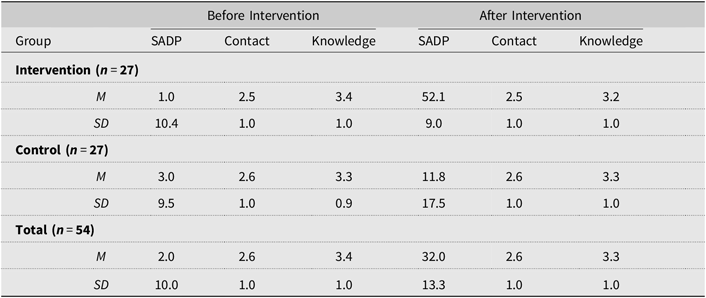
Descriptive statistics showed, compared with the control group, the experimental group had a lower pre-SADP mean (M = 1.0, SD = 10.4) and approximately the same precontact with PWDs mean (M = 2.5, SD = 0.5) and preknowledge about disability mean (M = 3.4, SD = 1.0). For the post-test, the experimental group had a higher post-SADP mean (M = 52.1, SD = 8.5) than the control group. Results for the control groups were: pre-SADP mean (M = 3.0, SD = 0.9), precontact (M = 2.6, SD = 1.0), preknowledge (M = 3.3, SD = 1.0), and post-SADP mean (M = 11.8, SD = 17.5). See Table 1 for more detail.
Descriptive results

SADP, scale of attitudes toward disabled persons.
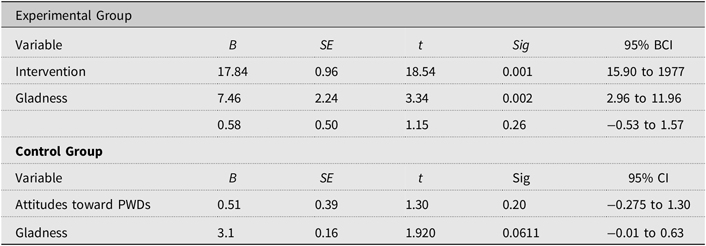
The MANCOVA result showed the theatre performance was more effective than the control group (F = 11.13, p = 0.002), with an adjusted R Square = 0.96. The covariance matrix homogeneity assumption is fulfilled based on the Box’s M Test (p = 0.015). The Pillai’s Trace statistic is 0.73, F = 59.1, p = 0.001. The model results in predicting improved attitudes toward PWDs and gladness. The step-down analysis (Roy-Bargmann analysis) revealed that group differences remained (B = 7.46; Bootstrapping CI 2.96 to 11.96) after accounting for the group effects on the positive emotion or gladness variable. We conclude that there are group differences in attitudes toward PWDs when we control for group differences on gladness. Result for text summary scenario was not significant (B = 0.54; CI −0.275 to 1.303) in attitudes toward PWDs. See Table 2.
Stepwise analysis result on attitude change toward PWDs

BCI, Bootstrapping CI; PWDs, persons with disabilities.
Discussion
The primary purpose of this exploratory study was to improve Latinos/as American students’ attitudes toward PWDs using live theater play. When students believe that PWDs are capable of intellectual and other tasks and can lead meaningful lives, their actions will align to such beliefs; as a result, these students will collaborate and involve PWDs in school and other activities (Jonas-Simpson et al., Reference Jonas-Simpson, Mitchell, Carson, Whyte, Dupuis and Gillies2012). The results showed that the live theater performance intervention was more effective than the control group in providing the positive emotion of gladness and in improving students’ attitudes toward PWDs. In addition, results showed group differences still remained after accounting for the group effects on the positive emotion or gladness variable.
It is not surprising that the theater play evoked positive emotions and was more favorable in changing attitudes than the media text in this study. This finding is in line with other studies (Greene et al., Reference Greene, Hitt, Kraybill and Bogulski2015; Jonas-Simpson et al., Reference Jonas-Simpson, Mitchell, Carson, Whyte, Dupuis and Gillies2012; Price et al., Reference Price, Gean and Barnes2015) that have compared theater intervention with other approaches. Theater play may be more effective than other approaches in changing attitudes toward PWDs.
The theater play in this study portrayed harmony (acceptance of a person after an initial rejection), and the success of a PWDs gaining employment. According to Trevino and Szymanski [as cited in Graf et al. (Reference Graf, Blankenship, Sanchez and Carlson2007)], work is highly valued by Latino Americans, and loss of the ability to work is tantamount to a loss of meaning in life. Witnessing a person gain employment as portrayed in the play may, therefore, be a strong force for eliciting positive emotion, in particular, gladness, within the Latino culture. In this case, a person with a disability helped her team win the debate and ultimately secured employment.
Perhaps the effectiveness of the emotional intervention compared with the control group could be improved by including information about disability in line with the Lee and Rodda (Reference Lee and Rodda1994) and Stone and Colella (Reference Stone and Colella1996) recommendations, or other information in line with specific cultural beliefs. According to Lee and Rodda (Reference Lee and Rodda1994) and Stone and Colella (Reference Stone and Colella1996), the types of knowledge required to change attitudes include knowledge about PWDs, barriers PWDs face, the Americans with Disabilities Act (ADA), and myths about PWDs. The information provided in the emotional performance intervention described above did not meet these standards. Information that meets these requirements can be dramatized and included in a live theater intervention that elicits positive emotion.
For Latino Americans, in particular, information that counters myths about the success of PWDs may be appropriate. Graf et al. (Reference Graf, Blankenship, Sanchez and Carlson2007), investigating the attitudes of Mexicans and Mexican–Americans toward PWDs, found that both these groups were generally kind to PWDs, and believed that PWDs were less likely to succeed or have a successful future. This may likely impact their values and beliefs about and action toward disability. Therefore, information disputing the myth about the lower likelihood of PWDs succeeding may be useful.
Limitations
Because of resource and logistical challenges when conducting this study, this pilot study had some limitations. Only Latinos/as students participated. A lack of resources (time and monetary) resulted in a small convenience sample, and some participants were given the survey at different times (days before the intervention or immediately before the performance). Also, it is worth noting, assignment of participants to the experimental and control groups was not random; however, the analysis, namely MANCOVA, helped to resolved concerns related to non-random assignment of participants or any differences between the experimental and control groups at the pretest measure. Knowledge about disability and positive emotions were measured using one-item scales and therefore, their measure may not be reliable.
Self-reported knowledge and attitudes can be misleading because respondents may provide only responses that portray them as socially desirable. Students’ private attitudes may be different from their public attitudes. A long-term effect is not guaranteed, as participants’ attitudes may change in a day or in a week. Research focused on long-term effects would, also, be beneficial.
Rehabilitation counseling education implications
Students are potential lawmakers, employers, and neighbors, among others. As Lu et al. (Reference Lu, Webber, Romero and Chirino2018) noted, some undergraduate (nursing and rehabilitation counseling) attitudes toward PWDs can impact their future quality of work with them. In their current setting, students can create a favorable or non-favorable atmosphere that can positively or adversely affect PWDs. This study’s finding showed a theater play improved the attitudes of students toward PWDs.
Professors in rehabilitation counseling, education, history, and other disciplines can collaborate with theater departments to have students perform skits or short plays. Live theater performances or plays that have been effective in changing attitudes toward PWDs can be recorded and used in future classes. After watching these plays, the students can discuss what information about disability they have gained. By dramatizing information that has been shown to change attitudes toward PWDs, the students’ attitudes could be improved. Also, other educational interventions that have already been shown to be effective can incorporate positive-emotion dramatic performances similar to the one in this study. For example, a lecture on PWDs might be augmented by a dramatic performance that was designed to produce positive emotion. In addition, such an intervention can extend to a great number of people through mass media in TV shows and movies. Through collaboration with filmmakers and advocacy efforts, such dramatic performances can be seen by the public, which may mean the potential to change a large number of people’s attitudes toward PWDs.
Negative attitudes of students toward PWDs can decrease classroom participation within the student population with disabilities, including in academic and social arenas, which, in turn, can impede vocational development. When helping a person with disability seek employment or career advancement and addressing other employment-related issues, rehabilitation counselors can explore their own personal (and others’) university or college experience with PWDs, both positive and negative, and how these experiences could affected PWDs. Theater play can then be created to enhance the positive experiences and change the negative ones, in order to provide a positive experience for PWDs in university and colleges.
Research implications
A replication of this exploratory pilot study to include other populations could make it more generalizable. Also, future research can recruit students using random sampling. Future studies can focus on long-term effects to ensure that positive attitudes persist.
According to Boiger and Mesquita (Reference Boiger and Mesquita2012), emotions can be culturally influenced. For Latino Americans, work and harmony are highly valued and their inclusion in the play, in this study, may have resulted in the evocation of emotion and change of attitudes toward PWDs (in the play, there was harmony/reconciliation of a PWD with her classmates and the PWD secured employment). Future research can evaluate whether these values in a live performance intervention do indeed have the potential to evoke the positive emotion or gladness and/or change negative attitudes toward PWDs. Researchers can also study these and other values for other racial groups in relation to evoking positive emotions (i.e., gladness) and/or change negative attitudes toward PWDs. Researchers can use qualitative methods in conjunction with quantitative approaches to help to understand these values better.
Conclusion
This pilot study is one of the few, if not the first, to use a live theater performance to change attitudes toward PWDs. Eliminating barriers to the educational advancement of PWDs is significant to students with disabilities, to universities, and to the general public. For students with disabilities, the absence of such barriers may mean that they can better collaborate on schoolwork with other students and participate in other school-related activities. For higher education, eliminating these barriers may mean a higher matriculation rate for students with disabilities.
Society, in general, may gain a more diverse workforce as fewer barriers to PWDs’ education may increase the possibilities of employment. While legislation, school policies, advocacy groups, and accommodations, such as assistive technologies, have provided the necessary foundations for increasing the educational success of PWDs (Hunt & Hunt, Reference Hunt and Hunt2004), barriers, such as negative attitudes (Mamboleo, Diallo, Ocharo, Oire, & Kampfe, Reference Mamboleo, Diallo, Ocharo, Oire and Kampfe2015), cannot be legislated away. Effective and cost-effective interventions using live theater, and recording them for future use, may help in changing attitudes toward PWDs. This, in turn, may result in equal access to higher education resources and benefits for PWDs, and moreover, improve the ultimate benefits of higher education, such as high employment wage and other resources that can improve the quality of life for PWDs.
Acknowledgements
I want to thank Dr. Dean and Dr. Kotsikorou for their initial editing of this manuscript.
Financial support
This research received no specific grant from any funding agency, commercial, or not-for-profit sectors.
Conflicts of interest
None.