





Introduction
The February 2018 Canadian Federal Budget, Equality + Growth: A Strong Middle Class, featured a $75 million investment in the province of New Brunswick’s healthy aging program. Provided through the Public Health Agency of Canada (PHAC), this investment underpinned New Brunswick’s Healthy Seniors Pilot Project (HSPP), an initiative in applied research intended to provide innovative solutions to healthy aging (Government of Canada, 2018). The HSPP was initially a 3-year endeavour, but was extended to March 2024 due to the COVID-19 pandemic. As such, the HSPP funded a total of 66 peer-reviewed studies, the first of which, the Nursing Home Without Walls (NHWW) project, was announced in May 2019 (Monitoring, Evaluation and Knowledge Transfer Unit [MEKTU], 2025). NHWW was focused on the development of innovative care pathways using social and built environments that explicitly fostered healthy aging, extending previous and ongoing evidence-based research on aging in place (Dupuis-Blanchard, Reference Dupuis-Blanchard2024; Dupuis-Blanchard & Caissie, Reference Dupuis-Blanchard and Caissie2022; Dupuis-Blanchard et al., Reference Dupuis-Blanchard, Bigonnesse, Gould, Andrew and Maillet2021, Reference Dupuis-Blanchard, Gould, Gibbons, Simard, Villalon and Éthier2015; Dupuis-Blanchard & Gould, Reference Dupuis-Blanchard and Gould2018; Gould et al., Reference Gould, Webster, Daniels and Dupuis-Blanchard2016; Simard et al., Reference Simard, Dupuis-Blanchard, Villalon, Gould, Éthier and Gibbons2015; Thériault & Dupuis-Blanchard, Reference Thériault and Dupuis-Blanchard2017).
The NHWW program was developed to support aging in place for older adults, while leveraging existing local resources and taking advantage of the expertise and knowledge found in long-term care (LTC) facilities (nursing homes). Importantly, the program extends LTC into the community, embracing and enabling the aging in place goal. With additional resources, such as dedicated funding for staffing and project activities, the four objectives of NHWW were to: (1) ensure that older adults and their caregivers have access to information and services related to aging in place; (2) provide social health initiatives to counter social isolation and loneliness; (3) increase knowledge on health-related issues important to aging in place; and (4) create supportive environments by helping local communities respond to the needs of an aging population and thus to become ‘age-friendly communities’ (Government of Canada, 2026a, n.p.).
In Canada, 93% of older adults live in their own home, whether it is a single-family dwelling, a condo, or an apartment unit (National Institute on Ageing [NIA], 2022; Statistic Canada, 2021). A 2025 NIA Ageing in Canada survey reported that 81% of Canadians over the age of 50 years want to remain in their home for as long as possible, while 13% indicated that they would probably stay in their own home, but that it was too early to decide (NIA, Reference Raîche, Hébert and Dubois2004). Three per cent of survey participants stated that they would move in with family, and 2% could not say where they would prefer to live. Although most older adults want to age in place, deteriorating health, loneliness, and the prospect of being a burden to family members may prompt them to reassess their ability to remain at home (Escapa et al., Reference Escapa, Julià, Marie-Klose, Cursach and Gallo2026). Despite the fact that it has long been known that older adults want to age in place, Canadian provinces and territories lack the effective programs and services that would allow older adults and their families to do this. For many, the questions of where and how to access services open a door to a disquieting unknown, creating enormous stress and crisis (Dupuis-Blanchard et al., Reference Dupuis-Blanchard, Bigonnesse, Gould, Andrew and Maillet2021).
The importance of providing home care and supports was first formally recognized by the Ontario government in 1970 (Canadian Healthcare Association, 2009). A multitude of documents since, such as the Romanow (Reference Romanow2002) and Kirby et al. (Reference Kirby and LeBreton2002) reports, have recommended that home care and support for aging in place be reliably provided across Canada by integrating the services into provincial and territorial health insurance plans. This has yet to be specifically recognized and regulated by the Canada Health Act, under which they are considered ‘extended health care services’ (Government of Canada, 2026b, n.p.). Provinces and territories thus fund their own range of services through their respective health plans. Recent federal budgets and bilateral agreements, however, have targeted home care and home services (Government of Canada, 2021), propelling discussions and initiatives to regularize support for aging in place.
With an aging population, aging in place is an affordable community approach to LTC. Daily home service costs were estimated in 2017 to be as little as $55, while a stay in hospital or in a LTC home would run to thousands of dollars (Sinha, Reference Sinha2017). A Canadian Medical Association (2021) study estimated an overall cost savings of $794 million by 2031 if home care were used to keep more people out of LTC facilities (CIHI, 2021). Yet, in 2025, only 4.4% of total health spending was dedicated to care in the community (CIHI, 2025), leaving recipients of home care and home services to pay up to 30% of the total cost out of pocket (CIHI, 2021; Gilmour, Reference Gilmour2018). As much as investments are needed to improve living conditions in LTC homes, the community sector must be treated as contiguous, and those homes must be treated as components of LTC continuums supporting aging in place. This would ensure that appropriate services and support are available to as many community-based older adults and their caregivers as possible, preventing or at least delaying their admission to LTC homes (Dupuis-Blanchard, Reference Dupuis-Blanchard2024).
In the United Nations Decade of Healthy Aging (WHO, 2026), programs fostering aging in place have been widely developed and implemented, including across Canada. However, older adults continue to identify barriers that impact their ability to stay at home. These can include personal factors, such as income, health status, and education, as well as other factors that are social and community-based, such as availability of transportation services, appropriate housing, informal supports, and engagement opportunities (Dupuis-Blanchard & Caissie, Reference Dupuis-Blanchard and Caissie2022; Dupuis-Blanchard & Gould, Reference Dupuis-Blanchard and Gould2018; Dupuis-Blanchard et al., Reference Dupuis-Blanchard, Gould, Gibbons, Simard, Villalon and Éthier2015, Reference Dupuis-Blanchard, Bigonnesse, Gould, Andrew and Maillet2021; Gould et al., Reference Gould, Webster, Daniels and Dupuis-Blanchard2016). The barriers found to be identified by older adults relate overwhelmingly to social and community-level needs, and seldom to medical difficulties such as a lack of access to primary care (Dupuis-Blanchard, Reference Dupuis-Blanchard2024).
The NHWW program is based on the experience of older adults aging in place and their caregivers in a system limited by shortages of funding and human resources. Evidence-based and community-informed, using an asset-based community development (ABCD) approach (McKnight & Russell, Reference McKnight and Russell2018; Russell, Reference Russell2020), the NHWW program is person-centred and sufficiently flexible to address any concern arising as older adults age in place. The program offers four groups of services: (1) accompaniment, providing one-on-one assistance with access to needed supports, for example, filling out forms, follow-ups once forms have been sent, and continued engagement with the older adult and their family to keep them informed of services available in their community; (2) social health initiatives, which can include intergenerational activities, friendly calls and visits, outings with free transportation, and volunteering within the program; (3) support services, such as home maintenance (inside and outside), transportation to medical appointments, groceries, and social activities, meal provision and delivery, and foot care; and (4) interactive community–nursing home services that offer the possibility for community-based older adults to use nursing home facilities, such as the tub, hair washing, foot care, and visits for socialization and a meal, with the possibility of a meal or two to take home.
The program’s target population is that of adults 65 years and older, and caregivers for those 65 years and older, residing in the community, outside institutional care. With 68 LTC homes in New Brunswick at the early onset of the pilot study (GNB, 2019), and little to no research on this type of innovative concept, NHWW seemed like a concept worth testing.
The funding received through the HSPP initiative was allocated to test the NHWW concept in four rural areas of New Brunswick, each centred on a participating LTC home. In the southeast region, NHWW united a large group of mostly English-speaking older adults through outreach efforts, most of whom engaged in group activities. In the Acadian Peninsula region, NHWW served three smaller French-speaking LTC homes (Lamèque, Paquetville, and Inkerman) offering mostly individual support with some group activities. LTC homes were initially made aware of the project during a 2015 presentation to the Annual General Meeting of the New Brunswick Association of Nursing Homes. Because LTC homes, already pressed, would receive both funding and staff for the endeavour, and because LTC staff know older adults are struggling at home, all LTC home directors immediately expressed interest. The first four to resume contact with the first author after notice that project funding had been confirmed were chosen to participate. What made these LTC homes particularly suited to the project was that the communities within which they were situated had high populations of older adults (over 30% of citizens over the age of 65).
In 2019, the four LTC homes received funding for the implementation of the NHWW concept. For each, this allowed the hiring of a program coordinator and assistant(s) to match specific services and care with older adult needs; it also supported activities and travel within the community. The employees selected had a range of task-appropriate credentials, for example, community development and/or community health, social work, and licensed practical nurses (LPN).
To evaluate the impact of the NHWW concept, an explanatory sequential mixed-method design (Creswell & Creswell, Reference Creswell and Creswell2018) was deemed the most appropriate. This established quantitative demographics and health conditions, as well as measures of service need, use, sufficiency, and satisfaction; and qualitative data to provide insights into the quantitative findings (Hecker & Kalpokas, Reference Hecker and Kalpokas2026). Together, these data would enable us to measure and appreciate the ways in which NHWW would: (1) allow participants to age in place; (2) provide services and/or support with which participants would be satisfied; and (3) describe the degree to which each of the four project sites became an age-friendly community.
Methods
Procedure and measures
Following ethics approval, the NHWW program coordinators in each of the four sites were notified that program advertising to notify potential participants would begin. All adults over the age of 65 seeking to receive services or to participate in activities on an ongoing basis would be invited to take part in the study component of the program. A wide range of methods were used to make the program known: Facebook pages, other social media postings, church bulletins, local radio and CBC news pieces, newspaper articles, notices in pharmacy prescription bags, along with tables set up at quilt and craft fairs, and grocery stores to allow coordinators to become familiar with the community and the community to get to know the program.
Once participants agreed to be part of the study, consent forms were signed, and Time 1 data collection began. The pilot program ran from summer 2019 to December 2023, but was paused in 2020 for 2 months due to the COVID-19 pandemic. No limit was set for any of the four project sites; everyone interested was accepted. The structure of services at each reflected its particular LTC home, community needs, and available resources.
For program evaluation, in addition to a 12-question sociodemographic survey (Table 1), three scaled surveys were administered by NHWW program coordinators, questioning participants on Aging in Place; Client Satisfaction with Services; and their general health and level of frailty. Each was administered twice: first upon registering in the program and again at the study’s end (Time 2) in fall 2023. The Aging in Place and Client Satisfaction surveys were developed by the research team on the basis of their professional knowledge of aging in the community, and of the first author’s extensive experience with current aging in place research. The survey instruments were pretested on three older adults living at home to confirm that items would be interpreted as intended. The similarity of responses amongst the three indicated that no further testing was needed. In addition, the response scales were simplified to three- or four-point answers in order to be age-friendly and low burden, a need the authors were sensitive to.
Participants’ descriptive data at Time 1 (n = 375)

Table 1. Long description
The table contains two columns: Variables and n (%).
Age group: 59 years or less 1 (0.3), 60 to 69 87 (23.2), 70 to 79 157 (41.9), 80 to 89 110 (29.3), 90 years or more 20 (5.3).
Gender: Male 137 (36.5), Female 238 (63.5).
Community: Lamèque 28 (7.5), Inkerman 13 (3.5), Paquetville 20 (5.3), Port Elgin 314 (83.7).
Educational level: No high school diploma 168 (44.8), High school diploma or higher 207 (55.2).
Household income: Less than $25,000 170 (45.3), More than $25,000 205 (54.7).
Language of choice for services: French 79 (21.1), English 295 (78.9).
Indigenous: Yes 22 (5.9), No 353 (94.1).
Self-rated overall health: Excellent/very good 37 (9.9), Good 182 (48.5), Fair 124 (33.1), Poor 32 (8.5).
Self-rated mental health: Excellent/very good 52 (13.9), Good 193 (51.6), Fair 109 (29.1), Poor 20 (5.3).
Chronic health conditions: Arthritis 217 (57.9), Hypertension 203 (54.1), Chronic pain 158 (42.1), Heart disease 114 (30.4), Gastric reflux 100 (26.7), Diabetes 97 (25.9), Depression 88 (23.5), Cancer 69 (18.4), Asthma 55 (14.7), C O P D 51 (13.6), Stroke 33 (8.8), Mood disorders other than depression 31 (8.3), Dementia 21 (5.6).
Services received in the last 6 months: Housekeeping 88 (23.5), Meal preparation or grocery shopping 62 (16.5), Help with bathing 26 (6.9), Help with grooming/dressing 21 (5.6), Respite/relief to family/friends 14 (3.7).
Recently relocated/moved: Yes, in a smaller house 10 (2.7), Yes, in an apartment or condo 12 (3.2), Yes, with one of my children 3 (0.8), Yes, with a family member 1 (0.3), Yes, with a friend 0 (0.0).
The first instrument, the Aging in Place Survey, asked 12 questions related to elements important to aging in place, such as social interactions, access to information, and feelings of security. Responses to the survey questions were structured on a 3-point scale (‘Yes, absolutely’, ‘Yes, somewhat’ and ‘No, not necessarily’). The second instrument, Client Satisfaction with Services, asked 6 questions on the program’s level of success in keeping the older adult informed, healthy, and at home. Responses again were registered on a 3-point scale (‘Yes absolutely’, ‘Yes somewhat’, and ‘No not necessarily’), except for one item with a 4-point rating scale (‘Very difficult’, ‘Difficult’, ‘Easy’, ‘Very easy’). Responses to the two survey scales were coded as 1, 2, and 3, respectively, indicating increasing levels of agreement (lower numbers meaning higher agreement). Variable 4 in the Aging in Place survey was coded as 1, 2, 3, and 4. For this variable, a higher score represents a more positive outcome.
The third survey instrument was the PRISMA-7 Questionnaire (Raîche et al., Reference Raîche, Hébert and Dubois2004), a 7-question, yes/no frailty screening tool that considers age, sex, general health, activities, and social support to determine a frailty score. Each ‘yes’ answer is allocated one point towards a final frailty score on a scale of 0–7 points. A score of 3 represents the tipping point: at 3 or higher, the authors suggest a visit to the participant’s primary care provider for follow-up (Raîche et al., Reference Raîche, Hébert and Dubois2004). The scale has a sensitivity and specificity of 78.3% and 74.7%, respectively (Raîche et al., Reference Raîche, Hébert and Dubois2008). The surveys took approximately 20 minutes to complete and were administered in person or on the phone by the program site coordinator.
Although the project started in summer 2019 and ended in December 2023, it was decided early on in the pandemic that data would be collected when program participants enrolled for services (and agreed to the study component) and again at the end of the project. The initial plan was to collect data every 6 months, but the difficulties presented by the pandemic and the workload of coordinators made two data collection times more workable.
Qualitative component
Towards the end of the pilot project, participants from each site were informed by the local program coordinator, verbally and with written information, that the research team was recruiting participants for individual face-to-face or telephone interviews. Anyone interested could contact the research team directly. The semistructured interviews were conducted at a date and time convenient to the participant and utilized an interview guide with open-ended questions related to the NHWW program and their satisfaction or dissatisfaction with the services. Interview questions were intended to clarify or to add information related to the quantitative findings, and consisted of questions such as services accessed, whether and how the services or activities supported living at home, and changes that could be made to the program to better meet their needs. All interview participants were assigned pseudonyms, and all telephone interviews were recorded and conducted by two researchers. This is a method used by other researchers (Monforte & Ubeda-Colomer, Reference Monforte and Ubeda-Colomer2021) that allows one to be responsible for conducting the interview and the other to take notes in case of technical difficulties, such as poor audio. All interviews began with the recording of sociodemographic data and averaged 60 minutes in length.
Analysis
Descriptive and advanced analyses were completed using IBM SPSS Statistics software. Data distribution and detection of outliers were verified. As assessed by visual comparison with a Normal Q–Q plot, the data followed a normal bell-shaped distribution; boxplots were used to detect outliers for advanced analysis. A few outliers (three variables) were detected as more than 1.5 box lengths from the box edge. Inspection of their values did not reveal them to be extreme, and they were retained in the analysis with the other variables and analysed via the paired sample t-test. Data with outliers were analysed using the nonparametric Wilcoxon signed-rank test; the difference scores, as assessed via the test’s histogram, approximated a symmetrical distribution.
Sex- and Gender-Based Analysis (SGBA) (Government of Canada, 2024) was carried out by including gender in the sociodemographic survey and intersecting gender with socioeconomic status in a subsequent analysis. The intersectionality of the two variables provided a useful lens with which to interpret the data, especially those relating to activity preferences. Observing the relationship between gender, socioeconomic status, and participants’ choice of certain types of activity allowed for greater understanding of the type of activities and services that could best be offered to all participants.
Qualitative data were analysed via content analysis of verbatim transcripts, initially line by line, and, as data were added, through cluster assessment for similarities and differences (Creswell & Poth, Reference Creswell and Poth2023). The inductive aspect of this analysis allowed for participant voices to be heard and provided confirmation of other findings, while the deductive aspect of content analysis directed the qualitative findings into predefined quantitative results (Hsieh & Shannon, Reference Hsieh and Shannon2005). Two research assistants independently coded and then compared their findings, discussing preliminary results with the principal investigator.
Results
Participants
A total of 375 older adults agreed to formally register and provide consent to participate in the NHWW program (Table 1). All NHWW program participants over the age of 65 were provided with the choice of participating in the research component without affecting the offer of services and support through NHWW.
Most (64%) participants identified as female, and although participants ranged in age from 59 to over 90, most (42%) were between the ages of 70 and 79. Just over half of the participants (55%) had a high school diploma or higher degree, and 54% had an income of over $25,000. A little over three-quarters (79%) preferred receiving services in English, while the rest favoured French. When asked about the type of services received in the last 6 months, housekeeping (24%) and meal preparation/grocery shopping (17%) were the most commonly cited. Just over half of the participants (52%) declared their overall physical and mental health to be good. It is worth noting, however, that 34% of participants self-rated their mental health as fair or poor, and that 24% reported that they had depression. Many participants lived with chronic health conditions such as arthritis (58%), hypertension (54%), and chronic pain (42%).
Towards the end of the pilot project, NHWW program sites were asked to recruit approximately five participants each for the qualitative portion of the evaluation. A total of 18 older adult participants agreed to take part in individual semistructured interviews with a member of the research team.
Attrition
A total of 63 participants were excluded from this study for the following reasons: deceased (n = 27), moved to a nursing home (n = 10), no longer wanted to be part of the study component (n = 6), or moved to another region (n = 20). The data from these excluded individuals (except those who no longer wanted to be part of the study) were analysed to understand the differences in characteristics compared with other participants.
Excluded individuals were older than the participants (42% between the ages of 80 and 89; and 11% aged over 90) and presented a higher percentage of the following illnesses: emphysema/COPD (23% versus 14%), stroke (18% versus 9%), and dementia (14% versus 6%). As for aging-at-home services, they were receiving more help at home compared to participants: 39% (versus 24%) were receiving help for housekeeping; 25% (versus 17%) for meal preparation/grocery shopping; and 13% and 11% (versus 7% and 6%, respectively) were receiving help with bathing and grooming/dressing. Up to 11% (versus 4%) were receiving respite/relief services for their family members and friends.
This group of individuals also presented a higher risk of frailty on the PRISMA-7 scale (M = 4.05, SD = 1.74; n = 57). Up to 41% declared being admitted to hospital in the last year. Many of them did not feel supported in aging in place: 29% did not know whom to contact to get information, 26% declared that the services/care needed to stay at home were not accessible, and 31% felt that they did not have the resources needed to stay at home. Also, up to 38% were not satisfied with their level of social interaction. Despite their shorter time in the project, 10 of the individuals (18%) declared that receiving services from NHWW had prevented them from going to a site for medical service provision, such as the Emergency Department.
Impact of NHWW: quantitative and qualitative analyses
In the following sections, results from the quantitative surveys are presented along with the qualitative data related to frailty, aging in place, and satisfaction with services.
Levels of frailty
Participants were asked to answer the seven questions of the PRISMA-7 scale when starting the NHWW program (Time 1) and again at the end of the project or the end of their participation (Time 2). At Time 1 data collection, the mean (M) and standard deviation (SD) for the total yes responses were M = 2.98, SD = 1.64 (n = 375); and at Time 2 data collection, they were M = 3.11, SD = 1.61 (n = 286). A statistically significant difference was found between the beginning and the end of the project (t(285) = −2.34, p < .05, d = −0.14). This slight increase in frailty can likely be explained by the increase in participants’ age: more participants declared being over 85 years old at the project’s end, a difference confirmed by a McNemar’s test (p < .001). No other significant differences were found across the other variables (Table 2).
Descriptive results (frequency and percentage) for the PRISMA-7 scale

Table 2. Long description
The table compares responses for seven variables at Time 1 and Time 2. Each entry includes the count n and the percentage in parentheses.
1. Are you 85 years old or older
- No: Time 1 = 300 80.0 percent, Time 2 = 187 64.9 percent.
- Yes: Time 1 = 75 20.0 percent, Time 2 = 101 35.1 percent.
2. Are you male?
- No: Time 1 = 239 63.7 percent, Time 2 = 192 66.7 percent.
- Yes: Time 1 = 136 36.3 percent, Time 2 = 96 33.3 percent.
3. In general, do you have health problems that require you to limit your activities?
- No: Time 1 = 191 50.9 percent, Time 2 = 146 50.7 percent.
- Yes: Time 1 = 184 49.1 percent, Time 2 = 142 49.3 percent.
4. Do you need someone to help you on a regular basis?
- No: Time 1 = 233 62.1 percent, Time 2 = 173 60.1 percent.
- Yes: Time 1 = 142 37.9 percent, Time 2 = 115 39.9 percent.
5. In general, do you have health problems that require you to stay at home?
- No: Time 1 = 270 72.0 percent, Time 2 = 218 75.7 percent.
- Yes: Time 1 = 105 28.0 percent, Time 2 = 70 24.3 percent.
6. In case of need, can you count on someone close to you?
- No: Time 1 = 23 6.1 percent, Time 2 = 14 4.9 percent.
- Yes: Time 1 = 352 93.9 percent, Time 2 = 274 95.1 percent.
7. Do you regularly use a cane, walker, or a wheelchair to move about?
- No: Time 1 = 253 67.5 percent, Time 2 = 189 66.1 percent.
- Yes: Time 1 = 122 32.5 percent, Time 2 = 97 33.9 percent.
The qualitative findings also reflected participants’ varying levels of frailty, varying needs, and the differences in the support NHWW was providing. Some participants needed personal care, while others were searching for opportunities to engage socially and have a community safety net in case their health status changed. One man in his late sixties, who had a low frailty score, explained: ‘My wife and I go to coffee-chat every week for the free coffee (laughter), but we also know by attending that if we need help, we’ll know who to contact’. Another participant who has no family living nearby shared:
I have Parkinson’s, and I struggle. I can’t drive my car anymore, so where I go, I have to ask, and at home, I’m not equipped to bathe myself. I go to NHWW for that and they also do my feet and hair.
Support for aging in place
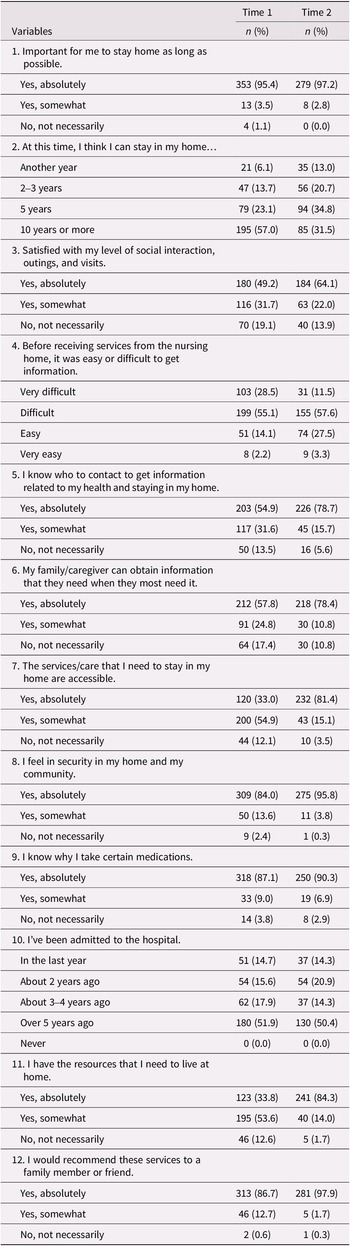
The Aging in Place survey results suggest that the participants felt supported by NHWW to age in place, and that improvement continued with participation in the program (Table 3).
Descriptive results (frequency and percentage) to aging in place survey

Table 3. Long description
The table contains three columns: Variables, Time 1 n (%), and Time 2 n (%).
1. Important to stay home: ‘Yes, absolutely’ increased from 95.4% at Time 1 to 97.2% at Time 2.
2. Estimated stay duration: ‘10 years or more’ decreased from 57.0% to 31.5%, while ‘5 years’ increased from 23.1% to 34.8%.
3. Satisfied with social interaction: ‘Yes, absolutely’ increased from 49.2% to 64.1%.
4. Ease of getting information before services: ‘Difficult’ remained the majority at 55.1% and 57.6%.
5. Knowledge of health contacts: ‘Yes, absolutely’ increased from 54.9% to 78.7%.
6. Family/caregiver access to information: ‘Yes, absolutely’ increased from 57.8% to 78.4%.
7. Accessibility of services: ‘Yes, absolutely’ saw a significant increase from 33.0% to 81.4%.
8. Feeling of security: ‘Yes, absolutely’ increased from 84.0% to 95.8%.
9. Knowledge of medication purpose: ‘Yes, absolutely’ increased from 87.1% to 90.3%.
10. Hospital admission: ‘Over 5 years ago’ remained the highest category at 51.9% and 50.4%.
11. Resources to live at home: ‘Yes, absolutely’ increased significantly from 33.8% to 84.3%.
12. Recommendation of services: ‘Yes, absolutely’ increased from 86.7% to 97.9%.
At Time 1, 34% of participants declared themselves to ‘absolutely’ have the resources needed to stay at home (Variable 11). At Time 2, this proportion rose to 84%. In terms of the program’s accessibility (Variable 7), the number of participants declaring that services for aging at home were accessible to them increased from 33% to 81% at the respective data collection times.
A Wilcoxon signed-rank test was conducted to determine changes between Time 1 and Time 2 for Variables 2 (Predicted ability to stay at home), 4 (Access to information), 8 (Feeling of security), and 12 (Would recommend NHWW). For Variable 2, a significant decrease (Time 1 versus Time 2) was observed in the years participants predicted they could stay at home, with 119 participants choosing fewer years, 36 choosing more years, and 92 choosing the same time (Z = −6.16, p < .001). As for Variable 4 (Access to information), a significant improvement at Time 2 was noted, with 98 participants reporting improvement (Z = 5.34, p < .001). A significant improvement was also seen at Time 2 for Variable 8 (Feeling of security), with 42 participants reporting feeling more secure (Z = −4.72, p < .001). For Variable 12 (Would recommend NHWW), a significant improvement again was found at Time 2, with 36 participants reporting improvement (Z = −4.51, p < .001).
A series of paired sample t-tests was conducted to examine social interactions, access to information, knowing whom to contact, support for caregivers, accessibility of services, feelings of security, availability of resources to age in place, and recommendation of the program to family and/or friends (Table 4).
Paired-sample t-test for Variables 3, 4, 5, 6, 7, 8, 11, and 12 from the aging in place survey

Table 4. Long description
The table contains nine columns: Variables aging in place, First data M, First data S D, Last data M, Last data S D, t, d f, p two-tailed, and Cohen's d. All variables show a statistically significant change with p < .001.
* Variable 3: First M 1.72, S D 0.78; Last M 1.49, S D 0.72; t 3.86; d f 278; Cohen's d 0.231.
* Variable 4: First M 1.92, S D 0.71; Last M 2.22, S D 0.68; t minus 5.66; d f 257; Cohen's d minus 0.352.
* Variable 5: First M 1.62, S D 0.73; Last M 1.27, S D 0.56; t 6.42; d f 281; Cohen's d 0.383.
* Variable 6: First M 1.60, S D 0.75; Last M 1.32, S D 0.66; t 4.74; d f 271; Cohen's d 0.287.
* Variable 7: First M 1.81, S D 0.62; Last M 1.22, S D 0.50; t 12.84; d f 274; Cohen's d 0.774.
* Variable 8: First M 1.18, S D 0.42; Last M 1.04, S D 0.22; t 4.95; d f 279; Cohen's d 0.296.
* Variable 11: First M 1.81, S D 0.65; Last M 1.17, S D 0.43; t 14.86; d f 275; Cohen's d 0.894.
* Variable 12: First M 1.14, S D 0.37; Last M 1.03, S D 0.18; t 4.70; d f 273; Cohen's d 0.284.
Note. In this table, except Variable 4, a lower score represents a higher agreement. For Variable 4, a higher score represents a more positive outcome.
Significant increases were found for Variables 3 (Satisfaction with social interaction), 5 (Access to information), 6 (Support to caregiver), 7 (Access to services), and 11 (Resources for living at home), all indicating improved outcomes for aging in place.
During the qualitative interviews, many participants shared how much they appreciated NHWW putting them in contact with services or providing access to resources:
NHWW came and they are still with us today, still helping. Since then, I had another surgery and home support comes six days a week, and we would never have been able to finance that, but they put me in touch with the right people to see how to get approved and helped us navigate the system. We wouldn’t be, probably, still in our home if that hadn’t happened.
When asked which services participants were receiving that were making a difference for aging in place, they noted transportation, navigation and accompaniment, and having help around the house (maintenance). Gender did not seem to influence the type of services that were making a difference, with one exception: low-income women sought transportation more than male participants. One theme that emerged was the list of essential program components highlighted by participants, a list that included accessibility, system navigation, and the one-on-one approach, but also the community outreach, the collaboration between service providers, flexibility of the program, and the adaptability of services to each person. One participant explained: ‘Well, if I need something or if something happened and my son wasn’t in the area, I can call NHWW and they would send somebody to help me. I know they would. It’s a lifeline’. Another shared:
I think it’s a necessary key to looking after people with severe needs that may be alone or isolated. NHWW is bridging the gap between their needs as well as people with not such serious needs, but a whole variety of things to have a healthy life and connecting them to services.
In addition, some participants noticed that initiatives facilitated by NHWW, such as going to the local nursing home for personal hygiene, would ease their transition from home to a LTC facility, if they needed that kind of support in the future. One participant observed: ‘If it comes time for placement, I would want to move into the same nursing home. There is a connection there, I already know the employees, and now I also know some who live there’.
Lastly, participants acknowledged that NHWW is also there for caregivers through a volunteer program that matches an older adult with another older adult who needs support. As such, one participant pointed out:
So, what they’ll do, is that they’ll go to the home once a week for three hours at a time to stay with the older adult. And they do things like puzzles, go for a walk, watch TV or read, anything that the older adult’s capable of doing. And during those three hours, the caregiver can go out, run their errands, get out of the house, get their hair done, visit a friend or even have a nap.
Client satisfaction with services
Participants reported overall satisfaction with the project, confirming that the services and support offered by NHWW helped them stay at home. Interestingly, participants declared that the services received prevented nonurgent medical visits, which dropped from 28% at Time 1 to 24% at Time 2 (Table 5).
Descriptive results (frequency and percentage) of the client satisfaction survey

Table 5. Long description
The table contains three columns: Variables, Time 1 n (%), and Time 2 n (%).
1. I am satisfied with the service/care I have received today.
- Yes, absolutely: Time 1: 293 (94.8); Time 2: 176 (98.9).
- Yes, somewhat: Time 1: 15 (4.9); Time 2: 2 (1.1).
- No: Time 1: 1 (0.3); Time 2: 0 (0.0).
2. The service/care I receive helps me to stay at home.
- Yes, absolutely: Time 1: 211 (72.8); Time 2: 140 (80.5).
- Yes, somewhat: Time 1: 61 (21.0); Time 2: 26 (14.9).
- No: Time 1: 18 (6.2); Time 2: 8 (4.6).
3. The service/care I receive helps me not to feel lonely or isolated.
- Yes, absolutely: Time 1: 214 (72.8); Time 2: 136 (76.0).
- Yes, somewhat: Time 1: 63 (21.4); Time 2: 37 (20.7).
- No: Time 1: 17 (5.8); Time 2: 6 (3.4).
4. The staff member has provided me with important information related to my health or the resources in the community to help me stay in my home.
- Yes, absolutely: Time 1: 268 (85.9); Time 2: 145 (82.9).
- Yes, somewhat: Time 1: 32 (10.3); Time 2: 23 (13.1).
- No: Time 1: 12 (3.8); Time 2: 7 (4.0).
5. The information received about my health and the resources in the community has increased my knowledge on the topic.
- Yes, absolutely: Time 1: 237 (75.7); Time 2: 142 (79.3).
- Yes, somewhat: Time 1: 61 (19.5); Time 2: 25 (14.0).
- No: Time 1: 15 (4.8); Time 2: 12 (6.7).
6. Receiving this service/care has prevented me from going to...
- The emergency department: Time 1: 57 (15.2); Time 2: 33 (11.5).
- My family doctor: Time 1: 12 (3.2); Time 2: 17 (5.9).
- Medical clinic: Time 1: 34 (9.1); Time 2: 20 (6.9).
Wilcoxon signed-rank tests were conducted for Variables 1 (Satisfaction with Services), 3 (Helped Me Not to Feel Lonely), and 5 (Increased My Knowledge), with satisfaction with services (Variable 1) showing significant improvements by Time 2 compared to Time 1 (Z = −2.98, p < .05, n = 14); the services received helped not to feel lonely (Variable 3) improved (Z = −3.31, p < .001, n = 35); and knowledge about healthy aging and resources in the community (Variable 5) improved (Z = −2.41, p < .05, n = 36).
A series of paired sample t-tests was conducted to examine the first four Table 5 variables: satisfaction with the services received; the services that helped with staying at home; the services that helped clients not to feel lonely; and the information received related to client health or to resources in the community that helped with staying at home (Table 6). All four client satisfaction items showed statistically significant improvement from Time 1 to Time 2.
Paired-sample t-test for Variables 1, 2, 3, and 5 from the client satisfaction survey

Table 6. Long description
The table consists of nine columns: Variables Client satisfaction, First data (M and S D), Last data (M and S D), t, d f, p two-tailed, and Cohen’s d.
* Variable 1: First data M 1.09, S D 0.31; Last data M 1.01, S D 0.11; t 3.06; d f 162; p less than .01; Cohen’s d 0.240.
* Variable 2: First data M 1.45, S D 0.60; Last data M 1.23, S D 0.53; t 3.63; d f 144; p less than .001; Cohen’s d 0.302.
* Variable 3: First data M 1.42, S D 0.58; Last data M 1.26, S D 0.48; t 3.43; d f 151; p less than .001; Cohen’s d 0.278.
* Variable 5: First data M 1.40, S D 0.60; Last data M 1.28, S D 0.58; t 2.53; d f 166; p less than .05; Cohen’s d 0.196.
SGBA provided insight into the type of activities preferred by gender. At the beginning of the program, women seemed to have more interest in the community activities being offered. Noticing this trend, the program decided to offer a ‘coffee chat group’ where participants could come once a week to have a coffee and share conversation, and quickly noticed that more male participants were taking part and showing up every week.
In the qualitative component, all participants shared that NHWW was precisely what they needed and that they were highly satisfied with the services and support being offered by project staff in their community. One participant explained: ‘If we didn’t have their help, we’d have to move out. This way, we’re still here, it means that we can stay in our home’. Another participant shared:
It’s so wonderful to have a service like that available. I’m very satisfied, if they weren’t there, I wouldn’t be able to take care of the house, because I live alone. I feel in security, I can call them, ask them for help. I’m so satisfied.
Participants also shared appreciation for the employees of NHWW, saying that ‘they are angels on earth’ and that ‘the program and the staff are amazing’. A volunteer in the program also expressed:
It’s a very rewarding experience to volunteer. You know, the one thing about volunteering is it’s assisting those who are, you are helping out or assisting those who need help, and it’s a very rewarding experience. I also sit on the advisory committee and listen to what has been happening, it’s so positive. Being so positive is so rewarding and to hear the great things that are being done.
Some participants commented on the impact of NHWW on their community: ‘Our community is really coming alive. We’ve got so many new things happening in our community and it’s been really good’.
Community awareness of aging
The final objective of the NHWW project was to create awareness in the four local communities that population aging was occurring and to familiarize municipal governments with the province’s age-friendly communities (AFC) initiative. In the three French-speaking communities where NHWW was tested, the notion of AFC was either known and in the process of becoming an official provincial program through its recognition process or already implemented. In the English-speaking community, very few people, including those in its local government, had heard of the AFC initiative. Here, NHWW employees met with key stakeholders (local health officials, community leaders, and municipal councillors) to explain the AFC initiative. After a few months of discussion with community leaders and local governance council members, they were invited to a council meeting to present the initiative. Council approved a resolution to adopt the initiative, and a committee was created to begin the process of becoming an AFC. The NHWW coordinators initiated discussions with council members and AFC committee members in all four communities and developed an ongoing collaboration.
Discussion
With the data collected in this pilot project, we show that the NHWW program successfully provided the services and/or supports necessary for participants aging in place, with a high level of satisfaction. Despite the challenges of the COVID-19 pandemic 8 months after project inception, and throughout the following years, the number of participants not only increased as the needs of older adults surfaced, but at an increasing rate during this time. The tremendous impact of the pandemic on the health of older adults, and its exacerbation of their level of frailty, is now common knowledge (Mete et al., Reference Mete, Tanir, Demirhindi, Inaltekin and Kanat2022; Seligman et al., Reference Seligman, Wysham, Shahoumian, Orkaby, Bidwell Goetz, Osvorne, Smith, Maciejewski, Hynes, Boyko and Ioannou2024). But the NHWW participants’ level of frailty remained stable, with the slight increase recorded credibly attributable to their increasing age: many moved over the 85-year mark, which can raise the score on the frailty scale. The fact that NHWW participants were supported and kept engaged likely contributed to the stability of their level of frailty. Importantly, in terms of frailty, participants’ mean score on the PRISMA-7 frailty scale remained close to the tipping point of 3.0. On PRISMA’s zero to seven scale, scores of 3.0 or more indicate increased risk of frailty. Not only did NHWW prevent levels of frailty from increasing, but it also managed to attract older adults at a time when the program could help prevent further decline.
The type of services offered by NHWW clearly made a difference to older adults’ perception of support for aging in place. Based on the first author’s previous studies on aging in place, as well as the ABCD approach, NHWW provided services in each community that were tailored to its needs: some services were similar across communities, whereas some differed. These were grouped into four categories: navigation and accompaniment, social health initiatives, nursing home–community interaction, and support. Within these service categories were included supports such as group activities, friendly home visits or calls, intergenerational activities, respite for caregivers, transportation (grocery shopping, medical appointments, and social activities), home maintenance (indoor/outdoor), social activities, lunch n’ learn, foot care, personal hygiene care at the nursing home, healthy meals, help filling out forms, and provision of information about the services available at all levels of government and in the community. All services were provided in a way that empowered older adults to do as much as they could and to find new ways of doing things that allowed the greatest independence. It is, therefore, no surprise that participants enrolled in NHWW showed such appreciation for the services, acknowledged that they now knew where to go for help, that the services were accessible, and that they felt secure in their homes. Feeling in security at home was previously identified as a key element for aging in place and one that older adults often mention (Dupuis-Blanchard et al., Reference Dupuis-Blanchard, Gould, Gibbons, Simard, Villalon and Éthier2015; Jones, Reference Jones2016; Lang et al., Reference Lang, Macdonald, Storch, Stevenson, Mitchell, Barber, Roach, Toon, Griffin, Easty, Curry, LaCroix, Donaldson, Doran and Blais2014; Tong et al., Reference Tong, Sims-Gould and Martin-Matthews2016).
NHWW also contributed significantly to the improvement of feelings of loneliness or isolation through a number of social health initiatives. Participants clearly indicated that the project had a positive impact on their lives. Much data has been collected to demonstrate the negative impact of social isolation and loneliness on older adults’ physical and mental health (Canadian Coalition for Seniors’ Mental Health, 2024; Conn et al., Reference Conn, Billard, Dupuis-Blanchard, Freedman, Hoang, Levasseur, Newall, Sullivan and Wister2024). This is especially important in light of the fact that participants’ Time 1 sociodemographic data indicated rates of 34% for self-reported fair–poor mental health, and of 23% for depression. Programs such as NHWW that offer activities tailored to diverse interests are essential to keeping older adults engaged, thus addressing social isolation. In NHWW, these ranged from engagement opportunities for active older adults in group settings to one-on-one interactions through friendly calls or the buddy program for caregiver respite.
The program also provided opportunities for learning that were important to older adults. Many situations were amenable to the addition of an educational component, such as a 15-minute presentation on winter driving at the beginning of a weekly coffee-chat group, or a workshop held to teach a specific skill, such as watercolour painting or training for cardiopulmonary resuscitation (CPR), or a lunch n’ learn. A variety of presentations related to healthy aging, and guest speakers from local and provincial organizations, provided much-needed learning opportunities for older adults, caregivers, and community members.
NHWW was not only successful in supporting aging in place, but participants were very satisfied (98.9%) with the project’s services and the approach. This is not a haphazard result. The evidence-based approach was developed in the knowledge that NHWW had to be person-centred and flexible, not rigid with a list, or a box-ticking form, of services offered. It also prioritized assets already available in the community to avoid service duplication. NHWW was accessible, offering services free of charge except when referring clients to other services that could have a cost, recognizing the bilingual aspect of New Brunswick, and bringing services to the places where people are located. Importantly, NHWW leveraged existing community infrastructure, LTC facilities, first for office space, but also for their knowledge of aging and of the community, the possibility of having meals prepared by the kitchen for NHWW participants in need, for ordering supplies such as protein drinks and incontinence products at cost for low-income participants, and for personal services such as bathing and footcare that could not be carried out at home.
Finally, NHWW successfully created awareness in local communities of the concept of AFC. Although three of the four communities in the project were already familiar with the provincial AFC initiative, NHWW was able to successfully promote and support initiatives at the local level. The fourth community and its local government were made aware of the AFC movement and the potential for recognition and inclusion. NHWW’s support with the first few steps of the recognition process helped this community decide to go ahead and implement actions aligned with the AFC initiative (GNB, 2026). They have since achieved formal recognition as a New Brunswick AFC.
Implementing a new approach, such as NHWW, confers both strengths and limitations. One of the most important strengths for NHWW was the use of the ABCD approach to guide project development. Others were its mixed-method methodology and the ability and decision to collect data twice during the project. Important limitations were imposed by the COVID-19 pandemic. The uncertainties of rolling pandemic restrictions impacted the number and timing of data collection periods, and an unexpectedly rapid uptake in participants significantly increased the workload for employees. Another important limitation was the collection of data by NHWW employees with limited research knowledge. Despite training and the use of surveys with drop-down menus for quick and easy data entry, difficulties with data collection remained. These were related to employees’ failure to follow up with all potential participants and/or to understand the importance of the data collection process, especially towards the end of the project. Looking back, the sociodemographic survey should have been administered again at Time 2 to capture health changes. Also, the range in the number of participants from one site to another was large: depending on the type of services offered, 30 participants in one community and 300 in another. Lastly, NHWW was meant to support caregivers as well as older adults, and despite some efforts to develop programming for them, NHWW only successfully developed the buddy program, which provided a few hours of respite. Addressing caregivers’ needs was not sufficiently taken into account through the pilot project.
As NHWW grows, continued research on the impact of its approach to aging in place remains important. While research is needed on older adults who participate in the program, special attention must also be given to caregivers. A better integration of SGBA is warranted as well. Finally, so that implementation guidelines can be developed to ensure true replication, there is also a need to document the spread and scale of NHWW.
Conclusion
With most older adults wanting to age in place and the health care system seeking solutions to alleviate current occupancy pressures, innovative programs such as NHWW are essential. Tested in four communities, the evidence-based approach had positive impacts that contributed to older adults feeling they could remain at home. NHWW addressed the need for guidance and accompaniment in the complex system that is health care, provided social health initiatives to counter social isolation and loneliness, and supplied opportunities to learn about aging while creating community awareness of aging populations and AFC. The fact that almost all participants had a high level of satisfaction and would recommend NHWW to family and friends confirms that the key elements of the program, such as person-centeredness, flexibility, absence of duplication of existing services, and accessibility, are critical. With population aging continuing for the next few decades, it is imperative that older adults and their families have access to the appropriate services to meet their needs. NHWW is one such initiative.
Acknowledgements
We want to acknowledge the project team members without whom the program could not have been developed. First, the nursing home directors who led the pilot testing in their community: Gaëtan Haché, Guylaine Ward, André Savoie, Bruno Holmes, Patricia Harrington, and Michel Haché, who initiated the phone call that started this journey. We are also grateful to the program coordinators who made the concept become reality: Terissa Salmon, Darlene Oulton, Sylvette Savoie, Kathleen Savoie, Pamela St-Coeur Leclair, and Andrée-Anne Blanchard.
Financial support
This project benefited from peer-reviewed funding from the Healthy Seniors Pilot Project (HSPP) initiative, a partnership between the Public Health Agency of Canada and the Government of New Brunswick.






 Open access

