Introduction
Among many organic molecules found in extraterrestrial space there are sugars and their related compounds. The simplest sugars – glycolaldehyde (CH2OHCHO) and ethylene glycol (HOCH2CH2OH), which is the reduced glycolaldehyde – have been detected in interstellar cloud Sagittarius B2 (N-LMH) (Hollis et al. Reference Hollis, Lovas and Jewell2000, Reference Hollis, Lovas, Jewell and Coudert2002). Ethylene glycol has been also detected in comet Hale-Bopp (Crovisier et al. Reference Crovisier, Bockelee-Morvan, Biver, Colom, Despois and Lis2004). The presence of glycolaldehyde in comets was predicted by Hudson et al. (Reference Hudson, Moore and Cook2005). The three-carbon sugar, dihydroxyacetone, and many simple sugar-related compounds (up to six carbon atoms in the molecule) have been identified in the Murchison and Murray meteorites (Cooper et al. Reference Cooper, Kimmich, Belisle, Sarinana, Brabham and Garrel2001). The possibilities of abiotic formation and accumulation of complex sugars (polysaccharides) in interstellar clouds were first discussed by Hoyle & Wickramasinghe (Reference Hoyle and Wickramasinghe1977a, Reference Hoyle and Wickramasingheb), and the possibility of a biological contribution to the entire suite of observed interstellar organic molecules was also later considered by the same authors (e.g. Hoyle & Wickramasinghe Reference Hoyle and Wickramasinghe2000). The argument here is that the origin of life through abiotic processes may happen only as a rare event on a cosmological scale, but subsequent spread is close to being inevitable. The bulk of interstellar organic molecules (and cometary and interplanetary molecules) is then interpreted as the detritus of biology.
The successful dissemination of life would be greatly assisted by mechanisms that offer protection against ultraviolet and cosmic radiation to iterant clumps of microbes. Microbes often develop biofilm to surround them, and such biofilm material consists of a high-mass fraction of extracellular polysaccharides. Radioastronomically detected molecules related to sugars could thus arise from biology itself.
The existence of such molecules in cosmic space was the motivation to extend our earlier investigations (concerning the interaction of low-energy ions with organic matter (Tuleta et al. Reference Tuleta, Gabla and Madej2001, Reference Tuleta, Gabla and Szkarlat2005)) to this class of molecules. To this end we examined a surface of saccharose irradiated by slow ions in the laboratory.
Experimental
In the present experiment a thin layer of saccharose (average thickness of a few tenths of a micrometre) on a glass substrate was bombarded by hydrogen (H2+) or argon (Ar+) ions with energy of 3.5 keV to a fluence of 6.4×10¹⁷ ions cm−2. After bombardment, the sample was removed from the vacuum chamber and dissolved in distilled water. An insoluble film remaining on the glass substrate was analysed by means of optical microscopy.
Results and discussion
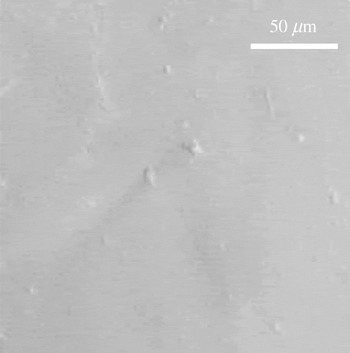
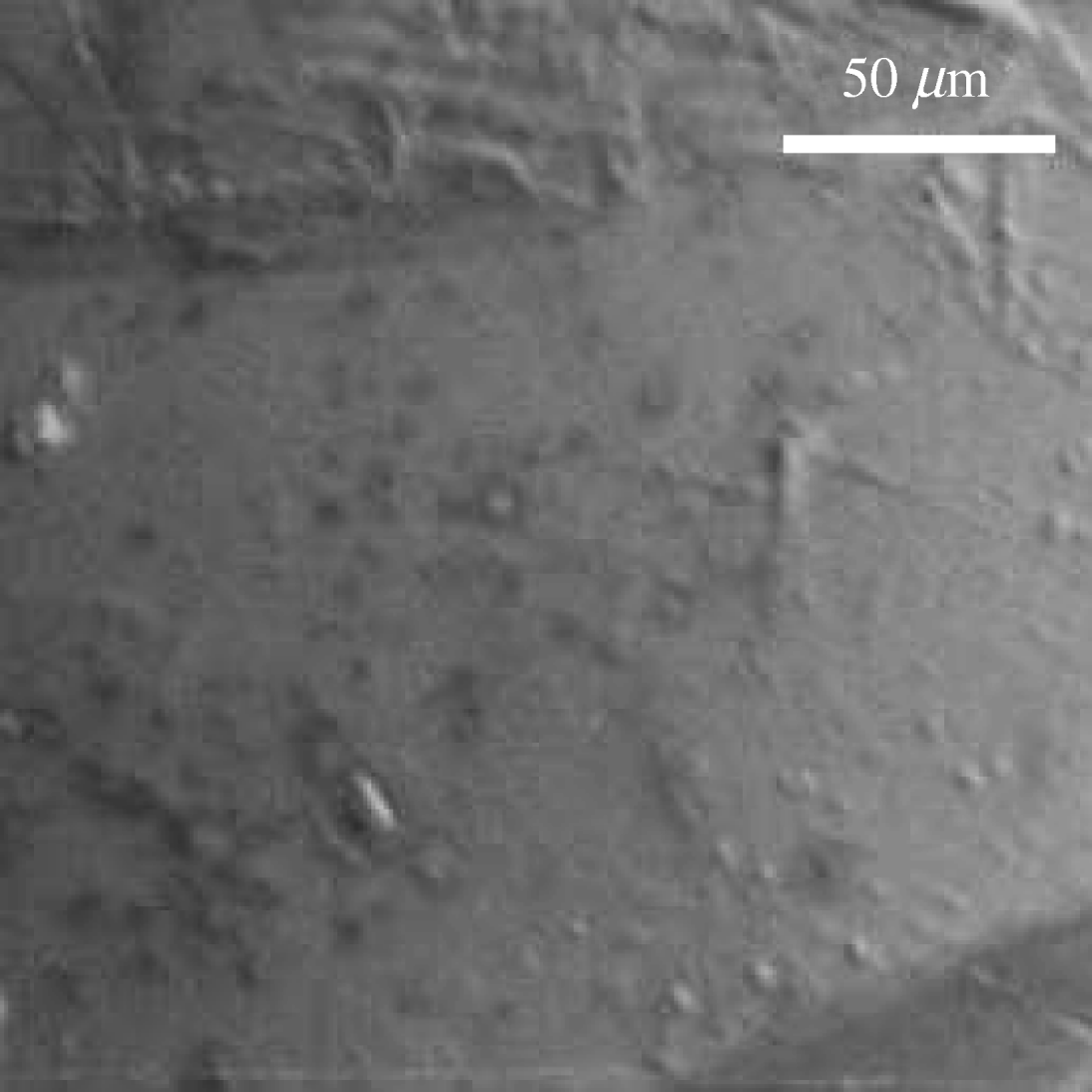
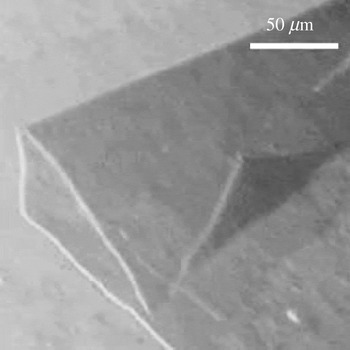
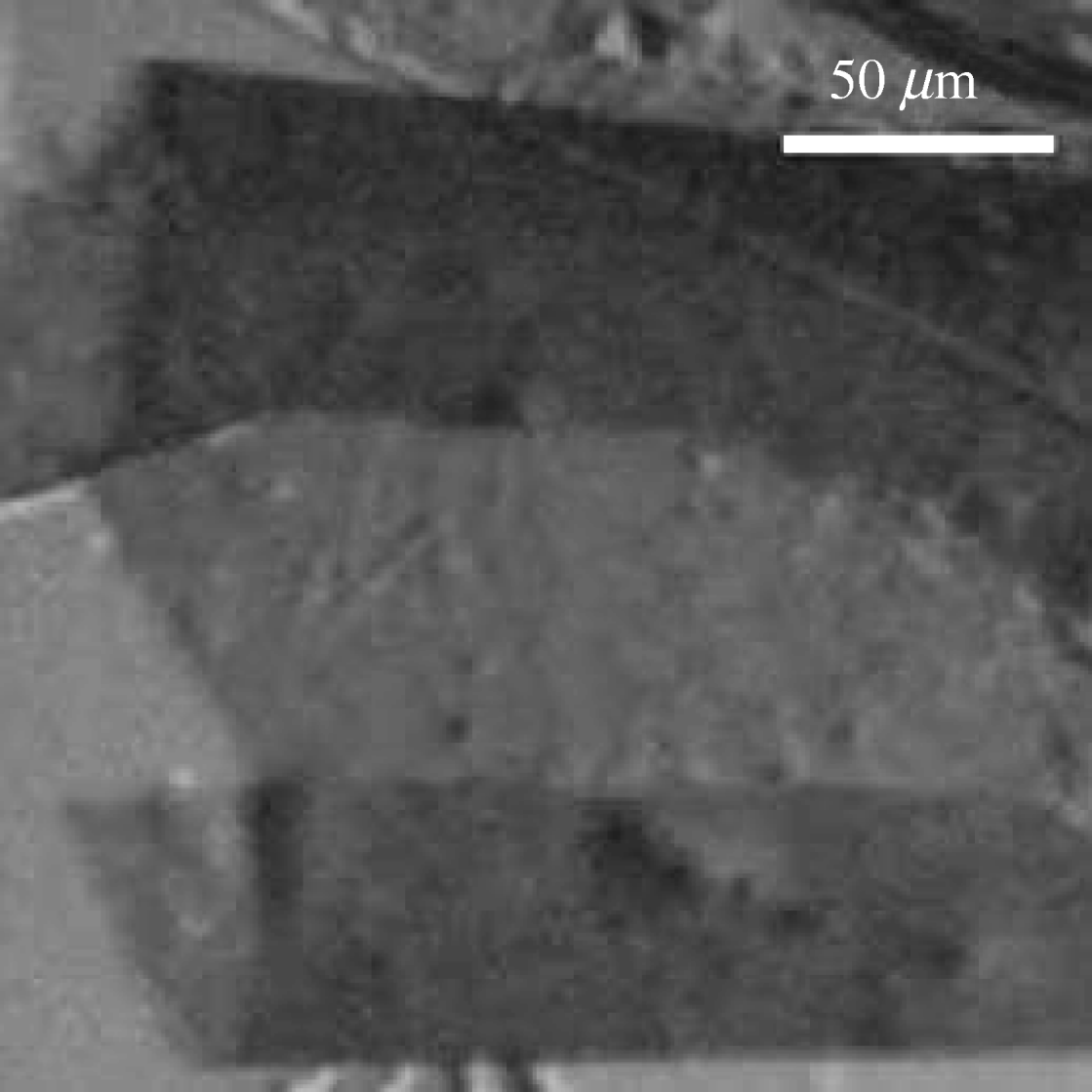
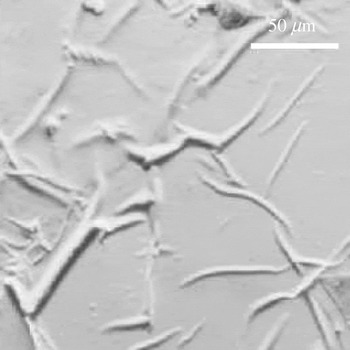
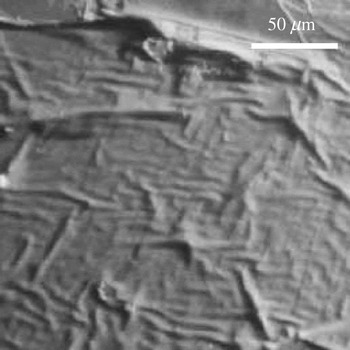
The films obtained are shown in Fig. 1 (bombarding by hydrogen ions) and in Fig. 2 (bombarding by argon ions). The formation and appearance of these films are caused by partial carbonization and polymerization of saccharose molecules. The intensity of these processes is mainly connected with the energy transfer by impinging ions to the nuclear system of the target. This transfer is larger in the case of argon ions and therefore the film obtained using these ions is darker and thicker compared with the film obtained using hydrogen ions. The carbonization process connected with partial dehydroxylation and dehydrogenation of saccharose molecules and their further modification and polymerization leads to formation of humic substances consisting of basic elements (cores) in the form of an aromatic ring with attached main reactive groups –OH. This is similar to the case of humic substances obtained during condensation of glucose warmed with sulphuric acid (Thiele & Kettner Reference Thiele and Kettner1953). The cores linked by bridges and van der Waals forces form structures of flat sheets with some of the edges curling upwards. This effect is shown in Fig. 3 (for hydrogen ions) and Fig. 4 (for argon ions). It was also observed for natural humic substances extracted from soil (Chen & Schnitzer Reference Chen and Schnitzer1976).
Film obtained after hydrogen ion bombardment of saccharose.

Film obtained after argon ion bombardment of saccharose.
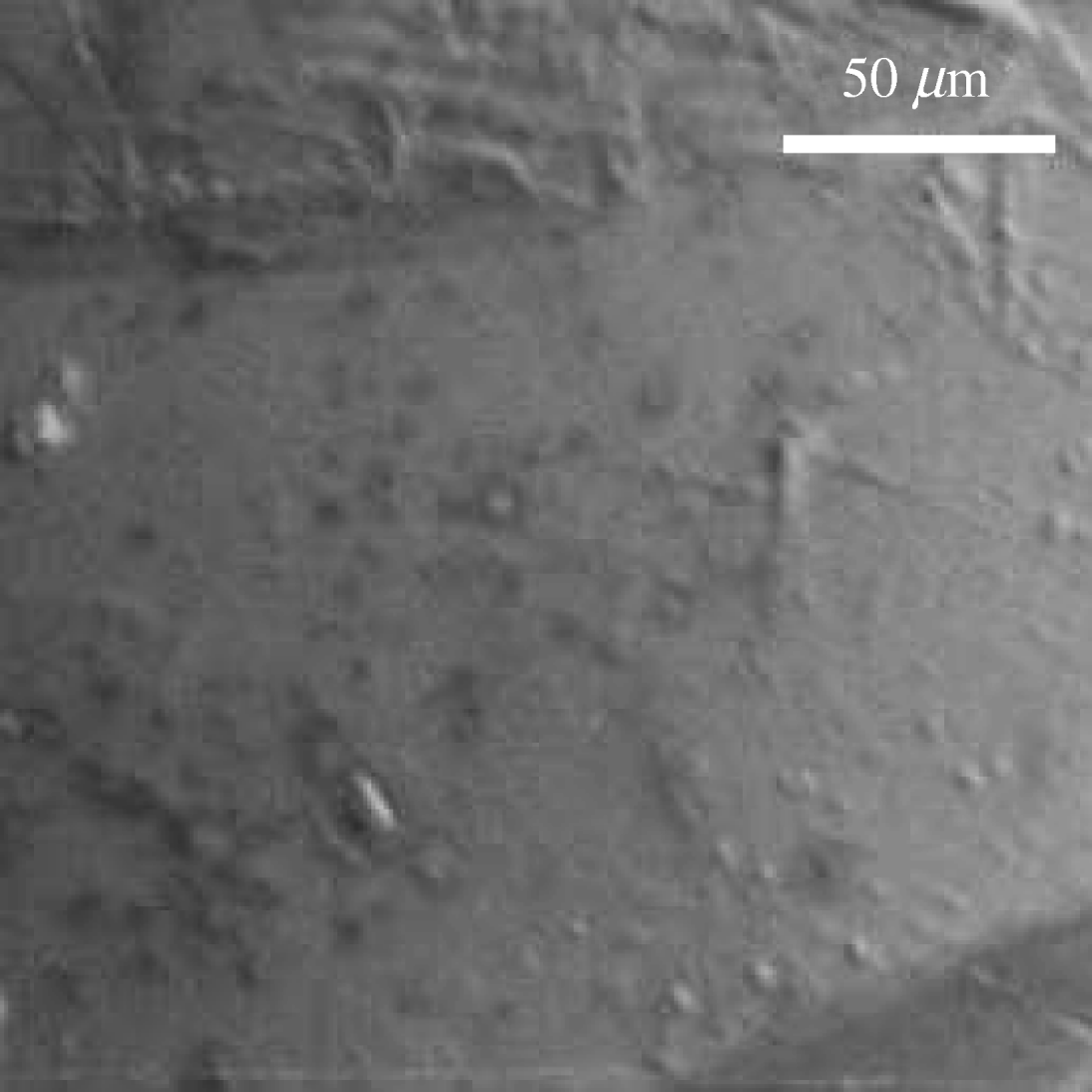
Effect of curling up of sheet produced by hydrogen ions.

Effect of curling up of sheet produced by argon ions.
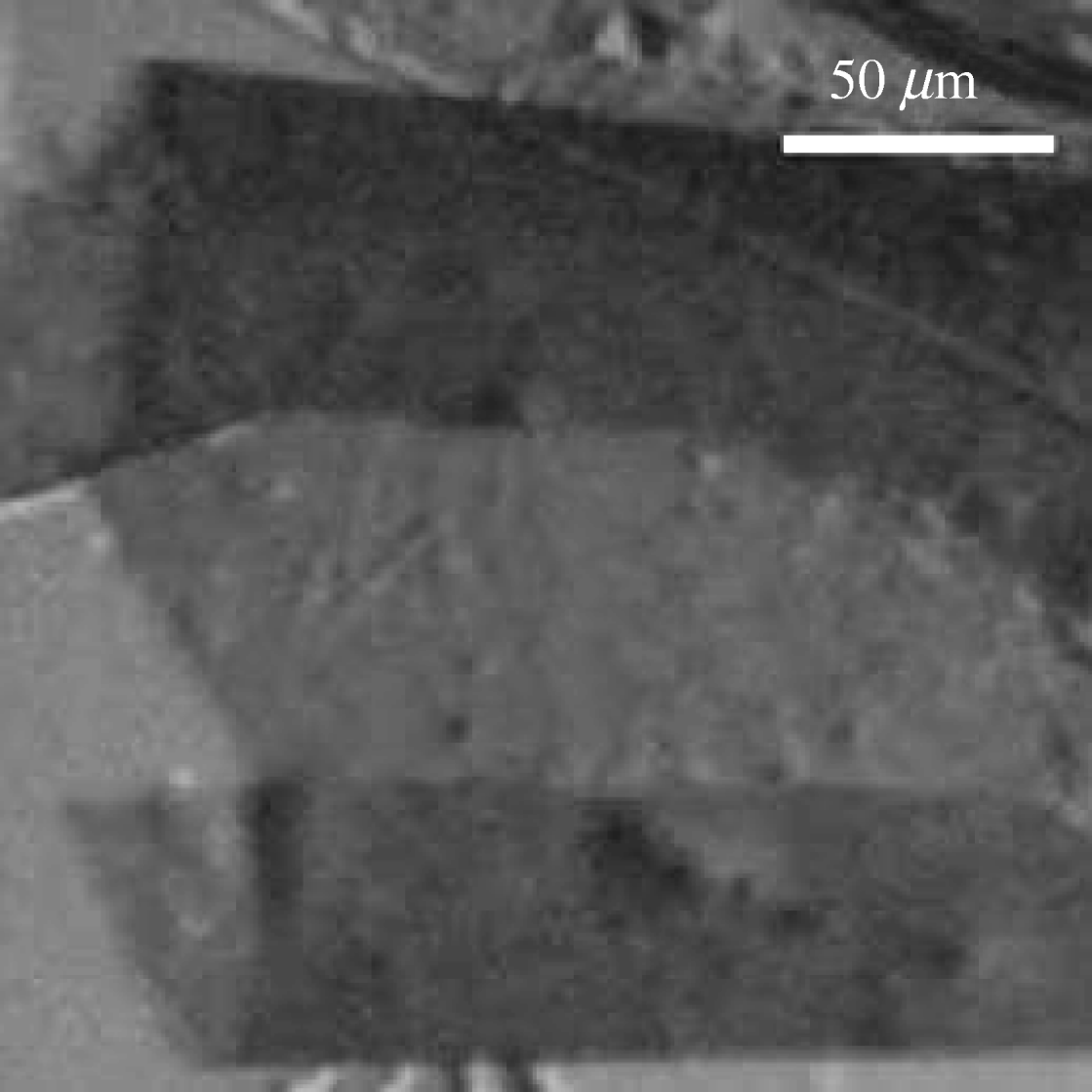
The other characteristic feature of humic materials is their ability to swell in the presence of water. This feature becomes visible after pulling a small drop of water into the space between the glass substrate and humic film, and is illustrated in Figs 5 and 6 for hydrogen and argon ions, respectively. From the above figures it also appears that the penetration of water reveals the fractal character of the humic film structure. As estimated using the box-counting method (Peitgen et al. Reference Peitgen, Jürgens and Saupe1992), the fractal dimension increased from 1.7 (for the structure shown in Fig. 5) to 1.9 (for the structure presented in Fig. 6). The enhancement of the fractal dimension value indicates a larger development of structure produced by argon ions that becomes more compact in comparison with that produced by hydrogen ions. The dark films with a high fractal index provide an excellent model for the protection of interior organic molecules and biochemicals from ambient ultraviolet radiation, thus enhancing the survival potential of viable cells in an interstellar or protoplanetary setting.
Swelling of film structure in the presence of water (film generated by hydrogen ions).

Swelling of film structure in the presence of water (film generated by argon ions).

The use of low-energy hydrogen ions enables the possibility of interpretating our results from the viewpoint of astrobiology. The remit of this new branch of science is to study the origin and evolution of life on Earth and wherever it might exist in the Universe, and to pose the question of whether the transference of life from one cosmic location to another is possible (Hoyle & Wickramasinghe Reference Hoyle and Wickramasinghe2000; Ehrenfreund et al. Reference Ehrenfreund2002, Reference Ehrenfreund2004). Prebiotic molecules, wherever they first formed, would surely have provided the initial raw materials that were responsible for generation of life. This process, however, requires preservation of fragile molecules against dissociation caused by exposure to ultraviolet and ionizing radiation in order to permit some form of prebiotic evolution to occur. This could occur through the formation of grain clumps where the interior material is protected from the external radiation environment (Hoyle & Wickramasinghe Reference Hoyle and Wickramasinghe1976). Such protection would be amply provided by sheaths of material such as we have generated in the laboratory.
In a panspermic context, the irradiation of bacterial clumps surrounded by biofilm with a high polysaccharide content would lead to dark humic sheaths that provide excellent protection from damaging radiation. The surviving fraction of iterant bacteria could be significantly enhanced in this manner. The present experiment simulates roughly the interaction of solar wind protons with interplanetary dust grains (Tuleta et al. Reference Tuleta, Gabla and Madej2001) containing molecules of sugars. A fraction of this dust could have a biological provenance with relevance to panspermia. This idea is supported by the fact that macromolecules similar to terrestrial humic substances are present in carbonaceous meteorites (Hayatsu et al. Reference Hayatsu, Winans, Scott, McBeth, Moore and Studier1980).
Conclusions
During ion bombardment of saccharose, humic and non-water soluble films with a fractal nature were obtained. Due to larger energy transfer to the target nuclear system, argon ions produce a thicker and more compact structure than hydrogen ions. From an astrobiological perspective, the results obtained show:
(a) the development of a survival strategy for viable cells transferred via panspermic processes; and
(b) the possibility of the abiogenic creation of a humic thin layer capable of curling up and bonding of water.
In the context of the origin of life, such layer might act like a cell wall isolating, at least partially, the interior of a protocell from the harmful influence of an external environment, which could assist in chemical evolution and the eventual emergence of a self-replicating living cell.