As noted in several of the contributions to this special issue, Latin American states provide public goods in an uneven manner. An example can be found in the provision of healthcare, which varies across the national territory inside countries: some provinces, states, and regions enjoy higher-quality care than others. We refer to this as territorial health inequality; that is, the gaps in access to care or differences in the quality of health services that correlate with a person’s geographical location in a country.
Such territorial health inequality is consequential, as residents of particular regions face shorter life spans and an increased risk of preventable disease. During the past 25 years, Latin America has witnessed notable reductions in multiple forms of inequality, and a growing body of research has sought to explain these trends (Huber and Stephens 2012; Pribble Reference Pribble2013; López-Calva and Lustig 2010; Garay Reference Garay2016). Yet little attention has been paid to territorial inequality inside countries.
This article focuses on healthcare inequalities. What are the trajectories of subnational health inequality in Latin America during the past 25 years, and why have some countries witnessed steeper declines in territorial inequalities than others? This article addresses these questions, focusing on Latin America’s largest federations: Argentina, Brazil, and Mexico. The analysis centers on trajectories of territorial inequality, rather than overall levels, because studies of long-term change allow for probing more directly the impact of policy innovations.Footnote 1
We contend that two key factors account for different trajectories of change in territorial health inequalities. One is the nature of the political coalition that pushed decentralization forward; namely, whether the primary advocates were subnational or national (i.e., bottom-up versus top-down).Footnote 2 The second is the existence or subsequent introduction of coordinating mechanisms for oversight and management from the central government.Footnote 3 We argue that the type of decentralizing coalition is an enabling condition that sets countries on a given trajectory (i.e., proequity vs. nonequity). The existence (or lack) of coordinating mechanisms of oversight by the national government can intensify (or reverse) trajectories of territorial inequality.
The study tests this explanation in Argentina, Brazil, and Mexico, the region’s three largest federal countries. It uses Otero-Bahamón’s operationalization (Reference Otero-Bahamón2016, 2019) to calculate a measure of territorial healthcare inequality and to assess and compare long-term trajectories of change. The analysis shows that Brazil’s bottomup decentralizing coalition generated a political commitment to reducing territorial inequality in health. It also fostered local-level state building and health policy innovation. This initial trajectory was further locked in and enhanced by the existence of coordinating mechanisms of oversight from the center, which together produced a large reduction in territorial healthcare inequality.
In Mexico, by contrast, the decentralizing coalition was top-down, which weakened the federal government’s attention to the issue of subnational inequality. Yet the subsequent introduction of coordinating mechanisms of oversight helped to lessen that initial impetus and ultimately led to a moderate decline in territorial inequality. In Argentina, the combination of a decentralizing coalition dominated by national interests and weak coordinating mechanisms produced a low decrease in territorial inequality until 2004, when new mechanisms of oversight from the central government were introduced, producing a moderate decline in the years that followed.
This article makes several important contributions to different bodies of literature in the field of comparative politics. First, it expands on an incipient but important scholarship on territorial inequality in the provision of public goods within and across countries. To date, most studies of territorial inequality have uncovered and explained variation within single countries, but they have not engaged in crossnational comparisons.Footnote 4 Second, the article provides an explanation to account for cross-national differences in territorial healthcare inequality, a topic that has not been widely studied by scholars of comparative social policy.
Third, the findings shed light on the old and unresolved debate about the effects of decentralization on the provision of social services.Footnote 5 The article shows that healthcare decentralization is neither inherently good nor bad for territorial inequality, but instead that the composition of the decentralizing coalition (i.e., bottom-up or top-down) influences whether a country embarks on a trajectory that is more or less likely to reduce territorial inequality.Footnote 6 This does not imply that reductions in territorial healthcare inequality are achieved only through decentralization. Instead, the findings suggest that among those countries that have decentralized health services, the nature of the coalition that pushed for that change and the presence of coordinating mechanisms of oversight help explain the pace of change in territorial inequality. Likewise, this study contributes to the strand of research in subnational politics that underscores that changes in territorial inequality are the result of multilevel dynamics, not simply the outcome of subnational differences (Giraudy et al. 2019). Furthermore, the article pushes us to revisit and rethink traditional theories of welfare state universalism.
The first section of the article offers a brief overview of the literature that assesses territorial divergences in health service delivery within countries, underscoring some of the limitations of these works for the study of territorial inequality. It also discusses and rules out potential alternative explanations. Then it presents the argument about the determinants of trajectories of territorial healthcare inequality and discusses the need to develop measures of territorial inequality, presenting an operationalization proposed by Otero-Bahamón (Reference Otero-Bahamón2016, 2019). The analysis examines change in that measure across time in Argentina, Brazil, and Mexico. It tests the argument about why the three countries exhibit divergent trajectories of territorial healthcare inequality, drawing on secondary material. The concluding section discusses the significance of the findings, as well as suggestions for future research.
Uneven Provision vs. Territorial Inequality
A growing group of scholars has begun to investigate why the quality and coverage of health services varies across subnational units in Latin America (Niedzwiecki Reference Niedzwiecki2018b; Alves Reference Alves2015; Osterkatz Reference Osterkatz2013; Touchton and Wampler Reference Touchton, Natasha and Wampler2014). In general, these studies point to political and economic variables endogenous to each subnational unit to explain why regions and municipalities exhibit variation in the quality of public healthcare. Niedzwiecki (Reference Niedzwiecki2018b), for example, finds that state capacity and policy legacies influence the success of health policy implementation, while political alignments between the president and governors also shape the implementation of cash transfers in Argentina and Brazil. Other studies, including Alves Reference Alves2015, point to the importance of electoral variables. Alves argues that Brazilian states with strong electoral competition exhibit better, more transparent, and more rules-based healthcare administration than states where power is concentrated.
Relatedly, Touchton and Wampler (Reference Touchton, Natasha and Wampler2014) find that Brazilian cities with participatory budgeting tend to have higher levels of health spending and lower levels of infant mortality than urban centers that do not provide for such participation. Wampler et al. (Reference Wampler and Touchton2019) argue that participatory institutions, citizenship-based social programs, and inclusive state capacity all contribute to improving subnational health and education services. McGuire (Reference McGuire2010a), by contrast, finds that infant mortality in Argentina’s provinces is not significantly influenced by electoral competition or partisanship, but instead is shaped by the share of women in the provincial legislature. Gibson (Reference Gibson2017, 2019) finds that the presence of social movement organizers in positions of power helps explain effective health administration in key Brazilian cities. Taking a more economic approach, Osterkatz (Reference Osterkatz2013) finds that variation in per capita GDP has a positive and significant effect on healthcare coverage in Spain and a negative effect on the infant mortality rate in both Brazil and Spain.
While these studies empirically show and explain why some subnational units perform better than others in terms of healthcare provision, they are not able to account for the factors that explain performance gaps in and across countries. In other words, these works do not account for cross-national differences in territorial healthcare inequality. Otero-Bahamón (Reference Otero-Bahamón2016, 2019) is, to our knowledge, the only scholar who has directly tackled the puzzle of cross-national variation in (subnational) territorial inequality. She argues that territorial equalization in the provision of public goods is a result of a dyad of autonomous technocrats and weakened subnational political elites. Equalization flows from this dyad in the form of two mechanisms: place-sensitive policy formation and controlled decentralization.Footnote 7 Drawing on evidence from Colombia’s education sector and Peru’s healthcare system, Otero-Bahamón (Reference Otero-Bahamón2016, 2019) shows that both countries have reduced territorial inequalities when national technocrats became autonomous and subnational political elites weakened.
According to Otero-Bahamón (Reference Otero-Bahamón2016, 2019), controlled decentralization is key for explaining increases and decreases in territorial inequality. Specifically, she contends that the ability of national technocrats to control the process of decentralization or to recentralize functions, so that the central administration controls a policy area (i.e., healthcare or education), reduces territorial inequalities. We depart from Otero-Bahamón in that we do not think recentralization or technocrats are needed, but we do identify mechanisms of oversight and management that may contribute to the kind of “controlled decentralization” Otero-Bahamón describes.
Although Otero-Bahamón is the only author we identified who has analyzed cross-national determinants of territorial inequality, scholars of the welfare state have looked at the question of why countries vary with regard to the quality of national-level healthcare. This literature suggests that public health services are of a higher quality in countries with high state capacity, high levels of economic development, and consolidated and competitive democracies (McGuire 2010b; Huber and Stephens 2012; Pribble Reference Pribble2013; Garay Reference Garay2016; Ewig Reference Ewig2016). Although these studies do not look directly at the issue of territorial inequality, one could infer that countries exhibiting high state capacity, high economic development, high levels of GDP growth, and competitive democracies might also have lower levels territorial inequality. If we were to take these as alternative explanations, however, they would fail to account for the varied trajectories of territorial inequality observed in our set of cases.
With similar levels of state capacity, Brazil’s trajectory of territorial inequality is one of a large decrease, while Argentina’s has been lower. The same can be said about levels of economic development. Measured by GDP per capita in current dollars, Argentina outperforms Brazil and Mexico, and therefore should have experienced a steeper decline in territorial inequality. Yet this study finds that the opposite is true: Argentina is the case with the least decline in territorial inequality. Furthermore, even though all three countries exhibit similar levels of democratic stability and competitiveness, trajectories of territorial inequality vary across the three states.
The Argument
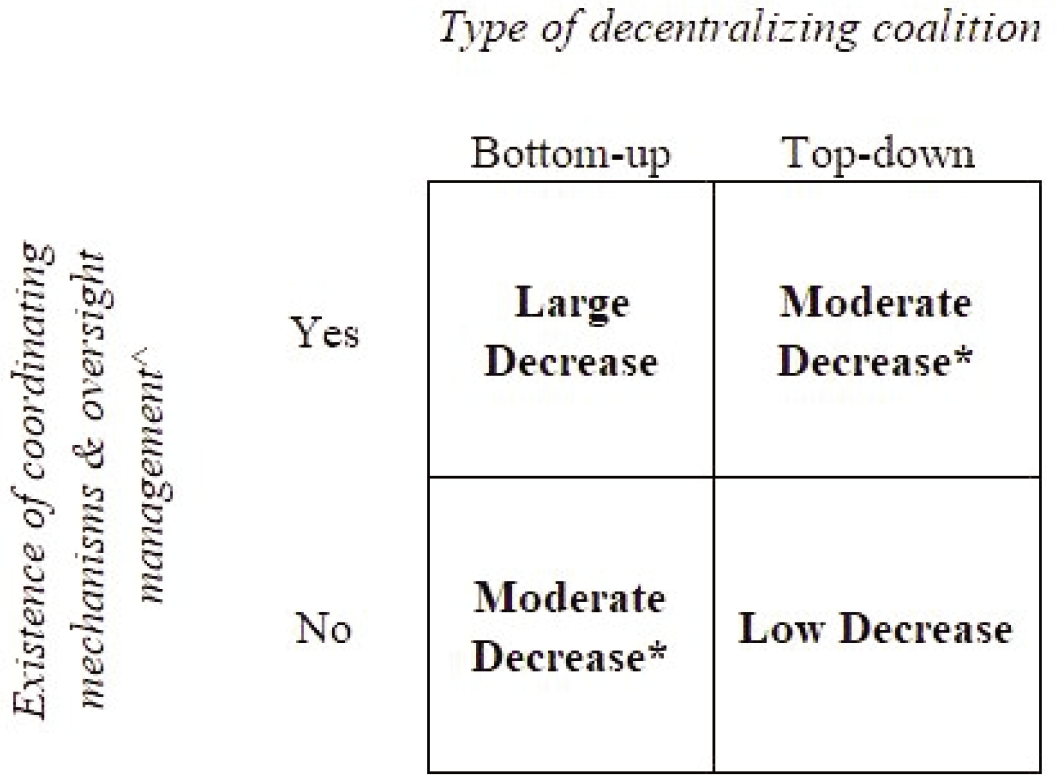
As shown in figure 1, we posit that two variables determine trajectories of change in territorial healthcare inequality: the type of decentralizing coalition and the mechanisms for oversight and management from the central government. We hypothesize that the first variable is an enabling condition that sets countries on a given trajectory (proequity vs. nonequity-focused). The existence of coordinating mechanisms of oversight by the national government (or lack thereof) has the capacity to intensify (or reverse) the trajectory.
Determinants of Trajectories of Territorial Inequality

Regarding the first variable, we build on the discussion of the importance of territorial interests as a trigger of different decentralizing coalitions. As Falleti notes (Reference Falleti2010), decentralization coalitions are structured by actors with specific territorial interests. By territorial interests, Falleti refers to the level of government—that is, national or subnational—that actors represent. Examples of national actors, both governmental and societal, are the national executive, the national cabinet, and ruling legislators elected in a national district. By contrast, subnational actors representing local territorial interests include governors and their cabinets, state legislators, regional unions, associations of mayors and governors, and subnational social movements, among others.
According to Falleti (Reference Falleti2010), two types of coalitions push for decentralization: those dominated by national actors (what we call top-down coalitions) and those whose prevailing actors are subnational (what we refer to as bottom-up coalitions).Footnote 8 Where top-down coalitions push for decentralization, we expect that change in territorial inequality will be minimal. By contrast, in settings where bottom-up decentralization is implemented, we expect to see sharper declines in territorial healthcare inequality. This is the case, we expect, because subnational actors represent the territorial interest of the region in which they reside and are attuned to subnational inequalities. These coalitions, therefore, are more likely to demand that the decentralization of responsibilities and funds be pursued in a way that boosts equity across the territory.
Moreover, when a subnational coalition pursues decentralization, it is likely to involve the consolidation of territorial networks of politicians and policy experts. Networks that are spread throughout the territory help to mitigate territorial inequalities. For instance, nationwide associations or networks of mayors and governors or civic and social movements are well positioned to ensure that all subnational units will be treated equally, with standardized guidelines to regulate the decentralized service(s) and with the same proportion of funds to cover the provision of goods. In addition, and as important, such networks can also facilitate local-level policy innovation (Sugiyama Reference Touchton and Wampler2012) and state building (Gibson Reference Gibson2017, 2019), boosting the performance of subnational units and evening out inequalities. Furthermore, bottom-up coalitions help prompt the formation of “place-sensitive” health policies, which, according to Otero-Bahamón (this issue), help reduce territorial health gaps.
By contrast, top-down coalitions are not necessarily concerned about equalization across the territory. Whereas some national technocrats might introduce decentralizing policies with an eye to preventing or reducing territorial inequality (OteroBahamón 2016, 2019), many national actors pursue decentralization with the broader goal of limiting federal spending and cutting costs (Ugalde and Homedes Reference Leyer2006) and may care little about the equalizing effects of policy. Moreover, these national actors may lack local-level expertise, making them blind to the need for “place-sensitive” policies. Such a focus, we argue, could exacerbate existing territorial inequalities.
The second variable, mechanisms of management and oversight from the center, is critically important to determine whether a decentralized service will result in more or less unequal provision across subnational units. Rodrigues-Silveira (Reference Rodrigues-Silveira2011) notes that rules regulating the allocation of resources between levels of government can have important effects on territorial inequality. We focus on three ways that management and oversight by the central government can occur: by providing national funding, by earmarking funds, and by creating and enforcing nationally mandated quality standards.
The first and most important determinant of territorial inequality is the existence or lack of federal funds for healthcare delivery. Where subnational units are solely responsible for the funding of services and public goods, territorial inequality will probably increase because not all units are able to generate sufficient revenue to sustain high-quality services (Rodrigues-Silveira 2019). By contrast, if the national government provides the bulk of healthcare funding, it evens out the revenue available to subnational units, which makes it more likely that all local governments (not just highly developed areas of the territory) can cover the cost of providing public goods and services. This, in turn, helps to reduce territorial inequality.Footnote 9
Another equally important aspect of funding is the way federal transfers are allocated to subnational units. Federal transfers can be divided into two categories: earmarked or unearmarked (unconditioned) (Bonvecchi and Lodola Reference Bonvecchi and Lodola2011). The former have strong spending restrictions, in that they do not allow subnational authorities to use funds in a discretionary manner. In other words, earmarked federal transfers have formal or legal restrictions on their use. Examples of earmarked federal transfers include funds for roads, housing, education, health, and environment. Earmarked federal funds can range from broadly defined (a set amount of funding must be used for healthcare in general, regardless of the level of care and category of spending) to more specific guidelines (a portion of the health funds must be devoted to primary care, funds cannot be used for personnel, etc.).
Unearmarked transfers, by contrast, do not come with any strings attached. As a result, recipients can, by discretion, decide how to use and allocate these funds. We argue that earmarked federal funds operate as a mechanism for management oversight from the center by requiring all subnational governments to spend funds on a predetermined service or public good. More specific earmarks can further encourage healthcare equality by requiring subnational units to guarantee basic primary care, preventive vaccinations, and other interventions linked to lower rates of infant mortality.
A third coordinating and oversight mechanism involves the creation of nationally defined guidelines and standards about the quality of healthcare services. In countries where the state has identified a core package of services that all subnational units must guarantee, territorial inequality is likely to be lower than in places where no such requirements exist. The presence of these guidelines allows the central state to set priorities, such as reducing infant mortality, which results in lower territorial health inequality among subnational units. We hypothesize that when states combine high levels of national funding, earmarked allocation of transfers, and nationally defined guidelines, reductions in territorial inequality are more likely than when these characteristics are absent. It stands to reason that countries exhibiting all three mechanisms of coordination will have stronger oversight and accountability than those that have only one or two mechanisms. We expect stronger oversight to produce sharper declines in territorial inequality.
Measuring Territorial Healthcare Inequality
Territorial healthcare inequality refers to disparities in the quality of health services that differentiate subnational jurisdictions in a country. This inequality can be measured in terms of gap—the distance between the lowestand highest-performing provinces or states—or dispersion, the distance of a set of values from a perfect distribution. Otero-Bahamón (Reference Otero-Bahamón2016, 2019) notes that an ideal measure of inequality would combine both gap and dispersion, as that provides insight into both the distance between the extremes of the distribution and the question of whether those extremes represent the broader range of values across cases. Otero-Bahamón proposes a new measure of inequality that she operationalizes as the product of gap and the coefficient of variation. We employ Otero-Bahamón’s measure, calculating territorial inequality in infant mortality across Argentina’s 24 provinces, Brazil’s 27 states, and Mexico’s 32 states.Footnote 10
We use infant mortality as a proxy indicator for healthcare quality because it has been widely studied, and scholars concur that infant mortality rates are lower where there is effective health service delivery (McGuire Reference McGuire2010a; Touchton et al. 2017; Touchton and Wampler Reference Touchton, Natasha and Wampler2014; Gibson Reference Gibson2017). This choice is not without drawbacks. Existing research finds that infant mortality is also shaped by other factors, including sanitation services, women’s education, and economic development (McGuire 2010b; Ross Reference Ross2006). Moreover, countries differ in how infant death is classified and what share of deaths are registered, which can skew cross-national differences (Liu et al. Reference Liu, Moon, Sulvetta and Chawla1992; Langer et al. Reference Langer, José and Juan1990). Similar distortions can exist if countries exhibit vastly different risk structures for infant death (Zylbersztejn et al. 2017), but we are not aware of significant differences in these two dimensions across our three cases. Another critique of infant mortality is that it focuses on only one segment of the population, neglecting the care provided to children, adolescents, adults, and seniors (Reidpath and Allotay 2003). Still, since infant mortality is closely tied to preand postnatal care, we contend that the measure provides some insight into the quality of care provided to pregnant women.
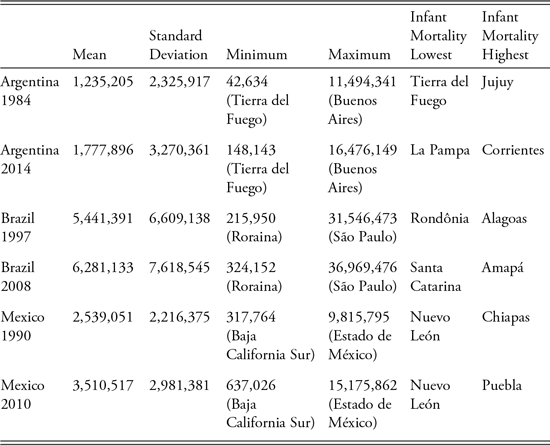
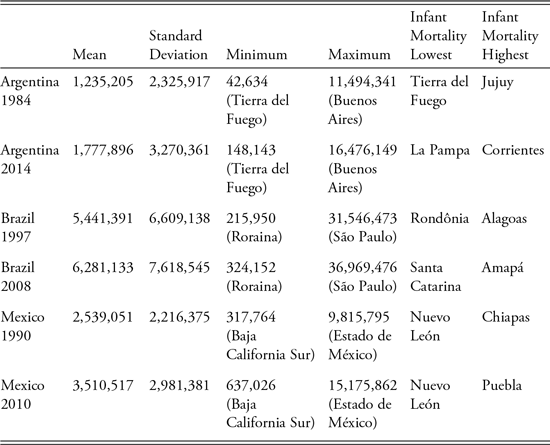
A final critique of infant mortality is that it is sensitive to differences in population size. In provinces or states that have small populations, a small shift in the number of deaths could produce a seemingly large change in the infant mortality rate. Conversely, in large provinces or states, sudden shifts in the infant mortality rate are less likely to occur because minor changes in the number of deaths are spread across a large number of births. To probe for potential problems related to this drawback, we analyzed the mean, standard deviation, minimum, and maximum population size for each state or province in our analysis. These values can be found in the appendix, table 2.
Brazilian states are, on average, much larger than Argentine or Mexican provinces and states, but the standard deviation changed relatively little across time in each country. This suggests that our cross-temporal analysis of trajectories should not be unduly influenced by sudden shifts in the distribution of the population.
Territorial Inequality in Infant Mortality, 1984–2013
Moreover, the population outlier states in each country and the infant mortality outlier states do not overlap with one another, with only one exception (Tierra del Fuego, Argentina in 1984), suggesting that cross-temporal change probably was not caused by population anomalies.
Alternative proxies for health service quality, namely vaccination rates, maternal mortality, or births attended by skilled health professionals, are not available across all subnational units for multiple points in time in our sample of countries. Moreover, as noted by Spangler (Reference Sugiyama2012), these indicators are also imperfect. For all these reasons, we opt for infant mortality, which is measured as the number of deaths among children below one year of age per one thousand live births. In highquality health systems, infant mortality tends to be low. Moreover, existing research on territorial healthcare inequality in Latin America focuses on infant mortality (Otero-Bahamón Reference Otero-Bahamón2016, 2019; Touchton and Wampler Reference Touchton, Natasha and Wampler2014; Osterkatz Reference Osterkatz2011; Gibson Reference Gibson2017). Our decision to use the indicator, therefore, allows us to build on this existing work by adopting a common standard for evaluating territorial health inequality.
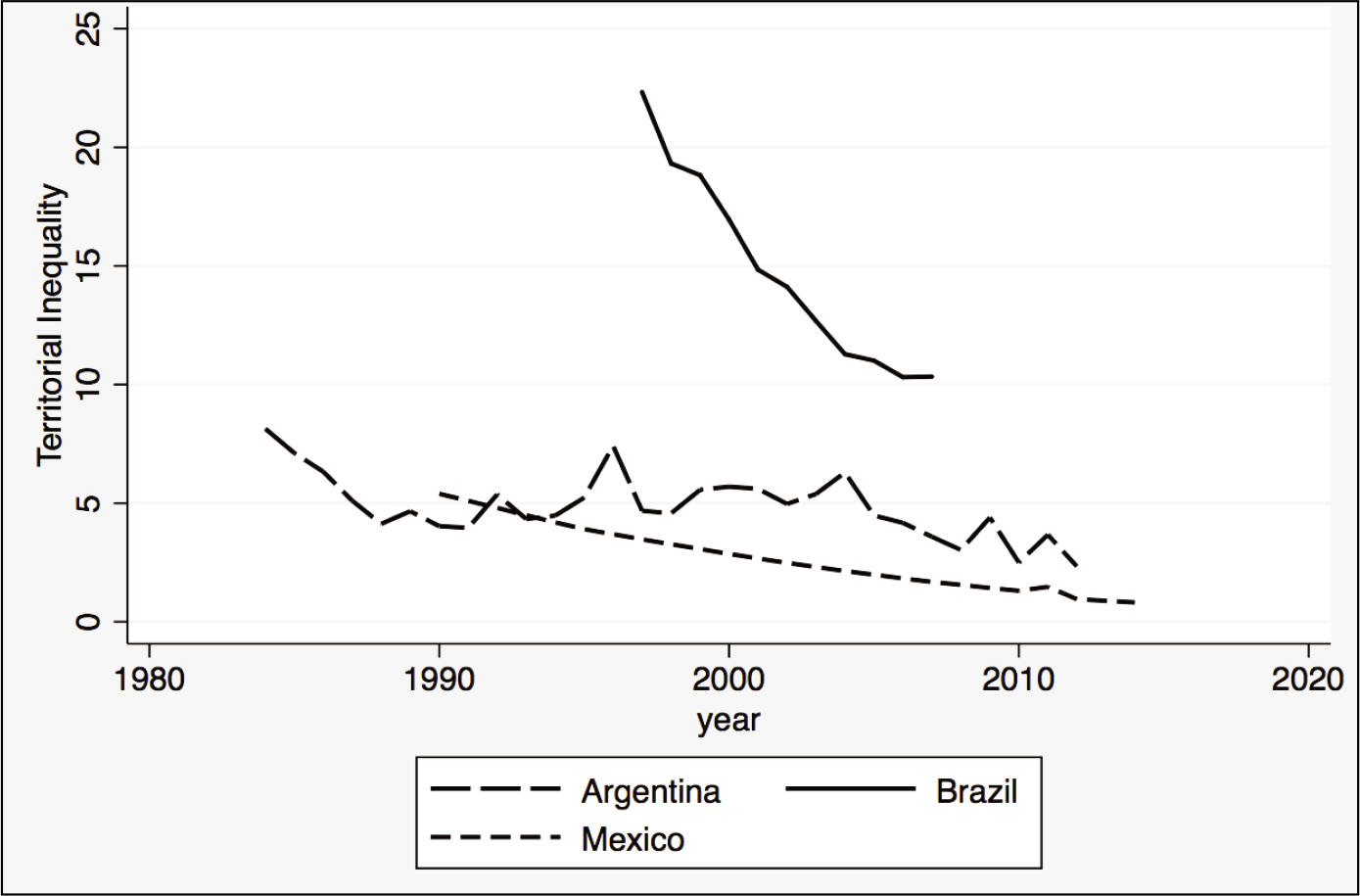
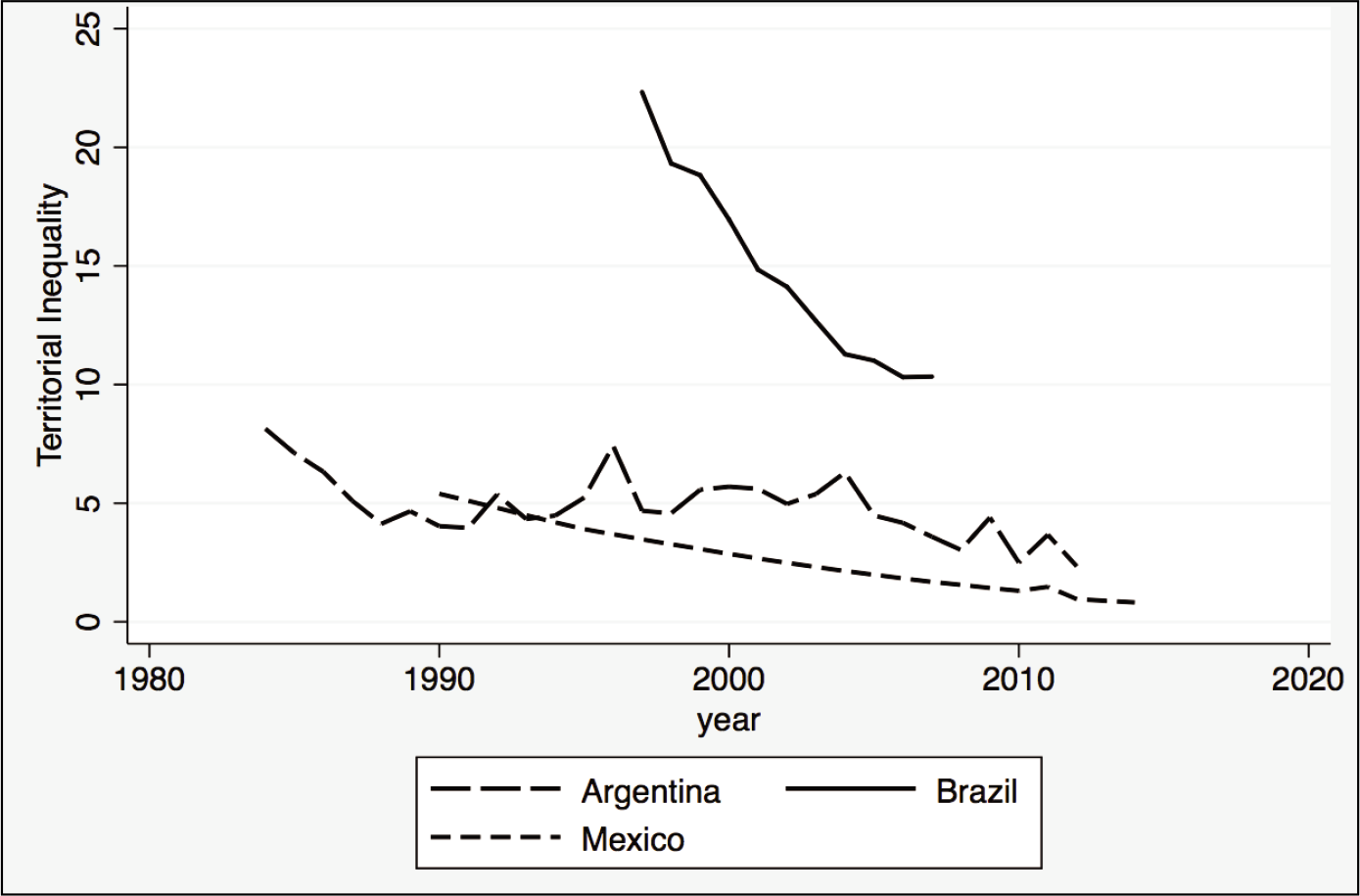
Figure 2 presents Otero-Bahamón’s measure of territorial inequality adapted to Argentina, Brazil, and Mexico for 1984–2013.Footnote 11 The data are taken from national sources (Secretaría de Salud 2015b; CONAPO 2017; Niedzwiecki Reference Niedzwiecki2018a; McGuire 2017), but unfortunately the coverage for Brazil is more limited than that for Argentina and Mexico.Footnote 12 The figure reveals that Argentina witnessed a notable decline in the early years of the series, followed by very little change in the late 1980s and 1990s. The country then witnessed a moderate decline in the 2000s. Meanwhile, Brazil and Mexico saw a steadier decline over time. The fall in inequality was most notable in Brazil, however, where it declined from 22.3 in 1997 to 10.3 in 2007. Mexico lies somewhere in the middle of these two countries.
Decentralizing Coalitions, Coordinating Mechanisms, and Territorial Inequality
We argue that Argentina’s, Brazil’s, and Mexico’s trajectories of territorial inequality result from the character of the decentralizing coalition and the presence (or lack) of coordinating mechanisms and oversight. In Argentina and Mexico, decentralization was pursued by a nationally led coalition in a top-down manner. The national technocrats who pushed for decentralization pursued it in order to cut costs and increase efficiency. In Brazil, by contrast, demands for healthcare decentralization emerged from a subnational coalition of nonstate actors and happened in a more participatory, bottom-up manner. This laid the groundwork for decentralization to produce health policy innovation and diffusion (Sugiyama Reference Touchton and Wampler2012), which improved capacity and reduced territorial inequality. It also spurred effective local-level state building (Gibson Reference Gibson2017), which improved service delivery and narrowed gaps.
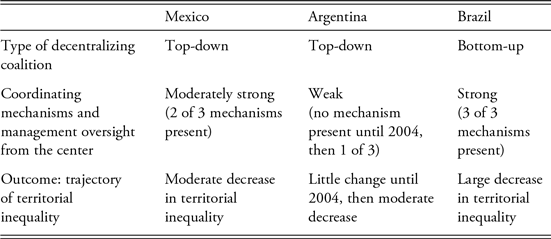
Brazil’s health reform created coordinating mechanisms for oversight and management, including the creation of minimum standards and financing tied to outcomes. In Mexico, similar mechanisms were introduced in the late 1990s and early 2000s. Yet these mechanisms, in the presence of a top-down decentralizing coalition, were only enough to moderately reduce territorial inequality. In Argentina, only weak mechanisms exist, and they did not take effect until 2007. This, coupled with a top-down decentralization coalition, produced a moderate decrease in territorial healthcare inequality in the early 2000s.Footnote 13Table 1 presents a summary of these variables and each country’s score. In what follows, we rely on secondary literature to flesh out how these variables operated in each individual country.
Variables of Interest and Hypothesized Outcomes

Brazil
Brazil’s Sistema Único de Saúde (SUS) includes a public and private tier. The public system is financed through general revenue and it is decentralized. This decentralization began in the 1980s, coinciding with Brazil’s return to democracy. The push for decentralization was connected to a strong social movement, the Movimento Sanitarista, which sought to guarantee access to healthcare as a social right for all Brazilians. This bottom-up push for decentralization was led by progressive doctors and left-leaning academics, who were active at the subnational level throughout the country.
The Sanitaristas advocated for universal rights to health, prioritization of preventive care, and decentralization (Avila Urdaneta Reference Urdaneta2010, 533–34; Osterkatz Reference Osterkatz2011; Sugiyama Reference Touchton and Wampler2012, 117; Falleti Reference Falleti2010, 153; Velázquez Leyer and Ferrero 2016; Niedzwiecki and Anria Reference Niedzwiecki and Anria2019). In an analysis of decentralization in Argentina, Brazil, Colombia, and Mexico, Falleti (Reference Falleti2010) notes that Brazil is the only case in which a subnational coalition, led by the Sanitaristas, demanded decentralization. Gibson (2019) also highlights the “movement-based” nature of Brazilian healthcare development. The Sanitaristas were active inside municipal and state health offices, as well as outside the state. Although the movement was rooted at the subnational level, it was present in multiple states and regions throughout the Brazilian territory. Sugiyama (Reference Touchton and Wampler2012, 145) notes that this gave the movement a sense of distinct subnational realities, which helped it make effective recommendations about the design of primary care and diffuse the agreed-on model across the territory.
Importantly, the Sanitarista movement was chiefly concerned with improving health equity (Velázquez Leyer and Ferrero 2016; Osterkatz Reference Osterkatz2011; Niedzwiecki and Anria Reference Niedzwiecki and Anria2019; Gibson 2019), which meant that from the very beginning, actors involved in the design and implementation of Brazil’s decentralized health system were focused on the challenge of homogenizing the quality of public care across the national territory. The result was the creation of a system with universal aims. Although underfunded initially, the SUS established a federal responsibility to fund the universal health system through transfers to the states and municipalities. This structure was facilitated by the bottom-up nature of the decentralizing coalition and the Sanitarista movement, which Niedzwiecki and Anria (Reference Niedzwiecki and Anria2019) find was crucial for pushing Brazil toward a universalistic health system.Footnote 14
The SUS was established in the 1988 Constitution, but it was not until the 1990s that enabling legislation more clearly established the roles and responsibilities of different levels of government (Osterkatz Reference Osterkatz2011). Despite this delay, Sugiyama (Reference Touchton and Wampler2012) shows that the creation of the SUS quickly spurred significant state and local experimentation with new preventive health policies, including a program called Estrategia Saúde Familia (ESF). This program, which was first implemented in several rural Northeastern municipalities through a place-sensitive approach, sought to improve preventive health through home visits and work with families, and by the mid-1990s, it was recognized as a model of effective primary care delivery. By 2011, 95 percent of all Brazilian municipalities had an ESF program in place (Sugiyama Reference Touchton and Wampler2012, 10). Niedzwiecki (Reference Niedzwiecki2018b) notes that ESF promotes policies such as immunization, nutritional controls, and prenatal care, which has helped to improve basic health indicators, including infant mortality.
The emergence of the ESF and its diffusion reveals how decentralization “from below,” led by a subnational coalition, can enhance territorial healthcare equality. The fact that Sanitaristas were well organized and dispersed across the entire territory helped to foster a local healthcare environment that fueled innovation and health policy improvement, thereby reducing territorial inequality in infant mortality.
Gibson (Reference Gibson2017) highlights another way that the bottom-up push for decentralization facilitated a reduction in Brazil’s territorial healthcare inequality: by encouraging local-level state building. Specifically, in the wake of decentralization, Sanitaristas lobbied to transform the municipal cabinet position of Municipal Health Department into SUS directorships. Movement leaders then went on to hold many of these directorships, using the office to build up primary health services, which led to lower rates of infant mortality and improved health service delivery (Gibson Reference Gibson2017). Sanitarista leaders inside the SUS directorships helped encourage politicians—parties and mayors—to support the goal of guaranteeing access to basic health services. This, too, improved health service delivery across municipalities in Brazil. In other words, the subnational coalition that initiated healthcare decentralization in Brazil was also able to improve local-level state institutions, thereby reducing health gaps across the territory.
In addition to the bottom-up coalition, Brazil’s national government put in place effective coordinating mechanisms and oversight management, which helped cement the proequity territorial trajectory. Brazil’s SUS gives states and municipalities relatively wide authority and responsibility with regard to healthcare financing and administration. While the importance of subnational funding probably limits reductions in territorial inequality, the federal government does maintain the power to set broad guidelines and parameters about health programs (Osterkatz Reference Osterkatz2011; Niedzwiecki Reference Niedzwiecki2018b; Rodrigues-Silveira 2019). These goals are enforced through earmarked federal transfers. This power was augmented in 2000 with the Fiscal Responsibility Law, which established that no more than 60 percent of net fiscal revenues can be spent on personnel (Niedzwieki 2018). Osterkatz (Reference Osterkatz2011) contends that this policy has constrained the autonomy of states and helped improve health equity.
The so-called baseline transfer further contributed to reducing territorial inequality. The transfer is made up of two elements: a fixed amount that is based on population size and a second transfer that can be adjusted to promote the ESF policies that guarantee basic health standards, as well as other programs (Niedzwiecki Reference Niedzwiecki2018b, 202). Through these earmarks, the center incentivizes all states and municipalities to meet minimum standards set by the national government with regard to care, which help even out territorial differences and reduce infant mortality (see Osterkatz Reference Osterkatz2011; Rodrigues-Silveira 2019, 284). In simple terms, Brazil exhibits two of the three mechanisms of management and oversight.
While the decline in Brazil is the largest of our cases, it is also the country with the highest level of territorial healthcare inequality. Indeed, the story of Brazil is one of progress in a setting of high inequality. Critics, therefore, may question whether the reduction in territorial inequality is important and if it constitutes a meaningful change in the lives of Brazilians. We contend that it does, though we recognize the detrimental effects of persistent gaps. As recent studies document, racial, gendered, and territorial inequality remains a problem in Brazil’s healthcare system (Caldwell Reference Caldwell2017; Wampler et al. 2019), but it is also true that the country cut its territorial health inequality in half. This is significant, and underscores what Gibson (2019, 1) describes as “nothing short of a historic transformation in its public health institutions and social development outcomes.” Thus, while Brazil has a long way to go to arrive at levels of inequality comparable to OECD peers, and while black Brazilians, women, and residents of the Northeast still face lower-quality care, the situation has improved notably since the transition to democracy, and it is important to understand how Brazil made these gains.Footnote 15
Mexico
The Mexican health system comprises three core providers: the public sector, the social security providers (IMSS, ISSSTE), and the private sector. In 1974, a hybrid provider, the IMSS-COPLAMAR, was created to serve citizens who lacked access to both the IMSS and public clinics and hospitals (generally residents of remote, rural areas). Under this plan, the federal government transferred funds to the IMSS to administer clinics and hospitals in rural communities. Between 1982 and 1989, the social security sector covered just about 50 percent of the population (Friedmann et al. Reference Friedmann, Lustig and Legovini1995, 361).Footnote 16 IMSS and ISSSTE are run and administered at the national level and are financed through payroll contributions. The private sector is also regulated at the national level, but it offers services to only a small minority of the population, approximately 2 percent to 3 percent in 2003 (Manatt Jones Global Strategies 2015, 2). The remaining portion of the population relies on Mexico’s public health services, which, as of the early 1980s, were administered by the Ministry of Health and Assistance (SSA) and financed mostly through federal spending.
In 1983, in the midst of the Mexican debt crisis, President Miguel de la Madrid (1982–88) undertook the country’s first significant step toward decentralizing healthcare. The effort was undertaken in response to the financial crisis, and several authors note that the central goal of decentralization was to rein in federal spending and boost efficiency (Homedes and Ugalde 2006; Birn Reference Birn2006; Olvera Santana Reference Santana2006). Decentralization of healthcare, therefore, was pursued in a top-down manner, as part of the structural adjustment reforms Mexico was being pushed to implement (Birn Reference Birn2006; Homedes and Ugalde 2006; Griffin Reference Charles1999).
To advance the reform, President de la Madrid approved a revision to Mexico’s general health law in 1983, and the following year, without any public consultation, decreed that primaryand secondary-level health services run by the SSA and the IMSS-COPLAMAR would be merged into one public, state-administered system.
The move, advanced by Mexico’s top-down coalition, created a two-stage process for decentralization. States would first be required to carry out a healthcare assessment and create a state health plan. In the second phase, states that had created a successful plan would sign decentralization agreements with the federal government. These agreements required that states increase their contribution to healthcare by between 20 percent and 40 percent of total health expenditures (Homedes and Ugalde 2006).Footnote 17
President de la Madrid sought to finalize decentralization by 1986, but as of 1987, only 14 of Mexico’s 32 states had signed agreements (Homedes and Ugalde 2006, 61). Even among those that did sign agreements, central oversight remained strong, and states were granted minimal financial autonomy. While these reforms were pushed from the top with little concern about territorial inequality, the existence of coordinating mechanisms of oversight helped minimize gaps between states. For one, the Health Ministry maintained control of the human resources budget and continued to earmark transfers. This helped ensure that in decentralized states, funds would be used to meet the central government’s health goals, helping to even out performance across the territory. By the end of the de la Madrid presidency in 1988, decentralized states controlled, on average, 23.4 percent of the health budget, only 3 percent more than states that had not signed decentralization agreements (Homedes and Ugalde 2006, 62).
Another coordinating mechanism that helped limit territorial health inequality was the central government’s power to define programmatic priorities for health spending (Cardozo Brum Reference Myriam1993). As a result, Mexico’s states were charged mostly with implementing the standards and programs set by the federal government, rather than defining their own standards (Homedes and Ugalde 2006, 63).
Mexico witnessed a new push for greater healthcare decentralization during the presidency of Ernesto Zedillo (1994–2000). Zedillo, like de la Madrid, pursued decentralization in a top-down manner, and the project was promoted only within the SSA (Homedes and Ugalde 2006, 70). Some observers saw the motivation for the decentralization as an attempt by Zedillo’s PRI government to appease the rival PAN and help secure support in the legislature for the president’s signature social policy program, PROGRESA.Footnote 18 Thus, the top-down coalition was focused not on territorial inequality but on other political goals.
Still, the Zedillo reform put in place new mechanisms for coordination and oversight, setting clear, nationally defined guidelines, which required states to create a package of 12 basic services that all state health secretariats had to offer free of charge to the uninsured (Homedes and Ugalde 2006, 71). These services included prenatal, delivery, and postpartum care, as well as nutrition and growth monitoring, all services that help address infant mortality. This oversight allowed the central state to hold subnational entities accountable for the provision of basic services, thereby minimizing territorial health inequality.
The Zedillo reform introduced new oversight mechanisms but also relaxed earmarks. The overall effect was that the central government maintained the ability to control much of the budget and define programmatic goals. The reform created state health boards, which were charged with administering public health services. The initiative also changed how healthcare was financed, with the federal government allocating funds directly to the states rather than routing them through the national Health Ministry. This was done through the Special Health Care Savings Fund (FASSA). FASSA funds continued to be earmarked for special purposes in 1998, but with time, state health boards were granted some autonomy to decide how to allocate the funds. Importantly, however, personnel decisions were left in the hands of the central government (Homedes and Ugalde 2006, 74). As a result, most Mexican states remained heavily reliant on national funds, and a large share of those funds was overseen by the central government, which helped to reduce territorial inequality.
States also enjoyed more leeway in programmatic terms following the reform, but the federal government established national standards that states were required to meet. An official in the Guanajuato state health secretariat noted that most funds were targeted to the goals established by the national government, thereby limiting the states’ power to develop alternative priorities (Arjonilla Alday Reference Alday2006, 213).
Under the Seguro Popular (SP) program, introduced by PAN President Vicente Fox (2000–2006), the Mexican central government instituted new oversight mechanisms through the expansion of healthcare guarantees for the country’s uninsured population. The reform was largely financed and overseen by the federal government, and some scholars argue that it has entailed a recentralization of health policy and administration (Homedes and Ugalde 2006). SP guarantees coverage of a package of services defined by the Health Ministry, and the central government covers the cost for all citizens in the bottom income quintile. At the time of its creation, SP covered 91 medical interventions. By 2008 that had grown to 266 services (Lakin Reference Lakin2010, 321) and in 2015 to 285 services (Secretaría de Salud 2015a). Many of these services are crucial for reducing infant mortality, including prenatal care, newborn and childhood preventive care, vaccinations, and other benefits. The program is financed by the federal government, state governments, and users, but states have resisted participating from the very beginning, and Lakin (Reference Lakin2010, 327) shows that contributions have fallen well below the amount required by law. SP introduced additional mechanisms of federal oversight, allowing national officials to alter the formula for distributing funds based on a state’s health performance (Lakin Reference Lakin2010, 322; Homedes and Ugalde 2006).
In summary, Mexico pursued decentralization more earnestly beginning in 1994, yet given the top-down nature of the decentralizing coalition and the moderate strength of the oversight mechanisms, reduction in territorial inequality was moderate. During the Fox administration, the state put in place a series of mechanisms that facilitated management oversight. As seen in figure 2, this helped continue the moderate reduction in Mexico’s territorial healthcare inequality begun in the mid-1990s.
Argentina
Argentina’s healthcare system has three components: social insurance funds (obras sociales), private insurance, and a public system that is administered by provinces and large municipalities. According to Rubenstein et al. (Reference Rubenstein, María, Cejas and López2018), about 36 percent of the population are exclusive users of the public system and are not covered by the private or contributory systems.
Similar to that of Mexico, Argentina’s process of healthcare decentralization emerged in a setting of economic crisis and budget shortfalls at the national and provincial levels (Avila Urdaneta Reference Urdaneta2010). As part of the 1978 reform, the administration of most hospitals was transferred from the national to the provincial level, and self-managed hospitals were introduced (Lloyd-Sherlock Reference Lloyd-Sherlock, Kaufman and Joan2004, 108). This process was not participatory, nor were national officials particularly interested in health equity (Griffin Reference Charles1999, 78). Instead, Argentina’s decentralization was imposed from above by the military junta, which delegated administrative responsibilities to the provinces without increasing fiscal transfers (Falleti Reference Falleti2010).
A national coalition was also responsible for initiating the country’s second round of decentralizing reforms in the mid-1990s. This top-down approach to decentralization generated long-term consequences, as “the nationally led process … did not create a group of supporters who could benefit from expanding the transfer of responsibilities, resources, and authority to subnational governments” (Falleti Reference Falleti2010, 120). It also meant that subnational networks among governors and mayors were minimal, which limited the likelihood of the kind of coordination, learning, and local-level state building that happened in Brazil. The result was a decentralization model that did not lend itself to large reductions in territorial inequality.
Avila Urdaneta (Reference Urdaneta2010) classifies this second period of decentralization as significant, as it granted notable management autonomy to provinces. In a similar vein, Lloyd-Sherlock (Reference Lloyd-Sherlock, Kaufman and Joan2004, 97) describes the extent of Argentina’s healthcare decentralization by the 1990s as vast, noting, “the federal Ministry of Health has become an increasingly marginal figure in national health policy.” Indeed, provinces took on the bulk of health spending, and funding from the federal government was not entirely guaranteed. Argentine provinces did receive general federal transfers, but the funds were not earmarked for health, nor did they specify spending standards (Lloyd-Sherlock 2004, 109). Furthermore, there were no federally mandated quality standards.
Indeed, the Argentine healthcare decentralization of the 1980s and 1990s did not create mechanisms of oversight. Brieba (Reference Brieba2018) notes that as decentralization progressed, federal resources became marginal, and the provincial health systems functioned in a nearly autonomous manner, fragmenting the national system with regard to both territorial differences and organizational operation (Brieba Reference Brieba2018, 47). In the period 1980–84, Argentina’s federal government financed 14.8 percent of spending on medical attention, while provinces covered 75.2 percent and municipalities the remaining 10 percent. By 1994, however, federal funds accounted for only 12.7 percent of total health spending (Bisang and Cetrángolo Reference Bisang and Cetrángolo1997, 14). In 1999, less than one percent of inpatient facilities were administered by the national government (Griffin Reference Charles1999, 77). All of this points to the absence of mechanisms of oversight, which created a situation in which the center had very little power to even out performance and pressure provinces to prioritize high-quality health services.
In 2004, a new national-level policy aimed at improving basic health services was created in Argentina. The program, Plan Nacer, was first introduced in nine provinces and expanded to the rest of the country in 2007 (Niedzwiecki Reference Niedzwiecki2018b, 228). Plan Nacer targets uninsured individuals up to 64 years old and covers preventive medical procedures, such as immunizations, checkups, and reproductive health interventions. The program is financed through federal transfers, with 60 percent of the cost granted automatically and the remaining 40 percent conditional on agreed-on health targets (Niedzwiecki Reference Niedzwiecki2018b). The policy thus establishes a system of oversight that was previously nonexistent in Argentina.
Plan Nacer also established an audit system, administered by the Argentine Supreme Audit Institution and the World Bank, to ensure that subnational governments meet health goals and that the national government upholds its funding commitment (Niedzwiecki Reference Niedzwiecki2018b, 230). Thus, beginning in 2004, Argentina adopted its first mechanism of oversight. The shift coincided with a moderate decline in territorial inequality, as illustrated in figure 2. That much of the decline that was witnessed in Argentina during the 1990s and 2000s occurred after the oversight mechanism was adopted lends support to our argument that such rules are decisive in narrowing territorial healthcare inequality.
Conclusions
This article has shown that the type of decentralizing coalition that pushes decentralization forward (top-down versus bottom-up) and the existence or subsequent adoption of coordinating mechanisms of oversight management played a key role in generating a large reduction in territorial inequality in Brazil, a more moderate decrease in Mexico, and a low decrease in Argentina. In addition to these findings, the analysis presented in this article makes important contributions to several bodies of literature.
First, the analysis of territorial inequality and its link to decentralization fills an important gap in the literature on the effects of decentralization. Some previous analyses have focused on the positive and negative impacts of the process, arguing that decentralization leads to improved service delivery (Faguet Reference Faguet2013; Galiani et al. Reference Galiani, Gertler and Schargrodsky2008; Habibi et al. Reference Habibi, Huang, Miranda, Murillo, Ranis, Sarkar and Stewart2003; Pirious-Sall Reference Pirious-Sall1998; Eskeland and Filmer Reference Eskeland and Filmer2002), while others have pointed to inefficiencies in the delivery of public services (Rodrigues-Silveira 2011; Akin et al. Reference Akin, Hutchinson and Strumpf2007; Bardhan and Jookherjee 2006; Crook and Sverrisson 1999; Solnick Reference Solnick1996). However, the literature has paid much less attention to the effects of decentralization on territorial inequalities of service provision.Footnote 19
This article has shown that territorial inequalities in healthcare are linked to the process of decentralization. Concretely, it has demonstrated that the character of the decentralizing coalition is consequential for shaping patterns of territorial inequality. The analysis also has revealed a related and important point: it is not the level of decentralization that shapes territorial inequality but the type of decentralizing coalition that pushes it forward, an idea suggested by Falleti (Reference Falleti2010). Furthermore, although the article does not study the decentralization process itself but the coalitions, the findings reveal that in the domain of healthcare, decentralization is, in and of itself, neither good nor bad for territorial inequality. Instead, it is the way that decentralization is pursued and whether there are coordinating mechanisms and oversight management that set countries on different trajectories of territorial inequality.
Second, this study has shown that even in decentralized polities, the role played by the central government in introducing coordinating oversight mechanisms is important for improving healthcare delivery and reducing territorial inequalities. This is a finding that the nascent scholarship on territorial inequalities has also stressed. Otero-Bahamón (Reference Otero-Bahamón2016, 2019), for instance, documents extensively the equalizing effect that national technocrats pose to the delivery of healthcare and education across subnational units in Colombia and Peru. While theorized differently, this study also underscores the importance of the central state in narrowing territorial inequalities. It finds that coordinating mechanisms and oversight management, rather than technocrats’ commitment to reducing gaps within territorial units, lead to a more equal provision of public goods within countries.
The importance of both the central state and subnational actors and institutions in reducing territorial health inequality points to the importance of adopting a multilevel approach for the study of healthcare inequality (Giraudy et al. 2019). Such an approach focuses on interactions between national and subnational factors to help understand change in territorial inequality. In this case, the interaction of national-level variables, such as coordinating mechanisms and oversight management, in conjunction with variables that have a subnational dimension, such as the type of decentralizing coalition, seem to account better for the increase or decrease in territorial health inequality than theories that focus solely on subnational factors (Collins et al. Reference Collins, Araujo and Jarbas2000).
A final contribution of this article relates to the literature on welfare state universalism. Universal welfare states guarantee access to high-quality education and health services, as well as generous income support as a right of citizenship. A growing body of research on Latin American social policy has focused on conceptualizing, measuring, and explaining variation in progress toward universalism in the region (Huber and Stephens 2012; Martínez Franzoni and Sánchez Ancochea 2016; Filgueira et al. Reference Filgueira, Papadópulos and Tobar2006; Pribble Reference Pribble2013). These studies have shed light on the question of why some countries have progressed toward more universalistic welfare states while others have not. These studies, however, fail to incorporate a territorial dimension into their measure of universalism, and omit multilevel dynamics from their theorization.Footnote 20 As a result, we know little about the extent to which social rights vary across the territory inside Latin American countries.
This study’s findings suggest that in Argentina, Brazil, and Mexico, there has been progress toward increased territorial universalism in healthcare, but the rate of change has varied. Moreover, this study reveals that multilevel dynamics and the way healthcare decentralization was pursued has shaped progress toward territorial universalism. All of this points to the need for a more careful conceptualization and theorization of universalism. Additional research on other policy areas and countries is needed to understand how multilevel dynamics and territorial unevenness might have evolved in other domains, including education and social assistance. By including additional policy areas, future research could more fully explore the typology of states proposed by Harbers and Steele (this issue).
This study has focused on Latin America’s three largest federations, but we expect that our argument should hold up in unitary states as well. Research on unitary states reveals that territorial healthcare inequality exists (Otero-Bahamón Reference Otero-Bahamón2016, 2019; Giraudy and Pribble Reference Giraudy and Pribble2019). To our knowledge, however, Otero-Bahamón (Reference Otero-Bahamón2016, 2019) is the only author who has analyzed why this inequality exists and why it is higher in some unitary states than in others. She finds that territorial health inequality decreased in Peru, and she notes that the growing power of technocrats and declining power of subnational elites helps to explain that reduction. Future studies might probe whether the character of Peru’s decentralizing coalition and mechanisms of coordination and oversight also shed light on change across time. The same could be explored in other unitary cases as well. More generally, additional research is needed to understand why countries vary with respect to the scope of territorial inequality and how those gaps change across time.
Appendix
Population Outliers and Infant Mortality Outliers