Introduction
Food insecurity – defined as ‘the inability to acquire or consume an adequate quality or sufficient quantity of food in socially acceptable ways, or the uncertainty that one will be able to do so’ (Radimer et al., Reference Radimer1992, p. 39S) – has historically been a challenge confined primarily to the developing world. Yet the 2008 global financial crisis and subsequent expansion of emergency food provision across Europe (commonly in the form of foodbanks) have reignited questions about both food insecurity (Borch and Kjærnes, Reference Borch and Kjærnes2016) and material deprivation more broadly (Saltkjel and Malmberg-Heimonen, Reference Saltkjel and Malmberg-Heimonen2017). The existence of food insecurity across welfare regimes is a visible and immediate demonstration of extreme poverty and social exclusion in Europe. Set against the backdrop of the declining adequacy of social assistance in Europe (Nelson, Reference Nelson2013), it also suggests that social policies have failed to adequately protect citizens’ most fundamental needs. Despite the importance of food insecurity to people’s quality of life, key evidence gaps remain. To remedy these omissions, this study explored the demographic risk factors of food insecurity across Europe in 2007 and 2011, then examined the roles of social benefit receipt and value on food insecurity.
Despite widespread sociological interest in social stratification and the uneven distribution of material and social resources, social inequalities relating to food are an under-researched topic. Sociological research has instead explored the social, cultural, and expressive aspects of food and eating (Beardsworth and Keil, Reference Beardsworth and Keil1996; Burnett Clark and Ray, Reference Burnett Clark, Ray and Pilcher2012). Within predominantly neoliberal political regimes, food consumption is considered a matter of individual responsibility and private choice (Dowler and O’Connor, Reference Dowler and O’Connor2012), allowing food insecurity to be framed as an individual failing and thus remaining a peripheral policy issue (Dowler, Reference Dowler, Riches and Silvasti2014; Lambie-Mumford, Reference Lambie-Mumford, Irving, Fenger and Hudson2015). Discussions about the structural and economic influences on food and consumption patterns have therefore been largely overlooked within Sociology (although they have enjoyed greater recognition within public health and nutrition research (e.g. Dowler, Reference Dowler2001; Dowler et al., Reference Dowler2011)).
Consistent with Blumer’s (Reference Blumer1971) thesis that sociological inquiry reflects social concern, in recent years the global recession, social welfare retrenchment, rising food prices and accompanying rapid expansion of emergency food provision have highlighted the existence – and apparent growth – of European food insecurity. In this context, understandings of the structural and economic constraints that contribute to socially-graded consumption patterns have improved, accompanied by a rise in sociologically-informed research interest on food insecurity. Researchers have taken a range of approaches, including quantitative (Alvares and Amaral, Reference Alvares and Amaral2014; Katsikas et al., Reference Katsikas2014; Bocquier et al., Reference Bocquier2015; Garratt, Reference Garratt2016, Reference Garratt2017), mixed-methods (Nielsen et al., Reference Nielsen, Lund and Holm2015; Pfeiffer et al., Reference Pfeiffer, Ritter and Oestreicher2015; Garratt et al., Reference Garratt2016; Purdam et al., Reference Purdam, Garratt and Esmail2016) and qualitative research (van der Horst et al., Reference van der Horst, Pascucci and Bol2014; Garthwaite et al., Reference Garthwaite, Collins and Bambra2015; Garthwaite, Reference Garthwaite2016).
Importantly, recent research evidence has served to challenge the neoliberal assumption that food practices primarily reflect individual choice, not social policy (Kõre, Reference Kõre, Riches and Silvasti2014; Pérez de Armiño, Reference Pérez de Armiño, Riches and Silvasti2014; Silvasti and Karjalainen, Reference Silvasti, Karjalainen, Riches and Silvasti2014). Empirical studies reporting a protective role of social benefit spending on European food insecurity (Loopstra et al., Reference Loopstra2016; Davis and Baumberg Geiger, Reference Davis and Baumberg Geiger2017) further challenge this assumption, and demonstrate that access to food in developed countries is a political concern, worthy of policy attention (Riches, Reference Riches2011).
Alongside its health consequences (e.g. Kirkpatrick and Tarasuk, Reference Kirkpatrick and Tarasuk2008; Seligman et al., Reference Seligman, Laraia and Kushel2010; Power et al., Reference Power2017), food insecurity also relates to wider experiences of poverty and material deprivation (Nolan and Whelan, Reference Nolan and Whelan2010). Notably, the Europe 2020 strategy – which targets a 20 million reduction in the number of EU citizens living in poverty by 2020 – is measured in relation to both income poverty and material deprivation (European Commission, 2010). Such interest in material deprivation may reflect the advantages of such measures over traditional income-based poverty measures. Income provides an indirect assessment of living (Nolan and Whelan, Reference Nolan and Whelan2010), and income differences between countries can inhibit meaningful comparisons (Nelson, Reference Nelson2012). Instead, material deprivation measures directly capture living standards using scales that commonly include food insecurity alongside indicators including financial capabilities and ownership of consumer durables (Whelan and Maître, Reference Whelan and Maître2013). Given its prevalence across Europe, food insecurity therefore deserves research attention both in its own right, and as a sensitive measure of material deprivation.
The current study
Research from Canada and the US – where food insecurity is routinely monitored – identifies certain demographic groups as particularly vulnerable to food insecurity, yet the applicability of this evidence to Europe is unclear given differences in social policy contexts. Likewise, while recent European research suggests that higher-value social benefits protect against food insecurity (Loopstra et al., Reference Loopstra2016; Davis and Baumberg Geiger, Reference Davis and Baumberg Geiger2017), these ecological studies are unable to demonstrate how macro-level social policies relate to micro-level risks of food insecurity. The current study therefore explored individual risk factors alongside the roles of social benefit receipt and value on European food insecurity.
Predictably, food insecurity is concentrated among socially and economically disadvantaged groups (Gorton et al., Reference Gorton, Bullen and Mhurchu2010). Women, people with disabilities, one-person households, and households containing children also faced elevated risks (Gorton et al., Reference Gorton, Bullen and Mhurchu2010; Neter et al., Reference Neter2014; Nielsen et al., Reference Nielsen, Lund and Holm2015). However, the risk of food insecurity for different demographic groups across Europe remains unknown, undermining the development of policy interventions. The first research question is therefore:
RQ1. What are the economic and demographic risk factors of food insecurity in Europe?
In light of evidence linking generous social benefits with reduced risks of multidimensional material deprivation (Nelson, Reference Nelson2012; Saltkjel and Malmberg-Heimonen, Reference Saltkjel and Malmberg-Heimonen2017), a natural question is whether social benefits protect against food insecurity, a sensitive and tangible measure of material deprivation. By increasing households’ material resources, social benefits are expected to reduce the risk of food insecurity either by providing money to spend on food or by covering other costs, thereby freeing up money for food. Recent welfare reforms have reignited research interest in the role of social benefits, yet coverage, overall spending, and the value of different components vary widely between countries according to their welfare regime and demographic needs, making it difficult to clearly identify their role. Existing evidence is inconsistent: at the population level, a reduction in social benefit receipt was associated with an increase in food insecurity (Borjas, Reference Borjas2004), however, individual-level analyses in Canada reveal mixed evidence for any protective roles of social benefit receipt (Loopstra and Tarasuk, Reference Loopstra and Tarasuk2013; Olabiyi and McIntyre, Reference Olabiyi and McIntyre2014; Ionescu-Ittu et al., Reference Ionescu-Ittu, Glymour and Kaufman2015; Li et al., Reference Li, Dachner and Tarasuk2016). Associations between social benefit receipt and food insecurity therefore remain uncertain, leading to the second research question:
RQ2. Is social benefit receipt associated with lower risks of food insecurity?
Finally, it is worth examining whether higher-value social benefits are associated with a lower likelihood of food insecurity among recipients. It is intuitively plausible that higher-value social benefits that provide more substantial material resources offer greater protection against food insecurity. However, existing country-level ecological analyses of social benefit value (e.g. Loopstra et al., Reference Loopstra2016) provide at best an indirect assessment of the potentially protective role of social benefits on individual food insecurity because they do not directly examine the role of higher-value benefits on recipients. The combined roles of social benefit receipt and value have never been explored in combination despite their relevance to food insecurity and material deprivation more broadly. The third research question is therefore:
RQ3. Are more generous social benefits associated with lower risks of food insecurity among recipients?
Data and methods
Data and sample
The European Quality of Life Survey (EQLS) is a repeated cross-sectional survey of adults living in private households in 35 European countriesFootnote 1. According to the availability of sampling frames, countries drew either random probability samples or random route samples. The sample comprised one adult (18 + ) per sampled household. Adults who were physically or mentally unable, who had language difficulties, or had been resident in the country for less than six months were ineligible to participate. Where more than one eligible adult was present in the household, the respondent was selected randomly. No proxy interviews were undertaken.
Changes in food insecurity following the 2008 global financial crisis were examined using data from 2007 and 2011. It was not possible to include data from the EQLS 2016 because social protection data are not available for all countries in 2016. The EQLS was used in preference to the European Survey of Income and Living Conditions (which also contains food insecurity questions) as the EQLS uses better-standardised interviews, so data quality may be higher.
Outcome variable
Food insecurity was captured using the indicator ‘Can I just check whether your household can afford a meal with meat, chicken or fish every second day if you wanted it?’ Because protein cannot be stored in the body, regular protein consumption is essential to achieving a nutritionally adequate diet. Economising on food spending commonly entails cutting down on meat (Griffith et al., Reference Griffith, O’Connell and Smith2015). The item features widely in multidimensional material deprivation scales within a ‘basic lifestyle deprivation’ dimension (Nolan and Whelan, Reference Nolan and Whelan2010), including scales defined using consensual methods (Lansley and Mack, Reference Lansley and Mack2015), thus demonstrating construct and face validity. As food is a flexible part of household budgets, measures relating to food affordability provide a sensitive and tangible measure of extreme deprivation and unmet nutritional needs (Dowler, Reference Dowler2001). By focussing on affordability, the question does not directly measure consumption, so can be answered by vegetarians. The qualifier ‘if you wanted it’ also aims to minimise social desirability bias (McKay, Reference McKay2005).
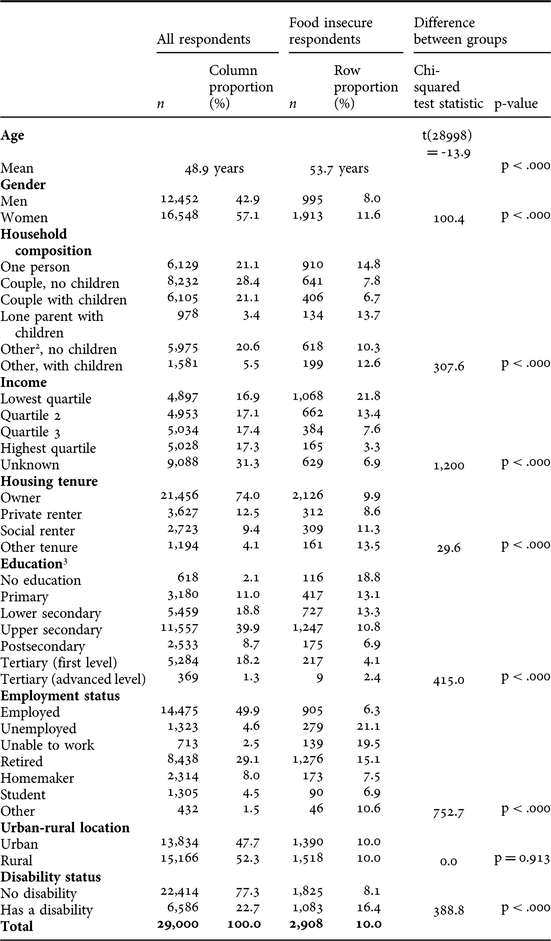
Food insecurity would ideally be assessed using the multidimensional instruments used in the US and Canada. These instruments are absent from European social surveys, and this limitation is reflected upon in the Discussion. Nonetheless, this single measure is associated with difficulties affording food (Davis and Baumberg Geiger, Reference Davis and Baumberg Geiger2017) and multidimensional food insecurity (Bocquier et al., Reference Bocquier2015), demonstrating its financial basis. The demographic patterns of food insecurity identified here in descriptive (Table 1) and multivariate statistics (Table 3) replicate those obtained using multidimensional instruments, further demonstrating its suitability.
Prevalence of food insecurity in relation to household characteristics in Europe, 20071

1 Equivalent figures for 2011 are available as supplementary analyses
2 ‘Other’ family types includes households containing multigenerational families, adult siblings, or unrelated adults living together.
3 Education is captured using the Harmonised International Standard Classification of Education categories.
Key predictor variables
The analyses covered both the receipt and value of social benefits paid to individuals and households. These measures were explored directly, as welfare state regime typologies such as those devised by Esping-Anderson and successors provide only an indirect measure of macro-level factors (Scruggs and Allan, Reference Scruggs and Allan2008). To explore social benefit receipt, respondents who stated that their household received (a) pensions, (b) child benefit, and (c) unemployment benefit, disability benefit or any other social benefitsFootnote 2 (hereafter ‘out-of-work benefits’) in the past 12 months were identified using indicator variables.
To explore social benefit value, country-level per capita spending on both total social benefits and the individual components were taken from Eurostat (2018a). Social benefits covered payments for people with disabilities, families and children, old age, housing, sickness and healthcare, social exclusion, and unemployment (see Supplementary Material for a summary). Social benefit values are presented as constant standard international Euros per capita adjusted for purchasing power parities, deflated to adjust for rising food costs and normalised between 0-1 to facilitate comparisons. Ideally, the Comparative Welfare Entitlements Dataset would have been used to enable a more detailed exploration of social benefits generosity; unfortunately, undercoverage (particularly in 2011) precluded this approachFootnote 3.
Age and age squaredFootnote 4, gender, household composition, equivalised within-country income quartile, housing tenure, employment status, education, urban-rural locality, and disability status were included as covariates. Each of these characteristics has been associated with food insecurity in previous research (Olson et al., Reference Olson2004; Gorton et al., Reference Gorton, Bullen and Mhurchu2010; Carter et al., Reference Carter, Dubois and Tremblay2014; Neter et al., Reference Neter2014; Nielsen et al., Reference Nielsen, Lund and Holm2015). These variables were included both for substantive reasons and to control for demographic differences between countries, thereby facilitating comparative analyses. Including a wide range of covariates also helps mitigate concerns over the possible impact of the dependent variable problem, where the concentration of social benefits among the most disadvantaged members of society could identify counterintuitive roles of social benefits (Vilar-Compte et al., Reference Vilar-Compte2015). Controlling for a wide range of relevant individual characteristics thus provides the strongest possible assessment of social benefit receipt and value among equivalent client groups. The national unemployment rate and GDP per capita were likewise included to account for underlying changes in macroeconomic circumstances over time.
Methods
Multilevel models were used to permit flexible modelling of food insecurity across Europe. Such models account for the clustering of individuals within countries (which violates the assumption of independence required for simple linear regression), and are commonly used when analysing international datasets. Multilevel models partition the variance in the outcome variable between models, thereby identifying the proportion of variance that exists between individuals (level 1) and countries (level 2). This consideration is important when examining the potential impact of social policies: if the proportion of country-level variation in food insecurity is small, the scope for social policies to make an impact is necessarily limited. Conversely, a large proportion of country-level variation would identify greater potential for social policies to reduce people’s risk of food insecurity.
Logistic multilevel (random intercept) models were estimated in which individuals (level 1) were nested within countries (level 2). Although the data relate to two time points, the EQLS is a repeated cross-sectional sample, not a panel sample, so it was not possible to cluster within both country and year. Instead, random effects of survey year were included at the country level, allowing changes in food insecurity prevalence over time to vary between countries. This specification is important to the time period under question, in which policy responses to the global financial crisis varied substantially between countries.
The use of multilevel models in European research has been subject to some debate, as the small number of countries can produce unreliable estimates of country effects, particularly for logistic models (Schmidt-Catran and Fairbrother, Reference Schmidt-Catran and Fairbrother2016). All models were therefore fitted using Markov Chain Monte Carlo estimation methods, which are more suitable in these circumstances (Bryan and Jenkins, Reference Bryan and Jenkins2016; Browne, Reference Browne2017). All models were specified to have a burn-in period of 1,000 iterations and a monitoring period of 50,000 iterations. Model fit was assessed using the Deviance Information Criterion, which accounts for model complexity. All analyses were undertaken using Stata 13, MLwiN, and runmlwin software (Rasbash et al., Reference Rasbash2009; Leckie and Charlton, Reference Leckie and Charlton2012; StataCorp, 2013).
Results
Descriptive statistics
The prevalence of food insecurity increased significantly from 9.4 per cent in 2007 to 12.2 per cent in 2011, and was substantially higher in Eastern Europe, Cyprus, and Greece (Figure 1). Overall, food insecurity rose in 23 countries and declined in only fourFootnote 5. These figures are broadly consistent with EU-SILC data from 2007 and 2011, and with UN figures from 2014 (FAO 2016).
Prevalence of food insecurity in Europe, 2007 and 2011.

The sample characteristics and their bivariate associations with food insecurity status replicated the demographic groups previously identified as vulnerable to food insecurity (Table 1). Food insecurity was more prevalent among pension and out-of-work benefit recipients, but was not consistently associated with child benefit receipt (see Supplementary Material).
Multilevel models
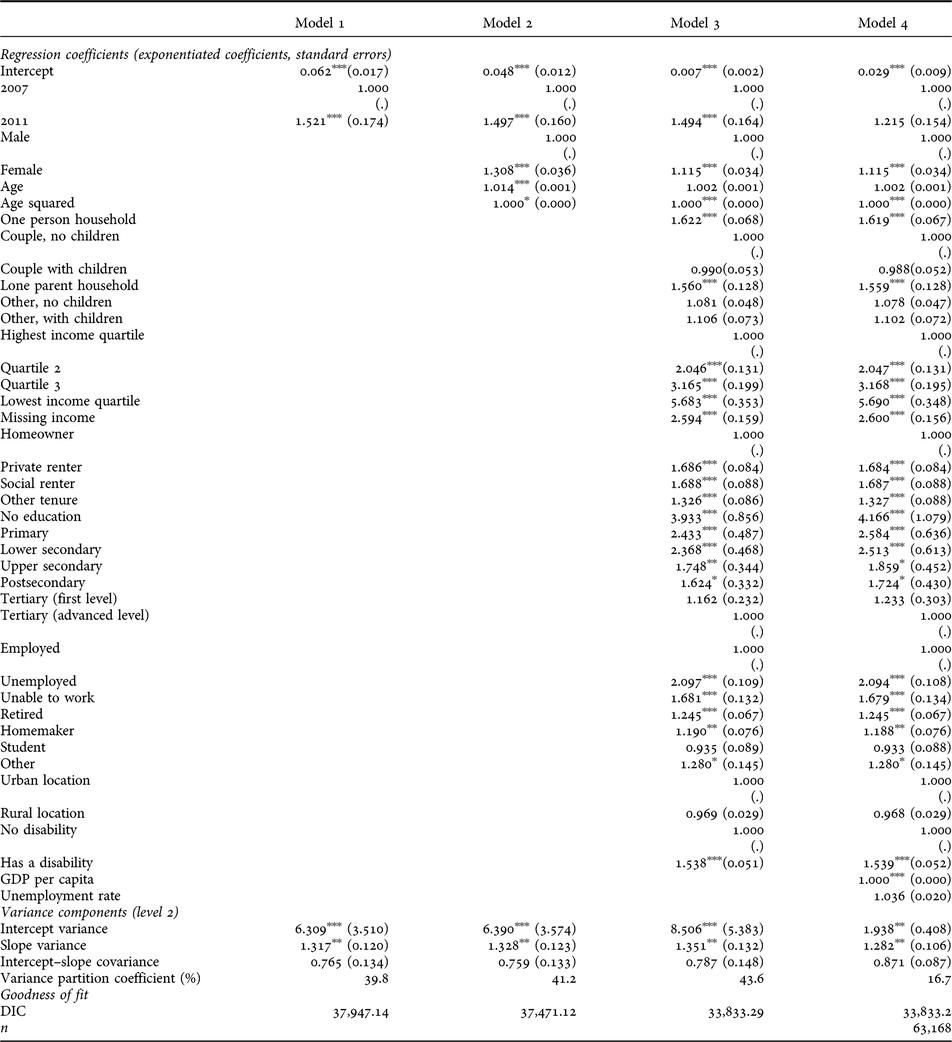
The first research question considered the individual economic and demographic risk factors of food insecurity in Europe. Table 2 displays these associations (Models 1-3) before adding the national unemployment rate and GDP per capita to add contextual controls (Model 4). In Models 1-3, food insecurity was significantly more prevalent in 2011 than 2007, in women, older people, those living in one-person and lone-parent households, lower-educated respondents, and those with disabilities. Predictably, economic factors were also important, with an increased risk of food insecurity at lower household incomes, those outside the labour market, and renters. These patterns were replicated after controlling for GDP and the unemployment rate (Model 4), demonstrating that the individual economic and demographic risk factors for food insecurity were robust to changing macroeconomic circumstances. Conversely, the year coefficient reduced in size and lost significance, suggesting that growing food insecurity between 2007 and 2011 reflected changing macroeconomic conditions. The significant coefficient for GDP indicates, predictably, that food insecurity was more prevalent in poorer countries. The unemployment rate was not associated with food insecurity.
Multilevel logistic regression models predicting food insecurity from individual economic and demographic characteristics

* p < .05, ** p < .01, *** p < .001. DIC = Deviance Information Criterion
† Level 1 variance is a function of the mean in logistic models so is not estimated
Looking at the variance components, the intercept variance demonstrated significant variation in food insecurity prevalence between countries, meaning that national social policies have considerable scope to reduce food insecurity. This result also confirms the suitability of multilevel models for exploring this research question. The slope variance was also significant, indicating increasing variation between countries in food insecurity prevalence over time, which may reflect differences in policy responses to the global financial crisis. The nonsignificant intercept-slope covariance indicates no association between countries’ baseline and changing prevalence of food insecurity over time. In other words, countries with a higher prevalence of food insecurity in 2007 did not see larger changes in food insecurity between 2007 and 2011.
The variance partition coefficient (VPC) captures the proportion of individual- and country-level variance. In Models 1-3, individual characteristics accounted for approximately 60 per cent of variation in food insecurity, rising to nearly 85 per cent after accounting for GDP and the unemployment rate (Model 4). These results demonstrate the relevance of macroeconomic factors, the importance of accounting for country-level characteristics, and of taking a multi-level approach more broadly.
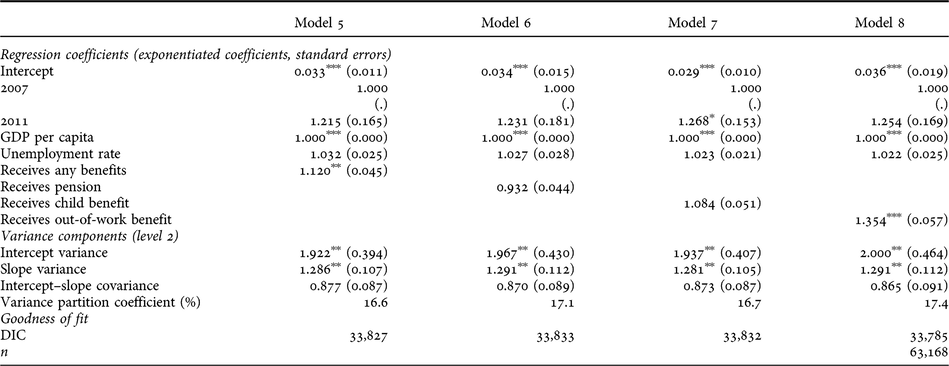
The second research question considered whether social benefit receipt is associated with food insecurity, after controlling for macroeconomic factors. Table 3 shows that people receiving any social benefits were 12 per cent more likely to report food insecurity, while people receiving out-of-work benefits were 35 per cent more likely to report food insecurity than non-recipients. Food insecurity was not associated with pension or child benefit receipt. The increased risk of food insecurity among all recipients therefore appears to be driven by out-of-work benefit receipt. The economic and demographic risk factors for food insecurity identified in Table 2 each remained significant and of similar size after accounting for social benefit receipt (see Supplementary Material), thus social benefit receipt did not counter the risk of food insecurity for certain groups.
Multilevel logistic regression models predicting food insecurity from social benefit receipt, adjusted for underlying economic conditions and individual economic and demographic characteristics

* p < .05, ** p < .01, *** p < .001. DIC = Deviance Information Criterion
†Level 1 variance is a function of the mean in logistic models so is not estimated
All models adjusted for age, age squared, sex, household composition, income, housing tenure, education, employment status, rural-urban location and disability status.
The variance components replicate the substantive patterns seen in Table 2, where food insecurity varied significantly between countries (intercept variance) and over time (slope variance), but there was no association between countries’ baseline and changing prevalence of food insecurity over time. Accounting for benefit receipt made very little difference to the intercept and slope variances, and to the VPC figure, suggesting that benefit receipt has limited relevance to the country-level prevalence of food insecurity.
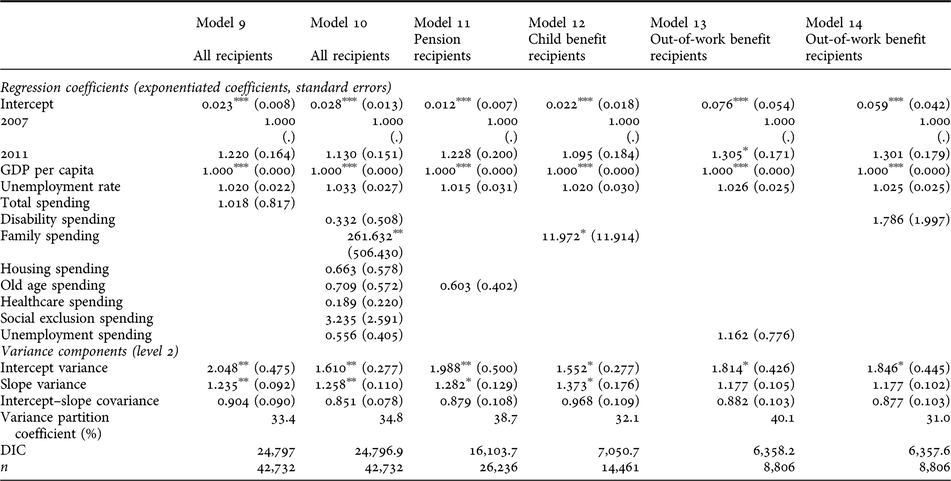
Finally, by examining the value of relevant social benefits among different recipient groups, the third research question considered whether more generous social benefits protect against food insecurity among recipients (Table 4). Among all recipients, food insecurity was not associated with total social benefit value (Model 9), nor the value of individual components (Model 10), although higher-value family spending was unexpectedly associated with a greater likelihood of food insecurity. Looking at the separate recipient groups, higher-value family spending was associated with greater food insecurity among child benefit recipients (Model 12). Old age spending was associated with nonsignificantly lower risks of food insecurity among pension recipients (Model 11), while higher spending on unemployment (Model 13) and disabilities (Model 14) was associated with nonsignificantly higher risks of food insecurity among out-of-work benefit recipients. Overall, these results did not reveal the anticipated association between higher-value social benefit spending and lower prevalence of food insecurity among benefit recipients.
Multilevel logistic regression models predicting food insecurity from the value of social benefits among recipients, adjusted for underlying economic conditions and individual economic and demographic characteristics

* p < .05, ** p < .01, *** p < .001. DIC = Deviance Information Criterion
†Level 1 variance is a function of the mean in logistic models so is not estimated
All models adjusted for age, age squared, sex, household composition, income, housing tenure, education, employment status, rural-urban location, and disability status.
The previously identified economic and demographic risk factors for food insecurity were broadly replicated in these models (see Supplementary Material). However, some differences were apparent when examining out-of-work benefits, where the greater prevalence of food insecurity among women, lone-parent families, and people with less education lost statistical significance after accounting for the value of out-of-work benefits, while an elevated risk of food insecurity emerged for students. The reasons for these changes among out-of-work benefit recipients only are not immediately clear, but suggest the existence of specific vulnerabilities among this client group that warrant further detailed investigation.
In each of the models included in Table 4, the country-level (intercept) variance denoted significant variation in food insecurity prevalence between countries, demonstrating that variation in social benefit generosity did not eliminate country-level differences in the prevalence of food insecurity across Europe. The slope variance was significant when examining receipt of pensions, child benefit, and all benefits, but not out-of-work benefits. Countries thus generally displayed increasing variation in food insecurity prevalence over time, which may reflect diversifying social policies over this period. Across all models, the nonsignificant intercept-slope covariance again suggests no association between countries’ baseline and changing prevalence of food insecurity over time.
The VPC values identify between 60 and 70 per cent of variance in food insecurity between benefit recipients as reflecting individual factors. As social benefit values are operationalised at the country level, this finding suggests either that variation in social benefit generosity has only limited relevance to the prevalence of food insecurity, or that individual differences between recipients (which may reflect eligibility rules and benefit coverage) are more relevant to food insecurity.
Discussion
Food insecurity is symptomatic of extreme material deprivation and social exclusion, and captures the uneven distribution of material and social resources across European populations. The question of food insecurity has recently received increasing research attention across Europe, yet the groups most at risk and the role of social protection receipt and value are unknown. Using data from 27 countries, this study first explored the demographic risk factors of food insecurity in Europe in 2007 and 2011, then examined the roles of social benefit receipt and value on food insecurity.
Key findings and implications
The first research question examined the economic and demographic risk factors of food insecurity in Europe. Food insecurity was more prevalent among economically disadvantaged groups (whether measured by income, housing tenure, education, or employment status), women, older people, one-person households, lone-parent households, and people with disabilities. These associations all remained after accounting for underlying macroeconomic circumstances. These patterns replicate those identified in the US and Canada alongside emerging European evidence (Alvares and Amaral, Reference Alvares and Amaral2014; Bocquier et al., Reference Bocquier2015), and suggest that despite considerable economic and social differences between settings, the large body of US and Canadian research evidence on food insecurity has relevance to Europe.
The second research question considered whether social benefit receipt is associated with lower risks of food insecurity. Equivocal associations between social benefit receipt and food insecurity were identified. Perhaps unexpectedly, food insecurity was significantly more prevalent among out-of-work benefit recipients and all social benefit recipients, but was not associated with pension or child benefit receipt. The immediate interpretation is that the value of social benefits are insufficient to protect recipients from food insecurity. This finding may alternatively reflect differential benefit coverage, where pensions and child benefit are commonly universally received by relevant groups. Conversely, out-of-work benefits are typically targeted, such that recipients may be particularly disadvantaged (Vilar-Compte et al., Reference Vilar-Compte2015). Likewise, those not receiving social benefits may be especially disadvantaged if their status reflects delays in receiving payments or welfare conditionality, experiences that are associated both with food insecurity severity (Prayogo et al., Reference Prayogo2017) and foodbank use (Loopstra et al., Reference Loopstra2018).
The third research question asked whether higher-value social benefits are associated with lower risks of food insecurity among recipients. Higher-value social benefits were unexpectedly not associated with lower risks of food insecurity among all recipients, and higher-value spending on relevant components was not associated with lower risks of food insecurity for the different recipient groups. The underlying reasons are not immediately clear, especially in light of recent European research reporting protective roles of higher-value social benefits on food insecurity
(Loopstra et al., Reference Loopstra2016; Reeves et al., Reference Reeves, Loopstra and Stuckler2017). This discrepancy may instead reflect differences in methodological approaches, where past research has comprised country-level ecological analyses that did not control for individual characteristics, meaning that higher-value social benefits may confer lower risks of food insecurity through mechanisms other than by directly increasing the material resources available to benefit recipients. In contrast, the use of multilevel models in the current study enabled a more direct and tightly-controlled assessment of the association between social benefit value and food insecurity among recipients.
The limited role for social benefits (both their receipt and value) in protecting against food insecurity has two potential interpretations. First, the value of social benefits available in Europe during this period was too low for respondents to afford a nutritionally adequate diet, and, second, that social benefits are unable to fully mitigate the individual risk factors for food insecurity, regardless of their value. Attesting to the first possibility, the elevated risk of food insecurity for unemployed people – after accounting for social benefit receipt and value – suggests that out-of-work benefits do not fully compensate for loss of wages. Indeed, Loopstra et al. (Reference Loopstra2016) reported that when social benefits were below $10,000 per capita, rising unemployment and falling wages led to increased food insecurity in Europe. In this scenario, benefits such as food stamps (which are widespread in the US and Canada) may be valuable in providing more targeted support for food provisioning. Alternatively, individual and structural risk factors could outweigh any protective role of higher-value social benefits if food insecurity is determined by wider factors than material resources alone. US evidence linking food insecurity with adverse life experiences and trauma demonstrates that material resources alone may be insufficient to protect vulnerable groups from food insecurity (Chilton et al., Reference Chilton2015). Instead, wider-ranging social policies across domains including education, employment and mental health may be needed.
Income and food insecurity
Replicating past research, the strongest correlate of food insecurity was household income quartile, and this association held for 22 of 27 countriesFootnote 6. The income variable was calculated within each country, so represents a relative measure of low income. The relevance of relative low incomes to food insecurity across countries with different absolute income levels demonstrates that food insecurity is not a simple consequence of incomes below subsistence level or extreme poverty. Consistent with past evidence for imperfect associations between low incomes and both food insecurity (Rose, Reference Rose1999; Olabiyi and McIntyre, Reference Olabiyi and McIntyre2014) and material deprivation (Bradshaw and Finch, Reference Bradshaw and Finch2003), there was moderate correspondence between income and food insecurity: 23 per cent of the lowest income quartile reported food insecurity, while 37 per cent of food insecure respondents were in the lowest income quartile. This asymmetric correspondence is unsurprising: the inability to afford adequate food necessarily reflects constrained resources, while food insecurity is not inevitable for people with limited resources.
Several dynamics could account for the greater sensitivity of food insecurity than income. In light of the clear policy objective to reduce food insecurity through sufficient incomes, these dynamics are worth considering. Substantively, food is a more flexible part of household budgets than other spending commitments such as housing and transport (Dowler, Reference Dowler2001), thus the risk of food insecurity is not limited to the lowest-income groups. If made widely available, benefits such as food stamps that are specifically targeted to food provisioning could be valuable in reducing food insecurity for both the lowest-income groups and those further up the income spectrum.
Furthermore, the skills, knowledge, physical capacity and time investments entailed in food provisioning will influence the strength of relationships between income and food insecurity (Borch and Kjærnes, Reference Borch and Kjærnes2016; Beagan et al., Reference Beagan, Chapman and Power2018). Indeed, the elevated risk of food insecurity among lone-parent households and people with disabilities identified here and in previous research could reflect more constrained opportunities to protect food consumption among these groups (O’Connell et al., Reference O’Connell2018). Policies that widen the availability of affordable childcare and social care provision for people with disabilities could prove valuable in mitigating the greater risk of food insecurity in these groups.
The availability of wider supplementary resources may also be relevant: low-income households who are able to draw on informal support, sale or exchange of goods, savings, and illegal activity may be comparatively protected from food insecurity (Elam et al., Reference Elam, Ritchie, Hulasi, Bradshaw and Sainsbury2000). Furthermore, evidence that both food insecurity and material deprivation are more closely associated with persistent than current poverty (Whelan et al., Reference Whelan, Layte and Maitre2003; Iceland and Bauman, Reference Iceland and Bauman2007) demonstrates the importance of income dynamics that are not easily captured in survey data. When designing social benefits, accounting for the persistence of poverty and offering additional support for persistent poverty could be valuable in protecting against food insecurity.
Future research directions
The important but variable role of income on food insecurity across Europe means that future research exploring the role of supplementary resources would be valuable. Little is known about the availability and value of such resources, which are also likely to vary according to factors including family structure, housing wealth, and social norms around kinship support. For example, the low prevalence of food insecurity among ‘other’ family types suggests that multigenerational families might enjoy extended familial support through activities such as intra-familial sharing or in-kind support that protect against food insecurity. In some countries – particularly the former Soviet states – family obligations have historically taken precedence over state and voluntary welfare, but familial support is now diminishing (for a discussion on Estonia, see Kõre (Reference Kõre, Riches and Silvasti2014)), potentially strengthening the need for social policy reforms.
Additional risk factors for food insecurity also merit further attention. It was not possible to control for immigration or citizenship status and the sample excluded migrants with less than six months’ residence. These characteristics may however be influential in light of the influx of Middle Eastern and African refugees to Europe during the survey period. Likewise, it was not possible to account for the costs of childcare and social care for older people, thereby over-stating the disposable incomes of certain family types. The consistently elevated risk of food insecurity among lone-parent families and older people supports this possibility. Further characteristics worth exploring in future research include persistent poverty (Whelan et al., Reference Whelan, Layte and Maitre2003), and adverse life events and financial strain (Prayogo et al., Reference Prayogo2017).
At the macro level, further consideration is needed of welfare conditionality and its impact on the relationship between social benefit receipt and food insecurity. As noted, associations between social benefit receipt and food insecurity can be difficult to interpret as respondents not receiving social benefits may have been affected by conditionality rules in which social assistance receipt is contingent upon activities such as job search behaviour. Ecological evidence linking benefit sanctions to greater UK foodbank use (Loopstra et al., Reference Loopstra2018) suggests that conditionality increases the risk of food insecurity and could thus complicate the association between social benefit receipt and food insecurity explored here. In comparative analyses, greater conditionality is anticipated to weaken any associations between social benefit receipt and food insecurity. This possibility merits further dedicated research attention.
Strengths and limitations
The current study has two particular key strengths. First, it offers the first examination of the demographic risk factors for European food insecurity, while simultaneously identifying between-country variation in these risk factors. Such insights are valuable when designing policies aimed at reducing food insecurity among European populations. Using multi-level models made it possible to partition the variance in food insecurity between individual- and country-level determinants. A large proportion of country-level variation gives greater scope for social policies to reduce the risk of food insecurity, while a small proportion conversely identifies more limited potential for impactful social policies. After accounting for GDP and the unemployment rate, between 16 and 40 per cent of variation in food insecurity reflected country-level factors. The importance of country-level factors identified here demonstrates the potential for economic and policy-relevant factors to reduce food insecurity, including provision of in-kind support such as food vouchers; market factors such as the costs of housing, food, and other commodities; and social factors including social networks and family obligations.
Second, the study directly examined the associations between social benefits and food insecurity using data on both the value and receipt of this provision. Some previous research relies on indicators of welfare state regime, which do not directly explore social benefit spending (Davis and Baumberg Geiger, Reference Davis and Baumberg Geiger2017), while more detailed analyses appear to rest on the assumption that social benefits exert protective effects via benefit receipt, without testing this mechanism using individual-level data (Loopstra et al., Reference Loopstra2016). By considering the associations between food insecurity and the value and receipt of social benefits, the current study provides the first direct assessment of the combined micro- and macro-level roles of social benefits on food insecurity.
The study’s main limitation is the reliance upon a single measure of the affordability of meat or fish to assess food insecurity. Food insecurity would ideally be determined using the multidimensional instruments used in the US and Canada, which capture a wide range of food concerns and restrictions, and their duration. Such measures are absent from European datasets, and their inclusion in future surveys should receive serious consideration. Statistically, the measure used here is probably less sensitive to marginal food insecurity – such as compromises over food quality which precede more significant changes in purchasing (O’Connell et al., Reference O’Connell2018) – than multidimensional measures, so estimates may consequently under-state the scale of food insecurity. Nonetheless, economising on food typically includes reducing meat consumption (Griffith et al., Reference Griffith, O’Connell and Smith2015), and the current measure is included in material deprivation indicators in Europe (Carney and Maître, Reference Carney and Maître2012; Eurostat, 2018b). It is also correlated with multidimensional food insecurity (Bocquier et al., Reference Bocquier2015), and affordability (Davis and Baumberg Geiger, Reference Davis and Baumberg Geiger2017), demonstrating its financial basis. Furthermore, the correlates of food insecurity identified here replicate those obtained using detailed multidimensional indicators used by the UN, and to monitor food insecurity in the US and Canada. Such correspondence provides initial evidence that the current analyses did adequately identify people experiencing food insecurity, although further work comparing the correspondence between single and multidimensional measures would nonetheless be valuable.
Conclusions
This study provided the first empirical identification of the demographic groups most at risk of food insecurity in Europe in 2007 and 2011; these groups are broadly consistent with those identified in the US and Canada. It established an equivocal role of social benefit receipt: people receiving out-of-work benefits and any social benefits were significantly more likely to report food insecurity, which may reflect benefit conditionality. Furthermore, higher-value social benefits were not associated with lower risks of food insecurity across the different recipient groups. Social benefits therefore appeared unable to fully mitigate the individual risk factors for food insecurity, perhaps because their value is too low, or because wider individual and structural risk factors outweigh an otherwise protective role. The topic of food insecurity has received limited research attention in Sociology, yet it signals the existence of severe material deprivation, health inequalities, and social stratification across Europe.
Supplementary materials
To view supplementary material for this article, please visit https://doi.org/10.1017/S0047279419000746