Introduction
Alzheimer's disease (AD) is the most common form of dementia worldwide (60–70%), estimated to affect 65.7 million people by 2030 and as many as 115.4 million by 2050. The cost of dementia accounts for around 1% of the world's gross domestic product which represents 60% of the long-term social spending, expected to reach 85% by 2030 (Banerjee, Reference Banerjee2012).
Multiple efforts have been made to develop effective interventions for the treatment of dementia, and carry out investigation on the benefits of pharmacological (Birks, Reference Birks2006) non-pharmacological treatments (Cotelli et al., Reference Cotelli, Manenti, Zanetti and Miniussi2012) or both, that “may enhance cognitive function in people with mild AD and these interventions should therefore be routinely offered” (Prince et al., Reference Prince, Bryce and Ferri2011).
Cognitive stimulation (CS) therapy in early stages of the disease, when learning and the retention of useful information are retained, has proved to be equally or more effective than pharmacological treatments (Woods et al., Reference Woods, Aguirre, Spector and Orrell2012; Aguirre et al., Reference Aguirre2013) also useful as primary and secondary prevention. A recent review on the effectiveness of 15 CS programs on patients with mild and moderate dementias evidenced a slowing cognitive impairment and the benefits for global cognitive function (1.74 points/year mean impairment on the Mini-Mental State Examination (MMSE)), communication, social interaction, and quality of life (Woods et al., Reference Woods, Aguirre, Spector and Orrell2012). The benefit in quality of life may be mediated by cognitive improvement (Spector et al., Reference Spector, Orrell and Woods2010). The effects are maintained between one and three months post-intervention (Woods et al., Reference Woods, Aguirre, Spector and Orrell2012). Furthermore, CS therapy has proved to have a greater impact on cognitive functions such as language (auditory–verbal comprehension and verbal expression) (Spector et al., Reference Spector, Orrell and Woods2010; Hall et al., Reference Hall, Orrell, Stott and Spector2013), verbal and visual memory and orientation, than on other domains (Hall et al., Reference Hall, Orrell, Stott and Spector2013).
However, despite these evidences, the benefits of CS therapy are unequal, and factors influencing response have not been identified to date. Some studies suggest that individuals over 80 years of age and females (Aguirre et al., Reference Aguirre2013) with better insight and functional capacity or decrease in behavioral disturbances (Binetti et al., Reference Binetti2013) obtain better results from CS therapy. Nevertheless, to our knowledge, only one study was undertaken to identify which baseline variables may predict patients’ responsiveness to CS programs (Binetti et al., Reference Binetti2013). In this study, the authors investigated individual predictors of response to a comprehensive stimulation program in a cohort of patients with dementia and subjects with mild cognitive impairment (MCI), using a longitudinal study. They found that a high level of insight, preserved functional abilities, a lack of severe delusions, euphoria, and aberrant motors behaviors are predictors of responsiveness to stimulation programs. Furthermore, 46.9% of subjects were classified as clinical responders, based on the treatment response algorithm calculated from a combined score change (after 6 months compared to before treatment) on the MMSE, Alzheimer's Disease Assessment Scale-Cognition (ADAS-Cog) and Clinician's Interview-Based Impression of Change plus carer interview (CIBIC-plus) (Binetti et al., Reference Binetti2013).
The aim of this study is to identify patients with mild AD who are likely to exhibit a better response to CS therapy and identify the cognitive and functional measurements before and after treatment that may indicate a better response 12 months post-intervention. A second aim is to bring improvements to the only study that has, to our knowledge, been published to date, regarding the response of patients diagnosed of mild stage AD, to a similar one-year CS program, assessed with an extensive neuropsychological and functional battery. Knowledge of the influence of these two measurements on a better response to such interventions would allow establishing a neuropsychological profile to identify potentially better responders before and after CS therapy. This would allow developing more personalized strategies of interventions and optimizing their efficacy to improve the management of patients and future action plans.
Methods
Participants
From May 2004 to March 2012, all the patients attended a CS program at the Outpatients Clinics (OC) integrated in the network of Consorci Sanitari de Terrassa (CST) (Sant Jordi y Sant Llàtzer, Terrassa, Barcelona), where the study was carried out. The study was approved by the Clinical Research Ethics Committee of the CST in agreement with the Declaration of Helsinki – 1964 (2008 revision) and the Guidelines on Good Practice. The inclusion criteria were: (1) clinical diagnosis of probable AD according to the criteria of the National Institute of Neurological and Communicative Disorders and Stroke-AD and Related Disorders Association (NINCDS-ADRDA) (McKhann et al., Reference McKhann, Drachman, Folstein, Katzman, Price and Stadlan1984) in the mild stage of the disease according to the Global Deterioration Scale (GDS) (Reisberg et al., Reference Reisberg, Ferris, de Leon and Crook1982); (2) having received CS treatment in any of the OC during 12 months; or (3) having completed two neuropsychological and functional assessments (baseline and after CS therapy). Exclusion criteria included (1) illiteracy; (2) residence outside the catchment area; (3) severe language disorders or persisting sensory impairment that would impede active participation or limit neuropsychological assessment; or (4) medical antecedents of cerebrovascular accident, brain tumor, epilepsy, traumatic brain injury, or diagnosis of severe mental disorder according to the revised version of The Diagnostic and Statistical (DSM-IV-R) (American Psychiatric Association, 2000) or unstable systemic diseases. The criteria for withdrawal from the study were: failure to attend a minimum of 80% of CS sessions or voluntary withdrawal from OC. A retrospective observational design was used on 457 participants who received 12-month CS treatment with a one-year follow-up. The following data were collected at baseline and at the end of the intervention: sociodemographic data, medical antecedents, cognitive measurements, and global functioning. A total of 397 subjects were excluded from the study for not meeting the inclusion criteria. Finally, a total of 60 subjects were included (25 men and 35 women), with ages ranging from 58–92 years (mean 75, SD 6.35), who signed an informed consent form.
Assessments
Baseline (T0) and follow-up (T1) assessment of CS therapy was undertaken by clinical neuropsychologists and occupational therapists specialized in dementia. Both sessions included: (1) an interview to collect patients’ sociodemographic data, medical antecedents, and level of insight, which was performed by a clinical neuropsychologist; (2) a cognitive and functional evaluation, which was performed by a clinical neuropsychologist and an occupational therapist, respectively (90 minutes). The same criteria and methods of administration were used for all tests.
Assessment of sociodemographic variables and medical conditions
The following data were collected at T0 and T1 interviews: sociodemographic data (age, sex, and level of education), patients’ medical antecedents (cardiopathy and cardiovascular risk factors (arterial hypertension (AHT), dyslipidemia (DL), hyperglycemia (HG), obesity, and alcohol consumption (AC)), anxiety and/or depressive symptoms, and treatment with cholinesterase inhibitors (ChEIs). Furthermore, the clinical neuropsychologist assessed patients’ insight (yes, no, or partial insight) regarding their cognitive impairment and impact on daily functionality. Formal measures of insight were not employed as analysis of this variable was not included in the original study.
Cognitive measures
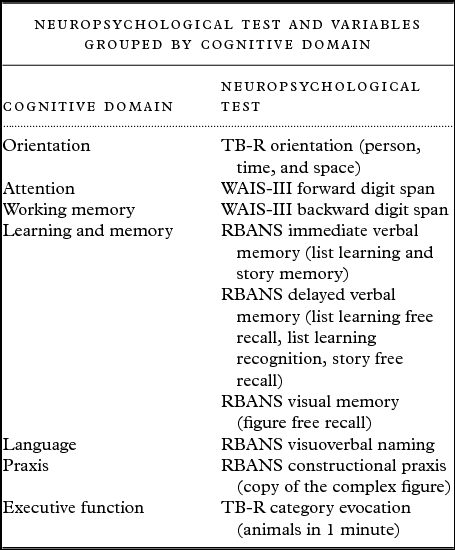
The cognitive assessment included the MMSE – a test of global cognitive functioning (Folstein et al., Reference Folstein, Folstein and McHugh1975), and a comprehensive neuropsychological battery to assess different cognitive functions: orientation, attention, working memory, learning and memory, language, praxis, and executive function (see Table 1 to review neuropsychological test used). The tests were administered in agreement with the procedure published in the corresponding manual. The scores obtained from each test were converted into T scores with a mean of 50 (SD 10). Scored neuropsychological tests were administered to at least 75% of patients at T0 and T1.
Neuropsychological test and variables grouped by cognitive domain

RBANS = Repeatable Battery for the Assessment of Neuropsychological Status Stimulus Booklet A (Randolph et al., Reference Randolph, Tierney, Mohr and Chase1998); TB-R = Review Barcelona Test (Peña-Casanova, Reference Peña-Casanova2005); WAIS-III = Wechsler Adult Intelligence Scale 3rd Edition (Wechsler, Reference Wechsler2001).
Functional measures
Functional assessment was done using the PGC-IADL scale (Lawton and Brody, Reference Lawton and Brody1969), to evaluate the instrumental activities of daily living (IADL) in eight domains from 0 and 1 point, ranging from 0 (total dependence) to 8 points (total independence) for women, and of 0–5 points for men to avoid gender bias. Likewise, the Barthel Index (BI) (Mahoney and Barthel, Reference Mahoney and Barthel1965) aimed to assess the capacity to perform ten basic activities of daily living (BADL) from 0, 5, 10, and 15 points, ranging from 0 points (totally dependent) to 100 points (totally independent).
Intervention
Treatment protocol of CS applied in the Day Hospital is based on the definition of Clare and Woods (Reference Clare and Woods2004) and the model of Bottino et al. (Reference Bottino2005) and follow the basic principles of non-pharmacological interventions with the final aim to improve the quality of life through the engagement in significant activities and tasks that have to be adapted to the needs and capacities of the patients. Our CS consists in a one-year program, in which patients are engaged in a range of activities and discussions in group aimed at general enhancement of cognitive and social functioning. Errorless learning and spaced retrieval techniques are used throughout all sessions; also a practical use in external memory aids and positive reinforcement The CS program is conducted by a therapist specialized in dementias, and it is written down to ensure that all therapists are homogeneous in the treatment and that all patients receive the same treatment. The program of activities is standardized and includes the structure of each session, the areas to stimulate (cognitive functions and occupational areas), the exercises and tasks to perform, and the goal to be attained by each patient. All tasks have written instructions for the therapist to standardize the administration.
A group CS program (10–12 patients per group) of two to three weekly sessions (mean 115 sessions/year) of CS and occupational therapy of two or three hours each.
It was delivered by an occupational therapist and supervised by a clinical neuropsychologist. In order to organize the sessions, activities were categorized by the main cognitive function that is relevant in the task and were applied in a rotated manner in order to avoid two similar tasks in a short interval of time. Activities always focus on the preserved cognitive functions, in order to enhance them through group interaction. In this intervention, the aim of the therapist was to guarantee a positive effort without judging the correctness of the responses.
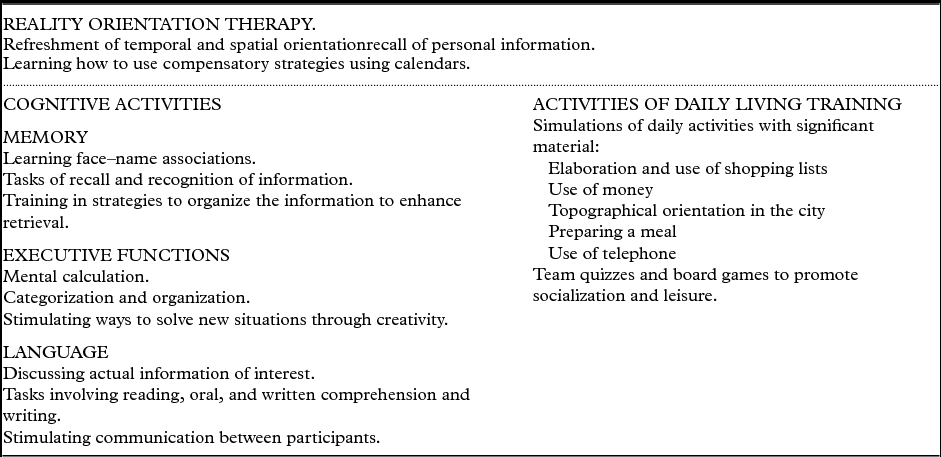
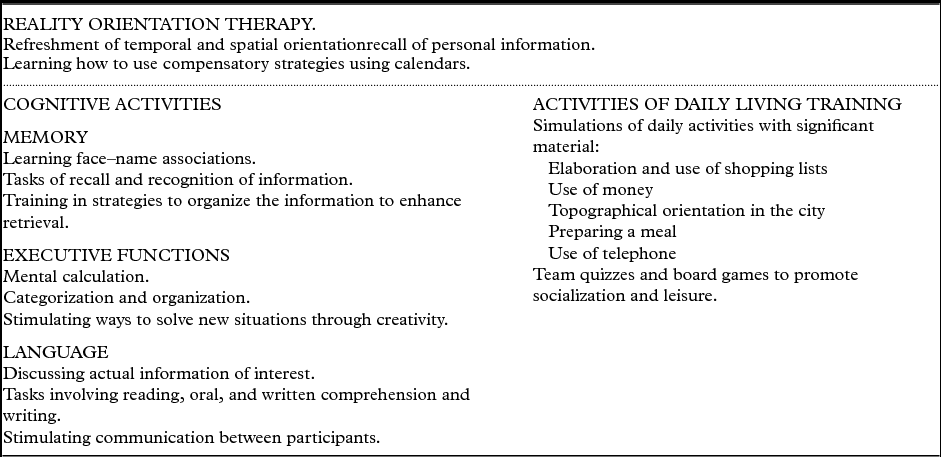
All sessions had the same structure, and included pen and paper tasks with guided practice to reality orientation therapy (10 minutes) and training attention and concentration, memory, language, calculation, gnosias, praxias, and executive function (50 minutes). The occupational therapist focused on personal independence, working on communication, activities of daily living/leisure, creative ability, and sensory-motricity (see Table 2 for a summary of the activities).
Summary of the activities in our cognitive stimulation protocol
Main measure of treatment outcome of CS
The annual rate of change scores on the MMSE was calculated by subtracting T0 MMSE score from T1 score. This allowed us to distinguish responders (R) to CS from non-responders (NR), following the criteria of other previous studies (Bottini et al., Reference Bottini2012; Woods et al., Reference Woods, Aguirre, Spector and Orrell2012; Binetti et al., Reference Binetti2013). No change or improvement on the annual rate of change (score ≥0 was considered a positive sign of response to treatment, and subjects were classified as R.
Statistical analysis
A descriptive analysis was conducted by calculating the frequency and percentage of each qualitative variable, and mean values and standard deviations were determined for quantitative variables. The Chi-Square (χ 2) test was used for comparisons of proportions between R and NR for qualitative variables, and the Student's t-test for quantitative variables between T0 and T1 in related and independent samples. Cohen's d was calculated for quantitative variables to determine effect size in difference between groups, with the following cut-off criteria: 1.10 to <1.45, very large effect; 0.75 to < .10, large effect; 0.40 to <0.75, medium effect; and 0.15 to <0.40, small effect (Cohen, Reference Cohen1988). Once all statistic parameters for neuropsychological variables were individually calculated, a matrix of correlations was computed (Pearson and Spearman) between all variables studied, using a stepwise linear regression model. Likewise, we studied the association and prediction of independent variables (relevant cognitive measures) and the outcome (annual rate of response) using stepwise linear regression model. Univariate analyses of covariance (ANCOVA) were used to examine the effects of the response of CS on different neuropsychological variables, global cognitive functioning, and functional status after controlling for cognitive variable predictors annual rate of response. A p value <0.05 was considered statistically significant throughout the analysis. Conditions of applications were verified for all statistical tests. The SPSS version 20.0 was used for statistical analysis (Statistical Package for the Social Sciences, Chicago, Illinois).
Results
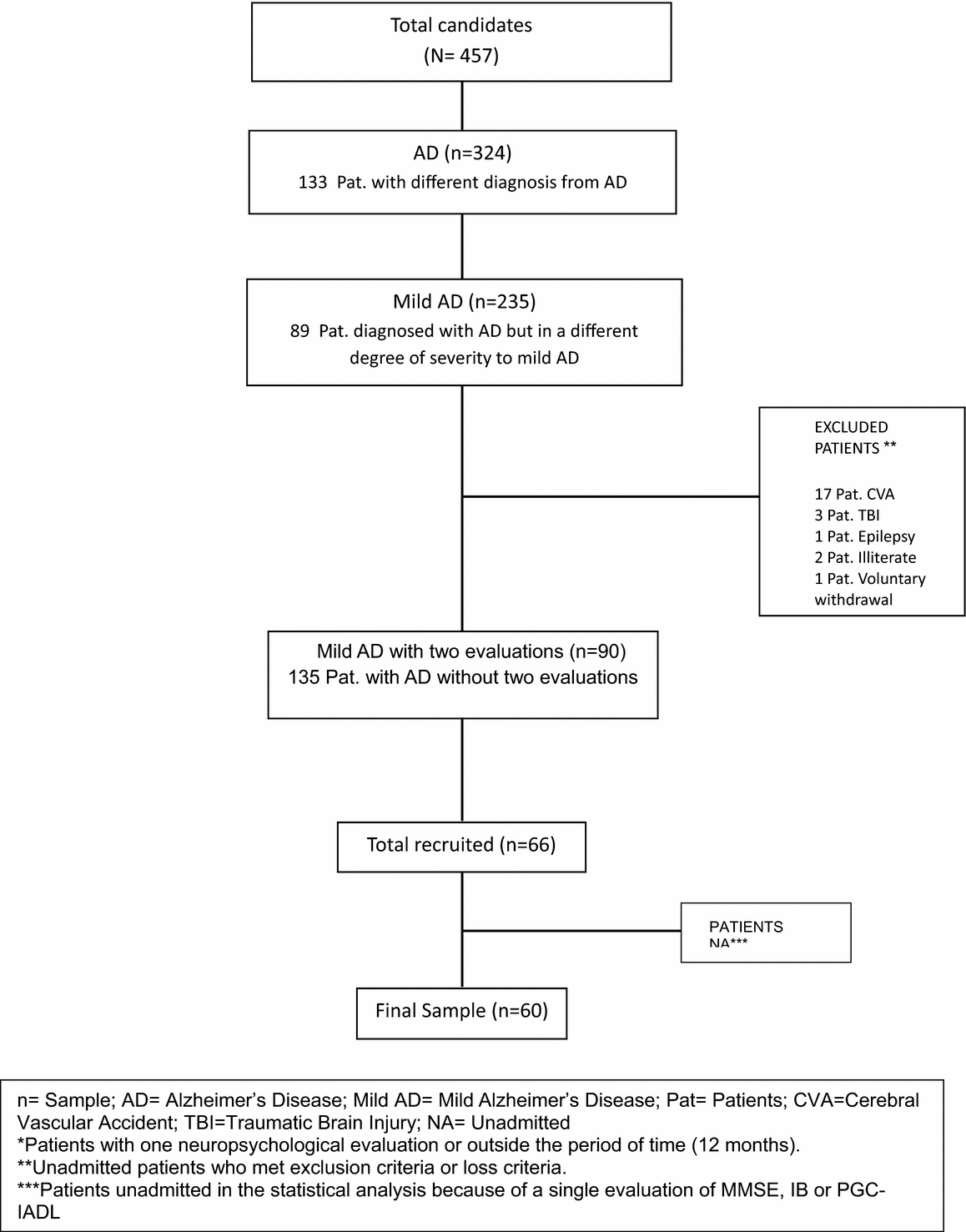
An initial sample of 457 subjects was obtained from the two OCs, 133 patients were excluded for presenting a diagnosis different from AD, 89 for being in a different phase from mild AD, and 135 for having a different neuropsychological assessment and not conforming to the established evaluation period. Furthermore, 24 patients were excluded for meeting one of the exclusion criteria or voluntarily withdrawing from the study. Initially, 66 subjects completed the CS program, but six had to be withdrawn from the statistical analysis for not having completed MMSE, BI, or PGC-IADL at T0 and/or T1. The final sample included 60 patients (Figure 1).
Sample recruitment and follow-up flow diagram.

Sociodemographic and medical characteristics of final sample and R and NR
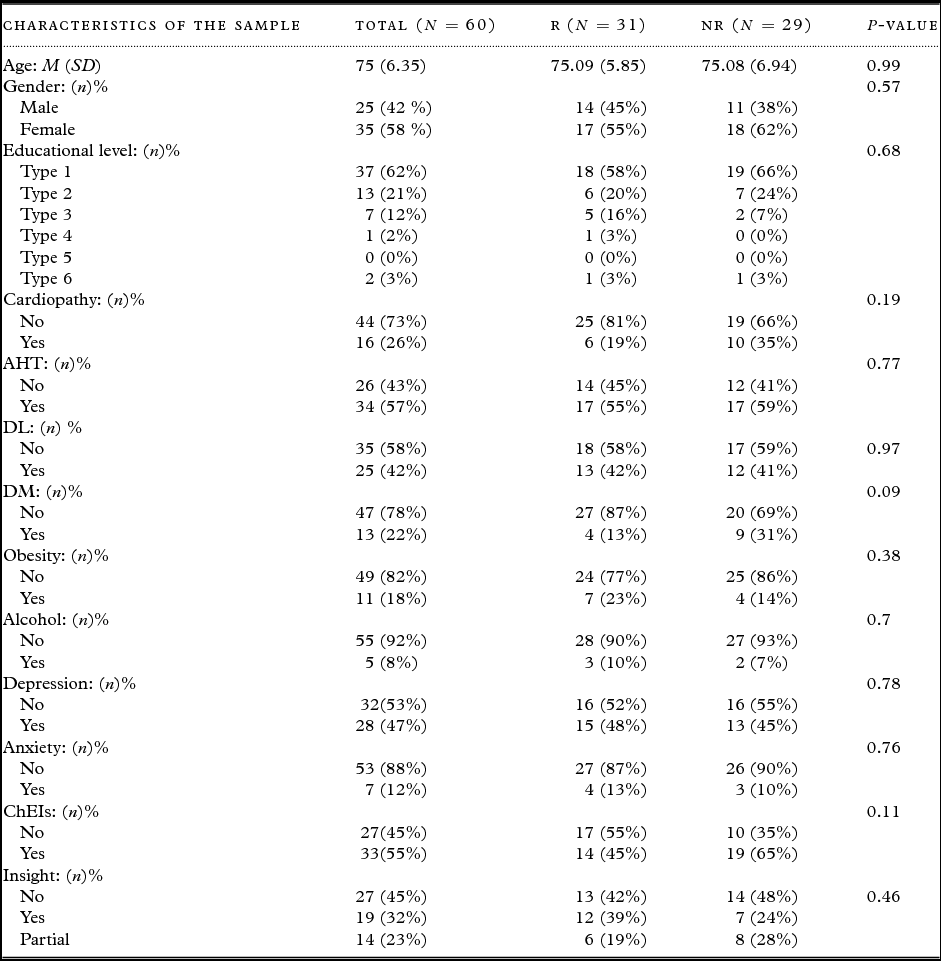
The sample (N=60), was composed of 25 (42%) men and 35 (58%) women, with a mean age of 75.1 years (6.35); 62% of subjects had incomplete primary studies. At baseline, 57% of patients had AHT, 42% DL, and 47% presented depressive symptoms; 55% were treated with ChEIs (Table 3).
Characteristics of the total sample and responders and non-responders in T0

R = responder; NR = non-responder; N = total sample; n = number of subjects; M (SD) = mean and standard deviation; Type 1= incomplete primary education; Type 2 = complete primary education; Type 3 = secondary education; Type 4 = vocational education and training (professional training); Type 5 = undergraduate degree; Type 6 = university degree (bachelor's degree); HT= hypertension; DL= dyslipidaemia; DM= diabetes mellitus; ChEIs= cholinesterase inhibitors.
*Alpha level for statistical significance p < 0.05 in Chi-Square (χ²) test for dichotomous variables.
The annual rate of response after 12-month therapy identified 31 R (51.7%), whereas 29 patients were classified as NR. No initial statistically significant differences were found between R and NR in any sociodemographic variables, medical conditions, anxiety and/or depressive symptoms, treatment with ChEIs, or level of insight.
Cognitive and functional capacity measures in R and NR
Comparison R versus NR at T0
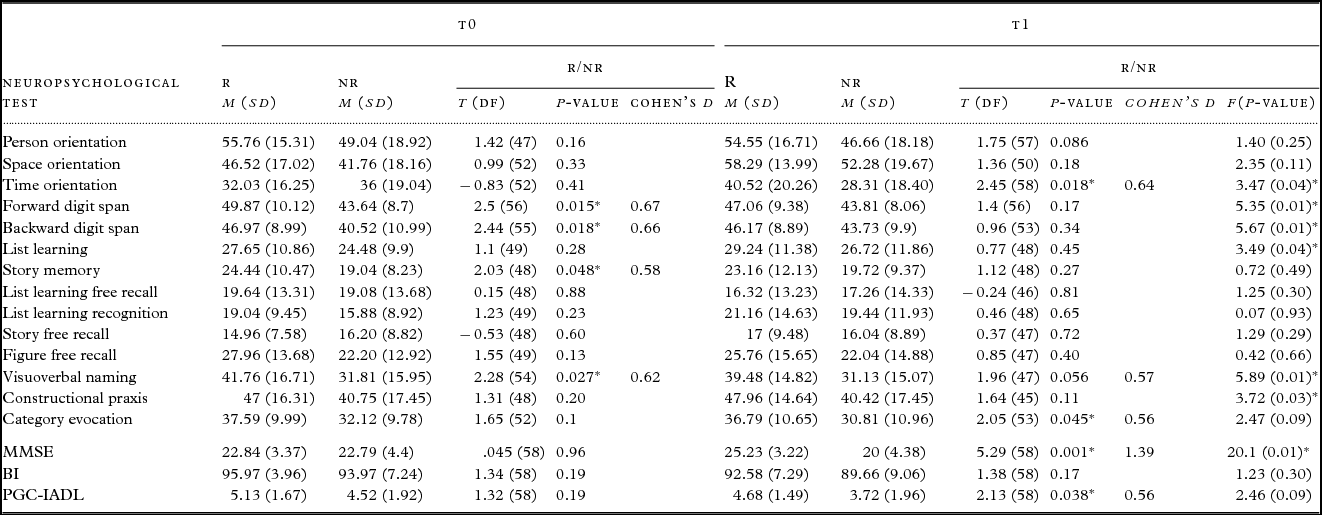
At T0, no statistically significant differences were observed between R and NR on MMSE or most of the neuropsychological tests administered, except on forward digit span t(56) = 2.5; p = 0.015, d = 0.67 (medium effect); backward digit span t(55) = 2.44; p = 0.018, d = 0.66 (medium effect); immediate story memory t(48) = 2.03; p = 0.048, d = 0.58 (medium effect), and visuoverbal naming t(54) = 2.28; p = 0.027, d = 0.62 (medium effect). Patients in the R group performed better on all the tests (Table 3).
Comparison R versus NR at T1
At T1, statistically significant differences between groups were observed on MMSE t(58) = 5.29, p = 0.001, d = 1.39 (very large effect), time orientation t(58) = 2.45; p = 0.018, d = 0.64 (medium effect), semantic category evocation t(53) = 2.05; p = 0.045, d = 0.56 (medium effect), and PGC-IADL t(58) = 2.13, p = 0.038, d = 0.56 (medium effect). The R group had a better performance on these tests (Table 4).
Comparison between R and NR in neuropsychological variables, global cognitive functioning and functional status at T0 and T1

T0 = basal line; T1 = post-treatment; M (SD) = mean and standard deviation of the T scores with mean 50 (10); t = value of the statistic; df = degree of freedom; Cohen's d: 1.10 to < 1.45, very large effect; 0.75 to < 1.10, large effect; 0.40 to < 0.75, medium effect and 0.15 to < 0.40, small effect. F = value of the statistic; p value of corrected model of ANCOVA (covariate: forward digit span).
*Alpha level for statistical significance p < 0.05 in Student's t-test for independent samples and ANCOVA.
Comparison between T0 and T1 in R and NR
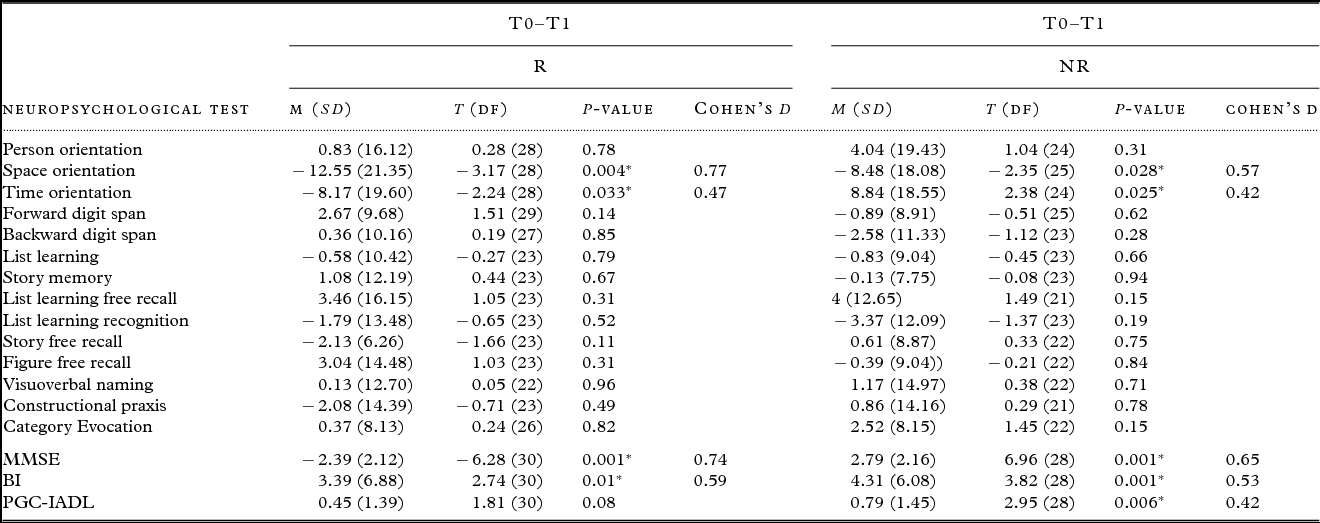
The R group had a better cognitive performance at T1 compared to T0 in space orientation t(28) = −3.17; p = 0.004, d = 0.77 (large effect), time orientation t(28) = −2.24; p = 0.033, d = 0.47 (medium effect), and MMSE t(30) = −6.28, p = 0.001, d = 0.74 (medium effect), whereas a statistically significant decrease was observed on BI t(30) = 2.74, p = 0.01, d = 0.59 (medium effect).
The NR group had a better cognitive performance at T1 compared to T0 in space orientation t(25) = −2.35; p = 0.028, d = 0.57 (medium effect), whereas a statistically significant decrease was observed in time orientation t(24) = 2.38; p = 0.025, d = 0.42 (medium effect), MMSE t(28) = 6.96, p = 0.001, d = 0.65 (medium effect), BI t(28) = 3.82, p = 0.001, d = 0.53 (medium effect), and PGC-IADL t(28) = 2.95, p = 0.006, d = 0.42 (medium effect) (Table 5).
Comparison between R and NR in neuropsychological variables, global cognitive functioning and functional status at T0 and T1

T0 = basal line; T1 = post-treatment; R = responder; NR = non-responder; M (SD) = mean and standard deviation of related differences in Student's t-test for dependent samples; t = value of the statistic; df =degree of freedom; Cohen's d: 1.10 to < 1.45, very large effect; 0.75 to < 1.10, large effect; 0.40 to < 0.75, medium effect and 0.15 to < 0.40, small effect; the difference between T0 and T1 does consider negative scores in M as a sign of improvement of T1 regarding to T0 and positive scores as a sign of loss.
*Alpha level for statistical significance p < 0.05.
In order to assess how cognitive variables can predict the annual rate of response, a stepwise linear regression model was calculated. The model considered those variables that had shown significant differences between R and NR at T0 as independent variables. These were forward digit span, backward digit span, story memory, and visuoverbal naming. Annual rate of response was the dependent variable. This analysis revealed that the coefficient β = −0.37, t(60) = −2.62, p = 0.012 was statistically significant in backward digit span, with a shared variance of 14% (R 2 = 0.14). Finally, ANCOVA was performed to examine the effects on the response of CS after controlling for cognitive variables predictors the annual rate of response, in this case, working memory (covariate backward digit span) (Table 4). ANCOVA showed statistically significant differences between groups in time orientation, forward digit span, backward digit span, list learning, visuoverbal naming, constructional praxis, and MMSE, after controlling for working memory.
Discussion
The main aim of the present study was to identify a cognitive and functional profile that may predict a better response to a 12-month CS treatment in a sample of patients diagnosed of mild AD. According to our results, 51.7% of patients were classified as responders, based on present stability or improvement of global cognitive function after 12 months of treatment. Importantly, we opted for a conservative approach as the primary measure of treatment outcome of CS (no change or improvement on the annual rate of change using MMSE) and following the criteria of other previous studies (Bottini et al., Reference Bottini2012; Woods et al., Reference Woods, Aguirre, Spector and Orrell2012; Binetti et al., Reference Binetti2013). This finding concurs with those of a previous study on predictors of efficacy to CS programs (Binetti et al., Reference Binetti2013) and other studies on factors associated with response to predictors of responsiveness to treatment with ChEIs (Saumier et al., Reference Saumier, Murtha, Bergman, Phillips, Whitehead and Chertkow2007; Bottini et al., Reference Bottini2012).
Predictors of response to cognitive stimulation
According to our findings, sociodemographic (age, sex, and level of education) and medical conditions were not predictors of response to CS, consistent with the findings of previous studies (Saumier et al., Reference Saumier, Murtha, Bergman, Phillips, Whitehead and Chertkow2007; Bottini et al., Reference Bottini2012; Binetti et al., Reference Binetti2013). However, the study published by Aguirre et al. (Reference Aguirre2013) identified age and sex as variables of good response. In their sample, age over 80 and being female were associated with increased cognitive benefits from the CS therapy. While Langbaum et al. (Reference Langbaum, Rebok, Bandeen-Roche and Carlson2009) found association between higher education attainment with responsiveness to memory training in independently living elderly adults older than 65 years. On the other hand, we studied insight as a possible predictor of good response, but our study did not find any association between insight and better response, as reported by others authors (Binetti et al., Reference Binetti2013). One possible explanation might be that formal measures of insight such as the Clinical Insight Rating Scale were not used. In AD, anosognosia is very common and is associated with advanced disease stages, cognitive dysfunction, and apathy (Mak et al., Reference Mak, Chin, Ng, Yeo and Hameed2015). The use of ChEIs has not predicted responsiveness to treatment, in line with other studies (Woods et al., Reference Woods, Aguirre, Spector and Orrell2012; Aguirre et al., Reference Aguirre2013).
A multiple regression was performed to establish the cognitive variables (memory, attention, and so on) that best predict if a subject responds to CS. This study found that attention, naming, immediate verbal memory, and working memory represent indicators of a better response to the intervention, in agreement with other authors (Saumier et al., Reference Saumier, Murtha, Bergman, Phillips, Whitehead and Chertkow2007). This may be related to the importance of cognitive functions in the activities practiced in CS therapies, which would imply that individuals with a better capacity in these domains would benefit more from the therapy. Moreover, it has been suggested that selective attention, which has higher complexity and requires greater attention, is particularly vulnerable during the initial phases of AD (Foldi et al., Reference Foldi, Lobosco and Schaefer2002). This may explain why passive auditory attention, with a lower requirement level, did not seem to be affected in any of the two groups of patients. Nevertheless, once patients were classified as R and NR, differences were observed as subjects classified as good responders to therapy achieved better performance than NR. Episodic memory deficit impedes the acquisition of new information, learning new or more adaptive cognitive skills, recalling CS instructions or retaining new strategies (Choi and Twamley, Reference Choi and Twamley2013). Therefore, better memory performance may increase the effectiveness of the CS, which also relates to a lower social withdrawal from activities (Clare and Woods, Reference Clare and Woods2004). Moreover, it is working memory that has shown greater relevance in predicting those subjects who are good responders to CS. Working memory refers to the ability to hold a limited amount of information in an active state (“on line”) for a brief period of time, and to manipulate this information (Baddeley, Reference Baddeley1992). This cognitive function is associated with fluid intelligence, a complex human ability that allows us to adapt our thinking to a new cognitive problem or situation. There is a considerable agreement that fluid intelligence is robust against influences of education and socialization (Ackerman et al., Reference Ackerman, Beier and Boyle2005), and it relates to the construct of cognitive reserve. Considering cognitive reserve suggests that there are individual differences in the ability to cope with brain pathology. It manifested as the ability to utilize more efficient and flexible cognitive strategies, which can be trained by means of a continuous exercise, according to authors like Liberati et al. (Reference Liberati, Raffone and Olivetti Belardinelli2012), it makes sense to consider the possibility of exploiting this capacity in the context of AD CS. The beneficial effects of CS are directly related to this degree of cognitive reserve, and patients with greater cognitive reserve may benefit more from cognitive therapies (Scarmeas and Stern, Reference Scarmeas and Stern2004). Conversely, global cognitive function assessed with the MMSE shows low discrimination as a predictor of good response to CS treatment, as described in previous studies (Saumier et al., Reference Saumier, Murtha, Bergman, Phillips, Whitehead and Chertkow2007; Bottini et al., Reference Bottini2012; Binetti et al., Reference Binetti2013). MMSE is a screening test and should not be used to establish a diagnosis, but only to identify patients’ global cognitive function. Final diagnosis should be established using diagnostic tests, where raw specificity over sensitivity, unlike the case in the screening test.
Functional capacity did not appear to predict response to treatment. This coincides with the findings of previous studies (Bottini et al., Reference Bottini2012). In contrast, Binetti et al. (Reference Binetti2013) found that larger functional ability predicts clinical response in responders. It is noteworthy that these authors included individuals diagnosed of AD and MCI, as well as other types of mild and moderate dementia, including varying degrees of functional impairment in their analysis, which in our study was controlled considering only patients diagnosed of mild AD. This achieved a more homogeneous sample regarding functionally.
Cognitive and functional measurements after CS treatment
In recent years, it has been shown that non-pharmacological interventions are an important complement (and in some cases an alternative) to pharmacological treatments for subjects with dementia. Cognitive enhancement therapies assume that neural plasticity is present in normal aging and dementia. Neural plasticity is defined as the ability of the brain to organize their patterns of neural connectivity and readjusting its functionality. Following the distinction adopted by Clare and Woods (Reference Clare and Woods2004 ) of CS, cognitive training and cognitive rehabilitation, the recent meta-analysis by Huntley et al. (Reference Huntley, Gould, Liu, Smith and Howard2015) shows better efficacy of CS in dementia. This meta-analysis is consistent with other published reviews and meta-analyses in finding CS significantly improved general cognitive outcomes such as MMSE and ADAS-Cog (Sitzer et al., Reference Sitzer, Twamley and Jeste2006; Woods et al., Reference Woods, Aguirre, Spector and Orrell2012). Despite the extensive literature on the effectiveness of CS in dementia, few functional studies focus on comparing the neuropsychological and functional outcomes in AD patients with good or bad response to a CS treatment. In our study, responders obtained a better global cognitive performance than non-responders. This finding is consistent with previous studies (Saumier et al., Reference Saumier, Murtha, Bergman, Phillips, Whitehead and Chertkow2007; Bottini et al., Reference Bottini2012; Binetti et al., Reference Binetti2013). Mean benefit was 2.39 points/year for the R group, higher than the 1.7 points reported by Binetti et al. (Reference Binetti2013). In addition, the cognitive profile after CS therapy showed a better performance in orientation and executive function in responders (Bottini et al., Reference Bottini2012), in line with the findings of other studies (Spector et al., Reference Spector, Orrell and Woods2010; Hall et al., Reference Hall, Orrell, Stott and Spector2013) with CS programs with a smaller number of sessions. This suggests that despite the heterogeneity between CS programs, responders are likely to obtain a greater benefit on functions that are more sensitive to improvement.
Functional capacity in the follow-up after the treatment showed that R had a better performance of IADL and reduced BADL in both groups, in contrast with other studies (Bottini et al., Reference Bottini2012). The different cognitive and functional profiles in post-treatment follow-up between R and NR, despite their similarity at baseline, indicate that CS therapy may produce a slowing of the decline process in AD in subjects who respond to therapy. Furthermore, the progress in executive function after the intervention may also improve functional capacity, as there is a significant relationship between executive function and IADL (Marshall et al., Reference Marshall2011).
Finally, all the patients who received CS improved in spatial orientation, regardless of the response group. These results coincide with the findings of Onder et al. (Reference Onder2005) who demonstrated the benefit of reality orientation therapy on cognition. This may be related to the characteristics of this therapy, based on repetition at the beginning of each session, and to the type information involved in spatial orientation, which is more stable.
Limitations and strengths
The present study has several limitations, such as the small sample size. Thus, it cannot be concluded that these findings may be extrapolated to other stages of AD or other types of dementia. Additionally, it was decided not to include the neuropsychological tests that were not scored at baseline and in the follow-up after the treatment for at least 75% of the patients included in the study. Another limitation is that only MMSE was used to classify subjects into responders and non-responders to CS and we opted for a conservative approach (no change or improvement on the annual rate of change using MMSE). It would be interesting to include functional measures. Finally, no formal measures were used to assess insight.
Despite the methodological limitations, the present study offers several advantages over previously published studies: a sample of subjects with a specific diagnosis of mild AD and sociodemographic and medical homogeneity between groups. Additionally, the same CS therapy of 12-month duration was administered to all patients and the use of an extensive battery of evaluation allowed obtaining measurements of distinct cognitive functions.
In our future research, we aim to include a larger sample of patients and a more extensive neuropsychological battery, with a special focus on the domains that emerge as significant predictors of a better response: attention, immediate verbal memory, naming, and especially working memory. We also seek to study the long-term evolution of this profile, identify the cognitive and functional profile at different stages of AD or other types of dementia, and personalize interventions according to the characteristics of each patient.
Conclusion
In conclusion, approximately half of the patients included showed a good response to treatment. Patients had similar baseline sociodemographic and medical characteristics. Patients classified as responders presented a baseline cognitive profile characterized by a better performance in attention, immediate verbal memory, language, and especially working memory, compared to non-responders. No baseline differences in global cognitive performance or functional capacity were observed between R and NR. After CS treatment, responders are characterized by a better cognitive performance in time orientation and executive function, and better functional capacity. This study will allow us to characterize a neuropsychological profile in order to offer more personalized strategies and optimize their effectiveness.
Conflict of interest
None.
Description of authors’ roles
Mar Martínez-Moreno, Dr Maite Garolera, Noemi Cerulla, and Gloria Chico contributed to the study design and conceptualization. Statistical analyses and interpretation were performed by Dr María Quintana. Mar Martínez-Moreno, Noemí Cerulla, and Gloria Chico contributed to data collection and management. All authors contributed to the writing and revision of the manuscript.
Acknowledgments
The authors of this paper would like to thank the Sant Jordi and Sant Llàtzer Day Hospitals for their collaboration and patients and relatives for their participation in this study.