


1. Introduction
Extensively exposed metamorphic rock suites in accretionary orogens can generally be attributed to two primary origins (Windley et al. Reference Windley, Alexeiev, Xiao, Kröner and Badarch2007; Xiao et al. Reference Xiao, Windley, Sun, Li, Huang, Han, Yuan, Sun and Chen2015; Zhang et al. Reference Zhang, Yu, Li, Yu, Lin and Mao2015, Reference Zhang, Lu, Mao, Teng, Zhou, Wu and Guo2021; Kröner et al. Reference Kröner, Kovach, Kozakov, Kirnozova, Azimov, Wong and Geng2015, Reference Kröner, Alexeiev, Kovach, Rojas-Agramonte, Tretyakov, Mikolaichuk, Xie and Sobel2017; Wang et al. Reference Wang, Song, Ni, Cao, Liu, Zhong, Sun, Sun, Deng, Li, Zhu, Liu and He2022). The first involves terranes that were rifted from cratonic margins and subsequently accreted to the orogen during subduction, representing basement rocks of ancient continental crust resulting from regional metamorphism (Kröner et al. Reference Kröner, Kovach, Kozakov, Kirnozova, Azimov, Wong and Geng2015, Reference Kröner, Alexeiev, Kovach, Rojas-Agramonte, Tretyakov, Mikolaichuk, Xie and Sobel2017; Zhang et al. Reference Zhang, Lu, Mao, Teng, Zhou, Wu and Guo2021). The second encompasses metamorphic sequences formed during orogenesis, which may either develop as low-temperature, high- and ultra-high-pressure assemblages through deep burial or deep subduction, or as high-temperature, low-pressure assemblages driven by anomalous thermal events (Zhang et al. Reference Zhang, Ai, Li, Rubatto, Song, Williams, Song, Ellis and Liou2007; Shi, Reference Shi2014; Xiao et al. Reference Xiao, Windley, Sun, Li, Huang, Han, Yuan, Sun and Chen2015; Zhang et al. Reference Zhang, Yu, Li, Yu, Lin and Mao2015). Consequently, meticulously determining the protolith ages and genetic types of these metamorphic rocks is fundamental to understanding the tectonic evolution of orogenic belts (Brown, Reference Brown2014; Shi, Reference Shi2014; Wang et al. Reference Wang, Song, Ni, Cao, Liu, Zhong, Sun, Sun, Deng, Li, Zhu, Liu and He2022).
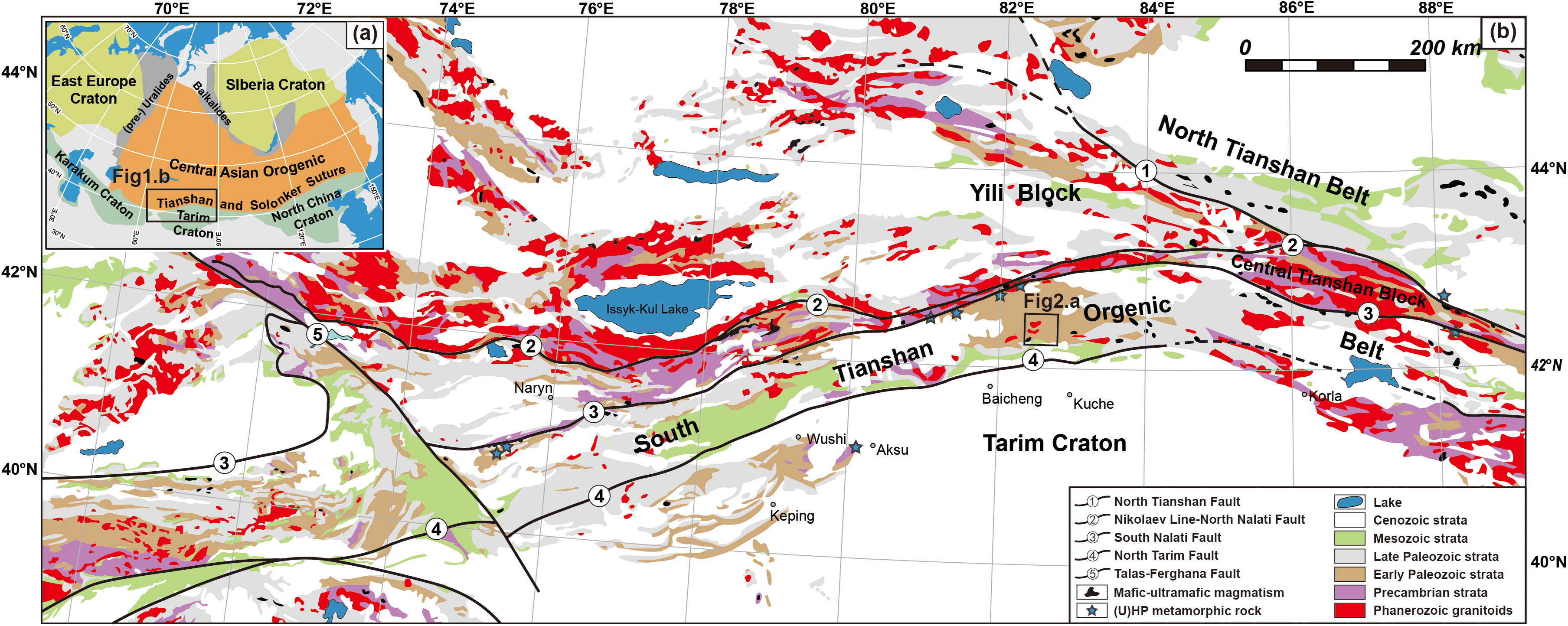
The South Tianshan Orogenic Belt (STOB), located along the southwestern margin of the Central Asian Orogenic Belt (CAOB), is a key component of the Paleozoic accretionary processes and multiple ocean basin cycles inside the CAOB (Figure 1; Windley et al. Reference Windley, Allen, Zhang, Zhao and Wang1990, Reference Windley, Alexeiev, Xiao, Kröner and Badarch2007; Xiao et al. Reference Xiao, Windley, Allen and Han2013; Wang et al. Reference Wang, Klemd, Gao, Jiang, Li and Xue2018; Gao et al. Reference Gao, Jiang, Wang, Li, Zhai, Hu and Qian2022). As the world’s largest, most long-lived, and tectonically complex accretionary orogen (Sengör et al. Reference Şengör, Natal’in and Burtman1993; Windley et al. Reference Windley, Alexeiev, Xiao, Kröner and Badarch2007; Wilhem et al. Reference Wilhem, Windley and Stampfli2012), the CAOB preserves a thorough record of the evolution of the Paleo-Asian Ocean from the Neoproterozoic to the Mesozoic (Zonenshain et al. Reference Zonenshain, Kuzmin and Natapov1990; Khain et al. Reference Khain, Bibikova, Salnikova, Kröner, Gibsher, Didenko, Degtyarev and Fedotova2003; Shu et al. Reference Shu, Zhu, Wang, Wu, Ma, Ma and Ding2013; Wang et al. Reference Wang, Klemd, Gao, Jiang, Li and Xue2018; Xiao et al. 2013, Reference Xiao, Windley, Sun, Li, Huang, Han, Yuan, Sun and Chen2015). In the southern Haerke Mountains, central segment of the STOB, a suite of high-grade metamorphic rocks including gneiss, schist, leptite, migmatite, and marble, is extensively exposed (Figure 2; XBGMR, 1984). Early geological mapping interpreted these rocks as Ordovician metaclastic strata intercalated with thick layered marbles (XBGMR, 1984). More recent work, however, has reassigned them to the Paleoproterozoic basement, correlative with the Xingditage Group of the Tarim Craton (XBGMR, 2014). However, the ages of these rocks have been assigned primarily on the basis of lithological features, successions, and regional correlations, and no reliable isotopic geochronological evidence is currently available. During our field investigations, we identified several thin interlayers of leptite within the lower part of the marble sequence, which exhibit sedimentary textures suggestive of a clastic protolith. Through integrated petrological, geochronological and zircon trace-element analyses, this study intends to constrain the protolith age and origin of these leptites, thereby shedding light on the depositional age and geotectonic setting of the host marbles. These results deliver new constraints on the genesis and evolution of metamorphic rocks in the STOB.
(a) Tectonic overview map showing the Central Asian Orogenic Belt and surrounding cratons (after Han et al. Reference Han, Zhao, Sun, Eizenhöfer, Hou, Zhang, Liu, Wang, Liu and Xu2016). (b) Simplified geological map of the northern Tarim Craton and the western sector of the Tianshan area, modified from Han et al. (Reference Han, Zhao, Sun, Eizenhöfer, Hou, Zhang, Liu, Wang, Liu and Xu2016).

Figure 1. Long description
Panel A: A tectonic overview map showing the Central Asian Orogenic Belt and surrounding cratons. The map includes various cratons such as the East Europe Craton, Siberian Craton, Tarim Craton, and the Central Asian Orogenic Belt. Key features include the North Tianshan Fault, Nikolaev Line-North Nalati Fault, South Nalati Fault, North Tarim Fault, and Talas-Ferghana Fault. The map also highlights different geological strata including Precambrian, Early Paleozoic, Late Paleozoic, Mesozoic, and Cenozoic strata, as well as mafic-ultramafic magmatism and UHP metamorphic rock. Panel B: A simplified geological map of the northern Tarim Craton and the western sector of the Tianshan area. This map includes specific blocks such as the Yili Block, Central Tianshan Orogenic Belt, and South Tianshan Belt. Key locations include Issyk-Kul Lake, Naryn, Wushi, Baicheng, Kuche, Aksu, and Keping. The map also shows various faults and geological strata similar to Panel A.
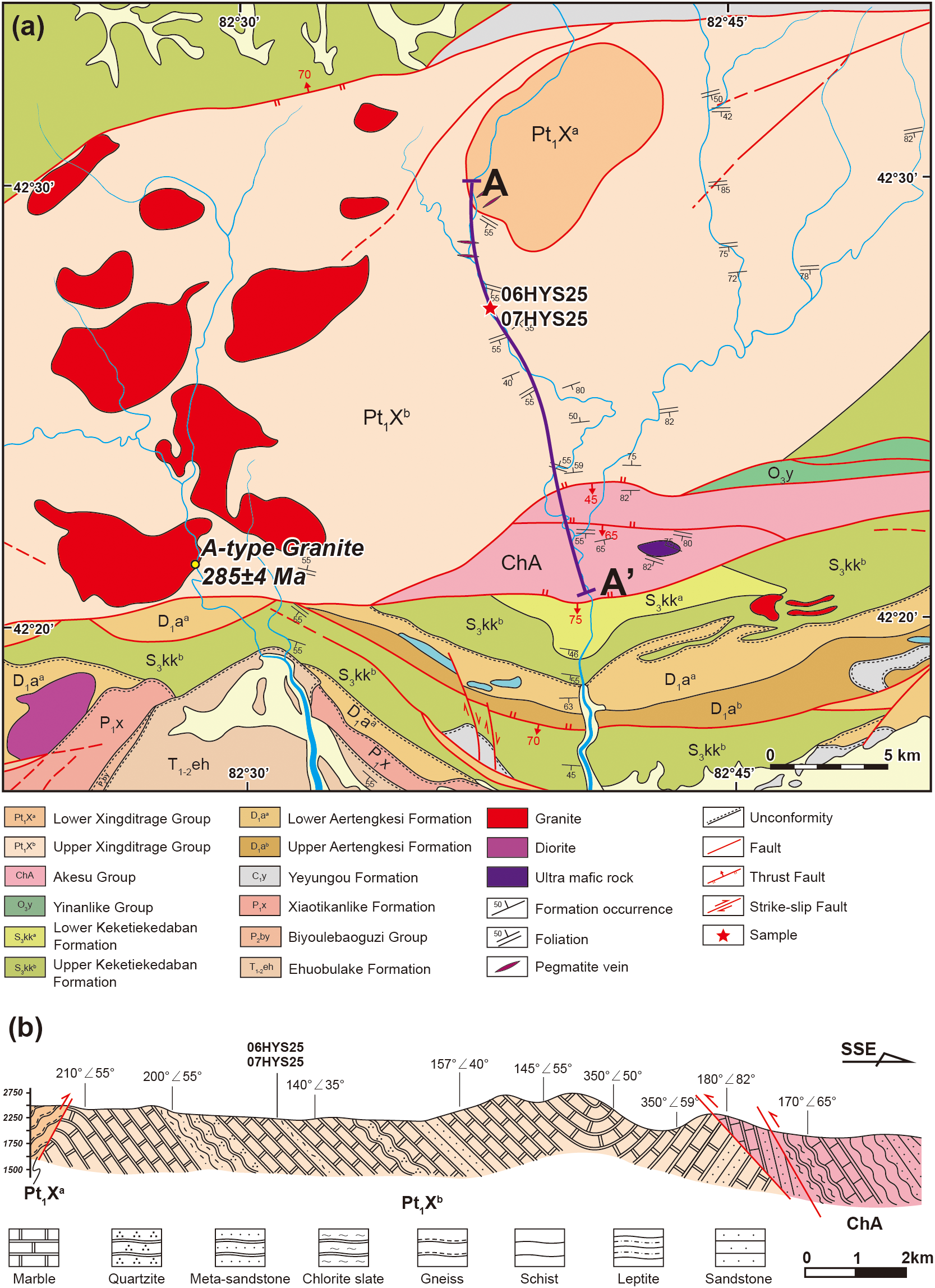
Simplified Geological Map of the northern Heiyingshan Area from the Xinjiang region in NW China (modified from Regional Geological Map of the Damangkuotan Area in Kuqa County-Baicheng County, Xinjiang (1:250000) (XBGMR, 2014)). Sample locations of leptites (06HYS25, 07HYS25) are indicated approximately. A more detailed structural map with cross-sections will be presented in a future contribution.

2. Geological background and overview of the study area
The CAOB (Figure 1a; Jahn et al. Reference Jahn, Wu and Chen2000; Xiao et al. Reference Xiao, Windley, Allen and Han2013), also known as the Altaids (Şengör et al. Reference Şengör, Natal’in and Burtman1993), is recognized as one of the Earth’s major accretionary orogens and furnishes essential knowledge of the tectonic and paleogeographic evolution of Eurasia (Şengör et al. Reference Şengör, Natal’in and Burtman1993; Windley et al. Reference Windley, Alexeiev, Xiao, Kröner and Badarch2007; Xiao et al. Reference Xiao, Song, Windley, Li, Han, Wan, Zhang, Ao and Zhang2019). Extending from the Ural Mountains in the west to the eastern Pacific margin, the CAOB preserves an extensive record of oceanic subduction, continental growth and orogenic collapse in the Paleo-Asian Ocean realm from the Neoproterozoic through the Mesozoic (Figure 1a; Şengör et al. Reference Şengör, Natal’in and Burtman1993; Khain et al. Reference Khain, Bibikova, Salnikova, Kröner, Gibsher, Didenko, Degtyarev and Fedotova2003; Xiao et al. 2019). Within this context, the STOB (Figure 1b) defines the southernmost suture zone of the CAOB and hosts tectono-stratigraphic records that chronicle the evolution and final closure of the South Tianshan Ocean (Han et al. Reference Han, He, Wang and Guo2011, Reference Han, Zhao, Sun, Eizenhöfer, Hou, Zhang, Liu, Wang and Zhang2015; Alexeiev et al. Reference Alexeiev, Biske, Djenchuraeva, Kröner and Getman2019; Biske et al. Reference Biske, Konopelko and Seltmann2024). Geographically, the STOB is bounded by the Tarim Craton to the south and the Yili–Central Tianshan Block to the north and lies adjacent to key deformation zones forming the current structural framework of northwestern China and adjacent Central Asian territories (Xiao et al. Reference Xiao, Windley, Allen and Han2013; Biske et al. Reference Biske, Konopelko and Seltmann2024).
Recent studies suggest that the Tarim Craton and the Yili–Central Tianshan Block initially amalgamated during the mid-Neoproterozoic, prior to the Ediacaran opening and subsequent Paleozoic expansion of the South Tianshan Ocean (Wu et al. Reference Wu, Zhang, Dilek, Chen, Wang, Lin, Cheng and Zhu2022, Reference Wu, Zhang, Dilek, Chen, Zhu, Lin, Wang, Deng and Cheng2023; Biske et al. Reference Biske, Konopelko and Seltmann2024; Wang et al. Reference Wang, Wu, Dilek, Li, Zhang, Huang, Deng, Chen, Lin and Cheng2024). The regional geodynamic evolution has conventionally been linked to northward subduction of the South Tianshan oceanic lithosphere beneath the Yili–Central Tianshan Block (Windley et al. Reference Windley, Allen, Zhang, Zhao and Wang1990; Allen et al. Reference Allen, Windley and Zhang1993; Gao et al. Reference Gao, Long, Klemd, Qian, Liu, Xiong, Su, Liu, Wang and Yang2009; Han et al. Reference Han, He, Wang and Guo2011; Xiao et al. Reference Xiao, Windley, Allen and Han2013; Alexeiev et al. Reference Alexeiev, Biske, Wang, Djenchuraeva, Getman, Aristov, Kröner, Liu and Zhong2015; Tao et al. Reference Tao, Yin, Xiao, Seltmann, Chen, Sun, Wang, Yuan, Thomson, Chen and Xia2021). However, integrated structural, stratigraphic and magmatic investigations – particularly the discovery of Silurian arc‑related magmatism along the northeastern margin of the Tarim Craton – have prompted alternative tectonic models that advocate for southward subduction (Lin et al. Reference Lin, Faure, Shi, Wang and Li2009, Reference Lin, Chu, Ji, Zhang, Shi, Wang, Li and Wang2013, Reference Lin, Zhang, Shi, Li, Xue, Wang and Wu2015) and divergent double subduction (Charvet et al. Reference Charvet, Shu, Laurent-Charvet, Wang, Faure, Cluzel, Chen and Jong2011; Wang et al. Reference Wang, Shu, Faure, Jahn, Cluzel, Charvet, Chung and Meffre2011, Reference Wang, Song, Ni, Cao, Liu, Zhong, Sun, Sun, Deng, Li, Zhu, Liu and He2022; Ge et al. Reference Ge, Zhu, Wu, Zheng, Zhu and He2012; Ma et al. Reference Ma, Shu, Meert and Li2014; Alexeiev et al. Reference Alexeiev, Biske, Wang, Djenchuraeva, Getman, Aristov, Kröner, Liu and Zhong2015) of the South Tianshan Ocean during the Silurian to Middle Devonian.
The STOB itself consists of a thick succession of Silurian to Carboniferous marine, volcanic and sedimentary rocks (Alexeiev et al. Reference Alexeiev, Biske, Wang, Djenchuraeva, Getman, Aristov, Kröner, Liu and Zhong2015). These strata manifest notable structural deformation, including folding and thrust faulting, and have experienced localized metamorphism (Figures 1b and 2; Alexeiev et al. Reference Alexeiev, Biske, Wang, Djenchuraeva, Getman, Aristov, Kröner, Liu and Zhong2015; Wang et al. Reference Wang, Song, Ni, Cao, Liu, Zhong, Sun, Sun, Deng, Li, Zhu, Liu and He2022; Biske et al. Reference Biske, Konopelko and Seltmann2024). Relict ophiolitic slices preserved along the belt provide further evidence of its oceanic origins. An extensive high-pressure/ultra-high-pressure metamorphic belt – signified by blueschists, eclogites and granulites – runs along the northern flank of the STOB (Figure 1b; e.g. Gao and Klemd, Reference Gao and Klemd2003; Zhang et al. Reference Zhang, Ai, Li, Rubatto, Song, Williams, Song, Ellis and Liou2007; Hegner et al. Reference Hegner, Klemd, Kröner, Corsini, Alexeiev, Iaccheri, Zack, Dulski, Xia and Windley2010; Wang et al. Reference Wang, Shu, Faure, Jahn, Cluzel, Charvet, Chung and Meffre2011, Reference Wang, Jahn, Shu, Li, Chung and Liu2012; Jiang et al. Reference Jiang, Gao, Klemd, Qian, Zhang, Xiong, Wang, Tan and Chen2014; Gao et al. Reference Gao, Jiang, Wang, Li, Zhai, Hu and Qian2022), with peak metamorphic conditions dated to c. 325–310 Ma (Han and Zhao, Reference Han and Zhao2018).
The study area is located in the Haerke Mountain region within the central segment of the STOB (Figure 2). The Precambrian Xingditage Group, exposed in this area, consists of metaclastic rocks (Member a) and marbles (Member b), along with Ordovician to Carboniferous carbonate and clastic sequences (XBGMR, 2014). Notably, volcanic and pyroclastic rocks are also developed within the Ordovician–Devonian strata (XBGMR, 2014; Alexeiev et al. Reference Alexeiev, Biske, Wang, Djenchuraeva, Getman, Aristov, Kröner, Liu and Zhong2015; Wang et al. Reference Wang, Song, Ni, Cao, Liu, Zhong, Sun, Sun, Deng, Li, Zhu, Liu and He2022). As a result of subsequent tectonic compression, a series of east–west-trending thrust faults and folds developed, and the succession was locally intruded by Early Paleozoic deformed granites and Late Paleozoic undeformed granitic plutons (XBGMR, 2014; Alexeiev et al. Reference Alexeiev, Biske, Wang, Djenchuraeva, Getman, Aristov, Kröner, Liu and Zhong2015; Wang et al. Reference Wang, Song, Ni, Cao, Liu, Zhong, Sun, Sun, Deng, Li, Zhu, Liu and He2022). Recent examinations indicate that the volcanic rocks, occurring as interlayers within the Ordovician–Devonian marine strata, formed during the Middle Ordovician to Early Devonian (460–410 Ma) (Zhong et al. Reference Zhong, Wang, de Jong, Zhai and Liu2019; Wang et al. Reference Wang, Song, Ni, Cao, Liu, Zhong, Sun, Sun, Deng, Li, Zhu, Liu and He2022). They exhibit overall negative whole-rock Nd and zircon Hf isotopic compositions, Mesoproterozoic Nd and Hf model ages, and calc-alkaline geochemical affinities, suggesting that these volcanic rocks probably originated in a continental magmatic arc setting (Zhong et al. Reference Zhong, Wang, de Jong, Zhai and Liu2019; Wang et al. Reference Wang, Song, Ni, Cao, Liu, Zhong, Sun, Sun, Deng, Li, Zhu, Liu and He2022).
The field section investigated in this study is exposed along the Yilalek River, a tributary in the upper reaches of the Altenkose River (Figure 2a). The northern part of this section is located in the core of an anticline and mainly exposes the lower member (Member a) of the Xingditage Group, which consists predominantly of gneiss, leptite and migmatite (Figures 2a,b; XBGMR, 2014). In contrast, the southern part traverses the southeastern limb of the anticline and the adjacent syncline, exposing the upper member (Member b) of the Xingditage Group in a monoclinal structure (Figure 2b; XBGMR, 2014). This member is lithologically characterized by diopside marble, quartzite, leptite and marble (Figure 2b; XBGMR, 2014).
3. Sampling and methods
3.a. Identification and characteristics of leptite interlayers
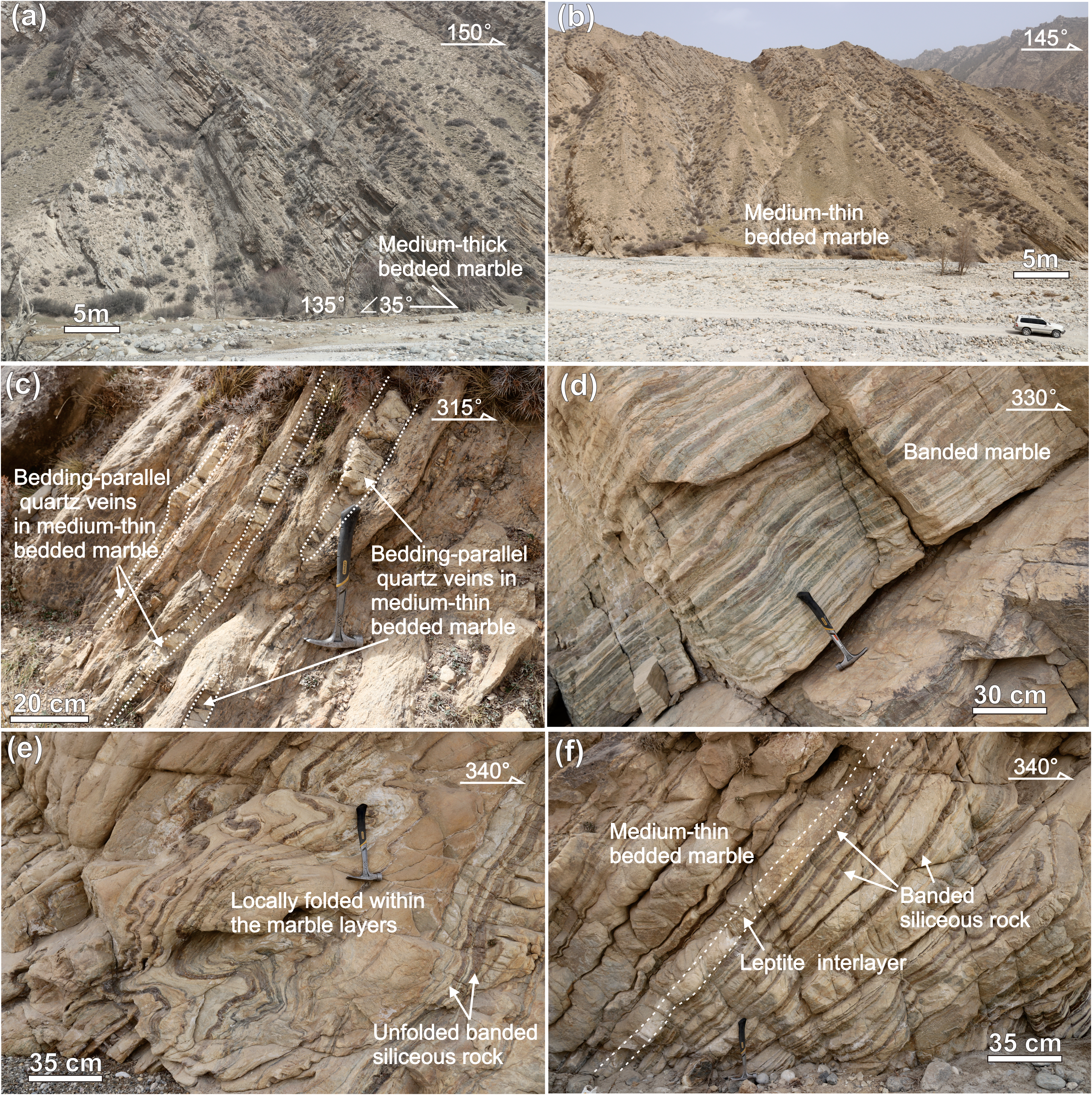
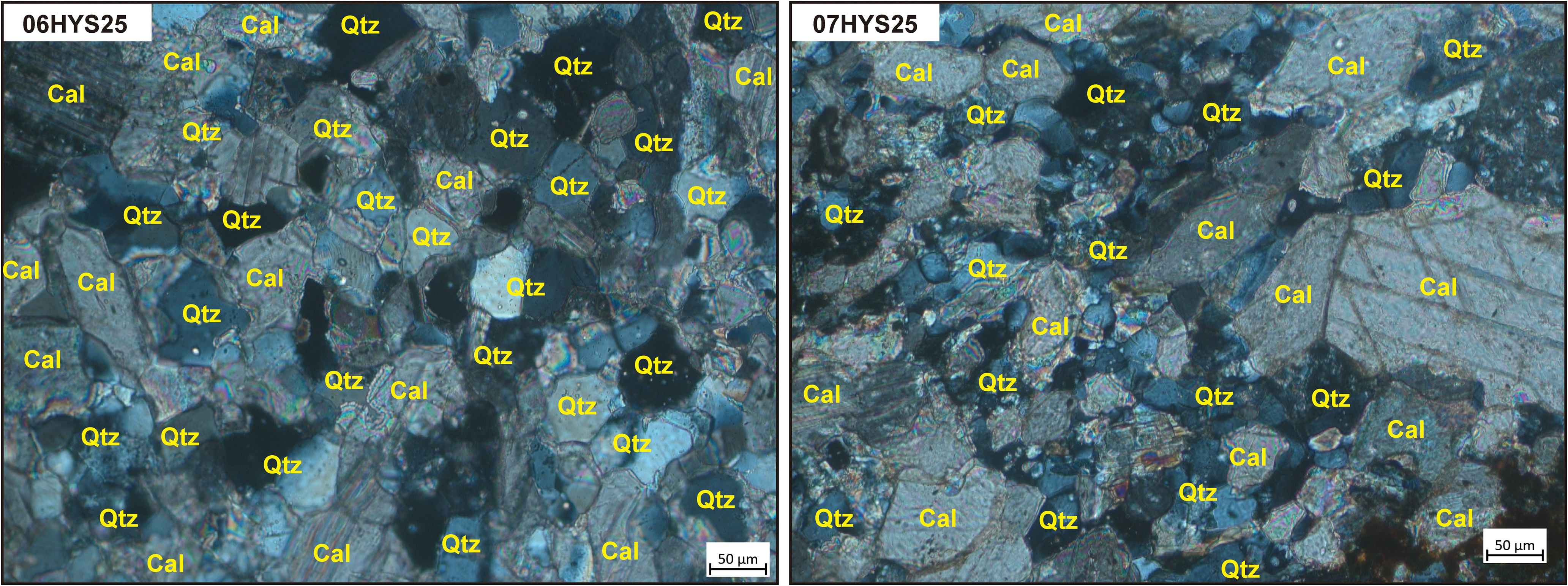
The lower part of the second member of the Xingditag Group is mainly composed of grey and greyish-white, medium- to thick-bedded and medium- to thin-bedded, banded marbles intercalated with quartzites and leptites (Figure 3a,b). Within the marbles, quartz veins are commonly developed along bedding planes (Figure 3c). The banded marbles are characterized by alternating light and dark bands, locally interlayered with siliceous rocks (Figure 3d). In some localities, thin-bedded marbles exhibit intrastratal fold deformation structures (Figure 3e). During this field investigation, two distinct layers of typical greyish-white, thin-bedded leptites (Figure 3f) were identified within the banded marbles, with an interval of approximately 10 m between them. Compared with the associated marbles, these rocks are lighter in colour and exhibit hardness close to that of siliceous rocks or quartzites. Petrographic observation under a microscope reveals that the leptites display a granoblastic texture, consisting mainly of fine-grained quartz and medium- to fine-grained calcite, with quartz contents ranging from 45% to 60% (Figure 4a,b).
Typical outcrop photographs of marbles and leptite interlayers along the Altenkose River section.

Petrographic characteristics of leptite samples. Cross-polarized (XPL) microphotographs of samples 06HYS25 and 07HYS25. Mineral abbreviations: Qtz = quartz; Cal = calcite.

Figure 4. Long description
Panel A: A cross-polarized light microphotograph of sample 06HYS25. The image displays various minerals within the metamorphic rock. Quartz (Qtz) and calcite (Cal) are labeled throughout the sample. The minerals exhibit distinct textures and structures under the microscope. Panel B: A cross-polarized light microphotograph of sample 07HYS25. Similar to Panel A, this image also shows labeled quartz (Qtz) and calcite (Cal) within the metamorphic rock sample. The minerals display unique patterns and formations visible under cross-polarized light.
3.b. Zircon U–Pb dating and trace element analysis
Two samples (06HYS and 07HYS) were collected from these two discrete leptite interlayers and initially processed by crushing, followed by froth flotation and magnetic separation. From the resulting mineral fractions, zircon grains exhibiting euhedral crystal forms and high transparency were precisely selected under a binocular microscope. These grains were subsequently mounted in epoxy resin, polished and cleaned to prepare target mounts for laser ablation (LA) analysis. Cathodoluminescence (CL) imaging was performed to reveal internal structures. The above preparatory procedures were carried out by Beijing Zircon Age Navigation Technology Co., Ltd.
In-situ U–Pb isotopic dating and trace element analysis of zircon were performed by LA–inductively coupled plasma–mass spectrometry (LA-ICP-MS) in the Research Center for Earth and Planetary Material Sciences, Zhejiang University. The analytical system comprised an Analyte HE LA unit, fitted with collision-type dual sample cones, coupled to an iCAP RQ ICP-MS instrument. Ablation employed a spot diameter of 35 μm, a repetition rate of 6 Hz and a fluence of 5 J/cm2. Ultra-high-purity helium served as the carrier gas, and argon was used as the make-up gas to optimize sensitivity. Zircon grains with smooth surfaces and devoid of visible fractures or inclusions were preferentially selected for analysis. Each analytical spot was pre-ablated with a laser pulse prior to data acquisition, followed by a 20-second background measurement, 40 seconds of sample ablation and a subsequent washout period. Correction for U–Pb isotopic fractionation was performed using the zircon standard 91500 (Wiedenbeck et al. Reference Wiedenbeck, Allé, Corfu, Griffin, Meier, Oberli, Von Quadt, Roddick and Spiegel1995) as the primary external standard, whereas Plešovice zircon (337 Ma; Sláma et al. Reference Sláma, Košler, Condon, Crowley, Gerdes, Hanchar, Horstwood, Morris, Nasdala, Norberg, Schaltegger, Schoene, Tubrett and Whitehouse2008) was employed as a secondary age control for quality assurance. Elemental concentrations were calibrated using NIST 610 and NIST 612 as external reference materials.
The data processing was carried out using the ICPMSDataCal program (Version 11.8) for the selection of signal and background time intervals, trace element analysis and U–Pb age calculation (Lin et al. Reference Lin, Liu, Yang and Hu2016; Liu et al. Reference Liu, Hu, Gao, Günther, Xu, Gao and Chen2008, Reference Liu, Hu, Zong, Gao, Gao, Xu and Chen2010). Common Pb correction for zircon samples was performed using ComPbCorr# B1 (Andersen, Reference Andersen2002). Zircon ages were calculated using the Excel-based program Isoplot 4.15 (Ludwig, Reference Ludwig2012), with individual analysis errors reported at the 1σ level. Zircon U–Pb concordia diagrams were plotted using Isoplot 4.15 and IsoplotR (Vermeesch, Reference Vermeesch2018). The ages of magmatic rocks were calculated as weighted mean 206Pb/238U ages, with errors reported at the 2σ level (95% confidence).
4. Results
The geochronological data for the two analysed samples are summarized in Appendix 1, and the corresponding rare-earth and trace-element compositions of the dated detrital zircons are listed in Appendix 2.
4.a. Zircon U–Pb geochronology
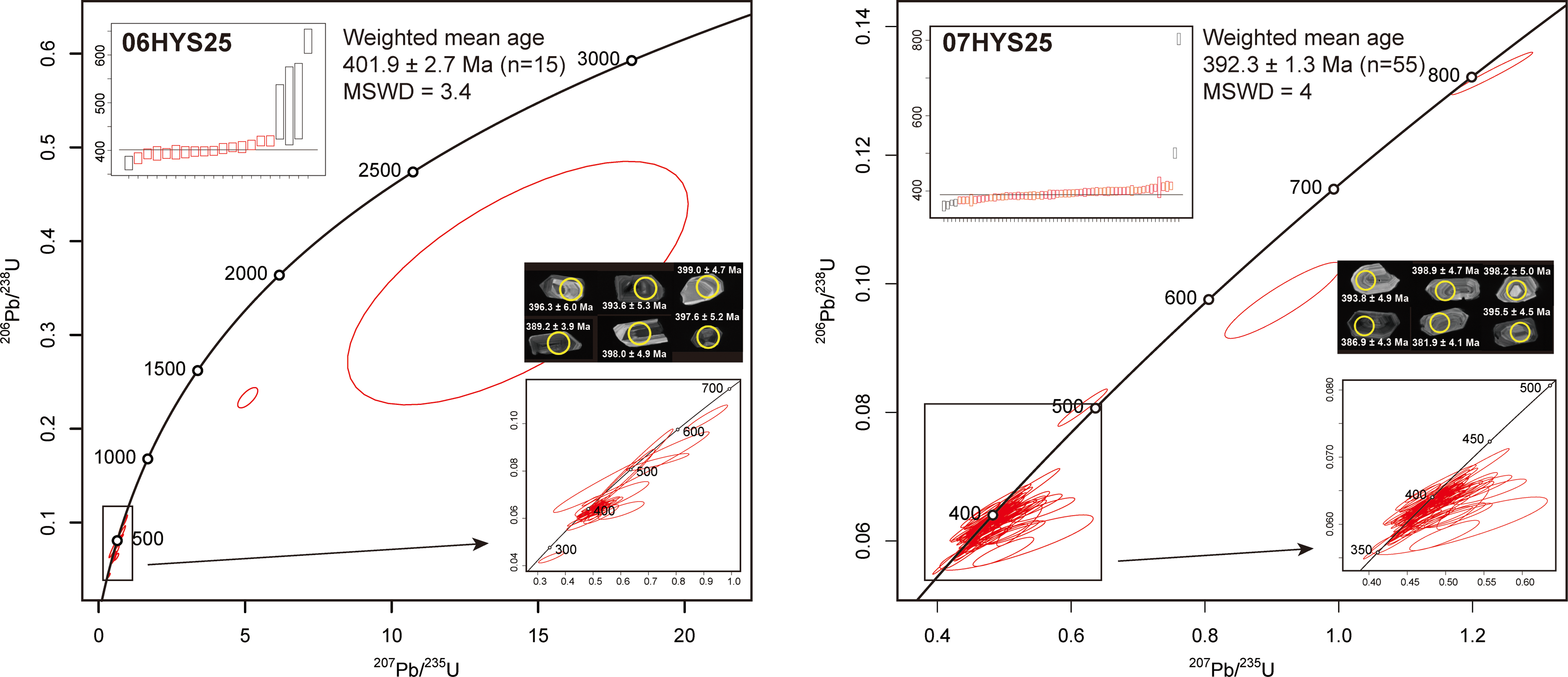
Zircon grains recovered from sample 06HYS25 are euhedral to subhedral, with grain sizes ranging from 50 to 110 μm and length-to-width ratios typically varying between 1:1 and 1:2.6. In CL images (Figure 5a), most grains exhibit distinct oscillatory zoning, although a minor population displays core-rim textures. A total of 45 spot analyses were conducted on 38 individual grains, of which 38 spots were positioned on oscillatory-zoned domains. The analysed zircons yield Th/U ratios ranging from 0.9 to 12.0. These morphological features and internal structures, together with the high Th/U ratios, indicate a magmatic origin for these zircons (Belousova et al. Reference Belousova, Griffin, O’Reilly and Fisher2002). Among the 45 U–Pb analyses, 22 concordant spots (concordance ≥ 95%) were obtained from 22 grains, comprising 21 Phanerozoic zircons (with ages ranging from 373 Ma to 503 Ma) and one Ediacaran zircon. The Ediacaran age, although consistent with widespread Precambrian magmatism in the South Tianshan and adjacent regions, is represented by only one grain and is therefore not further discussed. The remaining Phanerozoic zircons can be divided into two age groups: 420–500 Ma (n = 5) and 373–411 Ma (n = 16). The older group corresponds broadly to Early Paleozoic magmatic events in the STOB (Wang et al. Reference Wang, Song, Ni, Cao, Liu, Zhong, Sun, Sun, Deng, Li, Zhu, Liu and He2022) and is interpreted as representing xenocrystic/inherited zircon ages. The younger group spans most of the Devonian period. A weighted mean 206Pb/238U age of 401.9 ± 2.7 Ma (Mean Square of Weighted Deviates (MSWD) = 3.4, n = 15; Figure 5a) was calculated from the most coherent subset of this group, which is interpreted as the cooling and crystallization age of the volcanic protolith (i.e. air-fall tuff) of the leptite.
Zircon U–Pb Concordia diagrams and representative CL images for the zircons from the samples 06HYS25 and 07HYS25.

Figure 5. Long description
Panel A: A scatter plot representing zircon U-Pb data for sample 06HYS25. The horizontal axis is labeled 207Pb/235U and the vertical axis is labeled 206Pb/238U. The plot includes several data points forming clusters and a regression line. An inset histogram shows the distribution of weighted mean ages. Embedded images display zircon crystals with their respective ages. Panel B: A scatter plot representing zircon U-Pb data for sample 07HYS25. The horizontal axis is labeled 207Pb/235U and the vertical axis is labeled 206Pb/238U. The plot includes several data points forming clusters and a regression line. An inset histogram shows the distribution of weighted mean ages. Embedded images display zircon crystals with their respective ages.
Zircon grains from sample 07HYS25 are predominantly euhedral to subhedral, with grain sizes varying between 70 and 120 μm and length-to-width ratios ranging from 1:1 to 1:3. Most grains display well-developed oscillatory zoning under CL (Figure 5b), and some exhibit distinct core-rim textures. A total of 83 spot analyses were conducted on 73 zircon grains, yielding 83 U-Pb ages. Th/U ratios range from 0.8 to 2.7; combined with the morphological and internal textural evidence, these features indicate a magmatic origin for all analysed zircons (Belousova et al. Reference Belousova, Griffin, O’Reilly and Fisher2002). Of the 83 analyses, 81 spots yield concordant U-Pb ages (concordance ≥ 95%). Among these, one analysis yields a Precambrian age of 803.3 ± 7.7 Ma, represented by only one grain, and is therefore not further discussed. The remaining 80 concordant analyses were obtained from Phanerozoic zircon grains and yield ages ranging from 360 Ma to 501 Ma. Within this Phanerozoic population, one analysis yields a much older age of 500.5 ± 7.1 Ma, which is also represented by only one grain and is therefore not further discussed. The other analyses, however, yield a tightly clustered age range of 360–414 Ma. A weighted mean 206Pb/238U age of 392.3 ± 1.3 Ma (MSWD = 4.0, n = 55; Figure 5b) was calculated from the most coherent data within this group. This age is interpreted as the cooling and crystallization age of the volcanic protolith (air-fall tuff) of the leptite.
4.b. Trace element composition of zircons
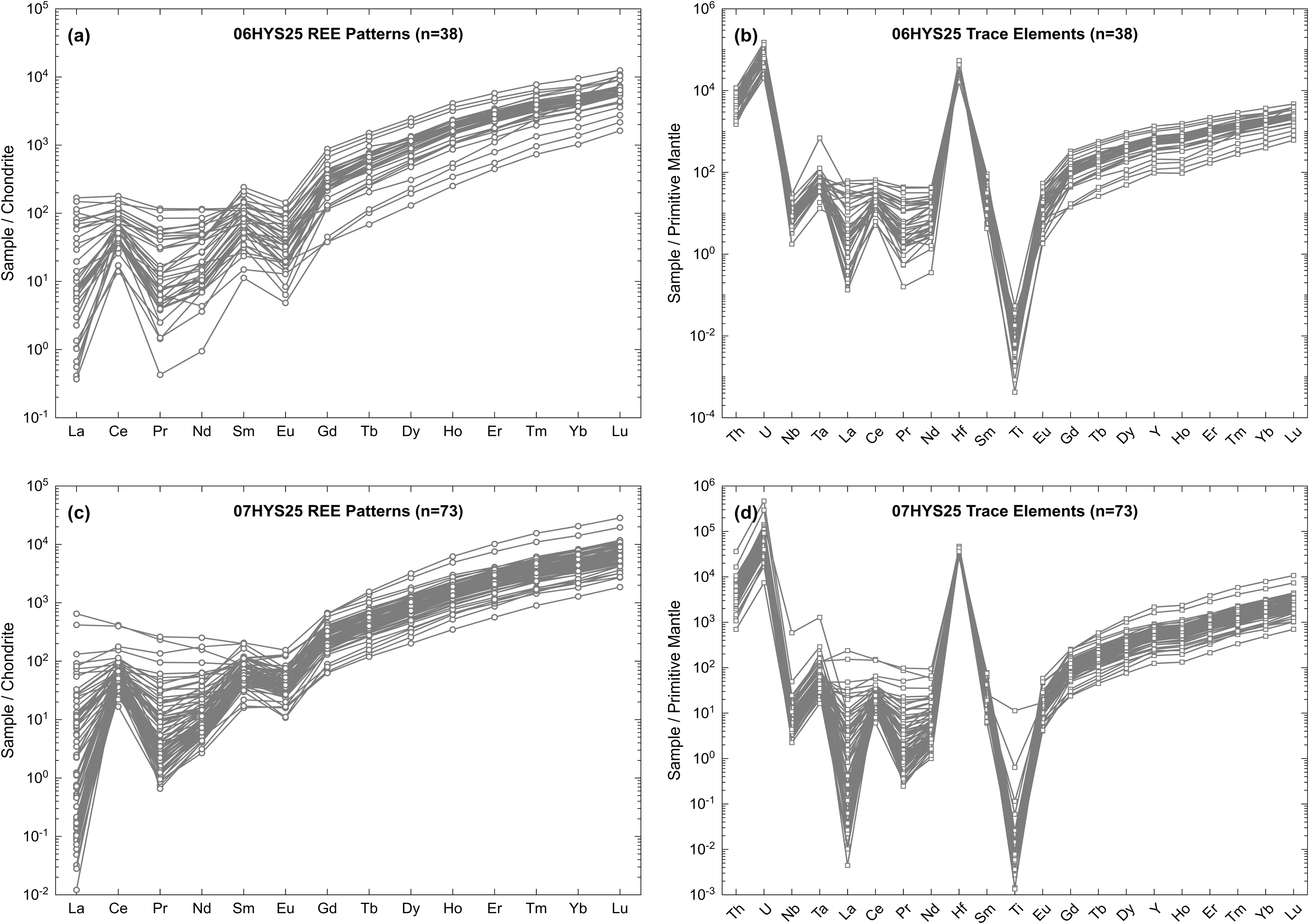
Trace and rare earth element (REE) concentrations of zircons from two leptite samples (06HYS25 and 07HYS25) were measured, and chondrite-normalized REE patterns (Figures 6a,c) and trace element spidergrams (Figure 6b,d) were plotted.
Chondrite-normalized REE distribution patterns (a, c) and trace element spider diagrams (b, d) for zircons from the leptite samples 06HYS25 and 07HYS25. The chondrite‑normalized and primitive‑mantle‑normalized data are from Boynton (Reference Boynton and Henderson1984) and Sun and McDonough (Reference Sun and McDonough1989), respectively.

The chondrite-normalized REE distribution pattern of sample 06HYS25 is characterized by a relative depletion in light REEs (LREEs) and an enrichment in heavy REEs (HREEs), together with a negative Eu anomaly (Figure 6a,b). The Eu/Eu* ratios range from 0.07 to 0.79, and the Ce/Ce* ratios from 0.97 to 77.83, both indicating negative Eu anomalies and positive Ce anomalies. These features further suggest that these zircons are of magmatic origin (Wu and Zheng, Reference Wu and Zheng2004; Lei et al. Reference Lei, Shi and Liu2013).
Similarly, the chondrite-normalized REE distribution pattern of sample 07HYS25 also displays a relative depletion in LREEs and enrichment in HREEs (Figure 6c,d). The Eu/Eu* ratios range from 0.15 to 0.62, and the Ce/Ce* ratios from 1.06 to 559.61, likewise indicating negative Eu anomalies and positive Ce anomalies. These results further confirm that these zircons are of magmatic origin (Wu and Zheng, Reference Wu and Zheng2004; Lei et al. Reference Lei, Shi and Liu2013).
5. Discussion
5.a. Age of the metamorphic rocks in the central South Tianshan
Along the Altenkose River section in the central STOB, a thick sequence of medium- to high-grade metamorphic rocks is exposed (XBGMR, 1984). However, the protolith ages of these rocks have long remained poorly constrained due to a lack of reliable isotopic geochronological data. Previous lithostratigraphic schemes have assigned these rocks to either the Ordovician–Silurian (e.g. XBGMR, 1984) or the Paleoproterozoic (e.g. XBGMR, 2014). Such a wide disparity in age interpretations has hindered not only a better understanding of the stratigraphic history, regional correlation and basin evolution in this area, but also the reconstruction of the tectonic evolution of the STOB and its geodynamic link to the surrounding blocks.
In this study, we identified two thin interlayers of leptite within the lower part of the metamorphic succession, which consists predominantly of layered marbles. Based on field observations and petrographic analyses, we interpret the protoliths of these leptynite layers as air-fall tuffs originally intercalated within the layered limestones (the protoliths of the marbles) and subsequently subjected to intense metamorphic recrystallization. Although future detailed structural mapping is required to fully resolve the relationship, the present field observations already indicate that the leptites occur as concordant interlayers within the banded marbles, and this interpretation is well supported by the current dataset. Zircon U–Pb geochronological analyses of these two samples further confirm that the leptynites represent air-fall tuffs derived from two discrete volcanic events during the Early–Middle Devonian (c. 390–400 Ma). Consequently, the age of the extensively exposed layered marbles in this region is constrained to the Devonian, rather than the Ordovician–Silurian or Paleoproterozoic as previously proposed. This metamorphic succession, dominated by layered marbles with minor leptynite and quartzite, is thus interpreted as a Devonian sequence composed of limestone, clastic rocks and tuffaceous interlayers. These rocks are broadly contemporaneous with Devonian clastic rocks and limestones in adjacent areas that are in fault contact with the study section (Figure 2a; XBGMR, 2014; Wang et al. Reference Wang, Song, Ni, Cao, Liu, Zhong, Sun, Sun, Deng, Li, Zhu, Liu and He2022).
It is worth noting that various types of gneiss, leptynite and migmatite are also developed under this layered marble sequence (Figure 2b; XBGMR, 1984). The ages and geotectonic affinities of the underlying rocks remain poorly understood and warrant further investigation.
5.b. Regional tectonic evolution and Devonian basin-forming setting of the South Tianshan region
The STOB constitutes a major component of the southwestern margin of the CAOB (Gao et al. Reference Gao, Long, Klemd, Qian, Liu, Xiong, Su, Liu, Wang and Yang2009; Han et al. Reference Han, He, Wang and Guo2011; Xiao et al. Reference Xiao, Windley, Allen and Han2013; Biske et al. Reference Biske, Konopelko and Seltmann2024). Its early evolution is closely connected to the fragmentation of the Rodinia supercontinent during the Late Neoproterozoic (Ge et al. Reference Ge, Zhu, Wilde, He, Cui, Wang and Zheng2014; Wu et al. Reference Wu, Zhang, Dilek, Chen, Wang, Lin, Cheng and Zhu2022). Rifting between the Tarim Craton and the Yili-Central Tianshan massif, occurring in two distinct phases, initiated the opening and subsequent sustained expansion of the South Tianshan Ocean during the early Paleozoic (e.g. Wu et al. Reference Wu, Zhang, Dilek, Chen, Wang, Lin, Cheng and Zhu2022; Wang et al. Reference Wang, Wu, Dilek, Li, Zhang, Huang, Deng, Chen, Lin and Cheng2024; Qiu et al. Reference Qiu, Dilek, Wu, Huang, Sun, Luo, Duan, Yuan, Chen and Zhang2024). Consequently, the northern Tarim margin, encompassing the South Tianshan region, is interpreted to have developed within a passive continental margin setting from the Cambrian through the Early Ordovician (Wu et al. Reference Wu, Zhang, Dilek, Chen, Wang, Lin, Cheng and Zhu2022; Wang et al. Reference Wang, Song, Ni, Cao, Liu, Zhong, Sun, Sun, Deng, Li, Zhu, Liu and He2022).
Regional geological mapping and biostratigraphic investigations (Yu et al. Reference Yu, Wang, Pan, Liang, Guo and Wang2011; Alexeiev et al. Reference Alexeiev, Biske, Wang, Djenchuraeva, Getman, Aristov, Kröner, Liu and Zhong2015; Wang et al. Reference Wang, Song, Ni, Cao, Liu, Zhong, Sun, Sun, Deng, Li, Zhu, Liu and He2022, and references therein) have revealed a stratigraphic architecture dominated by a relatively continuous succession of Early Paleozoic (Silurian to Carboniferous) strata, underlain by sporadic Precambrian high-grade metamorphic basement rocks. A notable feature is the widespread absence of Cambrian–Ordovician strata in the region (Wang et al. Reference Wang, Song, Ni, Cao, Liu, Zhong, Sun, Sun, Deng, Li, Zhu, Liu and He2022). Commencing in the Late Ordovician and extending into the Early Silurian, the northern Tarim margin–South Tianshan region experienced voluminous intermediate to felsic magmatic intrusions and the deposition of volcaniclastic sequences. This magmatic flare-up is widely regarded as the lithospheric response to the initiation of south-dipping subduction of the South Tianshan Ocean lithosphere (Lin et al. Reference Lin, Chu, Ji, Zhang, Shi, Wang, Li and Wang2013, Reference Lin, Zhang, Shi, Li, Xue, Wang and Wu2015). This subduction inception signified a pivotal geodynamic transition from a passive to an active continental margin setting, characterized by sustained compressional orogenesis, crustal thickening through folding and thrusting, and associated metamorphism (Ge et al. Reference Ge, Zhu, Wilde, He, Cui, Wang and Zheng2014; Alexeiev et al. Reference Alexeiev, Biske, Wang, Djenchuraeva, Getman, Aristov, Kröner, Liu and Zhong2015; Zhong et al. Reference Zhong, Wang, Alexeiev, Cao, Biske, Liu, Zhai and Xing2017; Wang et al. Reference Wang, Shu, Faure, Jahn, Cluzel, Charvet, Chung and Meffre2011, Reference Wang, Jahn, Shu, Li, Chung and Liu2012, Reference Wang, Song, Ni, Cao, Liu, Zhong, Sun, Sun, Deng, Li, Zhu, Liu and He2022). The recognition of inherited zircon grains with ages spanning 480–500 Ma to c. 420 Ma within the studied leucogranites offers strong evidence for active-margin magmatism, recording the signatures of this significant tectonic transition.
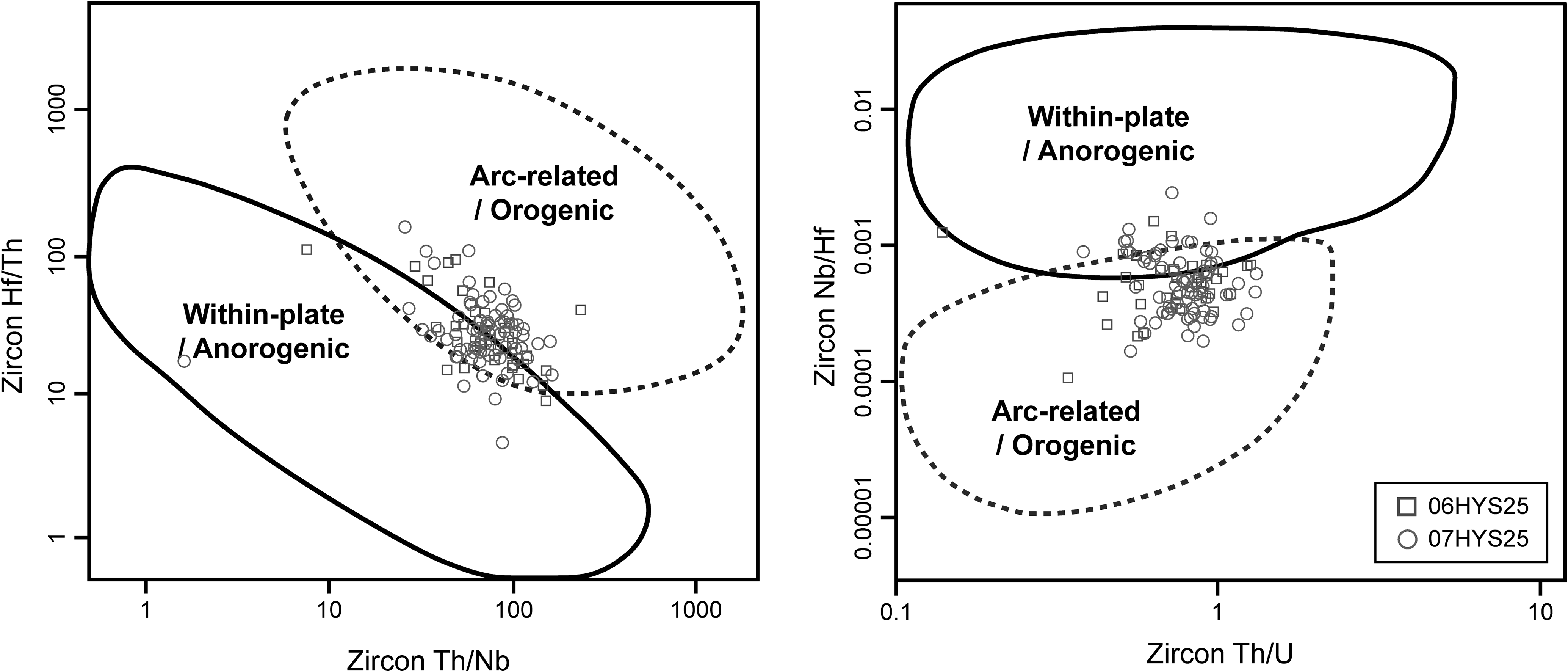
Following the Late Silurian to Early Devonian, the sedimentary record indicates a divergence in depositional environments across the South Tianshan. The southern sector witnessed widespread development of carbonate platform successions, whereas the northern domain remained characterized by volcanic edifices and associated magmatic intrusions (Alexeiev et al. Reference Alexeiev, Biske, Wang, Djenchuraeva, Getman, Aristov, Kröner, Liu and Zhong2015; Wang et al. Reference Wang, Song, Ni, Cao, Liu, Zhong, Sun, Sun, Deng, Li, Zhu, Liu and He2022). This observation raises a key question regarding the Late Devonian basin configuration in the South Tianshan. The extensive carbonate deposition in the south suggests a sediment-starved environment, likely indicating a phase of passive-margin development. However, our new U–Pb geochronological data from two thin leptite interlayers intercalated within banded marbles yield ages coincident with the Early–Middle Devonian boundary. Geochemically, these leptites are interpreted as air‑fall tuffs, representing distal volcanic ash deposits. Trace‑element results for zircons from these layers exhibit geochemical affinities characteristic of a continental magmatic arc setting (Figure 7).
Tectonic discrimination plot for the zircon grains of lepetites, Altenkose River section, South Tianshan, NW China (Data listed in Appendix 2). The discrimination diagram is adapted from Yang et al. (Reference Yang, Cawood, Du, Huang, Huang and Tao2012).

Figure 7. Long description
The image contains two scatter plots. Panel A: The scatter plot shows Zircon Hf/Th on the vertical axis and Zircon Th/Nb on the horizontal axis. The plot is divided into two regions: Within-plate/Anorogenic and Arc-related/Orogenic. Data points are represented by squares and circles, indicating different samples. Panel B: The scatter plot shows Zircon Nb/Hf on the vertical axis and Zircon Th/U on the horizontal axis. Similar to Panel A, this plot is also divided into Within-plate/Anorogenic and Arc-related/Orogenic regions. The data points are again represented by squares and circles, corresponding to different samples. Both plots include legends indicating the sample types and regions.
The Paleozoic arc magmatism in the STOB shows a dominant northward migration of magmatic activity through time, extending at least into the Middle Devonian (Alexeiev et al. Reference Alexeiev, Biske, Wang, Djenchuraeva, Getman, Aristov, Kröner, Liu and Zhong2015; Wang et al. Reference Wang, Song, Ni, Cao, Liu, Zhong, Sun, Sun, Deng, Li, Zhu, Liu and He2022). The spatial distribution of this arc magmatism – with Devonian arc‑related rocks concentrated along the northern margin of the STOB – has been used to infer southward subduction of the oceanic lithosphere beneath the Tarim continent (Lin et al. Reference Lin, Chu, Ji, Zhang, Shi, Wang, Li and Wang2013, Reference Lin, Zhang, Shi, Li, Xue, Wang and Wu2015). However, alternative models exist, including northward subduction (arc on the southern margin; Gao et al. Reference Gao, Long, Klemd, Qian, Liu, Xiong, Su, Liu, Wang and Yang2009) and divergent double subduction (Alexeiev et al. Reference Alexeiev, Biske, Wang, Djenchuraeva, Getman, Aristov, Kröner, Liu and Zhong2015; Wang et al. Reference Wang, Klemd, Gao, Jiang, Li and Xue2018; Wang et al. Reference Wang, Song, Ni, Cao, Liu, Zhong, Sun, Sun, Deng, Li, Zhu, Liu and He2022; Ning et al. Reference Ning, Jiang, Schulmann, Wang, Li, Shi and Qiu2023). Thus, the subduction polarity of the South Tianshan Ocean remains debated, particularly for different time intervals and segments of the belt.
Given this uncertainty, we do not claim that our data uniquely constrain subduction polarity. Instead, we interpret the air‑fall tuffs identified in this study as being most probably sourced from the active continental margin arc developed along the STOB (Ge et al. Reference Ge, Zhu, Wilde, He, Cui, Wang and Zheng2014; Alexeiev et al. Reference Alexeiev, Biske, Wang, Djenchuraeva, Getman, Aristov, Kröner, Liu and Zhong2015; Wang et al. Reference Wang, Song, Ni, Cao, Liu, Zhong, Sun, Sun, Deng, Li, Zhu, Liu and He2022; Ning et al. Reference Ning, Jiang, Schulmann, Wang, Li, Shi and Qiu2023). This interpretation is consistent with either a southward or divergent double subduction scenario, but we cannot exclude the possibility that the arc magmatism was generated by northward subduction affecting different margins of the ocean. Taking into account the regional distribution of arc‑related rocks and the depositional setting of our leptites on the southern (Tarim) side of the basin, we consider southward or divergent double subduction to be the most parsimonious model for the Early–Middle Devonian in this area.
Under this preferred model, the South Tianshan region during the Early–Middle Devonian likely occupied a late‑stage retro‑arc extensional basin, positioned on the Tarim continental margin (Alexeiev et al. Reference Alexeiev, Biske, Wang, Djenchuraeva, Getman, Aristov, Kröner, Liu and Zhong2015; Wang et al. Reference Wang, Song, Ni, Cao, Liu, Zhong, Sun, Sun, Deng, Li, Zhu, Liu and He2022). This period of potential back‑arc extension was followed by a return to more quiescent, passive‑margin conditions from the Late Devonian to Early Carboniferous, as evidenced by the predominance of carbonate‑dominated formations across the South Tianshan and the northern Tarim margin (Alexeiev et al. Reference Alexeiev, Biske, Wang, Djenchuraeva, Getman, Aristov, Kröner, Liu and Zhong2015; Wang et al. Reference Wang, Song, Ni, Cao, Liu, Zhong, Sun, Sun, Deng, Li, Zhu, Liu and He2022). Collectively, our findings underscore a complex, dynamic tectonic evolution of the STOB, involving switches between passive and active regimes during the early Paleozoic, but without uniquely resolving subduction polarity.
6. Conclusions
Zircon U–Pb dating of two leptite interlayers within banded marbles from the central South Tianshan yields protolith ages of 401.9 ± 2.7 Ma and 392.3 ± 1.3 Ma. These results restrict the depositional age of the regionally extensive marble succession to the Devonian, necessitating revision of previous lithostratigraphic assignments that placed these rocks in the Ordovician–Silurian or Paleoproterozoic.
Zircon morphology, high Th/U ratios and trace-element compositions indicate that the leptite protoliths represent air-fall tuffs derived from volcanic eruptions in a continental magmatic arc setting related to subduction of the South Tianshan Ocean. The specific subduction polarity (southward, northward or divergent double subduction) cannot be uniquely resolved by the present data.
The Devonian arc volcanism recorded by these tuff layers is broadly associated with the late-stage evolution of the South Tianshan Ocean, and the inherited zircon populations (480–500 Ma and c. 420 Ma) point to Early Paleozoic tectonothermal events (e.g. subduction initiation). More detailed tectonic settings (e.g. back-arc extension versus passive-margin transition) remain unconstrained by the present data and require further integrated studies including field mapping, petrology and geochemistry.
Supplementary material
The supplementary material for this article can be found at https://doi.org/10.1017/S0016756826100843
Acknowledgements
This research was co-funded by the National Major Science and Technology Project for New-Type Oil and Gas Exploration and Development (Grant No. 2025ZD1400501) and the National Natural Science Foundation of China (Grant No. 42372244). We thank the two anonymous reviewers for their constructive and perceptive comments and the Editor, Prof. Peter Clift, for his efficient management of the review process.
Author contributions
Caiming Luo: Investigation, Formal analysis, Writing –original draft & editing. Jianing Wu: Investigation, Methodology & Visualization. Yildirim Dilek: Investigation, Writing – review & editing. Shaoying Huang: Investigation & Funding acquisition. Hongxing Wei: Formal analysis & Project administration. Yunjiang Duan: Investigation. Xinxin Liang: Investigation. Fengquan Zhao: Investigation. Jinkai Xia: Investigation. Hanlin Chen: Investigation, Supervision, and Project Administration. Shufeng Yang: Supervision. Fengqi Zhang: Conceptualization, Investigation, Writing – review & editing, Supervision, Funding acquisition.
Financial support
This research was co-funded by the National Major Science and Technology Project for New-Type Oil and Gas Exploration and Development (Grant No. 2025ZD1400501) and the National Natural Science Foundation of China (Grant No. 42372244).
Competing interests
The authors declare that they have no known competing financial interests or personal relationships that could have influenced the work reported in this article.
Disclosure
The authors confirm that generative AI tools, specifically Deepseek and Grammarly, were employed exclusively to facilitate the translation of the manuscript from Chinese into English and to enhance linguistic fluency. The use of these tools occurred between February and April 2026, and was strictly confined to stylistic and grammatical improvements. No scientific concepts, analytical processes, interpretation of results or conclusions were produced by the AI. All content refined with AI assistance underwent thorough examination, verification and editing by the authors. The authors assume full responsibility for the correctness, originality and overall integrity of the article.


 Open access

