


Introduction
Global migration has increased cultural diversity in Australian schools, and prior to COVID-19 disruption, the number of students from migrant, refugee or asylum-seeker backgrounds was increasing (Ortiz & Seymour, Reference Ortiz, Seymour, Thielking and Terjesen2017). These students are culturally and linguistically diverse (CALD) and have English as an additional language. Although most CALD (the term used to refer to all groups in this article) students adjust and progress academically, a small minority encounters academic challenges and learning disorders (LDs) that require further assessment and intervention. Practitioners (the term is used here to refer to school psychologists and guidance counsellors) play a key role in identifying factors contributing to learning challenges of these students to plan appropriate, targeted interventions. Due to language and cultural barriers, practitioners must bring a flexible, adaptive, valid and culturally competent approach to the psychoeducational assessment process (Khawaja, Reference Khawaja2019; Vega et al., Reference Vega, Lasser and Afifi2016; Velasco Leon & Campbell, Reference Velasco Leon and Campbell2020). The importance of qualitative tools such as comprehensive interviews and observations has been recognised (Velasco Leon & Campbell, Reference Velasco Leon and Campbell2020). Although some standardised tests may function well, others may have to be modified and can only be used in a qualitative manner. Despite the complexity of psychometric assessment with students from CALD backgrounds, limited research and training is available in this area to support practitioners in Australian schools (Velasco Leon & Campbell, Reference Velasco Leon and Campbell2020). Therefore, the present article aims to facilitate practitioners’ practice in schools by proposing an assessment framework. Further, case studies are used to inform practitioners about salient assessment-related decisions, complexities associated with the manifestation of LDs, multiple psycho-biosocial factors associated with academic problems, and ways in which interviews and formal tests can be applied to help CALD students and their families understand their unique learning profiles, and to provide guidance on how best to support them in the classroom and the school.
CALD Students and Learning Challenges
Almost 50% of migrants, refugees and asylum seekers who resettle in Australia are minors (Australian Bureau of Statistics, 2019). Although migration usually involves a voluntary decision to relocate, refugees flee from dangers and are relocated to a safe country by the United Nations High Commission for Refugees (UNHCR), while asylum seekers are those who have applied for recognition and protection as a refugee, but for whom the decision on their refugee status is still pending (UNHCR, 2020). Children and young people may arrive with family members or alone. The school system often plays a key role in the English language proficiency and resettlement process of these young people (Kirk & Cassity, Reference Kirk and Cassity2007). All CALD students have to acquire a new language, adjust to an unfamiliar culture and manage discrimination (Joyce & Liamputtong, Reference Joyce and Liamputtong2017). As their families are also resettling, they may encounter psycho-social and financial hardships (Reed et al., Reference Reed, Fazel, Jones, Panter-Brick and Stein2012). As migrant families relocate for better educational and occupational opportunities, students from these backgrounds are often under intense pressure to achieve highly (Raleigh & Kao, Reference Raleigh and Kao2010), which can lead to a decline of mental health (Choi et al., Reference Choi, Lee, Park Lee, Park, Lee and Hahm2020). Students from refugee and asylum-seeker backgrounds may have additional challenges due to premigration experiences, including exposure to conflict and violence, separation from family, threats to personal safety, disruption of daily life, interrupted schooling, poor health and malnutrition, and possible maltreatment or abuse in refugee camps while in transit (Fazel et al., Reference Fazel, Reed, Panter-Brick and Stein2012; Reed et al., Reference Reed, Fazel, Jones, Panter-Brick and Stein2012).
Challenges in students’ learning could be due to a range of internal and external factors. It includes specific LDs and intellectual disabilities, which are neurodevelopmental disorders (AUSPELD, 2014). However, factors including behavioural, emotional or psychological issues, missed learning opportunities and English as an additional language/dialect (EAL/D) may also lead to students experiencing challenges with learning (DSF Literacy Services, 2018). Identifying the underlying factors impacting learning can inform decisions about appropriate intervention. Overall, in the current article, ‘learning challenges’ refer to a range of difficulties due to which the student is underachieving academically and offered targeted intervention and adjustments by schools. Considering the negative impact of poor academic performance on a student’s self-esteem and long-term occupational and educational outcomes, the schools take these matters seriously (Correa-Velez et al., Reference Correa-Velez, Gifford and Barnett2010; King & Owens, Reference King, Owens and Askell-Williams2015). Those who continue to experience academic difficulties despite remediation are identified for further formal assessment. There is now increasing evidence that psychological assessment may lead to overdiagnosis of cognitive or LD for students from migrant and refugee backgrounds (Kaplan, Reference Kaplan2009). Therefore, awareness of developmental, language and psychosocial factors that can mask or mirror learning difficulties in students from CALD backgrounds is an essential element of assessment, as practitioners have an ethical and professional obligation to conduct a valid assessment using a culturally fair assessment process.
Identification and Referral
Several factors may influence the referral and assessment process for CALD students experiencing academic difficulties. Some key points include a presence of prior diagnosis of intellectual disability and/or specific LD, psychological distress, and limited English language acquisition. In circumstances where the parent or carer of a CALD student reports an earlier diagnosis of cognitive impairment or a specific LD when enrolling at the current school, it may be appropriate to refer the student for further assessment immediately, with the aim of providing targeted, evidence-based intervention. For CALD students who are experiencing psychosocial difficulties due to trauma, loss or grief as a result of pre- and postmigration experiences, immediate assessment of psychosocial functioning and provision of support to the student and their family is likely to be the most appropriate initial step, rather than psychoeducational assessment. While the need for assessment is not excluded, psychosocial support and intervention is the priority (Kaplan et al., Reference Kaplan, Stolk, Valibhoy, Tucker and Baker2016). For many CALD students, however, who are at varying levels of acquiring the English language, an appraisal of their second language development is a critical initial step (Fraine & McDade, Reference Fraine and McDade2009).
It is important to understand whether the academic difficulties of CALD students are due to language acquisition. This may not be easily determined, as difficulties with acquiring English language may appear similar to features of a LD (Klingner & Eppollito, Reference Klingner and Eppollito2014). However, by understanding the process by which a second language is acquired and features of intellectual and/or learning disability, it may be possible to determine when a student is struggling with language acquisition rather than a developmental disorder (Klingner & Eppollito, Reference Klingner and Eppollito2014). Although the acquisition rate varies from student to student, CALD students take five to seven years or more to become proficient in English language (Demie, Reference Demie2013; Fraine & McDade, Reference Fraine and McDade2009). Further, listening or speaking can develop at a faster rate than reading or writing. Certain internal and external factors can promote the language acquisition. An engagement with social media in English, communication with English-speaking friends or family members (Jia & Fuse, Reference Jia and Fuse2007), or previous English language tuition expedites the development of an additional language in children (Paradis, Reference Paradis, Hoff and Shatz2007). Therefore, understanding each student’s exposure to English language is essential.
Different skills may develop at different ages — while middle childhood is considered to be important for building vocabulary (Paradis, Reference Paradis2011), older students may be required to work with greater amounts of text and abstract language in the classroom. Phonological memory, willingness to attempt using English and overall cognitive abilities tend to explain more variance in language acquisition outcomes than external factors (Paradis, Reference Paradis, Hoff and Shatz2007).
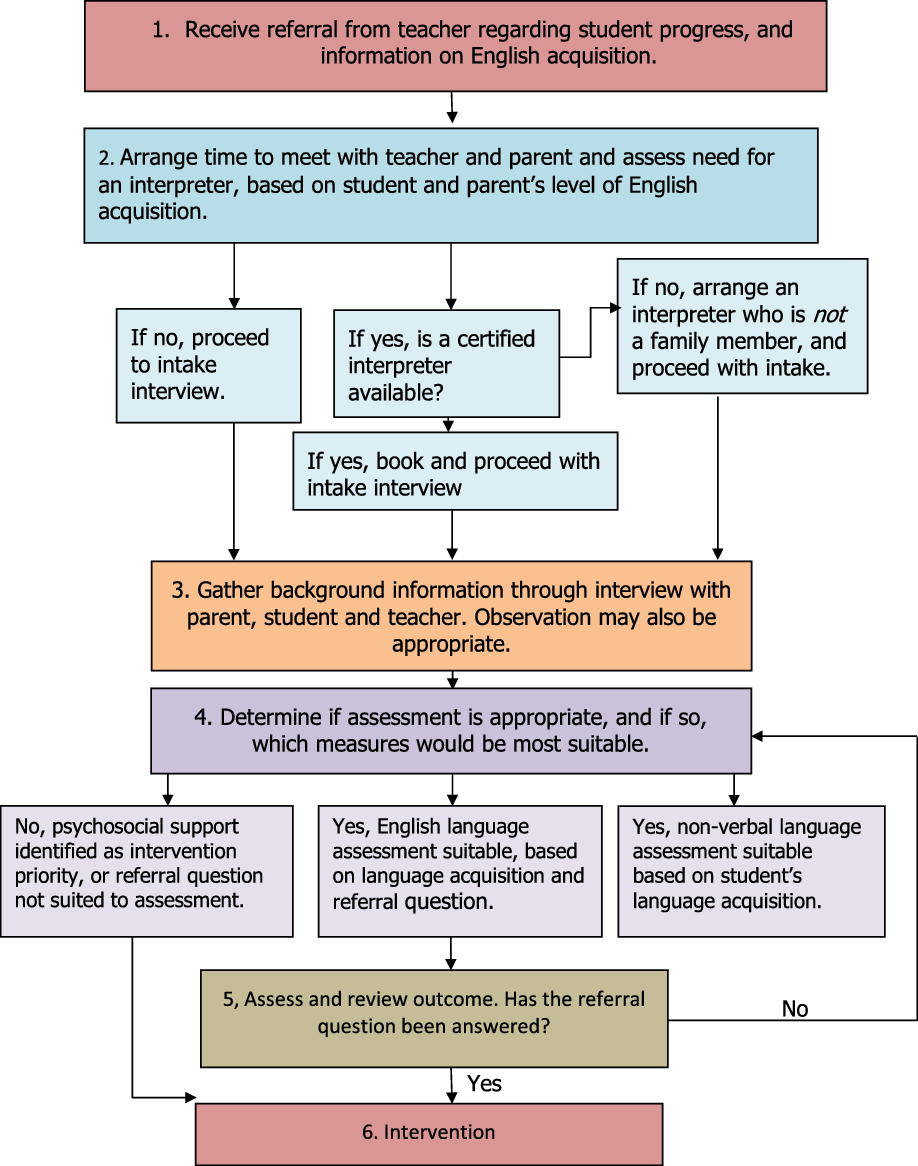
There is now emerging evidence (Khawaja & Howard, Reference Khawaja and Howard2020) that an assessment process for CALD students must consider a wide range of factors due to the students’ pre- and post-resettlement history, as well as their English language acquisition. Consistent with traditional methods of assessment, practitioners first use interviews and observations to gather information. Second, the information is used to develop hypotheses, which are then tested by a range of formal tests. Practitioners in the school settings have to make a number of assessment-related decisions (see the flowchart shown in Figure 1).
Assessment decision-making flowchart.

Assessment Process
Background
Collection of background data is a vital element of the assessment process for CALD students (Fraine & McDade, Reference Fraine and McDade2009; Velasco Leon & Campbell, Reference Velasco Leon and Campbell2020); yet, at the same time, it can be especially challenging when usual sources of information, such as reports from schools or health professionals, are unavailable. Where possible, documentation such as prior school or medical records should be requested. At least, consent to review formal and/or informal reports from the student’s current classroom teacher, and any EAL/D or language support teachers who have worked with the student should be sought, along with work samples. For students from refugee and asylum-seeker backgrounds in particular, records and documentation may be impossible to obtain. A detailed intake interview in these cases is of particular importance.
Interview
An intake interview with the CALD student’s parent or caregiver is an initial step undertaken by a psychologist working in schools. Due to its flexible and relational nature, interview methodology has proven to be the best approach to build a relationship and gather information (Sattler, 2020). Preinterview preparation, including becoming familiar with challenges encountered by migrants and refugees’ socio-political circumstances in the student’s country of origin, the student’s cultural norms, and the manner in which problems are culturally represented in the country of origin is a useful step when working with CALD students issues (Khawaja & Stein, Reference Khawaja and Stein2016). As it is not possible to know everything about people from other cultures, a practitioner can take a curious approach and show willingness to learn from the student and his/her family (Khawaja & Lathopolous, Reference Khawaja and Lathopolous2014). A culturally competent psychologist needs to reflect on his/her cultural biases and whether their gender or ethnicity could pose problems (Ortiz & Seymour, Reference Ortiz, Seymour, Thielking and Terjesen2017).
Communication can be modified to assist the student and parents or carers, who are likely also acquiring English language proficiency. If English proficiency is limited, an accredited interpreter should be utilised. Due to ethical concerns, family members are not recommended as interpreters (Australian Psychological Society, 2013). It is important to allow adequate time for the intake interview (at least 90 minutes), and the interview may need to be scheduled over more than one session (Khawaja, Reference Khawaja2011). It is paramount to ensure space and time for the client to tell their own story so that the client feels heard. Considering that CALD families may not be used to formal settings, informal settings may be used to facilitate comfort.
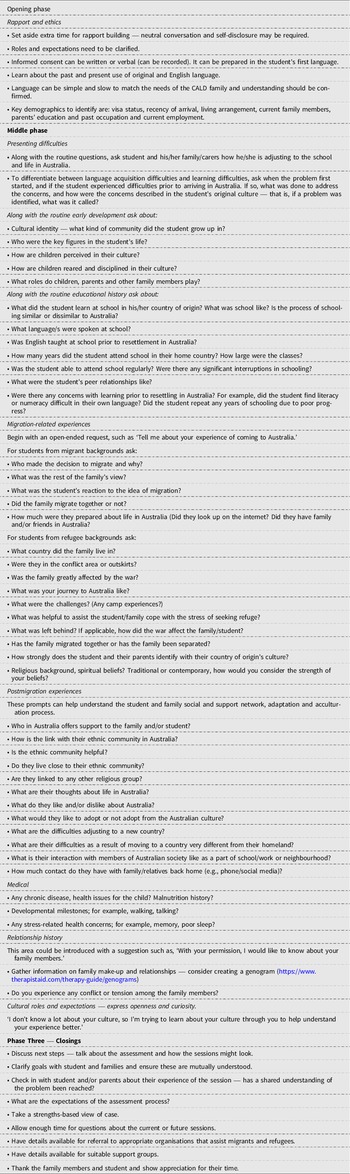
The intake interview can be divided into three phases: opening, middle and closing (Morrison, Reference Morrison2014). Examples of such comprehensive interviews can be found in Carr (Reference Carr2016) and Sattler (2020). The first phase is helpful in building rapport, obtaining consent, and explaining roles, agenda and confidentiality. The middle phase includes an exploration of the presenting issues as well as a series of questions related to developmental, educational, occupational and relational history. Finally, the last part focuses on ensuring that the clients leave the session with an intact self-esteem and an understanding of the student’s difficulties, as well as the planned approach to address the problems. Practitioners, in the process of assessing CALD students, cover all the areas. During this phase of the interview, all information is integrated, cross-checked and shared with the client.
Additional probing may be required to gather information relevant to CALD students, as seen in Table 1 (for details, see Khawaja, Reference Khawaja2011, 2019; Khawaja & Lathopolous, Reference Khawaja and Lathopolous2014). As seen in the table, the opening phase requires more attention to the rapport, ethical concerns and the demographic information. In the middle phase, it is important to explore cultural perspectives of the referral question, cultural identity and the cultural explanation of child rearing, parenting roles and family functioning (Kaplan et al., Reference Kaplan, Stolk, Valibhoy, Tucker and Baker2016). In the case of refugees, gentle and sensitive probing is required to gather information about the impact of war, camp experiences, and separation from or death of a significant others. It is helpful to be aware of health issues, particularly malnutrition in the case of students from refugee background, as malnutrition has been linked to poorer neurodevelopmental outcomes, including delayed academic achievement (Galler et al., Reference Galler, Koethe and Yolken2017). In order to explore the risks, attitudes towards Australia and acculturative stress require attention (d’Abreau et al., Reference d’Abreu, Castro-Olivo and Ura2019). Practitioners should also be aware of the risks of retraumatisation through being asked to share information prematurely and ensure this does not occur (Miller et al., Reference Miller, Brown, Shramko and Svetaz2019). All this information assists in understanding the student’s psychosocial challenges and the contribution of the culture to their learning difficulties. Protective factors, such as personal resilience and coping, positive attitude toward resettlement, and social and spiritual support should also be explored, as these can impact the resettlement process (Khawaja et al., Reference Khawaja, Ibrahim and Schweitzer2017). Finally, towards the end of the interview, information should be cross-checked to ensure a shared understanding of the problem has been reached. Information about the goals of the assessment and future sessions will have to be communicated clearly. As the family may be struggling from a range of issues, information about available multicultural services is advantageous (Khawaja & Lathopolous, Reference Khawaja and Lathopolous2014).
Additional questions and considerations in the intake interview

Assessment Planning
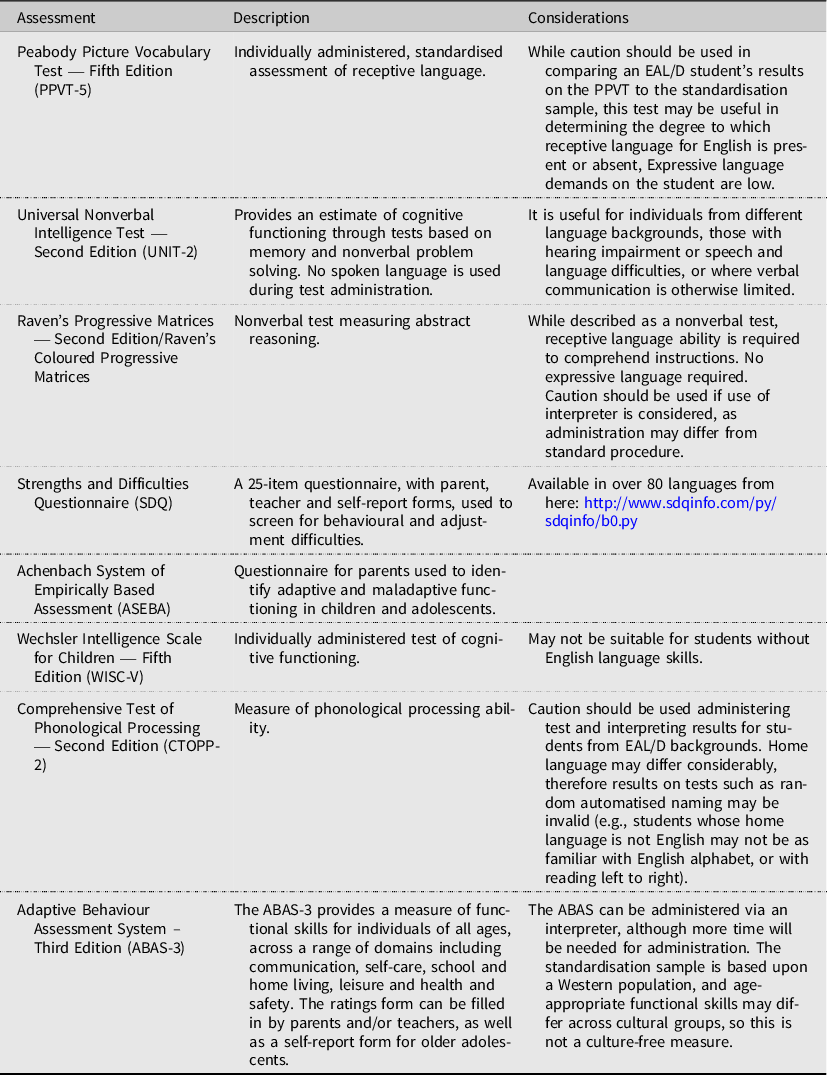
If, after a detailed intake interview, the decision is made to proceed with psychometric assessment to address the referral question, key considerations for assessing CALD students involve determining what constitutes a valid and fair assessment. As Ortiz, Piazza et al. (Reference Ortiz, Piazza, Ochoa, Dynda, Flanagan and McDonough2018) note, performance on many tests is impacted by two key developmental processes — the extent to which an individual has had the opportunity to learn and develop the language, and to acquire the cultural knowledge built into a test. While these processes are very much associated with any student’s individual and unique developmental history (emphasising the importance of the detailed intake interview), CALD students are less likely to have had the same opportunities to learn language and gain cultural knowledge relevant for standardised psychometric assessments developed and normed in Western countries. Therefore, factors that may limit the validity and fairness of standardised testing include language limitations, cultural factors and test limitations. With these limitations in mind, a number of approaches are discussed, and a list of assessment tools are provided that may be of benefit when working with students from EAL/D backgrounds, including refugees and migrants.
Assessment Approaches
Standardised Assessment in English
Many assessment measures used by school psychologists in Australia are standardised tests in English. There are a number of concerns about the language and cultural requirements of these tests that might result in a test score that is invalid when administered to CALD students from refugee and migrant backgrounds (Fraine & McDade, Reference Fraine and McDade2009). However, some researchers suggest that where possible (i.e., where there is sufficient language acquired to undertake the testing) administration of standardised English-language tests may be an appropriate place to start the assessment (Ortiz & Seymour, Reference Ortiz, Seymour, Thielking and Terjesen2017). If this is undertaken, very careful examination of the test scores would be required to determine their validity. One means of assessing this would be to consider the language and cultural weighting of all test components. Ortiz, Piazza et al. (Reference Ortiz, Piazza, Ochoa, Dynda, Flanagan and McDonough2018) have developed the Culture-Language Interpretive Matrix (C-LIM), which can help determine the extent to which language and cultural loading may impact test results.
Nonverbal Assessment
Various psychometric tests are described as ‘nonverbal’, indicating no spoken communication is required for administration or response to test items. Examples include the Leiter-3 and the Universal Nonverbal Intelligence Test — Second Edition (UNIT-2). While nonverbal tests may be a fairer estimate of cognitive function for children with limited English, there remain concerns with their use.
Communication is still essential in administration of nonverbal tests and they rely on culturally specific understandings, such as gestures (Ortiz, Flanagan et al., Reference Ortiz, Flanagan and Alfonso2018). Another consideration when assessing for specific learning disorders is that domains assessed in nonverbal tests may be limited compared to verbal cognitive tests — that is, it would not be possible to explore various domains that can play a key role in learning such as verbal reasoning or verbal memory (Ortiz & Seymour, Reference Ortiz, Seymour, Thielking and Terjesen2017). On the other hand, if verbal tests such as the Wechsler Intelligence Scale for Children — Fifth Edition (WISC-V) have been administered, the addition of a nonverbal test to the protocol can provide further information on the possible impact of language acquisition on performance.
Standardised Assessment With Modifications
Standardised assessments can be administered with modifications designed to assist the English learner to demonstrate their ability, including repetition or translation of instructions; exclusion of culturally or linguistically inappropriate items (such as those that rely on knowledge of Australian currency, or unfamiliar systems of measurement); and simplified instructions. However, once standardised assessments are modified like this, test scores are no longer valid and cannot be interpreted quantitatively (Ortiz et al., Reference Ortiz, Piazza, Ochoa, Dynda, Flanagan and McDonough2018a). What can be gleaned, though, is valuable qualitative information about the student’s abilities (Kaplan, Reference Kaplan2009; Ortiz & Seymour, Reference Ortiz, Seymour, Thielking and Terjesen2017) and about how the student is functioning in an English language-laden environment.
Assessment in Student’s Original Language
Some psychological measures are available in multiple languages. For example, the Strengths and Difficulties Questionnaire (SDQ) has been translated into over 80 languages. A parent report, when available through a translated measure, may provide valuable information. However, many standardised assessment tools are not available in languages other than English, and even if an assessment measure is available, if the student is bilingual rather than monolingual, norms cannot be assumed to be applicable as their language proficiency in their original language may be impacted through learning English (Ortiz & Seymour, Reference Ortiz, Seymour, Thielking and Terjesen2017). Furthermore, unless the psychologist is bilingual, interpreter support is likely to be required when interpreting translated measures (such as the SDQ) in order to avoid bias impacting the validity of the assessment.
Assessment Decision-Making Case Studies
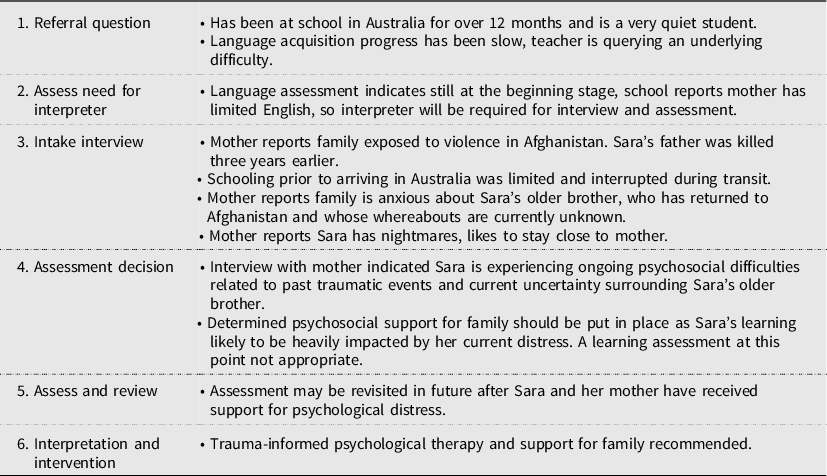
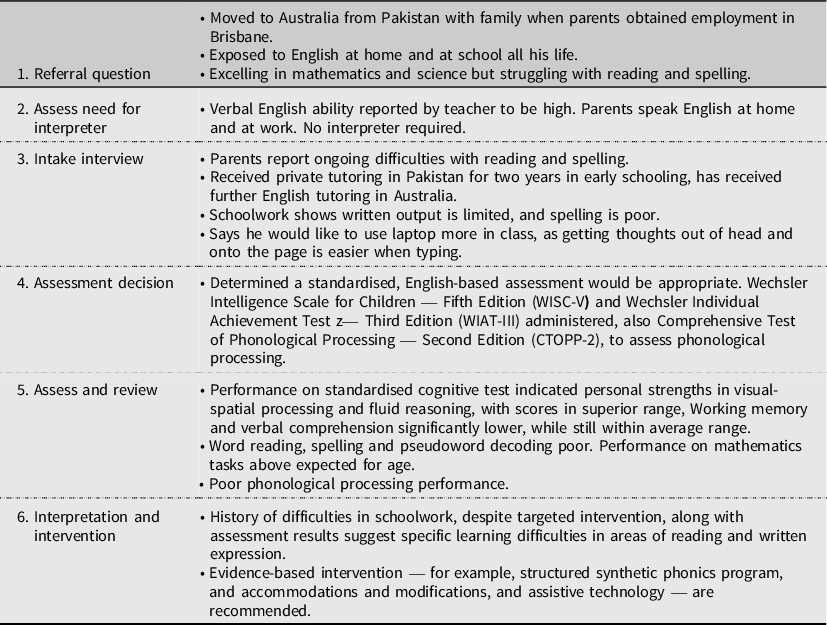
Two case studies are discussed below, demonstrating how learning difficulties can present in different ways for EAL/D students from refugee and migrant backgrounds. The flowchart shown in Figure 1 is a visual representation of the assessment process steps, and can be applied to both case studies. By following the steps outlined in the flowchart, key factors emerging for two different hypothetical case studies are detailed in Tables 3 and 4, along with the assessment decision, interpretations and recommendations for intervention.
Sample assessment tools with considerations for use with assessment of English as an Additional Language/Dialect (EAL/D) students

Case Study 1

Case Study 2

Case Study 1: Sara (11 Years Old)
Sara is 11 years old. Along with her mother and younger sister, she resettled in Australia from Afghanistan 12 months ago. Prior to resettlement, the family spent over a year in transit camps. Sara witnessed episodes of violence in her home country, and her father was killed during conflict. Sara’s education prior to arriving in Australia was limited and interrupted further during resettlement. Little documentation is available relating to her early development and education. Sara’s older brother remained in Afghanistan, and her family are uncertain of his whereabouts, a source of great anxiety for Sara, her mother and sister.
Case Study 2: Adnan (Nine Years Old)
Adnan moved to Australia with his parents and older brother from Pakistan, when his parents obtained professional employment in Australia. Adnan has been exposed to English at home and at school all his life. While doing particularly well in mathematics, Adnan has struggled with reading and spelling since he began school. He received support from a private tutor for two years.
Interventions
Intervention can be considered across all levels of the school system, from a whole-of-school approach to individually targeted programs.
Whole of School
A range of strategies can be implemented at the institutional level to promote the learning of children from refugee and migrant backgrounds. These include:
-
Promoting and celebrating diversity within the school community. Examples could include holding events at the school that focus on the diversity of backgrounds within the school community.
-
Ensuring staff have access to cultural competency training as part of professional development.
-
Seeking out opportunities to engage with parents of children from migrant and refugee backgrounds, and the broader communities.
-
Ensuring staff are aware of any administrative processes involved in assessment of children from refugee and migrant backgrounds — for example, how to arrange for an interpreter.
Classroom
-
Teachers and other staff working within individual classes can also support the learning of children from migrant and refugee backgrounds by ensuring a diverse and inclusive classroom.
-
Consider how classroom displays could be used to celebrate diversity.
-
Invite parents into the classroom where possible to promote the parent-school relationship.
Individual
-
Ensure information on external support groups or agencies is available where a need for referral is identified. This may be for the individual child or for family members.
-
Where assessment indicates a specific learning disorder with impairment in reading is contributing to academic difficulties, ensure evidence-based interventions, such as those based on developing phonological processing skills, are implemented, along with access to appropriate accommodations and adjustments.
-
Where possible, match resources (such as decodable readers) to the developmental age of the student.
Conclusion
With the number of students from CALD backgrounds in Australian schools increasing, school psychologists and guidance counsellors are increasingly likely to receive referrals of students from these backgrounds who are experiencing learning challenges. When assessing EAL/D students from refugee and migrant backgrounds to better understand learning challenges, language and culture are key factors to keep in mind. Standardised assessments may be administered where there is sufficient English language acquired, but validity of test scores must be carefully examined, and tools such as the C-LIM are available to assist with this.
Nonverbal tests may be preferable when language is not sufficient to undertake verbal tests, but these tests still require communication and have been developed within the context of Western culture. Validity must still be examined. Qualitative information is likely to be key to understanding learning challenges for EAL/D students from refugee and migrant backgrounds. There are range of sources that can contribute valuable qualitative information, including parent, student and teacher interviews, a detailed history, observation, standardised assessment measures and modified assessments. Background information, gathered from records and reports, and particularly a detailed interview with the caregiver and/or student, is a key part of the assessment decision-making process prior to any formal psychometric assessment.
Funding
The project was supported by a grant (no. 351) awarded to Nigar G. Khawaja in 2019 by Brisbane Catholic Education (BCE).
Ethical standards
The authors assert that all procedures contributing to this work comply with the ethical standards of the relevant national and institutional committees on human experimentation and with the Helsinki Declaration of 1975, as revised in 2008.
Conflict of interest
None.