With increasing conversion of South-East Asian forests to human-dominated landscapes, dramatic changes in biodiversity are likely to have ramifications on ecosystem processes (Sodhi & Brook Reference SODHI and BROOK2006). Dung beetles (Coleoptera: Scarabaeidae) have been used to investigate how biodiversity changes affect ecosystem functions (Larsen et al. Reference LARSEN, WILLIAMS and KREMEN2005, Slade et al. Reference SLADE, MANN, VILLANUEVA and LEWIS2007). Dung beetles provide important ecosystem services such as dung removal and secondary seed dispersal (Nichols et al. Reference NICHOLS, SPECTOR, LOUZADA, LARSEN, AMEZQUITA and FAVILA2008) and have been shown to be reliable indicators of tropical forest disturbance (Gardner et al. Reference GARDNER, HERNÁNDEZ, BARLOW and PERES2008, Klein Reference KLEIN1989). Here, we determine the effects of forest disturbance on the species richness of dung beetles and ecosystem functions they perform in Peninsular Malaysia and Singapore. As far as we know, there has been no known study published on dung beetle ecology on the Malay Peninsula. In this study, we test the hypothesis that old-growth forests contain dung beetle communities of higher species richness, abundance, biomass and larger body size. Previous studies have shown that changes in dung beetle communities have the potential to disrupt ecosystem services in natural habitats (Larsen et al. Reference LARSEN, WILLIAMS and KREMEN2005, Mittal Reference MITTAL1993). We also investigate whether dung removal is affected by forest disturbance and test the hypothesis that dung removal is reduced in more disturbed forests compared with less-disturbed forests.
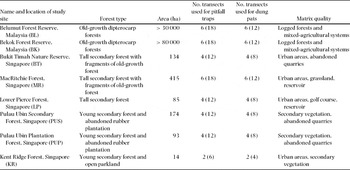
The study took place between 3 September 2007 and 13 March 2008 in eight forest sites located on the island of Singapore and the state of Johor in Peninsular Malaysia (1°38′N, 103°40′E). These experimental sites represent a range of tropical lowland dipterocarp forests (< 200 m in altitude) with varying levels of human disturbance (Table 1). Given that most of Singapore's forests have been subjected to human disturbances (Corlett Reference CORLETT1992), we included two continuous forest sites in Johor to serve as a baseline for dung beetle communities. Peninsular Malaysia and Singapore are part of the shallow Sunda Shelf (Voris Reference VORIS2000) that had been connected by a land-bridge several times during the Pleistocene ice ages. We included the forests in Peninsular Malaysia as they remain the best representation of a natural and undisturbed forest site for comparison.
Summary information of eight study sites in Peninsular Malaysia and Singapore. The numbers in parentheses refer to the total number of pitfall-trap transects carried out during three sampling cycles and the total number of dung-pat transects carried out during two sampling cycles.

At each of the eight sites, we conducted three cycles of dung beetle (Scarabaeinae, Aphodiinae) trapping using baited pitfall traps. Between two and six 120-m transects were randomly selected and placed at least 200 m apart at each experimental site (Table 1). A different set of transects was randomly placed during each of the three sampling cycles. Five pitfall traps (7 cm diameter, 9 cm depth) baited with c. 20 g of fresh cattle dung, were placed at 30-m intervals along a single transect. Baits were suspended 5 cm from the mouth of the traps using a piece of twine tied to a 20-cm wooden skewer. Each trap had a large leaf as a rain cover and a mixture of detergent and saturated salt solution (25%, v/v). Traps were collected after 48 h in the field.
Captured dung beetle individuals were preserved in 100% ethanol and identified to species in the laboratory. Specimens that could not be identified to species were identified to genus and assigned unique morphospecies numbers. We took measurements of dung beetle body length from 10 randomly selected individuals of each species with a ruler (± 0.1 cm). We did not separately measure males from females, as the sizes of both sexes were not distinctly different. To obtain the mean biomass of each dung beetle species, up to 10 individuals of each species were dried in an oven for 3 d at 70°C, until constant weight of beetles was achieved. Each individual was weighed on an electronic balance accurate to ± 0.001 g. For species that were too light (< 0.001 g) to register on the balance, their collective biomass was taken and an average weight was used.
Dung removal experiments were conducted twice (3 September–7 October 2007, and 31 January–13 March 2008) using standardized dung pats (7 cm diameter, 4 cm depth) made with c. 50 g of fresh cattle dung. Depending on the area of the site, 2–6 transects of 90 m each were set up (Table 1). Transects involved in dung-removal experiments were used for dung beetle sampling 1 d later to detect dung beetle species which were closely associated with the removal of dung. Within one transect, three experimental setups were separated at 30-m intervals and transects were separated from each other by 200 m. At each experimental set up, a pair of dung pats were placed 10 cm apart and subjected to either of these two treatments: (1) caged dung pat which acted as a control and was covered with a 2 × 2-mm green netting to exclude the smallest dung beetle from entering and (2) exposed dung pat without netting to allow complete access to dung beetles. The dung pats were left under a rain cover in the field and collected after 24 h. Any dung beetles found were removed by hand and dung pats were subsequently air-dried for 1 wk before being oven-dried until constant mass was achieved. Both dung pats were weighed using an electronic balance accurate to ± 0.01 g and mass loss between caged and exposed dried dung pats were used as a representation of dung removed by dung beetles.
The Kruskal–Wallis (K–W) test was used to determine if the mean value of captured dung beetle species, individuals, body length and biomass per transect across all sites were significantly different. On finding significant differences, the mean values were ranked and Duncan's multiple range test was used to determine which sites were different from the rest. Wilcoxon rank-sum test was performed on caged and removed dung pats for each site to assess the level of dung removed by the dung beetle communities.
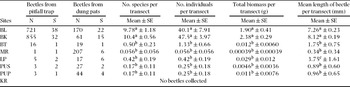
Individuals and species collected per transect differed significantly among sites (K–W = 70.3, df = 6, P < 0.0001 and K–W = 71.1, df = 6, P < 0.0001, respectively). Duncan's multiple range tests showed that the mean number of species and individuals per transect was significantly higher (P < 0.0001) in old-growth forests (e.g. Belumut) than disturbed forest sites (e.g. Lower Pierce). Furthermore, there was no significant difference among disturbed forest sites (Table 2). Our results are consistent with those of several other studies conducted in the region, which show that dung beetle species richness and abundance in disturbed forests is lower than that of undisturbed forests (Boonrotpong et al. Reference BOONROTPONG, SOTTHIBANDHU and PHOLPUNTHIN2004, Davis et al. Reference DAVIS, HOLLOWAY, HUIJBREGTS, KRIKKEN, KIRK-SPRIGGS and SUTTON2001, Shahabuddin et al. Reference SHAHABUDDIN, SCHULZE and TSCHARNTKE2005). In Sulawesi (Indonesia), Shahabuddin et al. (Reference SHAHABUDDIN, SCHULZE and TSCHARNTKE2005) found that abundance and species richness was highest in natural, least-disturbed forests, but did not differ significantly between young secondary forests and agroforestry systems.
Site data on dung beetle catch from pitfall traps and dung pats (N = number of individuals, S = number of species). Mean values of dung beetle catch were calculated with the average values of each transect over the total number of transects per site. Calculations were based on data collected solely from pitfall traps. Mean values within a column with different superscripts are statistically different from each other (Duncan's multiple range test, P < 0.05). For site abbreviations, see Table 1.

The lower dung beetle species richness and abundance in Singapore sites compared with Malaysian sites may be due to the smaller sizes of forest patches in Singapore. Smaller forests lead to declines in mammalian fauna (Laidlaw Reference LAIDLAW2000) that is correlated with a decline in dung beetle abundance and species richness (Andresen & Laurance Reference ANDRESEN and LAURANCE2007, Nichols et al. Reference NICHOLS, GARDNER, PERES and SPECTOR2009). There is a possibility that the low dung beetle species richness we observed in Singapore is related to the ‘island effect’, as our study sites were spread from mainland Malay Peninsula to Singapore and Pulau Ubin islands. Heaney (Reference HEANEY1984) showed a strong correlation between island size and mammalian species richness on islands around the Sunda Shelf. These factors may work synergistically, resulting in a depauperate dung beetle fauna in Singapore.
We found the highest total biomass and mean length of beetle in old-growth forests (Table 2). The mean length of beetle in Lower Pierce was higher than expected and approximately three times higher than the rest of disturbed forest sites (Table 2). No dung beetles were caught at Kent Ridge, Singapore. The decline in mean values of biomass and body length of dung beetles from primary continuous forests to other disturbed forest types, is consistent with results from Scheffler (Reference SCHEFFLER2005) and Gardner et al. (Reference GARDNER, HERNÁNDEZ, BARLOW and PERES2008), where larger beetles are more susceptible to population declines due to increasing disturbance, compared with smaller-bodied beetles. Hotter and drier environmental conditions in disturbed forests present a challenge for large dung beetles that dissipate excess heat slower (Bartholomew & Heinrich Reference BARTHOLOMEW and HEINRICH1978, Chown Reference CHOWN2001). The only large dung beetle in Singapore is Paragymnopleurus maurus, a roller beetle found in Lower Pierce and has also been observed to persist on small-forested islands in Lake Kenyir, Peninsular Malaysia (Qie L., pers. obs.).
Apart from Bukit Timah and Kent Ridge, all forest sites showed a decline in exposed dry dung mass. Old-growth forests showed significant dung-removal activity, with 70.1% and 27.5% of dung removed in Bekok and Belumut respectively. Dung removal was also high in a degraded forest – Pulau Ubin Plantation – with 34.5% of dung removed from our experimental set ups. Dung removal and subsequent mixing with the soil layer by dung beetles for breeding and feeding purposes is the first step towards all other critical ecosystem services (Nichols et al. Reference NICHOLS, SPECTOR, LOUZADA, LARSEN, AMEZQUITA and FAVILA2008). The process of dung removal by dung beetles has shown to decrease with increasing fragmentation and disturbance of forests in the Neotropics (Horgan Reference HORGAN2005, Klein Reference KLEIN1989) and our results support similar findings. Habitat disturbance reduces the general abundance of mid- to large-sized mammals (Laidlaw Reference LAIDLAW2000) that provide the main food source for a majority of dung beetle species (Estrada & Coates-Estrada Reference ESTRADA and COATES-ESTRADA1991). The old-growth continuous forests, which still contain large mammals, are therefore able to support a greater variety of large tunneller species (Cartharsius molossus, Copris agnus, C. doriae, C. haroldi, C. ramosiceps), which can contribute up to 75% of dung removal in tropical dipterocarp forests (Slade et al. Reference SLADE, MANN, VILLANUEVA and LEWIS2007). Out of the sites from Singapore, Pulau Ubin Plantation had high levels of dung removal. The higher density of wild boar Sus scrofa and long-tailed macaque Macaca fascicularis in a smaller forest area may have affected the dung beetle community there. Whether a robust population of small-bodied dung beetles compensates the absence of large tunnellers in this forest type should be investigated further. Altered dung beetle communities in disturbed forests may result in reduced ecosystem services such as parasite suppression (Horgan Reference HORGAN2005) and secondary seed burial (Andresen Reference ANDRESEN2003) during the process of dung removal. More research on the effects of human disturbance on other dung beetle-mediated ecosystem functions is still much needed in South-East Asia.
To summarize, our results show that there are significant changes in the species richness, abundance, biomass and mean body in disturbed forests compared with the undisturbed continuous forests. Such changes are highly likely to be a result of anthropogenic influence, though we are cautious not to rule out geographical influences such as the island effect. Changes in forest dung beetle communities may have led to the reduction in dung removal between undisturbed and disturbed forests, apart from a single site in Singapore, where it is presumed to contain a robust dung beetle population that could have established due to a high density of mid-sized mammals.
ACKNOWLEDGEMENTS
We are especially grateful to the National Parks Authorities in Singapore and the Economic Planning Unit in Malaysia for issuing research permits for this study, and the Singapore Zoological Gardens for the cattle dung provided for our research. Funding and support came from the National University of Singapore (Grant no. R-154-000-331-112). We would also like to express our gratitude to the following people whose comments have helped improve the manuscript: Mary Rose Posa, Qie Lan, Enoka Priyadarshani Kuda Vidanage, Matthew Lim Lek Min and Lian Pin Koh.