1 Introduction
1.1 (Adjectival) resultative constructions: causation and force-dynamics
This article is about the history of English adjectival resultative constructions (RCs), e.g. He wiped the table clean, never previously the subject of detailed investigation. However, before the historical analysis proper and in order to understand its importance, some general remarks on RCs are needed.
RCs (see e.g. Goldberg Reference Goldberg1995; Boas Reference Boas2003; Broccias Reference Broccias2003 among others) are usually defined as constructions containing a resultative phrase. A resultative phrase (RP) is, according to Levin (Reference Levin1993: 101), ‘an XP which describes the state achieved by the referent of the noun phrase it is predicated of as a result of the action named by the verb’. All three transitive examples in (1) below count therefore as RCs. The adjective clean in (1a) describes the state achieved by the table as a result of the event of somebody wiping it, the adjective hoarse in (1b) refers to the state the subject referent ended up in as a result of talking (possibly too much), and, finally, the adjective threadbare is predicated of the subject referent's sneakers as a result of him running probably too much. The sentences in (1) also show that English transitive RCs are found with all verb types, i.e. transitive (wipe), unergative (talk), and unaccusative (run). This also means that in the latter two cases the constructional objects (himself and his sneakers respectively) are not possible objects of the constructional verbs (talk and run) if they are used in isolation, i.e. independently of the construction in which they appear (cf. *He talked himself, *He ran his sneakers). For this reason, the reflexive object in (1b) is usually referred to as a fake reflexive (i.e. it is not subcategorised by the verb itself but, rather, by the construction).
- (1)
(a) He wiped the table clean.
(b) He talked himself hoarse.
(c) He ran his sneakers threadbare.
Some analysts (e.g. Halliday Reference Halliday1967; Rapoport Reference Rapoport1999) have pointed out however that we should distinguish ‘proper’ resultative examples like (1) from what I will refer to here as pseudo-RCs like (2):
- (2)
(a) He cut the bread thin.
(b) He painted the door red.
The distinction is explained most clearly by Rapoport (Reference Rapoport1999: 672) in connection with the example Smith cut the bread into thick slices, which differs minimally, from a syntactic point of view, from (2a) in that it employs a resultative PP (into thick slices) rather than a resultative AP (i.e. thick):
[The e]xample [Smith cut the bread into thick slices] . . . is not some kind of (double) resultative meaning ‘Smith caused the bread to go into thick slices by causing the bread to go to a cut state.’ What [this example] means, roughly is ‘Smith caused the bread to go to a cut state and the (final) cut state was (into) thick slices.’ The PP into thick slices is a modifier of the final cut state . . . (Rapoport Reference Rapoport1999: 671)
Rapoport's comment is based on a causal (see below) analysis of ‘proper’ RCs (see also Goldberg Reference Goldberg1995; Goldberg & Jackendoff Reference Goldberg and Jackendoff2004 inter alia). That is, ‘proper’ RCs are analysed as stemming from the conflation of two subevents, a causing subevent, e.g. talking in (1b), and a caused (or resultant/resultative) subevent, e.g. somebody becoming hoarse in (1b). Since cut entails a change of state, or to put it differently, since cut denotes an accomplishment, cut cannot be said to refer to a causing event (alone). Cut implies reference to both a causing and a caused event. Hence, the adjective thin in (2a) and the PP into thick slices (cf. Rapoport's example) are viewed as what can be called specifiers. They specify the change of state entailed by the verb. A similar analysis applies to paint in (2b) since this verb also entails a change of state.
However, a distinction should be drawn between what I will call causativity, i.e. the property by which a verb can be classified as causative, and what I will call causality, i.e. whether a construction depicts a causal chain of events, in the sense of Talmy (Reference Talmy2003); see also Ungerer & Schmid (2006: 226–9). For example, the fact that cut is a causative (accomplishment) verb does not mean that it does not depict a causal chain of events: quite the opposite, of course. Hence both ‘proper’ RCs and pseudo-RCs are similar in that they both evoke a causal scenario but differ in that, in the former type, the verb only symbolises the causing event in the causal chain, while in the latter type the verb symbolises both the causing event and the caused event in the causal chain.
In fact, the relation between causativity, a verbal property, and causality, a constructional property, is a matter of degree. Consider the following examples:
- (3)
(a) The police kicked him black and blue.
(b) He wiped the table clean.
(c) He cut the bread thin.
Kick neither entails nor probably implicates a change of state; hence we say that kick is not a causative verb and this example would count as a ‘proper’ RC, kick symbolising the causing event in the causal sequence (roughly) ‘the police caused him to become black and blue by kicking him’. (3c), which reproduces (2a), can be analysed as a pseudo-RC because cut is a causative verb. But we still have a causal chain. Cut symbolises both the causing and the caused subevents. Wipe in (3b) lies in the middle because it intuitively evokes a change of state more readily than kick, i.e. a change of state is probably an implicature for wipe, but not as readily as cut. That is, within the causal chain evoked by the construction in (3b), wipe symbolises the causing event and, to some extent, the caused event (a similar point concerning the continuous nature of the relation between verbs and constructions is also made by Langacker (Reference Langacker, Ruiz de Mendoza Ibáñez and Cervel2005) concerning the so-called Caused Motion Construction, e.g. He kicked the football into the garden).
The advantage of distinguishing between causativity and causality is also evident when we consider examples like (4):
- (4)
(a) The clothes dried wrinkled.
(b) The river froze solid.
The sentences in (4) are usually said to instantiate the so-called intransitive RC. It is a matter of debate, however, whether the examples in (4) can be analysed causally. Goldberg (Reference Goldberg1995), for example, argues against a causal analysis of intransitive examples. Broccias (Reference Broccias2003), by contrast, contends that a causal analysis is possible. Consider (4a) first. Dry is an achievement verb, i.e. it entails a change of state (that of becoming dry), but the adjective wrinkled does not refer to/specify the state of dryness, i.e. wrinkled is not a specifier. Rather, wrinkled could be said to refer to the state achieved by the clothes as a result of the drying event. In other words, a causal paraphrase is clearly possible, ‘the fact that the clothes dried (too much) caused the clothes to become wrinkled’. In (4b), solid seems to simply specify that the freezing event was complete, i.e. affected the whole river; see also Broccias (Reference Broccias2006). Nevertheless, one could claim that the example is still causal, the verb symbolizing only the caused subevent.Footnote 2 In sum, the classification of an example as a ‘proper’ RC, be it intransitive or transitive, simply depends on the conceptual distance between the event symbolised by the verb and the state referred to by the adjective. If the latter does not ‘paraphrase’ the former, then we have a ‘proper’ RC. But the previous discussion has also shown that the distinction between ‘proper’ RCs and pseudo-RCs may actually be a matter of degree. Crucially, causality can apply across the board both to transitive and intransitive examples.
Some analysts (see Broccias Reference Broccias2003 in particular but also Talmy Reference Talmy2003 and Langacker Reference Langacker, Ruiz de Mendoza Ibáñez and Cervel2005) have therefore focused on another notion, alongside that of causality (and that of causation). Broccias (Reference Broccias2003) contends that (in general) the distinguishing factor between transitive and intransitive examples is not causality but rather force-dynamics, to use Talmy's terminology, or energy transmission, in Langacker's words (I use these two terms as well as ‘energetic interaction’ and ‘energy flow’, see below, interchangeably). Force-dynamics (see Ungerer & Schmid Reference Ungerer and Schmid2006: 178–81 for a more detailed introduction) has to do with our view of the world ‘as being populated by discrete physical objects’ (Langacker Reference Langacker1991: 13). These objects interact with one another by exchanging energy, that is by exerting forces onto one another, so that changes (of position/state) ensue. One obvious example is a ball which is set in motion because of forceful contact with another ball that was already in motion. Importantly, the force-dynamic model is reflected in (or ‘symbolised by’) linguistic structure. For example, the transitive clause Tom broke the glass with a hammer can be linked to the conceptualisation of Tom as an energy source (or Agonist, in Talmy's words) acting, through the use of a hammer, upon an energy sink (or Antagonist, in Talmy's terminology), the glass in the case at hand. The result of Tom's exerting a force upon the glass is the glass's change of state, i.e. its ending up in a broken state. The intransitive clause The glass broke, on the other hand, only depicts the result part (or ‘tail’ in Langacker's words) of the action chain (see also the discussion above).
If we go back to the examples discussed so far, we notice that all the transitive cases symbolise an energetic interaction, either literal or metaphorical. For example, (1a), He wiped the table clean, describes a concrete energetic interaction (an energy flow) between, in Broccias’ (2003) terminology, a manipulator (he) and a manipulee (the table), resulting in a change of state of the latter. (1b), He talked himself hoarse, and (1c), He ran his sneakers threadbare, also involve energetic interactions. The subject referent can be described as a manipulator (not necessarily an intentional one, of course) who brings about some change of state in the manipulated entities, himself and his sneakers, respectively. The crucial point is that the verbal event can be construed metaphorically as a force or energy flow connecting the manipulator to the manipulee.
The force-dynamic analysis summarised here for transitive cases does not apply to intransitive examples. In (2a), for instance, the clothes cannot be described as a manipulator (rather, they are an affected entity). However, notice that, as was remarked above, a causal interpretation is still possible. It seems therefore that force-dynamics is a crucial notion for transitive examples, be they ‘proper’ RCs (the verb is not causative) or pseudo-RCs (the verb is causative).Footnote 3 We will see later that the earliest occurrences of adjectival RCs (in general, i.e. both ‘proper’ and pseudo-RCs) also evoke force-dynamics and that the history of this construction is one of expansion towards ‘proper’ (i.e. causative) RCs involving a metaphorical interpretation of verbal events, i.e. cases like (1b) and (1c).
1.2 Resultative adverbs
There is an important complication in the analysis of (adjectival) RCs, namely the fact that adverbs can sometimes be used in constructions which also have a resultative meaning. When this is so, such adverbs are usually called resultative adverbs (see e.g. Quirk et al. 1985: 560; Geuder Reference Geuder2000). Further, they cannot usually be replaced by adjectives (except in the colloquial register):
- (5)
(a) She fixed the car perfectly/#perfect.
(a′) The car is perfect.
(b) He grows chrysanthemums marvellously/#marvellous.
(b′) The chrysanthemums are marvellous.
(c) He loaded the cart heavily/#heavy.
(c′) The cart is heavy. vs The load is heavy.
(d) He cut the bread thinly/thin.
(d′) #The bread is thin. vs The slices are thin.
(5a) is an instantiation of what can be called the adverbial RC. Its syntax is the same as that of adjectival RCs except for the occurrence of an adverb in place of an adjective. Importantly, it is still possible to envisage a relation of predication between the RP and the manipulated entity, i.e. the direct object in the examples in (5). Whereas in (1a), He wiped the table clean, the predication relation was direct in the sense that the adjective refers directly to a property of the manipulee, i.e. ‘The table is clean’, this relation is indirect in e.g. (5a) because it involves the base of the adverb (perfect) rather than the adverb itself. In (5a), the car can be said to be perfect, i.e. in a perfect state. Similarly, the chrysanthemums can be described as marvellous in (5b). More complex is (5c). Which element can heavy be predicated of? It could describe the cart itself but also, and perhaps more plausibly so (see Geuder Reference Geuder2000 for details), what Geuder (Reference Geuder2000) calls the ‘resultant object’. Loading a cart results in the creation of a load. Similarly, in (5d), cutting a loaf of bread results in the creation of slices. These two resultant objects, load and slices, can be said to be heavy and thin, respectively. Hence, an adverbial RC involves a predication relation between a resultant object (if the verb can be construed as a verb of creation, as is the case for all verbs in (5) with the exception of fix; see (5a)) and the property to which the base of the adverb refers.
But there is a complication. Observe that in (5d), contrary to what happens in the other examples in (5), an adjective (thin) is also possible (independently of considerations of register). However, notice also that the adjectival version of (5d) differs from the other adjectival RCs considered in the previous subsection in that it does not allow, strictly speaking, for a direct predication relation between object and RP: it is not the bread but rather the slices which are thin. By contrast, ‘The table is clean’, see (1a), is perfect. Why is this so? Related to this point is the more general question of what criteria, if any, explain the occurrence of adverbs in place of adjectives (or vice versa) in so-called adverbial RCs.
Broccias (Reference Broccias2003, Reference Broccias2004) goes some way towards resolving this question by observing that some adverbial RCs involve subjective properties. The conceptualiser (i.e. the speaker), by using adverbs like perfectly and marvellously, as in (5a) and (5b) respectively, evaluates some resultant state. Perfection and beauty are, intuitively, more subjective properties than being clean, hoarse, thin and red, as in (1)–(2). Colour, for example, is naively regarded as being out there in the world independently of the conceptualiser (see also Fauconnier & Turner Reference Fauconnier and Turner2002: 79–81 for a similar point). Similarly, hoarseness implies well-defined, ‘objective’ physical effects. By contrast, perfection and beauty involve some subjective evaluation on the part of the conceptualiser. After all, as the proverb goes, ‘beauty is in the eye of the beholder’: the subject referent in (5b), for instance, may not find his chrysanthemums marvellous at all. The property of being marvellous is attributed to them by the speaker on the basis of her/his personal taste.Footnote 4
Admittedly, it is more difficult to seek a justification along these lines for heavily, (5c), and thinly, (5d). The occurrence of an adverb may be justified by the fact that some notion like ‘instrument/manner’ is involved in the examples in question and adverbs are typically used with that function. For example, the adverb in (5c) may be paraphrased as ‘with a heavy load’ (e.g. with a lot of boxes). Thinly in (5d) does not simply refer indirectly to the state of the resultant object (‘The slices are thin’) but may also be taken to depict how the action of cutting is carried out: the knife is placed close enough to one end of the loaf so as to produce thin slices, i.e. the distance between the edge of the knife and end of the loaf is small. These observations may motivate why adverbs are employed. Still, an interesting contrast obtains between (5c) and (5d), on the one hand, and (6), on the other hand:
(6) He painted the door *redly/red.
(6) is fine with an adjective but not with an adverb. Nevertheless, some notion like ‘instrument’ may be said to be relevant. The door ends up red because red paint was used. But colours, in our naive view of the world, are regarded as objective properties; hence, the use of an adjective is expected. One way out of this paradox (we may expect an adverb because the notion of instrument is relevant but we may also expect an adjective because we are referring to an objective property) could be to claim that heavily and thinly are more subjective than red, and heavily is more subjective than thinly (this would capture the difference between heavily and thinly vis-à-vis their potential substitution by the related adjectives). Schematically, we would have the continuum in figure 1 vis-à-vis the resultative constructions considered here (objectivity increases as one moves to the right). I will not try to settle the question of the status of adverbs vs adjectives in RCs here. However, I have pointed out that one relevant dimension of analysis may be the difference between objective and subjective properties and that such properties may be arranged along a continuum.
A possible objectivity scale

It must also be remarked that the status of certain RPs in terms of an either/or distinction between adjectives and adverbs is not clear. This is so with thin, for example. Thin, as well as small (in examples like She cut the sausage small) for that matter, was originally an adverb (see their respective entries in the Oxford English Dictionary, OED). It may be the case that thin and small in RCs are actually represented fuzzily in the speaker's mind (see Aarts et al. Reference Aarts, Denison, Keizer and Popova2004 on fuzziness in grammar and see e.g. Himmelmann & Schultze-Berndt Reference Himmelmann and Schultze-Berndt2005 on the relation between secondary predication, of which adjectival RPs are an instance, and adverbials). On the one hand, morphologically, they are not prototypical adverbs (if we accept that adverbs prototypically take an -ly suffix); on the other hand, they behave like adverbs in that they evoke notions like manner and they cannot be predicated of the constructional object (e.g. bread) but, rather, of the resultant object (e.g. slices of bread). Finally, one should note that, originally, non-ly adverbs tended to be more concrete than -ly adverbs (see Donner Reference Donner1991, also quoted in Brinton & Traugott Reference Brinton and Traugott2005).Footnote 5 In other words, both the notion of objective vs subjective properties and word-class fuzziness may be relevant factors in the analysis of RCs. Since the historical analysis, especially in the older stages of the language, proves resistant to a clear-cut word-class analysis, I will be using the neutral label ARC to refer to an RC (either a ‘proper’ or a pseudo-RC) containing either an adjective or an adverb which is not marked with an -ly suffix (bearing in mind that a clear-cut distinction between the two is not always possible). Moreover, I will use the label A to refer to the relevant RP (irrespective of its word-class status).
To sum up, the discussion so far has highlighted the importance of the notions of causality (a constructional notion to be separated from that of causativity, which applies to verbs) and force-dynamics in the synchronic analysis of RCs as well as the ambiguous status of some examples in relation to the distinction between adjectives and adverbs.
In what follows, I will offer a corpus-based analysis of the history of the adjectival RC, from Old English (section 2.1) through Middle English (section 2.2) to Early Modern English (section 2.3). This topic is of some importance both descriptively, since it sheds light on a (diachronically) much neglected topic, and theoretically. As to the latter point, I will try to show that the notion of force-dynamics is not only relevant to the analysis of present-day RCs (as argued e.g. in Broccias Reference Broccias2003) but also plays a crucial role in the evolution of this construction. I will argue that the historical data can be interpreted as pointing to the expansion of the RC from very specific instantiations, involving a limited set of verbs and adjectives/adverbs, towards more and more general types. This evolutionary path correlates with the metaphorical interpretation of actions as forces and the emergence of ‘proper’ causative examples (i.e. the verb no longer symbolises both the causing subevent and the caused subevent). Further, the present study testifies not only to the importance of the notion of force-dynamics in language but also to the importance of the usage-based model in linguistic analysis (see e.g. Taylor Reference Taylor2002: 27–8 for a summary). RCs probably emerge out of specific instantiations (e.g. as analogical extensions) rather than being directly related to an abstract template or construction (e.g. the causative construction).
The focus of the present investigation will be on the transitive pattern because of the paucity of the data involving intransitive examples (see section 2). The analysis also considers only adjectival RPs because, at present, it is still very difficult to extract RCs containing PPs from the available historical corpora; adjectival instantiations are easier to retrieve. To be sure, the conclusions arrived at here, which are summarised in section 3, must be checked against future investigations which take the evolution of prepositional RCs into account as well as the development of RCs in other Germanic languages (as is pointed out in section 3).
2 ARCs from Old English to Early Modern English
2.1 Old English
2.1.1 Previous analyses
I will start my discussion of OE RCs by commenting on previous analyses, which include, to the best of my knowledge, only a fleeting reference in Mitchell (Reference Mitchell1985) and a more detailed examination in Visser (Reference Visser1963).
Mitchell (Reference Mitchell1985: §129) observes that predicative adjectives (and participles) in the accusative are declined strong when they are declined. Still, he does not discuss resultative examples in any detail. The only ‘resultative’ example that he mentions is ÆCHom i.10.18 God hī gescēop ealle gōde ‘God created them all good’.Footnote 6 But it is debatable whether this example – which has an adjective declined strong – should be categorised as an instance of the resultative construction. Verbs of creation do not symbolise an energetic interaction between a manipulator and a manipulee (i.e. an affected entity) but, rather, a relation between a manipulator and a created (i.e. effected) entity.Footnote 7
Visser (Reference Visser1963: §659) remains up to now the only scholar to have commented at some length on ARCs from a diachronic perspective by way of a list of examples (arranged alphabetically by verb), starting with Old English data. Visser does provide some noncreation verb resultative constructions for Old English. However, as will be shown below, it is difficult to say whether his examples contain (accusative marked) adjectives. An alternative hypothesis would be to regard A in (some of) these examples as an adverb because of the -e ending found in most As, which is not only a possible adjectival ending for e.g. strong accusative feminine singular and all accusative plural forms but also a possible adverbial suffix. Importantly, Visser does not explicitly say whether his Old English data contain adjectives or not. He simply claims that the examples provided contain predicative adjuncts. Still, with the exception of the Old English (and possibly some Middle English/Present-day English) data, the remaining examples provided in Visser seem to have adjectival As. The four Present-day English examples heading Visser's §659 (He slept himself sober, He roared himself hoarse, He shrove himself clean, I painted the door green) are a case in point.
Before examining Visser's examples in more detail, it should be pointed out that unambiguously adverbial cases can indeed be found in Old English. Scēafmǣlum in (7), for instance, can be regarded as an adverb (see e.g. the corresponding entry in Clark Hall Reference Clark Hall1960) which codes both manner and result (in the sense that bundles of corn-cockle are created as a result of the action of tying the corn-cockle).
(7)


Keeping this example in mind, we can now move on to Visser's examples, which are all reproduced below in alphabetical order:Footnote 8
(8)
(9)
(10)
(11)
(12)
If we ignore (9) for the moment and take fægre in (10b) as being related to the notion of cleanness (see below), the remaining five examples can be divided into two types, as is shown in (i) and (ii) below (the verbs in small caps stand for classes of verbs which are semantically similar):
(i) wash + clean, e.g. āwascan clǣne, feormian clǣne
(ii) cut + small, e.g. gnīdan smale, gescearfian smale
Both types contain an RP which is to be interpreted as a specifier (see section 1.1) and evoke a force-dynamic scenario. Unfortunately, it is not possible to decide whether the RPs are adjectival or not. Let us consider clǣne first. Whether declined (strong) or not, the expected form for clǣne in (8) would be exactly that. Its referent, hit, is neuter and no case ending was used in the strong accusative singular of the adjectival declension. Further, this form, ending with an -e, can also be that of the corresponding adverb. By contrast, clǣne in (10) seems to be unmarked for accusative case. The case ending for the strong accusative singular of masculine adjectives – the referent of clǣne in (10) is the masculine NP þone pyt – is -ne. But here clǣne, rather than clǣnne, is used. Of course, this does not necessarily imply that clǣne is not an adjective since it could have been left undeclined (or the scribe could erroneously have used one n instead of two). Importantly, however, clǣne in this example (as well as other similar ones with wash verbs) is categorised as an adverb in the Dictionary of Old English (DOE, s.v. clǣne adv.). Further, this use of clǣne is listed in the DOE as a subsense of adverb clǣne meaning ‘utterly, entirely, completely, altogether, with nothing remaining or omitted’. Some examples of this use (mentioned also in Bosworth & Toller 1898/1921, BT for short, and Mitchell Reference Mitchell1985) are given below for the sake of completeness:
(13)
(14)
(15)
(16)
(10b) also seems to be an adverbial RC. fægre is analysed in this example as an adverb in the DOE (s.v. fægere, sense 3, ‘so as to be free from blemish or impurity’). It occurs in a riddle whose solution is ‘spear’. The preceding lines in the riddle make it clear that the intended referent is masculine (see lines 2–4, oþþæt me onhwyrfdon gēarum frōdne of. . . ‘until [they] turned me, old with years, from. . .’, where frōdne ‘old’ is an accusative masculine adjective). Hence, if an adjective were used in (10b), we would expect either undeclined fæger or declined fægerne, rather than the form fægre. The latter is, therefore, perhaps best analysed as an adverb, as in the DOE. This use would be similar to the one which was commented on with reference to (5b) above, He grows chrysanthemums marvellously, where a resultative adverb (used to convey a subjective evaluation of the resultant object) is employed.
Similar considerations about the categorial ambiguity of A in OE ARCs apply to what can be glossed as Present-day English small, which is found in conjunction with verbs of cutting. Since feminine wyrta – or more correctly, the parts of the plant resulting from the action of cutting (see the discussion of (5d) above) – is the entity of which smallness is intended to be predicated, the (strong feminine) -e ending is indeed expected if small is an adjective. But this form is syncretic with the corresponding adverb, so the issue concerning the status of small in (11) and (12) cannot be settled.
Two more examples with small from the Old English Herbarium (De Vriend Reference De Vriend1984)Footnote 9 are worth considering at this juncture (the remaining examples with small in the Old English Herbarium are inconclusive because the intended object referent is always feminine wyrta, as in (11)–(12) above):
(17)
(18)
Smæl in (17) has no ending. If it were declined as a strong adjective, the strong feminine ending -e would have been appended. (This ending, however, would make the lexical item in question morphologically indistinguishable from the corresponding adverb.) Still, smæl could be an undeclined adjective or an -e-less variant of the adverbial form. Smæle in (18) is perhaps best analysed as an adverb. Mitchell's observation concerning undeclined predicative adjectives does not apply here because the alleged adjective smæle is not in an accusative position (unless, of course, undeclined forms were also possible when the intended referent was not found in a direct, i.e. nominative or accusative, case position). Hence, if this lexical item were used as an adjective, we might expect the genitive form smæles to be used.
It must be pointed out that the issue of the categorisation of clǣne and smæle is further complicated by the fact that (at least) clǣne is found in OE as the object complement of complex transitive (causative) dōn ‘do’ (roughly corresponding in meaning to Present-day English make),Footnote 10 as in (19):Footnote 11
(19)
Cases like (19) support an adjectival analysis for clǣne since dōn is a complex transitive verb (i.e. it requires an object complement, and object complements are not usually realised as adverbs). Consequently, one might view (at least some of) the examples discussed above as elaborations of the causative construction associated with dōn (i.e. a construction describing an interaction between a manipulator and a manipulee resulting in the latter's change of state). In other words, the causative construction with dōn can be viewed as a schematic RC. It is schematic because the verb does not specify, for example, the manner in which the change of state took place. Conversely, the verb in an elaborated ARC would specify the manner in which the resultant state was brought about, so that such specific ARCs can be called ‘manner’ RCs in order to distinguish them from ‘schematic’ resultatives with verbs of making (e.g. dōn). For example, in (8), something is made clean by washing it; hence, (8) would count as a specific, manner RC relative to the general, schematic causative (or resultative) construction. Still, it must be pointed out that this analysis is not necessarily on the right track (or, at least, it is not necessarily viable in all instances), because a case language like Latin, for example, would use adjectives in sentences like (19) but adverbs in manner-specific instances like (17) (if a prepositional phrase, apparently the preferred option in, for example, the Latin source of the Old English Herbarium, is not used). This is shown in (20):Footnote 12
(20)
While the OE version has a PP, tō smælon dūste (‘into fine dust’), the Latin source combines a PP (in pulverem ‘to dust’) with an adverb in the superlative (mollissime ‘very finely’).
The only unambiguously adjectival ARC example mentioned in Visser (Reference Visser1963) was given in (9) above, which is reproduced below for the sake of convenience:
(9)
Orwīgne is clearly accusative marked (it has the ending -ne). It should be noted, however, that Visser does not place a comma after gebunde, while the quotation in (9) does. This is an important point because ǣghwæs orwīgne may be an appositive AP as the translation in (9) suggests (i.e. ‘you have bound me, wholly powerless to resist, firmly with fetters’ rather than ‘you have made me wholly powerless by binding me firmly with fetters’). The difference may be relevant to the analysis of this example and could make (9) a dubious instance of the adjectival ARC.
All in all, the issue of the categorial status of A in the Old English ARCs considered above cannot be solved satisfactorily – in fact, it may even point to a ‘fuzzy’ categorisation of A in ARCs in the Old English speaker's mind, as was observed in section 1.2.
2.1.2 Corpus evidence
The obvious question is therefore whether unambiguously adjectival ARCs can be found in Old English. In order to try to answer this question, a corpus search was carried out by using the 1.5 million word York–Toronto–Helsinki Parsed Corpus of Old English Prose (YCOE, Taylor et al. 2003) and the 71,490 word York–Helsinki Parsed Corpus of Old English Poetry, known as the York Poetry Corpus for short (Pintzuk et al. 2001).Footnote 13 These two parsed corpora allow the user to search for all predicative nouns and adjectives (or, at least, all lexemes parsed as such in the corpora). The search returned a total of 2,620 hits in the YCOE and 138 in the York Poetry Corpus. The hits had to be inspected manually so as to distinguish depictive from resultative examples and nominal from adjectival cases (cases where the adjective was in the nominative were also returned and they have been included in the present analysis since they can result from the passivisation of a complex transitive sentence, e.g. hē mihtig wæs gesceapen, lit. ‘he mighty was created’).
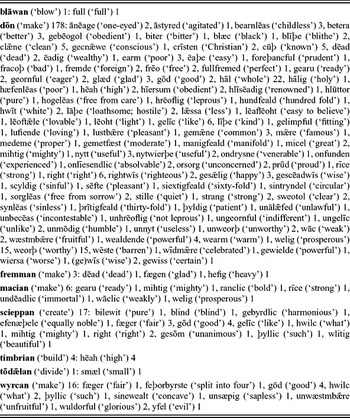
In the analysis summarised in tables 1 and 2,Footnote 14 I also considered, alongside ‘manner’ ARCs (i.e. examples which specify the manner in which the result was brought about), examples with verbs of making (dōn, fremman, macian, wyrcan), which can be viewed (see also above) as instantiating the schematic meaning shared by all resultative examples (i.e. an energy flow between a manipulator and a manipulee resulting in the change of state of the latter, as specified by the RP). I also included verbs of creation (scieppan, timbrian) even if they take an objectum effectum rather than an objectum affectum because of the similarity between the two cases – both involve a manipulator – and because the verb scieppan is given as an example of a verb taking a predicative complement in Mitchell (Reference Mitchell1985: §129). For the sake of completeness, I also took into consideration intransitive verbs of change, of which only one instance (involving wendan ‘turn, become’ in the York Poetry Corpus) was found.
There are two points which are worth commenting on in connection with the data from the YCOE. First, only two ‘manner’ (i.e. nonschematic, noncreation verb) resultative examples have been found, namely:
(21)
(22)
However, the classification of (22) as containing an adjective complement (i.e. smale) can be questioned since similar examples are all classified as having an adverbial A in the YCOE (see also the discussion above concerning the -e ending).Footnote 15 (21), by contrast, is a genuine adjectival example (and is classified as such in the DOE, s.v. full adj.). The corresponding adverb (meaning ‘completely’) was full (without an -e). Further, the occurrence of the genitive noun windes points to the classification of fulle as an adjective (windes being its complement).
The second point that emerges from the analysis of the YCOE data is that most examples with making/creation verbs are of an abstract nature (see table 1, below). Of course, there are exceptions, such as the combinations with e.g. blæc (‘black’), clǣne (‘clean’), sinewealt (‘concave’). This observation may turn out to be of some importance with respect to the analysis mentioned above of manner resultative constructions as possible elaborations of the schematic (e.g. dōn) resultative construction. If this analysis were correct, it could be hypothesised that the schematic resultative construction was actually the primary input for the rise of (manner) resultative constructions. Speakers possibly replaced the schematic verb (e.g. dōn) with manner-specific verbs. Unfortunately, at the present stage of our knowledge it is difficult to decide whether this was indeed the case. Potentially against it are: (i) the finding that complex transitive dōn is used, more often than not, with abstract predicates, while resultative constructions often involve concrete interactions (and refer to ‘objective’ properties like size and the absence of dirt on a surface); (ii) the crosslinguistic observation that languages like Romance ones have schematic resultative constructions but lack productive manner resultatives. Potentially in favour of complex transitive dōn as the main source for the manner resultative construction are: (i) the fact that, after all, objective properties related e.g. to colour (which is recorded in resultative constructions from the Middle English period, see below) and cleanness are also found in conjunction with making/creation verbs; (ii) the fact that it is not clear to what extent the YCOE can be taken as representative of the language at large and not of the written/formal register only. The higher percentage of abstract predicates may simply be due to the choice of abstract subject matter (e.g. notions like poverty, the purity of the soul, etc.). Since, however, the issue cannot be settled satisfactorily, it is advisable to exert caution and view the analysis of causative dōn as the primary source for the (manner) resultative construction at least suspiciously.
Verbs and As occurring in resultative (and related) constructions in the YCOE

Verbs and As occurring in resultative (and related) constructions in the York Poetry Corpus

There are very few comparable examples in the (rather small) York Poetry Corpus. Still, they confirm the trend observed in the YCOE. Most adjectival complement examples are found in conjunction with the verb dōn.
2.1.3 Conclusion
On the basis of the examples in Visser (Reference Visser1963) and the data retrieved from the YCOE and the York Poetry Corpus, it can be concluded that ARCs are seldom found in Old English texts. If we ignore schematic verbs of making and verbs of creation, the few ARC examples occurring in Old English texts evoke a force-dynamic scenario: they usually involve cut and wash verbs. Further, the verbs employed symbolise both the causing subevent and the caused subevent (i.e. they are not ‘proper’ RCs in the terminology of section 1). But it should be noted that blow, see (21), which is neither a verb of cutting nor a verb of washing, also qualifies as a force-dynamic verb and is more amenable to an analysis where it is taken to symbolise the caused subevent to a lesser extent (remember the discussion of (1a) above, He wiped the table clean, where a change is implicated rather than entailed). I have also pointed out that it is difficult to establish whether A is to be categorised as either an adverb or an adjective. Admittedly, however, an adverbial classification may sometimes be preferable despite the fact that A items, which are of a concrete nature, occur in complex transitive sentences with schematic verbs (remember that such schematic verbs may have been one of the inputs for the rise of the resultative construction). At worst, it may be the case that resultative As were linked to a ‘fuzzy’ part-of-speech representation in the Old English speaker's mind. Finally, it can be observed, as was originally pointed out by Visser (Reference Visser1963), that A items are, more often than not, of an ‘epexegetical character’ (Visser Reference Visser1963: 582), that is they further specify the result implied by the resultative verb. This is so precisely because the verb also symbolises the resultant subevent in the causal chain (i.e. causative verbs are used).
2.2 Middle English
Insofar as the paucity of OE ARCs is not a by-product of the limited number of texts and restricted range of styles which have come down to us from the Old English period, one can observe an increase in the tokens and types of ARCs occurring in the Middle English (ME) period (which is identified here, for the sake of convenience, with the time span from 1150 to 1500). If the rise of ARCs in ME does not simply reflect a wider spectrum of texts and text types, one can speculate that among its causes are the loss of inflections (which often rendered adverbs and adjectives indistinguishable from each other), analogical processes (by which e.g. the set of adjectives referring to the notion of removal, see below, could have been expanded), and the development of phrasal verbs (since phrasal particles may often be said to convey a resultative meaning; see Fischer et al. Reference Fischer, Kemenade, Koopman and Wurff2001: ch. 6, among others, on the development of phrasal verbs and Broccias Reference Broccias2003 on the relation between phrasal particles and resultative phrases).
Visser (Reference Visser1963) provides the following combinations (reproduced here in PDE orthography) as being first recorded in the ME period:
beat small (1399), beat black and blue (1460), burst (a door) open (1464), chew small (1425), chop small (1410), cleanse clean (1350), dye either green or blue (1486), eat bare (1300), flobber (‘soil’) foul (1378), grind small (1450), hew small (1420), paint bloody (1377), paint black (1400), rub rody (‘rosy’) (1377), searce (‘sift’) smooth (1440), shave smooth and clean (1412), shrive clean (1390), strike dead (1375), strip naked (1225), sweep clean (1325), wash clean (1200), wash white and fair (1225), wipe clean (1200)
In order to check whether Visser's list was sufficiently representative, as was the case for Old English, I also conducted a corpus search using the Penn–Helsinki Parsed Corpus of Middle English, second edition (PPCME2). By way of the same search procedure (see footnote 13), I obtained 3,667 small clause tokens, which had to be inspected manually for ARC examples. Since the majority of dynamic examples (i.e. both ‘manner’ resultatives and schematic resultatives) contain the schematic verb make (which replaced Old English dōn as the most common causative verb; see Hollmann Reference Hollmann2003: 170–1 inter alia) and they are similar to the Old English examples discussed above, I will not provide a list of the adjectives found with them. My focus will be solely on the ‘manner’ ARCs occurring in the corpus. They are all reproduced below in alphabetical order. (Each verb, glossed into Present-day English, is followed by the As occurring in the retrieved examples in Present-day English orthography. A translation is offered only when deemed necessary. If a translation is not provided, potentially difficult or confusing words are explained in the glosses.)
(23)
(24)
(25)
(26)
(27)
(28)
(29)
(30)
(31)
(32)
(33)
(34)
(35)
(36)
(37)
(38)
(39)
(40)
(41)
(42)
(43)
(44)
(45)
(46)
(47)
(48)
As was the case with the Old English data, some As are not necessarily adjectival but could also be categorised as adverbs. They include, for instance, small and wide (see also their ambiguous classification in the OED). One more example, not attested either in Visser or the PPCME2, is brode (i.e. PDE broad(ly)) as in (49):
(49)
Be that as it may, what is of crucial importance here is that both Visser's list and the data from the PPCME2Footnote 18 point to much the same conclusion regarding the type of scenarios activated by the ARC. We find both the ‘cutting small’ and ‘washing clean’ scenarios as in Old English but there are important additions. In general, the following scenarios can be discerned:
(i) the removal scenario: it includes both concrete and abstract events, e.g. wash/wipe clean and strip naked, which are concrete in character, and purge/purify/shrive clean, which are abstract;
(ii) the filling scenario: it is the opposite of (i) and includes cases like fill full (and stop full), colour/dye/paint + colour adjectives;
(iii) the destruction scenario: it includes verbs like break, chew, chop, grind, etc. One could also include verbs of food consumption, i.e. drink and eat, here;
(iv) the hitting scenario: it is obviously related to (iii) in that an energetic interaction in also involved here. It includes verbs of impact such as beat, strike and stamp;
(v) the change of shape scenario: it includes cases like comb broad, spread wider, burst open, pinch small;
(vi) the food preparation scenario: it is related to (iii) in that (iii) also often has to do with the manipulation of edible substances (see e.g. the Old English examples involving weeds). The difference is that no ‘destruction’ of the affected substance is implied. It includes bake and wall (i.e. ‘boil’).
Similarly, the As also set up a coherent network:
(i) configuration: small, short; open, deep, fast, wide
(ii) full vs empty: full vs clean, smooth, dry, bare, naked
(iii) moral evaluation: fair, honest vs foul (cf. clean)
(iv) colour
However, admittedly, there are some cases (hard, stark, warm/hot, blind) which are difficult to group with the others. It is also worth observing that a group of As, (iii), involves moral evaluation, which can count as subjective, of course. Hence, on the basis of the discussion in section 1.2, we may expect an adverb to be used. However, insofar as an adverbial categorisation is not feasible for such cases, one may notice that an A like foul is the opposite of clean, whose moral evaluation sense is clearly metaphorical in nature. Hence, at least some of the As in (iii) may be regarded as stemming from a metaphorical interpretation of As referring to concrete properties, which are compatible with adjectives.
Needless to say, classifications like the ones above are a convenient simplification. For instance, one could create more fine-grained categories so that verbs of food consumption, for example, are distinguished from what I referred to as the destruction scenario. Still, their epistemological value should be obvious. They make it evident that all ARCs are related to one another in a coherent way. All the scenarios identified above involve an energetic interaction of some sort, be it concrete (e.g. beat small) or abstract (e.g. purge clean).
In ME we therefore find, for the first time, RC examples which involve the metaphorical interpretation of actions as forces (see e.g. shear honest Footnote 19 and purge clean) as well as ‘proper’ RCs (see e.g. shear honest itself, beat black and blue, strike dead). Further, in ME we also find the first unsubcategorised object RCs, reproduced in (30) and (31):
(30) drink (full of water)
And þen ryght as a man leneth to a well and dryngketh his body full of watyr (CMMIRK, 32.907)
(31) eat (full of this colt)
and saide eme wil ye ete your bely ful of this colte (CMREYNAR, 59.589)
Observe that these two examples are similar to the fake reflexive one reported in (1a), He talked himself hoarse. Reflexive forms like himself of course originate from the merger of the personal pronouns and the noun self. In the examples above, instead of the generic noun self, we have the more specific body-part terms body and belly, respectively. It is also important to point out that, although a historical analysis of prepositional RCs is at present very difficult to conduct, a search in the OED (based on verbs used frequently in RCs; see e.g. Boas Reference Boas2003) did not provide any instances of unsubcategorised objects in prepositional RCs before the ME period. The two, relatively early, examples I found are both with the verb laugh:
(50)
The example in (50a) is a true fake-reflexive instance (although one could argue that self was still categorised as a noun at the time) and (50b) contains the unsubcategorised object him.Footnote 20
Summing up the status of ME ARCs, first one can say that they clearly involve force-dynamics. This is also evident when we consider the fact that ARCs often contain conjoined As and that As are often preceded by intensifiers such as all, stark, right. Both strategies probably aim to highlight the complete affectedness of the manipulated entities (see Broccias Reference Broccias2004 on the importance of the notion of complete affectedness for the semantic characterization of adjectival RCs). Some examples, where the intensifying mechanisms have been underlined, are provided below (from Visser Reference Visser1963):
(51)
Second, ME ARCs can be both adverbial and adjectival and are still mostly of an ‘epexegetical character’ (but see e.g. (51b)). Third, unsubcategorised object examples are found for the first time. Finally, the notion of force can be metaphorical. All in all, we observe an expansion of RCs in both types and tokens but RCs can be related coherently to one another by virtue of extension and analogical mechanisms (see the discussion of the various possible scenarios evoked by ME RCs above).
2.3 A note on Early Modern English
I won't have much to say about the later development of RCs in the Early Modern English (EModE) period except that by Shakespeare's time the types of possible RCs seem to be similar to the Present-day ones (as had already been noted by Visser). It will suffice here to report some examples, mostly from Shakespeare (quoted in Visser Reference Visser1963), which show that unsubcategorised-object examples are found regularly from the sixteenth century onwards (Present-day English spelling has been used):
- (52)
(a) they drink themselves so drunk (1522)
(b) you shall see him suck himsself asleep (1530)
(c) a lover's eyes will gaze an eagle blind (1588)
(e) . . . would all themselves laugh mortal (1603)
(f) weep our sad bosoms empty (1605)
(g) he drinks you with facility your Dane dead drunk (1604)Footnote 21
(h) cry myself awake (1611)
(i) cri'd their throats dry (1674)
Of particular interest are examples (52c) and (52g), because the unsubcategorised objects an eagle and your Dane do not refer to body parts (or the whole self) as is the case in the other instances reported in (52). These two examples seem therefore to testify to a further stage in the evolution of RCs in that, contrary to what one finds for ME, the unsubcategorised object is no longer restricted to a (pro)noun coreferential with the subject. By the EModE period, both ‘proper’ and pseudo RCs are possible with a variety of subcategorised and unsubcategorised objects. Crucially, however, the notion of force, be it literal or metaphorical, still applies. Gazing and drinking, for example, as in (52c) and (52g), can be understood metaphorically as forces bringing about a change of state of the metaphorically manipulated entity.
3 Conclusions and complication
The present investigation has revealed that ARCs originally (i.e. in OE) seem to occur with a restricted set of verbs, i.e. cut and wash verbs, and employ As like small and clean, which specify or intensify the verbal event (i.e. a causative paraphrase is not necessarily possible for such examples) and whose word-class status is not clear. Crucially, however, both cut and wash verbs are force-dynamic verbs and, as I have pointed out in section 1.1, the notion of energetic interaction is of great importance in the (synchronic) analysis of RCs. The energetic characterisation of RCs seems therefore to be also applicable to the earliest recorded stage of the English language. Later, ARCs apparently expanded so as to encompass other verb and adjective types (see Israel Reference Israel and Goldberg1996 for a similar point on the growth of the way-construction) as well as transitivity patterns (e.g. unsubcategorised objects). By the EModE period, ARCs appear to be as flexible as they are nowadays.
This evolutionary path accords well with a bottom-up (or usage-based) model of language such as Langacker's (Reference Langacker1999) (see also Boas Reference Boas2003 on the need for a maximalist and bottom-up approach to RCs). Language grows out of specific examples as generalisations over such specific usage events. The existence of a ‘schematic’ RC (i.e. the causative pattern with e.g. OE dōn and an adjectival object complement) may not, for example, be a strong enough trigger for the development of the RC. (Most of the adjectival dōn examples were abstract in nature and one should also remember that Romance languages have similar ‘schematic’ RCs but lack productive RCs, or rather, RCs which are as productive as the English ones.) The ME examples set up a coherent network of analogical extensions based on the cut and wash scenarios identified for OE. Consequently, we may take their evolution to have been triggered by other factors such as the indeterminate word-class status of A and the parallel expansion of phrasal verbs. To be sure, this line of enquiry should be investigated in more depth in future research, which should expand the diachronic analysis of RCs so as to encompass prepositional cases as well as other Germanic languages. The latter point is especially worth stressing because a quick look at other Germanic languages reveals a serious complication for the analysis advanced here.
I have remarked that unsubcategorised object cases do not seem to be recorded before the ME period. One could therefore take them to be a development subsequent to the OE period. The problem with this conclusion is that unsubcategorised object cases are also found in other Germanic languages (see Oya Reference Oya2002 and Boas Reference Boas2003 for German, Whelpton Reference Whelpton2006 for Icelandic), as shown in (53):
- (53)
(a) cry oneself hoarse
(b) sich heiser schreien (German)
(c) garga sig hásan (Icelandic)
(d) skrike seg hås/hes (Norwegian)
It is difficult to believe that this pattern was not possible in OE and that it developed (possibly after the Norman invasion) independently of the other Germanic languages. The fact that no examples of this pattern have been found in OE records may simply be a historical accident related to the restricted range of texts and text types which have come down to us (as was underlined at the beginning of section 2.2). Still, I would like to contend that the availability of fake-reflexive examples in other Germanic languages does not necessarily invalidate the present analysis, because an evolutionary path like the one sketched above may still have taken place. Significantly, ARCs of the cut something small type seem to be more ‘basic’ than others in that they are also found in Romance languages such as Italian (which, like the other Romance languages, generally lacks ARCs):
(54)
It may be that the diachronic details need revising, but the overall picture of a progressive extension from basic force-dynamic interactions symbolised by cut and wash verbs to more general types (both causatively and metaphorically) may still be on the right track. To be sure, force-dynamics turns out to be a notion to be reckoned with both synchronically and diachronically.