1 Introduction
This study is concerned with the variation between retaining and omitting the complementizer that in English adjectival complementation constructions (e.g. I'm happy (that) we are married). The topic is explored with regard to which factors prove to be most important in explaining the choice between these two variants. The factors included in the analysis are those which in previous studies have been shown to have an effect on this particular variation. However, most of these studies have been concerned with verbal complement-taking predicates, thereby neglecting to examine the effect of these factors on adjectival data (see Thompson & Mulac Reference Thompson and Mulac1991b; Rohdenburg Reference Rohdenburg1995, Reference Rohdenburg1996; Jaeger Reference Jaeger2010). Furthermore, the choice between these two variants has not been examined from the point of view of comparing the effect of different factors across extraposed (e.g. It was inevitable (that) he should be nicknamed ‘the Ferret’) and post-predicate clauses (I'm happy (that) we are married) (terminology from Biber et al. Reference Biber, Johansson, Conrad, Leech and Finegan1999; see Kaltenböck Reference Kaltenböck2006 for a study on extraposed clauses only). As a consequence, the aim of this study is twofold: (i) to test the effect of different factors on adjectival data as regards the variation between that-omission and that-retention, and (ii) to test whether there are any differences between extraposed and post-predicate clauses where the effect of those factors is concerned.
The article starts by examining previous research on the variation between retaining and omitting that in section 2, with emphasis placed on the Complexity Principle (Rohdenburg Reference Rohdenburg1996) and the Uniform Information Density Principle (Jaeger Reference Jaeger2010). The data and the design of the study are described in section 3. In section 4, the results of the analyses are presented, with the factors presented in sections 4.1–4.5. Section 4 ends with the presentation of multivariate analyses, establishing the effect of the different factors on the choice between retaining and omitting that. Finally, a discussion of the results and a summary are given in section 5.
2 Introducing two principles
Regarding the variation between that-omission and that-retention, there are two principles that merit a short discussion. Due to the bias towards verbal complementation in previous studies, both these principles are concerned with verbs complemented by that-clauses, but they can also be applied to adjectives, as will be shown in sections 3 and 4. The first of these two is the Complexity Principle, which states that ‘[i]n the case of more or less explicit grammatical options the more explicit one(s) will tend to be favored in cognitively more complex environments’ (Rohdenburg Reference Rohdenburg1996: 151).Footnote 2 In testing the Complexity Principle, Rohdenburg (Reference Rohdenburg1995, Reference Rohdenburg1996) is mainly concerned with variable uses of alternating constructions. As that-retention is a more explicit grammatical option than that-omission, Rohdenburg (Reference Rohdenburg1996) expects that-retention to be favored in cognitively more complex environments. In analysing the variable use of that to introduce complement clauses, Rohdenburg focuses on two different complexity factors, illustrated in (1) and (2).Footnote 3
-
(1) He told me yesterday that the young lady had gone away.
-
(2) He told me she had gone away.
The first of these two complexity factors is concerned with the separation between the matrix clause and the complement clause, as illustrated in (1) by yesterday.Footnote 4 According to the Complexity Principle, that-retention, as in (1), should be favoured since ‘any elements capable of delaying the processing of the object clause and thus of the overall sentence structure favor the use of an explicit signal of subordination’ (Rohdenburg Reference Rohdenburg1996: 161). Rohdenburg (Reference Rohdenburg1996) points out that, traditionally, this factor has been attributed to structural ambiguity, since the adverbial phrase could in theory be seen as part of the matrix clause or the complement clause. However, the crucial point made by Rohdenburg (Reference Rohdenburg1996) is that any element in this position, regardless of whether it causes structural ambiguity, can be seen as a complexity factor as it increases the likelihood of retention of that. The second complexity factor is concerned with the realization of the subject of the complement clause. The Complexity Principle predicts that the more complex the subject of the complement clause is, the more likely the retention of that becomes. This is manifested by a striking contrast between NPs headed by pronouns and NPs headed by nouns, in that NPs headed by nouns, as in (1), favour that-retention whereas NPs headed by pronouns, as in (2), favour that-omission.Footnote 5
The second principle of importance for the choice between retaining and omitting that is referred to as the Uniform Information Density Principle (UID) (Jaeger Reference Jaeger2010). UID is concerned with the influence of lexical items on the choice between grammatical options. UID predicts that ‘the more probable (expected) a word is in its context, the less information it carries (the more redundant it is) in that context’ (Jaeger Reference Jaeger2010: 24).Footnote 6 The idea behind UID is that not all words provide the same amount of information, and that speakers aim to distribute information uniformly in production. The way in which this works in practice is illustrated by the difference between (3) and (4) (from Jaeger Reference Jaeger2010: 127).
-
(3) My boss confirmed that we were absolutely crazy.
-
(4) My boss thinks I am absolutely crazy.
Retaining that, as in (3), distributes the information at the onset of the complement clause over one extra word (i.e. that), thereby lowering information density. Omitting that, on the other hand, as in (4), increases information density, as the information is distributed over one less word (see Jaeger Reference Jaeger2010: 27 for an illustrative figure explaining the difference in information density between (3) and (4)). UID takes the information at the complement clause onset as conditioned by the matrix predicate (i.e. confirm and think in (3) and (4)). UID predicts that the lower the information carried by the matrix predicate, the more likely speakers are to omit that and vice versa. The information carried by matrix predicates is based on how expected a predicate is in a given context. This is calculated by contrasting the frequency of co-occurrence of a given predicate with that-clauses with the frequency of the same predicate in the entire corpus. This means that the less information a given predicate carries, the more expected it is to be followed by a that-clause. This is the situation we have in (3) and (4), as confirm carries more information than think, and is thus less expected to be followed by a that-clause than think. Following this, verbs found to be frequently complemented by that-clauses, such as think, are predicted to be more likely to occur with that-omission than verbs found less frequently complemented by that-clauses, such as confirm.
In addition to these two principles and the factors they focus on, there are several other factors that have been found to influence the choice between retaining and omitting that. Perhaps the most widely discussed factor is the formality of different genres. Several studies have found that that-omission is more frequent in informal genres (see Elsness Reference Elsness1984; Biber Reference Biber1999; Kaltenböck Reference Kaltenböck2006; Mindt Reference Mindt2011). Other factors discussed in previous studies include the type of matrix clause subject and its interaction with different matrix verbs. In studies on grammaticalization, certain combinations of matrix clause subjects and verbs (e.g. I think) are found to frequently co-occur with that-omission, and are treated as reanalysed epistemic phrases (see Thompson & Mulac Reference Thompson, Mulac, Traugott and Heine1991a; Van Bogaert Reference Van Bogaert2011). According to Thompson & Mulac (Reference Thompson, Mulac, Traugott and Heine1991a), the pronominal matrix subjects I and you are the two pronouns most likely to occur with that-omission (see also Torres Cacoullos & Walker Reference Torres Cacoullos and Walker2009; Jaeger Reference Jaeger2010).
3 Data and design of the study
The data used in this study consist of a 3-million-word subcorpus of the BNC (British National Corpus; see Burnard Reference Burnard2007). The subcorpus has been compiled to facilitate comparisons across genres, with five genres represented: academic prose, popular science, news, fiction and conversation. The subcorpus has been carefully sampled to include as many different texts as possible. Rather than sampling whole texts, samples of 10,000 words were drawn.Footnote 7 Each genre contains 600,000 words and 60 different samples, making sure that all genres and subgenres are represented by an equal number of words as well as by equal amounts of text-files (see Kaatari Reference Kaatari2012 for more detailed information about the subcorpus). Furthermore, an equal number of samples were drawn from the beginning, the middle and the end of text files to minimize any skewing due to textual colligation and clustering (see Hoey Reference Hoey2005; Evert Reference Evert2006).
The constructions included in the analysis are extraposed and post-predicate clauses. In both these constructions, omitting that is optional, as seen in (5)–(8).Footnote 8 , Footnote 9
-
(5) Nevertheless, it is noteworthy from the annotation of their books that they use translations wherever possible [. . .]. (A1A 199) (Extraposed: +that)
-
(6) It was certain the display would be repeated. (B09 1162) (Extraposed: –that)
-
(7) I was glad then that he did not know the subject of the talk I had just given at the conference [. . .]. (H78 1007) (Post-predicate: +that)
-
(8) ‘I'm sure no one would have noticed.’ (GUU 3674) (Post-predicate: –that)
The data used in this study were extracted via a customized program called SVEP (see Garretson & Kaatari Reference Garretson, Kaatari, Vandelanotte, Davidse, Gentens and Kimps2014). A guiding principle was to include as many instances of adjectives complemented by that-clauses as possible, thus avoiding lexical lists as a starting point for the data collection process (see Mindt Reference Mindt2011; Van linden Reference Van linden2012). Accordingly, the dataset has no bias towards certain lexemes, and it also includes instances in which the adjective and the that-clause are separated (see Garretson & Kaatari Reference Garretson, Kaatari, Vandelanotte, Davidse, Gentens and Kimps2014: 68 for detailed information on the patterns used for data extraction).
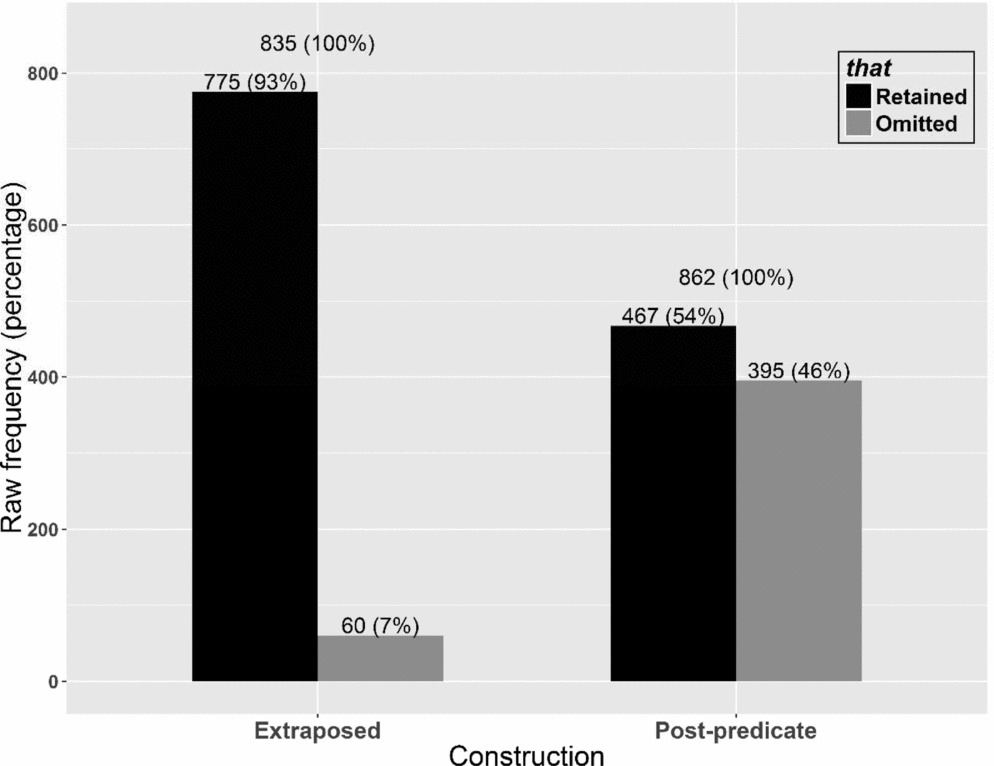
Figure 1 provides an overview of the data. Extraposed and post-predicate clauses are more or less evenly distributed as regards frequency (835 vs 862), but that-omission is far more frequent with post-predicate clauses (46 per cent) than with extraposed clauses (7 per cent).
Overview of the data

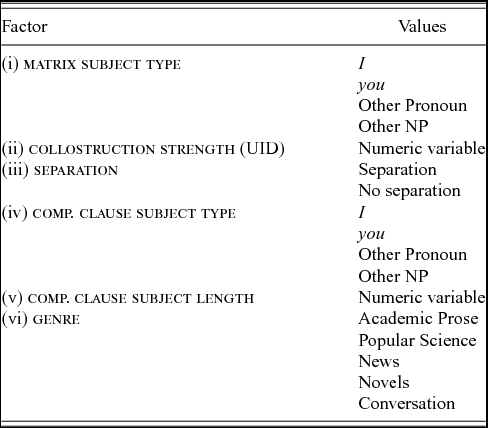
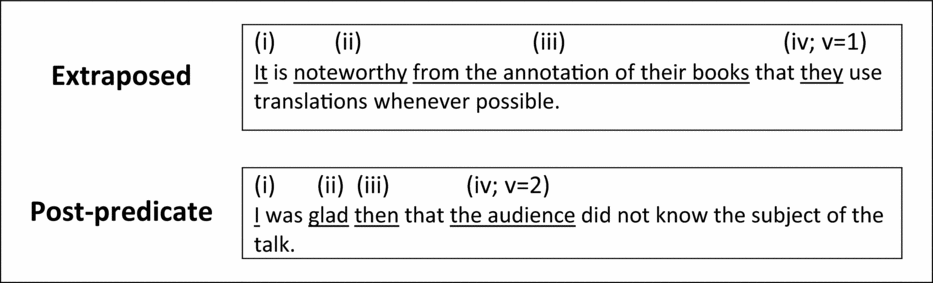
The analysis in this study is based on five different factors, listed in table 1, and further illustrated in figure 2. Factors (i)–(v) are numbered according to their position in the sentence (from left to right), whereas factor (vi) is extralinguistic. Factor (ii) tests the underlying assumption of the Uniform Information Density Principle, although here operationalized as Collostruction Strength (see Footnote footnote 13, section 4.2 for a justification), and factors (iii), (iv) and (v) test the Complexity Principle. Factors (i)–(v) are further illustrated in figure 2 together with the constructions included in the study.
Factors included in the analysis

Illustration of constructions and factors included in the analysis

Note that factor (i) is only applicable to post-predicate clauses as extraposed clauses do not allow variation of the matrix subject type (see Footnote footnote 9). Note also that construction type (i.e. extraposed vs post-predicate) is not included as a factor. The reason behind this is that the influence of the factors listed in table 1 will be tested on extraposed and post-predicate clauses separately in order to determine to what extent the two construction types differ as regards the variation between retaining and omitting that. Extraposed and post-predicate clauses are thus treated as two distinct constructions in this study.
4 Results
In this section, the results of each factor will be illustrated (sections 4.1–4.5) and section 4.6 presents a multivariate analysis, assessing the combined explanatory power of all factors.
4.1 Factor (i): matrix subject type
matrix subject type is implemented in this analysis as a variable with four levels: I, you, ‘Other Pronoun’, and ‘Other NP’. The reason why the pronouns I and you are distinguished from other pronouns is that they have been found to be particularly salient in triggering that-omission (see Thompson & Mulac Reference Thompson, Mulac, Traugott and Heine1991a; Jaeger Reference Jaeger2010). Matrix subject type ‘Other NP’ is represented by NPs headed by nouns and proper nouns.Footnote 10 The four types are illustrated in (9)–(12), with the matrix subject type underlined.
-
(9) I’m sorry I spoilt your sleep. (Type: I) (CML 1568)
-
(10) Are you sure you don't mean seven? (Type: you) (KNY 89)
-
(11) In a way he was glad that she was ‘in trouble’. (Type: Other Pronoun) (CR6 886)
-
(12) The employers are adamant that an agreement on working hours must be part of the deal. (Type: Other NP) (A9W 245)
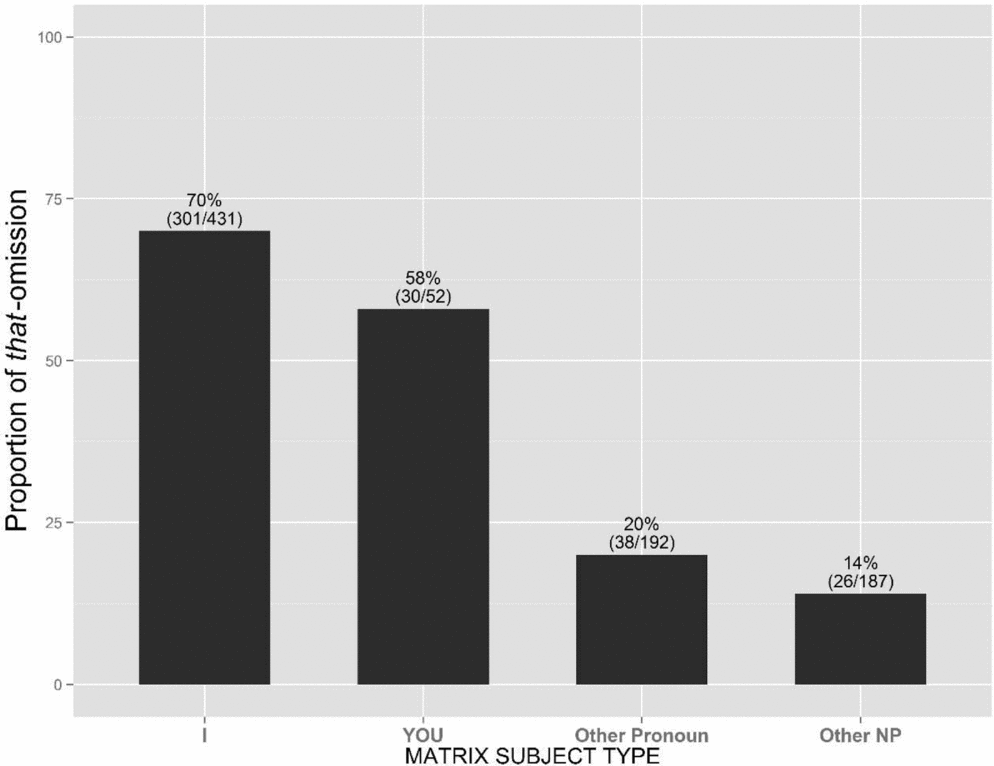
The influence of the matrix subject type on the choice between retaining and omitting that is shown in figure 3.
Proportion (raw frequency) of that-omission across matrix subject types

The two pronominal categories I and you are characterized by a much higher proportion of that-omission than the other categories. Furthermore, not only is I the subject type with the highest proportion of that-omission, but I is also more than twice as frequent as the second most frequent matrix subject type (‘Other Pronoun’), and accounts for 50 per cent of the total number of tokens (431/862). It thus appears that there is a divide between the categories I and you on the one hand, and the two remaining categories on the other hand in terms of the effect of matrix subject type on the choice between retaining and omitting that. These findings are in line with findings from studies on verbal predicates in which I and you have been found to be particularly strong triggers of that-omission (see e.g. Thompson & Mulac Reference Thompson, Mulac, Traugott and Heine1991a; Jaeger Reference Jaeger2010).
4.2 Factor (ii): collostruction strength
Factor (ii) tests the Uniform Information Density Principle (UID) (Jaeger Reference Jaeger2010) and the influence of particular adjectives on the choice between retaining and omitting that. UID is operationalized here as collostruction strength (Stefanowitsch & Gries Reference Stefanowitsch and Gries2003), since it closely models the notion of how expected a given word is in a given context. Collostruction strength is a measure of the attraction/repulsion of different lexemes to one particular slot in a given construction, in this case the degree to which individual adjectives are attracted to extraposed and post-predicate that-clauses respectively.Footnote 11 The appeal of using collostruction strength is that it can handle low frequency items, weighting them appropriately so as to avoid overestimating their importance. The operationalization of UID in Jaeger (Reference Jaeger2010), on the other hand, takes into account the frequency of a given word followed by a that-clause, divided by the frequency of the same word in the entire corpus, using the following formula:
-
UID = –log p(adj.+that | adj. total)
This formula does not in itself address the problem of low-frequency items, as they receive very low information density scores (remember that the lower the UID score, the more expected a word is in its given context).Footnote 12
The calculation of collostruction strength, on the other hand, takes into account the frequency of a given adjective followed by a that-clause, the frequency of that same adjective in all other constructions, the frequency of the construction (i.e. that-clauses) with other adjectives and the frequency of all other constructions with adjectives other than the given adjective (i.e. the total frequency of adjectives in the entire corpus) are also taken into account. These four frequencies are then entered into a 4-by-4 table, and submitted to a statistical test from which the collostruction strength value is derived (see Stefanowitsch & Gries Reference Stefanowitsch and Gries2003: 218–19; see also Hilpert Reference Hilpert2010 for a more practical discussion).
To sum up the discussion thus far, UID is operationalized here slightly differently than in Jaeger (Reference Jaeger2010), using collostruction strength as a measure of how expected different adjectives are in a given context. Collostruction strength is a numeric variable, assigning higher values to adjectives which are strongly attracted to a particular construction, in this case that-clauses. In this study, the Collexeme Analysis (see Stefanowitsch & Gries Reference Stefanowitsch and Gries2003), from which the collostruction strength values are derived, was performed using the statistical software R (R Development Core Team 2008) by implementing a script written by Gries (Reference Gries2007). The statistical measure used for calculating collostruction strength is log-likelihood.Footnote 13 According to the prediction of the Uniform Information Density Principle, we would expect more that-omission where adjectives have a high collostruction strength.
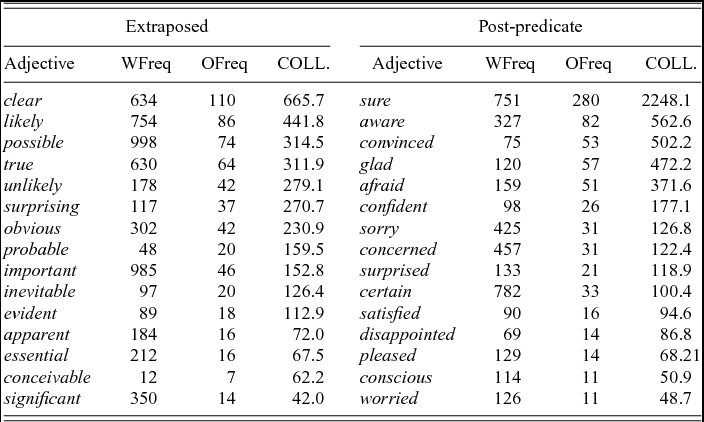
Before examining the mean collostruction strengths of those cases where that was omitted versus those where it was retained, we first inspect the collostruction strength of different adjectives across extraposed and post-predicate clauses. Table 2 lists the top fifteen adjectives according to collostruction strength (coll.) between the adjective and extraposed and post-predicate clauses respectively. The raw frequency of each adjective in the entire corpus (WFreq.) and the observed frequency of each adjective complemented by an extraposed or post-predicate clause (OFreq) are also given.
Top fifteen collexemes across extraposed and post-predicate constructions
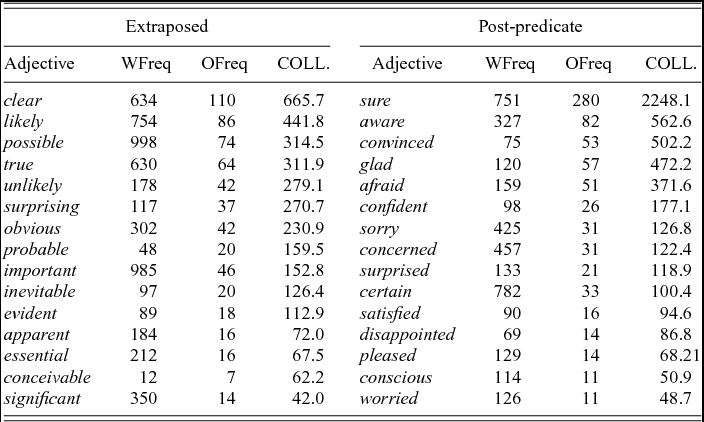
Looking only at the top fifteen adjectives, collostruction strength ranges between 2248.1 and 48.7 for post-predicate clauses, whereas the range among extraposed clauses is only 665.7 to 42.0.Footnote 14 In essence this means that sure is more strongly expected to be followed by a post-predicate clause than clear is expected to be followed by an extraposed clause. Looking at the (log-transformed) mean collostruction strength of extraposed and post-predicate clauses, we also find notable differences between the two constructions: extraposed 4.69; post-predicate 5.72.
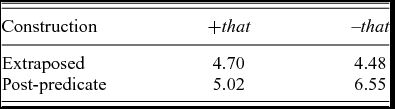
Turning to the influence of collostruction strength on the choice between omitting and retaining that, we find further differences between the two constructions. The difference in mean collostruction strength between retaining and omitting that is much smaller with extraposed clauses than it is with post-predicate clauses, as seen in table 3.
Mean collostruction strength across constructions (log-transformed)
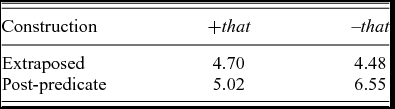
It is worth pointing out that a single adjective is potentially responsible for much of the mean difference in collostruction strength between the two post-predicate groups. The adjective sure has the highest collostruction strength and it is also the most frequent adjective, occurring 280 times, and thus accounts for 32 per cent of all post-predicate clauses, 73 per cent of which (203/280) are found with that-omission.
To sum up the results concerning the influence of collostruction strength on the choice between retaining and omitting that, we can say that this variable appears to play a larger role when it comes to post-predicate clauses. Furthermore, the results point in the direction predicted by UID, i.e. adjectives with higher collostruction strength are found to be more likely to occur with that-omission.
4.3 Factor (iii): separation
The first factor explicitly linked to the predictions of the Complexity Principle is concerned with separation between the adjectival matrix predicate and the complement clause. Separation of this type is illustrated by the underlined material in (13) and (14).Footnote 15
-
(13) It has become clear from all that we have said that the composition of the atmosphere is not fixed. (AMS 1554)
-
(14) He was certain too, she recalled crossly, that she and Travis were bedfellows. (JY1 439)
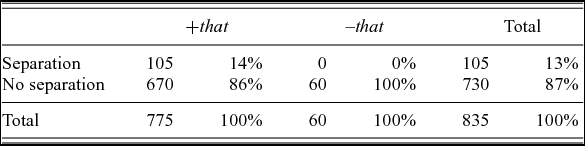
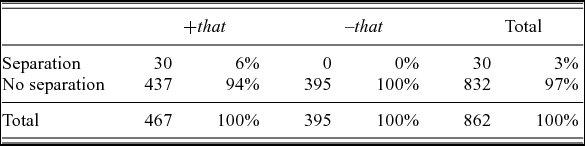
separation is here defined as intervening elements delaying the processing of the complement clause, regardless of whether these elements cause structural ambiguity or not (see section 2). In other words, it is immaterial to which clause, i.e. the matrix clause or the complement clause, the intervening material belongs. The prediction based on the Complexity Principle (see Rohdenburg Reference Rohdenburg1996) is that that-retention should be favoured in separation contexts, as they constitute cognitively more complex environments. An examination of the data reveals that this prediction seems to hold extremely well. As seen in tables 4a–b, there are in fact no instances in which separation co-occurs with that-omission, regardless of whether the clause is extraposed or post-predicate.
Raw frequency and percentage of separation (extraposed)

Raw frequency and percentage of separation (post-predicate)

There is, however, a difference between extraposed and post-predicate clauses in the total share of attested separation (13 vs 3 per cent). We also find a difference in mean separation length (measured in words) between extraposed and post-predicate clauses. Extraposed clauses have a longer mean separation length (0.48) than post-predicate clauses (0.24) when including all data points (i.e. including data points with a value of zero). On the other hand, including only data points with separation (i.e. > 0) post-predicate clauses have a slightly longer mean separation length (3.73) than extraposed clauses (3.60).
It is safe to conclude that the prediction of the Complexity Principle holds, in that separation is exclusively associated with that-retention. separation is thus treated as a knockout factor, i.e. a factor in which the response (+that vs –that) is invariant (see also section 4.6).
4.4 Factors (iv) and (v): comp. clause subject type and length
The second complexity factor included in this analysis concerns the type and length of the complement clause subject. The prediction based on the Complexity Principle (Rohdenburg Reference Rohdenburg1996) is that pronominal subjects favour that-omission whereas NPs headed by nouns favour that-retention. comp. clause subject type is implemented as a variable with four levels: I, you, ‘Other Pronoun’ and ‘Other NP’. All four types are illustrated in (15)–(18). The pronouns I and you are included as separate categories in the analysis as they have been reported in previous research to play a special role in the choice between retaining and omitting that (see Thompson & Mulac Reference Thompson, Mulac, Traugott and Heine1991a, Reference Thompson and Mulac1991b; Jaeger Reference Jaeger2010). Complement clause subject type ‘Other NP’ includes NPs headed by nouns and proper nouns.
-
(15) ‘I'm sorry I was a bit short with you this afternoon,’ Nick said when he rang Kelly later that night. (Type: I) (BP7 2835)
-
(16) I'm sure you’ll manage to come up with something plausible. (Type: you) (JXV 1513)
-
(17) We are hopeful that it will be a true festival of football. (Type: Other Pronoun) (A9N 135)
-
(18) It is true that Franciscan spirituality put new stress on the necessity for integrating action and contemplation. (Type: Other NP) (HY6 989)
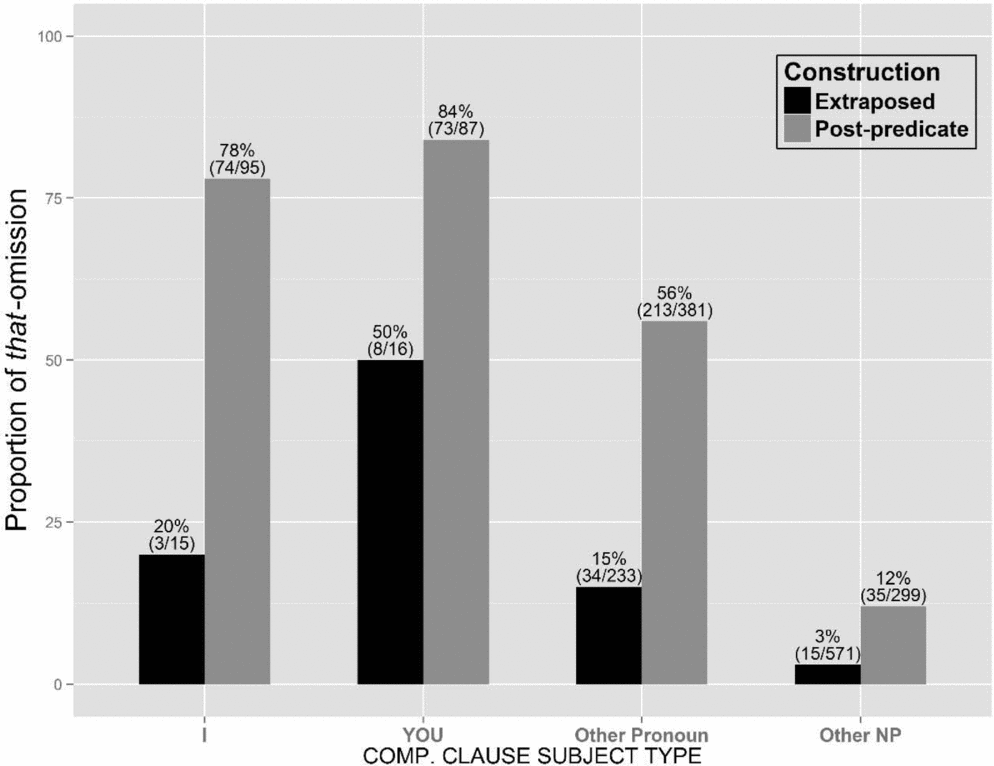
The distribution of complement clause subject types is presented in figure 4. First of all, we can see that the prediction of the Complexity Principle seems to hold; there is a clear difference in terms of the proportion of that-omission between the three pronominal categories and ‘Other NP’, supporting a division between NPs headed by pronouns and NPs headed by nouns.
Proportion of that-omission across subject types and constructions

Furthermore, we see that there are large differences between the pronominal categories; you is the subject type with the highest proportion of that-omission in both constructions. Complement clause subject type I takes an intermediate position, and the complement clause subject type ‘Other Pronoun’ is the pronominal category with the smallest proportion of that-omission. It is also clear that there are large differences between the two constructions. We can see that the post-predicate construction consistently has a higher proportion of that-omission across all levels of comp. clause subject type. This difference is most pronounced for complement clause subject type I, but is also pronounced for complement clause subject type ‘Other Pronoun’. With extraposed clauses, you stands out as the complement clause subject type with the highest proportion of that-omission.
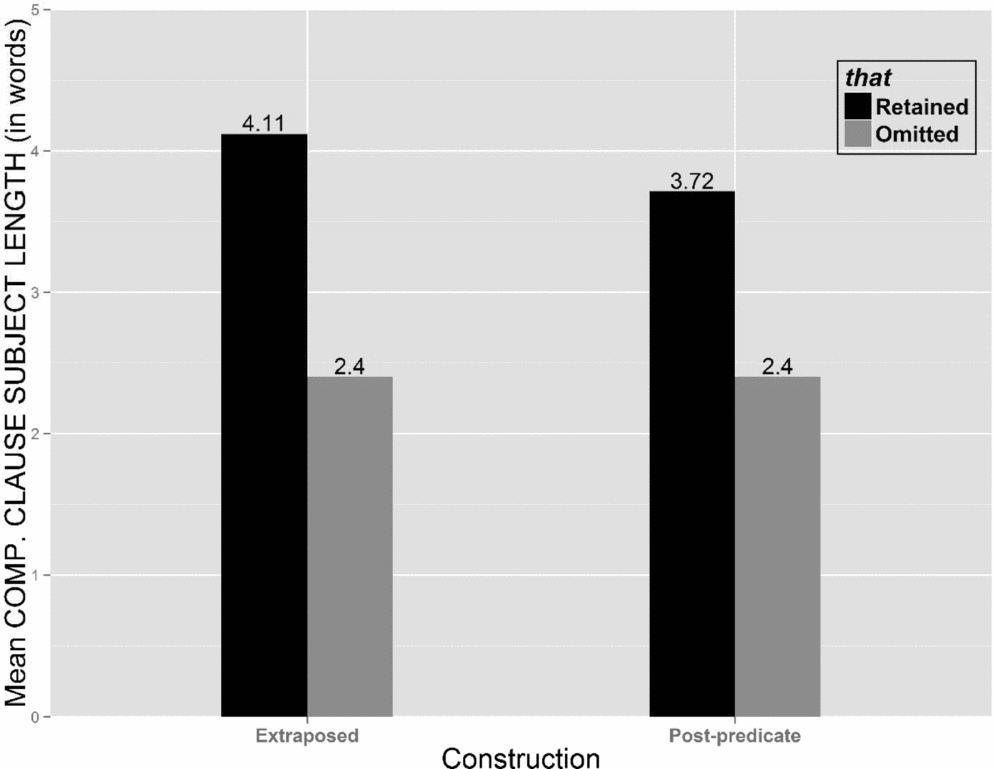
Turning our attention to factor (v), comp. clause subject length (measured in words), we now restrict the focus to complement clause subject type ‘Other NP’ only, as pronominal subjects do not exhibit any variation in length. As seen in figure 5, longer subjects favor that-retention across both constructions (range/standard deviation: Extraposed +that 1:21/3.22; Extraposed –that 1:5/0.75; Post-predicate +that 1:25/3.04; Post-predicate –that 1:4/0.45).
Mean complement clause subject length (in words) of ‘Other NP’ across constructions

This finding suggests that comp. clause subject length constitutes an important factor. In other words, when the subject of the complement clause is not pronominal, shorter subjects are still found to favour that-omission.Footnote 16
4.5 Factor (vi): genre
The sixth and final factor is concerned with the role played by genre on the choice between retaining and omitting that. It has been noted in previous studies that that-retention is favoured in more formal genres, whereas that-omission shows the reverse genre distribution (see Elsness Reference Elsness1984: 521; Biber Reference Biber1999: 145; Kaltenböck Reference Kaltenböck2006: 378; Mindt Reference Mindt2011: 162 ff.). Biber et al. (Reference Biber, Johansson, Conrad, Leech and Finegan1999: 680–1) attribute these differences to the difference in production circumstances and communicative purposes of different genres:
Conversations are spoken and produced online; they typically have involved, interpersonal purposes; and they generally favor the reduction or omission of constituents that can be easily reconstructed. These characteristics are associated with omission rather than retention of that as the norm. Academic prose has the opposite characteristics: written, careful production circumstances; an expository, informational purpose; and a general preference for explicit, elaborated structure. Correspondingly, that retention is the norm in academic prose.
The corpus used in this study comprises five genres (see section 3), with each genre represented by 600,000 words. Four of these represent written language and one represents spoken language.Footnote 17 These five genres can be placed along a continuum, indicating their respective degree of formality. As seen in figure 6, academic prose is positioned at the most formal end of the continuum, and conversation at the most informal end (see Biber et al. Reference Biber, Johansson, Conrad, Leech and Finegan1999: 680).
Continuum of formality

Conversation, as the sole representative of the medium of speech, differs from the written genres by being interactive. Furthermore, the main function of conversation is personal communication, a function not shared by the written genres. Of the written genres, fiction is closest to conversation, as it includes written dialogue. The remaining three written genres all share an informational focus but differ on other grounds. News has a wide public audience, whereas academic prose targets a specialist audience. Popular science is situated between news and academic prose, as it targets both a specialist audience and a wider audience, albeit not as wide as news (see Biber et al. Reference Biber, Johansson, Conrad, Leech and Finegan1999: 16 for an overview of the situational characteristics of different genres).
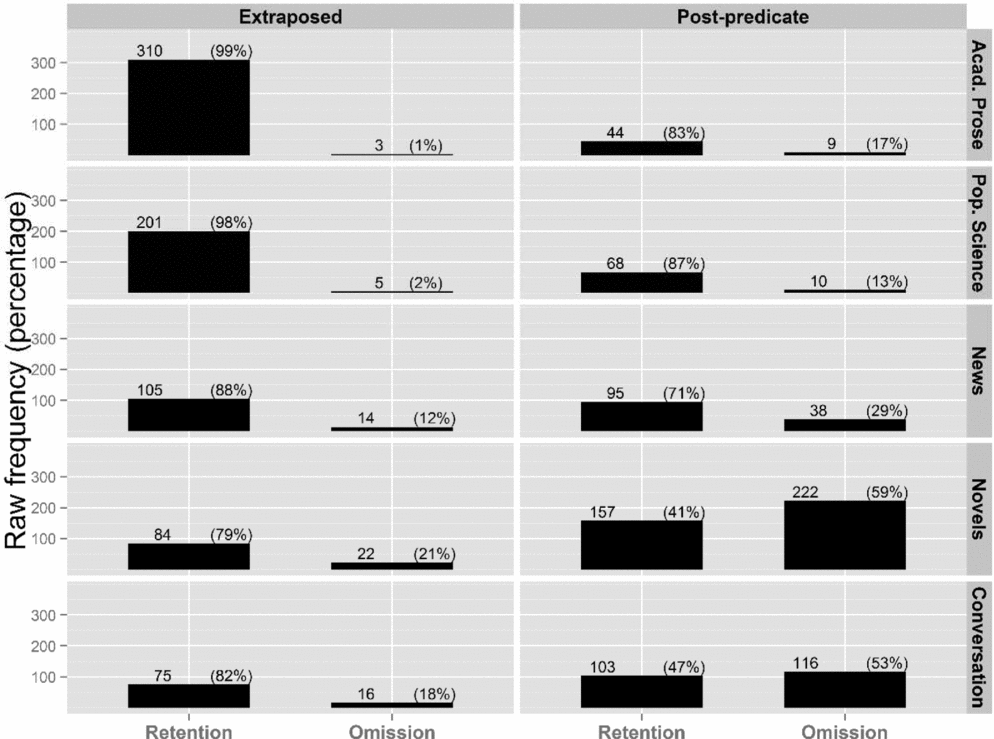
The distribution of extraposed and post-predicate clauses across genres is shown in figure 7. First of all, we can see that the prediction that that-retention is more frequent in formal genres largely holds; the proportion of that-retention generally decreases as we move down the continuum of formality.
Raw frequency and percentage by genre across constructions

There are, however, large differences between extraposed and post-predicate clauses. As shown, extraposed clauses have a strong preference for that-retention across all genres; the highest proportion of that-omission reaching only 21 per cent (novels). Post-predicate clauses, in contrast, have higher proportions of that-omission in general, and that-omission, in fact, reaches more than 50 per cent in the two least formal genres. Note also that novels, not conversation, exhibit the highest proportion of that-omission for both extraposed and post-predicate clauses.
In summary, the prediction of previous studies (see Elsness Reference Elsness1984; Biber Reference Biber1999; Kaltenböck Reference Kaltenböck2006; Mindt Reference Mindt2011) is confirmed in that the proportion of that-omission increases as we move from formal to informal genres along the continuum of formality, although we find notable differences between extraposed and post-predicate clauses.
4.6 Modelling variation
Now that we have seen the influence of the factors in isolation, it is time to assess the effect of the factors’ combined effect on the choice between retaining and omitting that. This section is thus devoted to multivariate analyses of the factors included in the study. Extraposed and post-predicate clauses will be treated as two different constructions and tested separately in different logistic regression models. All models are binomial models using the glm() function (see Crawley Reference Crawley2007: 511ff.) in the statistical software R (R Development Core Team 2008). Factor (iii), separation, is not included in these analyses as it was identified as a knockout factor, i.e. a factor in which the response (+that vs –that) is invariant (see section 4.3).
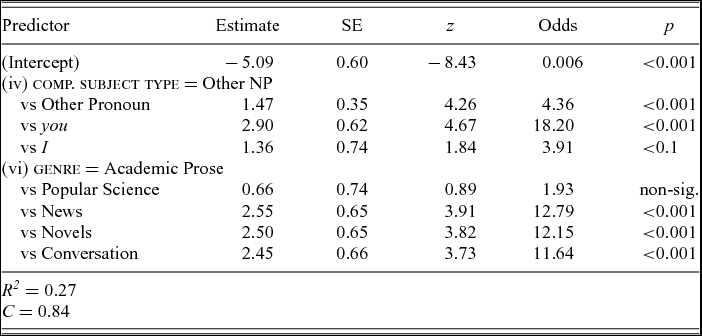
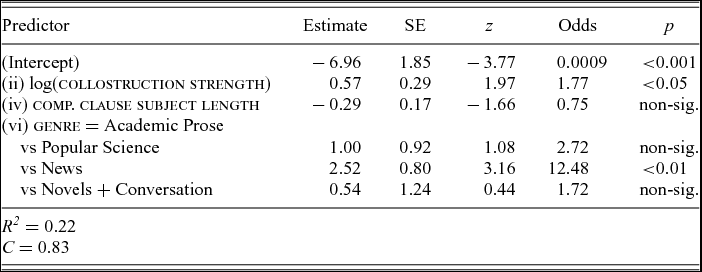
Starting with the models concerned with extraposed clauses in tables 5a–b, we should first note that matrix subject type is not included as this factor is not applicable to extraposed clauses (see section 3). Second, in order to avoid obvious multicollinearity, i.e. that two or more factors are correlated with each other, comp. clause subject length was removed from the main model as it correlates with comp. clause subject type. The factor was used in a second model which was fitted exclusively to data points with comp. clause subject type ‘Other NP’ (see table 6).
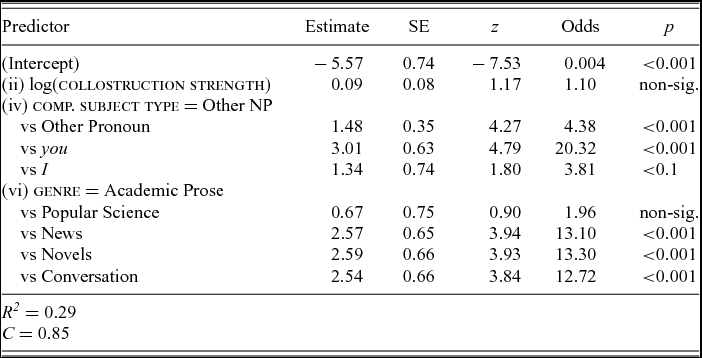
Saturated logistic regression model: extraposed clauses. Predicted outcome: omission of that

Minimal adequate logistic regression model: extraposed clauses. Predicted outcome: omission of that

Logistic regression model of the effect of comp. clause subject length : extraposed clauses. Predicted outcome: omission of that

In the minimal adequate model in table 5b, collostruction strength, the only non-significant factor from the saturated model in table 5a has been removed.Footnote 18 We see that two factors (factor (iv), comp. clause subject type, and factor (vi), genre) have a significant effect on the choice between retention and omission of that. comp. clause subject type ‘Other Pronoun’ and you are both found to trigger significantly more that-omission when compared to ‘Other NP’. We might also note that comp. clause subject type you is the factor with the strongest effect size (odds ratio (Odds) = 18.20). comp. clause subject type I, on the other hand, is not found to be significantly different from ‘Other NP’. This might be explained by the small number of I-tokens in the data (3/15 found with that-omission) as compared to ‘Other NP’ (15/571), even though the proportion of that-omission with I is much higher (20 per cent) than with ‘Other NP’ (3 per cent) (see figure 4, section 4.4). The effect of genre is such that Academic Prose and Popular Science contrast with the other genres, the latter triggering far more that-omission (as indicated by their positive z scores; see also figure 7, section 4.5).
With only two factors, the model is still quite good: Nagelkerke's R 2 = 0.29 and the model has good classificatory power C = 0.85. R² has been described as a measure of ‘the proportion of variation of the dependent variable which can be explained by the predictor variables of a given regression model’ (Mittlböck & Schemper Reference Mittlböck and Schemper1999: 17). C indicates how well the model accommodates the data it is based on and is thus concerned with the overall classificatory power of the model (according to Gries Reference Gries2009: 297, a C value of approximately 0.8 is considered good). The good classificatory power of the model could thus be interpreted as a reflection of the fact that the variation between retaining or omitting that is quite restricted with extraposed clauses (remember that only 7 per cent of extraposed clauses feature that-omission; see figure 1, section 3).
The effect of comp. clause subject length is tested in table 6 by fitting a model which excludes all pronominal complement clause subjects. In this model, we are thus only concerned with the ‘Other NP’ category of comp. clause subject type (n = 571; see figure 4, section 4.4). Due to the low-frequency of that-omission in certain genres, the two genres farthest towards the informal end of the continuum of formality (novels and conversation; see figure 6, section 4.5) have been conflated in this model for more reliable results.Footnote 19
As seen in table 6, comp. clause subject length does not prove to be a significant factor. In other words, when the subject of the complement clause is not pronominal, longer subjects are not found to significantly favour that-retention.
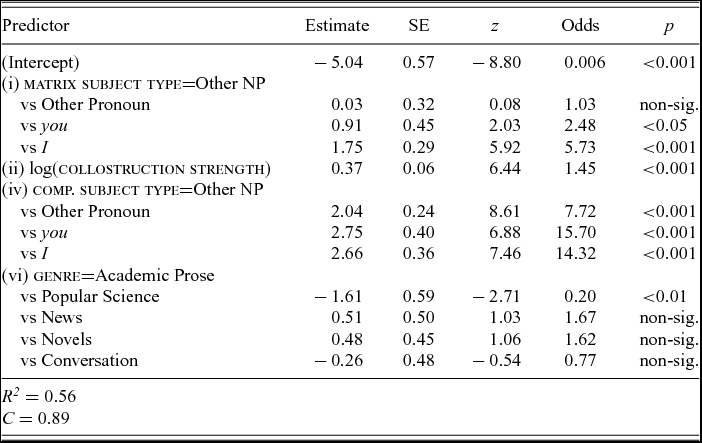
Shifting focus from extraposed to post-predicate clauses, the model in table 7 does not include the factor comp. clause subject length as this factor is tested on non-pronominal complement clause subjects only (see table 9), in order to avoid multicollinearity (see tables 5a–b above).
Logistic regression model: post-predicate clauses. Predicted outcome: omission of that

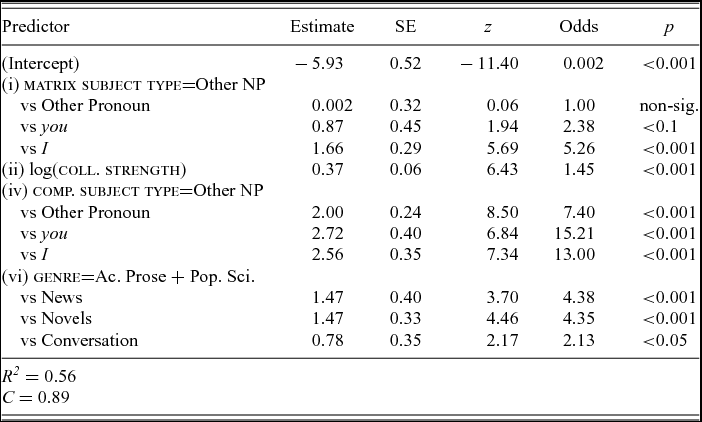
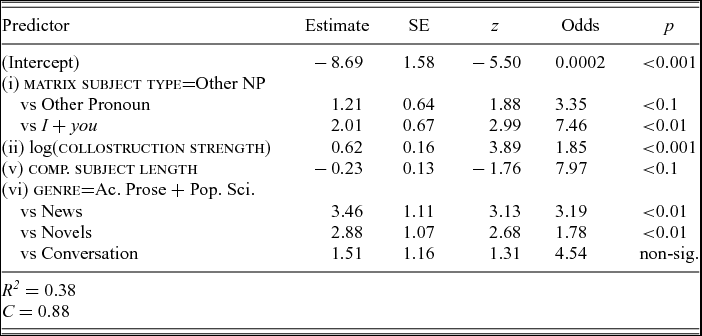
As seen in table 7, all factors included prove to be significant: matrix subject type I and you stand out as the most salient in triggering that-omission (see figure 3, section 4.1); collostruction strength is found to be highly significant in that higher collostruction strength favours that-omission (see section 4.2); the three pronominal levels of comp. clause subject type are all significantly different from ‘Other NP’ (see figure 4, section 4.4). However, looking at the effect of genre in the model in table 7, we see that the results differ from what we would expect, given the distribution in figure 7, section 4.5. Only popular science stands out as significantly different from academic prose, which we would not expect since novels and conversation seem more different from academic prose, given that they include far more instances of that-omission. These puzzling results for genre suggest that genre is correlated with one or more other factors. Upon closer inspection, certain values of factors such as matrix subject type and comp. clause subject type are not represented in academic prose or in popular science. The results for genre in table 7 could thus be attributed to correlations between genre and other factors, rendering an intuitively insignificant effect the only comparison with any classificatory power left in the combined model. To remedy this problem, a model was fitted which conflates academic prose and popular science, the two genres farthest towards the formal end of the continuum of formality (see figure 6, section 4.5), into one genre, as seen in table 8.Footnote 20
Updated logistic regression model: post-predicate clauses. Predicted outcome: omission of that

The new model in table 8, with academic prose and popular science conflated, has identical R2 (0.56) and C (0.89) values with the model in table 7, suggesting that this simplification is warranted. More importantly, the new model handles the genre comparisons better in that the three remaining genres are found to be significantly different from academic prose and popular science combined.
Turning to the effect of comp. clause subject length on post-predicate clauses, we once again restrict our focus to non-pronominal complement clause subjects (i.e. comp. clause subject type = Other NP; n = 299, see figure 4, section 4.4). The results of the model are presented in table 9. Note that for reasons discussed in the previous paragraph, academic prose and popular science are conflated into one genre. Furthermore, due to scarcity of data in certain cells, matrix subject types I and you have also been conflated.
Logistic regression model of the effect of comp. clause subject length : post-predicate clauses. Predicted outcome: omission of that

From table 9 we see that comp. clause subject length does not have a significant effect on the choice between omitting and retaining that.
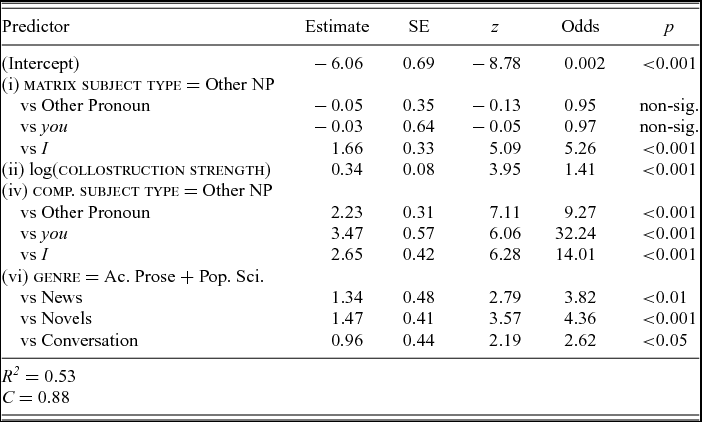
Finally, a model was also fitted to determine whether the effect of the factors observed for post-predicate clauses is largely due to the frequent adjective sure or not.Footnote 21 In this model, all tokens of sure are excluded (n=280). Furthermore, the collostruction strength values of the remaining adjectives have been re-calculated on the basis of sure being removed from the dataset (see section 4.2). The model is presented in table 10.
Logistic regression model: post-predicate clauses (sure removed). Predicted outcome: omission of that

We see that the same factors are still found to be significant, thus indicating that the previously observed effects are not just licensed by sure. However, we might note that matrix subject type you is no longer significant, indicating that much of the effect of this particular matrix subject type is licensed by sure. This is also illustrated by the fact that 56 per cent of all matrix subject type you tokens are found with sure, 76 per cent of which are found with that-omission.
5 Discussion and summary
The aim of this study has been twofold: (i) to test the effect of different factors on adjectival data as regards the variation between that-omission and that-retention, and (ii) to test whether there are any differences between extraposed and post-predicate clauses where the effect of those factors is concerned. The analysis of the choice between retaining and omitting that has identified several factors as significant in explaining this variation. However, looking at the difference between extraposed and post-predicate clauses with respect to this variation, we have seen that not all of these factors have a significant effect on extraposed clauses. We might conclude that the majority of the factors identified in previous studies on verbal predicates are primarily applicable to post-predicate clauses. This is not surprising, since adjectival post-predicate clauses closely mirror verbal post-predicate (or object) clauses. In what follows I will discuss the differences between extraposed and post-predicate clauses regarding the variation between that-omission and that-retention, with a special focus on the factors related to the Uniform Information Density Principle and the Complexity Principle.
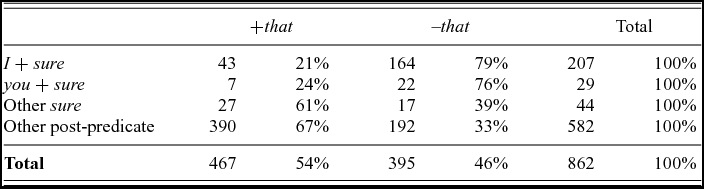
The prediction derived from the Uniform Information Density Principle (Jaeger Reference Jaeger2010) that adjectives with a higher collostruction strength will favour that-omission was only found to hold for post-predicate clauses. The main reason for this may be the fact that adjectives complemented by post-predicate clauses appear to be represented in more entrenched formulaic expressions, such as I'm sure, I'm convinced (remember that I was found to be the matrix subject most strongly triggering omission of that), thus promoting that-omission, whereas this does not appear to be the case among extraposed clauses. In other words, this is not only a matter of the expectedness of certain adjectives to be followed by a post-predicate that-clause, but also a matter of recurring subject–adjective combinations forming a highly recognizable unit more susceptible to that-omission. In connection with this, the numerous studies on the grammaticalization of the subject–verb combination I think and its preponderance for that-omission might serve as a good analogy (see Thompson & Mulac Reference Thompson, Mulac, Traugott and Heine1991a; Van Bogaert Reference Van Bogaert2010, Reference Van Bogaert2011; Kaltenböck Reference Kaltenböck and Schönefeld2011, Reference Kaltenböck, Aarts, Close, Leech and Wallis2013). In fact, one particular subject–adjective combination can be singled out as especially frequent and a strong trigger for that-omission. It was observed in section 4.2 that sure was the most frequent adjective complemented by post-predicate clauses. Taking a closer look at the preference of the subject–adjective combination I (’m/am) sure (including modifiers and negation such as I’m pretty sure and I’m not sure) for that-omission, we find that omitting that is quite prevalent (79 per cent, as shown in table 11).
Preference for that-omission with I (’m/am) sure vs other combinations (post-predicate clauses)

We have already observed that the effect of matrix subject type you was largely licensed by sure (see table 10, section 4.6), but comparing I (’m/am) sure to other combinations including sure, the proportion of that-omission drops dramatically (39 per cent). It drops even further when all other post-predicate tokens are taken into account (33 per cent). This suggests that the subject–adjective combination I (’m/am) sure is a major trigger for that-omission, comparable to the role of I think reported in previous studies on verbal predicates (see Thompson & Mulac Reference Thompson, Mulac, Traugott and Heine1991a, Reference Thompson and Mulac1991b; Jaeger Reference Jaeger2010; Torres Cacoullos & Walker Reference Torres Cacoullos and Walker2009; Van Bogaert Reference Van Bogaert2011; Kaltenböck Reference Kaltenböck, Aarts, Close, Leech and Wallis2013).
Regarding the predictions of the Complexity Principle, separation and comp. clause subject type were found to be significant factors for both extraposed and post-predicate clauses, whereas comp. clause subject length was not. A preliminary hierarchy of complexity factors most influential in that-omission would thus have separation at the top (remember that separation contexts invariably feature retention of that) followed by comp. clause subject type. It should also be pointed out that comp. clause subject type is the variable with the highest effect size across both extraposed and post-predicate clauses (see table 5b and table 8, section 4.6).
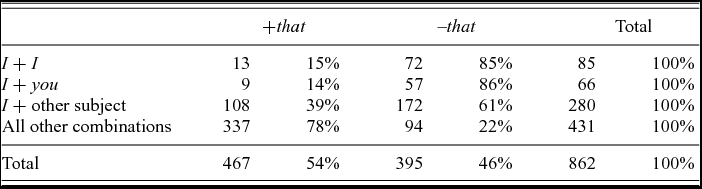
In relation to the complement clause subjects, Elsness (Reference Elsness1984) has pointed out that the preference of NPs headed by pronouns for occurring with that-omission (as compared to NPs headed by nouns) is largely due to coreferentiality between the matrix and complement clause subjects (here we might want to recall that I and you were found to be the subjects most consistent in triggering that-omission as both matrix subject and complement clause subject in post-predicate clauses). In extraposed clauses, such coreferentiality between the matrix and complement clause subjects is excluded. This fact highlights an important difference between extraposed and post-predicate clauses and might serve as an important clue as to differences in the proportion of that-omission between them (see also Kaltenböck Reference Kaltenböck2006: 387). Even though coreferentiality between matrix and complement clause subjects might serve as a powerful factor for triggering that-omission, I would like to argue that it is the matrix subject type that does most of the work. Consider table 12, and the apparent triggering of that-omission when the matrix subject type is I and the complement clause subject type is either I (i.e. coreferential) (85 per cent) or you (86 per cent). Corresponding figures for you + you (74 per cent) and you + I (67 per cent) further indicate that matrix subject type I combined with comp. clause subject type I or you could be seen as more important than coreferentiality in triggering that-omission, as indicated by the sudden drop in the proportion of that-omission for the other combinations, as shown in table 12 (see also Torres-Cacoullos & Walker Reference Torres Cacoullos and Walker2009: 25 for similar observations on the effect of coreferentiality on that-omission).
Raw frequency and percentage of selected matrix + comp. clause subject type combinations

Furthermore, the results suggest that the division between NPs headed by pronouns and NPs headed by nouns, as predicted by the Complexity Principle (Rohdenburg Reference Rohdenburg1996), should be further subcategorized when it comes to the complement clause subject; the results suggest that the division should be between the pronouns I and you, on the one hand, and ‘Other Pronouns’ and ‘Other NP’ on the other hand (see figure 4, section 4.4).
Another thing to note about the complexity factors is that extraposed clauses generally allow much more complexity than post-predicate clauses; they are found to have more attested examples with separation, they are also found more frequently with NPs headed by nouns as the complement clause subject, and thus their complement clause subject is found to be longer than that of post-predicate clauses. Even so, genre proved to be a highly significant factor in explaining the variation between retaining and omitting that (see table 5b, section 4.6). This might indicate that the frequent occurrence of complexity factors found for extraposed clauses should be seen as an inherent feature of the genres they most frequently occur in rather than as features triggering that-omission.