The claims in the patents involve computer technology that is highly complex and demands a significant amount of judicial time to understand. … Defendants have persuaded the court that there is significant overlap between the issues before the Patent Trial and Appeals Board and the claims in litigation. … Staying the case pending IPR makes common sense and will save cents. The IPR will resolve, streamline, and clarify the issues and save the court and parties from unnecessary expenditures of time and money.
—Judge Patti B. Saris, Intellectual Ventures I, LLC, et al. v. Lenovo Group Ltd., et al., No. 1:20-cv-10292-PBS (D. Mass. Aug. 30, 2017)In a key sense, district judges are the most pivotal personnel in the federal judiciary. The overwhelming majority of federal cases go no further than their courtrooms. Most disputes settle (e.g., Eisenberg and Lanvers Reference Eisenberg2009; Boyd and Hoffman Reference Boyd2013), and a substantial number of losing litigants simply do not appeal. Even when appeals do occur, they are tethered to a factual record that has been assembled under a trial judge’s watch and is entitled to significant deference. There are many high-quality studies of district court decision making (e.g., Boyd and Spriggs Reference Boyd2009; Sisk and Heise Reference Sisk2011; McKenzie Reference McKenzie2012; Boyd and Hoffman Reference Boyd2013; Boyd and Sievert Reference Boyd2013; Boyd Reference Boyd2015, Reference Boyd2016), but the sheer volume of work that federal trial judges perform still makes the comparative dearth of scholarship that is devoted to their decision making surprising.
This would be less consequential but for the reality that trial court decision making is unique in important ways (Kim et al. Reference Kim2009, 84–85; see also Boyd Reference Boyd2016). As a result, much remains unknown about the avenues through which legal (e.g., Perino Reference Perino2006, 499) and ideological (e.g., Kim et al. Reference Kim2009, 89) factors may influence the decisions of federal trial court judges. Specifically, and in contrast to judging in many other contexts, the uniquely iterative nature of district court business could operate to make ideology’s role “vary depending upon the stage of litigation at which a judge decides” (Kim et al. Reference Kim2009, 101). Related to this, we think, is the reality that much of the activity district judges engage in is procedural in nature (e.g., Kim et al. Reference Kim2009)—they routinely rule on objections, motions, or the admission of evidence. Without a careful examination of these procedural decisions, we risk underestimating the influence of ideology in the district court context.
In this article, we leverage data on patent litigation in the district courts to examine questions about ideology and the influence of legal factors on a procedural aspect of trial judge decision making. We focus on district court litigation commenced since passage of the America Invents Act (AIA) in 2011. Although we have more to say about that legislation, for now it is enough to note that the AIA marked the most fundamental recalibration of US patent law in over 50 years (e.g., Levitt Reference Levitt2011; Hurst Reference Hurst2013). It created the Patent Trial and Appeals Board (PTAB), an administrative tribunal within the United States Patent and Trademark Office (USPTO) that exercises several important responsibilities. The PTAB began operating in 2012, the year our analysis begins. Notably, the AIA established two new proceedings for challenging the validity of granted patents before the PTAB: inter partes review (IPR) and covered business method review (CBM). These procedures quickly became synonymous with administrative challenges to patent validity, but the vast majority of the petitions that the PTAB considers involve patents simultaneously being litigated in the district courts (see Simpson et al. Reference Simpson2015). Some have made the provocative assertion that parallelism has “transformed the relationship between judicial litigation and the administrative state” (Vishnubhakat, Rai, and Kesan Reference Vishnubhakat2016, 45).
These avenues of administrative opposition to issued patents implicate questions at the intersection of legislative, executive, and—most critically here—judicial behavior. We examine a key procedural decision that generalist district court judges face in such cases—whether to stay Article III patent proceedings while the PTAB considers administrative challenges to the validity of the patent(s) relevant to that litigation. One might anticipate that the vast majority of judges would choose to stay patent litigation pending administrative review, whether to avail themselves of expertise in a factually complex field, out of a desire for leisure (e.g., Epstein, Landes, and Posner Reference Epstein2013) or for any number of other reasons. But, as it turns out, there is substantial variation in the rates at which judges grant these motions to stay. We attempt to isolate the determinants of decisions regarding these motions to stay and, in so doing, contribute to a growing literature on decision making by district judges that increasingly recognizes their distinctiveness in the federal judicial hierarchy (e.g., Kim et al. Reference Kim2009).
In accounting for the variation that exists in this area of motion practice, we assess the influence of legal factors on stay decisions in the district courts while considering the possibility that ideology may also be influential in some circumstances. We begin by gathering relevant insights from scholarship on district court decision making. Then, to provide essential context for the sections that follow, we paint a more comprehensive picture of the role Congress assigned to the PTAB in reviewing administrative challenges to patents via IPR and CBM. Here we also delineate the relationship of these procedures to Article III litigation. With that in mind, we describe important legal considerations in patent litigation as well as the ways ideological predispositions are thought to apply to procedural aspects of federal litigation and more substantive issues of patent rights. We then articulate several hypotheses and describe our data, turning to measurement and modeling issues before presenting our results. We test a number of empirical implications that arise from our discovery of an ideological valence in the decision to grant a stay, focusing on case facts that might accentuate the frivolousness of an infringement claim. Finally, we consider directions for further research.
Contextualizing Decision Making in the District Courts
District court judges are unique in numerous ways, but perhaps none is more critical for understanding decision making than the fact that these trial judges make decisions across the life of a case (Boyd Reference Boyd2016, 791). This reflects “the dynamic, multistaged nature of litigation at the trial level” (Boyd, Kim, and Schlanger Reference Boyd2020, 467) and has prompted calls to study the decisions of federal district judges as opposed to their opinions (Kim et al. Reference Kim2009). Not every decision that district court judges make is memorialized in an opinion—in fact, precisely the opposite is true (Hoffman, Izenman, and Lidicker Reference Hoffman2007, 727)—and even when cases resolve without a final opinion, judges have almost certainly made choices that helped structure the outcome (see Kim et al. Reference Kim2009, 85).
As Kim et al. (Reference Kim2009, 100) illustrate with the example of ideology, this risks generating erroneous conclusions: “[Perhaps] decisions not memorialized in a written opinion are less subject to political influences. … Alternatively, district judges may be more inclined to allow their policy preferences to hold sway when their decisions are subject to the least scrutiny,” especially in instances in which—as with the motions to stay we examine—that decision is essentially unreviewable by a higher court.Footnote 1 In other words, a single-minded focus on opinions raises the possibility of selection bias. A series of studies on motion practice in district court litigation underscores the importance of looking beyond final opinions when it comes to understanding trial court decision making (Hoffman et al. Reference Hoffman2007; Boyd and Hoffman Reference Boyd2013; Boyd Reference Boyd2015), and, as described in subsequent sections, we focus on such a decision here.
District judges oversee proceedings in the intake courts of the federal system. This vantage point affords these judges the opportunity to assess controversies for the first time, and they routinely do so in civil cases that range from torts and contracts to prisoner petitions and intellectual property (Moore Reference Moore2015). Within this context, federal judges routinely complain about lawsuits that are meritless or even frivolous (Fradella Reference Fradella1999, 48).Footnote 2 These preliminary assessments about the merits of a case are important, given the dynamic nature of trial court decision making we have already noted. Conventional wisdom suggests that “eliminating meritless and frivolous claims as early in a case’s trajectory as possible … [will ensure] that available remedies are properly distributed to deserving plaintiffs” (Reinert Reference Reinert2014, 1191). That is primarily the trial judge’s responsibility. However, determining what is “meritless” or “frivolous” may frequently lie in the eye of the beholder. Tort law has typically taken center stage in these debates (e.g., Rhode Reference Rhode2004); however, the issue is also prominent in patent law (Hosie Reference Hosie2008, 85). Typically, frivolousness is a primary concern of the political Right, with efforts led by interest groups like the US Chamber of Commerce and the American Tort Reform Association (Rhode Reference Rhode2004, 451–52). An analogue exists in patent law in the form of efforts backed by large technology companies (Hosie Reference Hosie2008, 87). Even in the many instances in which cases clear the bar of legitimacy, judges can and do diverge in terms of the seriousness with which they ultimately approach the case (e.g., Guthrie Reference Guthrie2000).
Directly related to this point, many of the choices district judges make are “procedural” in nature. Yet, as others have pointed out, this is somewhat misleading: decisions that are “‘procedural’ can have an enormous influence on the scope of the subsequent litigation and thus the likelihood that a given litigant will ultimately prevail” (Kim et al. Reference Kim2009, 92). Even decisions simply related to delaying litigation can have serious consequences for the litigants. Whether a district court judge grants a motion to stay patent litigation in her court pending the outcome of administrative review is precisely the sort of discretionary, unreviewable choice that is procedural—yet, as we show in the next section, it carries with it more substantive implications as well.
Administrative Patent Challenges and Federal Litigation
The AIA was a truly wide-ranging policy response. It supplanted the “first-to-invent” system that had characterized US patent law with a “first-to-file” priority rule, thereby adopting the prevailing international standard for patent rights. It broadened the definition of prior art and expanded the prior use defense to patent infringement (Thomas Reference Thomas2014), created new administrative procedures for reevaluating the validity of patents, and gave the PTAB responsibility for conducting those procedures. Two in particular are relevant to the empirical examination that follows: IPR and CBM, both of which are adversarial processes that are typically conducted before three administrative patent judges. The PTAB must “institute” both IPR and CBM proceedings before ruling on the validity of any patents in dispute. While exceptions can be made, final decisions must typically issue within 12 months of institution.
The legal standards in these PTAB actions are broader than those used in district court litigation, which makes it easier for parties to demonstrate patent invalidity (Motl Reference Motl2015, 1976).Footnote 3 Congress’s creation of these procedures was largely driven by the belief that patent litigation had become too burdensome and expensive, and the PTAB has garnered a reputation for invalidating challenged patents. The former chief judge of the Court of Appeals for the Federal Circuit, which hears appeals from the USPTO, famously termed the PTAB’s panels “death squads killing property rights” (Williams and Eaton Reference Williams2015, 9). Others have argued that, as per Congress’s intent, the forum “is attractive to defendants in patent litigation and others seeking to invalidate low quality and potentially threatening patents” (Motl Reference Motl2015, 1978). Even though Congress envisioned IPR and CBM as cheaper and more efficient substitutes for traditional litigation over patent validity (see Vishnubhakat et al. Reference Vishnubhakat2016, 65), the vast majority of these administrative challenges involve patents that are also the focus of federal litigation.
There are some differences between these two adversarial administrative proceedings. Validity challenges in IPR are limited to prior-art patents and prior-art publications; CBM is often thought to be even more advantageous to parties seeking cancellation of patents because it permits wider-ranging patentability challenges, although those patents must relate to financial products or services (Stach and Strickland Reference Stach2014). These methods patents have been described as “the bane of the corporate world, and business groups say they encourage frivolous lawsuits based on faulty application of patent law” (Wyatt Reference Wyatt2011). IPR is a permanent program; Congress designed CBM review to be transitional, and it expired in September 2020. Finally, when instituted IPRs result in written decisions, individuals are prevented from pursuing issues that were either “raised or reasonably could have been raised” in the proceedings (Stach and Strickland Reference Stach2014). This prohibition extends to USPTO hearings, matters involving the International Trade Commission, and future federal court litigation. In contrast, CBM review is more forgiving—it prohibits raising similar issues in later USPTO proceedings, but that bar does not apply to federal court litigation (Vishnubhakat et al. Reference Vishnubhakat2016, 63). We elaborate on the ways in which these sorts of distinctions may relate to our analysis shortly.
In instances in which patents are the subject of traditional litigation and administrative challenges, district court judges have the option of staying litigation before them pending the outcome of PTAB proceedings if a party moves to do so. Although these stays are discretionary—and any determinations by the PTAB are not binding on district courts, in part because slightly different standards of claim construction and demonstrating invalidity exist (Motl Reference Motl2015, 1990)—there are certain legal guidelines that trial court judges are expected to weigh when deciding them.Footnote 4 The AIA does not articulate a specific standard to guide the issuance of IPR stays, and there is no inherent legal right to them, but several factors rooted in precedent play an important role (Frontz Reference Frontz2015; Vishnubhakat et al. Reference Vishnubhakat2016). District Judge Michael Simon’s decision denying a motion to stay represents a textbook articulation of these factors:
-
1. whether discovery is complete and whether a trial date has been set;
-
2. whether a stay will simplify the issues in question and trial of the case; and
-
3. whether a stay would unduly prejudice or present a clear tactical disadvantage to the non-moving party. (Drink Tanks Corp. v. Growlerworks, Inc., No. 3:16-cv-410-SI, 2016 WL 3844209, at *2 [D. Or. July 15, 2016])
In contrast, Congress specified a particular test that “shall” be used to govern CBM-related stays in the AIA (Vishnubhakat et al. Reference Vishnubhakat2016, 65).Footnote 5 We unpack the potential implications of these considerations when we present our hypotheses in the next section.
District Court Judges, Ideology, and Patent Law
It is beyond serious dispute that ideology plays a role in judicial behavior, but findings about its influence on decision making by federal trial judges are mixed (for an overview, see Boyd and Boldt [Reference Boyd2017, 266–69]). The more equivocal nature of these conclusions is likely a partial function of the unique institutional context we have described, which also bears on the acknowledged importance of law and precedent in trial venues (Boyd Reference Boyd2017, 136). These considerations, in turn, produce in district judges a broad range of goals as well as substantial variation in how those goals are ordered (Baum Reference Baum1997, 24–25; Zorn and Bowie Reference Zorn2010, 1213).
Ideology’s role in judging is almost always conceived as tapping substantive dimensions rooted squarely in the legal domain the case involves—does a judge’s decision favor the corporation or the individual, the government or the accused, private property rights or governmental regulation? But thinking about ideology’s relevance to district court judges in this way alone seems to us both incomplete and inconsistent with the guidance of those who have urged scholars to look beyond mere opinions (Kim et al. Reference Kim2009). Given the unique nature of district court decision making, our interest lies in approaching the potential influence of ideology on more procedural decisions.
Rowland and Carp (Reference Rowland1996) suggest that the special responsibilities of district judges may activate different cognitive processes in them. This raises an interesting possible corollary—might the influences of procedure and fact-finding, along with the iterative nature of their decision making and their gatekeeping role in the federal judiciary, lead district court judges to exert ideologically consistent behavior in ways that map onto questions of procedure? Another way of posing this question is to ask whether we would expect procedural considerations to be especially dominant or salient to district court judges, given the institutional context in which they operate. Collins (Reference Collins2008, 868) has shown that judges are more likely to evince ideologically consistent behavior when issues are especially salient to them, and it seems plausible to argue that the federal judiciary’s gatekeepers—district court judges—may find issues related to judicial access especially salient as compared to many questions related to actual legal substance.Footnote 6 To the extent that this is the case, a lack of attention to the ideological valence of procedural issues would underestimate or ignore an important aspect of ideology’s role in district court decision making.
We probe the influence of ideology on a specific procedural motion in the district courts—a judge’s decision to grant or deny a stay pending the resolution of parallel administrative proceedings in the PTAB. We refer to the stay decision as a procedural one, although procedural decisions can ultimately play a role in the substantive outcomes of litigation (see Kim et al. Reference Kim2009). A cursory look at our data illustrates this; the granting of a stay is associated with a decrease in the likelihood that the plaintiff will win the case.Footnote 7 As table 1 demonstrates, when no stay is granted in a case, the probability of the plaintiff winning is 67%, but that drops to just 33% when a stay is granted. Notably, the granting of a stay is also associated with an increase in the likelihood of a settlement.
Dispositions in Cases with Stay Request

Using patent cases to test for the existence of this “procedural ideology” is advantageous for several reasons. First, fundamental ideological distinctions are relevant to issues involving “frivolous litigation,” access to justice, and judicial efficiency. These constructs are highly pertinent to patent litigation because, as Gugliuzza (Reference Gugliuzza2018, 640) observes, “policy discussions of patent litigation regularly invoke tropes about abusive and frivolous lawsuits—the same rhetoric that has pervaded policy discussions of civil litigation generally.” Calls for curtailing frivolous litigation implicate clear ideological divides, with Republican politicians and conservative interests including the US Chamber of Commerce and the American Tort Reform Association being strongly supportive of civil litigation reform (Haltom and McCann Reference Haltom2004; Rhode Reference Rhode2004, 451–53). The ideological valence of the judicial access issue is apparent across all levels of American government, with executives, legislators, and judges alike taking positions that reflect this divide (e.g., Sugarman Reference Sugarman2006).Footnote 8
This ideological cleavage has also been displayed in recent Supreme Court decisions. For example, in 2013 the justices split along ideological lines, with the conservative majority upholding an arbitration clause to foreclose judicial access. Two years before that, the liberal bloc objected to making it more difficult to certify class actions.Footnote 9 In Ashcroft v. Iqbal (556 U.S. 662 [2009]), the Court’s conservatives made it easier for judges to dismiss civil cases at an early stage—in fact, the New York Times characterized Iqbal as arguably “the most consequential ruling” in Chief Justice Roberts’s then-10-year leadership of the Court, owing to its procedural implications for judicial access in federal civil cases (Liptak Reference Liptak2015).
Modern patent litigation represents an inviting target for those who have expressed concern over frivolous litigation in the federal courts. One litigator has argued that these sorts of attacks have played a role in “shaping the way federal district court judges view patent cases” (Hosie Reference Hosie2008, 77). Others have lamented that “vexatious patent litigation … cost[s] defendants and taxpayers tens of billions of dollars each year and delay[s] justice for those who legitimately need a fair hearing of their claims” (Rader, Chien, and Hricik Reference Rader2013). The classic target for critics is the nonpracticing entity, or so-called patent troll, which holds a series of patents that it does not use but asserts in suing a defendant or defendants for infringement. Scholars differ as to exactly what qualifies as a patent troll (e.g., Schwartz and Kesan Reference Schwartz2014), but certain behavior tends to generate suspicion. For example, one indicator of the “nuisance patent plaintiff” is when a patent holder sues a large number of defendants in the same action (Sudarshan Reference Sudarshan2008, 164). We use this indicator to identify suits filed by potential trolls in the models that follow.
An examination of patent cases represents a stringent test of ideological influence as it relates to questions of judicial access. When it comes to the pure “substance” of patent rights, ideologically conservative judges should generally be more protective of patent rights than their liberal counterparts. This predilection, which has been found to characterize the behavior of federal appellate judges, tends to be true of both patent rights specifically and intellectual property more generally (Landes and Posner Reference Landes2003; Miller and Curry Reference Miller2009; Sag, Jacobi, and Stych Reference Sag2009).Footnote 10 Owing to the PTAB’s reputation as a forum that is generally hostile to patent rights, a district judge’s decision to stay litigation pending administrative review is tantamount to a liberal outcome with respect to patent law itself. Substantively, all else equal, a conservative jurist who is favorably inclined toward patent rights should disfavor pausing her own proceeding to await what is likely to be an antipatent administrative decision. This means, in some sense, that any finding of ideological decision making with respect to procedure in these cases must overcome a countervailing substantive concern.
A district court judge’s stay is a fundamentally conservative decision when considered from a procedural perspective rooted in concern over frivolous litigation. Why? The answer turns on the distinction between assessments of patent validity and patent infringement. Only valid patents can be infringed, and examiners sometimes issue patents to low-quality inventions when they probably should not have.Footnote 11 If a patent is later deemed invalid for obviousness, any attempt to recover damages from an “infringer” is essentially rendered frivolous. Sudarshan (Reference Sudarshan2008, 186) captures the logic of why a district court stay pending reassessment of a patent’s validity is a procedural move that cuts against those who bring potentially frivolous cases by referencing litigation costs: “Staying the infringement portion of the case gets to the heart of the advantage enjoyed by nuisance-value patent plaintiffs because it requires all parties to focus first on validity, where neither plaintiffs nor defendants enjoy a particular cost advantage.” Because they require defendants to hire experts and devote significant time and money to interpreting claims, it is these questions surrounding infringement that drive up litigation costs (165). Prioritizing this assessment of validity “is merely a matter of procedure as far as the patent right is concerned” (187). It bears repeating that district courts are not required to hold the infringement portion of litigation in abeyance while the PTAB adjudicates patent validity.
We believe these sorts of procedural issues will dominate among most district court judges, given the daily importance of such matters and the fact that substantive ideology of patent law is probably not akin to the salience that ideological divisions in, say, civil liberties or civil rights cases hold for these judges. Furthermore, the procedural issue in play in these cases—involving otherwise highly contested questions of access to justice (e.g., Sugarman Reference Sugarman2006; Reinert Reference Reinert2014)—should enhance the ideological salience of procedure vis-à-vis whether to grant a stay.
Our first four hypotheses are motivated by the centrality of legal factors to decision making by district court judges, and, in generating them, we draw on the legal guidelines governing stays described in the previous section. Recall that three basic legal considerations govern IPR- and CBM-related stays, with the caveat that the CBM framework is statutorily specified and includes a fourth provision that is thought to enhance the probability of a stay (see n. 5). Under the first common factor, district courts consider the progression of a litigation action under the procedural schedule. The third factor is related, because it instructs judges to consider whether a stay would introduce a clear strategic disadvantage to the nonmoving party. As a general rule, these two factors suggest that, the more advanced the case, the less likely the court should be to issue a stay. This leads to hypothesis 1:
Hypothesis 1. As more time elapses in a case, a judge should become less likely to issue a stay.
According to the second factor, district courts consider whether granting a stay is likely to simplify the issues in question. As part of this calculation, many courts first consider whether the PTAB has instituted proceedings or whether the parties are still waiting for an institution determination. If administrative review has not been instituted, this probability of simplification by a decision on the merits is far more uncertain. In addition, courts under this factor generally examine the overlap between the patents and claims at issue in the litigation and those implicated before the PTAB. For example, in Acqis, LLC, v. EMC Corp. (109 F. Supp. 3d 352, 357 [D. Mass. 015]), the district court found that this factor weighed in favor of a stay for which only two of the 11 patents in suit and only three of the 22 asserted claims were under review in the instituted IPRs. However, the court noted that there was significant overlap between all 22 of the asserted claims as well as among all 11 patents. While the Acqis court stayed the entire case, some courts will only stay the overlapping portions of cases. Put differently, the more patents and patent claims at issue in a case, the less likely an IPR or CBM review is to significantly simplify the substantive issues.
Hypothesis 2. A judge should be more likely to issue a stay once the PTAB has instituted review proceedings.
Hypothesis 3. The greater the number of patents in suit, the less likely a judge will be to issue a stay.
Finally, for reasons we have already outlined, the factors courts are required to consider when faced with whether to stay litigation pending CBM make it especially likely that stays will be granted in that context. This informs hypothesis 4:
Hypothesis 4. Judges should be more likely to grant motions to stay pending CBM review than in IPR.
The final consideration we test involves the influence of ideology on stay decisions. Given the context in which district judges operate, because of the salience of procedural issues related to judicial access in that context, as well as the points we have raised about frivolousness in the realm of patent litigation, we offer hypothesis 5:
Hypothesis 5. Conservative judges should be more likely to stay litigation than their liberal counterparts.
Data and Variables
To test these hypotheses related to legal and ideological considerations on district court decision making, we used Lex Machina, a data analytics platform affiliated with LexisNexis, to identify patent cases filed in the district courts between January 1, 2012, and June 30, 2020, in which a defendant filed a motion to stay litigation pending IPR or CBM review.Footnote 12 After excluding cases in which both parties stipulated to staying, those cases involving patent reexaminations, and those cases based on a plaintiff’s motion to stay, we are left with 1,005 observations. We then read the docket entries associated with each case and coded numerous variables associated with them. Our dependent variable, Stay Granted, is coded 1 when the judge grants the motion to stay and 0 otherwise.
We then created several variables to test our four hypotheses rooted in legal considerations. The first, Postinstitution, is a dichotomous indicator of whether the motion to stay was filed after the institution of proceedings by the PTAB (1 if yes; 0 otherwise). A positive coefficient on this variable would be evidence in support of hypothesis 2. A second dummy variable, which we call CBM, captures the type of administrative review in question—values of 1 denote CBM, with 0 indicating IPR. Here, a positive coefficient would suggest support for hypothesis 4. To capture additional legal aspects of each case, we include Patent Count and Time to Stay. The count variable captures the number of distinct patents at issue in a case, and the timing measure allows us to control for the length of time (in months) since the case was filed until the stay decision is announced. Hypotheses 1 and 3 suggest that these two variables should be negatively signed, since higher values of them are expected to depress the likelihood of a stay.
We capture judicial ideology with the approach first developed by Giles, Hettinger, and Peppers (Reference Giles2001) and extended by Boyd to the district court context (e.g., Boyd Reference Boyd2015).Footnote 13 Those scores are scaled from −1 (very liberal) to +1 (very conservative). We use an alternate coding in the appendix to check that our coding choice does not influence our subsequent findings.
We include three dummy variables to capture the main technological field involved with each case: Biological, Computer, and Mechanical. In the regressions that follow, Biological is the excluded group and serves as a baseline. In addition, to help us capture the potential frivolousness of a case, we include a measure called Simultaneous Litigant. This variable is coded 1 if a plaintiff has filed an infringement action against multiple defendants on the same set of patents before the same district court judge. For the reasons discussed above, we believe that this is a good indicator that the entity filing the infringement cases in federal court is likely to be pursuing a case with relatively little legal substance—often termed a nuisance suit in the tort reform literature. We include descriptive statistics for all included variables in table A1.
Results
We estimate a series of logit equations displayed in table 2. In each, we cluster the errors simultaneously on judge and court to account for nonindependence across observations on both dimensions. Model 1 represents what other scholars have referred to as the “standard model” in these types of cases: a defendant is sued for patent infringement and asks the PTAB to review the validity of the patents they are alleged to have infringed. It does not include control variables. Model 2 varies only in that it includes control variables (discussed in the appendix). Unless otherwise noted, we use model 1 in describing the results.
Regression Results

Note.— N = 1,005. LR = likelihood ratio. PRE = proportional reduction in error.
* p < .05 (all tests two-tailed).
Legal factors have a decisive influence on the decision of whether to grant a stay. Figure 1 shows how the probability of a stay changes when shifting from whether a stay is instituted or not, from one (10th percentile) to eight (90th percentile) patents, from a stay being requested after 5 months (10th percentile) have elapsed since a suit was filed to 25 months (90th percentile), and whether the stay requested is part of a CBM proceeding. The direction of all legal results is consistent with our expectations as laid out in hypotheses 1–4. Whether an IPR proceeding has been instituted by the PTAB is the single most important predictor of a stay being granted. There is an 18-percentage-point increase once institution has occurred, resulting in a change in the likelihood of a stay from 58% to 76%. Cases in which the patent is challenged in a CBM proceeding are 8 percentage points more likely to result in a stay. Conversely, as the number of patents in a case increases, the likelihood of a stay decreases by 15 percentage points. As the amount of time between when a case is initiated and when a stay is requested increases, the chance that a stay will be granted decreases by 6 percentage points, although this relationship is not statistically significant. Another approach to understanding the influence of these legal factors is to simulate likely outcomes when all of them weigh in favor of or against a stay. Using this simulation approach, when all factors favor a stay (i.e., there is institution, it is a CBM review, the stay has been requested quickly, and there is only one patent involved), the likelihood of one being granted is 87% [83%, 92%] (throughout, 95% confidence intervals are in brackets), but when the legal factors disfavor a stay (i.e., no institution, IPR review, the stay request is delayed, and there are eight patents involved), the likelihood of a stay plummets to 42% [28%, 56%].
Legal factors. Points represent mean estimates; bars represent 95% confidence intervals.

Our expectations with respect to how judicial ideology will influence the decision to grant a stay center on the framing of patent disputes in terms of the frivolousness of many infringement disputes. We expect that procedural preferences for quick resolution, particularly of frivolous cases, will push conservative judges to grant stays more readily. The significant positive coefficients for Judge Ideology in our models indicate that procedural concerns do dominate in this context. Moving across the range of ideology, the most conservative judge in our data is about 11 percentage points [2, 21] more likely to grant a stay than is the most liberal judge. Substantively this is the same as increasing the number of patents involved in a suit from one to eight. Or, put differently, ideology definitely matters in the decision whether to grant a stay, but its influence is only half that of whether the PTAB has decided to institute a proceeding.
Another way to understand the influence of ideology on the likelihood of granting a stay is to compare its influence in a situation in which a stay is likely to be granted based on legal factors to a situation in which a stay is less likely based on legal factors. In a situation in which the granting of a stay is legally likely, moving from the most liberal to the most conservative judge in our data increases the likelihood of the grant of a stay by 7 percentage points [2, 11]. The influence of ideology is three times as large in a less legally constrained situation: moving across the range of ideology, the most conservative judge is 15 percentage points [3, 27] more likely to grant a stay than is the most liberal judge. Put differently, in the case of stays in patent cases, it appears that the law can restrain the influence of ideology by up to 50%.
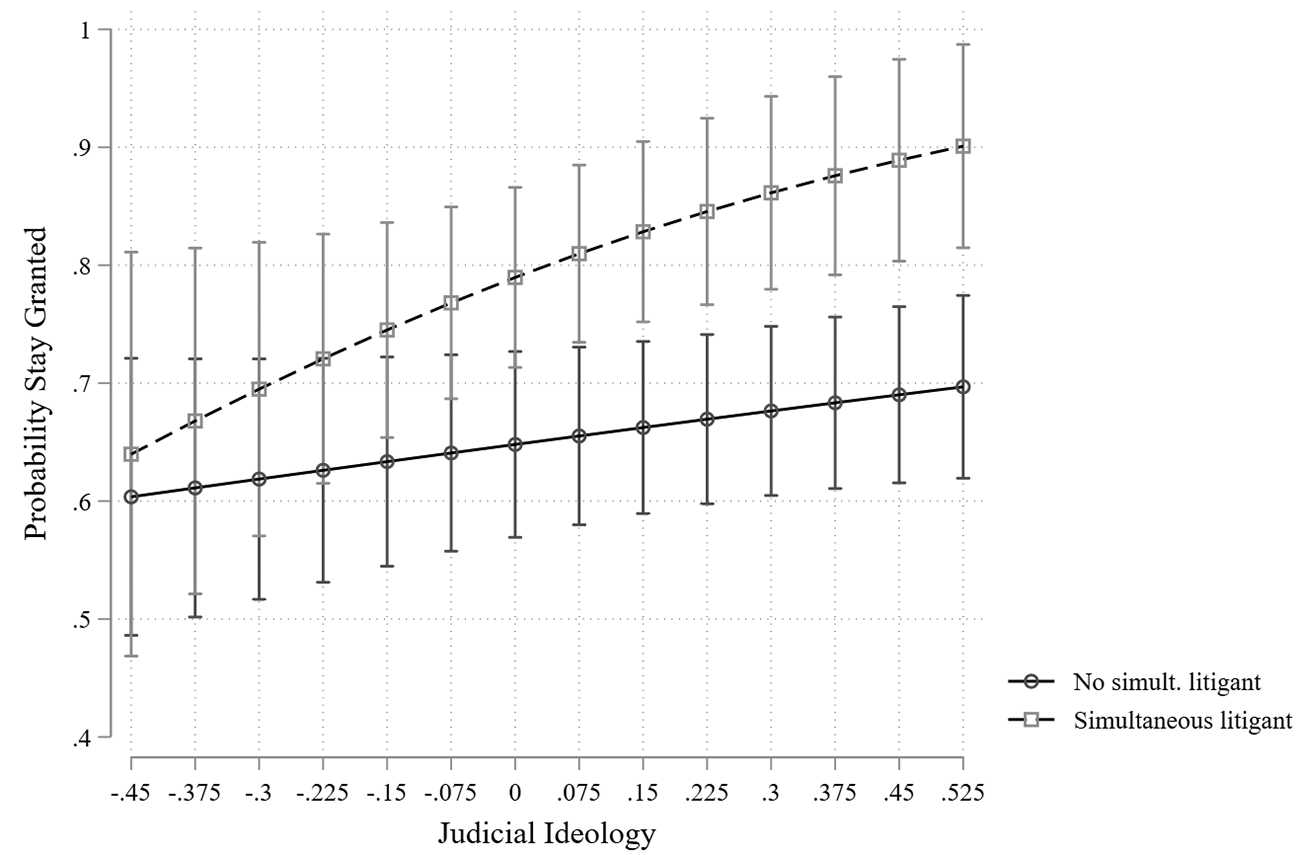
Finally, our variable indicating whether a filing is particularly likely to be frivolous—Simultaneous Litigant—is a strong predictor of the likelihood of granting a stay. Across all judges, when a case involves simultaneous filings on the same set of patents, by the same plaintiff, in the same court, the likelihood of a stay being granted increases by 14 percentage points [2, 25].
To better understand how ideological decision making is activated in these patent cases, it is useful to analyze the conditional role of ideology—especially when concerns over frivolous litigation are likely to be elevated. To do this, we create a model in which we interact our measure of judicial ideology with our indicator for a simultaneous litigant. Table 3 (model 3) and figure 2 display the results of this exercise. Given the interaction terms, it is easiest to interpret the findings graphically, so we focus on figure 2 in describing these results. Ideological reactions to frivolousness are strong, as the slope for ideology is considerably steeper in cases involving simultaneous litigants than it is in cases that do not. For liberal judges—those with negative ideology scores—there is basically no statistically meaningful difference in their likelihood of granting a stay in either type of case. However, as a judge becomes more conservative, the difference in the likelihood of granting a stay between the two kinds of cases increases quickly. At the 10th percentile of ideology there is only a 7-percentage-point difference in the likelihood of granting a stay, a difference that is not statistically significant. At the 90th percentile of ideology there is a statistically significant 20-percentage-point difference in the likelihood of granting a stay. These results strongly suggest that concerns over frivolousness motivate ideological reactions to a stay request.
Conditional Influence of Ideology

Note.— N = 1,005. LR = likelihood ratio. PRE = proportional reduction in error.
* p < .05 (all tests two-tailed).
Ideology in simultaneous litigant cases. Points represent mean estimates; bars represent 95% confidence intervals.

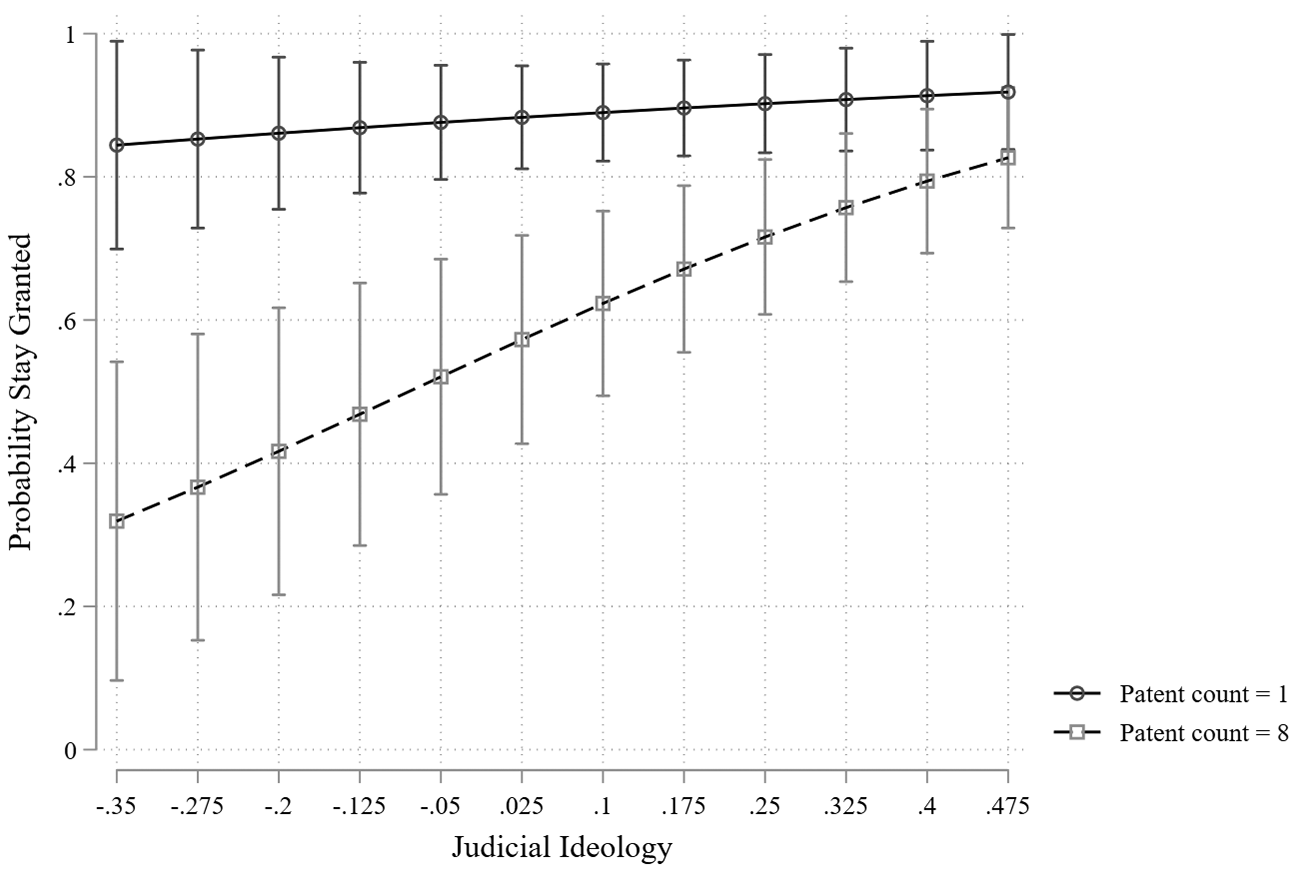
The finding with respect to heightened ideological reactions to cases involving simultaneous litigants raises the possibility of strategic action by such plaintiffs. Of the legal factors that influence the likelihood that a stay is granted, only the number of patents in suit is controlled by the plaintiff. Recall, as the number of patents in a case increases, the likelihood of a stay decreases. This is sensible because as the number of patents involved in the lawsuit increases, the simplifying force of a stay decreases. Therefore, knowing that cases involving multiple defendants and the same patents are more likely to be stayed, these plaintiffs may attempt to add patents to a lawsuit to insulate themselves from a stay. Figure 3 plots the results of a model involving a three-way interaction between judicial ideology, the presence of a simultaneous litigant, and the number of patents involved in a case.Footnote 14 Focusing only on cases involving simultaneous litigants, in simple cases involving one patent there is no variation in the likelihood of a stay being granted. However, in complex cases involving eight patents the likelihood of a stay increases substantially as the conservatism of the judge increases. This reaction suggests the importance that concerns over frivolousness have in animating the ideological dimension of decision making in these cases. Liberal judges are substantially less likely to see a stay as simplifying a case when there are a large number of patents in a case, but conservative judges seem to view the inclusion of large numbers of patents in a simultaneous litigation scenario as a potentially strategic move by a litigant they are already disinclined to favor.
Influence of ideology and number of patents, simultaneous litigants. Points represent mean estimates; bars represent 95% confidence intervals.

One final possible implication for ideology’s conditional influence centers on the constraining role of the law itself. In CBM cases judicial discretion is more likely to be restrained by the law, since Congress has designated that in these proceedings there is a strong presumption of patent invalidity. To test the conditional influence of ideology in CBM cases, we interact the two variables. Table 3 (model 4) and figure 4 display the results. Unlike cases involving simultaneous litigants, we find no meaningful ideological differences in CBM cases. We interpret this to mean that the stronger legal presumption in these cases overwhelms any tendency to see these cases in ideological terms. Put differently, it seems to induce liberal judges to see the cases as frivolous in the way that conservative judges see them. The likelihood of granting a stay still grows with increases in judicial conservatism, but it does so at essentially the same rate in both CBM and non-CBM cases.
Ideology in CBM cases. Points represent mean estimates; bars represent 95% confidence intervals.

We estimated a number of robustness checks for our results; full results for them are contained in the appendix. It is possible that certain high-volume patent courts known for the speed with which they handle patent cases drive our results. To ensure that this is not the case, we included a variable that captures various sets of courts known for their “rocket dockets” without any appreciable change in our results. Finally, we include indicator variables for two pertinent Supreme Court decisions that could have possibly altered the decision-making environment for stays in patent cases. The inclusion of these indicator variables does not alter our conclusions in any meaningful way.
Conclusion
The results of this study have significance for law, policy, and behavior. In terms of behavior, our findings underscore the importance of treating law as a constraint on what judges do. Apart from illustrating the role of legal considerations in structuring that decision making, the law operates to limit judicial ideology’s influence at trial as well. It is worth reiterating that, according to our findings here, legal factors can constrain the influence of judicial ideology by nearly 50%. A related implication stems from just how we ought to think about notions of ideology in structuring the behavior of judges—especially trial judges engaged in fact-finding. Given contextual distinctions that others have highlighted (e.g., Kim et al. Reference Kim2009; Boyd and Boldt Reference Boyd2017), the ideological landscape facing district court judges is arguably more variegated than conventional wisdom might suggest.
We anticipated that ideology’s valence in the district court context would track with the divides that exist on access to justice and concern for frivolous litigation. Our results confirmed that expectation, and supplemental tests of ideology’s interactive role provided suggestive evidence to support the idea that this influence was most accentuated in precisely the types of cases we would expect—those having traditional markers of more frivolous patent suits such as simultaneous pursuit of different defendants for infringing the same patents and the number of patents in suit. Along similar lines, we found that in cases in which the law tends to narrow the room for judicial discretion—such as in CBM cases—significant ideological differences between judges do not emerge. Although we found ideological preferences related to judicial access important in this context, we certainly do not mean to suggest that this will hold across all types of district court decisions or necessarily be true for every issue area. The durability of this result in other areas should be considered in future research. However, we do think our findings lend credence to the notion that ideology likely plays a more significant role in decision making—and specifically in the many procedural aspects of decision making—in trial courts than has previously been appreciated.
With this in mind, we hope scholars will undertake investigations with an eye toward better appreciating the extent to which there is ideological valence to a variety of procedural issues in the courts. Studies of stays are not common, but there are areas where it could be fruitful to probe for the relationship between ideology and procedural decisions. To take an example, Klausner et al. (Reference Klausner2020, 1785) conclude that stays were granted about 50% of the time in state court proceedings when there was a parallel federal action involving securities regulation. It would be interesting to know whether there are ideological differences in the propensity of state judges to grant those stays. Because discovery is a key driver of litigation costs and judges are frequently asked to stay discovery while motions to dismiss are pending (Lynch Reference Lynch2012, 71), this too could be a propitious area in which to examine ideological perspectives on judicial access and the degree to which this is related to those decisions. More fundamentally, we think it is likely that our findings with respect to ideology and procedure in the district courts will extend to additional areas of motion practice.
Our analysis also speaks to issues related to patent policy itself. One of the key motivations behind Congress’s creation of CBM review in particular was to prevent “meritless litigation over patents of dubious quality” (Wyatt Reference Wyatt2011). Our results, which show a high probability that stays will be granted in CBM cases, indicate that district court judges have clearly heeded that advice. A broader objective of Congress in the AIA was for PTAB review to serve as a cheaper and more efficient substitute for traditional patent litigation. Although PTAB review has not become the substitute for litigation that many in Congress envisioned, judges do grant motions to stay pending administrative action in nearly two-thirds of traditional patent cases. This is a substantial proportion of cases. Yet the importance of key legal considerations to those decisions suggests that the willingness to stay proceedings, while considerable, is hardly reflexive.
In describing the relationship between administrative patent challenges and federal court litigation, we noted that PTAB determinations are not formally binding on the district courts. Further, in an instance in which the PTAB and a district court were to disagree on the question of patent validity, the Court of Appeals for the Federal Circuit would have the final say (see n. 4). Although not a common occurrence, this raises interesting questions for future exploration. For one, does the Federal Circuit tend to favor PTAB determinations in such instances, those of the district courts, or have no durable affinity for either’s conclusions? For another, are there case-based characteristics that tend to be associated with disagreements between the PTAB and district court determinations?
Finally, given the considerable proportion of cases that are stayed pending PTAB proceedings, it would be useful to know more about the factors that structure decision making by administrative patent judges. The PTAB may largely be a “death squad” (Williams and Eaton Reference Williams2015, 9), but it does occasionally grant stays of execution. Although there is some evidence that its decisions may vary some across technological areas, little else exists in the way of systematic knowledge about the factors involved in shaping administrative cancellation proceedings themselves. We hope to explore aspects of this process in future research.