Introduction
Virtual reality is a tool increasingly used in medical education and surgical training.Reference Dawe, Pena, Windsor, Broeders, Cregan and Hewett1–Reference Zhao, Kennedy, Yukawa, Pyman and O'Leary4 Practising temporal bone dissection through virtual reality surgical simulation has been shown to improve post-graduate otorhinolaryngology trainees’ competency in mastoidectomy technique.Reference Andersen3–Reference O'Leary, Hutchins, Stevenson, Gunn, Krumpholz and Kennedy5 Virtual reality surgical simulation can also improve bimanual skills, which are a vital component of surgical technique.Reference Knobe, Carow, Ruesseler, Leu, Simon and Beckers6, Reference Liu and Curet7
Medical students have previously found three-dimensional (3D) virtual reality interactive models useful for teaching the anatomy of the middle ear.Reference Zhao, Kennedy, Yukawa, Pyman and O'Leary4, Reference Nicholson, Chalk, Funnell and Daniel8 The use of virtual reality models in anatomy teaching is also a rewarding and enjoyable experience for students.Reference Venail, Deveze, Lallemant, Guevara and Mondain9 However, there are little data around the potential role of virtual reality surgical simulation in the teaching of middle-ear pathology such as cholesteatoma. Teaching in this area is lacking, with many graduates not feeling confident in diagnosing common ENT pathology.Reference Chawdhary, Ho and Minhas10 As 20–40 per cent of general practice encounters are ENT-related,Reference Scott, Best and Micomonaco11, Reference Griffiths12 a basic understanding of middle-ear disease is vital for many practising doctors.
ENT is a competitive surgical specialty which is under-represented in undergraduate medical education, meaning that students have limited practical ENT experiences.Reference Chawdhary, Ho and Minhas10–Reference Haddad, Shah and Takoudes15 In the UK, undergraduate ENT clinical attachments are only, on average, one and a half weeks long,Reference Mace and Narula13 and the experience can vary greatly in quality.Reference Campisi, Asaria and Brown14, Reference Haddad, Shah and Takoudes15 Similarly, in New Zealand, compulsory ENT attachments in the undergraduate curriculum last approximately one week. This limited exposure can be considered insufficient, with a UK study reporting that only 20 per cent of medical students felt they had adequate experience to consider ENT as a career upon completion of their attachment.Reference Doshi and Carrie16
A significant proportion of students, 41–45 per cent, choose their future career path before they complete their undergraduate training.Reference Markert17, Reference Zeldow, Preston and Daugherty18 Of these, only 20–45 per cent change their minds, meaning that the majority of these decisions ultimately determine their future vocation.Reference Markert17–Reference Kassebaum and Szenas19 Students’ experiences in the clinical environment can greatly influence their choice of specialty.Reference Pianosi, Bethune and Hurley20–Reference Bland and Isaacs22 Virtual reality has been shown to increase student motivation and heighten interest in surgical careers,Reference Schlickum, Hedman and Felländer-Tsai23 and as a practical experience, it may have a role in attracting students to ENT specifically.
This study aimed to provide an initial assessment in relation to two hypotheses: firstly, that virtual reality surgical simulation is an enjoyable and useful adjunct in the teaching of otological pathology to undergraduates; secondly, that surgical simulation can assist medical students in considering their future career plans, possibly heightening interest in ENT.
Materials and methods
Ethical approval was gained from the University of Auckland Human Participants Ethics Committee (26 April 2017; reference number 018921).
Consecutive fifth-year medical students from the University of Auckland were prospectively recruited from those based at Waikato Hospital, New Zealand, during the 2017 academic year (n = 32). Students were recruited while completing their mandatory 5-day clinical attachment in ENT.
At the beginning of the workshop, participants were asked to complete a short questionnaire. Students were asked about their preferred career path, and whether they had observed mastoid surgery or used a surgical simulator previously. Five-point Likert scales were used to investigate participants’ certainty in their career plans, and whether their practical experience in medical school was sufficient to make career decisions. Any illegible answers were excluded from the results.
The 1-hour workshop was led by an otorhinolaryngologist tutor (AW). The medical students were given a brief tutorial on how to use the temporal bone virtual reality surgical simulator and the basic steps to a mastoidectomy, often used to address cholesteatoma pathology. Other teaching resources were available in the room, including some slides showing temporal bone radiological anatomy, short videos on cholesteatoma pathology and surgery, and the opportunity to practise ear examination. These were provided to give context to the surgical simulation. Participants were free to carry out the procedure on the virtual reality surgical simulator and use the other study aids under the tutor's supervision.
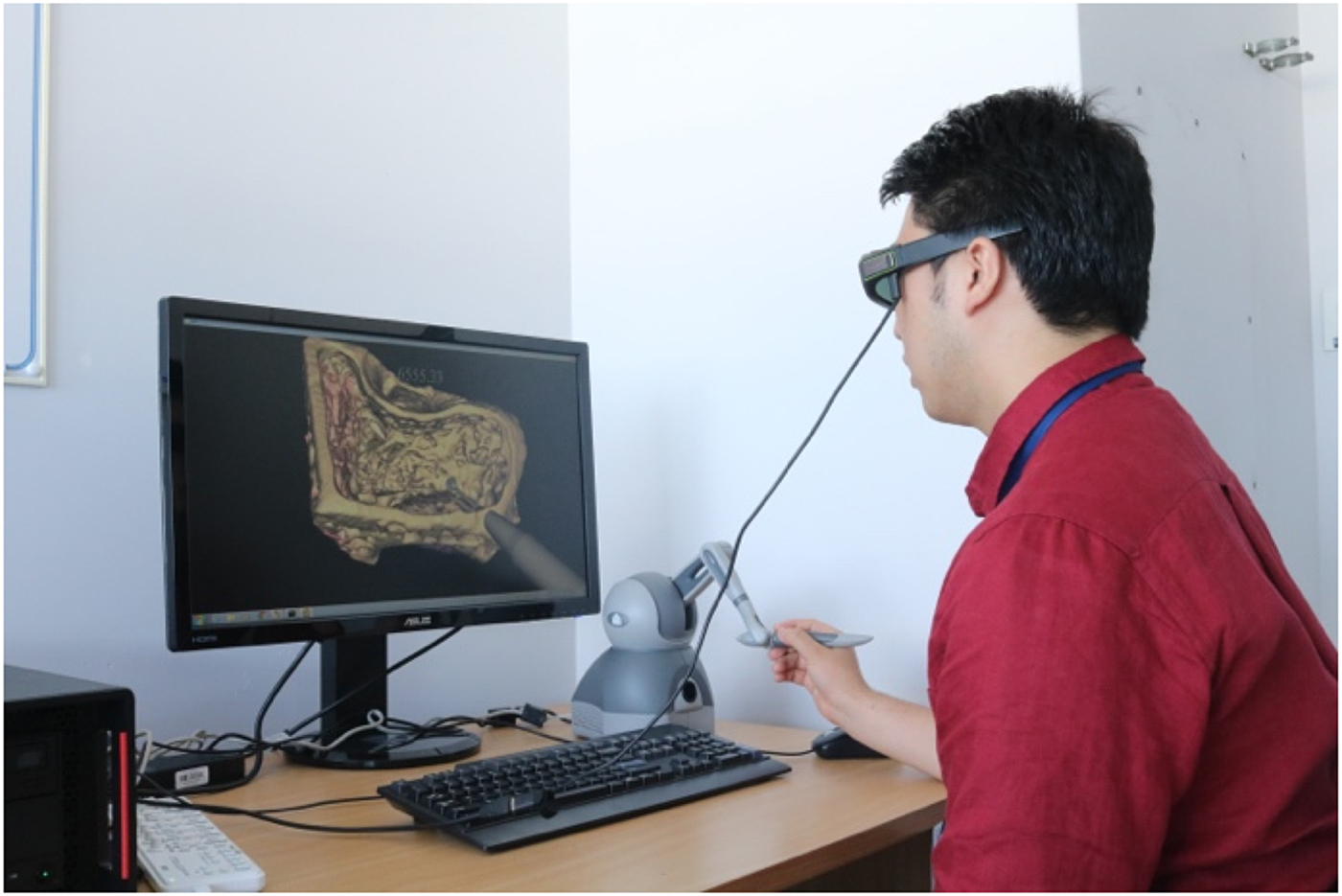
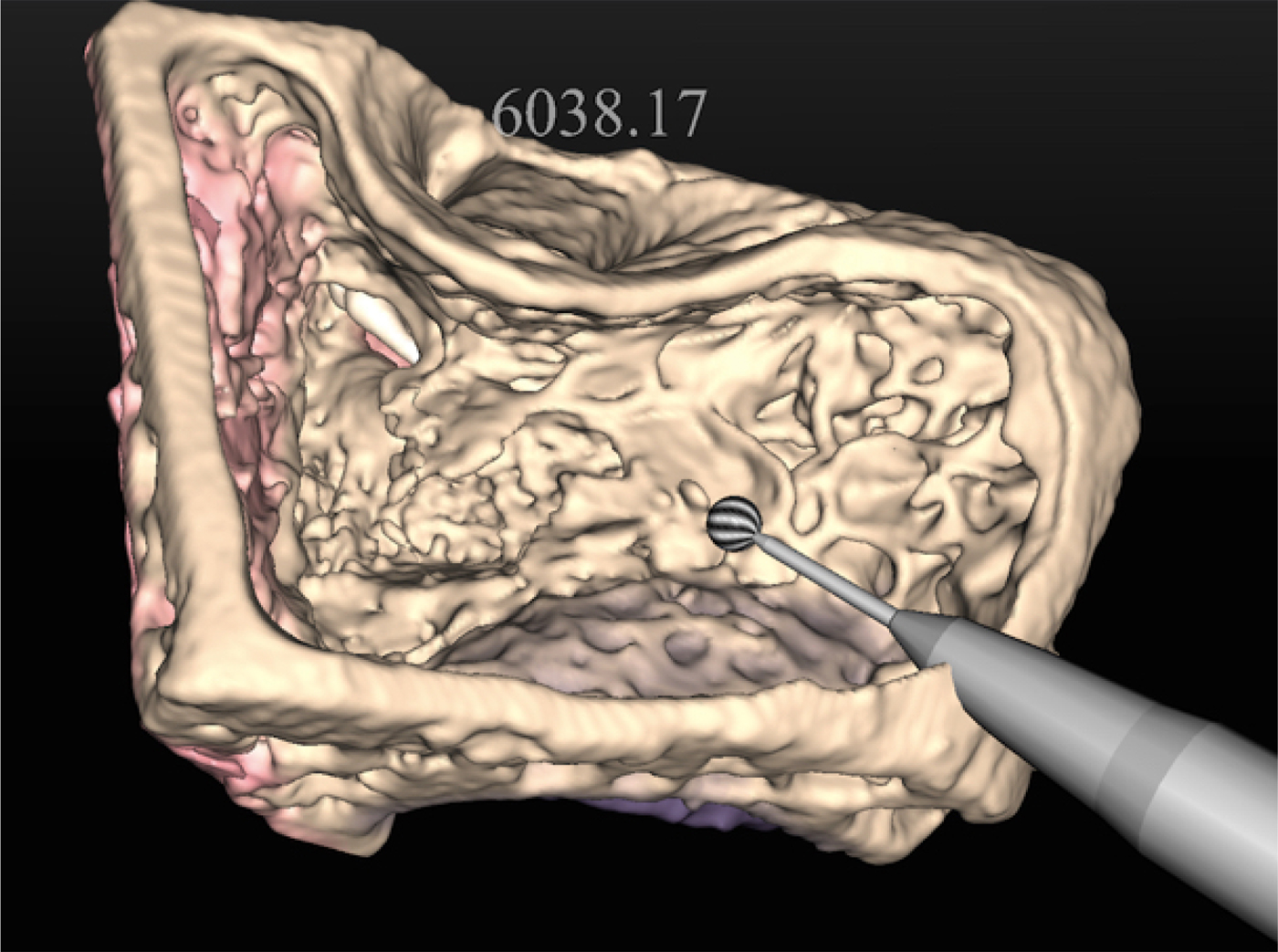
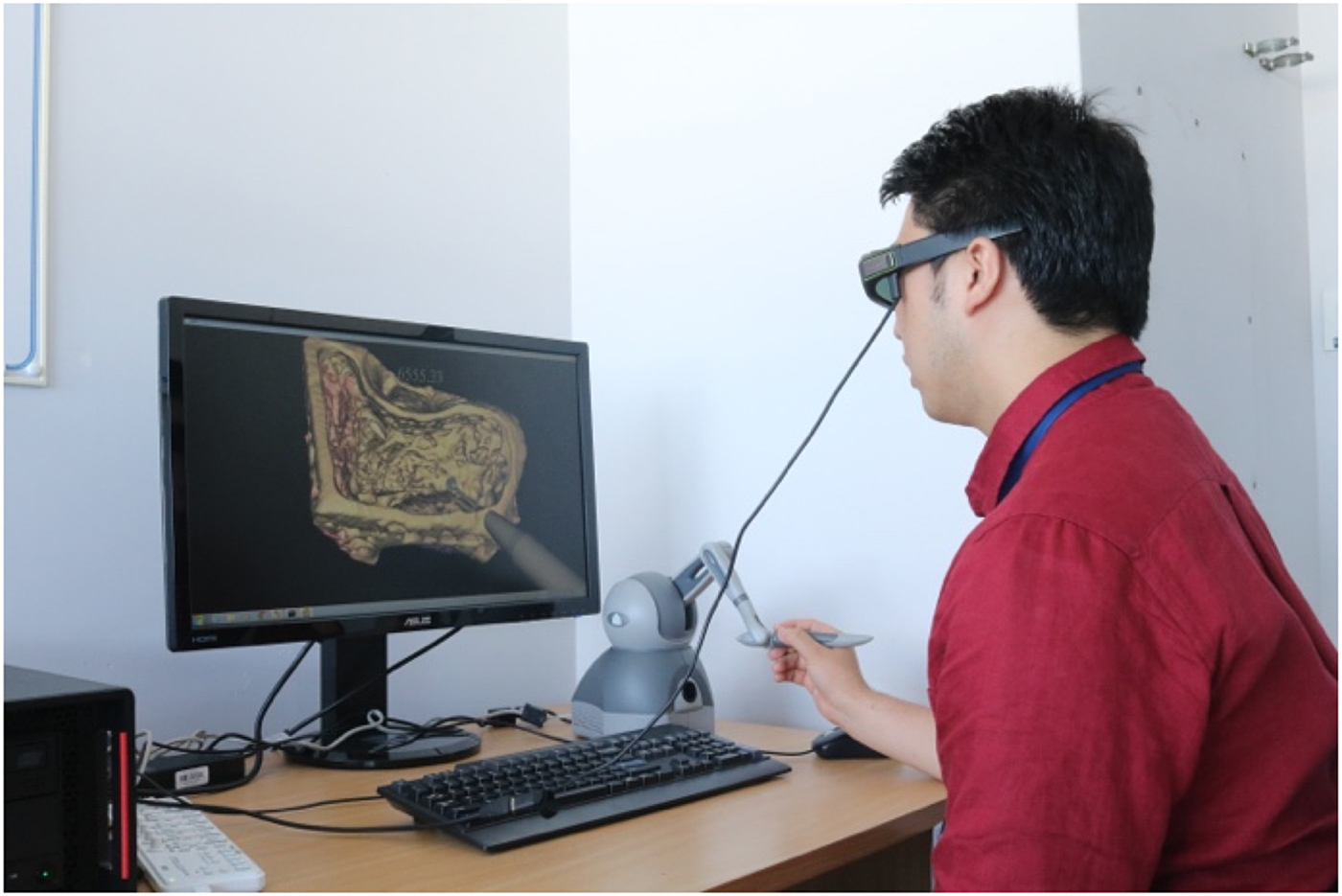
The virtual reality surgical simulator is described in detail in other studies.Reference Zhao, Kennedy, Yukawa, Pyman and O'Leary4, Reference O'Leary, Hutchins, Stevenson, Gunn, Krumpholz and Kennedy5, Reference Hutchins, O'Leary, Stevenson, Gunn and Krumpholz24, Reference Hutchins, Stevenson, Gunn, Krumpholz, Adriaansen and Pyman25 The simulator consists of a desktop computer, which is used to produce a 3D volumetric model of a temporal bone (Figures 1 and 2). The image is perceived in 3D by the user wearing Nvidia 3D Vision® 2 shutter glasses. The temporal bone image was created from a computed tomography scan. A Geomagic® Touch™ haptic stylus was used by students to guide a burr on screen to carry out the procedure. The size and type of burr (i.e. diamond or cutting) could be changed by the user. Participants were alerted through a beeping sound if they burred into embedded anatomical structures.
Student performing cortical mastoidectomy on the virtual reality surgical simulator. Temporal bone model is shown on a desktop computer monitor, perceived in three dimensions with shutter glasses; a haptic stylus is used to control the burr on screen.
Screen capture of the on-screen view of a volumetric model of a right temporal bone with partially completed mastoidectomy.

Upon completion of the workshop, students were asked to complete a second questionnaire. Participants’ pre- and post-workshop questionnaires were linked via the use of an anonymous participant code that was written on both forms. The post-workshop questionnaire used five-point Likert scales to investigate the usefulness of the virtual reality surgical simulator for: teaching disease processes (specifically, cholesteatoma as an example of a relevant pathology for this procedure), providing hands-on experience of the surgical procedure and stimulating thoughts in relation to career plans (surgical careers in particular). Five-point Likert scales were also used to investigate how enjoyable using the virtual reality surgical simulator was, and whether, after the experience, the students had greater interest in a career in surgery or in ENT. Any illegible answers were not included in the results.
Questionnaire responses were collated for each participant based on the participant codes, and medians were calculated for each question. Students’ responses were also divided into two subgroups for further analysis: those interested in a surgical pathway and those interested in non-surgical pathways (including both medical options and general practice). The Mann–Whitney U test was used to compare the answers of students within these groups for the five-point Likert scale responses, with the aim of testing the hypothesis that medically inclined students would find the simulator equally as valuable as those who are surgically inclined. For this sub-analysis, those who were ‘not sure’ were excluded.
Results
A total of 32 University of Auckland fifth-year medical students were recruited, and a total of 8 workshops were carried out with 4 students per group. Neither attendance at the workshop nor completion of the questionnaires was mandatory, although both attendance and completion of the study was 100 per cent. The questionnaire responses were anonymous.
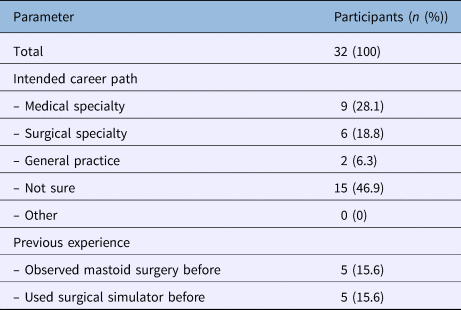
A total of 17 participants (53.1 per cent) had made some decisions as to which career path they wished to pursue. Of these, nine intended to pursue a medical specialty, six planned on pursuing a surgical specialty and two intended to become general practitioners. Only a small proportion of participants had observed mastoid surgery or used a surgical simulator previously (15.6 per cent and 15.6 per cent respectively; Table 1).
Participants’ intended career paths pre-workshop, and previous experience with mastoid surgery and surgical simulators

Only three participants (9.4 per cent) thought the practical experience they had received to date in medical school was sufficient to make informed decisions about their future career (Figure 3).
Participants’ perceived adequacy of practical experience in medical school for career decision making, and the certainty around their career paths.

Responses on the certainty of their career path were mixed, with 11 participants (34.4 per cent) agreeing or strongly agreeing that they were certain about their career path (Figure 3).
The majority of students found the virtual reality surgical simulation experience useful or very useful for: stimulating thoughts in relation to career plans (71.9 per cent), providing hands-on experience (93.8 per cent) and teaching disease processes (specifically cholesteatoma) (93.8 per cent) (Figure 4). All participants found the workshop experience either enjoyable or very enjoyable (Figure 5). Two participants’ answers to this question were excluded as they were not legible.
Participants’ perceived usefulness of the surgical simulator for: stimulating thoughts around career planning, hands-on experience and teaching disease processes.

Participants’ perceived enjoyment of the mastoidectomy workshop.

The overall workshop experience affected some students’ career interests, with 53.1 per cent of students more interested in a career in ENT and 50 per cent more interested in a career in surgery in general (Figure 6). Only 9.4 per cent of students reported that the tutorial did not increase their interest in a career in ENT and 9.4 per cent reported that it did not increase their interest in a career in surgery in general.
Participants’ change in interest in ENT or surgery in general as a career path, as a result of the workshop experience.

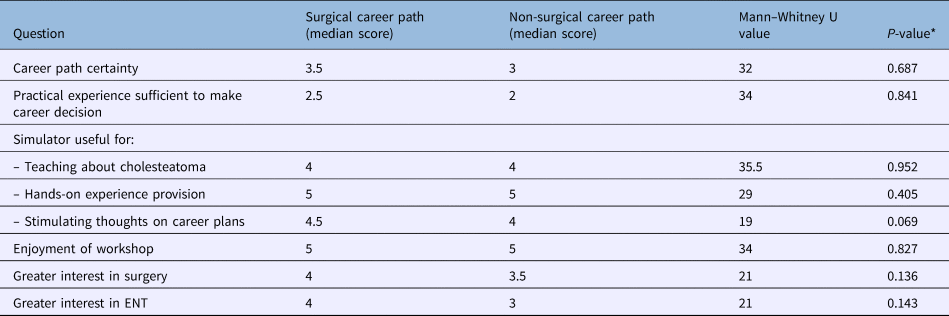
A Mann–Whitney U test was used to determine if there were differences in responses between students who were interested in surgical career paths and those interested in non-surgical career paths. The response distributions did not differ significantly between groups (Table 2).
Median scores and statistical results for participants interested in surgical and non-surgical career paths

* Asymptotic, two-tailed.
Discussion
Previous studies have highlighted the usefulness of virtual reality models in learning about middle-ear anatomy,Reference Zhao, Kennedy, Yukawa, Pyman and O'Leary4, Reference Nicholson, Chalk, Funnell and Daniel8 and this study indicates that virtual reality surgical simulation may have further applications in teaching pathology. The majority of students (93.8 per cent) found the mastoidectomy simulation experience useful for the teaching of disease processes, specifically cholesteatoma. This may be the result of virtual reality surgical simulation illustrating the surgical management of cholesteatoma, highlighting potential affected structures and emphasising the possible invasiveness of the disease. The results reflect a student-perceived efficacy of virtual reality as a learning tool in teaching around cholesteatoma. As ENT teaching has only a small representation in the medical curriculum, it is vital that all student experiences are worthwhile; virtual reality surgical simulation may have utility in providing such experiences.
• The value of virtual reality surgical simulation for undergraduate teaching of otological pathology has not been greatly studied
• Student participants found the simulator experience enjoyable and useful for learning about cholesteatoma pathology
• More than half of participants felt their university experience was insufficient to make a career decision
• ENT is often under-represented in undergraduate curricula, meaning it may not be considered as a vocation
• Use of the mastoidectomy surgical simulator heightened interest in careers in ENT and surgery in general
The virtual reality surgical simulation experience was well received by the participants, with all students enjoying the experience. Interestingly, there was no significant difference in enjoyment between those who originally stated they were interested in surgical specialties and those interested in non-surgical specialties. This suggests that virtual reality surgical simulation would be received positively by all students if introduced to the general medical school curriculum. As many students may not find traditional learning methods such as didactic teaching and textbook learning satisfying, virtual reality surgical simulation provides an engaging alternative in which students can learn and have fun while doing so.
During medical school, guidance for students around career planning is limited, even though some preparation is needed in advance to meet the requirements of a specialty training programme. Some universities offer career resources to their students,Reference Howse, Harris and Dalgarno26 but this is not always the case. In this study, the majority of participants (59.4 per cent) felt that the practical experience they had received in medical school was not sufficient to make an informed decision regarding a career path. Although students are exposed to a number of specialties as junior doctors, the range of disciplines experienced is still limited. This emphasises the need to make the most of every clinical attachment during medical school, particularly those that cannot be given much teaching time, such as ENT.
Medical students, whether they are sure of their future career path or not, may benefit from some form of career guidance. Of the participants, 56.3 per cent had made a decision as to which broad career path they wished to pursue, whether surgical, medical or general practice. This is in keeping with other studies examining the career interests of medical students.Reference Markert17, Reference Bland and Isaacs22, Reference Boyle, Shulruf and Poole27 Despite this, only 34.4 per cent of students felt certain of their career choice.
Students who begin career planning while still at medical school have the opportunity to explore the admission requirements for training schemes at an early stage. Career planning may also encourage students to seek out further experiences in their chosen field, partake in research and meet people within the specialty. Extracurricular clinical experiences have been shown to increase certainty of career choice, regardless of the chosen specialty,Reference Weinstein and Gipple28 and mentors within a specialty are also considered beneficial.Reference Sternszus, Cruess, Cruess, Young and Steinert29–Reference Ranta, Hussain and Gardiner31
In this study, the surgical simulator stimulated thoughts in relation to career planning, regardless of the participants’ stated career interests at the beginning of the workshop. This suggests that virtual reality experiences could be beneficial to all medical students. The data also suggest that virtual reality surgical simulation is currently not used in our institution for medical student teaching in any form, offering the potential for innovation.
The workshop was shown to inspire a greater interest in both ENT and surgery in general for the majority of participants. For specialties that are not prioritised in the medical curriculum, such as ENT, virtual reality could be a low risk and efficient way of providing students with an insight into the discipline. We would suggest that the 72 per cent who originally reported less interest in surgery have also benefitted by having their initial career plans challenged.
In terms of limitations, this study did have a relatively small sample size, utilising students from a single medical school. It is also acknowledged that the workshop did include other learning resources as adjuncts to the virtual reality surgical simulator experience; however, questions specific to the use of the simulator itself were asked in the post-workshop questionnaire.
Conclusion
In addition to being an enjoyable experience, and offering a unique and effective way of learning anatomy and pathology, mastoidectomy virtual reality surgical simulation may also have a role in stimulating thoughts around career planning, potentially increasing interest in careers in ENT and surgery in general. The use of surgical simulation and assistance with career planning both appear to be under-represented in the local undergraduate curriculum.
Acknowledgements
We would like to acknowledge the New Zealand Society of Otolaryngology, Head and Neck Surgery for purchasing the simulator, and the University of Melbourne for providing it.
Competing interests
None declared