Significant outcomes
-
∙ An open trial of the non-narcotic antitussive, tipepidine in patients with treatment-resistant depression.
-
∙ Tipepidine improved depression and cognitive function.
Limitations
-
∙ The sample is small and there is no control.
Introduction
Between 50% and 70% of depressed patients respond to treatment with the first or second prescribed antidepressant, given at maximal doses for at least 2 months (Reference Souery, Amsterdam and de Montigny1,Reference Nemeroff2). The remaining patients are deemed non-responders. Treatment-resistant depression constitutes a serious clinical problem and is defined as a non-response to at least two types of antidepressant medication (Reference Nemeroff2,Reference Thase and Rush3). However, a recent review demonstrated that prolonged use of the same antidepressant mechanistic action provided a great therapeutic benefit than switching mechanisms (Reference Schosser, Serretti and Souery4). In addition, there are staging models, which can be used to classify treatment-resistant depression (Reference Ruhé, Van Rooijen, Spijker, Peeters and Schene5). The concept of remission has been discussed previously (Reference Thase6,Reference Fava, Ruini and Belaise7). The most common next step is augmentation therapy using lithium and atypical antipsychotics (Reference Nemeroff2). Despite this, there remains a great need to identify new therapies for treatment-resistant depression.
Tipepidine hibenzate [3-(di-2-thienylmethylene)-1-methyl-piperidine; Asverin; Mitsubishi Tanabe Pharma Co., Osaka, Japan] has been used as a non-narcotic antitussive in Japan since 1959. The general safety of tipepidine was established during this time, with routine treatment deemed safe (60–120 mg/day). In an open study, tipepidine produced that antidepressant effects on depression in adolescent patients (Reference Sasaki, Hashimoto and Tachibana8). A recent study demonstrated that tipepidine induced antidepressant-like effects in rats during the forced swimming tests (Reference Kawaura, Ogata and Inoue9). From pharmacological points of view, the antidepressant-like effects of tipepidine are mediated partially through dopamine (DA) and norepinephrine mechanisms (Reference Kawaura, Miki and Urashima10,Reference Kawahara, Soeda and Kawaura11). Interestingly, c-fos-like immunoreactivity in the brain, stimulated by tipepidine, is similar but distinct from that induced by desipramine, suggesting that tipepidine may evoke a novel model of antidepressant action (Reference Kawahara, Soeda and Kawaura11). Tipepidine activates mesolimbic DA neurons via inhibiting G-protein-coupled inwardly rectifying potassium channels and that it modulates monoamine levels in the brain (Reference Hamasaki, Shirasaki, Soeda and Takahama12). It is this theory that prompts further investigations into its efficacy in treatment-resistant depression.
The hypothalamic–pituitary–adrenal axis is activated by stress and is thought to be involved in the pathophysiology of depression. Cortisol targets at the hippocampus via glucocorticoid receptors. Hippocampus and prefrontal cortex are candidates for mediator of the impaired functions associated with depression. Previous studies reported that blood cortisol, dehydroepiandrosterone sulphate (DHEA-S) and cortisol/DHEA ratio were increased in depressed patients (Reference Takebayashi, Kagaya and Uchitomi13–Reference Michael, Jenaway, Paykel and Herbert19). These blood markers might be useful in evaluating patients’ functions.
Here, we have conducted an open-label study of tipepidine augmentation with ongoing antidepressant drug therapy, in patients with treatment-resistant depression using 17-item Hamilton Rating Scale for Depression (HAM-D). In addition, we examined the effects of tipepidine on cognitive and memory functions (trail making test, verbal fluency test, Stroop test, Rey auditory verbal learning Test (RAVLT) and verbal paired associated test), since the depressed patients showed lower performances in neuropsychological tests (Reference Hinkelmann, Moritz and Botzenhardt17,Reference Douglas, Porter, Knight and Maruff20,Reference Egeland, Lund and Landro21). We also investigated levels of the stress-related hormones, adrenocorticotropic hormone (ACTH), cortisol, and DHEA-S in the blood of study participants.
Methods and materials
The participants consisted of 11 patients with treatment-resistant depression [age: 37.7±3.2 years (mean±SD)]. All patients were recruited from the outpatient clinic of Teikyo University Chiba Medical Center, met the DSM-IV criteria for major depressive disorder (first episode), and had no other psychiatric disorders (22). Inclusion criteria required persistent symptoms of moderate depression, after therapy with at least two antidepressants given over a period of 8 weeks each (Reference Souery, Amsterdam and de Montigny1,Reference Nemeroff2). The patient scores were required to be 14 or more on the 17-item HAM-D.
In this study, the duration of illness was 26.2±15.5 months [mean±SD]. The trial number of antidepressants per patient was 2.3±0.6 [mean±SD]. The number of patients receiving augmentation therapy of lithium, sodium valproate, olanzapine, and aripiprazole are 4, 4, 7, and 7, respectively. Intelligence quotient (IQ) scores were estimated from the scales of information, digit span, and picture completion, using the short version of the Wechsler Adult Intelligence Scale-Revised. The mean estimated IQ was 90.0±19.9 [mean±SD].
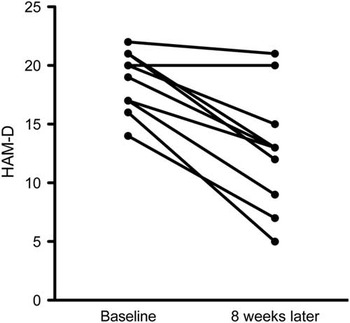
The doses of tipepidine were 60 mg/day for the first 2 weeks, and 120 mg/day for the next 6 weeks. Depressive state was scored on the 17-item HAM-D at baseline and 8 weeks later after augmentation therapy with tipepidine (Fig 1). Response is defined as a reduction to <50% in depressive symptoms, but not necessarily recovery. Remission is defined as a full recovery, classified as a score of <7 on the HAM-D. This research was approved by the ethics committee of Teikyo University Chiba Medical Center (study TU-COI 13-067), and performed in accordance with the Declaration of Helsinki. Written informed consent was obtained after the procedure had been fully explained to each participant.
Individual patient scores on the HAM-D at baseline and 8 weeks following the augmentation therapy with tipepidine. n=11. HAM-D, Hamilton Rating Scale for depression.

Prefrontal cortex and hippocampus are the candidate regions for depression, as indicated by clinical studies. To assess cognitive function of the prefrontal cortex, three neuropsychological tests, namely the trail making test, the verbal fluency test, and the Stroop test were performed. To examine hippocampus-related memory functions, RAVLT and the verbal paired associated test were administered. Tests were evaluated at baseline and 8 weeks after treatment with tipepidine.
We have examined blood cortisol, DHEA-S, and cortisol/DHEA ratio at baseline and 8 weeks after treatment with tipepidine.
The data were analysed using paired Student’s t-test. Differences were set to be significant when p<0.05.
Results
First, tipepidine significantly improve depressive state on the HAM-D, from 18.7±2.6 at baseline to 13.0±4.8 at 8 weeks later [mean±SD] (p=0.0002) (Table 1). Second, scores on the trail making test and RAVLT were significantly improved after add-on treatment with tipepidine (Table 1, p=0.006 and 0.0004, respectively). Other tests showed no statistical change after tipepidine treatment. Finally, examinations for stress-related hormones failed to change after add-on tipepidine (Table 1).
Cognitive test scores at baseline and 8 weeks after the start of treatment
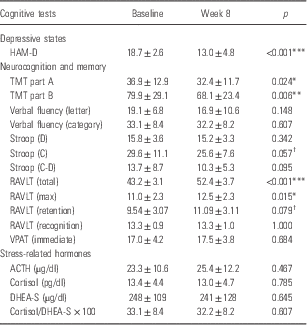
DHEA-S, dehydroepiandrosterone sulphate; HAM-D, Hamilton Rating Scale for depression; RAVLT, Rey auditory verbal learning test; TMT, trail making test; VPAT, verbal paired associated test.
***p<0.001, **p<0.01, *p<0.05 (paired Student’s t-test).
† A trend for significance.
Discussion
In this open-label study 11 outpatients with treatment-resistant depression showed significantly improved scores for their depressive state on the HAM-D, after tipepidine augmentation therapy. This result is of clinical interest, since among the study participants, nine previously failed to receive beneficial effects from augmentation therapy with aripiprazole or olanzapine. Two patients on this study achieved remission.
Add-on treatment with tipepidine significantly improved scores on RAVLT and the trail making test part B. Interestingly, a recent study reported that RAVLT is useful in assessing therapeutic response in severe depression (Reference Douglas, Porter, Knight and Maruff20). From a neuropsychological point of view, tipepidine could exert beneficial effects on verbal learning and memory, and executive functioning. Previous studies reported elevated cortisol levels and cognitive impairments in verbal memory and executive functions in depression (Reference Hinkelmann, Moritz and Botzenhardt17,Reference Egeland, Lund and Landro21). In addition, we found that these cognitive tests were not altered by two measurements in four healthy subjects (data not shown). Therefore, it is unlikely that the improvement induced by tipepidine on memory and executive functions in treatment-resistant patients were due to practice effects.
The stress-related hormones, ACTH, cortisol, DHEA-S, and the cortisol/DHEA-S ratio showed no change during treatment with tipepidine, despite improvements in depressive status. Previous studies demonstrated that treatment responders showed significant alterations in cortisol, DHEA, and cortisol/DHEA ratios compared with controls (Reference Takebayashi, Kagaya and Uchitomi13–Reference Hinkelmann, Moritz and Botzenhardt17). The present result of tipepidine seems to be irrelevant to the stress-related hormones, namely ACTH, cortisol, and DHEA-S.
Since tipepidine activates the mesolimbic DA system without methamphetamine-like behavioural sensitisation (Reference Hamasaki, Shirasaki, Soeda and Takahama12,Reference Hamao, Kawaura, Soeda, Hamasaki, Shirasaki and Takahama23), the pathophysiology of treatment-resistant depression may result from alterations in the DA system. Supporting this theory, other studies demonstrated that DA levels in the nucleus accumbens may be critical for the therapy of treatment-resistant depression (Reference Kitamura, Yagi and Kitagawa24,Reference Bewernick, Hurlemann and Matusch25). However, in addition to the DA system, there may be other mechanisms underlying the action of tipepidine.
This study has several limitations. First, is its small sample size. Second, this is an open trial study without controls. Third, here, inclusion criteria for treatment-resistant depression was 14 or more on the HAM-D score, although there are different criteria, such as 17 or more on the 17-item HAM-D, response (a 50% reduction in symptom severity on the HAM-D) or remission (7 or less on the 17-item HAM-D). In this study, patients scored 17 or more on the 17-item HAM-D at baseline, with the exception of two patients’ scores of 14 and 16.
In conclusion, this open-label study indicates that tipepidine might be a potential therapeutic drug in the clinical management of treatment-resistant depression. Although to date there have been no safety issues in Japan, the long term safety of this drug still needs to be evaluated. Randomised, double blind studies will be needed in the future.
Acknowledgements
All authors met the following authorship criteria: (1) substantial contributions to conception and design of, or acquisition of data or analysis and interpretation of data, (2) drafting the article or revising it critically for important intellectual content, and (3) final approval of the version to be published.
Financial Support
The study was funded by Teikyo University Chiba Medical Center, Ichihara, Japan.
Ethical Standards
The authors assert that all procedures contributing to this work comply with the ethical standards of the relevant national and institutional committees on human experimentation and with the Helsinki Declaration of 1975, as revised in 2008.