Introduction
Parties that criticize the entire political establishment are on the rise in Europe and are particularly successful in the countries of Central and Eastern Europe, where electoral volatility has always been high (Haughton and Deegan-Krause, Reference Haughton and Deegan-Krause2015). Their success often raises the question whether voters turn their backs to established parties mainly because of their general dissatisfaction with politics or if ideological considerations actually play a part in these electoral choices. While scholars come to different conclusions when looking at radical right parties (see, e.g., Birch and Dennison, Reference Birch and Dennison2017), in Central and Eastern Europe, there is a successful type of party that is most likely to benefit from non-ideological protest: centrist anti-establishment parties (CAPs). Ideologically, CAPs do not visibly differ from the political mainstream and, therefore, most debates about their initial breakthroughs center on their anti-establishment platform, rather than on their ideology (Hanley and Sikk, Reference Hanley and Sikk2016; Pop-Eleches, Reference Pop-Eleches2010; Učeň, Reference Učeň2007). This paper explores the claim that CAPs attract protest voters independently from their ideological positions and asks what role, if any, ideological considerations play in CAP voters’ electoral decisions. Focusing on the parties’ electorates through the use of survey data, the paper shows that the answer is more complex than previous literature suggests. Nearly half of all CAPs already attract either mainly left-wing or mainly right-wing voters in their first election, while the other half attracts an ideologically more heterogeneous electorate. This finding has important implications for further research on CAPs and contributes to the general debate about the relationship between protest voting and ideologically driven voting, showing that, in many cases, ideology matters even when it is not at the core of a party’s political program.
CAPs have won many elections in Central and Eastern Europe.Footnote 1 They are defined as a type of new party that uses anti-establishment rhetoric extensively – usually attacking the political elite for its purported corruption – but does so without representing the extreme positions of the radical right or the radical left. As Hanley and Sikk (Reference Hanley and Sikk2016: 523) put it, these parties are ‘[…] committed to mainstream models of liberal democracy and the market economy and display neither the populist radical right’s inclination to ‘illiberal democracy’, ethnocentrism and social conservatism (Mudde, Reference Mudde2007) nor the anti-capitalism of the radical left (March and Mudde, Reference March and Mudde2005)’. Their newness itself is sufficient for them to present themselves as the ‘better and cleaner’ alternative (Sikk, Reference Sikk2012). Their ideological positions in the political mainstream and their emphasis on anti-establishment rhetoric have gained them the label of centrist populists (Pop-Eleches, Reference Pop-Eleches2010; Učeň, Reference Učeň2007), anti-establishment reform parties (Hanley and Sikk, Reference Hanley and Sikk2016), or, in this case, CAPs.Footnote 2 It is important to mention that in this paper, as well as in previous studies, the ‘centrist’ label is used to distinguish CAPs from the anti-establishment parties on the radical right and the radical left, rather than to insinuate a clear centrist ideology or position.Footnote 3
CAPs’ verbal attacks on the political elite and their inconspicuous ideological positions have led scholars to assume that ideology only plays a subordinate role in their electoral breakthroughs. Voters’ dissatisfaction with existing parties is singled out as the main driver of the new parties’ success. For instance, Pop-Eleches (Reference Pop-Eleches2010: 226) describes CAPs as a manifestation of protest voting and as purely non-ideological entities driven by particular personalities. In a similar vein, Učeň (Reference Učeň2007: 51) ascribed a ‘relative lack of ideology’ to them. However, apart from a few recent case studies that reach very mixed results (Havlík and Voda, Reference Havlík and Voda2016, Reference Havlík and Voda2018; Stanley and Czesnik, Reference Stanley and Czesnik2016), no empirical work has looked at the relationship between ideology and individual-level support for CAPs more closely. This paper complements the few findings that existing research on the topic has produced and, from a comparative perspective, explores whether CAPs’ success really classifies as purely protest-driven (with ideology only negligibly affecting voters’ choice) or if ideology actually matters despite the strong use of anti-establishment claims.
Using data for eight countries between 2002 and 2016 from the European Social Survey (ESS), the paper takes into consideration both the level of trust and the ideological composition of the CAPs’ electorates. It shows that, although CAPs attract voters with a lower level of political trust, they nonetheless have ideological tendencies that sort voters along ideologies lines. The degree of ideological sorting, however, varies across CAPs. While some parties mainly attract voters from one side of the political spectrum, others attract voters from the left, the center, and the right more equally.
This finding has important implications for future research on CAPs. First, it shows that even in the most likely case of pure protest voting, when new parties are ideologically indistinguishable from mainstream parties, as is the case with CAPs, we do find ideological sorting. Thus, CAPs should not be labeled non-ideological or ideologically incoherent a priori, before taking a closer look at their ideological platforms. Second, if CAPs sort their voters ideologically to varying degrees, the consequences of their entry on national party systems may vary as well. In most cases, we should expect more continuity and predictability when CAPs attract an ideologically homogeneous electorate, because their future paths and strategic options are less affected by differing and sometimes opposing interests in their electorate. The paper thus highlights the importance of accounting even for CAPs’ relatively modest (in terms of their positions and the emphasis given to them) ideologies.
The paper is structured as follows: I first present the theoretical expectations about protest voting and its relationship to ideology. I then discuss the data and the classification I use in the subsequent section and proceed to test these expectations empirically. The final two sections engage with the theoretical implications of the findings for CAPs’ future trajectories and conceptualization and offer concluding remarks.
Mainstream protest, empty protest?
Pop-Eleches (Reference Pop-Eleches2010) has explained the electoral breakthroughs of CAPs within the framework of protest voting. The concept of protest voting has mainly been discussed in the literature on third-party votes in majoritarian systems, such as the U.S. or Canada (Bélanger, Reference Bélanger2004; Bowler and Lanoue, Reference Bowler and Lanoue1992; Kang, Reference Kang2004; Kselman and Niou, Reference Kselman and Niou2011), or to account for popular support for radical right parties in Western Europe (Bélanger and Aarts, Reference Bélanger and Aarts2006; Bergh, Reference Bergh2004; Oesch, Reference Oesch2008; van der Brug et al., Reference van der Brug, Fennema and Tillie2000, Reference van der Brug, Fennema and Tillie2005). They all have in common that citizens’ dissatisfaction with the political establishment and the major political parties is part of the definition. According to Pop-Eleches (Reference Pop-Eleches2010), CAPs fit into the framework of protest voting since their electoral breakthroughs only occurred after both mainstream political camps – the (reformed) communist successor parties and the former anti-communist block – had alternated in government and failed to fulfill voters’ expectations. In line with this argument, Hanley and Sikk (Reference Hanley and Sikk2016) and Engler (Reference Engler2016) have shown that rising levels of corruption and bad economic outcomes explain the success and breakthroughs of new (anti-establishment) parties. Therefore, a deep dissatisfaction with the political establishment in general, and not only with the incumbents, seems to generate support for new CAPs. Nevertheless, this relationship has only ever been tested at the country level so far. I examine whether this relationship also holds at the individual level:
Expectation 1: The level of political trust is lower among CAP voters than the average political trust among voters.
While protest voting clearly suggests that voters are not satisfied with the political establishment, its meaning for the party system at large, and the role ideology plays in it, remains unclear (see Birch and Dennison, Reference Birch and Dennison2017). The literature on third-party votes in majoritarian electoral systems usually presents protest voting as the opposite of ideological voting, since voting for a third party is perceived as irrational (a ‘waste of [one’s] vote’) and is only used to signal dissatisfaction with the established parties (Bélanger, Reference Bélanger2004; Bowler and Lanoue, Reference Bowler and Lanoue1992; Kang, Reference Kang2004; Kselman and Niou, Reference Kselman and Niou2011). Similarly, several studies on protest voting in proportional electoral systems measure the strength of protest voting with the absence or weakness of ideological/issue voting (van der Brug et al., Reference van der Brug, Fennema and Tillie2000, Reference van der Brug, Fennema and Tillie2005). Talking about the electoral breakthroughs of CAPs, Pop-Eleches (Reference Pop-Eleches2010: 223) explicitly denies any ideological considerations behind protest voting. He defines the latter as a pure punishment of the political establishment, independent of any programmatic considerations on the voters’ part. This view on protest voting clearly derives from the nature of CAPs as he perceives them. According to Pop-Eleches (Reference Pop-Eleches2010), CAPs are empty protest vehicles without radical ideologies rather than protest parties representing ideologies from the political mainstream. From this perspective of ‘pure’ protest voting, one should expect a very low ideological coherence among CAP voters – that is, finding dissatisfied voters from the left as well as the right, both equally supporting them.
Expectation 2a: The ideological coherence of CAPs voters is lower than the ideological coherence of the voters of other major parties.
However, the literature also offers other interpretations that do not perceive protest voting and ideological voting as mutually exclusive. Bélanger and Aarts (Reference Bélanger and Aarts2006), for instance, have shown that programmatic considerations and political discontent co-existed among voters of List Pim Fortuyn in the Netherlands. Pytlas (Reference Pytlas2016) arrives at similar conclusions about the regional-level support for the Alternative for Germany (AfD). Birch and Dennison (Reference Birch and Dennison2017) go even further and argue that protest voting can occur precisely because of a lack of ideological representation by the mainstream parties. The latter might be less likely for CAPs than for anti-establishment parties of the radical right or left, because CAPs represent positions from the ideological mainstream that are most likely already represented by other mainstream parties.Footnote 4 However, there is no reason why the co-existence of ideological and protest considerations among CAP voters should not be possible. On the contrary, the highly volatile party systems of Central and Eastern Europe (Powell and Tucker, Reference Powell and Tucker2014) and the re-occurring success of new political parties (Haughton and Deegan-Krause, Reference Haughton and Deegan-Krause2015) send dissatisfied citizens a message that voting for a newcomer is likely to result in parliamentary representation or even participation in government. Consequently, even protest votes cannot be perceived as ‘wasted votes’ with no political consequences.
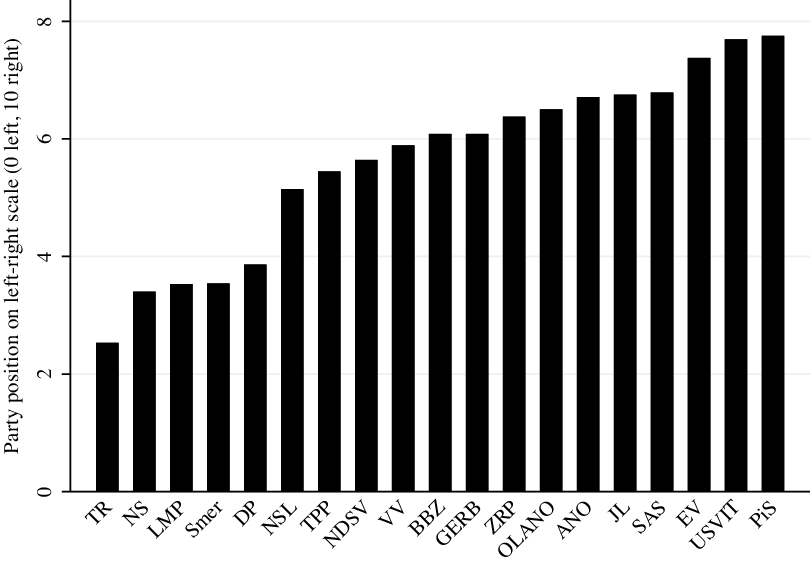
In addition, a closer look at the actual ideological positions of CAPs reveals large differences among them (see Figure 4). Some parties, such as the National Resurrection Party in Lithuania, indeed exhibit a ‘relative lack of ideology’ (Učeň, Reference Učeň2007: 51). However, the category of CAPs also includes parties like the center-left direction (Smer), the neoliberal Freedom and Solidarity (SaS) in Slovakia, or the conservative Law and Justice (PiS) in Poland. The first electoral participations of Smer and Alliance of New Citizens (ANO) offer a good comparison of distinctive ideological platforms. Both competed in the Slovak national parliamentary elections for the first time in 2002 and both parties have been classified as CAPs by earlier studies (see Hanley and Sikk, Reference Hanley and Sikk2016; Pop-Eleches, Reference Pop-Eleches2010; Učeň, Reference Učeň2007). Nevertheless, when asked about these two formations, experts considered Smer a centrist-left party and ANO a more right-leaning party in 2002 (Chapel Hill Expert Survey, see Figure 4).
Given that the ideological positions of CAPs vary greatly within the scope of the ideological mainstream, the possibility that CAPs sort protest voters along ideological lines should be considered. In fact, Stanley and Czesnik (Reference Stanley and Czesnik2016) have shown that the ideological profile of Palikot’s Movement (TR) – a CAP that entered the Polish political arena in 2011 – was relevant to voters despite its clear stances against the political establishment. I therefore claim that the ideological differences of CAPs need to be taken into account and expect CAPs that are clearly identifiable as either left- or right-leaning parties to mainly attract voters from the left or the right of the spectrum, respectively. Conversely, CAPs that cannot be clearly assigned to either one or the other side should have a higher ideological diversity among their voters. An alternative expectation with respect to the ideological composition of the electorate of CAPs is therefore:
Expectation 2b: The ideological coherence of CAP voters is not necessarily lower than the ideological coherence of other major parties (depending on the party’s ideological platform).
Classification of CAPs, data, and research design
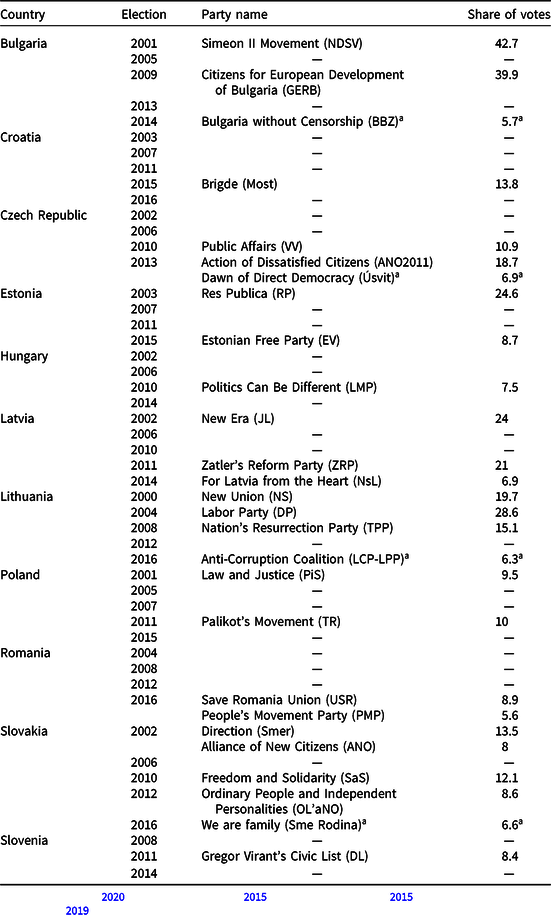
In the empirical analysis, I look at the electorates of CAPs in their first national parliamentary elections. Following Hanley and Sikk (Reference Hanley and Sikk2016), I define CAPs as genuinely new political parties located in the ideological mainstream that make an extensive use of anti-establishment rhetoric. The classification is based on quantitative criteria using data from expert surveys. We have conducted our own expert survey (Engler et al., Reference Engler, Armingeon and Deegan-Krause2020) that allows for a comparison of the parties’ salience on anti-establishment rhetoric during the electoral campaign, measured on a scale from 0 (no salience) to 10 (high salience). If a new party has a salience higher than the average salience of all major parties in that election, it is classified as an anti-establishment party.Footnote 5 From this subsample, I exclude all anti-establishment parties that do not represent positions from the ideological mainstream (defined as the opposite of ideological extremism, see Hanley and Sikk, Reference Hanley and Sikk2016: 523) and, therefore, cannot be considered CAPs. The ideological data from the Chapel Hill Expert Survey (Bakker, de Vries et al., Reference Bakker, de Vries, Edwards, Hooghe, Jolly, Marks, Polk, Rovny, Steenbergen and Vachudova2015; Bakker, Edwards et al., Reference Bakker, Edwards, Hooghe, Jolly, Marks, Polk, Rovny, Steenbergen and Vachudova2015) allow me to identify all parties with a radical right or a radical left position. Radical right positions are built around the traditional/authoritarian pole of the cultural dimension (comprised nationalist, nativist, and authoritarian values; Mudde, Reference Mudde2007). Consequently, all anti-establishment parties with a galtan-value higher than 8 (0 libertarian/postmaterialist; 10 traditional/authoritarian) are excluded.Footnote 6 In contrast, radical left positions occupy the leftmost space on the economic dimension (Bernhard and Kriesi, Reference Bernhard and Kriesi2019; March, Reference March2011), that is, all anti-establishment parties with lrecon-values lower than 2 (0 extreme left economic positions; 10 extreme right economic positions) are also not considered CAPs.Footnote 7 Table 1 presents the remaining CAPs in all 11 Central and Eastern European EU member states since 2000.Footnote 8 Our data also show that, with the exception of the Lithuanian cases, all CAPs listed in Table 1 also have an above-average salience of their anti-corruption claims. This is in line with Stanley (Reference Stanley, Rovira Kaltwasser, Taggart, Ochoa Espejo and Ostiguy2017), who argues that the issue of corruption often serves as a substitute of a thick ideology that complements populist/anti-establishment claims and, therefore, is usually part of centrist populism.
New CAPs since 2000

Source: Engler et al. (Reference Engler, Armingeon and Deegan-Krause2020), Bakker, de Vries et al. (Reference Bakker, de Vries, Edwards, Hooghe, Jolly, Marks, Polk, Rovny, Steenbergen and Vachudova2015), Bakker, Edwards et al. (Reference Bakker, Edwards, Hooghe, Jolly, Marks, Polk, Rovny, Steenbergen and Vachudova2015), ParlGov-dataset by Döring and Manow (Reference Döring and Manow2019).
a Borderline cases between CAPs and radical right parties.
In the empirical section, I compare the electorates of all CAPs in their first national parliamentary election with the electorates of the other major parties in the same election. A party is a major party in a particular election if it ranks among the five parties that won the highest percentages of the vote and if it won more than 5% of the vote in these elections. Because a CAP always ranks among the five major parties in all of the elections in my sample, the analyses in fact compare CAPs’ electorates with the electorates of the other four major parties (or fewer parties if less than five parties reach the threshold of 5%) in each election.Footnote 9 I focus on the first election because first, CAPs are very short-lived and often lose a substantial number of votes in subsequent elections (Haughton and Deegan-Krause, Reference Haughton and Deegan-Krause2015) and second, their anti-establishment appeals often wane over time and therewith the relationship between protest voting and ideology can change as well. By only including the first election, we avoid confounding the protest nature of the parties’ initial campaigns with their future transformations. To see whether CAPs indeed attract more voters with low political trust and whether the voters are ideologically diverse or not, we need individual data on vote choice, political trust, and ideological self-positioning.
I base my analyses on the ESS (rounds 1–8) that asked respondents about their vote choice in the previous national parliamentary elections between 2002 and 2016. The covered elections took place between 2001 and 2015. Data are available for 15 out of 27 CAPs (as not all countries are included in all rounds). The survey allows us to identify the voters of a particular party through the question ‘which party did you vote for in the last national election?’. Political trust is captured by the variable trstplt that measures the respondent’s trust in politicians on a scale from 0 (‘no trust at all’) to 10 (‘complete trust’).Footnote 10 The main analysis focuses on the general left–right axis that is included in all ESS rounds and measured by asking the respondents to place themselves on a scale from 0 (‘left’) to 10 (‘right’). The general left–right axis has proven to be a useful concept, and parties and voters in Central and Eastern European countries also refer to it (McAllister and White, Reference McAllister and White2007).Footnote 11 It summarizes a bundle of different issues into a single dimension (Bobbio, Reference Bobbio1994) and therewith makes the comparison between different national contexts, where different issue dimensions may be important, possible. In addition, I also look at indicators that are related to a two-dimensional model of party competition – the economic dimension and the cultural dimension – that portrays the ideological space in European countries even more adequately (Kitschelt, Reference Kitschelt1992; Marks et al., Reference Marks, Hooghe, Nelson and Edwards2006). For the cultural dimension, I use the question that asks the respondent to rate his/her agreement with the statement ‘Gays and lesbians [are] free to live life as they wish’ (1 agree strongly, 5 disagree strongly).Footnote 12 The economic dimension is operationalized with the item ‘Government should reduce differences in income levels’ (1 agree strongly, 5 disagree strongly). For each dimension, I measure the ideological coherence of each CAP’s electorate by comparing the standard deviation of the responses of its voters to the average standard deviation of the responses of the other major parties’ voters. In addition to comparing the ideological coherence and the level of political trust of the CAPs electorate to those of the electorate of other major parties (using variance-comparison tests and t-test statistics), I also conduct logistic regression models of individual vote choice [where CAP = 1 and other parties/mainstream (non-radical) parties = 0]. The models include control variables for age, gender, and unemployment. Instead of ideological coherence, I measure the effect of respondents’ ideological self-positioning in two ways: respondents’ position on a 0–10 left–right scale and their closeness to the center (i.e., distance to the midpoint of five on the left–right axis).Footnote 13 Fixed effects for each country election control for unobserved variance at the country and time level.
Results
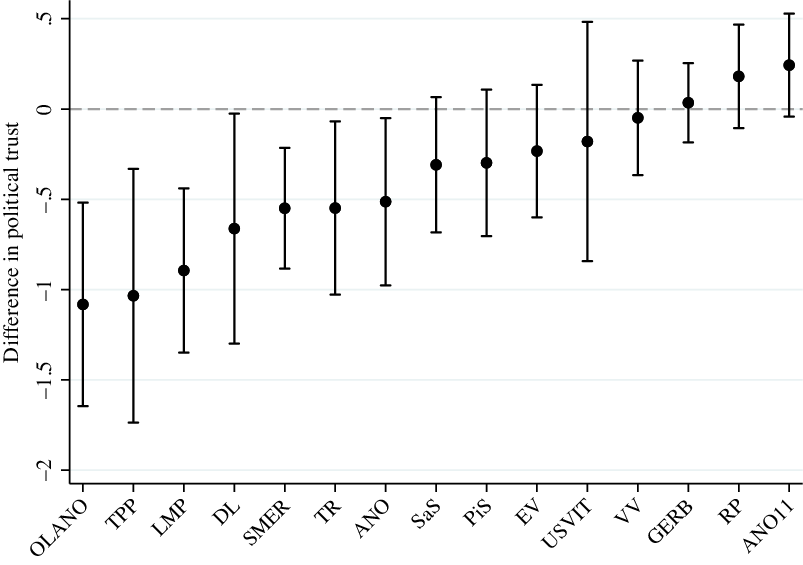
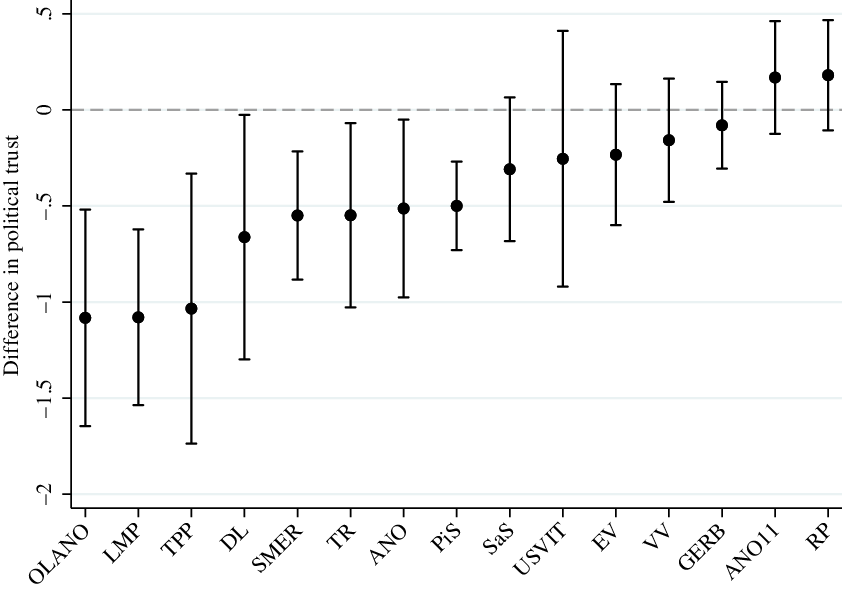
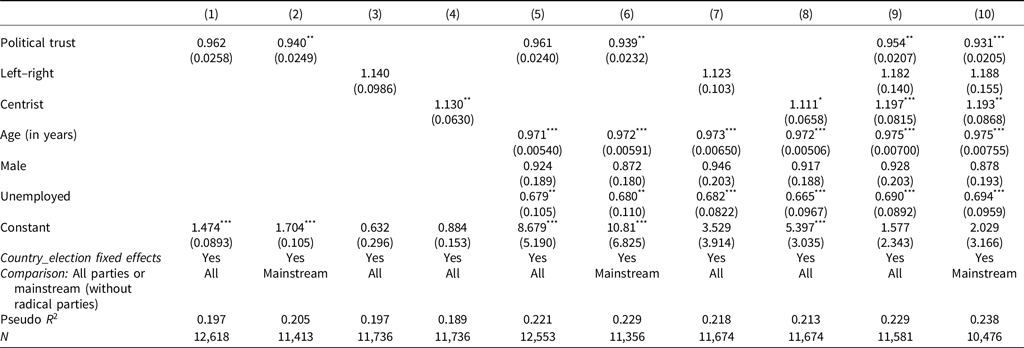
A first look at the CAPs’ electorates in their first parliamentary elections reveals that most CAPs do in fact attract more voters with lower levels of trust in politicians than other major parties in the same elections. However, the magnitude of the differences is often weaker than the literature on CAPs would have led us to expect. As Figure 1 illustrates, 12 out of the 15 CAPs attract voters with political trust lower than that of the average voter, but only for 7 of them there is significant difference (at the 90% level). None of the three parties whose voters have higher-than-average political trust scores a significant difference with the election’s mean. The differences between CAPs and other major parties become more apparent when excluding other anti-establishment parties (such as the radical right attacks (ATAKA) in Bulgaria and the radical left Communist Party of Bohemia and Moravia (KSČM) in the Czech Republic) from the calculation of the overall mean; since those parties usually attract an audience even more skeptical than that of CAPs.Footnote 14 After excluding these parties, 13 out of 15 CAPs have a level of political trust lower than that of the average mainstream voter (for 8 CAPs, this level is significantly lower), while still no CAP attracts voters with a significantly higher level of political trust (see Figure A1 in the appendix). To conclude, CAPs attract voters with lower political trust, but they do so to a lesser extent than other (radical) anti-establishment parties. This result is also confirmed by the logistic regression model that predicts the individual vote choice. As Table A1 in the appendix illustrates, the effect of political trust on individuals’ vote for a CAP is negative in all models (with odds ratios smaller than 1), with effects reaching statistical significance in the models that exclude the voters of radical left and radical right parties (and both full models).
Difference between the CAPs electorates’ trust in politicians in the first elections (mean) and the average trust of other major parties’ electorates in the same election. Abbreviations: DL (Gregor Virant’s List, Slovenia 2011); TR (Palikot Movement, Poland 2011); TPP (National Resurrection Party, Lithuania 2008); OL’aNO (Ordinary People’s Party, Slovakia 2012); GERB (Bulgaria 2009); Smer (Slovakia, 2002); ANO (Slovakia 2002); PiS (Poland 2001); SaS (Slovakia 2010); LMP (Hungary 2010); VV (Czech Republic, 2010); Usvit (Czech Republic, 2013); RP (Res Publica, Estonia 2003); EV (Free Party, Estonia 2015); ANO11 (ANO2011, Czech Republic 2013). Note: Trust in politicians ranges from 0 (no trust at all) to 10 (complete trust); 90% confidence interval of estimated differences between the CAPs’ mean and major parties’ mean. Minor parties are not considered in the calculation of the mean in order to exclude the effect of protest voters of marginal parties. Source: Own calculations based on the ESS.

While the results in Figure 1 mostly follow the theoretical expectations of protest voting and political trust (expectation 1), the results on the ideological coherence of the CAPs’ electorate are much less clear. According to Pop-Eleches (Reference Pop-Eleches2010), the success of CAPs should be a symptom of pure protest voting without any impact of the ideological considerations of their electorates. Consequently, we would expect CAPs to attract voters from the ideological left, center, and right in equal proportions (expectation 2a). In a first step, I examine this expectation by comparing the ideological variance within the CAPs’ electorates to the variance within other major parties’ electorates. Respondents were asked to place themselves on a left–right scale ranging from 0 (left) to right (10). Ideological coherence is then measured by the standard deviation of their voters’ ideological self-positioning, for both CAPs, and the average standard deviation of each other major party. The higher the standard deviation, the more widespread voters are on the left–right axis.
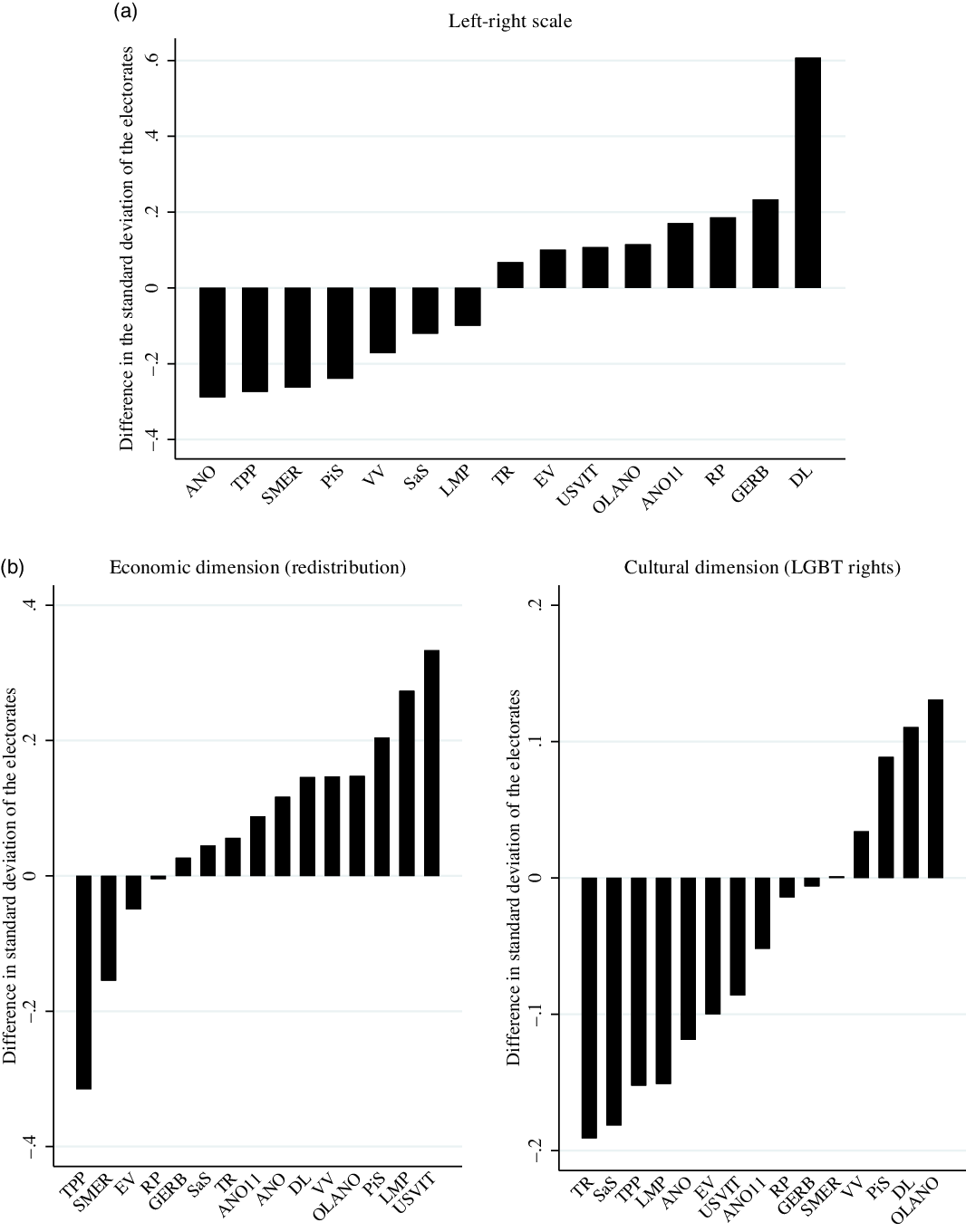
Figure 2a compares the ideological coherence among CAP voters in the party’s first elections to the average standard deviations of the other major parties’ electorates (displaying the differences between the two standard deviations) on the left–right axis. There are no clear patterns with regard to ideological coherence. Eight out of fifteen CAPs show a wider distribution of their voters’ ideological positions (i.e., displaying larger standard deviations), while the other seven CAPs show distributions more narrow than the country’s average (i.e., displaying smaller standard deviations).Footnote 15 A statistical comparison of the variances of the different electoratesFootnote 16 reveals that most CAPs do not significantly differ from other major parties, because they have a distribution of voters similar to that of at least one other major party. Only the electorates of Civic List (DL) in Slovenia and ANO2011 in the Czech Republic have a significantly higher variance than the voters of any other major party in the same election.
(a) Ideological variance (standard deviation on the left–right scale) of CAPs’ electorates in their first election, compared to the average ideological variance of the electorates of the other major parties in the same election. Abbreviations: DL (Gregor Virant’s List, Slovenia 2011); TR (Palikot Movement, Poland 2011); TPP (National Resurrection Party, Lithuania 2008); OL’aNO (Ordinary People’s Party, Slovakia 2012); GERB (Bulgaria 2009); Smer (Slovakia, 2002); ANO (Slovakia 2002); PiS (Poland 2001); SaS (Slovakia 2010); LMP (Hungary 2010); VV (Czech Republic, 2010); Usvit (Czech Republic, 2013); RP (Res Publica, Estonia 2003); EV (Free Party, Estonia 2015); ANO11 (ANO2011, Czech Republic 2013). Note: Average ideological variance: arithmetic mean of the standard deviation of each of the other major parties. Difference > 0: ideological variance of the CAP electorate higher than the average variance; difference < 0: ideological variance of the CAP electorate lower than the average variance. Source: Own calculations based on the ESS. (b) Ideological variance (standard deviation on the economic and cultural dimension) of CAPs’ electorates in their first election, compared to the average ideological variance of the electorates of the other major parties in the same election. Note: Average ideological variance: arithmetic mean of the standard deviations of each of the other major parties. Difference > 0: the CAP ideological variance is higher than the average variance; difference <0: the CAP ideological variance is lower than the average variance. Source: Own calculations based on the ESS.

With its electorate’s low political trust and low ideological coherence, DL seems to represent Pop-Eleches’s (Reference Pop-Eleches2010) archetype of pure protest voting, at least when we only consider the unidimensional left–right axis.Footnote 17 The results for all other CAPs, however, speak more in favor of the second interpretation of protest voting (expectation 2b).
The picture remains mixed when we look at the economic and cultural dimension (Figure 2b). The voters of most CAPs do indeed seem more heterogeneous on the economic dimension than the average electorate of the other major parties; however, the opposite is true on the cultural dimension, with most CAPs having a more coherent electorate. DL in Slovenia and OL’aNO in Slovakia are the only examples of CAPs whose electorates’ ideological positions are always more dispersed. All other CAPs have a voter base that is more ideologically coherent than the average of other major parties on at least one dimension.
While the survey data confirm that CAPs mainly attract voters with a level of trust in the country’s political elite that is lower than that of the average voter, they also show that many CAPs sort voters along the ideological left–right axis to the same extent as mainstream parties do. At this stage of the analysis, it remains unclear whether this ideological coherence derives from the fact that CAPs mainly attract moderate voters who are clustered around the ideological center (value 5) or whether there are also parties that mainly attract voters from either the left or the right. The results from the logistic regression models in Table A1 are not clear in this regard. Speaking to the former, the results indeed indicate that CAP voters are generally closer to the centrist position than are the voters of other parties. However, the results also suggest that they are mostly located on the center-right than spread around the center on the left and the right (although the effect is not significant). As the results very likely differ between CAPs, the next section will look more closely at how each individual CAP’s voters are distributed along the left–right axis to better understand where the coherence or incoherence of the electorate stems from.Footnote 18
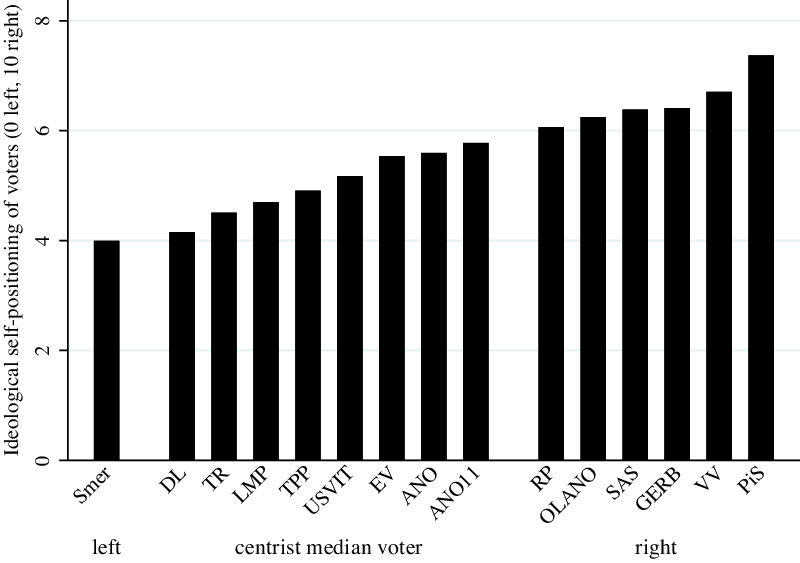
Figure 3 offers a closer look at the ideological composition of the CAPs’ electorates and presents the mean and median values of the parties’ electorates. We find three different types of parties: (1) the first type consists of parties where left-leaning voters alone represent at least 50% of total votes, while the remainder is split between centrist and right-leaning voters. Only Smer, 53% of whose voters placed themselves on the left (values from 0 to 4), 31% in the center (value 5), and only 16% on the right (value from 6 to 10), belongs to this category. The center-leftist platform of Smer had therefore already sorted voters along the left–right axis, albeit mainly attracting voters with lower levels of political trust. (2) The composition of the electorates of the second type of parties, which includes parties such as Citizens for European Development of Bulgaria (GERB) and O’LaNO, also speaks in favor of a broader concept of protest voting that incorporates ideology. The CAPs of this type all have a mean and a median ideological value that is equal to 6 or higher. They therefore mainly attract voters from the right (>50%), and less than half of their voters claim to be centrist or left-leaning. (3) The last type of CAPs has neither a dominant left nor a dominant right electorate (i.e., both <50%). The largest share of support for this type of party usually comes from voters who claim to be centrist (value 5). Only ANO and ANO2011 have a higher share of right-leaning voters. The interpretation of a respondent choosing the midpoint (5) on an 11-point left–right scale (from 0 to 10) is difficult. It can, of course, have the intended meaning of a centrist position equidistant from the left and the right. However, there is evidence that many indecisive respondents choose that option instead of opting for a non-response. In addition, the centrist position can also derive from leftist positions on some and rightist positions on other issues, that is, a less coherent position on the left–right scale (Kroh, Reference Kroh2007). If a party has a dominant group of centrist voters (which is only the case with LMP), I therefore avoid speaking of a dominant ideological group among its voters.
CAPs electorates’ average positions in the parties’ first elections, grouped into categories of parties with a left-leaning (median voter: 4), a centrist (median voter: 5), and a right-leaning (median voter: 6 or 7) electorate. Abbreviations: DL (Gregor Virant’s List, Slovenia 2011); TR (Palikot Movement, Poland 2011); TPP (National Resurrection Party, Lithuania 2008); OL’aNO (Ordinary People’s Party, Slovakia 2012); GERB (Bulgaria 2009); Smer (Slovakia, 2002); ANO (Slovakia 2002); PiS (Poland 2001); SaS (Slovakia 2010); LMP (Hungary 2010); VV (Czech Republic, 2010); Usvit (Czech Republic, 2013); RP (Res Publica, Estonia 2003); EV (Free Party, Estonia 2015); ANO11 (ANO2011, Czech Republic 2013). Source: Own calculations based on the ESS.

The existence of CAPs that sort voters along ideological lines (type 1 and type 2) is another indication that we should not neglect ideology when we talk about CAPs and their ability to attract voters with low levels of political trust. Despite the latter characteristic, CAPs neither rely on electorates that are more ideologically heterogeneous than other major parties’ voters, nor are they mainly attracting centrist or indecisive voters. Rather, many cases show pronounced differences across the ideological compositions of the parties’ electorates. There is evidence that many CAPs provide voters with enough programmatic reference points to explain the ideological sorting. First, as Figure 4 illustrates, CAPs vary across clearly leftist, centrist, and clearly rightist positions. The only common denominator is that all of them (by definition) still represent the ideological mainstream and not positions from the radical right or left. The party positions displayed are based on expert evaluations from the Chapel Hill Expert Survey (Bakker, de Vries et al., Reference Bakker, de Vries, Edwards, Hooghe, Jolly, Marks, Polk, Rovny, Steenbergen and Vachudova2015; Bakker, Edwards et al., Reference Bakker, Edwards, Hooghe, Jolly, Marks, Polk, Rovny, Steenbergen and Vachudova2015).Footnote 19 If a party platform was ideologically empty, as perceived by Pop-Eleches (Reference Pop-Eleches2010) or Učeň (Reference Učeň2007), a more centrist value for the same party would be the most likely outcome of all expert evaluations taken together. This is not the case for many CAPs.
CAPs’ positions on the left–right dimension in their first election. Abbreviations: TR (Twój Ruch; former: Palikot’s Movement, Poland, 2011); NS (New Union, Slovakia, 2000); LMP (Politics Can Be Different, Hungary, 2010); Smer (Direction, Slovakia, 2002); DP (Labor Party, Lithuania, 2004); NsL (Latvia from the Heart, Latvia, 2014); TPP (National Resurrection Party, Lithuania, 2008); NDSV (Simeon II Movement, Bulgaria, 2001); ANO11 (Action of Dissatisfied Citizens, Czech Republic, 2013); VV (Public Affairs, Czech Republic, 2010); BBZ (Bulgaria without Censorship, 2014); GERB (Citizens for European Development of Bulgaria, Bulgaria, 2009); ANO (Alliance of the New Citizen, Slovakia, 2002); ZRP (Zatlers Reform Party, Latvia, 2011); OL’aNO (Ordinary People’s Party, Slovakia, 2012); JL (New Era, Latvia, 2002); SaS (Freedom and Solidarity, Slovakia, 2010); EV (Estonian Free Party, Estonia, 2015); Usvit (Dawn of Direct Democracy, Czech Republic, 2013); PiS (Poland, 2001). Source: Bakker, de Vries et al. (Reference Bakker, de Vries, Edwards, Hooghe, Jolly, Marks, Polk, Rovny, Steenbergen and Vachudova2015), Bakker, Edwards et al. (Reference Bakker, Edwards, Hooghe, Jolly, Marks, Polk, Rovny, Steenbergen and Vachudova2015).

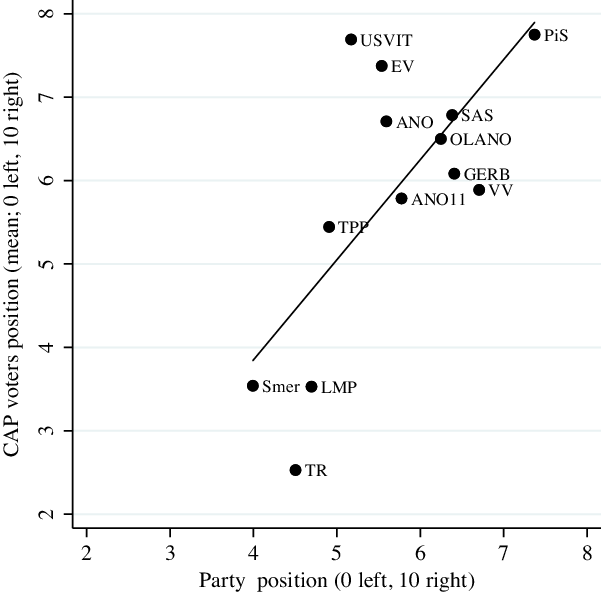
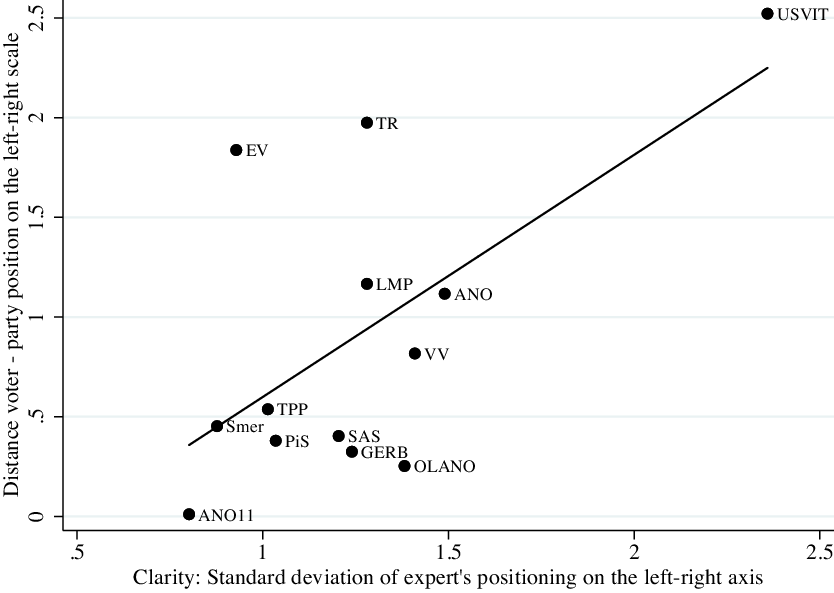
Second, as we see in Figure 5, CAPs’ electorates’ average ideological positions correlate with their respective parties’ positions. If party positions were not communicated clearly enough to play a role in protest voters’ choices, as the defenders of the pure protest voting thesis (Pop-Eleches, Reference Pop-Eleches2010) would argue, there should not be a relationship between the two. Yet, while we find a correlation, we also see that the more clearly a CAP communicates its position, the better the fit between the party’s position and the position of its electorate becomes. This relationship is illustrated in Figure A2, with clarity of a party’s position measured as the degree to which experts agree on their assessment of a party in the Chapel Hill expert survey (standard deviation of positioning on the left–right axis).Footnote 20
CAPs’ positions on the left–right dimension and the average position of their electorates. Abbreviations: DL (Gregor Virant’s List, Slovenia 2011), TR (Palikot Movement, Poland 2011), TPP (National Resurrection Party, Lithuania 2008), OL’aNO (Ordinary People’s Party, Slovakia 2012), GERB (Bulgaria 2009), Smer (Slovakia, 2002), ANO (Slovakia 2002), PiS (Poland 2001), SaS (Slovakia 2010), LMP (Hungary 2010), VV (Czech Republic, 2010), Usvit (Czech Republic, 2013), RP (Res Publica, Estonia 2003), EV (Free Party, Estonia 2015), ANO11 (ANO2011, Czech Republic 2013). Note: r = 0.73 (N = 13; party-level data are missing for DL and RP). Source: Own calculations based on the ESS; Bakker, de Vries et al. (Reference Bakker, de Vries, Edwards, Hooghe, Jolly, Marks, Polk, Rovny, Steenbergen and Vachudova2015), Bakker, Edwards et al. (Reference Bakker, Edwards, Hooghe, Jolly, Marks, Polk, Rovny, Steenbergen and Vachudova2015).

We can therefore conclude that we find evidence of CAPs sorting their voters along ideological lines. The degree of sorting, however, ranges from very weak sorting (i.e., CAPs that attract a very mixed electorate) to CAPs whose electorate either consists of a majority of left-wing or a majority of right-wing voters.
CAPs, ideology, and implications for future research
In the cases of at least one-half of the parties of interest, ideology seems to matter for the initial breakthroughs more than the literature expected. Even if it is their voters’ lack of trust, and not the CAPs’ ideological positions that contributed to their support, the results clearly show that ideology matters at least when protest voters make a selection. While this does not necessarily make a difference when we look at CAPs’ initial breakthroughs, as the number of protest voters, and not their political orientations, matters most, the composition of the electorate very likely has an impact on the party’s future trajectory.
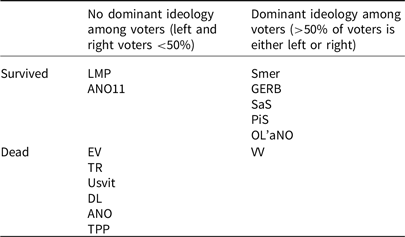
As soon as the party has been able to stand out from the pool of challenger parties and won seats in parliament, the pressure to take clearer ideological stances increases. Coalition negotiations require commitment to other parties and policy positions; positions on a variety of issues need to be formulated during the legislative period, where incoherence will be criticized by political adversaries and the public; and finally, the next election poses a challenge as the initial protest strategy of running as outsider to the entire political establishment has become more difficult. Thus, as soon as a CAP enters the political arena, questions about whether and in which direction it changes its political platform, and what consequences this will have for the dynamics of party competition, arise. Changes in the political platform, however, always bear the risk of alienating voters that hold different ideological beliefs. A quick glance at CAPs’ survival rates, for example, points in this direction as it shows that CAPs with electorates that are more ideologically homogeneous are much more likely to survive than those parties that attract very mixed electorates (see Table A2 in the appendix). If debates about CAPs rely on a false assumption that these parties are never more than non-ideological vehicles designed for pure acts of protest, without any trace of ideological characteristics, an important factor relevant to many questions about a CAP’s future trajectory and its consequences for party competition remains omitted.
This debate therewith reveals one of the main weaknesses of the conceptualization of CAPs. While the concept is very helpful in distinguishing new anti-establishment parties from their radical counterparts and suits the analysis of the electoral breakthrough that is embedded in the framework of protest voting, it is problematic when it comes to analyzing the consequences of their entry, as the latter can vary depending on the different ideological foundations of CAPs. CAPs should therefore not be treated as an ideological category equivalent to a party family but rather serve as a conceptualization of new challenger parties that can subsequently be further classified according to their ideological stances and the clarity of their positions. The analyses in this paper would suggest differentiating between at least three different subtypes: CAPs on the center-left, CAPs on the center-right, and CAPs without any, or with, ambiguous ideological positions. Depending on the focus of one’s research, other ideological categories (such as conservative, liberal, or progressive) are also possible.
Conclusion
CAPs rank among the most successful new political parties in Central and Eastern Europe. Their strategy of attacking the whole political establishment, while representing the same positions as the political mainstream, has proven to be an effective way of winning votes as newcomers. Their focus on newness (Sikk, Reference Sikk2012) and, less so, on other (ideological) characteristics of their political platforms has, in the past, led scholars to the conclusion that they are mere empty vehicles of protest, which attract voters independent of ideological considerations (Pop-Eleches, Reference Pop-Eleches2010). This has also been identified as the main reason why many CAPs are unable to maintain their support over time and simply disappear from the political arena after a single election (Haughton and Deegan-Krause, Reference Haughton and Deegan-Krause2015; Pop-Eleches, Reference Pop-Eleches2010). While there is evidence on the macro-level that economic downturns and rising corruption levels increase their likelihood of initial breakthrough (Engler, Reference Engler2016; Hanley and Sikk, Reference Hanley and Sikk2016), the role of dissatisfaction and ideology has never been tested at the individual level, except for some party-specific studies with ambiguous results (Havlík and Voda, Reference Havlík and Voda2016, Reference Havlík and Voda2018; Stanley and Czesnik, Reference Stanley and Czesnik2016).
This paper has sought to explore whether the success of CAPs can be considered purely protest-driven (with ideology being irrelevant to voters’ choice) or, if not, to what extent ideology matters. Using ESS data for eight countries between 2002 and 2016, I consider both the level of trust and the ideological composition of CAPs’ electorates. As expected, the average level of political trust of CAPs’ electorates is indeed lower than that of the average mainstream party voter. This finding is in line with the theory of protest voting and the findings from previous, macro-level studies on CAPs’ electoral breakthroughs. As far as the relationship between ideology and protest voting is concerned, however, we must reject the prevailing view that all CAPs attract groups of voters more ideologically heterogeneous than other major parties’ electorates. Rather, evidence suggests that protest voting can co-exist with ideological considerations. A closer look at the ideological composition of CAPs’ electorates reveals that a non-negligible number of CAPs mainly attracted voters from either the left or the right as early as their first elections. Voters’ ideological positions also correlate strongly with the parties’ political platforms.
The paper therefore shows that, although unsatisfied voters are the main factor behind CAPs’ success, ideological considerations have been important since the parties’ first elections. Portraying CAPs as empty vehicles of protest is misleading and underestimates the importance of ideology. Although an ideological platform may not have determined whether a CAP is successful in its first election or not, the ideological composition of each CAP’s electorate can be an important determinant of the party’s future trajectory and can influence its decision-making, future transformations, or coalition-building strategies.
The implications of this paper go beyond Central and Eastern Europe. First, parties such as the Five Star Movement in Italy, Ciudadanos in Spain, or En Marche! in France strongly resemble the definition of CAPs in their first election, and more CAP-like parties may well appear in other Western European party systems in the future. This possibility is particularly likely in countries where political scandals and high levels of corruption shape political life. Furthermore, the findings contribute to the theoretical debate about the role ideology plays in the rise of radical anti-establishment parties and, in particular, the radical right. Showing that ideology matters for protest voters even in the least likely case – namely, when parties do not represent positions different from those of mainstream parties – makes the claim that only dissatisfaction with the establishment, rather than a radical agenda, makes voters opt for the radical right even less plausible.
Acknowledgements
I would like to thank Endre Borbàth, Raimondas Ibenskas, Hanspeter Kriesi, Allan Sikk, as well as participants in the 24th International Conference of Europeanists in Glasgow and the 2018 Annual Conference of the Swiss Political Science Association in Geneva for their valuable comments on earlier versions of this paper and Ana Petrova for excellent copy-editing. I am also very grateful to Klaus Armingeon, David Weisstanner, Simon Lanz, and Isabelle Stadelmann-Steffen for their support and helpful suggestions.
Appendix
Difference between the CAPs electorates’ trust in politicians in the first elections (mean) and the average trust of the mainstream (i.e., non-radical) parties’ electorates in the same election. Abbreviations: DL (Gregor Virant’s List, Slovenia 2011); TR (Palikot Movement, Poland 2011); TPP (National Resurrection Party, Lithuania 2008); OL’aNO (Ordinary People’s Party, Slovakia 2012); GERB (Bulgaria 2009); Smer (Slovakia, 2002); ANO (Slovakia 2002); PiS (Poland 2001); SaS (Slovakia 2010); LMP (Hungary 2010); VV (Czech Republic, 2010); Usvit (Czech Republic, 2013); RP (Res Publica, Estonia 2003); EV (Free Party, Estonia 2015); ANO11 (ANO2011, Czech Republic 2013). Notes: Trust in politicians ranges from 0 (no trust at all) to 10 (complete trust); 90% confidence interval of estimated differences between the CAP mean and mainstream parties’ mean. Source: Own calculations based on the ESS.

The distance of party position to the position of their electorate and the clarity of their position. Abbreviations: DL (Gregor Virant’s List, Slovenia 2011); TR (Palikot Movement, Poland 2011); TPP (National Resurrection Party, Lithuania 2008); OL’aNO (Ordinary People’s Party, Slovakia 2012); GERB (Bulgaria 2009); Smer (Slovakia, 2002); ANO (Slovakia 2002); PiS (Poland 2001); SaS (Slovakia 2010); LMP (Hungary 2010); VV (Czech Republic, 2010); Usvit (Czech Republic, 2013); RP (Res Publica, Estonia 2003); EV (Free Party, Estonia 2015); ANO11 (ANO2011, Czech Republic 2013). Source: Own calculations based on the ESS and Chapel Hill Expert Survey (Bakker et al. Reference Bakker, de Vries, Edwards, Hooghe, Jolly, Marks, Polk, Rovny, Steenbergen and Vachudova2015a, Reference Bakker, Edwards, Hooghe, Jolly, Marks, Polk, Rovny, Steenbergen and Vachudova2015b).

Logistic regression models of voting for CAP with country-fixed effects (odds ratios in cells)

* P < 0.10, ** P < 0.05, *** P < 0.01; Odds ratio (<1: negative effect; >1: positive effect); standard errors clustered by country election in parentheses; Lithuania is missing because there are no sampling weights included.
Patterns of survival and ideology composition of the CAPs electorate in their first election

Res Publica (RP) has merged with the nationalist Pro Patria Union before participating in a second election. It is therefore difficult to determine whether its persistence can be counted as survival or not.