Introduction
The genus Psammina Sacc. & M. Rousseau currently includes nine species which are either saprophytic, lichenized, or algicolous and lichenicolous (Earland-Bennett & Hawksworth Reference Earland-Bennett and Hawksworth2005; Cáceres & Aptroot Reference Cáceres and Aptroot2016). The algicolous and lichenicolous species include P. inflata Earl.-Benn. & D. Hawksw., P. simplex Earl.-Benn. & D. Hawksw., and P. stipitata D. Hawksw., which all grow on green coccoid algae and crustose lichens on trees, stones and wood (Earland-Bennett & Hawksworth Reference Earland-Bennett and Hawksworth2005). Psammina stipitata, the first lichenicolous species of the genus to be recognized (Hawksworth Reference Hawksworth1979), seems to be a rather frequent species in Europe: it is known from many locations in the UK (Earland-Bennett & Hawksworth Reference Earland-Bennett and Hawksworth2005) and also from France (Coste Reference Coste2012), the Netherlands (van Herk & Aptroot Reference van Herk and Aptroot1994) and Ukraine (Khodosovtsev et al. Reference Khodosovtsev, Darmostuk and Gromakova2016). In the UK and the Netherlands, Psammina species can be found by actively searching for small and often somewhat granular black spots on crusts of algae and lichens on the dry side of trees and stones. Examination of Psammina collections from this habitat has led to the discovery of a further species characterized by particularly long (over 50 μm) conidial arms, described here as P. filamentosa. We describe the new species and compare the dimensions of its conidial arms with those of other Psammina species occurring in the same habitat. The new species is most similar to P. stipitata but the dimensions of the conidial arms differ markedly between the two species. We also provide a key to the ten species of the genus currently known worldwide, including those on plant material and not associated with either algae or lichens.
Methods
Most Psammina specimens included in this study were collected in the Netherlands between 2015 and 2020, and one additional specimen was collected in the UK in 2011. The collections were examined with a binocular microscope (×10 and ×30) and a light microscope (×40, ×100 and ×400). The collections from the Netherlands are preserved in the private collection of HK, except for the holotype of the new species deposited in the fungarium of the Royal Botanic Gardens Kew (with an isotype in the private collection of HK).
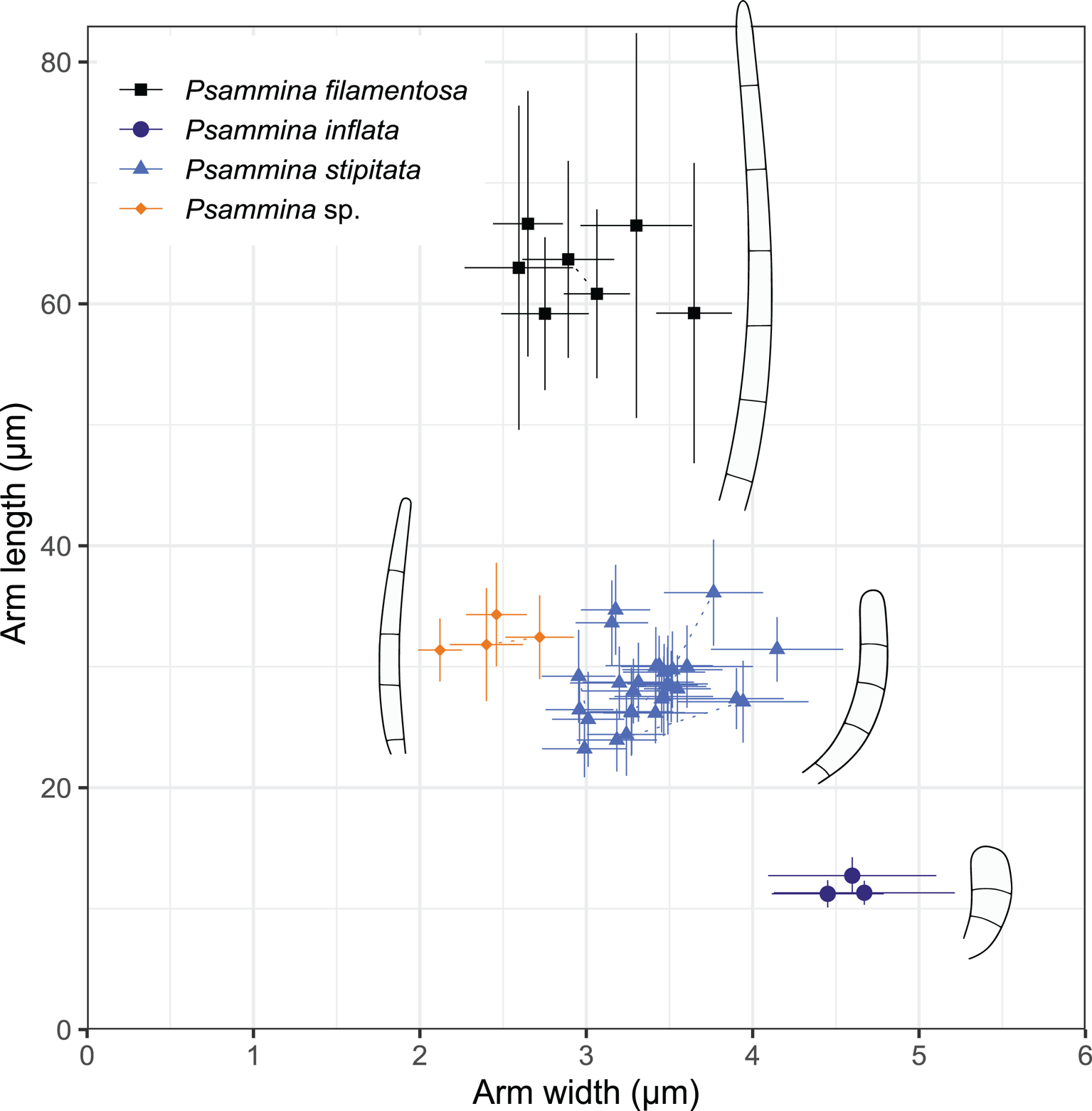
In order to compare the dimensions of the conidial arms with other Psammina species occurring in the same habitat (Fig. 1), we measured the conidial arms of 36 Psammina collections in a standardized way: six collections of the new species P. filamentosa, 24 of P. stipitata, and three each of P. inflata and an unknown Psammina species. In each collection, conidia were squashed in water and the width and length of 20 conidial arms were measured. The measurements were taken from four images that were made with an SLR camera through a light microscope at ×400 magnification. Each image was taken of different conidia and five conidial arms were measured from each of the four images. Only conidial arms of full-grown conidia were measured. From each set of 20 conidial arm measurements, the mean and standard deviation of the arm length and width were calculated. In seven collections the measurements were repeated in different sporodochia.
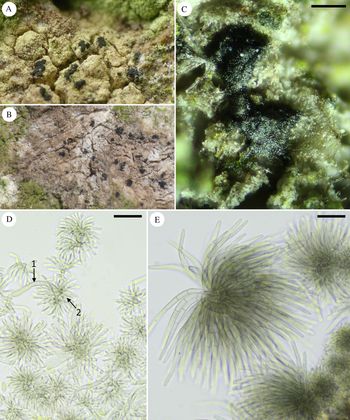
Psammina filamentosa. A–C, sporodochia. A, on Psilolechia lucida (H.K. 1856). B, on bleached green algae. C, close-up on green algae. D, conidiophore (arrow 1) and young conidium (arrow 2). E, mature conidium with several immature conidia (B–E from holotype, K(M) 264328). Note that the pale brown conidia appear greenish in D and E. Scales: C = 100 μm; D & E = 20 μm.

Taxonomy
Psammina filamentosa Kolk & Earl.-Benn. sp. nov.
MycoBank No.: MB 836580
Differing from Psammina stipitata by the larger conidia, 120–160 μm diam., and the distinctly longer and somewhat tapered conidial arms, measuring 50–80(–100) × 2.5–4.0 μm.
Type: The Netherlands, Noord-Holland, Zaandam, 52.4269°N, 4.8424°E, on green algae on Pterocarya fraxinifolia, 5 December 2019, H.-J. van der Kolk (K(M) 264328—holotype; H.K. 1708—isotype).
(Fig. 1)
Colonies discrete, dispersed, dark brown to black, appearing slightly granular or almost smooth, 100–200 μm across; mycelium immersed in the host tissue, consisting of brown, branched torulose hyphae, 2.5–3.5 μm wide.
Conidiomata absent. Conidiophores semi-macronematous, arising in small sporodochial groups, erect, straight, unbranched, smooth-walled, septate, 30–50 × 3.0–3.5 μm. Conidiogenous cells monoblastic, integrated, terminal, cylindrical, not clearly delimited from the conidiophores, 10–15 × 2.5–3.5 μm. Conidia arising singly, dry, acrogenous, multiseptate, palmate, pale brown, comprising c. 70–100 arms, 120–160 μm diam. when lightly squashed; arms curved at the base, becoming straighter and sometimes slightly attenuated towards the apex, sometimes unevenly thickened, pale brown, smooth-walled, 6–8-septate, 50–80(–100) × 2.5–4.0 μm.
Etymology
Filamentosa, named after the long and almost thread-like conidial arms.
Ecology
Growing over crusts of green algae and lichens, for example Psilolechia lucida and Lecanora expallens, on the dry side of stones and trees. Pathogenic and causing bleaching of the host.
Distribution
Currently known only from the UK and the Netherlands.
Additional collections examined
Psammina filamentosa. The Netherlands: Gelderland: Apeldoorn, 52.207°N, 5.961°E, on Psilolechia lucida on sandstone, 1 i 2015, H. van der Kolk (H.K. 308); Ellecom, 52.0291°N, 6.0792°E, on Lecanora expallens on Quercus, 23 xi 2019, H. van der Kolk (H.K. 1689); Malden, 51.7808°N, 5.8893°E, on green algae on Cytisus scoparius, 8 ii 2020, H. van der Kolk (H.K. 1764). Noord-Brabant: Den Bosch, 51.7036°N, 5.3048°E, on Psilolechia lucida on sandstone, 22 ii 2020, H. van der Kolk (H.K. 1856).—Great Britain: England: V.C. 25, East Suffolk, Ipswich, Rushmere Heath, 52.06°N, 1.21°E, on green algae on Prunus padus, 14 ix 2011, P. M. Earland-Bennett & C. J. B. Hitch (K(M) 264329).
Psammina inflata. The Netherlands: Gelderland: Valouwe, 52.0935°N, 5.7154°E, on green algae on Betula, 4 i 2020, H. van der Kolk (H.K. 1745); Beekbergerwoud, 52.1664°N, 6.0156°E, on green algae on Quercus, 26 iii 2020, H. van der Kolk (H.K. 1875). Noord-Brabant: Schijndel, 51.6356°N, 5.4651°E, on green algae on Populus, 22 ii 2020, H. van der Kolk (H.K. 1858).
Psammina stipitata. The Netherlands: Drenthe: Mensinge, 53.1326°N, 6.4365°E, on Lepraria incana on Quercus, 19 iv 2017, H. van der Kolk (H.K. 701). Friesland: Vlieland, 53.2714°N, 4.9846°E, on Lepraria incana on Quercus, 18 i 2020, H. van der Kolk (H.K. 1753). Gelderland: Hoge Veluwe, 52.0924°N, 5.8227°E, on Psilolechia lucida on sandstone, 28 xii 2015, H. van der Kolk (H.K. 419); Epe, 52.3467°N, 5.9871°E, on Lecanora expallens on Quercus, 24 iii 2018, H. van der Kolk (H.K. 1168); Bennekom, 52.001°N, 5.6592°E, on Lecanora expallens on Quercus, 12 iii 2019, H. van der Kolk (H.K. 1401); Gortel, 52.3008°N, 5.8626°E, on Lepraria incana on Quercus, 25 xii 2019, H. van der Kolk (H.K. 1749); Valouwe, 52.0893°N, 5.7118°E, on green algae and Lepraria incana on Quercus, 11 i 2020, H. van der Kolk (H.K. 1750); Valouwe, 52.0889°N, 5.7111°E, on green algae on Betula, 11 i 2020, H. van der Kolk (H.K. 1751); Valouwe, 52.0884°N, 5.7014°E, on green algae and Lepraria incana on Quercus, 11 i 2020, H. van der Kolk (H.K. 1752); Apeldoorn, 52.2179°N, 5.9382°E, on Lepraria incana on Quercus, 19 ii 2020, H. van der Kolk (H.K. 1854); Apeldoorn, 52.2191°N, 5.938°E, on Lepraria incana on Picea, 19 ii 2020, H. van der Kolk (H.K. 1855); Renkum, 52.0056°N, 5.7351°E, on green algae on Quercus, 22 iii 2020, H. van der Kolk (H.K. 1873); Renkum, 52.0047°N, 5.735°E, on Lepraria incana on Quercus, 22 iii 2020, H. van der Kolk (H.K. 1874). Groningen: Warffum, 53.393°N, 6.5538°E, on green algae on Aesculus, 25 i 2020, H. van der Kolk (H.K. 1754); Warffum, 53.3927°N, 6.5538°E, on Lepraria incana on Aesculus, 25 i 2020, H. van der Kolk (H.K. 1755). Noord-Brabant: Biesbosch, 51.7477°N, 4.816°E, on Lepraria incana and Lecanora expallens on Populus, 24 iii 2019, H. van der Kolk (H.K. 1410); Den Bosch, 51.7036°N, 5.3048°E, on Psilolechia lucida on sandstone, 22 ii 2020, H. van der Kolk (H.K. 1857); Schijndel, 51.6356°N, 5.4651°E, on green algae on Populus, 22 ii 2020, H. van der Kolk (H.K. 1859). Noord-Holland: Zwanenwater, 52.8192°N, 4.7064°E, on green algae on Quercus, 30 iii 2018, H. van der Kolk (H.K. 1177); Zaandam, 52.4279°N, 4.8443°E, on green algae on Acer, 5 xii 2019, H. van der Kolk (H.K. 1713); Bussum, 52.282°N, 5.1693°E, on Lepraria incana on Tilia, 31 xii 2019, H. Timans (H.K. 1851). Overijssel: Almelo, 52.3539°N, 6.6464°E, on Lepraria incana on Quercus, 17 xi 2019, H. van der Kolk (H.K. 1679); Deventer, 52.2588°N, 6.1539°E, on green algae on Acer, 15 ii 2020, H. van der Kolk (H.K. 1852); Deventer, 52.2757°N, 6.1785°E, on Lepraria incana on Quercus, 15 ii 2020, H. van der Kolk (H.K. 1853).
Psammina sp. The Netherlands: Noord-Holland: Bergen, 52.6749°N, 4.6796°E, on green algae on Quercus, 11 iii 2020, H. van der Kolk (H.K. 1872). Zeeland: Oostkapelle, 51.5757°N, 3.538°E, on green algae on Quercus, 19 x 2019, H. van der Kolk (H.K. 1632). Zuid-Holland: Meijendel, 52.1315°N, 4.327°E, on Lecanora expallens on Quercus, 6 i 2018, H. van der Kolk (H.K. 1081).
Discussion
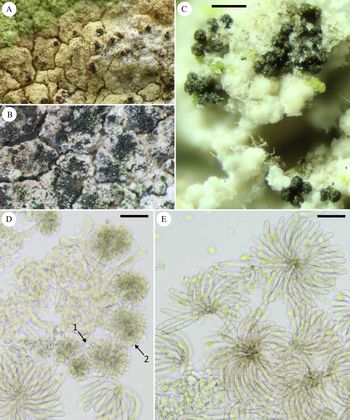
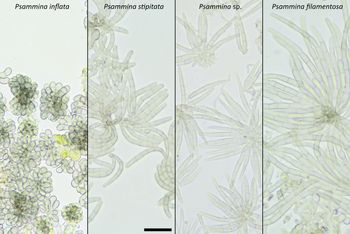
Psammina filamentosa is characterized by the long conidial arms and can therefore not be confused with any other Psammina species when mature conidia are examined (Figs 2 & 4). Mature conidia of P. filamentosa differ distinctly from the mature conidia of the more common P. stipitata in the longer and often also somewhat tapered conidial arms. The width of the conidial arms in P. filamentosa is variable and overlaps with the width of the arms of P. stipitata (Fig. 2). No collections were found, however, in which the length of mature conidial arms were intermediate between the two species (Fig. 2). Young conidia of P. filamentosa are very variable in the shape and size of the conidial arms but in all specimens the typical full-grown conidia with long conidial arms were present. Also, compared to mature conidia of P. stipitata, the arms of similar-sized young conidia of P. filamentosa lack clear septa and are more slender. Mature conidia of P. inflata cannot be confused with young conidia of P. filamentosa or P. stipitata since they are inflated and on average 4.5 μm wide (Figs 2 & 4). Psammina filamentosa and P. stipitata can, however, co-occur: at two locations they were collected from the same tree and stone. This is not surprising given that both species have a similar ecology, growing mostly lichenicolous and algicolous in the same habitat, and given that P. stipitata seems to be rather common. In the field, with a strong hand lens (≥ ×15 magnification), the surface structure of the sporodochia can provide a hint as to the identity of the species. In P. stipitata, the conidia are not intertwined with each other and they therefore mostly have a granular appearance (Fig. 3C). The conidia of P. filamentosa, in contrast, generally do intertwine with each other, resulting in the surface appearing more or less smooth rather than granular (Fig. 1C).
Conidial arm width and length of 36 Psammina collections of four species growing on algae and lichens on the dry side of bark or stone. Points and error bars depict the means and standard deviations of 20 conidial arm measurements. Dots connected with an interrupted line indicate measurements from different sporodochia of the same collection. In colour online.

Psammina stipitata. A–C, sporodochia. A, on Psilolechia lucida (H.K. 1857). B, on Lepraria incana (H.K. 1874). C, close-up on Lepraria incana (H.K. Kolk 1855). D, conidiophore (arrow 1) and young conidium (arrow 2) (H.K. 1754). E, mature squashed conidia (H.K. 1873). Scales: C = 100 μm; D & E = 20 μm.

Comparison of mature conidia of algicolous and lichenicolous Psammina species. Psammina inflata (H.K. 1745), P. stipitata (H.K. 419), Psammina sp. (H.K. 1632) and P. filamentosa (H.K. 1856). Scale: applies to all images = 20 μm.

The arms of Psammina stipitata were originally described as 25–50 × 3–3.5 μm on the basis of the single collection then known (Hawksworth Reference Hawksworth1979). Here, we found that the arms are generally somewhat shorter and more variable in width, 21–40 × 3.0–4.0 μm (Fig. 2). The dimensions of the conidial arms of P. stipitata thus overlap with the dimensions of those originally reported for P. simplex, (7–)15–25(–29) × (1.5–)2–4 μm (Earland-Bennett & Hawksworth Reference Earland-Bennett and Hawksworth1999). The number of septa in the conidial arms was originally described as the main difference between P. stipitata and P. simplex, but later Earland-Bennett & Hawksworth (Reference Earland-Bennett and Hawksworth2005) considered that feature less reliable. Also, the number of arms per conidium is variable in P. stipitata and cannot be used to distinguish it from P. simplex. Given the overlapping measurements between the two species and the lack of other diagnostic features separating them, we suggest that P. simplex might prove to be a synonym of P. stipitata. A molecular study, ideally including the holotypes of both species, could conclusively resolve this issue but it was not possible to attempt this during the current study.
An unidentified Psammina was collected three times and the dimensions of the conidial arms resemble those of P. stipitata but differ in being more slender and slightly attenuated towards the tip (Figs 2 & 4). The conidial arms of these unidentified collections measure 28–37 × 2–3 μm and so match those reported for P. mariae-theresiae Dias & Teixeira, a species described from dead branches of Smilax nigra (Dias & Teixeira Reference Dias and Teixeira1963), material of which we have not seen.
Psammina inflata, characterized by the short and inflated conidial arms, was originally described from the UK (Earland-Bennett & Hawksworth Reference Earland-Bennett and Hawksworth1999), and has also been reported from France (Roux et al. Reference Roux, Monnat, Gonnet, Gonnet, Poumarat, Esnault, Gardiennet, Bertrand, Bauvet and Houmeau2018), Germany (Eichler et al. Reference Eichler, Cezanne and Teuber2010a) and Luxembourg (Eichler et al. Reference Eichler, Cezanne, Diederich, Ertz, van den Broeck, van den Boom and Sérusiaux2010b). We now report it also from three localities in the Netherlands (Figs 2 & 4).
In conclusion, the new species P. filamentosa is distinguished from all other described Psammina species by the long conidial arms. The genus Psammina now includes ten species which are saprophytic, lichenized, lichenicolous, or algicolous. The genus has no known sexual morph and is currently classified in the subphylum Pezizomycotina, but not referred to any order or family (Wijayawardene et al. Reference Wijayawardene, Hyde, Al-Ani, Tedersoo, Haelewaters, Rajeshkumar, Zhao, Aptroot, Leontyev and Saxena2020). There is, however, a need for a molecular study of the genus to determine whether the three species described from plants belong in the same genus. Hawksworth (Reference Hawksworth1979) described the first lichenicolous Psammina species and pointed out that the type, P. bommeriae Sacc. & M. Rousseau, had been considered an acervular coelomycete rather than a hyphomycete by Sutton (Reference Sutton1980; incorrectly as ‘bommerae’). The conidiophores, arising from a basal tissue (textura intricata) structure, were more appropriately viewed by Hawksworth (Reference Hawksworth1979) as a rudimentary stroma. This feature alone, however, does not provide a basis for separating the plant-based species from the others now recognized in the genus. In the case of P. elegiae S. J. Lee & Crous described from dead culms of Elegia juncea, no definite hymenium-like layer was formed (Lee & Crous, Reference Lee and Crous2003). Also, the conidiophores of P. lobariae (Diederich & Etayo) Earl. Benn. & D. Hawksw., the only lichenicolous species growing on foliaceous lichens, do arise from a structure similar to an acervulus (Etayo & Diederich Reference Etayo, Diederich, Daniels, Schulz and Peine1995; Earland-Bennett & Hawksworth Reference Earland-Bennett and Hawksworth2005). Wijayawardene et al. (Reference Wijayawardene, Hyde, Wanasinghe, Papizadeh, Goonasekara, Camporesi, Bhat, McKenzie, Phillips and Diederich2016) excluded Psammina from their treatment of coelomycete fungi with brown or brownish conidia but noted a similarity in the conidia to those of Coelodictyosporium Thambug. & Hyde, but that genus has definite rounded pycnidia enclosing the conidiogenous structures and walls of angular pseudoparenchymatous cells (textura angularis).
An updated worldwide key to the species of Psammina
This key updates those of Lee & Crous (Reference Lee and Crous2003) and Earland-Bennett & Hawksworth (Reference Earland-Bennett and Hawksworth2005). It is important to examine mature conidia to measure the dimensions and number of septa when using this key. The unidentified Psammina mentioned in this article is included here as Psammina sp.
1 Conidia with < 20 arms………2
Conidia with > 20 arms………4
2(1) Arms non-septate, 8–12 × 2–2.5 μm, lichenized ………P. palmata
Arms septate, lichenized or lichenicolous………3
3(2) Lichenicolous on Lobaria pulmonaria, arms 21–27 × 2.5–3.5 μm………P. lobariae
Lichenized, arms 20–25 × 2.5–3.0 μm………P. tropica
4(1) Arms > 15 μm long (P. bommeriae has occasionally arms < 15 μm long which are, however, < 3 μm wide)………5
Arms 10–15 × 3.5–6.0 μm and inflated at the top, algicolous and lichenicolous………P. inflata
5(4) Arms < 50 μm long………6
Arms 50–80 × 2.5–4.0 μm long, algicolous and lichenicolous……… P. filamentosa
6(5) Arms 21–40 × 3.0–4.0 μm, apex rounded, 3–7-septate, algicolous or lichenicolous………P. stipitata
Arms < 3.0 μm wide or < 25 μm long and < 3-septate, algicolous, lichenicolous or on plant material………7
7(6) Arms < 25 μm long………8
Arms > 25 μm long………9
8(7) Arms mostly 0–2-septate, 15–25 × 2–4 μm, algicolous and lichenicolous………P. simplex
Arms 3–6-septate, 12–25 × 2–2.5 μm, on Ammophila arenaria and Juncus effusus………P. bommeriae
9(7) Arms > 2 μm wide and on average more than 3-septate………10
Arms 26–30 × 2 μm, (2–)3(–4)-septate, on Elegia juncea………P. elegiae
10(9) Arms 27.5–45 × 2.5–3 μm, on dead branches of Smilax nigra………P. mariae-theresiae
Arms 28–37 × 2.0–3.0 μm, attenuated towards the apex, algicolous or lichenicolous………Psammina sp.
Author ORCIDs
Henk-Jan van der Kolk, 0000-0002-8023-379X.