INTRODUCTION
The zoogeographical range of a species refers to the distribution of a species, either horizontal or vertical, largely determined by the pervasiveness of certain environmental anomalies and biotic components that favour establishment of the species, and whose boundaries are defined by gradual dilution or abrupt termination of these components. Coastal ecosystems being dynamic are rich in diverse assemblages with estimates of about 80% of marine fauna inhabiting these areas (Ray, Reference Ray, Wilson and Peter1988, Reference Ray1991; Anon, Reference Anon1989) with highly overlapping boundaries that are influenced by complex relationships among varying niches in the marine environment. These coastal areas also support rare fish species (Engel & Kvitek, Reference Engel and Kvitek1998; Froese & Pauly, Reference Froese and Pauly2008) predominantly belonging to two finfish orders, namely Perciformes (perch-like fish) and Scorpaeniformes (scorpion fish, rock fish and sting fish) (Froese & Pauly, Reference Froese and Pauly2008). Among the perch-like fish, the fusiliers belonging to the family Caesionidae are particularly unique with regards to evolutionary trends that display transition from benthic carnivorous to semi-pelagic planktivorous behaviour (Carpenter, Reference Carpenter1988).
The inshore shelf waters of Goa, central west coast of India up to 20 m depth, are subjected to anthropogenic inputs such as commercial trawling (Ansari et al., Reference Ansari, Chatterji, Ingole, Sreepada, Rivonkar and Parulekar1995, Reference Ansari, Sreepada, Dalal, Ingole and Chatterji2003) and maritime activities (Anil et al., Reference Anil, Venkat, Sawant, Dileepkumar, Dhargalkar, Ramaiah, Harkantra and Ansari2002) that pose a potential threat to coastal ecosystems and the resident biota. The present paper describes the new record of occurrence of rare fusilier species, Caesio cuning (Bloch, 1791) found outside its geographical locale in the coastal waters of Goa along the west coast of India.
MATERIALS AND METHODS
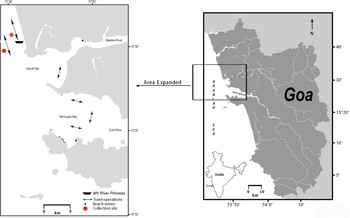
The present study area encompasses the Mandovi–Zuari estuarine complex (Figure 1) and the adjacent fishing grounds up to 20 m depth that are subjected to increased levels of exploitation by commercial trawl operations. The potential fishing grounds located between 15°29′N and 15°34′N latitudes and between 73°40′E and 73°51′E longitudes were selected for intensive sampling. During the present study period (May, 2005 to May, 2008), intensive sampling comprising 92 trawling operations with a total effort of 146 hours was undertaken in the estuarine and offshore areas of Goa, central west coast of India to assess the diversity and total community structure of demersal fish fauna. Trawl-nets with mesh sizes of 15 mm (mouth-end) and 9 mm (cod-end) were towed approximately at a speed of 2 knots (4 km. h−1). The catch obtained was sorted into five sub-samples. Uncommon (or rare) specimens were picked out, put on ice and sent to the laboratory for detailed examination. In addition, samples were obtained by operating beach seine along Betim (15°30′18″N 73°49′52″E) during December, 2005 and twice in the vicinity of Mormugao Port Trust (15°24′16″N 73°48′56″E) during December, 2005 and September, 2006 to assess the occurrence of demersal species in the estuarine embayment as these were inaccessible to demersal trawlers.
Map of the study area indicating sampling sites and location of collection of Caesio cuning.

At the laboratory, a detailed morphological study of the biological specimens was carried out using identification keys (Fischer & Whitehead, Reference Fischer and Whitehead1974; Talwar & Kacker, Reference Talwar and Kacker1984; Froese & Pauly, Reference Froese and Pauly2008).
RESULTS
MATERIAL EXAMINED
Two unsexed specimens; RP-1, 6.08 cm SL and RP-2, 5.21 cm SL (co-ordinates: 15°30′43.1″N 73°45′40.1″E to 15°32′28.1″N 73°45′9.4″E; water depth: 11–14 m). Coll. V.P. Padate, 11 March 2007.
Two unsexed specimens; RP-3, 6.89 cm SL and RP-4, 6.11 cm SL (co-ordinates: 15°29′43.2″N 73°44′39.7″E to 15°33′15.2″N 73°42′41.6″E; water depth: 6–7 m). Coll. V.P. Padate, 25 March 2007.
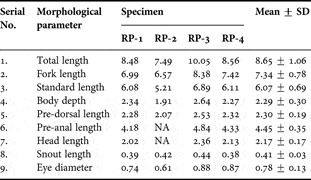
Details of morphometric measurements of fish specimens along with their mean and standard deviation are provided in Table 1. Reference voucher sample is deposited at the Marine Biology Laboratory, Department of Marine Sciences, Goa University.
Details of morphometric measurements (in cm) of Caesio cuning specimens (N = 4) collected along the coast of Goa.

RP, site of sample collection in the vicinity of the MV ‘River Princess’ grounded off the coast of Goa.
Ascending maxillary process is completely separated from the pre-maxilla (Carpenter, Reference Carpenter1988). In other related perciform fish, particularly snappers (family Lutjanidae), the ascending maxillary process is confluent with the pre-maxilla (Carpenter, Reference Carpenter1988). The above morphological character is an adaptation towards a planktivorous feeding habit.
The taxonomic identification of these specimens up to the species level was carried out using identification keys provided by Carpenter (Reference Carpenter1988) and Froese & Pauly (Reference Froese and Pauly2008).
A single post-maxillary process; posterior end of maxilla blunt, its greatest depth posterior to end of pre-maxilla (Carpenter, Reference Carpenter1988).
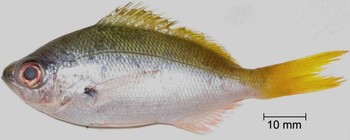
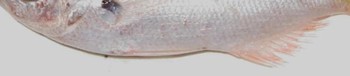
Distinguishing characters and colour of a fresh specimen of Caesio cuning.

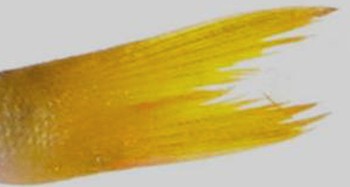
Caudal fin of Caesio cuning indicating characteristic yellow coloration.

Ventral portion of Caesio cuning indicating characteristic pink coloration.

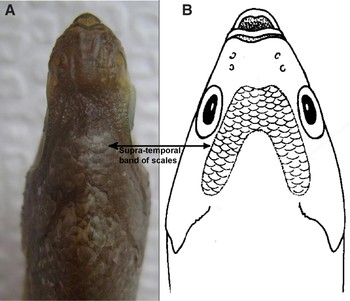
Supra-temporal band of scales in Caesio cuning. (A) Present specimen; (B) diagrammatic representation of supra-temporal scales of C. cuning provided by Carpenter (Reference Carpenter1988).

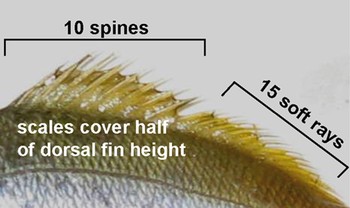
Dorsal fin of Caesio cuning indicating scaled portion and characteristic fin count.

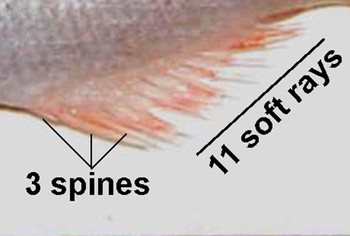
Anal fin of Caesio cuning indicating characteristic fin count.

Dorsal region of body from tip of snout to anterior spinous portion of dorsal fin greyish yellow, mid-lateral portion of body pale-white (Figure 2); caudal fin yellow, lacking prominent blackish markings (Figure 3); ventral region of body from cheeks to lower portion of caudal peduncle, pectoral, pelvic and anal fins light pink (Figure 4). Supra-temporal band of scales of either side confluent at dorsal midline (Figure 5); dorsal fin with ten spines and 15 soft rays, its spinous portion covered with scales up to half its greatest height (Figure 6); anal fin with three spines and 11 soft rays, covered with scales (Figure 7); about 4–5 scale rows on cheek; 48–51 scales in lateral line.
The data on morphometry of present specimens was compared with existing literature. FishBase, the world-wide geographical information system on finned fish (Froese & Pauly, Reference Froese and Pauly2008) reveals that Caesio cuning grows to a size of 60 cm total length (TL). However, the present specimens (N = 4) ranged between 7.49 cm and 10.05 cm TL, thus confirming the capture of juvenile/young individuals of this species.
DISCUSSION
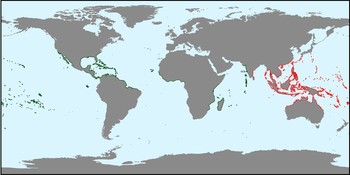
The existing data on the geographical distribution of Caesio cuning (Figure 8) suggest that this species inhabits the Indo-Pacific region from the Gulf of Mannar to the Vanuatu Islands in the South Pacific (Carpenter, Reference Carpenter1988; Froese & Pauly, Reference Froese and Pauly2008). Carpenter (Reference Carpenter1988) attributed the geographical distribution of this species to availability of appropriate habitat and adequate ecological parameters that favour the occurrence of this species. Published literature on the commercial finned fish of the Indian coast (Talwar & Kacker, Reference Talwar and Kacker1984) indicates that C. cuning occurs along the Andaman coast which falls within the known zoogeographical range of this species. However, FishBase (Froese & Pauly, Reference Froese and Pauly2008) indicates the possible expansion of occurrence of this species to the adjacent waters. Published literature along the Goa coast (Prabhu & Dhawan, Reference Prabhu and Dhawan1974; Ansari et al., Reference Ansari, Chatterji, Ingole, Sreepada, Rivonkar and Parulekar1995, Reference Ansari, Sreepada, Dalal, Ingole and Chatterji2003) provides information on the total demersal fish community structure with major emphasis on commercial finfish species. However, this species is not mentioned in available literature from the present study area.
Map of the world indicating geographical distribution of Caesio cuning.  , Known zoogeographical range of Caesio cuning;
 , Possibility of occurrence of Caesio cuning; GOA, site of present collection.

In view of the above, our observations primarily focus on the occurrence of rare species along the coast of Goa. Subsequently, the efforts of the three-year study led to the reporting of C. cuning for the first time off Goa and along the entire west coast of India. It has been well documented earlier (Carpenter, Reference Carpenter1988) that this species and its congeners occur in coastal reef areas. The present specimens were obtained from bottom trawl catches in the vicinity of the grounded ore-carrier, MV ‘River Princess’ off the Candolim–Sinquerim shore. The MV ‘River Princess’ grounded off the coast of Goa in 2000 (Ingole et al., Reference Ingole, Sivadas, Goltekar, Clemente, Nanajkar, Sawant, D'Silva, Sarkar and Ansari2006) and might have created an artificial reef-like habitat, thereby attracting several reef inhabitants from adjacent reefs (Qasim & Wafar, Reference Qasim and Wafar1979) and further facilitated recruitment of their larval and juvenile forms (Arena et al., Reference Arena, Jordan and Spieler2007). FishBase (Froese & Pauly, Reference Froese and Pauly2008) reveals that C. cuning grows to a size of 60 cm TL. However, the present specimens (N = 4) ranged between 7.49 cm and 10.05 cm TL, thus confirming capture of young stages. Secondly, existing literature indicates the presence of partially submerged rocky reefs off the Aguada Hill, that are inaccessible for trawl-net operations (Qasim & Wafar, Reference Qasim and Wafar1979), thus suggesting suitability of habitat in this area. Moreover, the above region has nutrient-rich turbid waters owing to transport of suspended material from the adjacent Mandovi estuary and Aguada Bay (Ansari et al., Reference Ansari, Chatterji, Ingole, Sreepada, Rivonkar and Parulekar1995). Kessarkar et al. (Reference Kessarkar, Purnachandra Rao, Shynu, Ahmad, Mehra, Michael and Sundar2009) reported two seasonal peaks in suspended particulate matter (SPM) concentration (20 mg. l−1 and 19 mg. l−1 during June–September and February–April, respectively) from the Mandovi estuary and attributed these to interactions between strong seasonal winds, wind-induced waves and tidal currents in the estuary. It is probable that wind-induced waves, tidal currents, along with the resultant turbidity in the water column, might have induced the migration of C. cuning juveniles towards the bay–estuarine waters. Carpenter (Reference Carpenter1988) suggested that C. cuning prefers turbid waters, thus corroborating the present observations. Further, Leis & Carson-Ewart (Reference Leis and Carson-Ewart2003) suggest the orientation of pelagic larvae of certain reef-fish in response to solar or reef-based cues. The present observations reveal that the prevalence of similar ecological conditions might have enabled the younger population of C. cuning to migrate to a coastal–estuarine embayment.
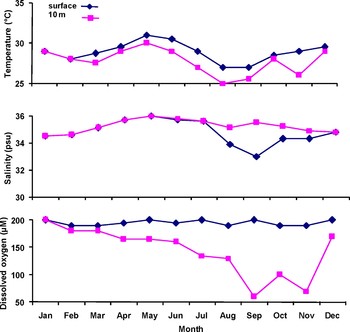
Caesio cuning inhabits the eastern Indian Ocean and western Pacific Ocean regions (Carpenter, Reference Carpenter1988) which are influenced by hydrographic parameters (temperature, salinity and dissolved oxygen) characteristic of tropical oceans (Moore, Reference Moore, Russell and Yonge1972). Hydrographic parameters measured during the present study were observed to be similar and indicated clear seasonal variations at 10 m depth (Figure 9), however, the value was found to be comparatively higher at the time of collection of C. cuning. The study area experiences a seasonal upwelling phenomenon (Ansari et al., Reference Ansari, Chatterji, Ingole, Sreepada, Rivonkar and Parulekar1995) rendering the region highly fertile in terms of primary productivity (13.12 to 14.21 mg C.m−3.h−1; Krishna Kumari et al., Reference Krishna Kumari, Bhattathiri, Matondkar and John2002). Such high productivity sustains high zooplankton biomass (Qasim & Sen Gupta, Reference Qasim and Sen Gupta1981). As C. cuning is a zooplankton feeder (Carpenter, Reference Carpenter1988), it is possible that schools of this species might have migrated to the above region to forage upon the abundant zooplankton.
Monthly variations in hydrographic parameters at surface and 10 m depths during 2007.

Furthermore, the intensive sampling effort covering a wider coastal region through use of modern fishing vessels and gear that provide access to submerged rocky patches in coastal inshore embayment may have enabled entrapment of this species. However, it must be noted that in the present study, only four specimens were obtained in the light of the intensive sampling (N = 92) with a core fishing effort of 146 hours over a period of three years excluding monsoonal periods (June–August), wherein it was found to occur only in two hauls. The present observations contradict earlier observations (Carpenter, Reference Carpenter1988) that suggest a shoaling behaviour, indicating either these individuals might have strayed away from the larger shoal and got trapped in the trawl-net over the soft substratum or might have not been able to establish as a large shoal largely due to habitat complexity.
Moreover, the study area is a potential fishing ground and has been intensively exploited by demersal trawlers perennially (with the exception of a 75-day monsoon ban) ever since the initiation of mechanized fishing in 1963 and its further expansion during the subsequent decades. Such long-term intensive trawling activity may lead to changes in the structure and composition of the resident demersal communities and benefit other species groups as reported earlier from the Gulf of Thailand (Longhurst & Pauly, Reference Longhurst and Pauly1987).
CONCLUSION
Our observations suggest that this is the first new record of Caesio cuning off Goa along the entire west coast of India that lies outside its known geographical array. The present study, through intensive sampling effort of 146 hours over three years, attempted to highlight the occurrence of the rare species, C. cuning. The occurrence of this species in low numbers could primarily be due to sampling gear and local bathymetry in the vicinity of the grounded ship that probably reduced the chances of entrapment of this species in the trawl-net. Furthermore, it appears that the selection of gear with increased efficiency in such reef dominated habitats might yield more individuals from such areas. It is suggested that further detailed ecological studies on this species might provide more detailed information and explain its occurrence and various biological processes in such habitats. Moreover, molecular studies of this species using genomic DNA would further enhance the understanding of its population stock structure and connectivity with existing populations (Carmen & Ablan, Reference Carmen and Ablan2006).
ACKNOWLEDGEMENTS
The authors take this opportunity to express their gratitude to the Bollast water Management Programme, India executed by National Institute of Oceanography, Dona Paula, Goa for Directorate General of Shipping, Ministry of Shipping, Government of India. We also thank the owner and crew of the fishing trawler ‘Jesus Bless’ for assisting in the intensive sampling programme. We would also like to take this opportunity to express thanks to Mr Venkat Krishnamurthy for the specimen photography and artwork included in this manuscript. This is a joint contribution of Goa University and National Institute of Oceanography (NIO contribution no. 4661).