Introduction
The American Heart Association has released an updated scientific statement on the evaluation and management of neurodevelopmental outcomes in children with CHD, emphasising again the importance of screening, long-term surveillance, and routine neurodevelopmental assessments of children with CHD. Reference Sood, Newburger and Anixt1 Individuals with complex CHD are at increased risk for deficits in cognitive, psychosocial, and physical functioning, resulting in diminished health-related quality of life. Reference Sood, Newburger and Anixt1,Reference Sanz, Anixt and Bear2 Neurodevelopmental follow-up programmes provide evaluations to support the identification of neurodevelopmental impairments in children born with CHD. Reference Ware, Butcher and Latal3 Additionally, when impairments are identified, these programmes recommend intervention therapies to lessen their impact. Reference Monteiro, Serrano and Tsang4,Reference Spittle, Anderson, Tapawan, Doyle and Cheong5 Many programmes are part of the paediatric cardiac centre where surgical repair was completed; however, significant gaps remain in consistent patient referral processes, enrolment, follow-up evaluations, and general approach. Reference Loccoh, Yu and Donohue6,Reference Glotzbach, Ward and Marietta7,Reference Miller, Sadhwani and Sanz8
A recent multicentre cohort study showed that attendance rates for neurodevelopmental follow-up evaluations vary greatly between centres (7.8%–54.3%) with an average 29% attendance rate. Reference Ortinau, Wypij and Ilardi9 Although this attendance rate is higher than previously shown, it is suboptimal. Specifically, there is concern that CHD patients from families with lower income and parental education may be disproportionally impacted. Reference Loccoh, Yu and Donohue6
As attendance in neurodevelopmental follow-up programmes is variable, more information is needed regarding specific barriers to participation. Reference Monteiro, Serrano and Guffey10,Reference Ortinau, Smyser and Arthur11 Recent studies have sought to understand better patient and family factors, including socio-economic status, insurance barriers, and other social determinants of health influencing adherence to routine neurodevelopmental follow-up care. Reference Ware, Butcher and Latal3 However, to our knowledge, no prior studies have examined provider perceptions that may serve as barriers to care, particularly within minority and historically underserved communities. The Cardiac Neurodevelopmental Outcome Collaborative, Diversity, Equity, and Inclusion Special Interest Group conducted a survey of Cardiac Neurodevelopmental Outcome Collaborative institutional and affiliated members to assess their patient education practices, perceived patient barriers to neurodevelopmental follow-up, previous diversity, equity, and inclusion education of providers, and confidence in caring for historically marginalised populations.
Methods
Study design
This was a cross-sectional survey of Cardiac Neurodevelopmental Outcome Collaborative members who provide care in neurodevelopmental follow-up clinics across North America. Cardiac Neurodevelopmental Outcome Collaborative was founded in 2016 and brought together a multidisciplinary group of clinicians and scientists interested in determining and implementing best practices for neurodevelopmental and psychosocial services in the CHD population. Reference Marino, Sood and Cassidy12,Reference Sood, Jacobs and Marino13 Since then, the Cardiac Neurodevelopmental Outcome Collaborative membership has grown, and currently, it has more than 50 member institutions in North America and Europe. Diversity, Equity, and Inclusion Special Interest Group members designed an online survey to assess providers’ perceptions of the barriers families might encounter when seeking cardiac neurodevelopmental care. The member institution administering the survey (Baylor College of Medicine) acquired Institutional Review Board approval for the study. The Institutional Review Board approved the procedure of implied consent, in which each participant agrees to participate in the study by completing the survey.
Procedure and measures/Data collection?
A 42-item electronic survey was developed by Cardiac Neurodevelopmental Outcome Collaborative Diversity and Inclusion Special Interest Group members. Survey items were initially developed following a review of existing literature on barriers to care for historically marginalised patients and families in medical settings and, specifically, with CHD care. The survey was further reviewed and edited by relevant stakeholders and diversity, equity, and inclusion subject matter experts at the second author’s institution. The final survey was reviewed and approved by the Cardiac Neurodevelopmental Outcome Collaborative steering committee leadership before being submitted to all Cardiac Neurodevelopmental Outcome Collaborative members. An email describing the purpose of the research study, requirements to participate, time to complete the survey, identifiers to be collected, and potential risks and benefits of the study was sent, including a link to the online survey. Study data were collected and managed using Redcap electronic data capture tools hosted at Texas Children’s Hospital. Reference Harris, Taylor, Thielke, Payne, Gonzalez and Conde14,Reference Harris, Taylor and Minor15 There was no limit to the number of respondents per institution completing the survey to collect various views and perspectives from providers within and across institutions. At the time of the study, CNOC membership included 46 institutional members from North America, including medical providers, patients, parents, and those caring for patients with CHD. However, even though the survey was distributed to over 1000 people using the CNOC email blast, its target was only medical providers. The survey was first distributed on 23 April 2022, with three reminder emails sent before the 21May 2022 deadline.
The survey was divided into four sections: A) Respondent demographic data, including years in practice and clinical role in the follow-up programme; B) perceived patient barriers to follow-up, including difficulties with transportation/driving distance to the clinic, difficulties obtaining child-care, inability to miss work and insurance coverage, etc.; C) providers’ awareness of supports in place, including interpretation services offered, presence of bilingual providers, late and no-show policies; D) individually perceived barriers, including their comfort level with assessing patients from various backgrounds and interest in further education regarding diversity/inclusion/cultural humility.
Statistical analysis
Survey results are summarised using mean with standard deviation, median with 25th and 75th percentile, or frequency with percentage using Stata v15 (StataCorp, College Station, TX).
Results
Respondents’ demographic data
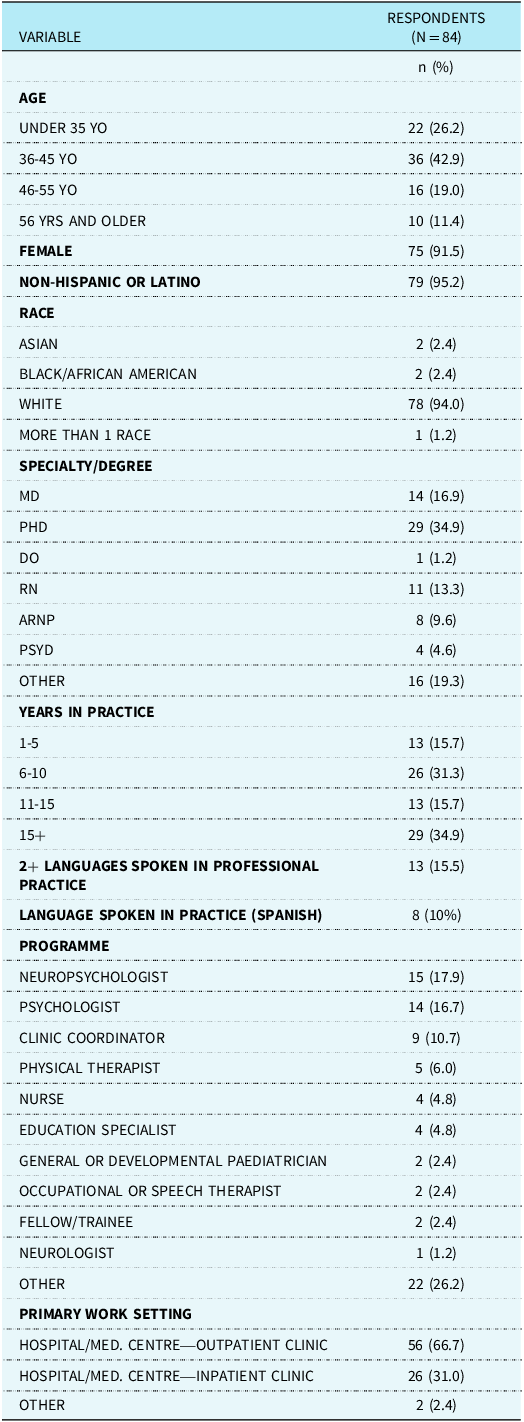
A total of 84 participants from 37 institutions completed the survey, including respondents from 31 Cardiac Neurodevelopmental Outcome Collaborative member institutions and 6 non-member affiliate institutions in North America. This represents 67% (31/46) of Cardiac Neurodevelopmental Outcome Collaborative-affiliated member institutions that responded at the time of this survey. Figure 1 and Table 1 illustrate the geographic locations of participating Cardiac Neurodevelopmental Outcome Collaborative members and non-member sites and other respondents’ demographic information. Most of the survey respondents were White (94%), non-Hispanic (95%), and female (92%). In addition, respondents were between 36 and 45 years of age (43%) and had been in practice for more than 15 years (35%). Respondents hold a variety of specialties/degrees, but most were PhD-level providers (35%) in psychology (17%) or neuropsychology (18%), and 67% worked at a hospital/medical centre/outpatient clinic. Only 16% of the respondents spoke more than one language in their professional practice, and the most common language was Spanish (10%) (Table 1).
Map of CNOC sites and respondent center affiliation. CNOC member institution with survey respondent (blue). CNOC member institution without survey respondent (red). CNOC non-member institution (yellow).

Demographics of all participants who completed the survey

Providers’ awareness of programme practices and support in place
This survey aimed to ascertain providers’ awareness of the type of support families receive in their programmes. Over 70% of the individuals who responded to the survey reported having three or more points of contact where they could approach families and provide education on the importance of neurodevelopmental follow-up. These points of contact included prenatal diagnosis visits (48%) during in-patient hospitalisation (86%) and at the time of hospital discharge (71%). After discharge, some families were contacted by phone (7%), but most during outpatient visits to the cardiology clinic (69%). At points of contact, 44% of respondents said their centres provided printed material with information about the neurodevelopmental programme in languages other than English, with the most common materials printed in Spanish (37%). Fifty-two percent of the respondents’ neurodevelopmental programmes had bilingual providers, providing services predominately in Spanish (43%). However, other languages spoken by bilingual providers included French (6%), Arabic (2%), Mandarin (1%), Haitian-Creole (1%), Tagalog (1%), Maori/Tongan/Samoan (1%), and Russian and Hindi (1%). Bilingual provider roles included clinic coordinators (16%), nurses (14%), developmental paediatricians (14%), psychologists (14%), neuropsychologists (10%), physical therapists (10%), speech therapists (8%), fellow/trainee (8%), occupational therapist (6%), paediatrician (2%), and others (11%). Language interpretation services were generally available in person in both the inpatient and outpatient settings, with less than 2% (inpatient) and 4% (outpatient) responding they had difficulty obtaining an interpreter. However, 15% of respondents admitted having available translation services for written neurodevelopmental reports. Additionally, 39% reported having educational materials provided to families after the visit in languages other than English.
Regarding policies and procedures for neurodevelopmental clinic visits, most respondents answered that accommodations were offered to families for missed clinic visits, including rescheduling of no-shows (85%) and rescheduling of cancellations (80%). Those who failed to come to multiple visits were not allowed to reschedule at a minority of respondents’ programmes (20%). Finally, a small number of respondents answered that at their institutions, late-arriving patients were rescheduled for another date (18%), while some programmes had no formal policies in this regard (24%).
Perceived patient barriers to follow-up
Survey respondents considered driving distance (31%) and understanding the reason for the need for neurodevelopmental follow-up (31%) to be major barriers for patients seeking cardiac neurodevelopmental follow-up services. Similarly, the perception of neurodevelopmental follow-up not being a high priority (compared to cardiac follow-up) was also perceived as a barrier (30%). Among other barriers, caregiver anxiety regarding potential developmental findings (i.e. hearing bad news), was perceived to contribute the least (7%) (Figure 2A). Respondents acknowledged that their programmes provided support to families who might experience financial or logistical barriers to attending neurodevelopmental follow-up visits. The most reported backings available included transportation (41%), meal tickets (41%), and gas vouchers (39%) (Figure 2B). Another service offered to families was video-based telemedicine visits, including the availability of language interpretation services. Seventy-eight percent of the providers responded that their institution offered telemedicine visits, while 12% did not, and 10% were unaware if telemedicine was available. The use of video-based telemedicine visits reported by respondents included feedback/review of testing results (56%), intake (45%), consultation (38%), or neurodevelopmental assessment without formalised testing (36%). Only 11% of providers acknowledged their programmes provided formal neurodevelopmental testing during telemedicine visits (Figure 2C).
( a ) Perceived barriers for families seeking cardiac neurodevelopmental follow-up services; ( b ) Available support; and ( c ) Video-based services available to families. All respondents’ survey results were summarized as percentages.

Provider’s comfort level
Lastly, we asked providers about their comfort level in caring for patients from a wide range of socio-demographic backgrounds including those from minority racial/ethnic groups, those with primary languages other than English, recent immigrants, and international patients (Figure 3). Most respondents strongly agreed or agreed with feeling comfortable caring for these patients (94%) and considered that patients currently participating in the neurodevelopmental programme are a fair representation of the local population with high-risk CHD (71%). A majority of respondents (90%) strongly agreed or agreed that they take into consideration patients’ cultural and linguistic backgrounds when interpreting neurodevelopmental data. Regardless of this comfort level, a majority (84%) strongly agreed or agreed that programmes can do more regarding making evaluations more accessible to minority and underserved populations. Consequently, respondents strongly agreed or agreed that they have an interest in educational programming to improve the care of patients from minority or underserved populations and those with a preferred language other than English (90%). When asked if their institution provides cultural competency training most of the respondents answered positively (92%) and they reported an increase in promotion of inclusion initiatives in the last 1–2 years (83%).
Individual perceptions of respondents and interests. All respondents’ survey results were summarized as percentages.

Discussion
The results of this provider survey highlight efforts to support neurodevelopmental follow-up care for children with CHD through parental/caregiver education at multiple time points; from prenatal diagnosis through in-patient hospitalisation, and during long-term follow-up at outpatient cardiology visits. Furthermore, respondents endorsed accommodations are in place to facilitate attendance for those making it to the clinic and rescheduling of those who cancel/no-show or are late to their visits. In addition, based on providers’ responses many programmes support families by providing or facilitating transportation, meal tickets, or gas vouchers. Despite these efforts, there remain significant opportunities for growth as the current average attendance rate for neurodevelopmental follow-up programmes in North America is only 29%. Reference Ortinau, Wypij and Ilardi9
The survey findings highlight the limitations of bilingual assessment given the limited number of bilingual providers available. Although not comparable, language interpretation is widely available during visits both in the inpatient and outpatient settings. However, written materials and reports are not widely accessible for families with a preferred language other than English. These barriers contribute to limited access to valid and reliable assessment and dissemination of testing results to families. Additionally, research designed to examine patterns of performance and neurodevelopmental effects of CHD could be limited in these cohorts.
Providers identified the two major barriers they think influence attendance to their programmes: driving distance, and the belief that caregivers might not understand the importance of neurodevelopmental follow-up. Previous studies in the paediatric and adult cardiac care setting have indicated that greater distance from the cardiac centre is associated with lower attendance rates. Reference Loccoh, Yu and Donohue6,Reference Monteiro, Serrano and Guffey10,Reference Cherestal, Hudson and Lopez16 Telemedicine visits are one strategy that could help alleviate the travel burden. During the COVID-19 pandemic, many cardiac centres with neurodevelopmental follow-up programmes started offering telemedicine visits. Reference Cox, Butcher and Sadhwani17 Indeed, in this survey, 78% of the providers responded that their programmes offered telemedicine visits. Most telemedicine services available were for in-take visits and feedback/review of previous testing. Even though virtual formal neurodevelopmental testing is not widely offered, and some assessment tools have not been validated for telemedicine administration, the possibility of parents being able to avoid long-distance travel to receive neurodevelopmental follow-up could help improve adherence. Reference Haffner and Bauer Huang18 Although telemedicine could help lessen this barrier, a lack of appropriate access to technology, equipment, and the internet, for example, could limit its use in some families like those in historically marginalised groups. Reference Chakawa, Belzer and Perez-Crawford Yeh19
Regarding the perception that caregivers do not understand the importance of neurodevelopmental follow-up, providers must clearly communicate, advocate, and continuously emphasise the importance of neurodevelopmental follow-up when conversing with families. A recent study on factors associated with neurodevelopmental programme attendance revealed that the strongest predictor for completed follow-up was having hospital-initiated scheduling for neurodevelopmental evaluations instead of family initiated. Reference Ortinau, Wypij and Ilardi9 That observation would support the need for programmes to initiate the scheduling process while continuing to educate families on the importance of neurodevelopmental follow-up. Furthermore, education should also involve other providers that are part of the care team for these patients. Indeed, respondents acknowledged that caregivers perceive neurodevelopmental follow-up visits as a lower priority compared to cardiology follow-up visits. Therefore, it is recommended that cardiology providers support neurodevelopmental follow-up programmes by continually educating families about neurodevelopmental care in the context of the late effects of CHD and facilitating scheduling to ease the burden for caregivers.
The impact of health disparities on medical and psychosocial outcomes of CHD patients has been well recognised. Reference Lopez, Morris, Sexson Tejtel, Espaillat and Salemi20,Reference Jackson, Grant and Barnett21,Reference Bucholz, Sleeper and Sananes22 Studies have identified race/ethnicity, and socio-economic factors that may significantly influence neurodevelopmental outcomes findings. Reference Peyvandi, Baer and Moon-Grady23 Racial and ethnic inequities, as well as provider biases, have been shown to impact health outcomes for those with CHD and among other vulnerable medical populations. Reference Jackson, Grant and Barnett21,Reference Fraiman, Barrero-Castillero and Litt24 There was a perception of comfort amongst respondents in evaluating patients from different cultural and linguistic backgrounds. The majority of those surveyed in this study reported prior receipt of at least some cultural competency training. Furthermore, many respondents indicated they consider the patient’s cultural and linguistic background when interpreting neurodevelopmental data. However, a recent review of the diversity and inclusion education literature demonstrates that comprehensive training of trainers, longitudinal evaluations of interventions, and the establishment of best practices are still needed to increase cultural competency and cultural humility in health care. Reference Brottman, Char, Hattori, Heeb and Taff25 Most of the respondents agreed that their programmes could be doing more to serve underrepresented populations and expressed interest in further educational opportunities. Indeed, the commitment to active engagement and lifelong process of learning, in addition to institutional accountability, as coined in the term “cultural humility” is a goal that all should strive to attain. Reference Tervalon and Murray-Garcia26 Therefore, at the institutional level, there should be continuous training programmes to combat bias and offer providers the tools to better serve diverse communities. Lopez et al. (2024) identified potential mitigation strategies within systems—and institution/organisation–level health policies to improve equity in health care for those affected by CHD. Of note, they stressed the importance of organisational health literacy to enable all patients and families equitable access to information and understanding of their health and their healthcare system to make informed decisions about their care. These authors also highlighted support, such as patient navigators, resources in multiple languages, and patient and family advocacy groups that are representative of the patient population that can lead to more equitable care and engagement.
A primary limitation of this study is that it focused on provider perceptions about their programme’s informed care practices rather than objective measures or patient perception of their care. It is unclear if provider beliefs about the quality of care are consistent with actual patient experience and data-driven outcomes. It is possible that medical providers over- or underestimate their attentiveness to cultural factors in actual practice. Therefore, future studies should evaluate families’ perspectives to understand their barriers to health care and their perceptions about whether the care they receive meets their needs. As there was no limit to the number of respondents per institution completing the survey, in some instances, it was evident that providers’ awareness of their institution support varied within an institution. Although our initial goal was to collect a range of views and perspectives, we could not analyse these differences because of the small sample size. A follow-up investigation is recommended to explore the reasons for the low individual response rate at each institution. Another limitation of this study was the limited diversity of survey respondents. A recent review in the CHD literature explains the lack of representation of underrepresented minorities in medicine, the implications for health equity, and potential solutions to address it. Reference Lopez, Allen and Baker-Smith27 An increase in the racial and ethnic diversity of the healthcare workforce is one of the core recommendations of the American Psychological Association Presidential Task Force on Psychology and Health Equity. 28,Reference Soranno, Simon and Bora29 If survey respondents are representative of the provider cohort around the country, then diversification of the workforce is necessary to provide more equitable care. Additionally, there was limited participation from providers in programmes that, geographically, have a high percentage of minority or historically marginalised populations. This may have unintentionally resulted in an unintended bias favouring perceptions from providers that see fewer diverse patients and families. To fully support neurodevelopmental follow-up for all patients, including those from historically marginalised populations, objective outcomes are needed to evaluate the impact of diversity and cultural competency training on actual practice and measurable outcomes for patients and families affected by CHD. Lastly, while there is some evidence that neurodevelopmental programmes do improve health outcomes, studies often only include self-report as a primary outcome, resulting in the same potential biases as our survey. Reference Miller, Sadhwani and Sanz8 Collaborative initiatives with relevant community stakeholders to identify family and patient perceptions and experiences are also sorely needed.
Acknowledgements
The members of the Diversity, Equity, and Inclusion Special Interest Group gratefully acknowledge the Cardiac Neurodevelopmental Outcome Collaborative members for their thoughtful responses to the survey, the Cardiac Neurodevelopmental Outcome Collaborative Steering Committee for their support for this project, and the Publications Committee for the insightful feedback on earlier versions of the manuscript.
Financial support
None.
Competing interests
None.