Introduction
On a sunny afternoon in April 2013, two women quarreled by the side of the road in Bwaise, an impoverished neighborhood in the north of Uganda's capital, Kampala. One woman accused her neighbor of sweeping rubbish into her yard and proceeded to sweep it back towards the neighbor's feet. The neighbor, irate, denied the accusation, grabbed the first woman's broom, and began sweeping back in the other direction. This quarrel was performed in front of an appreciative roadside audience by a local drama troupe contracted to spread awareness about a new campaign being launched by an international environmental NGO. Their confrontation escalated dramatically until the two women had to be separated by an older man. “Why are you quarrelling,” he asked, “don't you know that waste is wealth?” He explained that there are useful things in rubbish and that the women should value garbage as a resource they can use, not as a problem to sweep away. The wise older man then showed the two women how to turn their domestic waste into biomass briquettes they could use to cook or even sell to their neighbors. Having seen the treasure in their trash, the two women turned on each other again, this time jostling to collect the remaining rubbish scattered on the floor, to hearty laughter from the crowd.
Under the slogan “waste-to-wealth,” NGOs proposed a novel solution to Kampala's ongoing garbage problem: make people see the latent usefulness of garbage and they will stop disposing of it carelessly and start gathering, sorting, and reusing it. Harnessing the population's entrepreneurial energies, waste-to-wealth projects promised to tackle the city's environmental and economic issues simultaneously, bringing income and cleanliness to informal settlements like Bwaise.Footnote 1 As dramatized in the skit's uproarious conclusion, however, this newfound resource is not easily disentangled from the neighborhood's social tensions and inequalities.
At least one in the crowd who had gathered to watch the drama was already involved in making briquettes in Bwaise. In his late twenties, Daudi Lukonge, a volunteer with the neighborhood government's sanitation committee, who earned his living as a traditional healer in the daytime and motorcycle taxi driver in the evenings, was one of the founding members of the Bwaise Tusobola [we can] Development Association (BWATUDA).Footnote 2A small community-based organization (CBO) with about thirty members including a core team of five leaders, BWATUDA had been making biomass briquettes for over a year as part of an ongoing effort to manage waste, improve sanitation, reduce flooding, and create sustainable incomes in its corner of Bwaise. In order to make briquette production viable, however, BWATUDA needed the financial support of national or international NGOs. Crucially, in order to secure this support, BWATUDA had to capitalize on community, transforming the everyday intimacies and ongoing social processes constitutive of collective life in their corner of Bwaise into “Community”Footnote 3: an entrepreneurial subject intelligible to donors and exhibiting appropriate forms of developmental virtue.
As the role of the state has been reimagined and redirected in the decades since structural adjustment, Communities are figured as both the beneficiaries of development, and, increasingly its agents.Footnote 4 However, the NGO economy assumes the existence of Communities as spatially bounded entities with coherent shared interests and the capacity for collective action among residents. It also tends to position Community leaders as the transparent mediums of these interests and capacities. Assuming that Community is always already present, the work that goes into its production, and the transformative effects of this work on everyday social relations, remains invisible in hegemonic accounts such as development industry monitoring and evaluation reports.Footnote 5 As a corrective, this article offers an ethnographic account of BWATUDA's engagement with Waste-to-Wealth to illustrate how, by working with waste, BWATUDA sought to produce an immaterial good, Community, a process rooted in the materiality of the waste stream and the slum.
The concept of immaterial labor is useful for understanding this work because it illuminates the variety of relations, interactions, and intimacies that are vital for development work. While it appears that there are two production processes at work—the material production of biomass briquettes and the immaterial production of Community—BWATUDA's waste work demonstrates the fundamental entanglement of the two. By focusing on the immaterial labor of development, I show how a seemingly informal and extraordinarily material form of waste work is shaped by the norms, expectations, and values of the moral economy of development. Bwaise's waste was valuable as a material resource base for the production of a new mode of capital: not briquettes, but Community.Footnote 6 Even though they are functionally interdependent, the forms of material and immaterial labor BWATUDA engages in are unevenly valued. This divergence is structured by and exacerbates hierarchies of gender and education within the group, as well as hierarchies of race and mobility between the CBO and their desired international partners. Rather than approaching waste as primarily symbolic—to trace cultural logics of pollution—or as purely material—to highlight the embodied and environmental costs of contamination—this approach theorizes waste as moral matter that enables forms of labor through which virtue can be accrued, intelligibility produced, and social relations transformed.
Immaterial Development
Broadly, immaterial labor refers to “labor that produces an immaterial good, such as a service, knowledge, or communication,” as opposed to the industrial manufacture of durable commodities.Footnote 7 In the context of post-Fordist, de-industrialized, global capitalism, this kind of work, it is argued, has attained an increasingly dominant social position. Moreover, the shift from industrial to service jobs in first-world economies has given increasing priority to “knowledge, information, communication, and affect” in the labor process.Footnote 8 While the political intention of drawing attention to immaterial labor has been to decenter a masculinist vision of the industrial proletariat as the sole bearer of revolutionary agency, critics have pointed out that this account is overly simplistic, erroneously conflating “the industrial manufacture of products with material labor processes and the provision of services with immaterial labor processes.”Footnote 9 The binary framing, predicated on a false distinction between manual and mental labor, Sylvia Yanagisako argues, mirrors managerial perspectives that devalue manual labor outsourced to the Global South and privilege supposedly Western creativity and communication skills. In fact, as feminist analyses of capitalism have shown, affective, communicative, and informational labor is critical for the production of material goods, while materially extensive and capital-intensive communications technologies, networked infrastructures, and logistical systems underpin the supposedly immaterial service economy.Footnote 10
Multiple forms of immaterial labor, both paid and unpaid, contribute to the development economy, a sector clearly distinct from the tradition of industrial manufacturing insofar as it aims to produce and deliver care, wellbeing, expertise, and policy rather than material goods. A great deal of immaterial labor goes into both providing and benefiting from development, challenging assumptions about the passivity of aid recipients.Footnote 11As with many post-colonial developing countries, in Uganda, receiving developmental and humanitarian aid is labor-intensive work. Receiving Anti-Retroviral Treatments in Uganda's complex landscape of AIDS care, for example, requires actively becoming a client by traveling, often large distances, cultivating enduring relationships with clinics and medical assistants, documenting and demonstrating adherence, managing paperwork, and mobilizing personal and familiar resources in the quest for health.Footnote 12 Likewise, girls’ empowerment programs in Kampala entail intense immaterial labor of self-narration and self-presentation that goes into crafting moral subjects both in need and worthy of NGO support.Footnote 13 These pre-established narratives consolidate African women's place in the development industry, redoubling racial hierarchies that position Africans as essentially needy aid recipients such that even aid professionals labor not as experts, but as bodies authenticating NGOs’ ties to grassroots communities. Similarly, in order to remain eligible for donor support, workers at a Ugandan orphanage simultaneously perform a specific GandaFootnote 14 ethics of care, gifting, and interdependence while translating these into practices legible to international monitoring and evaluation regimes that produce transparency and accountability.Footnote 15 Far from passive beneficiaries of donors’ generosity then, aid recipients are actively engaged in a variety of forms of immaterial labor that underpin the moral and affective economies of development. While not concerned with the production of goods, this immaterial labor is nonetheless intensely material. Involving practices like (re)producing and presenting bodies, mobilizing documents, making and sharing food, and taking medicines, the immaterial labor of development entails a dense material culture. BWATUDA's work reveals the ways in which household garbage becomes enrolled in this moral economy.
Positioned as both aid recipients and aspiring aid providers, BWATUDA's members shared a real desire to improve the material conditions of life in their neighborhood, earn a living, establish professional identities, and achieve socially valued roles as community leaders. BWATUDA's founding members all had other jobs, working as a school teacher, motorcycle taxi driver, shop-keeper, porter and handy-man, and driver for a safari company. But these did not position them properly as developmental subjects because of a discursive emphasis on entrepreneurialism that privileges “job-creators” and devalues wage-earners as parasitic dependents.Footnote 16BWATUDA energetically took up the requirement to demonstrate its own “techno-moral”Footnote 17 virtue: its capacity to ameliorate the moral and material condition of the community in which it is based. BWATUDA, they hoped, could begin as a CBO and become an NGO in its own right, giving them a seat at a bigger table and access to a larger slice of what was often referred to as the development “cake.” This was a well-established, but hard to navigate, path for small organizations.
Waste became an important substance upon which they could perform a form of labor that would move them up the developmental hierarchy. By immersing themselves in the rotting banana peels, handling soot-covered equipment, shoveling mounds of char, and convincing neighbors to get their own hands dirty sorting waste, BWATUDA sought to render themselves socially valuable and recognizable as developmental entrepreneurs. As in myriad other contexts, cleaning is, in itself, understood as a fundamental moral action of world making even if the workers who clean are themselves marginalized.Footnote 18 Moreover, organization itself is a sign of virtue, a contrast to the assumed informality deemed to be the degraded condition of life in settlements like Bwaise. Waste matters both as a problematic substance that smells, clogs drains, and impedes a dignified life in Bwaise, and as a means to perform moral labor through which Community could be capitalized in ways intelligible to outside donors.
Waste in Bwaise's Moral-Material Landscape
As in other British colonial cities, planning and infrastructural investment in colonial Kampala focused on protecting the health and economic interests of the colonial elite, a pattern that has continued into the post-colonial period.Footnote 19 Investment in “modern” urban areas was, and continues to be, authorized by the rhetorical construction of an abject “bad city.”Footnote 20 Formal plans detailed the squalid living conditions and infrastructural inadequacies in the city's unplanned areas, yet mobilize this specter to either redouble investment in already provisioned elite areas or to propose the expulsion of the poor to make way for systematic redevelopment. Emerging in the shadows of plans, informal settlements like Bwaise—radically underserved by municipal health, sanitation, education, and other services and vulnerable to floods, environmental toxicity, and illnesses exacerbated by overcrowding—comprise twenty-one percent of the city's land area and are home to thirty-nine percent of its population.Footnote 21
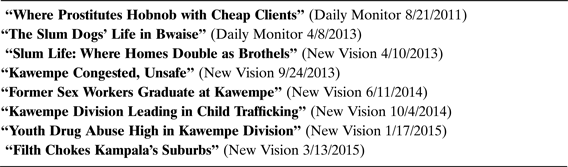
Today, Bwaise comprises three parishes in Kawempe Division, the poorest and most populous of Kampala's five administrative divisions. Generally represented as the epitome of Uganda's urban crisis (see Table 1), Bwaise is one of the city's most notorious slums. Bwaise appeals to low-income residents because its low rents and relative proximity to major commercial centers means that transportation costs are affordable. Built on low-lying land tenuously reclaimed from the Lubigi Swamp, the unplanned settlement has inadequate drainage and sanitation infrastructure and is prone to regular, extreme flooding. In addition to its floods, Bwaise is represented in the media as a congested and over-crowded area with a reputation for poverty, crime, drug use, prostitution, and HIV.Footnote 22 In this rhetorical construction of the slum, residents themselves are held responsible for the fact that their settlement is unplanned. Morally stigmatizing the urban poor, these present-day interpretations of the material conditions of the neighborhood as evidence of the immorality of its residents are a continuation of racist colonial conventions representing African bodies as filthy and polluting threats to the establishment of a reputable modern urban order.Footnote 23
Selected headlines from press stories on Bwaise and Kawempe Division.

Garbage plays an important part not only figuratively in this moral representation of undeserving subjects, but also materially in making Bwaise flood. Uncollected garbage washes into the area's open drains, causing blockages that force storm water out of the drains and into homes and businesses. Floods are moral events. Evidence of the problematic character of Bwaise's residents, they consolidate the neighborhood's place in the urban imaginary. The municipal government, the Kampala Capital City Authority (KCCA), individualizes the problem through the moralized figure of the litterer, arguing that if residents ended the vice of littering, drains would not overflow. In conversation, however, KCCA officials recognized that the accumulation of garbage in drains is an inevitable consequence of the low-rates of collection they provide combined with poor residents’ inability to pay for private waste collection. In this context, Community-Based Organizations like BWATUDA are touted as the solution to Bwaise's infrastructural problems. Through CBOs, communities are “empowered” to solve their own problems, charged with self-provisioning municipal services and improving their moral and material character. Turning garbage into gold, in the hands of CBOs, biomass briquettes promise to resolve Bwaise's problems of waste, flooding, and unemployment.
The Alchemy of Waste and Wealth
BWATUDA was formed in 2009, when four neighbors began organizing monthly neighborhood clean-up days. Soon after, they expanded their work and initiated weekly door-to-door garbage collection. After about a year of these activities, the CBO's members became frustrated with the lack of participation, complaining that no one was willing to pay even a token amount for door-to-door collection and that their neighbors hid from the monthly cleaning exercises. Moreover, without support from the KCCA, BWATUDA had no way of disposing of the trash they collected and inadvertently created a centralized dumpsite that began to stink. The area's elected leader asked them to stop collecting, arguing that it was better for people to leave their rubbish at home where it was hidden than to bring it out to sit in plain view. In 2011, Daudi Lukonge, one of the four founders, was selected for training in charcoal briquette making by a Belgian-funded development project. Daudi completed his training and was given the basic equipment required to set up a briquette-making project. Since, he has trained other members in briquette production and this has become BWATUDA's main activity.
Biomass briquettes are made by removing moisture from and compacting organic matter. At industrial scales this often takes place alongside the centralized processing of agricultural commodities, such as maize, coffee, and rice, where a large and regular supply of organic by-products are generated.Footnote 24 In Bwaise, the most widely available waste material usable for this purpose was the peelings from matooke, the green banana that, steamed and mashed, constitutes the staple food of Central Uganda.Footnote 25 Matooke is imported to Kampala by the truck-load in large bunches and sold in ever-decreasing bundles through the city's markets and retail networks and peeled at home. As a result, matooke peelings are diffusely distributed across the city and tend to become mixed in with other forms of domestic waste, meaning that gathering the peelings is a complex task that reaches into the most intimate spheres of domestic life.
Gathering peelings enmeshed BWATUDA members profoundly in Bwaise's communal intimacies. While Daudi would have liked to collect peelings on a regular weekly basis, they in fact did so only sporadically, when they had space available and time to store and dry more materials. A team of two to eight members moved through the area with a wheelbarrow, entering into compounds to find each household's garbage typically stored in plastic gunny sacks stacked behind the home, against a latrine, or otherwise out of the way. Working in pairs, BWATUDA members located these trash sacks, emptied them out, and sorted through for usable materials which they stashed in their own sacks to carry back to the wheelbarrow. Ismail Ntale, another founding member, explained that they could do this work because all of the members were well known in the neighborhood. This trust meant that nobody minded them entering their compounds unannounced and sorting through their rubbish.
Ismail explained that they had to do much of the sorting themselves: “When people separate for us they expect some payment, so we just go to the trash and get it ourselves for free.” The cognitive labor of sorting, the act of inserting categorical differences based on “re-use value” into the undifferentiated matter of the mass-waste stream, was the foundation of the production process.Footnote 26 While waste-to-wealth projects are predicated on the assumption that there is an over-abundance of garbage, it proved to be harder than expected to locate and retrieve peelings. Embedded in briquettes is the assumption, made manifest in the promotional skit, that the urban poor simply do not realize the latent value in rubbish. But NGOs were not the first ones to realize the utility of Kampala's waste. Agents working for a cattle herder, for example, traded glasses of milk for residents’ organic waste that they would then feed to cows kept on the urban periphery. As such, BWATUDA's collection had to be carefully calibrated to the routines of the neighborhood. Ismail and Daudi decided that they would have to start collecting in the afternoons, despite the heat, because it would be after lunch, when many peelings were discarded, but before other collectors arrived. In mid-2013, this temporarily ceased to be a problem. The KCCA had not sent a truck through the neighborhood for several weeks and trash began to pile up. In these conditions, neighbors began separating out peelings themselves before discarding them, dumping them in BWATUDA's work area. “We've accidentally made this place a dumping site,” Ismail told me, fearing that others would start bringing unsorted trash that would complicate their relations with their immediate neighbors.
BWATUDA's primary workspace was a small courtyard nestled between the back wall of a primary school, a latrine, and a few rental residences. Daudi laid out tarps on the muddy grass in front of a neighbor's home and spread out the peelings to dry in the sun. This could take three days to a week, depending on the weather. During the rainy season this step required attentive supervision as the peels had to be recollected during downpours. Once he had accumulated ten sacks full of dried peelings, Daudi moved on to the next step: charring. Using a charring drum donated by the Belgian-funded project, he burned the dried peels, a day-long process that produced several sacks worth of powdery char. Charring also produced a lot of smoke, so he had to carefully place, and periodically relocate, the drum so that the process would not spoil the neighbor's hanging laundry.
While one or two other men in the group usually assisted Daudi in this work, the next step, crushing the char into a fine powder, typically involved a group of women members led by Rose Birungi, another founding member who worked as a teacher at the neighboring school. They sat on a tarp sifting through a heap of char with their hands and pulverizing the remaining large pieces. As they did this painstaking work, Daudi prepared for the next step: heating several gallons of water and mixing in a pound of store-bought cassava flour that would act as a binding agent. Once the char had been sufficiently crushed, he poured the paste over it and mixed it together with a shovel. Once the mixture was consistent, he scooped the mixture into the briquette press' nine CD-sized, four-inch deep cavities. Daudi and another man then took it in turns to pound the mixture, strenuously slamming it with an iron rod to compact it into form. Finally, they scraped the tops of the briquettes clean and pressed them up out of the press to place them on a reed shelf to dry. In this way, BWATUDA could turn several sacks of char into about 150 briquettes in about three hours, each selling for 250 shillings (about 10 US cents).
It was unusual for all of these steps to be underway simultaneously or even sequentially during the same day. Production was far from continuous: The different steps had radically different temporalities and try as he might, Daudi could not sustain a permanent production schedule. He called me to demonstrate charring one day, to assist with pounding another. Indeed, the only time I observed multiple steps simultaneously in production was when BWATUDA hosted an NGO study group one morning, an event I discuss below. Much of the production process involved waiting for peels to dry or the charring drum to char. Daudi did other work and socialized during this time. BWATUDA's workspace was a lively place. CBO members and neighbors stopped by to greet each other, exchange news, flirt, relax in the shade, eat lunch, listen to the radio, smoke tobacco pipes, and drink local gin to dull the scent of garbage. A steady stream of hawkers passed by bearing second hand clothes, snacks, phone accessories, and airtime, and members delighted in engaging these traders and one another.
The briquette production process depended on multiple forms of immaterial labor. It involved cultivating ongoing positive relations with BWATUDA's immediate neighbors who lived with the noise and smoke of the production process. It created new intimacies and relied on the long-standing interpersonal trust that allowed BWATUDA members to rifle through domestic waste piles. It took planning and calibrating BWATUDA's activities to the daily routines and changing economies of the neighborhood. Production was pleasurable to members partly because it was highly porous both in space and time; BWATUDA was constitutively embedded in the routine life and social relations of the neighborhood, as members and others came and went both to work and socialize.
Production also relied on mobilizing and sustaining members’ hopes. No wealth was forthcoming in the year I worked in Bwaise, so Ismail, Rose, and Daudi struggled to keep members interested. Without regular clients, they had little incentive to produce regularly, and without more machines they could not scale up their production to the level required to attract more institutional customers with a high and constant demand for cooking fuel. Their production process was very time-consuming and labor-intensive, and although there was plenty of labor available to them, they did not have the means to compensate this work. “Why would you come and work freely,” Rose asked, “when you have people to feed at home?” Rose was of the opinion that the government and NGOs should be doing more to promote and create a market for briquettes. “People don't know this product,” she explained, “and so we can make it, but it is hard for us to get that market.” Indeed, NGOs proved very capable of promoting waste-to-wealth programs to CBOs, but there was no broader effort to advertise the product to consumers, and marketing was left up to each of the small, underfunded, and untrained community organizations to take on individually.Footnote 27 Other CBO leaders I interviewed told me they had been lucky to be connected to major anchor clients with regular demand: hotels, schools, restaurants, and chicken breeders. Without these institutional links, BWATUDA only sold its products sporadically to neighbors, and was unable to compete with charcoal, which sold at a lower unit cost and was already well established in the cooking practices of Bwaise households.
Daudi and Ismail's proposed solution to these problems was to scale up, to acquire more machines that would cut down on the arduous work of pulverizing char and pounding briquettes into the press. To scale up they needed funding and to get funding they had to appeal to “donors,” an amorphous category that referred to the ever-present yet elusive development industry that saturated Kampala. To appeal to donors, they had to get organized, to transform the loosely structured social relations of production into a new kind of agent, an entrepreneurial Community.
Capitalizing Community and Reifying Gender
To actually make enough money to compensate members for their work, BWATUDA would need to find a designated plot of land, get more charring drums, expand their capacity to dry peelings and finish briquettes, buy presses, acquire safety equipment, and train more members in production. To raise funds for these expenses, Ismail—a university educated job seeker with a degree in social work—began to craft a “concept,” a written proposal outlining BWATUDA's aims, projects, and environmental and social impacts, or, rather, its costs and benefits. This and other documents emphasized the moral virtue of the CBO, describing BWATUDA as a transformative force that would clean the neighborhood, inspire neighbors to engage in development, and bring hope to a benighted part of Kampala. Enrolling my help in this process, we met at a nearby internet café to work, bringing drafts of the proposal to Daudi to confirm details about the production process. Waste figured centrally in these documents, as both a problem facing the neighborhood and a resource that could transform it, if the entrepreneurial energies of the CBO could be adequately supported. The proposal produced waste as a moral substance, evidence of the neediness of the community and of the virtue of the Community, embodied in BWATUDA.
Paperwork does not simply describe an organization's work, however. The process of documentation and planning can transform the internal structure of a group, the subjectivity of its members, and its aspirations. Even for avowedly revolutionary actors, “the habitus individuals acquire as they attempt to bring about social change by founding their own NGOs can lead them to reinforce or reproduce the very social conditions they initially set out to change.”Footnote 28 The work of paperwork embroils members in norms and forms established by powerful donors and states. In order to be embraced by these regulatory forces, NGOs must mimic bureaucratic state forms.Footnote 29 This work is central to non-governmentality, a form of “rule by NGO”Footnote 30 that disseminates specific modes of organizing social activity, articulating grievances, and seeking recognition, channeling broad-based aspirations to improve the material conditions of everyday life into predictable manageable forms.Footnote 31Even without being waged then, BWATUDA's paperwork is part of a transnational form of state-craft producing developmental subjects for the NGO economy.
Based on his understanding of donor's desires, Ismail explained that “we also need to make a program for the ladies, this production is only good for men; we need to propose a craft project for them, to show gender.” He envisioned using plastic bags, straws, and other plastic waste as a craft material to make jewelry, baskets, or mats, a popular activity that he had seen other CBOs engaged in. To “show gender,” a criterion Ismail knew would be important to the NGOs, BWATUDA thus had to further segregate its activities, relying on essentialist tropes about proper, respectable “women's work” that their own already-mixed production and collection process undermined.Footnote 32
To produce BWATUDA as a virtuous developmental agent on paper they had to embody the “gender agenda.” However, the professional and bureaucratic means of producing and representing the CBO as gender inclusive processually marginalized women. While they had been central to the production process, in the official version of Community, BWATUDA's women would be confined to a side-project merely adjacent to the group's primary activity. The process of constructing the proposal also fractured the CBO along educational lines. Like most members, Daudi, the most active in the actual production process, was not as comfortable reading in English as Ismail, and so could consult on the proposal but not participate fully in writing it. After a month's work, Ismail presented the ten-page document, complete with a project summary, justification, schedule, measurable objectives, budget, and cover letter to the group. Gathered in a dark and stuffy room, he read the proposal aloud in English, translating each sentence into Luganda, and inviting members to comment. After two hours, most of the group had dispersed or fallen asleep. Ismail turned to me exasperated, and whispered, “You see how these communities do not want to be involved!” Distinguishing his professional practices from the recalcitrance of other members, he distanced the group as one among many of “these communities” needing development by organized CBOs.
Eventually, after searching Bwaise's internet cafés for a functioning printer, the proposal was ready and the cover letter signed (Rose's signature replaced Daudi's at the last minute to “show gender”). Dressed up in jackets and ties, Ismail and I crossed town by motorbike to the southern suburban neighborhood where NGOs proliferated in large homes converted to office space. At the first NGO, a receptionist greeted us cautiously and listened as Ismail explained that we would like to deliver a concept to the project manager. The appropriate person was out of the office, “in the field for a study-tour,” the receptionist explained, but she would give him our proposal when he returned. This scene was repeated at the next NGO, where everyone in the office was out attending a workshop on public-private partnerships.
The experience of finding the NGOs’ offices empty left Ismail dejected, feeling the highly unequal terms of connection between his organization and those he sought to solicit. He realized that to access donor funds, BWATUDA needed to become more professional, starting with an office of their own where they could properly host visitors and make plans. As described above, BWATUDA's work was deeply embedded in the everyday imponderabilia of Bwaise life. The production process was structured by always ongoing negotiations with neighbors over the use of space and time. The very loud pounding step, for example, took place during breaks in the primary school day so as not to disturb lessons. Members came and went, assisting when their other tasks (domestic chores, tending kiosks, teaching at the primary school) permitted. This complex embeddedness made the production process pleasurable and appealing to members, but it came to be understood as a sign of unprofessionalism, an obstacle to securing the donor funding that would enable BWATUDA to truly turn waste into wealth. Ironically, attracting funding required dis-embedding, establishing distance between the CBO and the social environment in which it was based. To be fundable, BWATUDA had to be in the slum, but not of it, standing apart and above as an organized group that could transcend and transform Bwaise's abject material conditions. BWATUDA relied on Bwaise's notoriety, describing the area's deplorable conditions in their proposal to emphasize the urgency of their work, but had to remain distinct from its reputation for immorality and informality in order to be worthy of support. The material signs of this morality resided both in the cleanliness they produced by collecting organic waste and in the formalization of the Community.
Dis-embedding from Bwaise took spatial form in Ismail's plan to secure a designated office and workspace instead of the complex, shared space that actually sustained their work. The office would allow BWATUDA to engage with Bwaise as a field into which they could enter to “do Community work” and that they could, in turn, exit from to engage in the distinct work of planning and documenting production. Temporally, this would mark a shift from the loosely structured sociality of production in which members came and went to a new regime of meetings at designated set-aside times, dedicated to distinct purposes. This would, in turn, mean curtailing the range of activities that members engaged in while participating in the CBO, focusing attention on set goals rather than on the broad ranging and polyphonic conversations I observed in members’ existing practices. Ismail half-joked, “We'll need to have a training on how to have meetings.” Rendering a recognizable Community would thus entail remaking the habitus of the urban poor, inserting the norms and rhythms of bureaucratic office life into members’ daily lives, a change that was both difficult to achieve and unpleasant to experience. The professional Community had no space for flirting or trying on clothes, let alone smoking and drinking.
The immaterial labor of producing the CBO was itself highly contingent on material means of production. The paper on which paperwork could appear, the hard-to-find printers to copy it, the electricity needed to run a meeting in the evening, the desired office space and organized work zone for making briquettes, their constitution, proposals, reports, production ledgers, and visitors’ books, all were vital for differentiating BWATUDA from Bwaise. This proliferation of documents privileged those members more comfortable with written English and more accustomed to the rituals of organizational life—formal meetings, planning, and accounting. In doing so, it created two tiers of BWATUDA membership along gendered and educational lines. It distinguished between those who could speak for and represent the Community and those who were simply part of it; leaders on one hand, and locals on the other. This disjuncture between the material production process and the immaterial labor of producing Community became fully apparent during the visit of two international NGOs to BWATUDA's work area in June 2013.
Performing Local Labor
On an overcast morning I joined Ismail and Daudi to make a big batch of briquettes. Ismail and I laid out a tarp and covered it with fresh peels, waiting for the sun to come out and dry them. Daudi lit the charring drum, emptied out a sack of already charred peels onto another tarp, and made some phone calls. Soon, seven other BWATUDA members joined us. Three women began crushing char while Rose boiled water and went to fetch cassava powder. Soon we had a tarp full of paste, and Daudi and three other young men began filling up the briquette presses, pounding the paste into shape, finishing the tops, and setting the completed briquettes out to dry. Ismail's phone rang and he announced to the group, “Ok, they're coming!” He went to change into a fresh shirt. Rose and most of the other women discreetly walked away. Soon, a small tour-bus pulled up on the nearby street and twenty people descended.
The tour group, comprised of East African, European, and Indian NGO staff, gathered around to watch the production process, take photographs, and comment on the conditions they observed. “Look at these puddles; can you imagine?” one visitor asked. A videographer set up a tripod near the charring drum and pointed his camera at Ismail, who was welcoming the visitors to Bwaise, introducing BWATUDA, and explaining their projects. Ismail emphasized the challenges that people in Bwaise faced: poor sanitation, flooding, disease, and unemployment that means “everyone stays at home” or “engages in sex for money.” Here, as in media representations of Bwaise, waste, flooding, and commercial sex appear side-by-side as material evidence of the area's moral conditions, conditions requiring the immaterial labor of CBOs.
BWATUDA is trying to tackle these problems, Ismail told the tour, by turning flood-causing trash into an employment opportunity that can reform abject environmental and moral conditions. Daudi stepped up next to go over the production process. He quickly switched into his more comfortable Luganda and a tour-group leader tried as best she could to keep up translating his rapid-fire explanation. The group began to lose focus and talk amongst themselves. “Why aren't we supporting such projects?” asked a Ugandan woman. “This would be so cheap to start, they don't need much.” “Yes!” an enthusiastic British colleague replied, “It's great because it is all on their own initiative. We could be doing this in Tanzania and Ethiopia, too!” The group crowded around to watch Daudi demonstrate the penultimate step of the production process, pushing briquettes out of the press. He handed around nearly dried samples for the study tour to handle and shared a visitors’ book for everyone to sign before the group's leader ushered them back into the bus.
Later, Ismail explained that these people were from two NGOs “doing water.” They had come to visit BWATUDA before, but they did not offer any support: “They just want to make it look like they are involved in so many communities, but when we call them they cannot answer.” Ismail registered a chasm between his world and the moneyed world of NGOs, a world in which the production and consumption of scenes like the one he had just staged authenticates and lubricates the flow of wealth in the form of donor funds. While BWATUDA and its members had been available for these NGOs' visit, elaborately staging their Community work in the hopes of accessing donor funds, NGO staff remained elusive. While Ismail struggled to get across Kampala to deliver a proposal, the NGO staff's mobility, the ease with which they could casually propose “doing this in Tanzania or Ethiopia,” kept them out of reach. The radical difference in mobility that Ismail encountered is one of the mundane ways in which NGOs are spatialized as “above” CBOs, able to drop in on BWATUDA for study visits that cannot be reciprocated, creating an affective experiential sense of vertical encompassment embedded in everyday metaphors and mundane bureaucratic practices.Footnote 33 The performance reinforced BWATUDA's position “below,” as merely a local entity with limited possibility and importance.
Moreover, the immaterial labor of performing production, narrating the CBO, and demonstrating its virtue relied on displacing the material conditions of briquette production. The NGO gaze, desirous of gender inclusion, in fact, marginalized BWATUDA's women. Most of the women who had been involved in producing briquettes spent the study-tour visit hidden out of sight. Rose told me later that they did not want to be seen “dressed like this,” referring to the comfortable but informal wraps and T-shirts she had spent the morning working in. She said that it was uncomfortable to “have those people looking at us here,” gesturing to the puddles, the smelly latrine, and the mangy dog that often lingered around. The visit made Rose embarrassed, the influx of professionally dressed NGO staff highlighting the impoverished conditions of her own life. Without time to change into her nicer teaching clothes, she felt insufficiently distinguished from her surroundings and unwilling to be presented as part of the morally suspect slum that Ismail described.
The rise of the NGO as a global governing force owes in part to “the assumption that they are less hierarchical, more democratic, more devoted to welfare and to serving subordinate or minority populations, and more cost effective than states […] NGOs themselves often rely on discourses of connection to grassroots movements.”Footnote 34 CBOs like BWATUDA play a vital role in this discourse. When they partner with international NGOs to translate agendas into projects, to recruit participants and organize activities, to supply photo opportunities and narrative evidence, and to interface with local politicians and other leaders they materialize the connections constitutive of a transnational NGO economy. As bureaucratic representatives of Community, CBOs are NGOs’ preferred partners, authenticating globally circulating best-practice projects by providing evidence of local participation and consultation.Footnote 35
Waste-to-wealth projects have emerged as a popular means for NGOs to partner with CBOs. These projects encapsulate the relations through which “rule-by-NGO”Footnote 36 proceeds: NGOs promote a concept that circulates globally; they train a select number of local partners as “development entrepreneurs”Footnote 37 and provide some basic equipment; local partners take up the project themselves, hoping it will become sustainable once the NGO moves on to new programs. Through the hegemonic discourse of partnership, CBOs have become crucial mediators between urban populations and transnational development institutions,Footnote 38 a status that was institutionalized over the course of the 1990s in an attempt at making informal settlements governable by delineating narrowly circumscribed spheres and modes of local developmental activity and aspiration.Footnote 39 Much of this work is unpaid. Partnerships capitalize on poor people's hopes and energies, their desires to earn a living and to contribute to improving their worlds. Communities do not simply lie in wait for developmental partnerships; they must be made and managed. Fetishizing Community ignores this work, the ways it structures encounters with moral matter like waste, and the ways it transforms social relations, reproducing transnational and gendered racial hierarchies, projecting them into the intimate and everyday interactions of aspiring development entrepreneurs.
Waste Work, Recognition, and Alienation
While the bind that BWATUDA found itself in was especially visible to me as an outside observer, it was not invisible to the members themselves. It became manifest in the contrast between NGOs' ability to drop in on BWATUDA and Ismail's finding empty offices, and in the way Rose and other women sought shelter from the NGO gaze. BWATUDA's members were not dupes unaware of the conditions in which they worked. Nor were they cynical manipulators bent on extracting resources from the development industry. BWATUDA did not have a radical political ideology co-opted by the state. They reflected the much more ordinary everyday politics of the urban poor.Footnote 40 They wanted trash in the neighborhood to be cleaned up, they wanted flooding to be less disruptive of their lives, they wanted to garner some sort of income to support their children and possibly move to more salubrious grounds. They were genuinely committed to the material improvement of their neighborhood, trying to follow the most apparent means of doing so. In contrast to the claims made by informal recyclers in South Africa, whose actions Melanie Samson interprets as an “ontological insurrection”Footnote 41 disrupting the categories of being allowed to appear in the public sphere, BWATUDA's efforts were precisely about crafting community as Community in order to become legible within an existing economy of aid and development. Like other workers in the economies of development and humanitarianism, they were critically aware of and reflective about the limits placed on their ambitions.Footnote 42
Waste was both a problem to be solved and a means of achieving these goals, giving substance to the organizational process required to achieve recognition. Waste-to-wealth discourse gave new content to their organization, emerging as a possibly attractive and fundable activity. Seeking inclusion and substantive citizenship across multiple scales through encounters with waste, BWATUDA embodies a form of “subaltern cosmopolitanism,”Footnote 43 through which lives are lived in even the most seemingly marginal parts of Kampala.
Although BWATUDA is a struggling CBO in a marginal neighborhood, the waste-to-wealth discourse in which they participate is a global trend in development and at the core of ideological projections of the future of ethical capitalism. While consumer capitalism generates vast wealth through waste—in the form of planned obsolescence, disposability, packaging, and labor exploitation—environmental crises have generated efforts to resolve the ecological contradictions of capitalism. So-called green, or sustainable, capitalism includes efforts to valorize waste as a resource in order to mitigate pollution and climate change. Recycling offers “a redemptive possibility to the problematic consequences of rising levels of consumption.”Footnote 44 Circular economies like those transforming household waste into a new energy source offer the tantalizing promise of undoing the ravages of what Julie Livingston describes as “self-devouring growth.” But the transformation of waste-to-wealth depends on the production of an ideal of Community legible to donors, a process that entails dis-embedding the CBO from the neighborly social relations that, in fact, sustain it.
While the promotional discourse on waste-to-wealth focuses on the production of briquettes, it ignores this requisite social production, naturalizing Community as an already-existing socio-spatial entity in which an organization is “based.”Footnote 45Michael Hardt observes that a sense of connectedness and community is one of the possible products of affective labor that can “produce collective subjectivities, produce sociality, and ultimately produce society itself.”Footnote 46 BWATUDA's waste work and paperwork illustrate the nature of this production. Producing briquettes is extremely, materially laborious, involving gathering, charring, crushing, pounding, and processing tons of waste material. It is more productive, however, in producing Community, not in the sense of an affective life-world, but as a particular kind of subject in the economy of development, seeking to attract resources and engage with international NGOs as a subordinate partner. Even though as of 2014, BWATUDA was not successful in either profiting from briquettes or attracting investment, their Community making work had powerful, if unintentional, effects: exacerbating differences of class and education between members, while widening the gap between the CBO and the slum.
These forms of labor may not appear to be exploitative or alienating in the traditional Marxist sense, in which surplus is accumulated when waged workers are paid less than the value of the products they produce, and when the commodities produced belong to the owners of capital and not those who produced them.Footnote 47 No work in BWATUDA is waged. As entrepreneurs, BWATUDA owns the briquettes they produce at the end of the production process, even if they are of little commercial value. The production of Community as a form of capital rendered through the substance of waste, however, entails a form of alienation. Producing Community divides members between leaders and locals, and paradoxically, disentangles BWATUDA from the ongoing social relations of the neighborhood that sustain the production process itself.