INTRODUCTION
Marine tourism is an increasing activity and comprises several branches of the economy, being considered as the major industry in the world (Wood, Reference Wood2001). On the Brazilian coast, marine protected areas (MPAs) receive a large number of tourists every year (Ferreira & Maida, Reference Ferreira and Maida2006). In Abrolhos Marine National Park, considered the most important coral reef formation of the south-western Atlantic, the number of tourists increased 400% in only five years during the late 1980s and early 1990s (Leão, Reference Leão, Hetzel and Castro1994).
The current consensus is that when intensive human recreational activities occur without proper planning and regulation, changes in the ecosystems and organisms are often observed (Creed & Amado Filho, Reference Creed and Amado Filho1999; Eckrich & Holmquist, Reference Eckrich and Holmquist2000). It has been shown that implementing protection measures makes marine areas even more attractive to tourists (Badalamenti et al., Reference Badalamenti, Ramos, Voltisiadou, Sanchez-Lisazo, D'Anna, Pipitone, Mas, Ruiz Fernandez, Withmarsh and Riggio2000). Therefore, the purpose of primary importance for any protected area is to take the required management measures (Milazzo et al., Reference Milazzo, Anastasi and Willis2006). Choosing specific no-take zones for diverse uses should be considered to preserve environmental health and simultaneously educate visitors to ensure MPA sustainability (Herrera-Silveira et al., Reference Herrera-Silveira, Cebrian, Hauxwell, Ramirez-Ramirez and Ralph2010).
Studies on human recreational activities impacts inside MPAs have usually focused on the impact of diving (Medio et al., Reference Medio, Ormond and Pearson1997; Hawkins et al., Reference Hawkins, Roberts, Van't Hoff, De Meyer, Tratalos and Aldam1999; Barker & Roberts, Reference Barker and Roberts2004), boat anchorage (Creed & Amado Filho, Reference Creed and Amado Filho1999; Milazzo et al., Reference Milazzo, Chemello, Badalamenti, Camarda and Riggio2002), human trampling (Eckrich & Holmquist, Reference Eckrich and Holmquist2000; Milazzo et al., Reference Milazzo, Chemello, Badalamenti, Camarda and Riggio2002) and artificial fish-feeding (Milazzo et al., Reference Milazzo, Anastasi and Willis2006). Concerning the impact of diving, there are some divergences among authors' opinion which vary between negative (Medio et al., Reference Medio, Ormond and Pearson1997) or no effects (Hawkins et al., Reference Hawkins, Roberts, Van't Hoff, De Meyer, Tratalos and Aldam1999). However, for the other human activities there is a consensus about their negative consequences. Artificial fish feeding can alter fish behaviour towards humans (Perrine, Reference Perrine1989; Cole, Reference Cole1994; Sweatman, Reference Sweatman1996) and influence the abundance of some species (Cole, Reference Cole1994). Nevertheless, the ecological consequences caused by this ever-increasing activity have received little attention (Cole, Reference Cole1994; Sweatman, Reference Sweatman1996; Orams, Reference Orams2002; Milazzo et al., Reference Milazzo, Badalamenti, Vega Fernández and Chemello2005; Ilarri et al., Reference Ilarri, Souza, Medeiros, Grempel and Rosa2008), especially in marine environments.
Learning the extent and causes of the impact inflicted by tourists is important for the viability of MPAs. Therefore, there is an urgent need for understanding the impacts of this practice, in order to stimulate improvements in management efforts. The main purpose of our study is to address the influence of artificial feeding on the reef fish community structure of two MPAs (MPA Recife de Corais and MPA Costa dos Corais), evaluating changes of community parameters (abundance, richness and trophic dominance) in the presence of tourists, using different approaches for impact assessment: (a) comparing ‘before’, ‘during’ and ‘after’ artificial feeding periods, where they occur on a specific area using baits; and (b) comparing impacted and control sites, within regular and no visitation areas, respectively, where food items offered consist of animal ration and human food (bread and crackers).
MATERIALS AND METHODS
Study area
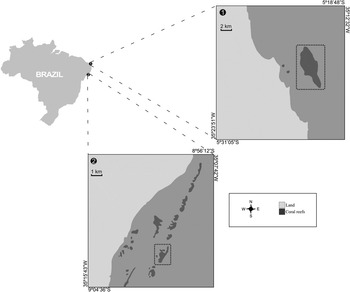
The study areas are located inside two MPAs distant nearly 500 km from each other with different geographical and physical characteristics. The multiple use MPA Recife de Corais, on the northern coast of Rio Grande do Norte (Figure 1), covers an area with complex reef types, ranging from beach rocks to shallow and deep coral reefs (Feitosa et al., Reference Feitosa, Pimenta and Araújo2002). Maracajaú reefs (09°02′46.64″S 35°11′49.94″W), comprise an area of approximately 13 km2 of ellipsoid-shaped reefs, 7 km off the coast with depths ranging from 1 to 4 m. These reefs are formed by coral pinnacles supported by a shallow sandy base. The main reef builder in this region is the stony coral Siderastrea stellata (Verrill, 1868) (Laborel, Reference Laborel1969) with vermetid gastropods and crustose coralline algae providing a great contribution to the reef cover (Maida & Ferreira, Reference Maida and Ferreira1997; Castro & Pires, Reference Castro and Pires2001). The marine tourism in the Maracajaú reefs occurs on a daily basis. Tourists get to the reefs on motor boats. In those reefs a floating dock is found, where tourists receive information about the local reef environment and snorkelling and SCUBA activities are offered. In addition, tourists can interact with reef fish fauna providing fish baits (fish, shrimps and squids), previously acquired by tourist operator employees from a local fisherman at Maracajaú beach. Fish feeding occurs at the rear steps of the floating dock.
Location of sampled areas.

The multiple use MPA Costa dos Corais extends 135 km from the southern coast of Pernambuco to the northern coast of Alagoas State (Figure 1) and constitutes the first and the most extensive Federal Conservation Unit to include coastal reefs in the area of protection (Ferreira & Cava, Reference Ferreira and Cava2001). The Maragogi reefs (5°23′10.22″S 35°15′32.51″W) are located approximately 3.5 km off the coast and comprise a sandstone bank with a thin framework formed by corals (mainly Porites species), calcareous algae and vermetid molluscs (Laborel, Reference Laborel1969). The marine tourism in the Maragogi reefs also occurs on a daily basis. Through pontoon boats, tourists get to the reefs and receive information about the local reef environment during their journey to the area. Human visiting is concentrated in specific locations at low-tide, delimited with buoys where shallow sandy areas are formed. Fish feeding is random and widespread throughout the visiting area and animal ration or human food (bread and crackers) can be bought at the beach or from other boats at the visiting area.
SAMPLING PROCEDURES
The community structure of reef fish from Maracajaú (MPA Recifes de Corais) was previously assessed by Feitosa et al. (Reference Feitosa, Pimenta and Araújo2002) and the data were used in this study. Additionally, visual censuses, adapted from Sale & Douglas (Reference Sale and Douglas1981), were performed using transects of 50 × 4 m, in areas not visited by tourists in the Maragogi reefs. The purpose of these censuses was to characterize the community structure, where a total of 24 surveys were conducted from April 2003 to March 2004.
In Maracajaú, the effect of the artificial feeding was analysed below a floating dock. As it consisted of a small restricted area (nearly 160 m2), stationary censuses were carried out, with a defined radius of 3 m (Bohnsack & Bannerot, Reference Bonhsack and Bannerot1986), using SCUBA. The censuses were performed before, during and after the feeding activity. ‘Before' sections refer to the observations made at least one hour before the tourists arrived at the floating dock. ‘During' sections were assessed while fish were fed. This activity lasted on average for 2.5 hours. Nearly 60 minutes after departure of tourists and consumption of all food by fish the censuses of ‘after’ sections were carried out. Eight censuses were performed for each treatment, totalling 24 censuses from April 2003 to March 2004. The surveys were made in the morning at low tides and lasted on average for 15 minutes.
As previously mentioned, human visiting in the Maragogi reefs is concentrated in specific locations at low-tide, where, very shallow sandy areas are formed. For the purposes of this research, two reef areas, 200 m apart from each other, being one treatment area (where the activity is common and delimited with buoys) and the other classified as the control area (where no visitation is allowed) were established to assess the effects of fish feeding. Reefs had very similar substratum and depth. Underwater visual census was employed along 50 × 4 m strip transects, modified from Sale & Douglas (Reference Sale and Douglas1981). Four censuses (two for each area) were conducted per month between December 2003 and March 2004, totalling 16 surveys.
The number of tourists in both MPAs was obtained through the Maracajaú Diver tourism operator and the Recifes Costeiros Project (http://www.recifescosteiros.org) on the same day the visual censuses were performed. In Maracajaú, the first author personally assessed with the local diving operator, which coordinated activities took place on the floating dock. As for Maragogi, data were gathered by the first author with agents of the Recifes Costeiros Project. This project had the main purpose of providing scientific support for the management plan of the MPA Costa dos Corais.
DATA ANALYSIS
Fish abundance data were recorded on plastic sheets and species were later classified in trophic categories according to Ferreira et al. (Reference Ferreira, Floeter, Gasparini, Joyeux and Ferreira2004) as follows: planktivores, roving herbivores, territorial herbivores, mobile invertebrate feeders, sessile invertebrate feeders, carnivores, piscivores and omnivores.
To analyse the effects of artificial feeding, the most abundant species were compared among treatments. As changes on the fish community within the area of influence of artificial feeding (treatment area) are evident even without any quantification, the most representative species on treatment and control areas were compared. Significant differences of these species would be expected if fish are being attracted by the activity. Data were tested using the Friedman and the Mann–Whitney tests (BioEstat 5.0 software), for the Maracajaú and Maragogi treatments, respectively. A one-way analysis of similarity (ANOSIM) was used to test for significant differences of meaningful groups, considering the total abundance data of all replicates on treatments (Clarke, Reference Clarke1993). Prior to the analysis data were log-transformed (log x + 1). This analysis was conducted using PRIMER 6.0 software.
Spearman correlations were also employed to verify associations between richness and abundance with the number of tourists (BioEstat 5.0 software). Correlations were made between before/during treatments and during/after treatments to verify if there was any change on the community with human presence in situations of no food and the moment after an offer ceased. Both situations were tested separately as in the latter situation food remains were still detected, interfering with results.
RESULTS
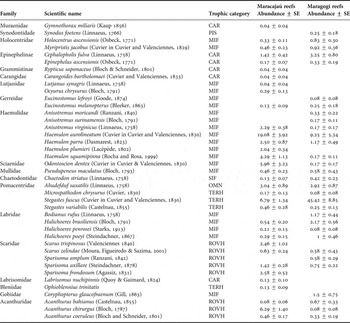
Assessing the community structure of the Maracajaú reefs, 34 species belonging to 18 families were recorded. Of these, 22 species belonging to 13 families were recorded under the floating dock (Table 1). The fish community of the Maracajaú reefs was characterized by the high abundance of three species: Haemulon aurolineatum Cuvier, 1830 (19.08 ± 3.92), Stegastes fuscus (Cuvier, 1830) (6.79 ± 1.34) and Sparisoma axillare (Steindachner, 1878) (1.42 ± 0.28). The trophic categories most abundant were mobile invertebrate feeders (32.83 ± 3.75), followed by territorial herbivores (13.92 ± 2.24).
Species recorded for assessment of the community structure of the Maracajaú and Maragogi reefs, with respective mean abundance and trophic category.

CAR, carnivores; MIF, mobile invertebrate feeders; PLK, planktivores; PIS, piscivores; OMN, omnivores; TERH, territorial herbivores; ROVH, roving herbivores; SE, standard error.
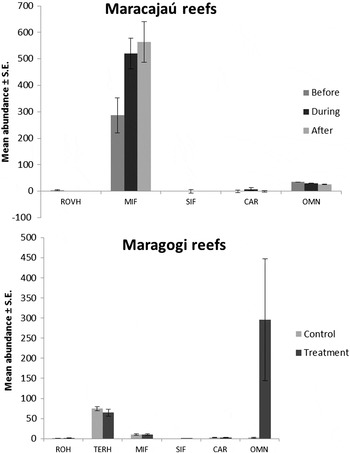
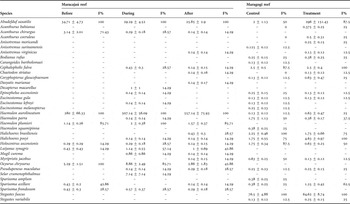
For feeding activity effects, the species H. aurolineatum, Abudefduf saxatilis (Linnaeus, 1758), Lutjanus synagris (Linnaeus, 1758), S. axillari, Ocyurus chrysurus (Bloch 1791) and Acanthurus chirurgus (Bloch, 1787) were considered, as they were abundant and their frequency of occurrence seemed affected by the activity (Table 2). Among species recorded within periods, H. aurolineatum was the most abundant, followed by A. saxatilis and Ocyurus chrysurus (Bloch, 1791) (Table 2). The most common trophic categories in all treatments were mobile invertebrate feeders and omnivores (Figure 2)
Mean abundance with standard error (SE) of each trophic category presented in Maracajaú and Maragogi reefs.

Species mean abundance (±SE) and frequency of occurrence (F%) among treatments in the Maracajaú and Maragogi reefs.

SE, standard error.
The mean abundance with standard error found for before, during and after treatments were 312 ± 62.74, 544.12 ± 51.47 and 582.25 ± 69.63, respectively. The richness with standard error recorded for before, during and after treatments were 8.25 ± 0.41, 12.87 ± 1.18 and 15.62 ± 1.18, respectively. Survey periods presented significant differences for mean abundance and richness (Friedman test; P = 0.0131 and P = 0.0008; respectively), both with differences only between ‘before’ and ‘after’ periods. For trophic categories, difference was only detected for mobile invertivores (Friedman test; P = 0.0183), also for ‘before’ and ‘after’ periods. The fish community composition did not differ between ‘before’, ‘during’ and ‘after’ feeding treatments (ANOSIM; R = 0.124, P = 0.44).
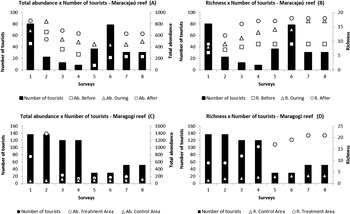
The effect of fish feeding was evident immediately after the treatment: the correlations between the number of tourists ‘before’ and ‘during’ treatment were highly significant for total abundance and richness (Spearman; r = 0.579, P = 0.0148 and r = 0.6079, P = 0.0096, respectively). After 1 hour (correlations between during and after treatments), the abundance and richness did not change (Spearman; r = –0.1741, P = 0.504 and r = 0.2883, P = 0.2617, respectively), indicating that the food offer effect remains within the activity area for some time after the tourists departed (Figure 3).
Number of tourists, total abundance and richness/surveys for Maracajaú (A and B) and Maragogi (C and D) reefs.

In the Maragogi reefs, 31 species belonging to 21 families were recorded. All species were recorded during the censuses in the treatment and control areas (Table 1). The fish community of the Maragogi reefs is characterized by the high abundance of three species: Stegastes fuscus (45.42 ± 8.85), Haemulon aurolineatum (9.25 ± 5.34) and Cephalopholis fulva (Linnaeus, 1758) (3.25 ± 0.80) (Table 1). The trophic category most abundant were territorial herbivores (45.75 ± 8.82), followed by mobile invertebrate feeders (19.83 ± 5.44) (Figure 2).
Among species recorded for the treatment area, the most abundant were A. saxatilis (296 ± 151.43) and S. fuscus (64.62 ± 8.74), the latter being also the most abundant in the control area (76.5 ± 4.88) and the former, rarely detected (2 ± 1.13) (Table 2). Other species not present in the treatment area, such as Anisotremus surinamensis, Carangoides bartholomei, Eucinostomus melanopterus and E. lefroyi could be considered as occasional species as they presented low frequencies (around 12%) and only few individuals were recorded in the control area. Sparisoma amplum which attained 25% of frequency also presented low abundance in the control area, preventing us making further assumptions concerning the effects of fish feeding.
A significant difference for fish total abundance between control and treatment areas was observed (Mann–Whitney; P = 0.0027), however this difference was not detected for richness (P = 0.372). As a consequence of the most abundant species, the most common trophic category in the control area was territorial herbivores (74.71 ± 4.85) and mobile invertebrate feeders (10.28 ± 1.64). In the treatment area, the omnivores (296 ± 151.42) and territorial herbivores (64.87 ± 8.79) predominated. Although there was a minor decrease on mean abundance of territorial herbivores on treatment areas, testing trophic categories between control and treatment areas showed that only omnivores were significantly different (Mann–Whitney; P= 0.046), especially for A. saxatilis. Changes were also confirmed when the fish community structure was significantly different between control and treatment areas, forming two distinct groups (ANOSIM; R = 0.436, P = 0.005).
The relationship between the number of tourists and total abundance and richness in Maragogi was similar to the Maracajaú reefs, where the number of tourists altered only abundance (Spearman; r = 0.8454, P < 0.001) (Figure 3).
DISCUSSION
The present study found that where the fish feeding activity was intense in a restricted area and bait was provided (Maracajaú reefs), by far the most abundant species (before, during and after feeding treatments) was a mobile invertebrate feeder, Haemulon aurolineatum, forming shoals of about 800 individuals, which were attracted by the activity. The ecological role of high concentrations of schools of the genus Haemulon includes protective mimicry and foraging facilitation behaviour (Pereira et al., Reference Pereira, Feitosa and Ferreira2011) and they are important to several reef fish species in mixed-species schooling behaviour, especially aggregated individuals with limited populations. This emphasizes the great ecological and social importance of these schools on reef fish communities and consequently, that minor changes in abundance could alter complex ecological processes (e.g. competition for food and space; foraging associations) (Pereira et al., Reference Pereira, Feitosa and Ferreira2011). Although a higher abundance of H. aurolineatum is also observed on non-fish feeding areas, it was strikingly exacerbated on the floating dock vicinities and more research is needed on this matter.
The second most abundant and frequent species at the three periods of activity, was an omnivore (Abudefduf saxatilis), which was quickly attracted by the external source of food provided by tourists. Although not especially abundant, changes between treatments were not observed as expected, especially because the floating dock also functions as a substratum for the spawning activity of this species, where guarding nests were often observed. Therefore, it can be suggested that both species are already used to consume the artificial food constantly available, reflecting on the community found.
In contrast, where the activity is more random and human food is offered by tourists (Maragogi reefs), data indicate that A. saxatilis is the most common species, although rarely observed in the control area. This result corroborates the work of Medeiros et al. (Reference Medeiros, Grempel, Souza, Ilarri and Sampaio2007), who found that A. saxatilis corresponds for almost 2/3 of total individuals during feeding activity recorded in north-eastern Brazil (Picãozinho reefs—Paraíba State). This species is opportunistic, cosmopolitan, forms shoals and behaves in a peculiar manner in relation to tourists, as it is unafraid and readily attracted by the presence of humans (Feitosa et al., Reference Feitosa, Pimenta and Araújo2002). The Sergeant-major responds rapidly when food is offered, probably moving from adjacent areas to where tourists or boats are present. Sazima et al. (Reference Sazima, Sazima and Silva-Jr2003) observed that this species feeds also on the faeces and vomit of the spinner dolphin (Stenella longirostris Gray, 1828), with a quick response to the presence of food.
Opportunistic feeding on occasional or frequently available items has been reported for several reef fish species (Ilarri et al., Reference Ilarri, Souza, Medeiros, Grempel and Rosa2008; Chaves et al., Reference Chaves, Feitosa and Pereira2010), mainly generalists, thus indicating benefits for those with some level of feeding plasticity. It is very likely that over the years this ill-planned activity has continued and tourism has strongly benefited the individuals of A. saxatilis, increasing the overall abundance of this species. These findings demonstrate that this activity is responsible for increasing the abundance of determined species of fish, as has also been pointed out by several other authors (Harmelin-Vivien, Reference Harmelin-Vivien1992; Orams, Reference Orams2002; Milazzo et al., Reference Milazzo, Badalamenti, Vega Fernández and Chemello2005).
The recreational fish feeding is amongst the most practised activity and is known to affect directly and indirectly the fish communities, especially fish distribution and trophic structure (Orams, Reference Orams2002). Differences in ecological effects from artificial food or bait are more likely to be explained by the cumulative influence of many factors including: type, quantity (number of tourists), and distribution of food; duration of feeding; social behaviour of target species; and population and community composition. For instance, in Maragogi the main trophic category was territorial herbivores, however in treatment areas omnivores were significantly more abundant, although not necessarily detrimental to territorial herbivores, which remained the same. In the Maracajaú reefs, the type of food provided did not alter the trophic guilds, as mobile invertebrate feeders were the most abundant in both areas. In this case, the differences observed were related to the abundance and richness of some species between before and after fish feeding periods, which were attracted by the activity. In general, the offer of fish, shrimps and squids (naturally accessed by fish) favoured mobile invertebrate feeders, whereas animal ration and human food caused aggregations of omnivores.
Some authors defend recreational fish feeding, arguing that this activity is a popular attraction that can be used to keep the tourists away from the more vulnerable reef areas (Hawkins et al., Reference Hawkins, Roberts, Van't Hoff, De Meyer, Tratalos and Aldam1999), or even to provide self-sustainability for management actions inside the MPAs (Milazzo et al., Reference Milazzo, Anastasi and Willis2006). However, food artificially accessible to fish can still: (1) alter their natural behaviour patterns and population distribution (Eifler, Reference Eifler1996; Doenier et al., Reference Doenier, Delgiudice and Riggs1997; Orams, Reference Orams2002); (2) create addiction to food provided by the tourists (Orams, Reference Orams2002); (3) increase aggressive behaviour and competition (Perrine, Reference Perrine1989); and (4) cause health problems to animals (Orams, Reference Orams2002; Vignon et al., Reference Vignon, Sasal, Johnson and Galzin2010). The evidence of this study corroborates points (1) and (2) in the list above.
The artificial manner of attracting fish is common in marine tourism in Brazil and worldwide (Strong et al., Reference Strong, Murphy, Bruce and Nelson1992; Cole, Reference Cole1994; Sweatman, Reference Sweatman1996; Orams, Reference Orams2002; Milazzo et al., Reference Milazzo, Badalamenti, Vega Fernández and Chemello2005; Medeiros et al., Reference Medeiros, Grempel, Souza, Ilarri and Sampaio2007). Although the direct effect of fish feeding was more explicit for A. saxatilis and H. aurolineatum, the food type offered, number of tourists and activity distribution are believed to be the major factors for modifications in the community structure of the studied reefs. This activity has been carried out in both locations for over 10 years, but effects of the great abundance of species such as A. saxatilis on other reef fish species, especially territorial ones, and on the fish community as a whole have not been yet addressed. Nevertheless, the data provided in this study were essential to the Recifes Costeiros Project and the Municipal Council of Environmental Defense. Based on these results, a Conduct Adjustment Term was established in the MPA Costa dos Corais and recreational fish feeding has been banned in the Maragogi reefs ever since. This measure has improved the quality of diving activity and some species which were not seen frequently before in the area (e.g. Acanthurus coeruleus, A. bahianus, Epinephelus adscensionis and Lutjanus alexandrei) have been recently recorded (C.V. Feitosa, personal observation).
The results presented in this study are sufficient to conclude that the potential for negative ecological effects exists, as a result of providing food through artificial feeding or baiting. The main fact is that fish feeding causes an increase in abundance of some species, as they converge toward focal food sources, changing the community trophic structure and consequently disrupting species' normal daily or seasonal movements. The quality of observations during diving activities is also significantly reduced. As this study focused on temporary changes in the reef fish community, it was not possible to analyse other ecological effects, such as the increase of competition among species. Future research is still needed to address this hypothesis and therefore, while fish feeding is proposed to be a tool providing an approximation between tourist and nature awareness, it should be used with caution in order to ensure both tourism activities and conservation goals.
ACKNOWLEDGEMENTS
We thank Ana Lídia Bertoldi Gaspar, Sigrid Neumann Leitão and William Severi for reading and making helpful comments on the first draft of the paper. We also thank Jim Ellis and two anonymous referees who improved this manuscript with suggestions. This research was partly funded by Fundação de Apoio ao Desenvolvimento (FADE) of the Universidade Federal de Pernambuco (UFPE).