Introduction
Coffee is one of the most consumed beverages in the world, with Arabica being the most produced and consumed worldwide, due to the particular chemical characteristics of its grains, which produce a beverage with better sensory attributes, in addition to being a functional food and beneficial to human health (Melo Pereira et al., Reference Melo Pereira, Carvalho Neto, Júnior, Prado, Pagnoncelli, Karp and Soccol2020). Global production of coffee involves approximately 25 million farmers, most of whom are small producers (Waller et al., Reference Waller, Bigger and Hillocks2007). The Americas have a remarkable relevance in the production of the grain, accounting for 57% of the coffee marketed in the world, with Brazil occupying a prominent position (FAO, 2020) as the largest producer and the second largest consumer of Arabica coffee (ICO, 2021a, 2021b).
The production of specialty coffees is an alternative for producers to increase their income and diversify their agricultural production (Teles and Behrens, Reference Teles, Behrens, Almeida and Spers2020). In recent years, the growing demand for specialty coffees offers opportunities for good financial returns for small producers. In this sense, associating high yield with excellent beverage qualities promotes greater value addition to the commodity. In addition to the social and economic benefits, sustainable management of coffee cultivation can promote environmental benefits, as the crop has great potential to mitigate or reverse negative impacts of climate, becoming a ‘carbon sink’ (Noponen et al., Reference Noponen, Healey, Soto and Haggar2013, Reference Noponen, Góngora, Benavides, Gaitán, Hayward, Marsh, Stout and Wille2017).
There are two main objectives in coffee cultivation: obtaining high yields to meet the growing internal and external demand, and obtaining grains with high quality for the production of specialty coffees (Romano et al., Reference Romano, Giomo, Coelho, Filla and Lemos2022). Both are influenced by genetic factor and the environment, especially by air temperature and rainfall which are closely related to altitude (Rolim et al., Reference Rolim, Oliveira Aparecido, Souza, Lamparelli and Santos2020). Lower altitudes and higher temperatures influence the coffee crop cycle and beverage quality (Oliveira Aparecido et al., Reference Oliveira Aparecido, Rolim, Moraes, Valeriano and Lense2018; Rolim et al., Reference Rolim, Oliveira Aparecido, Souza, Lamparelli and Santos2020), in addition to agricultural practices, post-harvest processing and storage (Barbosa et al., Reference Barbosa, Oliveira, Rosado, Sakiyama, Cruz and Pereira2019; Barrios-Rodriguez et al., Reference Barrios-Rodriguez, Cordoba-Salazar, Bahamón-Monje and Gutiérrez-Guzmán2021).
The ideal environment for Arabica coffee cultivation is characterized by mild temperatures, with optimal range from 18 to 21°C, and the crop develops well in equatorial regions at altitudes above 1000 m (Rena and Maestri, Reference Rena, Maestri, Castro, Ferreira and Yamada1987). However, due to the increase in world demand for coffee, its cultivation can migrate to less suitable regions, with high temperatures and low altitudes, in order to meet the growing demand. In addition, due to the increase in the average temperature of the earth in recent decades, some regions that were coffee producers currently have restrictions on cultivation due to high temperatures (Morello et al., Reference Morello, Mingotte, Leal, Coelho, Salvador Neto and Lemos2020).
The main limitations in marginal regions are higher temperatures and water deficit. However, these difficulties are not a factor that prevents sustainable coffee production (Teixeira et al., Reference Teixeira, Souza, Pereira, Oliveira and Rocha2015; Morello et al., Reference Morello, Mingotte, Leal, Coelho, Salvador Neto and Lemos2020). Cultivation is feasible and high yields can be obtained by cultivars more adapted to regions with high temperatures (Teixeira et al., Reference Teixeira, Souza, Pereira, Oliveira and Rocha2015; Carvalho et al., Reference Carvalho, Botelho, Ferreira, Teramoto, Lima, Junior and Guerreiro Filho2022a). Although the climate variable is considered the most influential in coffee production, technological advancement and greater use of new technologies by producers are the main factors that will promote increased production and yield (Ferreira et al., Reference Ferreira, Ribeiro Júnior and Fátima Souza2019).
There are several alternatives to mitigate the impact of climate factors in less suitable regions, such as the cultivation of shaded coffee, high planting density, use of irrigation and use of more heat-tolerant cultivars (WeldeMichael and Teferi, Reference WeldeMichael and Teferi2020). Among these alternatives, the adoption of commercial cultivars more tolerant to high temperatures can allow satisfactory yields to be obtained in marginal regions, in addition to generating information for the development of new cultivars by breeding programmes. It is also worth mentioning that this alternative would be the most practical and fast, since cultivars available in the market would be used. There are 139 cultivars of Arabica coffee registered in Brazil (Brasil, 2022), however there is a lack of information on the performance of these genotypes in low-altitude regions (Teixeira et al., Reference Teixeira, Souza, Pereira, Oliveira and Rocha2015; Souza et al., Reference Souza, Teixeira, Torres, Silva, Espindula and Rocha2019; Morello et al., Reference Morello, Mingotte, Leal, Coelho, Salvador Neto and Lemos2020).
Based on the hypothesis that coffee cultivars have different agronomic and qualitative responses in a marginal region for cultivation due to high temperatures, the objective of this study was to identify short-stature Arabica coffee cultivars with the best agronomic and qualitative performance in low-altitude regions.
Materials and methods
Experimental area description and weather characterization
The experiment was conducted in Jaboticabal, state of São Paulo, Brazil, in an experimental area near the coordinates 21°14′30.23″ S, 48°17′51.66″ W (central point of the area) and altitude of 565 m (Fig. 1). The climate is classified as Aw (humid tropical with rainy season in summer and dry winter), according to Köppen's climate classification (Alvares et al., Reference Alvares, Stape, Sentelhas, Gonçalves and Sparovek2013). According to the Brazilian classification, the soil of the experimental area was classified as Latossolo Vermelho eutroférrico (Santos et al., Reference Santos, Jacomine, Anjos, Oliveira, Lumbreras, Coelho and Cunha2018), which corresponds to Oxisol in the American classification (Soil Survey Staff, 2014). The soil has a clayey texture, with clay, silt and sand contents of 533, 193 and 274 g/kg, respectively.
Geographical location of the experimental area to evaluate the quantitative and qualitative performance of the 17 short-stature Coffea arabica cultivars (a); (b) anthesis in the first season; (c) coffee samples drying in full sun on trays; (d) aerial view of the experiment in the fourth season.

Based on average data from 1971 to 2014 (measurements of the weather station at the university began in 1971), the average annual temperature (T avg) of the region was 22.3°C, the average temperature of November (T n) was 24°C and the annual rainfall was 1417 mm. The data were obtained at a weather station located 1.5 km from the experimental area. It is noteworthy that for Agricultural Zoning of Climate Risk of coffee in Brazil, the temperature in November is one of the most relevant, a time that coincides with the flowering/beginning of fruit growth. These average data presented here point to a limitation to coffee cultivation in this region, which is the thermal restriction. T avg is within the range of restriction, according to the criteria of Pinto et al. (Reference Pinto, Zullo Junior, Assad, Brunini, Alfonsi and Coral2001), between 22 and 23°C. T n is at the limit adopted by the Agricultural Zoning of Climate Risk (Zoneamento Agrícola de Risco Climático – ZARC), of 24°C (Brasil, 2011). The classification of the region would change from ‘suitable’, according to Pinto et al. (Reference Pinto, Zullo Junior, Assad, Brunini, Alfonsi and Coral2001), to ‘marginal with thermal restriction’.
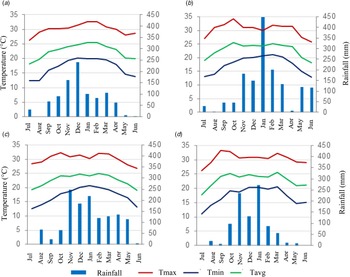
The temperature and rainfall data of the first four coffee seasons, period of this study, are presented in Fig. 2. The average temperatures between the first and fourth seasons were 23.0, 23.1, 22.7 and 23.0°C, respectively, while the average temperature for November was 24.4, 24.8, 23.9 and 23.9°C, respectively. The accumulated precipitation in the first, second, third and fourth harvests was 1218, 1974, 1301 and 762 mm, respectively.
Average data of maximum, minimum and average temperature (T max, T min, T avg) and rainfall. (a) 1st season (2014/2015); (b) 2nd season (2015/2016); (c) 3rd season (2016/2017); (d) 4th season (2017/2018).

The average annual water deficit of Jaboticabal between 1971 and 2000 was 56 mm (Fig. 3(a)), with no water restriction for cultivation, according to the criteria used in agroclimatic zoning of coffee (Pinto et al., Reference Pinto, Zullo Junior, Assad, Brunini, Alfonsi and Coral2001; Brasil, 2011). However, during the experimental period (2013–2018), the average annual water deficit was 109 mm (Fig. 3(a)), within the range from 100 to 150 mm, characterizing water restriction, so water supply by irrigation was indicated (Matiello, Reference Matiello2008). The water balance was carried out according to the methodology described by Thornthwaite and Mather (Reference Thornthwaite and Mather1955).
Climatological water balance (a) from 1971 to 2000 and (b) during the experimental period from 2013 to 2018. Def: water deficit; Exc: water surplus.

Experimental design and treatments
The experimental design was randomized blocks, with four replicates, and the treatments consisted of 17 short-stature Arabica coffee cultivars (Supplementary Table 1). The seedlings were produced in a system of tubes with artificial substrate based on coconut fibre, peat and slow-release fertilizer and planted in the field when they had five pairs of leaves. At the time of field planting, the seedlings were 5 months old.
Each experimental plot consisted of a 4-metre-long coffee row, with eight plants, at spacing of 0.50 m between plants and 3.5 m between rows. The cultivar Acauã was used along the entire border of the experiment. Throughout the experiment, Urochloa ruziziensis was sown broadcast between the rows in order to form vegetation cover on the soil surface, avoiding erosion.
The seedlings were planted in April 2013. The first harvest was carried out between April and May 2015. The present study encompasses the first four coffee seasons, from 2015 to 2018. In the experimental area, a drip irrigation system was used, with pressure-compensating emitters spaced 0.50 m apart, with service pressure of 150 kPa and flow rate of 1.6 l/h. The irrigation interval was 7 days, with a water depth of 15–20 mm per week throughout the dry season. In dry spells during the rainy season, the system was also activated. From July to the first half of August, irrigation was suppressed to promote anthesis (Lima et al., Reference Lima, Santos, Torres, Cardon, Caldeira, Lima, Davies, Dodd and Chalfun-Junior2021).
In the four seasons, the soil of the experimental area was subjected to fertility analysis (Raij et al., Reference Raij, Andrade, Cantarella and Quaggio2001) (Supplementary Table 2). According to Raij et al. (Reference Raij, Fernandes, Oliveira, Malavolta, Raij, Cantarella, Quaggio and Furlani1997), there was no need for liming or gypsum application before, as base saturation was above 70% and aluminium saturation was low (almost 0%), indicating ideal conditions for coffee growth in Brazil. Soil tillage was carried out by subsoiling, plowing and harrowing in September and October 2012. Liming, gypsum application and mineral fertilization for production (after planting) were performed as recommended by Raij et al. (Reference Raij, Fernandes, Oliveira, Malavolta, Raij, Cantarella, Quaggio and Furlani1997). It is worth mentioning that organic fertilization was carried out in all agricultural years, using cattle manure as source, in the amount of 10 t/ha, applied in August. Agricultural gypsum was also applied in October 2016 at a dose of 2 t/ha, aiming at the supply of Ca and S, as well as the improvement of the soil environment in subsurface to favour root growth. Regarding the mineral fertilization for production, doses within the range of 350–450 kg/ha of N, 80–100 kg/ha of P2O5 and 300–350 kg/ha of K2O were applied. Nutrients (N, Zn, Mn, Ca, B, Cu, Mo) were also supplied by foliar fertilization, in 4–6 applications per agricultural year. These application ranges of fertilizer rates and spraying occurred depending on the two-year period of coffee production and the pressure of pests and diseases in each year. After 2018, the coffee was pruned and harvested two more times. These data after 2018 were used in another study with a new approach to skeleton pruning in Arabica coffee grown in low-altitude region.
Field and laboratory evaluations
Plant height was measured with a graduated ruler, from the ground to the apical meristem. Crown diameter (cm) was measured from the end of the branches farthest from the plant and perpendicular to the planting row. For the degree of fruit maturation (%), 1 l (standard methodology for coffee) of coffee was collected in each plot and used for classification and quantification of green, cane-green, cherry, raisin and dry fruits, as described in Pezzopane et al. (Reference Pezzopane, Salva, Lima and Fazuoli2012). After harvesting and homogenizing the fruits, the total volume of coffee harvested in each plot was measured, and 10 L of raw coffee were collected and put to dry in the sun on a concrete terrace. After drying, the dried coffee beans were processed. From the weight of raw coffee bean, obtained after processing and moisture correction to 12.5% (wet basis), the yield (in bags of 60 kg of processed coffee per hectare) and the processing yield (% of coffee beans relative to dried coffee beans) were estimated.
The coffee beans, 1 l of each plot, were placed on a set of sieves arranged in the following order: round sieve 17 (flat berry bean), round sieve 15 (flat berry bean), oblong sieve 10 (peaberry bean), round sieve 13 (flat berry bean) and bottom (sticks, stones, broken grains, among others). After sieving, the mass of grains retained on each sieve was quantified and the percentages of grains by size and shape contained in each sieve and sample were determined. In the same sample collected for classification by size and shape, black, immature and sour grains were selected and weighed to establish the percentages of these defects. Four samples of 100 grains, flat berry type, were selected and counted in each plot. The average of the samples was used to establish the hundred-grain weight (HGW).
Sensory analysis was performed following an adaptation of the methodology of the Specialty Coffee Association (SCA) (Lingle, Reference Lingle2011), by a specialty coffee taster (QGrader), qualified and certified by the Coffee Quality Institute (CQI). The coffee roasting level corresponded to 58 points on the Agtron scale for the whole bean and 63 points for the ground bean. In each evaluation, five cups of coffee representative of each experimental plot were tasted, and a sensory analysis session was performed for each replicate, totaling three replicates for each treatment.
Statistical analysis
The data were subjected to outlier analysis by the generalized ESD test (Rosner, Reference Rosner1983) and it was checked whether the assumptions of the analysis of variance (ANOVA) including normality of residuals, by the Levene test (Levene, Reference Levene1960) and homogeneity of variances, by the Jarque–Bera test (Jarque and Bera, Reference Jarque and Bera1980) were met. When one of the assumptions was violated, the data were transformed to meet the requirements of ANOVA. Data were analysed using one-factor ANOVA (one-way ANOVA). When the F test was significant (P < 5%), the Scott–Knott clustering test was performed to compare the means. The analyses were carried out using SpeedStat® software (SPEED Stat, UFV, Viçosa, Brazil).
Due to the dependency structure of the variables analysed, multivariate exploratory analysis by principal components (Hair et al., Reference Hair, Black, Babin, Anderson and Tatham2009) was applied in order to plot the distribution of the Arabica coffee cultivars in two dimensions and group the variables into new latent variables (principal components).
Production and qualitative variables of coffee beans were used for the multivariate analysis. Prior to the analysis, all variables were standardized, generating null mean and unit variance. The number of principal components was chosen according to Kaiser's criterion, using those with eigenvalues above 1.0 (Kaiser, Reference Kaiser1958). The eigenvalues were extracted from the covariance matrix of the original variables. Variables with scores close to or higher than 0.600 were considered relevant for the explanation within each principal component (Romano et al., Reference Romano, Giomo, Coelho, Filla and Lemos2022).
To identify the cultivars with specific characteristics, ellipses covering the values of the X and Y axes, ranging from −1.96 to 1.96, were plotted. These values refer to the Z value of the normal distribution; values lower than −1.96 and higher than 1.96 indicate points with specific characteristics at 5% probability level. Thus, it was possible to identify the cultivars with specific characteristics for each principal component, as performed by Romano et al. (Reference Romano, Giomo, Coelho, Filla and Lemos2022). Multivariate statistical analyses were performed using Statistica® software, version 7.0 (StatSoft, Tulsa, USA).
Results
Significant differences were found for the morphological attributes, including plant height (PH) and crown diameter (CrD) increment (Table 1). For PH, the largest increases between the first and second seasons were obtained for the cultivars ObV, ObA and Sacr, with a variation of 1.14–1.27 m. The highest increment between the seasons for CrD was obtained by the IAC cultivars (SH3, CA62, CV99, OrV and OrA) and the cultivar IPR100 (Table 1).
Plant height (PH) and crown diameter (CrD) increment (m), processing yield (PY) and hundred-grain weight (HGW) of Arabica coffee cultivars on average of the fourth seasons

SH3: IAC Catuaí SH3; CA62: Catuaí Amarelo IAC 62; CV99: Catuaí Vermelho IAC 99; OrV: IAC Ouro Verde; OrA: IAC Ouro Amarelo; ObV: Obatã IAC 1669-20; ObA: IAC Obatã 4739; Tupi: Tupi IAC 1669-33; IAC125: IAC 125 RN; Catiguá: Catiguá MG1; Oeiras: Oeiras MG 6851; PBr: Pau-Brasil MG1; Sacr: Sacramento MG1; IPR99: IPR 99; IPR100: IPR 100; IPR103: IPR 103; Sabiá: Sabiá Tardio. Means followed by the same letter do not differ from each other by the Scott–Knott test at 5% probability level. *Significant at 5% probability level. **Significant at 1% probability level.
Differences in fruit maturation between cultivars were obtained in all years (Supplementary Table 3). The average percentage of green fruits (G) ranged from 17.7 to 22.3% between seasons, with an overall mean of 22%. The overall mean of cherry (C) and raisin + dry (R + D) fruits was 44 and 23.9%, respectively (Supplementary Table 4).
The average processing yield (PY) among the four seasons ranged from 42.4 to 50.2%, with an overall mean of 46.7% (Table 1). Among the IAC cultivars, CA99, OrV, OrA, IPR100 and Sabiá were in the group with the highest PY. Considering all cultivars, the overall mean was 10.9 g. The average HGW of the seasons was between 9.6 and 12.3 g. The cultivars that produced the lightest grains were Catiguá and PBr, with means of 9.6 and 9.9 g, respectively.
Differences in yield between cultivars were obtained in all seasons, highlighting the genotypic and phenotypic expression differences in this environment (Table 2). In the 1st season, several cultivars reached high yields. IAC cultivars had yields above 40 bags/ha, except for SH3 (32.2 bags/ha) and ObA (24.1 bags/ha). The other cultivars of this institution produced between 42 and 52 bags/ha.
Grain yield of Arabica coffee cultivars in the first four seasons (2015, 2016, 2017, 2018)

SH3: IAC Catuaí SH3; CA62: Catuaí Amarelo IAC 62; CV99: Catuaí Vermelho IAC 99; OrV: IAC Ouro Verde; OrA: IAC Ouro Amarelo; ObV: Obatã IAC 1669-20; ObA: IAC Obatã 4739; Tupi: Tupi IAC 1669-33; IAC125: IAC 125 RN; Catiguá: Catiguá MG1; Oeiras: Oeiras MG 6851; PBr: Pau-Brasil MG1; Sacr: Sacramento MG1; IPR99: IPR 99; IPR100: IPR 100; IPR103: IPR 103; Sabiá: Sabiá Tardio. Means followed by the same letter do not differ from each other by the Scott–Knott test at 5% probability level. *Significant at 5% probability level. **Significant at 1% probability level.
In the 3rd season, Catiguá and Sacramento were in the least productive group, with about 30 bags/ha. ObV and PBr were the most productive, with approximately 60 bags/ha. In the 4th season, all IAC cultivars were in the most productive group (Table 2), with yields between 54.2 (CA62) and 77.1 bags/ha (OrA). Among the other cultivars, only IPR100 was in this group, with 55.7 bags/ha. The two groups with the lowest yields were composed of the cultivars Catiguá, Oeiras, PBr, Sacr and Sabiá Tardio. Catiguá and Sacr also had the lowest PY and low HGW (Table 1).
The variation of yield among the four seasons per cultivar can be better visualized in Fig. 4. The cultivars with the lowest variation between years were IPR100, IPR103 and Sabiá Tardio, indicating greater yield stability.
Average grain yield of short-stature Arabica coffee cultivars in the first four seasons. SH3: IAC Catuaí SH3; CA62: Catuaí Amarelo IAC 62; CV99: Catuaí Vermelho IAC 99; OrV: IAC Ouro Verde; OrA: IAC Ouro Amarelo; ObV: Obatã IAC 1669-20; ObA: IAC Obatã 4739; Tupi: Tupi IAC 1669-33; IAC125: IAC 125 RN; Catiguá: Catiguá MG1; Oeiras: Oeiras MG 6851; PBr: Pau-Brasil MG1; Sacr: Sacramento MG1; IPR99: IPR 99; IPR100: IPR 100; IPR103: IPR 103; Sabiá: Sabiá Tardio. PRO: Procafé. Error bar indicates mean standard error.

Yield increments in each season were observed for the cultivars SH3, Catiguá and Sacr (Fig. 4). The cultivar PBr showed wide oscillation between seasons, producing about 50% less after a high yield. Oeiras and PBr also had biennial production in all seasons. Despite the low yield in the 1st season, ObA showed an increase from the next season, doubling its yield (48.4 bags/ha), maintaining it in the 3rd season (45.9 bags/ha), and reaching 69.6 bags/ha in the 4th season, with an overall mean of 47 bags/ha. The highest yields were obtained in the 4th season for most cultivars.
The percentage of grains retained on sieves with the largest openings is presented in Supplementary Table 5. As observed for PY and yield, the size and type of grains may vary according to the agricultural year. The lowest mean values for S17 (17.7% and 28.6%) were obtained in the 1st and 4th seasons. When evaluating the retention of small grains (Supplementary Table 6), greater retention was observed in the 1st season compared to the others, with an average of 22.2% of S13 grains, a value 116% higher than the overall mean (10.13%).
The percentage of peaberry beans is presented in Supplementary Table 7. Flat berry beans come from well-developed cherries, but the coffee plant can also produce some beans with a round shape, called peaberry. This type results from the fertilization of only one of the eggs of the coffee cherry, leading to a round bean instead of two flat-sided beans. In coffee classification, peaberry beans are not considered defects, but rather anomalies.
The cultivars that produced the highest average percentage of peaberry beans were PBr and Sacr (13 and 13.8%, respectively), followed by CA62 (10.6%), Tupi (11.6%) and Catiguá (10.2%). The percentage of the main grain defects (BIS – black, immature and sour beans) also differed among cultivars in all seasons (Supplementary Table 7).
Two principal components (PC) were relevant to explain 66.22% of the variability of the data, corresponding to 37.6% for PC1 and 28.6% for PC2 (Fig. 5). The relevant variables – with eigenvalues close to or above 0.600 (Romano et al., Reference Romano, Giomo, Coelho, Filla and Lemos2022) – for the first PC were HGW, S17, S15, S13, PY and YLD. Variables with equal signs are directly correlated with each other, and variables with opposite signs are inversely correlated. Therefore, HGW, S17, PY and YLD were directly correlated that the higher the HGW, S17 or PY, the higher the grain yield. The variables S15, S13 and Peaberry were inversely proportional to the above-mentioned attributes (Table 3). The larger the amount of grains of lower sieve and peaberry grains, the smaller the amount of large grains, PY and HGW, and consequently the lower the yield.
Biplot of the principal components to evaluate the dispersion of the average agronomic and qualitative attributes in the first four seasons of 17 Arabica coffee cultivars. Jaboticabal, SP, Brazil. SH3: IAC Catuaí SH3; CA62: Catuaí Amarelo IAC 62; CV99: Catuaí Vermelho IAC 99; OrV: IAC Ouro Verde; OrA: IAC Ouro Amarelo; ObV: Obatã IAC 1669-20; ObA: IAC Obatã 4739; Tupi: Tupi IAC 1669-33; IAC125: IAC 125 RN; Catiguá: Catiguá MG1; Oeiras: Oeiras MG 6851; PBr: Pau-Brasil MG1; Sacr: Sacramento MG1; IPR99: IPR 99; IPR100: IPR 100; IPR103: IPR 103; Sabiá: Sabiá Tardio.

Factor loadings of the variables in the principal components

PC1, principal component; HGW, hundred-grain weight; S17, flat berry beans retained on sieve 17; S15, flat berry beans retained on sieve 15; S13, flat berry beans retained on sieve 13; PY, processing yield; BIS, black, immature and sour beans; G + CG, green and cane-green fruits; C, cherry fruits; R + D, raisin and dry fruits; YLD, grain yield of the first four seasons. The values highlighted in red represent the relevant variables in each principal component with a score close to or above 0.600.
For PC2, the relevant variables were the percentage of peaberry beans and the green + cane-green (G + CG), cherry (C) and raisin + dry (R + D) degrees of fruit maturity. C and R + D fruits were directly correlated with each other and inversely correlated with the immature fruits (Table 3).
It was possible to identify cultivars with the best performance for agronomic and qualitative attributes with the PC analysis (Fig. 5). The cultivars with specific characteristics for the two PCs are located outside the ellipse. For PC1, the cultivars with the best agronomic performance were those from Tupi, CV99 and IAC125, characterized by higher production of larger beans, with higher S17, HGW, PY, higher yields and lower amounts of beans of the peaberry type and of lower sieve. Among the three cultivars, IAC125 stood out, located farther to the right in the biplot. ObV and ObA are located below the ellipse due to the high percentage of green fruits and lower amount of S17 beans, but also stood out for their high yields.
The opposite side contained the cultivars with the worst performances, PBr, Sacr and Catiguá (Fig. 5). Although it is recommended to cultivate these materials under the same conditions considered suitable for planting cultivars of the Catuaí group, their performance was significantly lower compared to the cultivars of this group. Even the cultivar Sacr, which showed excellent vegetative development (Table 1), and which is characterized by high vegetative vigour and high yield in the first seasons, showed poor performance in the region of Jaboticabal.
In PC2, the cultivars with specific characteristics were ObV and ObA, with a higher percentage of immature fruits (G + CG) and defects (BIS). The greater amount of defects is related to the greater presence of fruits with green beans, which contribute to increasing the percentage of BIS beans. Conversely, the percentage of more mature fruits (C and R + D) was relevant, and Tupi stood out (Fig. 5).
Regarding beverage quality, the sensory analysis of the cultivars confirmed the hypothesis about the possibility of producing specialty coffees in the region of Jaboticabal (Table 4). Only OrA did not achieve the specialty beverage score, being slightly inferior, with 79 points, classified as fine cup, or ‘hard to better’.
Beverage score of the 17 short-stature Arabica coffee cultivars

SH3: IAC Catuaí SH3; CA62: Catuaí Amarelo IAC 62; CV99: Catuaí Vermelho IAC 99; OrV: IAC Ouro Verde; OrA: IAC Ouro Amarelo; ObV: Obatã IAC 1669-20; ObA: IAC Obatã 4739; Tupi: Tupi IAC 1669-33; IAC125: IAC 125 RN; Catiguá: Catiguá MG1; Oeiras: Oeiras MG 6851; PBr: Pau-Brasil MG1; Sacr: Sacramento MG1; IPR99: IPR 99; IPR100: IPR 100; IPR103: IPR 103; Sabiá: Sabiá Tardio. Means followed by the same letter do not differ from each other by the Scott–Knott test at 5% probability level. *Significant at 5% probability level. **Significant at 1% probability l. Beverage score based on the SCA scale (Speciality Coffee Association).
Discussion
The increase in the global average temperature in recent decades (Rounce et al., Reference Rounce, Hock, Maussion, Hugonnet, Kochtitzky, Huss, Berthier, Brinkerhoff, Compagno, Copland, Farinotti, Menounos and McNabb2023) has promoted deep changes in cultivation in some crops, such as Arabica coffee (Malhi et al., Reference Malhi, Kaur and Kaushik2021; Richardson et al., Reference Richardson, Kath, Byrareddy, Monselesan, Risbey, Squire and Tozer2023). Regions that were previously traditional and suitable for the cultivation of Arabica coffee began to be classified as marginal or unsuitable for its cultivation (Camargo, Reference Camargo2010; Volsi et al., Reference Volsi, Telles, Caldarelli and Camara2019). This can be exemplified by the change in coffee cultivation in Brazil, where the state of São Paulo was the largest national producer but currently Arabica coffee cultivation has migrated to the state of Minas Gerais, in regions of higher altitude (>900 m) and with milder temperatures.
To revive coffee cultivation in these regions and generate other cultivation possibilities for producers to diversify their income, this study evaluated the adaptation of 17 short-stature coffee cultivars in a region with low altitude and high temperature. This study may help producers, technicians and breeders in the development of cultivars that are more tolerant to heat, with genotypes capable of facing climate change in the coming decades with greater yield associated with improved quality. To this end, variables related to the growth, yield and quality of Arabica coffee were evaluated.
It should be noted that Agricultural Zoning of Climate Risks does not prohibit the production of Arabica coffee in regions marginal to cultivation, it only indicates the risk of production in a given location. The fact that the region is considered high risk or even marginal does not mean that production cannot occur, but rather that there is a certain risk for the producer that must be taken into account. Furthermore, small annual losses can lead to significant damage for the producer in the long term. In this way, several strategies can be used to mitigate these risks and promote greater production stability and safety.
Some management practices can be adopted to minimize the risks of Arabica coffee production in regions marginal to cultivation. Among them, irrigation, cultivation of cover crops in coffee inter rows, application of anti-stress products, balanced and adequate fertilization, spacing, among others, in addition to cultivar choice itself (Camargo, Reference Camargo2010) stand out. It is known that there are Arabica coffee cultivars that are more tolerant to heat (Kahsay et al., Reference Kahsay, Turreira-Garcia, Ortiz-Gonzalo, Georget and Bosselmann2023), therefore, the use of these genotypes would help reduce production risks in marginal regions and optimize resources. In this context, the present study aims to elucidate and recommend these genotypes under Brazilian conditions, promoting greater security for producers.
The differences in coffee tree growth variables (PH and CrD increment) among cultivars may be attributed to the genetic variability between the genotypes studied, since they were developed by different breeding programmes in Brazil. The cultivars ObV, ObA and Sacramento showed the highest growth in PH increment, due to their high vegetative vigour (Carvalho et al., Reference Carvalho, Bartelega, Sera, Matiello, Almeida, Santinato and Hotz2022b).
The higher percentage of green fruits in the last two seasons may be related to the higher rainfall in the months of August preceding the 3rd and 4th seasons, advancing flowering. Fruit maturation is genetically controlled, but this characteristic is greatly influenced by the edaphoclimatic conditions of the region of cultivation, especially temperature and water availability (Osorio Pérez et al., Reference Osorio Pérez, Matallana Pérez, Fernandez-Alduenda, Alvarez Barreto, Gallego Agudelo and Montoya Restrepo2023).
Fruits in the senescence phase are more susceptible to the action of fermenting microorganisms, which produce alcohols and acids that can depreciate the aroma and flavour of the beverage if fermentation occurs for a longer time (Mesquita et al., Reference Mesquita, Rezende, Carvalho, Fabri Júnior, Moraes, Dias and Araújo2016). To reduce the probability of occurrence of undesirable fermentation, cultivars with a longer cycle, such as ObV and ObA, would be appropriate to prevent harvest from coinciding with some rains that may sporadically occur in May. In addition, the choice of cultivars with different maturation times on the same farm promotes better harvest management and processing (Medina Filho et al., Reference Medina Filho, Bordignon and Carvalho2008).
Temperatures in the experimental area are higher than in regions of higher altitude, accelerating the maturation process. In the state of São Paulo, coffee can ripen up to 2–3 months earlier compared to regions with milder temperatures, such as in producing regions in the state of Minas Gerais (Oliveira Aparecido et al., Reference Oliveira Aparecido, Rolim, Moraes, Valeriano and Lense2018). In these regions, harvest is concentrated in the months from June to August, while in the present study almost all cultivars were suitable to be harvested in May, including materials classified as late.
Considering the state of São Paulo, there are also differences in cycle duration between the different regions. In higher regions, such as Alta Mogiana, where altitudes are higher than 800 m, maturation occurs after May, while in regions with low altitudes, such as the central-western region of the state, at less than 600 m, the cycle is shorter (Bardin-Camparotto et al., Reference Bardin-Camparotto, Camargo and Moraes2012). Higher temperatures, for reducing the grain growth period, cause less accumulation of photosynthates, reducing the potential for beverage quality (Oliveira Aparecido et al., Reference Oliveira Aparecido, Rolim, Moraes, Valeriano and Lense2018).
Although the production of good quality beverage is positively correlated with altitude (Rolim et al., Reference Rolim, Oliveira Aparecido, Souza, Lamparelli and Santos2020), low altitude is not an insurmountable obstacle for Arabica coffee producers in these regions with higher temperatures. In addition to climate, the intrinsic potential of the cultivar, crop management, and post-harvest processing influence beverage quality (Barbosa et al., Reference Barbosa, Oliveira, Rosado, Sakiyama, Cruz and Pereira2019; Barrios-Rodriguez et al., Reference Barrios-Rodriguez, Cordoba-Salazar, Bahamón-Monje and Gutiérrez-Guzmán2021). Therefore, choosing cultivars with greater adaptability to environments located at lower altitudes, associated with good agronomic practices and adequate processing, grain selection and storage, can result in the production of coffee lots with superior quality even in these regions.
Most cultivars in the present study were within the appropriate range of processing yield for Arabica coffee, which is 45–55% (Krug et al., Reference Krug, Malavolta, Moraes, Dias, Carvalho, Monaco, Franco, Bergamin, Heinrich, Abrahão, Rigitano, Souza and Fava1965). The cultivars with means below the recommended range were ObA, Catiguá, Oeiras and Sacr, whose means ranged from 42.4 to 44.7%. The PY parameter establishes the amount required for filling a bag of coffee. PY is an indication of coffee quality used by cooperatives and coffee processing industries, as well as by the farmer, because the higher the PY, the larger the amount of raw coffee.
The values found for yield demonstrate that it is possible to obtain yields similar to those observed in traditional regions of cultivation, despite the low altitude. Carvalho et al. (Reference Carvalho, Botelho, Ferreira, Teramoto, Lima, Junior and Guerreiro Filho2022a) also obtained maximum yields similar to those found in the present study for the 1st coffee season in a region with lower altitude (25 m altitude), even for the cultivar ObA. These results demonstrate the high adaptation of coffee cultivars to regions with higher temperatures. The least productive cultivars were Catiguá (13.6 bags/ha) and Sacr (16.3 bags/ha). In the other seasons, these cultivars also remained among the ones with the worst performance.
IPR99, developed by IAPAR, produced grains with an average weight of 11.9 g, slightly lower than the value found for IAC125 (12.3 g). Both cultivars are characterized by the production of large grains (Carvalho et al., Reference Carvalho, Bartelega, Sera, Matiello, Almeida, Santinato and Hotz2022b).
Using the Scott–Knott mean test, four groups of means were established for yield across the four seasons. In the first group, yield ranged from 46.0 to 51.6 bags/ha, in the second group from 40.2 to 44.8 bags/ha, in the third from 34.7 to 37.3 bags/ha and in the fourth from 26.7 to 29.1 bags/ha. Considering the average of the four seasons, the group with IAC cultivars was the most productive. Most cultivars produced 46–50.2 bags/ha, except for SH3 and OrV, with slightly lower performance (close to 44 bags/ha), but still above the average (42.5 bags/ha). In the other groups, only IPR100 was among the most productive, reaching 51.6 bags/ha. IPR99 and IPR103 performed well, with 40.2 and 41.6 bags/ha, respectively. These values are well above the average yields of Brazil (less than 25 bags/ha) and São Paulo state (22.4 bags/ha) and are similar to that of the region with more ‘technified’ producers, 45.1 bags/ha (Conab, 2022). The average yield for irrigated coffee plantations is within the range of 40–50 bags/ha (Sakai et al., Reference Sakai, Barbosa, Carvalho Silveira and Matos Pires2015). Based on the average of the four seasons, among the 17 cultivars, the 12 cultivars of the two superior statistical groups were within or above this range.
The IAC's breeding centre for Arabica coffee cultivars is located in a region which is approximately 700 m above sea level (Campinas, SP), while the other institutes are located in regions which are more than 900 m above sea level. Thus, the superiority of IAC cultivars for yield compared to the cultivars from the other research and breeding institutes can be explained by the greater similarity between the climate of the region of the present study and that of the IAC's breeding centre where most of the cultivars were developed.
In the average of the four seasons, the cultivars of the superior group (letter of mean ‘a’) reached an average yield of 48.6 bags/ha, while in the inferior group (letter of mean ‘d’) the value was 27.9 bags/ha. This demonstrates that, on average, the appropriate choice of Arabica coffee cultivar in a low-altitude region may result in up to 74% yield increase as was observed in the present study. When considering the most contrasting cultivars (IPR100 and Sacr), this difference reaches 93%. In regions with higher altitude and greater suitability for coffee cultivation in Minas Gerais, IPR103 and Sabiá also showed adaptability and stability, regardless of the environment (Carvalho et al., Reference Carvalho, Botelho, Rezende, Ferreira, Cunha and Pedro2013).
The cultivar with the highest value of large grains (four seasons average) was IAC125, with 49.4% of grains retained on S17. This cultivar has characteristics of oblong fruits and large grains, with average sieve of 17 (Fazuoli et al., Reference Fazuoli, Braghini, Silvarolla, Gonçalves, Mistro, Gallo and Guerreiro Filho2018b), which favours the retention of grains on sieves with larger openings. CA62, CV99, IPR99 and Sabiá also showed high production of S17 grains, close to 40%. The inferior group was composed of Catiguá, PBr and Sacr, which also showed low performance for PY, HGW and YLD. The cultivars Catiguá, Sacr, PBr and Oeiras MG 6851 produced 27–48% less than the most productive cultivars.
Coffee is a commodity that allows the addition of value according to its quality, and the attributes evaluated include its size and shape. Grain size is one of the elements that influence price, because larger grains have higher commercial value (Leroy et al., Reference Leroy, Ribeyre, Bertrand, Charmetant, Dufour, Montagnon, Marraccini and Pot2006). Lots with greater unevenness of grains result in lower quality and price. Larger grains roast more slowly, while small grains roast quickly (Hoffmann, Reference Hoffmann2018). Grain size and shape, depending on the cultivar, influence the quality of the beverage (Luna González et al., Reference Luna González, Macías Lopez, Taboada Gaytan and Morales Ramos2019), and larger grains are preferable for export.
In all seasons, the average values of peaberry were close to 10%, being at the limit of the range considered normal. The range of peaberry beans considered acceptable in sales contracts on the stock exchange is up to 10% (BMF – BM&FBOVESPA, 2006); for the production of certified seeds, it is up to 12% (Guimarães et al., Reference Guimarães, Mendes, Souza, Guimarães, Mendes and Souza2002). PBr and Sacr produced above the limit mentioned, reaching values higher than 15%. In Carmos de Minas, at 1231 m altitude, a region suitable for cultivation, percentages of peaberry beans between 10 and 20% were also obtained for the cultivars Catiguá, Sacr and PBr, exceeding these parameters (Silva et al., Reference Silva, Rezende, Carvalho, Carvalho, Rezende and Ferreira2016).
The high percentage of peaberry beans may indicate deficiency in fertilization, related not only to the genetic factor, but also to nutrition and climatic factors, such as low humidity during flowering in warm regions (Matiello et al., Reference Matiello, Santinato, Garcia, Almeida and Fernandes2020). As peaberry beans have a lower weight when compared to two flat berry beans, a high percentage in the production of these grains is not desired. In addition, the mixture of flat berry beans with peaberry beans compromises the coffee roasting process. However, lots with small peaberry beans can get higher scores compared to lots with flat berry beans (Soares et al., Reference Soares, Kannen, Jordao Junior and Garcia2019).
The overall mean of BIS defects was about 8%. Tupi, IAC125, Oeiras and Sabiá had a lower percentage of BIS beans in the overall mean (5.4–6.1%). Black, immature and sour beans are considered the worst defects of coffee, as they affect the appearance, colour and type of the beverage, and reducing these defects should be one of the main goals for the production of superior quality coffee (Mesquita et al., Reference Mesquita, Rezende, Carvalho, Fabri Júnior, Moraes, Dias and Araújo2016).
According to the PCA, the cultivars that presented the highest values for attributes related to the agronomic and qualitative performance of Arabica coffee, such as HGW, S17, PY and YLD, were IAC125, Tupi and CV99. These cultivars were related to these attributes and presented specific characteristics, being located outside the average of the other cultivars (outside the ellipse of the normal distribution).
On the other hand, cultivars such as Catiguá, Sacr and PBr stood out for their agronomic performance below the average of the other cultivars. In the biplot graph, these cultivars are located in the opposite direction to the variables that demonstrate the agronomic and qualitative performance of the Arabica coffee and outside the average of the cultivars (outside the ellipse). The multivariate analysis corroborated and complemented the results of the univariate analysis, so it can be used in breeding programmes to identify materials with superior characteristics for these and other attributes (Romano et al., Reference Romano, Giomo, Coelho, Filla and Lemos2022), being also a useful tool in the selection of commercially available cultivars.
Sixteen cultivars had scores equal to or above 80, according to the methodology of the Specialty Coffee Association (SCA), and the beverages were classified as specialty coffee, within the ‘very good’ category (SCAA, 2015). The cultivar with the highest score was ObA, with 83 points, similar to the scores presented by the breeders who developed this cultivar (Fazuoli et al., Reference Fazuoli, Braghini, Silvarolla, Gonçalves, Mistro, Gallo and Guerreiro Filho2018a, Reference Fazuoli, Braghini, Silvarolla, Gonçalves, Mistro, Gallo and Guerreiro Filho2018b).
Although higher temperatures accelerate the maturation process compared to regions with higher altitude, lower temperatures and lower solar radiation, it was possible to obtain good quality beverages in a marginal region for Arabica coffee cultivation. The results prove that it is possible to combine high grain production with good technological quality and the capacity to obtain specialty beverages in regions of lower altitude.
Conclusion
We found that short-stature Arabica coffee cultivars showed differences in agronomic and qualitative performance in a region marginal to cultivation. The cultivars of the ‘IAC’ breeding programme: CA62, CV99, OrA, ObV, ObA, Tupi and IAC125, together with IPR100, were those with the highest yield, close to 50 bags/ha. Among them, CV99, Tupi and IAC125 produced grains with the best quality, making it possible to associate high yields with quality of grains and beverage of Arabica coffee in a region of low altitude and high temperatures. Finally, the appropriate choice of the Arabica coffee cultivar for low-altitude region may result in yield gains of up to 74%, generating production alternatives for farmers.
Supplementary material
The supplementary material for this article can be found at https://doi.org/10.1017/S0021859624000674.
Author contributions
V. A. F., A. P. C., O. F. M. and L. B. L. conceived and designed the study. O. F. M., F. T. L., J. P. L. D., B. M. C., P. A. C. J., S. S. S. and J. A. F. conducted data gathering. V. A. F. and A. P. C. performed statistical analyses. V. A. F., A. P. C., O. F. M. and L. B. L. wrote the article.
Funding statement
This research received no specific grant from any funding agency, commercial or not-for-profit sectors.
Competing interests
The authors declare there are no conflicts of interest.
Ethical standards
Not applicable.
This paper is based on research of the first author's PhD thesis ‘Desempenho agronômico e qualitativo de café arábica de porte baixo em região de baixa altitude’, V. A. Filla (2023), Unesp.