I
A steady stream of research continues to be produced on the creation and evolution of various types of financial assets – stocks, bonds, annuities, mortgages – in Western European countries during the period 1500–1800, before the appearance in most countries of corporate banking firms and formal stock exchanges (Carlos and Quinn Reference Carlos, Quinn, Diebolt and Haupert2018; Hart et al. Reference ’t Hart, Brandon and Torres-Sanchez2018). Most scholarship treats the evolution of financial asset classes from the perspective of the potential borrower – the state needing funds to wage warfare, merchant trading companies seeking capital to reach and maintain facilities in distant markets, industrialists wanting capital for factories, and landowners taking up mortgages for liquidity and the payment of children's portions. The struggle of governments as borrowers has attracted the most attention (Stasavage Reference Stasavage2016). In the case of Britain, debates for a couple of decades revolved around two issues: whether the Glorious Revolution's curtailment of monarchical power constituted the critical element in enabling the government to raise funds to extend its empire (North and Weingast Reference North and Weingast1989) and, on the downside, whether the robust growth in government debt ‘crowded out’ and thus slowed down the pace of investment in the Industrial Revolution (Williamson Reference Williamson1984). Neither hypothesis has gained general acceptance, as scholarly interest has migrated to studying the slow build-up, beginning in the seventeenth century, of a financial infrastructure to promote and expand public, commercial and landed debt – stock jobbers, town clerks goldsmiths, scriveners, and attorneys that dealt in company stocks, bonds, annuities and mortgages (e.g. Melton Reference Melton1986; Carlos et al. Reference Carlos, Key and Dupree1998; Hoffman et al. Reference Hoffman, Postel-Vinay and Rosenthal2000, Reference Hoffman, Postel-Vinay and Rosenthal2018; Bogart Reference Bogart2005; Murphy Reference Murphy2009; Pincus Reference Pincus2009; Gelderblom and Jonker Reference Gelderblom and Jonker2011; Petram Reference Petram2011; Temin and Voth Reference Temin and Voth2013; Briggs and Zuiderduijn Reference Briggs and Zuiderjuijn2017) – as Western Europe became a global trade juggernaut and a battleground for continual warfare (Brewer Reference Brewer1989). No one any longer finds it credible that early modern borrowers in Britain, the Low Countries and France required corporate banks to obtain a steady flow of credit or that securities were not consistently traded in a secondary market from the later seventeenth century onward. The Glorious Revolution is just one piece in the transformation of the English political economy, and enough capital seems to have come into the market so that crowding out cannot be perceived (Clark Reference Clark2001).
Some important questions, however, particularly in the case of Britain, persist: the breadth of participation in tradeable securities from the late seventeenth through the eighteenth century and changes in investor preferences. In a society where the propertied classes had so heavily relied on rents for their income, continuing to add to real estate holdings might seem the most familiar and safest investment choice. Private loans secured by bond, personalty, or simply pledge had for centuries constituted the other main alternative among Western Europeans, although reclaiming one's principal from a debtor often proved a painful process (Muldrew Reference Muldrew1998; Smail Reference Smail2016). While by the seventeenth century, mortgages secured by land grew in popularity, barriers to recovery in case of default emerged with those assets as well (Briggs and Zuiderjuin Reference Briggs and Zuiderjuijn2017). Would frustration with these kinds of investments lead to a broad-based shift towards the stocks and bonds that had emerged as alternatives in the later seventeenth century?
Researchers have uncovered some investor information from the registers of securities purchases recorded by the Bank of England, the East India Company and government sources (Dickson Reference Dickson1967, ch. 11; Carter Reference Carter1975, pp. 67–74; Bowen Reference Bowen1989, pp. 199–201; Carlos and Neal Reference Carlos and Neal2006, pp. 512, 522–3; Walsh Reference Walsh2014, ch. 3; Graham Reference Graham2019, pp. 72–3; Li Reference Li2019, p.186). They have generally found that 80–90 percent of the holders of securities resided around the greater London area or major international entrepôts such as Amsterdam. Government agencies and corporate entities such as livery and trading companies invested heavily. One study that goes beyond the registers of securities and delves into family papers to study elite women's financial investing finds them gravitating towards government annuities as they became more available (Froide Reference Froide2017, table 5.1). Most of this work, however, concerns the pre-1750 period before the 3 percent Consols burst on the scene. Thereafter, it is noted that ‘increasingly’ more investors chose to place funds into government debt rather than land (Michie Reference Michie1999, p. 25) and that English capital markets ceased to be regionally segmented by 1800 (Buchinsky and Polak Reference Buchinsky and Polak1993). The emergence of what became the most spectacular early modern financial product (Neal Reference Neal1990, p.117; Clark Reference Clark1996, p. 575; Carlos and Quinn Reference Carlos, Quinn, Diebolt and Haupert2018, p. 17) – perpetual annuities, specifically the 3 percent Consols, to fund eighteenth-century English government debt – has continued to be relatively unexplored from the domestic investor standpoint, despite the annuities’ central importance in national and international balance sheets of the time (Neal Reference Neal1990) and despite questions about the rationality of that demand through analysis of prices and rates of return (Heim and Mirowski Reference Heim and Mirowski1987; Odlyzko Reference Odlyzko2017). When, who, where and why remain to be studied.
It has proven difficult to find one source that covers all three types of investment – real estate, private loans, both secured and unsecured, and corporate or government securities. English probate inventories, popular records for investigations of wealth, unfortunately exclude most types of real estate, and they more or less cease covering in a general way the English propertied population by the 1730s. They do, however, report, up to that date and in varying levels of detail, financial assets. A study of London commercial classes in the1660s-80s indicates that the probated held more of their wealth in private loans including mortgages than in stocks, annuities and other government securities. However, in the next 30-year period, the same study shows that traded securities exceeded private loans (Earle Reference Earle1989, p. 146) for these London investors. Inventory data I collected for East Londoners over the same periods, shows a similar pattern. I find no evidence of company stock shares or government debt holding in the 1660s, but in the Bubble period of the 1720s, 57 percent of the value of these decedents’ financial assets were stocks and government securities. In contrast, only one out of 305 decedents’ inventories from the 1720s in southern Worcestershire, a Midlands area far from London, listed any securities at all (see Appendix), suggesting very little movement outside the metropolis.
The most comprehensive look at real estate holdings and rental income comes out of a study Gregory Clark undertook using Parliament's Charity Commission Reports (hereafter Reports) to track gifts of assets from the sixteenth to the early nineteenth century (Clark Reference Clark1998). The article of most relevance to our concerns here compared the returns from real estate, private loans such as mortgages and the reported yield on public debt (Clark Reference Clark2001). At the end of this exercise, Clark concluded that he had created a puzzle. He could not understand why the soaring public debt in the later eighteenth century produced very little rise in private rates of return. He speculated, from GDP estimates showing a decline in the proportion of income coming from land and housing rents, that perhaps that drop could in some way account for the anomaly, but he took it no further. Could different data retrieved from the Reports on individual donors tell us more about investment preferences and possible reasons for static rates of return on real estate? Let us see.
II
The 32 volumes of Reports published from 1819 to 1840 (see Appendix) tracked gifts for charity schooling in England and Wales from the sixteenth century onward. The Commission hoped to recapture some of the gifts that, despite the donor's intent, had for one reason or another not been used for the specified educational purpose and also document the fate of gifts that had found their proper home. Commission staff went through depositories in England and Wales looking for such gifts in old wills, deeds and indentures. They then queried local trustees, executors, their successors and parish authorities to trace what had actually happened to the donation. In this process, one learns which assets the donor specified be given. In some cases, the donor directed his or her executors/trustees to liquidate an existing asset and purchase another type. In some instances, donors left the choice of asset to the executors or trustees.
Obviously these donations cannot be viewed as coming from the generality of the English and Welsh population. While parish priests and others of modest means might contribute small amounts to further the agenda of the charity school movement, many donors had honorific titles of one sort or another after their names. According to the most recent estimate of the long- eighteenth-century social structure (Allen Reference Allen2019, pp. 105–10), such classes represented a mere 5–6 percent of families. At the end of the eighteenth century, 9 percent of families, mostly drawn from the landed and business elites, received 50 percent of total annual income. Also to be noted, the Reports document only a particular type of investment decision: one that needed to provide income over a long period of time after the death of the donor. Any generalizing about investor preferences from these data must be done fully cognizant of such limitations.
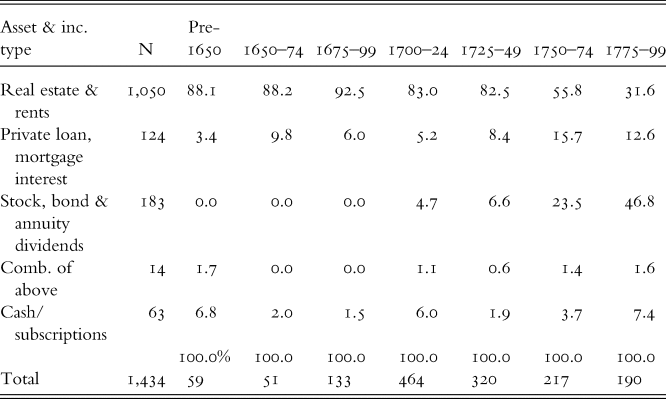
The dataset of over 1,400 charitable donations that I collected from the 32 volumes of Reports is described in the Appendix. Table 1 charts the change in the type of assets specified by donors or their executors/trustees in 25-year increments from the period prior to 1650 to 1799. As can be seen, very few cases come from the years before 1650 and the bulk are from the 1700s. I ended the collection of observations in 1799, just before the creation of a formal London Stock Exchange and the passage of laws regarding corporations that altered once again the investment environment. The gifts by donors are divided into three main categories based upon type of income provided to fund the gift: (a) real estate income from land held or to be purchased, rent charges and tithes; (b) interest on private loans unsecured or secured by promissory notes, private bonds or mortgages; (c) dividend-bearing securities including corporate stocks, government annuities, and returns from turnpike and canal trusts.Footnote 1 Those gifts that had a combination of asset types are also tallied as are those donations of cash or subscription payments made to a fund operated by a local school.
Charitable trust gifts: asset type percentage by time period

Source: See Appendix.
Prior to 1750, Table 1 indicates that gifts of real estate, whether rents or money to purchase land for rents, averaged well over 80 percent of the donations made to charity schooling. The pound sterling income provided by real estate gifts also constituted over 80 percent of the total income donated in the sample during that time period. These results are consistent with what one knows about early modern British elites and their preoccupation with landed wealth. In contrast, interest from private loans as a choice in Table 1 never reached 10 percent, despite the fact that we know a great deal of what is called peer-to-peer lending occurred in communities in Britain and elsewhere to handle life-cycle needs of households: on the one hand, a spinster needing a place to put cash she had received as a portion or as wages and on the other, an heir who needed liquidity to pay the portions of his younger siblings mandated in his father's will (e.g. Gayton Reference Gayton2013; Briggs and Zuiderduijn Reference Briggs and Zuiderjuijn2017). Gifts of publicly traded securities, surface only in 1700–24 and constitute less than 5 percent of the total. The last category – cash/subscription donations – were mainly those to existing schools where they were added to whatever fund had been established without clear indication of the assets in the fund.
After 1750, however, a dramatic change occurs. By the 1750–75 period, gifts of real assets decline to 56 percent. Interest from private loans and mortgages double their presence in donations, moving up into the teens. The real surprise, though, occurs with publicly traded securities: they garner almost a quarter of the gifts, a huge leap from 7 percent in the previous period. The upward trend continued in the fourth quarter of the eighteenth century, as these dividend-bearing securities become the most common asset in charitable gifts for education, while realty plummeted to less than a third of gifts and interest from private loans stayed more or less static. In terms of pound sterling annual income generated by these three categories during the last half of the eighteenth century, tradeable securities also climb to the top, edging out real estate 49 to 45 percent with private loans and mortgages a far distant 6 percent of the total. This profile of trust assets is very different from the period before 1750 or if one looks at the extant charitable trust pool dating from the sixteenth century to the end of the Reports (Analytical Digest, Great Britain 1842, p. 828).
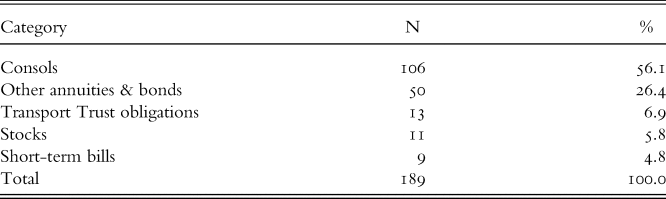
Table 2 breaks down the type of dividend-bearing securities being bought or transferred to educational uses as gifts. Annuities appealed the most to donors and trustees with the 3 percent Consol, a tradeable, perpetual annuity first issued by the British government in the early 1750s, being the hands-down favorite. The Bank of England handled the processing of trades in the Consols. By 1783, the Bank required 54 clerks to record these transactions (Murphy Reference Murphy2019, p. 68). Earlier annuities, or corporate issuances the government transformed into annuities, such as those of the South Sea Company, ranked second. Some were perpetual or for a very long term, while others terminated within a set period of years (Dickson Reference Dickson1967). Toll road and canal trust obligations emerge at the end of the period. Corporate stocks – East India Company, South Sea, various insurance company stocks and even Bank of England stock rarely surfaced as choices nor did short-term government debt such as Exchequer bills appear often.
Categories of dividend-bearing securities gifted, 1700–99

Source: See Appendix.
Note: Total includes all donations of dividend-bearing securities including those few combined with real estate or interest paying loans.
In the economic history literature, ownership of these publicly traded securities has been viewed as highly concentrated among people living in and around London and a few other important entrepôts involved in international finance such as Amsterdam (Dickson Reference Dickson1967; Carter Reference Carter1975, p. 67; Bowen Reference Bowen1989, p. 201; Michie Reference Michie1999, p. 33). Indeed, it has been argued that capital market integration had occurred between London and Amsterdam in the first quarter of the eighteenth century (Neal Reference Neal1990), prior to integration in the English home market. Provincials, it has been suggested, found other places to invest. The thinking, which continues well into the present, was that few would want to wager a large proportion of their wealth on financial instruments which might well be subject to insider trading going on far from where they lived.
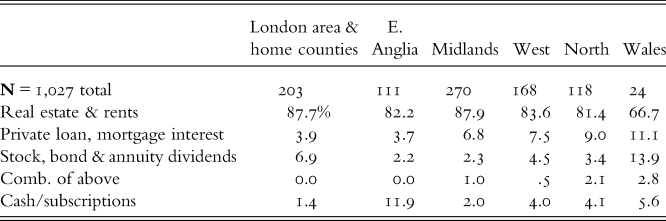
Table 3 breaks down the type of assets donated by the region of the school, from the end of the sixteenth century to 1749. Everywhere, from London and the home counties to the North of England, land and rent charges constituted the prime asset given to support charity schooling in 80 percent or more cases. Interest on loans occupied a distant second choice as an asset choice for a donation in most places outside London and the home counties. And even there the publicly traded securities mustered only 7 percent of bequests. Almost always donors gifted to charity schools in the locality where they lived or had an estate, although some wealthy London merchants and businessmen chose to make donations to the parish where they had been born. These constituted a small number of cases and did not affect the overall pattern, either before or after 1749. Only in Wales does one see an impact from Londoners and Anglican clergy who promoted charity school giving. The church struggled to teach the reading of a vernacular that almost no one in Wales spoke. Thus London-based supporters of the Society for Promoting Christian Knowledge (SPCK) and church officialdom played a significant role in funding Welsh charity schools. They did not necessarily own real estate there: hence the lower percentage of donors in Wales pledging rents, although the percentage still reached two-thirds of the gifts. Also the comparatively small number of observations could have led to some distortions.
Charitable trust gifts: asset type percentage by region, 1550–1749

Source: See Appendix.
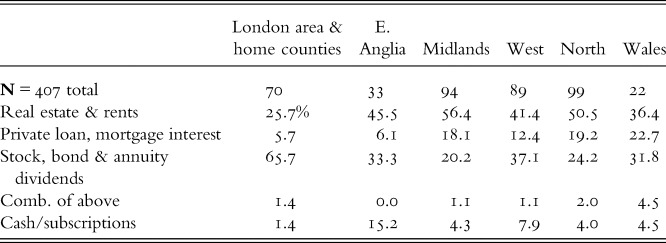
The situation alters greatly, however, if we compare what happened in the last half of the eighteenth century. Table 4 covers 1750–99 and reveals a sharp drop in the proportion of gifts in real estate and rents, everywhere. The percentages dropped 30–40 points except in London and the home counties, where it fell over 60 points. And in all areas, the switch raised publicly traded securities into a strong second position except in London and the home counties, where it became the most preferred asset for charitable trusts rather than private loans. In the North, where it has been stated that little interest could be found in government debt (Anderson Reference Anderson1969, p. 210), about a quarter of gifts came in the form of dividend-issuing securities, which, as we know from Table 2, largely consisted of Consols. In the West and East Anglia a third or more of gifts fell into this category. Undoubtedly, people from London and surrounding counties contributed a much higher proportion of the funding of the total pound sterling debt than their share of investors represented, because the private wealth of the mercantile elite loomed so large nationally. What Table 4 demonstrates, however, is the clear growth in acceptance of these financial products for trust and gift purposes throughout the country in the last half of the eighteenth century.
Charitable trust gifts: asset type percentage by region, 1750–99

Source: See Appendix.
III
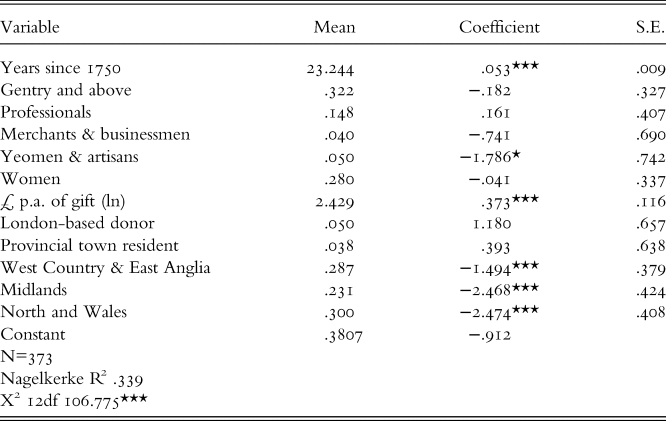
Delving deeper into the characteristics of those donating securities, primarily 3 percent Consols, to charity schooling in the last half of the eighteenth century and those who chose other types of assets produces results that are more remarkable for the differences that fail to show up than for those that do. A logistic binary regression of donor/trustee preferences between 1750 and 1799 in Table 5 reveals that, once controlling for other variables, it made no statistically significant difference if the donor of securities was a man or a woman, from the landed gentry, a professional or a merchant. Only the yeoman and artisan appeared to shy away from the annuities, and the presence of a rough wealth indicator, the natural log of the size of the annual income from the gift, suggests that more than just limited economic resources played a role. Residing in a provincial town center rather than in a village did not make any difference. Being a Londoner did increase the likelihood, but not quite at the .05 level. Thus among those making charitable gifts, donations of securities had become generalized through the nation with regional differences only in degree and no longer in just non-participation. Table 5 also shows those making larger gifts favored securities, and each year increased donors’ fondness for those assets.
Probability of a donor gifting a dividend-bearing security, 1750–99 (binary logistic regression)

Source: See Appendix.
Note: *** indicate p < .001; ** p < .01 and * p < .05. Reference categories: for occupation = unknown; region = London area and home counties
What can be said about the geographical differences that continued to exist in terms of asset choice in trusts? No region had as high a likelihood of gifting them for charity schooling as London and the home counties, where mercantile wealth and familiarity with these financial assets obviously played a role. Lack of access to annuities such as Consols per se in other parts of the country seems unlikely, though, because of the socio-economic level of those making charitable gifts. The finding in Table 5 that donors who lived in rural areas were no less likely to be gifting securities than those who lived in provincial centers argues against an access problem for this group. The government, which continuously had a lot of debt to unload, and those corporate bodies handling its debt made purchasing annuities quite easy, especially after 1750. Many bought annuities directly at the Bank of England, where public space had been greatly expanded to accommodate the traffic (Murphy Reference Murphy2019, pp. 62, 68,74). Propertied Britons from all over the country visited the capital at least seasonally to transact business and deal with legal matters. Publications provided the current prices of securities and regional almanacs listed where and when they could be bought (Murphy Reference Murphy2019, p. 69). Alternatively they could be purchased through a London agent with the help of a local attorney, merchant or country banker that handled the client's bills of exchange and other investments. Such facilitators existed everywhere in the last half of the eighteenth century (Pressnell Reference Pressnell1956, passim; Froide Reference Froide2017, pp. 16, 69; Turner Reference Turner2015, ch. 5).
Reluctance on the part of some to shift from investing in land may have been affected by the ability to realize greater returns from rents than securities. For example, the Midlands, which was no further from London than most of the western counties, showed significantly less enthusiasm for investing in securities, all other factors equal. Perhaps not coincidently, the Midlands enjoyed higher rental values than most other regions during the last half of the eighteenth century (Clark Reference Clark2002, p. 297). Indeed, Table 4 indicates that the region had been the most reluctant to exit rents in the period, with over 50 percent of donations still being real estate.
Distance or lack of access may seem a more obvious reason for the lesser likelihood of the North and Wales investing in securities, but the impact on the donors may have been indirect rather than direct. In those regions, three to five times more donors chose income from loans and mortgages than did donors from London, the home counties or East Anglia. Given the relatively sparse availability of country banking in Wales and the North (Pressnell Reference Pressnell1956, pp. 4–11; Turner Reference Turner2015, table 11), the demand for personal loans by neighbors and tenants may have been greater than in other regions, perhaps raising the rates and also the pressure to offer loans.Footnote 2
All in all, though, the main story remains the broad-based shift away from investment in real estate by donors and their trustees and toward the use of dividend-bearing securities – most particularly annuities. The Consols were perpetual annuities, meaning the government could not be compelled to repay the principal. But they could be traded on the secondary market. They have been described as ‘safe assets’, ‘secure and liquid’ and notable for the ‘relative ease’ by which they ‘could be acquired and disposed of’ (Neal Reference Neal1990, pp. 14, 222; Gorton Reference Gorton2017, p. 554). While it is true that Consols could be easily liquidated, the seller might not be pleased at the price, which during the years of war with France fell to as low as half of par (Neal Reference Neal1990, pp. 232–57; Wright Reference Wright1999, p. 355). Such declines benefitted those entering the market but not those trying to exit. A long history exists as to the general public's skepticism about traded securities. As late as the 1950s in the United States only an estimated 6 percent of adults held securities (Perlo Reference Perlo1958). During the later eighteenth century, by no means everyone was a fan of the Consol (Froide Reference Froide2017, p. 121). Nevertheless, the analysis here shows that donors increased their resort to these annuities for charitable gifting over those years despite some volatility. The love affair between trusts and Consols, moreover, continued into the nineteenth century (Odlyzko Reference Odlyzko2017).
IV
A long-term shift from real estate investment into securities by those creating or managing charitable trusts seems understandable given the relative ease of administering them and the comparative stability of the British government. What continues to be puzzling, however, is the rapidity of the change in the mid eighteenth century. Details on the history of each of the gifts in the Reports provide some insight: the texts describe legislation, judicial decisions and the behavior of trustees, executors and heirs that clearly made both rent charges and interest from private loans less desirable, at least for charitable gifts.
The Charitable Uses Act, which came into effect in England and Wales in 1736, appears to have played some role in the decline of real estate gifts and the switch to other assets to support charity schools. This legislation banned donations that would ‘restrain the disposition of lands, whereby the same become inalienable’ (9 George II, c. 36). It made it illegal to give real estate and the rents from it for charitable purposes, unless it was transferred by deed rather than will and executed before two witnesses at least 12 months prior to the death of the donor and then enrolled in Chancery within six months of its execution. In other words, one could not on one's deathbed as part of a last will and testament devise land or bequeath a rent charge to a charity (Stebbings Reference Stebbings1991). Somewhat misleadingly, contemporaries labeled this law of George II the ‘Mortmain Act’ and it is often referred to as such in the Reports, even though it had nothing to do with the earlier royal edicts bearing the name that prohibited or granted that privilege. During the medieval period, the Crown and lords disliked charitable gifts in perpetuity because they added to the power of the Catholic Church and circumvented the feudal fees that had to be paid periodically upon death or marriage by whoever occupied the land. The ability of a charitable institution to avoid transfer dues to the monarch, though, stopped having any relevance altogether in 1660 when the Crown abolished all feudal tenures. The only aspect shared by the earlier proscriptions and that of 1736 was resentment of an established church.
From the summary statement attached to the legislation, it appears multiple motives went into the 1736 Act, which certainly complicated charitable giving for those with landed wealth. The title of the summary cited above mentions concern about land becoming ‘unalienable’, implying the legislation sought to remove encumbrances to developing real estate commercially. Another sentence in the Act alleges that the ‘improvident’ dispositions of real estate by ‘languishing or dying persons’ had ‘greatly increased’ in recent times. This comment seems to be consistent with the theme of needing rational business considerations to guide decisions on the dispersal of real estate not the anxieties of a testator about to leave the world. The final clause, however, that criticizes devises and bequests for charitable uses that disinherit ‘lawful heirs’ when combined with the ‘greatly increased’ remark mentioned above, hints at another motive that students of inheritance in Western societies will find very familiar – the rivalry between church and the lineage for the wealth of decedents (Jones Reference Jones1969). The passages may be veiled references to the Church of England's campaign during the first third of the eighteenth century to gain adherents through charitable activities, especially the schooling of poor children (Jones Reference Jones1938). And indeed the largest number of charitable gifts in the Reports occurs in the period 1700-30s, as Table 1 demonstrates. The supposed heirs losing out to charity were from the propertied classes not the laboring masses, and the donors gave money not just for teaching youth to read the catechism but for other human capital purposes such as instruction in writing and arithmetic. If Parliament, which was dominated by the landed classes, had such concern about lack of alienability, as stated in the Charitable Uses Act, why did it allow the strict family settlement to develop and flourish from the seventeenth century on, as it created much greater barriers to the sale of property than did charity gifts? Here one sees a different motivation, unrelated to market-based decision-making: the maintenance of the landed classes’ patrimony and power.
We know from the Reports detailing charitable devises and bequests before the Act took effect that testators often wanted to delay the gift of rents or real estate until after they or their widows or other dependents died. The statute complicated such arrangements, just as it foiled any deathbed devises. It also handed passed-over heirs firm grounds for challenging wills in Chancery. The disincentives to using real estate to make charitable gifts after the George II statute appear obvious. But how do we know that it actually got enforced and that it actually changed behavior?
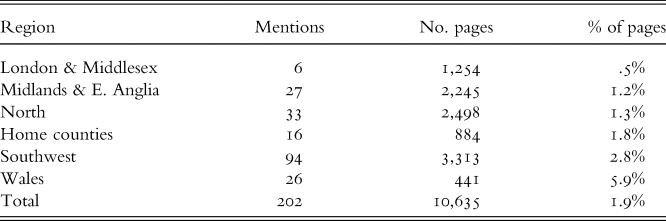
The Reports on charitable gifts made after 1735 reveal a fair amount about the handling of real estate donations by benefactors, trustees or executors and the courts. I went through the first 10,000 pages of the Reports, identifying mentions of rent charges or land devises being void or at risk of being declared void. The results by region are shown in Table 6. Only on 2 percent of the pages does one find such mentions, indicating that most donors after 1735 either avoided charity gifts involved with real estate or went through the laborious and problematic procedure of gifting by indenture and then Chancery enrollment within six months, eliminating the possibility of changing any terms for themselves and their heirs as they could with a will and hoping that they lived at least a year after making the indenture; or they had obtained the promise from their heir-at-law to waive ownership. Some heirs honored the gifts despite their illegality because their parents or benefactors had ordered it and they wished to honor the commitment to the locality All voidable rent charges are flagged by Commission staff in the Reports, even if an action in Chancery or a tenant refusal of payment did not occur. The Charity Commissioners noted these instances of property at risk of voiding, and they are included in the numbers in Table 6. The older the original post-1735 gift, the more likely it was for the property to pass from the heirs to new owners, who would refuse to make further donations.
Mentions of charitable gifts of realty violating the 1736 Charitable Uses statute by region

Source: Great Britain (1819–42), Parliamentary Papers. Charity Commission Reports, vols. 1–17 and 32 pt. 3.
The accounts in the Reports about actions in Chancery indicate that the court seemed to go out of its way to void gifted real estate and rent charges for charitable uses, as they ruled that a testator dying after the statute had passed though having willed the gift earlier had violated the law. They, moreover, expanded the law progressively over the following decades to include as voidable bequests of money erecting a charitable building if some of the money went to purchase land; the sale of land for the purpose of making a charitable gift; bequests of leaseholds, though they were not real estate but personalty; devises of copyholds; bequests of mortgage-secured loans; and gifts of turnpike toll and canal obligations (Jones Reference Jones1969, pp. 114–19).
Table 6 also reveals that conformity to the statute varied by region. Almost no cases, less than half of 1 percent, appeared on the 1,254 pages of London and Middlesex charitable gifts, usually made by those living in the area. Most of the rest of the nation kept under 2 percent –Midlands and East Anglia, the North and the home counties. For reasons not completely clear, the West Country and the Southwest, most notably Devonshire and Hampshire, had somewhat higher percentages, and Wales, not so surprisingly, had about 6 percent, a definite contrast with the London area. Rather than being a north/south difference, it seems the contrast is between east and west. The question, which cannot be answered here, is whether this difference reflects the degree of penetration of equity law or some other difference. Whatever the case, the overall verdict seems clear: donors establishing trusts and making charitable gifts after 1735 had difficulty evading the statute, which in turn means it successfully operated to deter charitable gifts of real estate and rent charges and, therefore, probably reduced philanthropy. Certainly that was the conclusion reached a century later by some Parliamentarians who attempted to repeal the statute on the grounds that it discouraged charitable gifts (Hansard 1846). The effort failed.
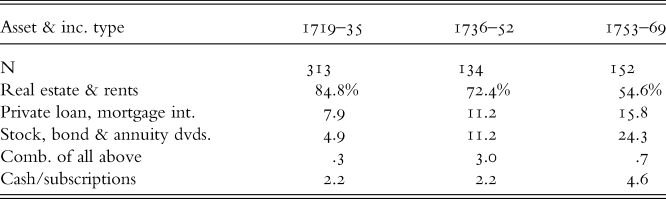
To what extent can the decline in gifts of real estate be attributed to the 1736 Act rather than the attractiveness of managing a trust with annuities, not pesky tenants in arrears? Difficulties arise in trying to separate out the effects of the Act from the appearance of the most popular form of annuity issued by the government in the eighteenth century – when the consolidated debt vehicle, the Consol, first surfaced – because the effects of the Act and of the Consol come close to overlapping. In 1736 not everyone immediately understood what the Act covered and clarity came slowly with Chancery decisions. In addition, benefactors sometimes left it up to their executors to make the asset choice and the executors would only act after the death of the benefactor, which did not always occur in the same year as the will. But leaving those problems aside, Table 7 compares the asset choices in the 16 years prior to the enactment with the 16 years after it became law up through 1752, after which Consols came on the market. The final column shows the 16-year period, 1753–69, to indicate the effect of both the Act and the availability of the new annuities on charitable gifting.
Comparison of Charitable Trust asset choices before and after the 1736 Charitable Uses Act

Source: See Appendix.
In the first period, 1719–35, roughly 85 percent of benefactors donated real estate and rents to their trusts, not too different from most of the preceding periods (see Table 1). The period 1719–35 was vibrant albeit volatile time for financial assets, as the famous Bubble occurred in these years. Long-term annuities were issued not just during the Bubble years but over the whole first third of the eighteenth century (Dickson Reference Dickson1967, table 3); however, very few donors (just under 5 percent) put them in their trusts. Slightly more, nearly 8 percent, chose interest-bearing private loans. However, that percentage did not differ much from the past. The next column treats the post-1736 Act and pre-Consol period. The proportion of charitable gifts in real estate clearly drops, going down to 72 percent, while private loans rose to 11 percent, as did tradeable securities, which more than doubled even though no Consol product had yet appeared on the scene. When Consols began to be sold in 1753, the proportion more than doubled again. While the proportion of private loans rose as well, it fell noticeably behind securities. In the years 1753–69 gifts of real estate continued their decline, going down to around 55 percent.
So even before Consols came on the market, the use of real estate in charitable gifting fell noticeably, leaving one to surmise that the 1736 Act played a role in making that happen. Donors dealt with its effect pre-Consol by gifting in similar numbers of gifts – private loans and tradeable securities. The latter, however, rose more than the former.
Why did private loans in charitable trusts not keep pace with securities? Consols started out at 3 percent, while personal loans could go up to 5 percent before hitting usury limits. Trustee issues may have been involved. What the Reports indicate is that trustees often kept the gift to be put out at interest themselves and just paid the specified amount to the school or schoolmaster quarterly. Out of the 123 cases where donors set aside money to be put at interest, the median per annum interest came to £5 with 75 percent of payouts being for £10 or less. And, as the payments needed to be received quarterly from the borrower before they could be transmitted to the charity, trustees might have found the process burdensome. Keeping the money themselves, however, ran the risk of either their own default or the successor trustees forgetting about their responsibility. Such instances are recorded in the Reports. Also a donor contemplating a long-term gift to a parish charity school might hesitate to gift interest on a loan or specify that trustees put money out to interest, as most loans had relatively short durations that required renewals or replacements. Loans securitized by bonds had their own issues. Even though such documents specified a double payment of debt in the case of default, doubling was seldom enforced by courts. Thus the consequences to a debtor of default would be a lot less daunting than might appear initially.
Later in the eighteenth century, 1766 to be exact, Chancery, under the guise of the 1736 Act, shut down the best gift option involving private loans at interest – the mortgage – where the borrower securitized a loan with land. Only six cases in this dataset mention mortgages, and in only one of those cases does it seem the trustees had chosen that form of securitization. The rest appear to have been transferred by the donor as the mortgagee. The lack of enthusiasm for gifting mortgages as providers of steady income for schools may also be in part due to earlier Chancery decisions during the seventeenth century. By the third quarter of that century, rulings had established equity of redemption rights by mortgagors that made it very difficult to oust them from the land (Waddilove Reference Waddilove2017). Eighteenth-century schoolmasters reliant on mortgage payments to continue operations could not wait out a long default. Mortgages, moreover, were not long term, so the trustees would have the same problem with that form of private loan as with the other types secured or unsecured.
Annuities such as the 3 percent Consols seem to have won out by process of elimination after the 1736 Act made the gifting of rent charges and real estate so difficult. Even if donors had no problem with jumping through all the hoops and gifting rent charges to a charity, that left executors and trustees the job of collecting money from late eighteenth-century tenants being pressured by cost of living issues. As mentioned above, GDP evidence suggests that profits from land and housing were declining. Commentary by churchwardens and school administrators in the Reports about the inability to raise rents supports that conclusion. Consols also took care of the problem of indebted trustees pocketing money supposed to be put at interest, and defaulting mortgagors who claimed equity of redemption. Judging by the behavior noted in the Reports, trustees over time, when they had a choice of investing in land or public securities, seemed to prefer the latter as more trouble free. In this they followed the Accountancy General of Chancery itself, which by the mid eighteenth century, even before the 3 percent Consol had become a major component of government annuities, placed the sizable suitors’ accounts it held in dividend-bearing securities (Dickson Reference Dickson1967, p. 293). The perpetual and set nature of Consols proved particularly important for donors and trustees. Corporate stocks provided the potential of a higher rate of return but also the chance of no return at all. Consols, of course, would not have had such appeal if the British government had not enjoyed a comparatively successful eighteenth century.
V
This article follows the mid-eighteenth-century emergence in England and Wales of widespread ownership of publicly traded securities by a particular type of holder – individual charitable trusts. In making gifts, in this case to support schooling for the poor, English donors of all statuses and occupations in all regions of the country had earlier relied almost exclusively on gifts of real estate or rent charges. Secured and unsecured private loans came in a distant second. Dividend-bearing securities surfaced in the later seventeenth century, but not among this group of investors; they also proved less popular than income from private loans in the first half of the eighteenth century. That changed in the third quarter, and in the fourth quarter tradeable securities soared past even real estate and rent charges to be the most often chosen asset class.
The phenomenon has been worth examining for several reasons. First, because of the traditional reluctance of people to own securities of any sort without strong government encouragement or carefully designed products from the financial community, it is interesting to see the characteristics of the product that attracted the first geographically broad group of English buyers. It turned out to be the same kind of security that the Dutch had popularized – a perpetual fixed-income annuity funding government debt that could be traded on the secondary market. The British government had experimented with a few annuities of this type before, but the 3 percent Consol put out in the early 1750s was a large issuance that consolidated the debt and was the principal component in the triumph of securities over real estate and private loans in the asset choices of those setting up or managing trusts, small and large. The Consols were not completely safe: they fluctuated rather sharply in value, particularly during wartime. Their liquidity came at a price, and they did not necessarily offer the highest return. But trustors and especially trustees apparently ignored these drawbacks, as they planned to hold the securities over the long term and valued predictability over yield. The appeal of these annuities to those making charitable gifts presumably would extend to those needing to arrange postmortem payments to family dependents as well. The fact that by the 1750s the British government had not had a default within the living memory of anyone nor a debasement most likely also helped reassure investors. The analysis here shows that after 1750 it made no statistically significant difference if donors choosing securities lived in the countryside or a provincial town or if they were gentry, merchants/businessmen or had professional status or if they were men or women. Even London residents missed the standard .05 level significance. Region mattered, with individuals from the home counties being more likely to choose securities. However, a third or more of those in East Anglia and in the West chose securities, as did about a quarter in the North and a fifth in the Midlands. Being tied to a local economy as a yeoman or artisan also discouraged securities investment. The popularity of what in the nineteenth century were called the ‘gilts’ is well known, but its spread appears to have originated in the mid eighteenth century and enjoyed great success with those setting up trusts.
A second reason that tracking the switch to tradeable securities from real estate in charitable trusts has been worth studying is the light it sheds on the debate over the effect of the sharp increase in the issuance of government debt on investment. Propertied individuals making charitable gifts invested in annuities by either cashing-in real estate, which GDP estimates indicate might be underperforming, or eschewing the purchase of said real estate in favor of securities. Consols among these investors did not compete with higher risk/reward investments such as those in industrial endeavors.
Finally, the Charitable Uses Act of 1736 apparently acted as a prod for charitable donors to move away from rent charges and real estate purchases toward securities. Evidence in the Reports indicates this legislation changed the behavior of settlors of trusts and their trustees. Even before Consols came on the scene, the percentage realty constituted of gifts noticeably dropped. While more investigation could be undertaken to discover the motivation behind this legislation, which both changed the assets given and reduced charitable gifts, the best guess is that it came out of mixed agendas and cannot be easily classified as part of the eighteenth-century effort to spur economic development in the countryside. In practice, it operated to bolster the patrimonial claims of kin. The volume of the transactions, however, assisted in the growth of the professional finance industry.
Appendix
I compiled the dataset used in this article from the 32 volumes that comprise the first Charity Commission Reports published from 1819 to 1840 and from information about social status and residency found in printed or online local county record collections. These Reports are part of the Parliamentary Papers series, now also available online through Proquest. Tompson (Reference Tompson1979) has recounted in detail the Herculean undertaking of the Commission, and many economic historians are familiar with the source from the in-depth description of it in Clark (Reference Clark1998). The Reports cover all of England and Wales and contain information about the nature and the price of personalty and real estate gifted, bequeathed and devised from the sixteenth century to the early nineteenth century in indentures, wills and deeds dug out of government and local depositories by the Commission staff. The observations in Clark's datasets were not individuals. He was particularly interested in returns on real estate, and consequently he produced separate datasets on land values and enclosures. A third dataset included capital assets; however, the values of publicly traded securities such as Consols were not included, as he focused not on the principal but rate of return.
Because my interest involved understanding changes in investment choices, the 1,434 observations that comprise my dataset cover donors to charity schooling whether that education occurred with other paying students or in formal charity schools. The amount of the gift is expressed as per annum yield from rents, interest or dividends. If a donor specified a lump sum of money that was to be converted to land, private loan, or dividend-bearing securities then 4 percent was taken as the per annum amount. My objective was to discover what kind of assets donors or their executors/trustees were choosing for these long-term gifts, not what actually materialized. Many of these gifts came to naught. My observations concern the original intent of the donor or the trustees/executors, in cases where a donor left it open to his/her immediate trustees, as far as the donation and the asset to be donated. What Chancery or a distant successor trustee ultimately decided in terms of asset was not what appears in this dataset. Those subscribing as a group to a particular school fund are placed in one observation, as it proved impossible to know all the names, amounts and the type of assets in the fund.
The status/occupation of the donor appeared in the reports mainly when the person held an honorific title. Otherwise, I had to go to other local records to find information about their position. If a person was identified as an esquire but made a living as a merchant or a lawyer then that occupation was used as it was more informative. Thus most of those remaining that were coded gentlemen or esquires were probably largely in the rentier class.
The counties that form the regional designations shown in Tables 3 and 4 are grouped in the following manner: (a) home counties: Berkshire, Buckinghamshire, Hampshire and Isle of Wight, Hertfordshire, Kent, Surrey and Sussex; (b) East Anglia: Bedfordshire, Cambridgeshire, Essex, Norfolk, Suffolk; (c) Midlands: Derbyshire, Huntingdonshire, Leicestershire, Lincolnshire, Northamptonshire, Nottinghamshire, Oxfordshire, Rutland, Shropshire, Warwickshire, Worcestershire; (d) the West: Cornwall, Devon, Dorset, Gloucestershire, Somerset, Wiltshire; the North: Cheshire, Cumberland, Durham, Lancashire, Northumberland, Westmorland, Yorkshire; (e) Wales: Anglesey, Breconshire, Cardiganshire, Carmarthenshire, Denbighshire, Flintshire, Glamorganshire, Merionethshire, Monmouthshire, Montgomeryshire, Pembrokeshire, Radnorshire. I included Middlesex with London, and created a variable London resident which included all known donors living in the City of London and Middlesex who either gifted there or outside the metropolis.
For the data in Table 6, I drew on the first 17 volumes which supplied nearly the whole 10,000 pages. Then, to include Wales, I added volume 32, pt. 3, which includes pages on both North and South Wales. The Charity Commission Reports are not arranged by date nor is a volume entirely devoted to a particular county or region. Instead each volume contains the reports by county ready at that point. Listings of gifts to localities in one county can be found in multiple volumes. The online volumes were searched using two different terms ‘mortmain’ and ‘void’.
Listing of the archives used in the inventories from East London and southern Worcestershire in the 1660s and 1720s mentioned in the text can be found on p. 302 of Shammas Reference Shammas1990.