The historiography of the women's suffrage movement in the United States has long emphasized the whiteness of the dominant organizations that promoted women's voting rights—the National American Woman Suffrage Association (NAWSA) and the National Woman's Party (NWP).Footnote 1 This emphasis was a function of the conscious exclusion of African Americans from the movement. After 1890, NAWSA accommodated white southern concerns by adopting a states’ rights approach that enabled southern affiliates to set membership requirements and policy within the states.Footnote 2 As momentum for women's suffrage built, NAWSA and NWP made concessions to white southern suffragists, noting that the Nineteenth Amendment would leave state racial barriers intact.Footnote 3
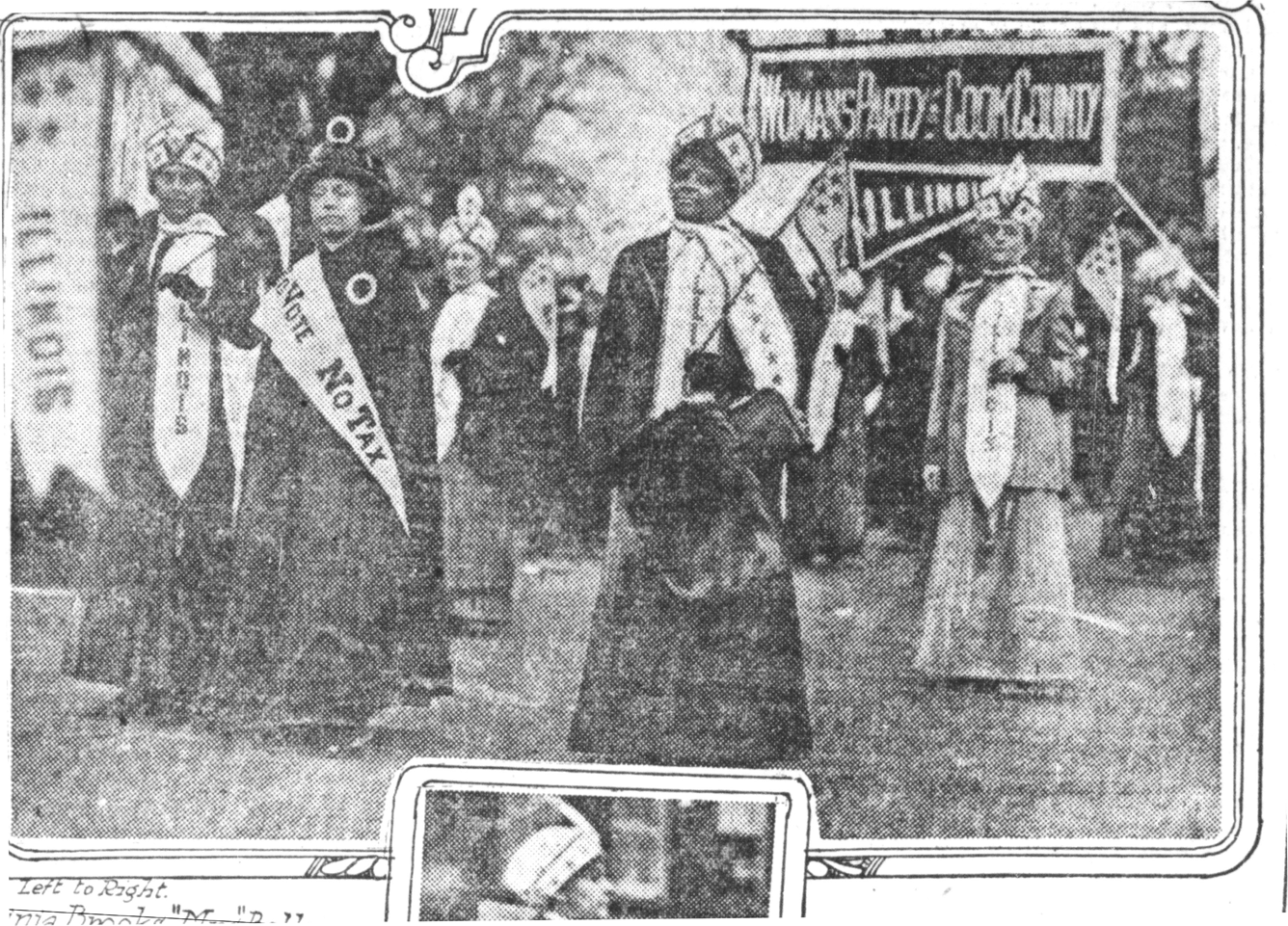
Notable incidents support this emphasis on racial discrimination in the suffrage movement. In March 1913, as African American women mobilized to join a suffrage march in Washington, DC, NAWSA organizers attempted to relegate them to a separate grouping at the procession's rear. Howard University student Nellie Quander had heard that African Americans might be singled out for special treatment by march organizers, and she wanted no part of it. Quander wrote to march co-organizer Alice Paul two weeks before the march, her second letter on behalf of her sorority, Alpha Kappa Alpha, expressing the group's desire “to participate in the woman suffrage procession,” but adding, “We do not wish to enter if we must meet with discrimination on account of race affiliation.” In a separate but parallel incident, on the day of the march, Ida B. Wells-Barnett defied the organizers’ instructions and at the last minute slipped into the line of march with her white Illinois colleagues (fig. 1).Footnote 4
Ida B. Wells marching in the Illinois contingent at the March 1913 suffrage parade in Washington, DC. Chicago Tribune, Mar. 5, 1913.

Discrimination continued in the less visible, daily activities of NAWSA. In 1919, the Northeastern Federation of Women's Clubs, a federation of Black women's clubs in New England and the mid-Atlantic states, applied for NAWSA affiliation. NAWSA officers denied the request, noting “that if NAWSA admitted ‘an organization of 6,000 colored women … the defeat of the amendment will be assured.’”Footnote 5 In 1921, NWP planned to commemorate the movement with the unveiling of a statue of Lucretia Mott, Elizabeth Cady Stanton, and Susan B. Anthony, followed by a national conference. Efforts to include as a speaker Mary B. Talbert, noted African American activist and former president of the National Association of Colored Women (NACW), failed; Paul also resisted a delegation of sixty Black activists who lobbied that Black concerns should have a place on the convention's agenda.Footnote 6
Yet during the century since the adoption of the Nineteenth Amendment to the U.S. Constitution, we have learned that there is more to the story of Black women's suffrage activism than their exclusion from the ranks of white suffragists. The historian Rosalyn Terborg-Penn laid the foundation for a new generation of scholars and the emergence of new questions about Black women suffragists.Footnote 7 Terborg-Penn identified seventy leaders of the Black women's suffrage movement and analyzed their activism between 1850 and 1920.Footnote 8 The theme that emerged in her account is how the broader racial struggle of African Americans intersected with and shaped the Black women's suffrage movement and differentiated the efforts of Black and white women.
My own research builds on Terborg-Penn's work. Beginning in 2008, I proposed to collect and publish online the writings of Black women suffragists whom Terborg-Penn had identified. We worked together in selecting the group and commissioning scholarly essays to accompany the collection. Subsequent work assembled more than two thousand writings by and about Black women suffragists. After we published the first writings, recent scholarship and the digitization of Black newspapers led to the discovery of more and more Black suffragists, leading me to expand the project and take it in a biographical direction. Most of the seventy suffragists of Terborg-Penn's study were national leaders whose biographies were included in leading reference works.Footnote 9 Most of the women I was discovering were grassroots or local leaders about whom little or nothing was known. By 2015, I had identified about two hundred such suffragists; that number now approaches four hundred. Beginning in 2016, I reached out to scholars, librarians, archivists, teachers, and students and commissioned brief biographies for this growing group of Black women suffragists.
The project expanded as I added NWP and NAWSA suffragists to the crowdsourcing project. The database now includes some thirty-six hundred grassroots suffrage activists, including Black and white suffragists, and militant and mainstream suffragists. The resources of the internet make this research and accompanying database construction possible. I am working with more than forty state coordinators to help with outreach and the work of copyediting and fact-checking the resulting sketches. By the end of the process, I expect to have worked with more than fifteen hundred volunteers. Alexander Street, our online publisher, is taking on the technical challenges of constructing a freely accessible website. The database is public, is expanding steadily, and should be complete by mid-2021.Footnote 10
My focus here is on the suffrage and reform activism of the almost four hundred Black women suffragists that we've identified thus far. I rely on four distinct sets of sources. The first consists of about three hundred biographical sketches that have been completed to date, including those of the prominent activists identified by Terborg-Penn. Eventually these brief biographies will allow us to consider new questions about Black women and the suffrage movement: Was there a Black women's suffrage movement? What was its character? What issues did it address? And what part did Black women suffragists play in the Long Freedom Movement? But right now, I am mainly working on the level of detail in the individual biographical sketches to address the question: What can we learn about the Black women's suffrage movement from the details of these women's lives?
Second, I have created a small database with about thirty variables coded from each suffragist sketch completed thus far.Footnote 11 I've compiled a preliminary statistical overview of the group. In addition, I have assembled more than two thousand works written by or about these activists. Lastly, at least ninety-five of these women corresponded with W. E. B. Du Bois, the founder of the National Association for the Advancement of Colored People (NAACP) and leader of the Black freedom movement after the death of Booker T. Washington in 1915. This correspondence—1,640 items in all—has been digitized, providing a valuable source for analyzing connections between Du Bois and Black women suffragists.Footnote 12 Taken together, these resources permit new explorations of Black women suffragists’ activism before and after the passage of the Nineteenth Amendment. This progress report comes while we still await about one hundred more biographical sketches that are out on assignment. The findings are preliminary, but still useful.
What can we learn from these biographical sketches? Some of these suffragists are relatively unknown; others are quite famous. Their demographic data and personal experiences reveal their geographic distribution, age, religious affiliation, education, economic standing, and social justice commitments. Using the sketches, we can construct a collective portrait of Black women suffragists that will help us to understand their importance in the context of broader social movements. For example, their stories reveal the significance of migration from the South to the emergence of an organized Black movement for women's suffrage. Importantly, their stories also show that the Black women's suffrage movement was the composite creation of dozens of local women's groups addressing their own individual circumstances. A national picture emerges from myriad local ones, revealing the importance of paying close attention to local actors and events.
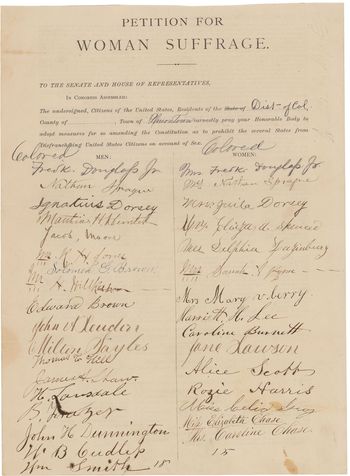
Let's begin with two obscure women who were part of a group of Washington, DC, African Americans who supported women's suffrage during the Reconstruction decade. They were signers of a petition submitted to Congress in January 1878 that called for a constitutional amendment “to prohibit the several States from Disfranchising United States Citizens on account of Sex” (fig. 2).Footnote 13 The petition seems to have been organized by a son and daughter of the noted abolitionist, Frederick Douglass, who circulated it among friends and acquaintances, including a group of African American settlers on the former Barry Farm—a planned settlement organized by the Bureau of Refugees, Freedmen and Abandoned Lands, or Freedmen's Bureau, with small lots sold to freedmen and freedwomen at low monthly installments. More than a third of the petition signers lived in this neighborhood, less than a mile from the homestead, Cedar Hill, that Frederick Douglass purchased in 1877.Footnote 14 The three Douglass sons—Lewis, Charles, and Frederick, Jr.—all purchased lots at Barry Farm, and Lewis submitted a second women's suffrage petition in 1878.Footnote 15
Petition for Woman Suffrage from Frederick Douglass, Jr., and Other Residents of the District of Columbia, 1878. Petitions and Memorials, Resolutions of State Legislatures, and Related Documents Which Were Referred to the Committee on the Judiciary during the 45th Congress (HR 45A-H11.7), Records of the U.S. House of Representatives, 1789–2015, record group 233, no. 7330216, National Archives, Washington, DC, www.docsteach.org/documents/document/douglass-petition-woman-suffrage (accessed June 28, 2020).

Among the signers of Frederick Douglass, Jr.'s petition were Caroline Chase and her adult daughter Elizabeth. In 1860, the Chases lived together in Ward 2 in Northwest DC and worked as washerwomen. Elizabeth was listed in Freedmen's Bureau records as receiving $3 in cash relief twice just after the Civil War. Caroline was recorded in the 1870 census as owning real property valued at $200.Footnote 16 These resources enabled mother and daughter to purchase nearby lots on Elvans Avenue in Uniontown before 1871. By 1873, Elizabeth Chase was living in her new neighborhood and was operating an eating saloon, a decided step up from domestic labor. In April 1874, Augustus Straker, a Black lawyer employed by the Treasury Department, gave a lecture at the nearby Pioneer Lyceum, titled “Citizenship, its rights and duties—woman suffrage.” Whether either Elizabeth or Caroline Chase attended that lecture is unknown, but the petition confirms their support for women's suffrage.Footnote 17 Washington, DC, was home to 15 percent of Black women suffragists in this study. Along with New York City, the District was a leading center for Black women's suffrage activism, and an example of the power of migration and local communities in this history.
Brooklyn was a second locale that played a significant role in the emergence of a Black women's suffrage movement in the early twentieth century. One suffragist whose story this project has uncovered was Alice Wiley Seay. Born a slave in 1858 in south-central Virginia, in 1886 she married a tobacco farmer from her hometown of Giles. By the mid-1890s, she and her husband had moved to Brooklyn; he was recorded at different times as a coachman, blacksmith, and janitor; she, as a dressmaker. Without children, Alice could devote her energy to social activism. A devout churchgoer, she was president of the Dorcas Home Missionary Society of the Concord Baptist Church and was active in the Black women's club movement in Brooklyn. Seay was elected president of the Northeastern Federation of Women's Clubs in 1905, and three years later founded the Empire State Federation of Women's Clubs (ESFWC), which joined in campaigns for women's suffrage.Footnote 18
After the death of her first husband, Seay remarried in 1910, to another Virginia tobacco farmer, though she continued to live in Brooklyn.Footnote 19 In December 1916, the Dorcas Home Missionary Society gave her a testimonial dinner as she moved permanently to her husband's farm.Footnote 20 Though she lived in Virginia thereafter, she made lengthy visits to her old Brooklyn neighborhood and had a sister still living there.Footnote 21 Virginia death records noted Alice Wiley Seay as a social worker, an appropriate occupation for an active Black clubwoman. Although Seay resided in Virginia for the last two decades of her life, more than three hundred of her former friends and neighbors attended a memorial service held in Brooklyn.Footnote 22
These individual life stories speak to larger social processes at work among Black women suffragists as they struggled for citizenship rights. Analyzing the quantitative information contained in their biographical sketches and in other secondary sources fills out the picture that emerges from individual stories. Those suffragists who lived to see the ratification of the Nineteenth Amendment, and who may have voted in that year's presidential election, had a mean age in 1920 of forty-eight, and they had been active suffrage supporters for eleven years on average. Black suffragists were well distributed across the country: 42 percent lived primarily in New England and the middle Atlantic states, 32 percent came from the South, and the remainder lived in the Midwest and West. These activists were part of the first wave of the Great Black Migration that reshaped the lives of African Americans between 1890 and 1920. Of 260 Black suffragists with known places of birth and death, 159 were born in the upper or lower South. Only 21 percent of these Black southerners died in the states of their birth—almost 80 percent migrated and died elsewhere, a testament to the importance of the Great Black Migration in the emergence of the Black women's suffrage movement in these decades.
Among the additional characteristics that stand out are the activists’ high level of education and their strong participation in the Black women's club movement. Fully 67 percent of the activists for whom level of education is known attended college or university. Overall, 42 percent had a BA degree or higher. In a time period when Black Americans often had to struggle just to support public education in their communities, the higher educational achievements of Black women suffragists are striking. Equally significant in this emerging picture of active citizenship was the fact that fully 58 percent were members of a club associated with the NACW. This number is no doubt an underestimate; many more were probably engaged in club work than is apparent from these sketches. In researching Black women suffragists, one finds numerous references to women's engagement in efforts on behalf of their race, but far fewer indications of their commitment to women's suffrage. The suffrage activism was folded into the larger racial project in this period when Jim Crow and Black disfranchisement were gaining strength. Suffrage was a means to achieve broader ends—particularly the defense of Black men and women against lynching and racial subjugation.
Religion was as significant as the Black women's club movement for these suffrage activists. The biographical sketches reveal denominational affiliations for about half of the women. Except for a lone Catholic and one Baha'i convert, all were Protestants; Baptist (40) and African Methodist Episcopal (35) were the two leading denominations. Churches encouraged and facilitated aid to the poor that was strongly compatible with the concern for racial uplift central to the Black club movement's activities. Denominational groups also offered additional venues for both advocating for the race and advancing the status of women within church and society. The Woman's Convention, an auxiliary to the National Baptist Convention was a particularly important site for women's activism as the Black women's suffrage movement was taking shape. In terms of goals, programs, and leaders, the Woman's Convention and the NACW were closely intertwined.Footnote 23
This new trove of biographical sketches enables us to place suffrage activism within the context of the broader Black freedom struggle that emerged in the early twentieth century. Almost a third of the women—ninety in all—were active in the NAACP. Another sixty-one were active in the Young Women's Christian Association (YWCA), forty-five in fraternal organizations, and thirty-four in the Woman's Christian Temperance Union. The sketches reveal that activists engaged in the gamut of social justice campaigns within the Black community.
This conclusion is consistent with the perspective offered by scholars of Black women's political engagement in the years between the passage of the Thirteenth and Nineteenth amendments. Elsa Barkley Brown's research on women in Richmond, Virginia, emphasizes the community dimension of Black women's political engagement, focusing on racial group concerns rather than gender.Footnote 24 Terborg-Penn captured a similar point in quoting Josephine St. Pierre Ruffin: “We are justified in believing that the success of this movement for equality of the sexes means more progress towards equality of the races.”Footnote 25
Founded in 1896, the National Association of Colored Women was committed from the beginning to collective racial uplift, with suffrage as a central issue. From its founding, the NACW had a suffrage department, headed by the Brooklyn activist Sarah J. Garnet.Footnote 26 The suffrage issue, though, had a different meaning for African American women during this era than it had for white women suffragists. Addie Hunton, a founder of the NACW, captured that distinction, writing in 1908 about the NACW's suffrage department: “They are making no fight for the ballot for women, but they are earnestly working for the rights of our men.”Footnote 27 In a period of growing disfranchisement, Black clubwomen initially made defending the voting rights of Black men their first suffrage priority.Footnote 28 Taking a long view, Black women's clubs moved from an emphasis on temperance and wholesome family life for Blacks to a call for a change in attitudes and behavior on the part of whites. This perspective evolved from a call first to protect or restore Black men's voting rights in order to better protect the race, and after 1912 to extend the ballot to Black women as well.
The picture of Black women suffragists that emerges here becomes clearer when we realize that 47 percent were teachers or educators; another 10 percent were writers or journalists, and 7 percent were professionals. Only 8 percent of the Black suffragists were in working-class occupations; in that group, only ten were domestic servants, six did sewing, and one worked in agriculture—major occupations for African American women at this time. NWP supporters actually displayed a more diverse occupational profile: Writers and journalists comprised almost 15 percent of those with recorded occupations, a figure similar to that for Black suffragists. Teachers and educators, though, comprised only 14 percent of NWPers, less than a third of the figure for Black activists. The group that stands out in the NWP, though, consisted of working-class occupations, comprising almost a quarter of NWPers with known occupations. At the other end of the occupational spectrum, almost 5 percent of NWP supporters were recorded as business women. So, while Black suffragists were concentrated in middle-class occupations, the militant white suffragists were well represented at both the lower and upper ends of the class spectrum.
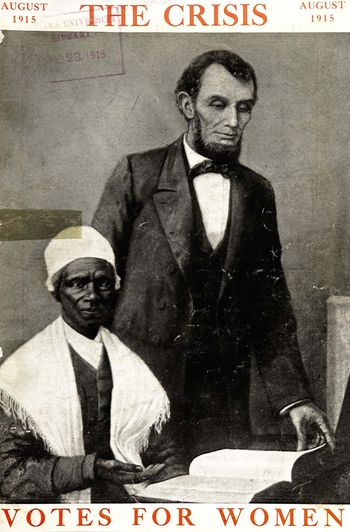
One other aspect of the networks of Black women suffragists needs mention. Fully 95 of the women activists had correspondence with W. E. B. Du Bois, with more than 1,640 letters in all. Du Bois stood out among Black male rights advocates for his early and consistent support for women's suffrage. He edited two special issues of the NAACP's official magazine, The Crisis, devoted to women's suffrage, and he gave coverage to Black participation in the March 1913 suffrage parade in Washington, DC (fig. 3).Footnote 29 We see among Du Bois's most active correspondents a long-time commitment to women's suffrage: those correspondents who exchanged ten or more letters with Du Bois averaged sixteen years of suffrage activism, compared with less than eight years for those with no correspondence with Du Bois.Footnote 30
Cover, special suffrage issue of The Crisis, Aug. 1915.

Black suffragists looked to Du Bois for advice and leadership and they also wrote words of support and encouragement. Four leaders of the Brooklyn-based Equal Suffrage League wrote in August 1907 as the Niagara Movement was getting launched: “be assured that we are with you in the spirit of the work to co-operate in any practical way.”Footnote 31 Six months later, they shared with Du Bois a copy of a petition they had sent to Congress calling for enforcement of the Fourteenth and Fifteenth Amendments to protect Black citizenship rights “[t]hroughout all its section[s],” a pointed reference to the denial of Black voting rights in the South.Footnote 32
NACW co-founder Addie Hunton, who was also a leader in the early NAACP, was one of the most prolific correspondents: she and Du Bois exchanged more than hundred letters between 1907 and 1934. In one of her earliest letters, when Hunton had just moved to Brooklyn, she wrote of meeting “with some women who want to inaugurate a movement among colored women but who seem too afraid of the southern white women to do right.” These might well have been the same women who had recently written to Du Bois in support of the nascent Niagara Movement. Hunton did not feel at liberty to discuss their plans, but suggested that she might consult him later: “you could perhaps help me in deciding what can be done.”Footnote 33
While white and Black women created largely separate organizations to work for women's suffrage, the existence of distinct groups did not preclude alliances. One such effort took shape in Tennessee, which eventually became the thirty-sixth and final state needed to approve the Nineteenth Amendment in August 1920. The previous year, the Tennessee state legislature had approved a bill providing women municipal and state suffrage. In the runup to local elections in Nashville, white and Black women's suffrage leaders joined forces. As the historian Carole Stanford Bucy has written, white suffrage leader “[Catherine] Kenny forged a political relationship with Frankie J. Pierce and Dr. Mattie Coleman, two African American activists, to support reform candidates in the 1919 local Nashville elections. In return, Kenny promised support for Pierce's legislative agenda, a state vocational school for African American girls.”Footnote 34
Both of these Black suffrage leaders addressed mixed suffrage audiences. Dr. Coleman spoke at the annual convention of the Tennessee Equal Suffrage Association in early June 1919. As the Nashville Tennessean recorded her speech: “The negro woman stands for purity and uplift. … We ask merely to be treated right. This war work we have been doing has done more to bring us into close touch with you women than any other thing.” After quoting further from Coleman's speech, the article noted that “Dr. Coleman was made chairman of the Tennessee negro women's suffrage organization,” and assured the paper's (white) readers that she would be working “under the supervision” of white suffragists. Another account from the Tennessean in July 1920 named that organization as the Negro Women's Reconstruction League and noted that it had already registered some sixteen hundred voters.Footnote 35
In the spring of 1920, Kenny “invited Frankie Pierce to address the meeting” of the Tennessee League of Women Voters. “Pierce told the [LWV] convention that her sisters would use the vote to ‘uplift our people’ and asked only for a ‘square deal.’”Footnote 36 Dr. Coleman, for her part, launched a campaign that registered some twenty-five hundred Black women for the 1919 election. In 1921, the state legislature provided for the establishment of the Tennessee Vocational School for Colored Girls, which opened in October 1923. In this way, Black women gained resources for the Black community by exercising their newfound voting rights.Footnote 37
The historian Anita Shafer Goldstein, who has offered the fullest account of this interracial alliance in Tennessee, concluded that “the alliance produced concrete gains and demonstrated the importance of organization within the African American community. … The decision to support reformers against machine candidates in the city was a bid for access to the growing agencies of state government via the Democratic party organization.” Goldstein emphasized the agency of Black women suffragists, noting, “It was not ‘apathy, accommodation, and caste’ that characterized them, but vigorous action, the offer of cooperation in return for concrete benefits, and an eagerness to make use of any breach in the walls of separate sisterhoods.”Footnote 38
Wilmington, Delaware, offers a second example demonstrating the possibilities of white and Black suffragists working together, even as they worked through segregated organizations. Like Nashville, Wilmington was situated in a Civil War border state that had a sizable Black population and a lengthy post-slavery history of segregation. Events there emphasize how important local initiatives were as Black women suffragists emerged as political players in women's suffrage campaigns. This story suggests, in fact, that the practice of Jim Crow could actually contribute to the emergence of a strong Black women's suffrage movement. The story begins with the Howard School, an all-Black high school in Wilmington—in fact, the only four-year free high school that Black students in Delaware could attend. Because of residential segregation, the teachers were largely confined to a few square blocks centered on East 10th and 11th Streets, the city's Black middle-class enclave. The density of teachers living there gave East 10th Street the informal name “Teachers’ Row.”Footnote 39
The Black faculty included half a dozen teachers who joined with other women in March 1914 and founded the Equal Suffrage Study Club (ESSC), aimed at “arousing interest in the suffrage movement among colored women.”Footnote 40 Many of these women had earlier worked together on Black self-help undertakings, exemplified in their support for two Black institutions, the Home for the Aged and the Settlement House.Footnote 41 The new group held twice-monthly meetings focused on “questions of municipal, state, national, and international interest.” In May 1914, members joined the city's white suffragists and “marched, in a separate contingent, in Wilmington's first [woman] suffrage parade,” with Blanche Stubbs serving as marshal of the “‘colored’ section.”Footnote 42
The two groups continued to work to secure women's suffrage in a 1915 effort to amend the state constitution and a 1919–20 campaign to convince the state legislature to ratify the Nineteenth Amendment. In the latter campaign, schoolteacher and ESSC member Alice Baldwin joined a group of NWP members who “lobbied the governor to convene a special session of the legislature to consider ratification.” According to her biography, “Two days later, she was the only African American speaker at an NWP ‘suffrage mass meeting’ held at the (segregated) Majestic Theater in Wilmington. … Alice Baldwin's address was entitled, ‘The Colored Teacher's Tale.’”Footnote 43
The state legislature did not ratify the Nineteenth Amendment, but Delaware women won the vote with the Amendment's final ratification in August 1920. Immediately, ESSC members turned their club into the Colored Women's Republican Committee, “blocked out the city into workable districts,” and worked to register the newly enfranchised Black women voters. Their efforts came off smoothly and Alice Baldwin reported in a letter to the NAACP that “things passed off here very nicely and peaceably. Many women voting … intelligently and honestly.”Footnote 44
While Black women voted in Wilmington, that was not the case for Blacks in the South more generally.Footnote 45 Mary Woodlen, another ESSC member, “took part in a protest over the disfranchisement of African American women in states of the former Confederacy.” Woodlen joined a Delaware group in February 1921 to observe the unveiling in the capital of a statue of suffrage leaders Stanton, Anthony, and Mott. There she joined a delegation of sixty Black suffragists, including fellow Wilmington residents Alice Dunbar-Nelson and Blanche Stubbs, that met with Alice Paul and protested the NWP's failure “to go on record as disapproving the disregard of the Nineteenth Amendment” throughout the South.”Footnote 46 Whether marching in a suffrage parade, lobbying Delaware state legislators to ratify the Nineteenth Amendment, or protesting the racism of the NWP's accommodation of white supremacy, Black women in Wilmington were engaged suffragists determined to secure their citizenship rights.
This discussion leads us logically to our final focus—what Black women suffragists did after the passage of the Nineteenth Amendment. One can sum it up in one word—politics—though there was more than one way to proceed in post-suffrage politics. Now that Black women were voters, at least outside the South, they increasingly came to pressure their representatives. At the federal level, the leading issue was a demand for anti-lynching legislation. Of course, Ida B. Wells-Barnett had been working to make lynching a very visible issue for almost three decades before the adoption of the Nineteenth Amendment, but after 1920, the anti-lynching campaign gained the NAACP's institutional support.Footnote 47 Congress got much more serious about the cause after 1920, with the Dyer Anti-Lynching Bill providing the vehicle for the movement. Still, the cause could not overcome the threat of a southern filibuster in the Senate. Notable suffragists who joined the NAACP's campaigns included Charlotta Bass, Nannie Helen Burroughs, Alice Dunbar-Nelson, Bertha Higgins, Lugenia Burns Hope, and Mary B. Talbert.
The other avenue for suffragists’ fuller entry into politics came through work within the Republican Party. An early indication of the power of the vote came in Chicago, well before the Nineteenth Amendment was ratified. In 1913, the Illinois state legislature approved women's municipal and presidential suffrage. Wells-Barnett had anticipated the development by founding the Alpha Suffrage Club earlier that year, and Black women suffragists played a major role in succeeding aldermanic elections, registering new Black women voters, sponsoring candidate forums, and getting out the vote in both primary and main elections. Their race efforts met success in 1915 with the election of Oscar DePriest as the first Black alderman in Chicago.Footnote 48
Black women suffragists joined the Republican Party before and after 1920. In Wilmington, the ESSC rapidly reorganized as the Colored Women's Republican Committee. In New York, shortly after the November 1917 referendum that approved women's suffrage, Black women in Harlem organized the Women's Non-Partisan Political League. Two New York City Black suffragists, Gertrude Curtis and Laura Fisher, served as delegates to the state Republican convention in 1918. In Kentucky two years later, Annie Simms Banks was appointed a delegate to that state's Republican convention.Footnote 49 Suffragists got on the ballot themselves in numerous states: Mary Byron Clarke and Ida B. Wells-Barnett in Illinois; Grace Campbell in New York; Charlotta Bass in California; and Alice Presto in Washington.Footnote 50 They were not successful in these early runs for office, but they energized Black voters.
Viewing the database of Black women suffragists as a whole, we find ninety-two women active within the Republican Party, seven among the Democrats, and five active in the Socialist, Communist, or Progressive parties (though a migration to the Democratic party began to be evident with FDR's election in 1932). Both major parties played roles in cementing Black loyalty to the Republican Party for several generations—the Republican Party in passing the Thirteenth, Fourteenth, and Fifteenth amendments, which enfranchised freedmen after the Civil War, and the Democratic Party in the South in overthrowing Reconstruction and then disenfranchising Black men in the 1890–1910 period. This political alignment was fixed in place well before the passage of the Nineteenth Amendment, and Black women suffragists did not hold back when they had the opportunity. Moreover, they did not just follow the lead of Black men in politics. They had, in fact, developed a critique of the ineffectiveness of Black men in the years when only men could vote,Footnote 51 and they built on their decades of organizing in the Black women's club movement and carved out a place for themselves in city, state, and national politics.
Black suffragists’ post-1920 activism reinforced alliances that had been established in the struggle for the vote. Recall that Wilmington Black activists spoke at a mass meeting of the NWP in the joint effort to get the Delaware state legislature to ratify the Nineteenth Amendment. Three years later, the leading Delaware Black suffragist Alice Dunbar-Nelson convinced the Delaware Federation of Colored Women's Clubs to endorse the newly proposed Equal Rights Amendment promoted by the NWP.Footnote 52 Even at a time when Black suffragists were pressing the NWP to lobby for the Nineteenth Amendment's enforcement in the South, they could find other grounds on which to join with the NWP in pressing for broadened rights for women.
The evidence presented here leads to a number of conclusions. Black women made a serious commitment to the women's suffrage cause, embedding it in the broader African American campaign for citizenship rights. Given the mounting attacks on Black Americans in a period described as “the nadir” in race relations, race trumped gender in the thinking and efforts of Black women suffragists.Footnote 53 The national activist Mary Church Terrell expressed a perspective that was widely shared: “nowhere in the United States have my feelings been so lacerated, my spirit so crushed, my heart so wounded, nowhere have I been so humiliated and handicapped on account of my sex as I have been on account of my race.”Footnote 54 This was a central fact in the lives of Black women suffragists that white suffragists did not face.
Given the growing racial division in the nation in the early twentieth century, Black women organized suffrage activities on their own; white and Black priorities were not the same. Still, at numerous points in the women's suffrage struggle, Black and white activists coordinated their efforts. Moreover, the suffrage activism of Black clubwomen contributed to a growing women's presence in early civil rights struggles. It is no coincidence that so many of the Black women suffragists noted here were among the founders and activists in the early NAACP. And the legacy of their activism is visible still today. They launched traditions of civic engagement that showed the way for Ella Baker, Fannie Lou Hamer, Shirley Chisholm, and Stacy Abrams, who have brought these citizenship struggles into our time. Whether it is the Black Lives Matter movement or today's fight against voter suppression, the struggles launched by Black women suffragists are still being fought fully a century later.