Implications
Traditionally, lactating sows are placed in farrowing crates to avoid crushing of the suckling piglets by the sow. Our research indicated that temporary confinement might be sufficient to secure piglet survival. In the current study, confinement of the sow for 4 days was enough to reduce piglet mortality. This has significant implications for reducing the period of time necessary to place behavioural restrictions on lactating sows, and thereby improve their welfare. However, research is needed to identify the balance between the welfare impacts of temporary crating on the sow v. the survival of the piglets.
Introduction
The increased focus on animal welfare within intensive pig production has resulted in an expectation that sows in the future will be loose-housed during the lactation period, as is already the case in Norway, Sweden and Switzerland (Weber et al., Reference Weber, Keil, Fehr and Horat2009). Currently, farrowing crates are the most widespread means of housing sows during lactation, with an estimated 98% of lactating sow being kept in crates (Barnett et al., Reference Barnett, Hemsworth, Cronin, Jongman and Hutson2001). The period of confinement varies between countries, but within the European Union sows normally enter the crates ∼1 week before expected farrowing and then stay confined until weaning of the piglets between 21 and 28 days postpartum. The farrowing crates have clear advantages in being space-saving, labour-saving and provide practicability for handling faeces and urine from the sows, and thereby maintain a hygienic immediate environment for the suckling piglets (Barnett et al., Reference Barnett, Hemsworth, Cronin, Jongman and Hutson2001; Rantzer and Svendsen, Reference Rantzer and Svendsen2001). Nevertheless, from a welfare point of view, the farrowing crate has its limitation. The crate limits the sows’ possibility to perform natural behaviours such as nest building and interaction with the piglets. In addition, crating of the sow during farrowing can cause prolonged farrowing, as sows in crates have lower oxytocin levels in the blood (Verhovsek et al., Reference Verhovsek, Troxler and Baumgartner2007; Oliviero et al., Reference Oliviero, Heinonen, Valros and Peltoniemi2010). Several authors have reported a correlation between prolonged farrowings and increase in stillborn piglets (Fraser et al., Reference Fraser, Phillips and Thompson1997; Borges et al., Reference Borges, Bernardi, Bortolozzo and Wentz2005; Canario et al., Reference Canario, Cantoni, Le Bihan, Caritez, Billon, Bidanel and Foulley2006), and indeed Cronin et al. (Reference Cronin, Simpson and Hemsworth1996) and Oliviero et al. (Reference Oliviero, Heinonen, Valros and Peltoniemi2010) observed more stillborn piglets among sows in farrowing crates compared with sows that were loose during farrowing. On the other hand, Cronin et al. (Reference Cronin, Lefébure and McClintock2000), Weber et al. (Reference Weber, Keil, Fehr and Horat2007) and Pedersen et al. (Reference Pedersen, Berg, Jørgensen and Andersen2011) failed to detect such a difference.
Blackshaw et al. (Reference Blackshaw, Blackshaw, Thomas and Newman1994), Weary et al. (Reference Weary, Pajor, Thompson and Fraser1996) and Marchant et al. (Reference Marchant, Rudd, Mendl, Broom, Meredith, Corning and Simmins2000) observed more dead piglets after farrowings in pens with loose sows than among sows giving birth in crates, whereas Weber et al. (Reference Weber, Keil, Fehr and Horat2007) reported the same pre-weaning mortality among loose and crated sows. Nonetheless, in the investigation by Weber et al. (Reference Weber, Keil, Fehr and Horat2007), a higher proportion of piglets were crushed by sows in the loose systems compared with the sows housed in farrowing crates. The contradictory results from the different work indicate that satisfactory results in the form of acceptable pre-weaning mortality have yet to be consistently achieved. The majority of piglets that die pre-weaning die within the first day postpartum (Holyoake et al., Reference Holyoake, Dial, Trigg and King1995; Marchant et al., Reference Marchant, Rudd, Mendl, Broom, Meredith, Corning and Simmins2000), mainly because of crushing and starvation (Dyck and Swierstra, Reference Dyck and Swierstra1987; Pedersen et al., Reference Pedersen, Jørgensen, Heiskanen and Damm2006). This means that potentially lactating sows do not have to be restrained during the entire lactation period. However, there is limited knowledge on the time period that lactating sows need to be confined to reduce pre-weaning mortality.
The aim of the present study was consequently to investigate whether confinement of the sow for a limited number of days after farrowing would affect piglet mortality. The hypothesis tested was that confinement of the dams in farrowing crates in the first days postpartum would reduce piglet mortality.
Material and methods
This study was conducted in accordance with the guidelines of the Danish Ministry of Justice with respect to animal experimentation and care of animals under study.
Experimental design
The effect of confinement of the sows in farrowing crates on the number of stillborn and dead piglets until day 10 postpartum was studied in a commercial 750-sow piggery (Siljebjerggaard, Braedstrup, Denmark). The sows and their subsequent litters were followed from entry into the farrowing section until 10 days postpartum. A total of 220 sows (Danish Landrace × Danish Yorkshire) were randomly allocated on the basis of parity to one of four treatments: (a) loose during the entire experimental period (LL), (b) loose and then crated after the end of farrowing from days 0 to 4 postpartum (LC4), (c) loose and then crated after the end of farrowing from days 0 to 7 postpartum (LC7) or (d) crated from introduction to the farrowing pen to day 7 postpartum (CC7). For treatments LC4 and LC7, the crates were closed when the staff registered termination of farrowing after expulsion of the placenta. The study was conducted over 11 farrowing batches and during each batch ∼20 sows entered the study.
Housing
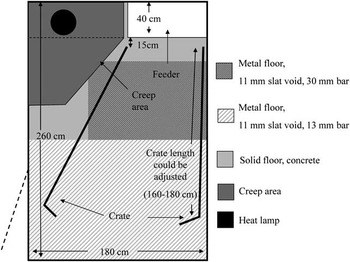
In the mating and gestation units, the sows were individually housed in stalls and fed home-mixed liquid feeds formulated to fulfil or exceed the nutrient requirements for this genotype of pigs. The farrowing house consisted of 13 sections with different types of combination farrowing pens (combi-pen) and traditional farrowing crates. The farrowing house was diffuse ventilated with a room temperature of 22°C to 23°C. Only one section with 20 identical combi-pens was used in the current study. A drawing of the combi-pen can be seen in Figure 1. The individual combi-pen measured 4.7 m2 and was equipped with a farrowing crate that could be used to confine the sow. When the sow was loose, the sides of the crate were opened and placed along the sidewall and the covered creep area. There were no protection rails along the sidewalls or the creep area to protect the piglets when the sow was lying down. The partitions were solid on all sides except in front of the trough and in the gate to the aisle. One-third of the floor in front of the trough was drained (10% void) and two-thirds was fully slatted (40% void). The drained floor constituted the expected lying area for the sow. The creep area had solid floor with floor heating with an outflow temperature of 42°C to 43°C. For the first 4 days after farrowing, a 150 W heat lamp was provided in the covered part of the creep area. The covered creep area was placed towards the aisle for easier supervision and access to the piglets for the staff. When the piglets had to be handled, it was possible to close the creep area with a plate that could be lowered in front of the entrance.
Layout and size of the combi-farrowing pen used in the current study.

Management routines
Apart from the period during which the sows were confined, there were no differences in the handling of the sows and their litters. Sows were fed normal Danish diets formulated to fulfil the requirements for this genotype of sows. The energy level was 10.5 MJ NE/kg dry matter (DM) and CP content was 12% for gestating sows. They were fed ∼26 MJ NE per day. For lactating sows, the energy level was 11.1 MJ NE/kg DM and CP content was 14%. The sows in the farrowing house were fed a liquid feed three times a day, and the animals had ad libitum access to water via drinking nipples in the trough. The sows were moved into the farrowing section ∼1 week before expected farrowing. After entry to the farrowing pens, all sows received ∼3.5 kg DM per day. Two days before expected farrowing this was reduced to ∼2.1 kg DM per day, and after parturition the amount of feed was gradually increased so that the sows received ∼9.9 to 10.5 kg DM per day, 14 days postpartum. The manure system restricted the amount of nest-building material possible to provide to the sows. Therefore, the sows only received a handful of chopped straw each morning and evening until they had farrowed. In the treatment groups LC4, LC7 and CC7 where the sows were confined, the sides of the crate were adjusted according to the size of the sow. No further adjustment of the crate was done before it was opened on days 4 or 7 after farrowing. The suckling piglets were shut in the creep during the first feeding of the sow after termination of farrowing. Litters were equalized within 24 hours after birth when it was expected that all piglets in a litter had consumed colostrum. At litter equalization, first and second parity sows were entrusted 14 piglets, whereas all other sows were allotted 13 piglets. Only sows with fewer functional teats were assigned fewer piglets. Weak born piglets were defined, as piglets deemed unable to survive if ignored. All weak born piglets were fostered to a nurse sow in a different section that was not part of the trial to ensure that all piglets in the study were viable. After litter equalization, the litters were stable meaning that no sow received additional piglets. The piglets were tail docked, and males were surgically castrated on days 3 or 4 after farrowing. During the experimental period, the piglets had ad libitum access to both fresh water and water with added iron through nipple drinkers.
Records
Sow parity and date were listed when the sow entered the farrowing section, along with the dates when the crate for the sows receiving treatment LC4, LC7 and CC7 were closed and opened, respectively. In addition, farrowing date and the number of stillborn and live-born piglets at farrowing were noted in addition to the date for litter equalization and the number of piglets with the sow after litter equalization, day 7 postpartum and day 10 postpartum. All piglets that died during the study were registered with date and cause of death judged by staff. No pigs in the study were subjected to a postmortem examination, and for that reason all piglets that were found dead when termination of farrowing was recorded were enumerated as stillborns. Piglets that were found dead after termination of farrowing was recorded were enumerated as ‘crushed’ if visible signs of crushing, as dead of ‘diarrhoea’ if signs of diarrhoea under the tail and if the neither signs of crushing or of diarrhoea they were classified as ‘other’. Piglets that were falling behind their littermates after litter equalization and that were too weak to stay in the litter were moved to a nurse sow and the date was recorded. When moved, these piglets left the trial and no further registrations were made concerning these individuals. Furthermore, birth assistance given when deemed necessary, and treatments against farrowing fever were recorded.
Statistical analysis
All calculations and statistical analyses were performed using SAS version 9.2 (SAS Institute Inc., Cary, NC, USA) with each litter or sow as the experimental unit. The effect of confinement period (treatment) on number of total born piglets, live-born piglets, piglets after litter equalization and piglets at day 10 postpartum were analysed by the mixed linear model (MIXED) procedure, with confinement period and sow parity as fixed effects and week of farrowing as random effect. The effect of confinement periods on the number of stillborn piglets, dead piglets from farrowing to litter equalization, dead piglets between litter equalization and day 10 and piglets removed from the litter were analysed by the general linear mixed model (GLIMMIX) procedure, with confinement period, sow parity and total born piglets as fixed effects and week of farrowing as random effect. Statistical significance was accepted at P < 0.05 and P < 0.10 was considered a trend.
Results
Owing to health problems, one sow commencing the LC7 treatment and three sows from the CC7 treatment failed to complete lactation and were consequently removed from the data set. The number of gilts per treatment was 10, 10, 9 and 4 for treatment LL, LC4, LC7 and CC7, respectively. The average parity number of the sows was 2.9 ± 0.19, 2.8 ± 0.19, 2.9 ± 0.20 and 3.1 ± 0.22 (mean ± s.e.) for treatment LL, LC4, LC7 and CC7, respectively, and as planned not different. Birth assistance was given to 27 sows with an even distribution (P > 0.05) across treatment corresponding to six LL sows, seven LC4 sows, five LC7 sows and nine CC7 sows. No sows in the study received treatment for farrowing fever.
Performance indices
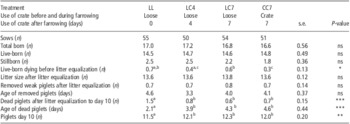
The number of total born and live-born piglets were unaffected by treatment of the sows (Table 1). However, fewer piglets died after litter equalization by the sows that were housed in crates after farrowing compared with the loose sows. The piglets that died on the sows that were loose during the entire experimental period were younger at time of death compared with the piglets that died in treatment groups with confinement of the sows (P < 0.001).
The effects of confining sows before and after farrowing for 0, 4 or 7 days on piglet survival

LL = loose during the entire experimental period; LC4 = loose and then crated after the end of farrowing from days 0 to 4 postpartum; LC7 = loose and then crated after the end of farrowing from days 0 to 7 postpartum; CC7 = crated from introduction to the farrowing pen to day 7 postpartum; ns = non-significant.
Results are mean values and stated per litter.
a,b,cValues within a row without a common superscript differ (P < 0.05).
*P < 0.05; **P < 0.01; ***P < 0.001.
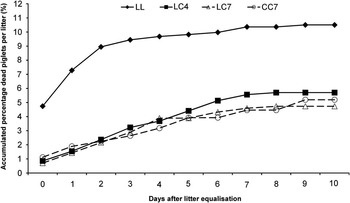
In all treatment groups, the piglet mortality was highest in the first 3 days after farrowing (Figure 2). Overall, the LL sows had the highest mortality (Table 1), but this was because of more suckling piglets dying within the first 3 days after farrowing compared with the other treatment groups. From days 3 to 10 postpartum, piglet mortality was not significantly different between the treatments (Figure 2).
Accumulated percentage of live-born piglets dying from litter equalization and until day 10. LL = loose during the entire experimental period; LC4 = loose and then crated after ended farrowing from days 0 to 4 postpartum; LC7 = loose and then crated after ended farrowing crated from days 0 to 7 postpartum; CC7 = crated from introduction to the farrowing pen to day 7 postpartum.

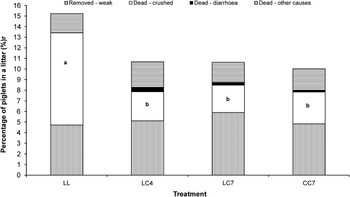
The number of piglets removed from the study after litter equalization and causes of death are shown in Figure 3. Most dead piglets died because of crushing. In all treatment groups, crushing was the main cause of death, accounting for 65% of all live-born deaths; however, among the LL sows, this percentage was higher (P < 0.001), as 83% of the live-born dead piglets were crushed.
Causes of live-born piglet mortality from litter equalization to day 10. LL = loose during the entire experimental period; LC4 = loose and then crated after ended farrowing from days 0 to 4 postpartum; LC7 = loose and then crated after ended farrowing crated from days 0 to 7 postpartum; CC7 = crated from introduction to the farrowing pen to day 7 postpartum. Bars with different letters differ significantly, P < 0.001.

Discussion
Stillbirths
The study did not show a reduction in the number of stillborn piglets among the sows that were loose before and during farrowing compared with the sows that were housed in crates. The suckling piglets were not subjected to postmortem examinations, and therefore it is likely that some of the piglets were incorrectly classified as stillborns even though they were alive at birth. In previous studies (Edwards, Reference Edwards2002), it has been found that many deaths are misdiagnosed. Nonetheless, this potential error will have been evenly distributed among treatments and is only likely to have overestimated the number of stillborns.
In the present study, there was no difference in the portion of nest-building material between the treatments; however, the allocation was low (two handful per day). There was a difference between treatments in available space for the sow, and as results by Lawrence et al. (Reference Lawrence, Petherick, McLean, Deans, Chirnside, Vaughan, Clutton and Terlouw1994) and Jarvis et al. (Reference Jarvis, Lawrence, McLean, Deans, Chirnside and Calvert1997) indicated that the close confinement of the crate might induce physiological stress in gilts. The results of Lawrence et al. (Reference Lawrence, Petherick, McLean, Deans, Chirnside, Vaughan, Clutton and Terlouw1994) were supported by results of Jarvis et al. (Reference Jarvis, Calvert, Stevenson, Leeuwen and Lawrence2002) who found that provision of space reduced physiological stress in gilts with straw availability having little effect. In contrast to Lawrence et al. (Reference Lawrence, Petherick, McLean, Deans, Chirnside, Vaughan, Clutton and Terlouw1994) and Jarvis et al. (Reference Jarvis, Calvert, Stevenson, Leeuwen and Lawrence2002), the current study included both gilts and older parity sows. Previously, a few authors have reported that better options for conducting nest-building behaviour by housing the sows loose instead of in a crate resulted in easier farrowing and a shorter farrowing time (Oliviero et al., Reference Oliviero, Heinonen, Valros, HcTlli and Peltoniemi2008; Oliviero et al., Reference Oliviero, Heinonen, Valros and Peltoniemi2010). On the contrary, others did not detect a difference in the farrowing time between loose sows and sows in crates (Damm et al., Reference Damm, Lisborg, Vestergaard and Vanicek2003; Jarvis et al., Reference Jarvis, Reed, Lawrence, Calvert and Stevenson2004). Farrowing time can influence the number of stillborn piglets, as a prolonged farrowing time increases the risk of the piglets dying during farrowing (Borges et al., Reference Borges, Bernardi, Bortolozzo and Wentz2005; Canario et al., Reference Canario, Cantoni, Le Bihan, Caritez, Billon, Bidanel and Foulley2006; Oliviero et al., Reference Oliviero, Heinonen, Valros and Peltoniemi2010). A prolonged farrowing time is likely to increase the frequency of birth assistance; however, in the current study, treatment did not affect the occurrence of birth aid.
When comparing production results from loose and confined sows, Cronin et al. (Reference Cronin, Lefébure and McClintock2000) reported that fewer loose sows received birth assistance compared with sows housed in crates. From the report it could not be determined whether the cause was because of easier farrowings among the loose-housed sows or whether it was more difficult for the personal to perform birth assistance to the loose-housed sows. However, no difference in the number of stillborn piglets was reported, indicating that the loose sows did not have the same need for birth assistance as the sows housed in crates.
Another factor affecting the number of stillborn piglets in the current study, and a possible explanation for the lack of difference in the number of stillborn piglets was that all sows were used to being housed in crates, as all sows in the herd were crated during gestation. Therefore, it is possible that the sows housed in crates before and during farrowing (CC7) were not additionally negatively stressed, as they were used to crating. In accordance, Marchant and Broom (Reference Marchant and Broom1993) showed an increased amount of frustrated behaviour before farrowing in crates for sows that had been loose during gestation, and Jarvis et al. (Reference Jarvis, Vegt, Lawrence, McLean, Deans, Chirnside and Calvert2001) reported that sows to a certain extent can adapt their behaviour around farrowing to the housing conditions. Sows in crates had a higher plasma cortisol levels and changed positions more frequently compared with loose-housed sows (Lawrence et al., Reference Lawrence, Petherick, McLean, Deans, Chirnside, Vaughan, Clutton and Terlouw1994; Jarvis et al., Reference Jarvis, Vegt, Lawrence, McLean, Deans, Chirnside and Calvert2001). However, Jarvis et al. (Reference Jarvis, Vegt, Lawrence, McLean, Deans, Chirnside and Calvert2001) were able to show a reduction in plasma cortisol and posture changes in the second compared with the first farrowing among the crated sows. This was interpreted as the sows experienced less stress because of the previous experience with being crated; nonetheless, the conclusion was that crated sows were more stressed compared with the loose sows because of the negative influence on nest-building behaviour caused by the restrictive environment in the crate. The authors concluded that adaptation or previous experience with being crated was not sufficient to eliminate the stress experience among the crated sows.
Contrary to the current study, Oliviero et al. (Reference Oliviero, Heinonen, Valros and Peltoniemi2010) reported fewer stillborn piglets among loose sows compared with sows that farrowed in crates. In that study, the sows were loose during gestation and sows that were loose during farrowing had sawdust in the pens, whereas no nest-building material was provided for the sows that farrowed in crates.
Mortality after farrowing
As hypothesized, higher piglet mortality was observed among the LL sows in the current study. This higher mortality was probably due to more piglets being crushed; however, as the piglets in the current study were not subjected to a postmortem examination, cause of death is not certain. Nonetheless, even when piglets are autopsied, identifications of the cause of death depend on the person conducting the postmortem examination (Vaillancourt et al., Reference Vaillancourt, Stein, Marsh, Leman and Dial1990 and Reference Vaillancourt, Marsh and Dial1992; Christensen and Svensmark, Reference Christensen and Svensmark1997).
In the current study, all piglets classified at birth as weak were moved to a nursing sow and removed from the trial. Therefore, all piglets in the study were viable and with no particular risk of dying, for example, because of low birth weight or starvation. In addition, litter equalization was carried out to ensure uniform distribution of piglets between treatments, so consequently there should not have been any difference between treatments on the piglets’ capability of surviving. The observed difference in mortality is therefore most likely because of the difference in housing of the sows.
Nonetheless, it is possible that the large litter sizes in the present study have contributed to more piglets being crushed by the LL sows compared with the sows that were confined. With larger litters, the risk of piglets being crushed increases compared with smaller litters simply because of a greater chance of piglets being close to the sow when they change position (Weary et al., Reference Weary, Phillips, Pajor, Fraser and Thompson1998). Another contributing factor to the higher mortality among the LL sows might have been that the pens did not fulfil all of the design criteria for alternative farrowing systems described among others by Baxter et al. (Reference Baxter, Lawrence and Edwards2011). For instance, the pens did not have sloped walls (Damm et al., Reference Damm, Moustsen, Jørgensen, Pedersen, Heiskanen and Forkman2006) or protection rails along the walls to protect the piglets from being crushed. In a Norwegian study with 39 herds with loose lactating sows, Andersen et al. (Reference Andersen, Tajet, Haukvik, Kongsrud and Bøe2007) reported lower piglet mortality in pens with protection rails; however, contrarily Weber et al. (Reference Weber, Keil, Fehr and Horat2009) did not find a difference in mortality between pens with or without rails. The pens in the present study (4.7 m2) were smaller than, for example, the pens in the investigation by Weber et al. (Reference Weber, Keil, Fehr and Horat2009) (7.0 m2) and in the study by Andersen et al. (Reference Andersen, Tajet, Haukvik, Kongsrud and Bøe2007) (6.4 m2). Several research reports have indicated that pen size might affect piglet mortality among loose lactating sows; however, in none of the studies (Blackshaw et al., Reference Blackshaw, Blackshaw, Thomas and Newman1994; Weary et al., Reference Weary, Phillips, Pajor, Fraser and Thompson1998; Marchant et al., Reference Marchant, Rudd, Mendl, Broom, Meredith, Corning and Simmins2000; Marchant, Reference Marchant2002; Andersen et al., Reference Andersen, Tajet, Haukvik, Kongsrud and Bøe2007; Weber et al., Reference Weber, Keil, Fehr and Horat2007; Weber et al., Reference Weber, Keil, Fehr and Horat2009) the relationship between pen size and pre-weaning mortality was studied systematically, and no statistical findings on the influence of pen size have been reported. Cronin et al. (Reference Cronin, Dunsmore and Leeson1998) investigated effects of farrowing nests size without detecting differences in piglet survival but concluded that the size of the farrowing nest area may affect sow and piglet behaviours that may be relevant for piglet survival. The pen sizes described in the studies by Blackshaw et al. (Reference Blackshaw, Blackshaw, Thomas and Newman1994), Weary et al. (Reference Weary, Phillips, Pajor, Fraser and Thompson1998), Marchant et al. (Reference Marchant, Rudd, Mendl, Broom, Meredith, Corning and Simmins2000), Marchant (Reference Marchant2002), Andersen et al. (Reference Andersen, Tajet, Haukvik, Kongsrud and Bøe2007), Weber et al. (Reference Weber, Keil, Fehr and Horat2007) and Weber et al. (Reference Weber, Keil, Fehr and Horat2009) refers to the total area of the pens, and if a relationship between pen size and mortality is facilitated by restrictions of the sow and the abilities of the sow to move around and perform certain behaviours, it would possibly be more accurate to compare rates of mortality with the space available to the sow and the dimensions of the available space. With the majority of suckling piglets dying within the first days of life, it is important to investigate ways to protect the animals in the period when they are most vulnerable. The current study has demonstrated that confinement of the sow for 4 days post-farrowing results in fewer deaths among the piglets than allowing the sow to remain continuously loose. Subsequently, there were no differences between the treatments in piglet mortality demonstrating that confinement of the sow was only necessary for 4 days to reduce suckling piglet mortality.
In conclusion, the current study could not confirm that loose sows would give birth to fewer stillborn piglets. However, this conclusion needs verification in future studies because of the low amount of nest-building material in the current study as well as the sow being used to stalls from the gestation period. Importantly, the present study demonstrated that crating the sow for only 4 days postpartum was sufficient to reduce piglet mortality.
Acknowledgements
The authors are grateful to the owners and staff of Siljebjerggaard and would like to sincerely thank them for letting us use their pens and sows. In addition, technician Jens Martin Strager is acknowledged for helping with data collection and statistician Mai Britt Friis Nielsen is recognized for her help with the statistical analysis.