Introduction
Studies of parasite communities are useful in that they reveal information about ecological relationships such as the distribution of parasites, interactions between parasite species, microhabitat preferences, accumulation across time, and spatiotemporal changes in parasite composition. Studies of parasite communities also provide information about parasite interactions with their hosts, other species, and the environment, as well distribution and migration patterns of the hosts (Poulin, Reference Poulin2007). For Antarctic fish, most parasitological studies have focused on determining the parasite species from the hosts using ecological and taxonomical approaches. So far, 260 parasite taxa have been recorded from 142 Antarctic fish species (Oğuz et al., Reference Oğuz2015). Considering that fish diversity in the region comprises 322 species (Eastman, Reference Eastman2005), information about fish-related parasites is still incomplete.
More than 70% of Antarctic fish belong to the suborder Notothenioidei (Eastman, Reference Eastman2005), with Nototheniidae being the most abundant family. Species of this family are commonly known as notothens (DeWitt et al., Reference DeWitt, Heemstra, Gon, Gon and Heemstra1990), and three species are recognized in the circum-Antarctic zone: Notothenia rossii (Syn. Notothenia rossii marmorata), N. coriiceps (Syn. N. neglecta), and N. cyanobrancha. The latter species is distributed primarily along the eastern part of Antarctica at Kerguelen and Heard Islands (DeWitt et al., Reference DeWitt, Heemstra, Gon, Gon and Heemstra1990), whereas N. rossii and N. coriiceps are relatively abundant and sympatric species that are widely distributed in East and West Antarctica. They have been recorded between 30°W and 90°W longitude (northern Antarctica Peninsula, Scotia Arc, and South Georgia), between 30°E and 90°W (at Prince Edward, Iles Crozet, Kerguelen, Heard and Macquarie islands, Ob’ and Lena Banks), and between 120°W and 180°W (some parts of the Ross Sea) (DeWitt et al., Reference DeWitt, Heemstra, Gon, Gon and Heemstra1990). These species were commercially overexploited in the 1970s and 1980s (Froese and Pauly, Reference Froese and Pauly2018), which caused a dramatic decline in population due to a reduction in egg production and juvenile size (Walton, Reference Walton1987). Even though there are currently controlled fisheries in Antarctica, the maximum body sizes and reproductive levels of these fish have been restored in overfished areas (Casaux and Barrera-Oro, Reference Casaux and Barrera-Oro2002; Cali et al., Reference Cali2017).
To our knowledge, there are seven studies describing the parasite communities found in Antarctic notothen fish (Szidat, Reference Szidat1965; Palm et al., Reference Palm1998, Reference Palm, Klimpel and Walter2007; Zdzitowiecki and Zadrozny, Reference Zdzitowiecki and Zadrozny1999; Zdzitowiecki and Laskowski, Reference Zdzitowiecki and Laskowski2004; Laskowski and Zdzitowiecki, Reference Laskowski and Zdzitowiecki2005; Nezhybová and Mašová, Reference Nezhybová and Mašová2015), meaning there is still much to learn about Antarctic fish parasites. There are three published articles concerning parasite communities in N. coriiceps and no studies on N. rossii. Also, a few studies exist relating to parasite assemblages that focus on only a group of parasites, such as digeneans (Zdzitowiecki and White, Reference Zdzitowiecki and White1992; Laskowski et al., Reference Laskowski, Jeżewski and Zdzitowiecki2014) and acanthocephalans (Zdzitowiecki and White, Reference Zdzitowiecki and White1996). Thirty-four parasitic taxa have been recorded for N. rossii. Thirty-one species have been identified at the specific level, with another three unidentified cestodes of different genera (Rokiki and Zdzitowiecki, Reference Rokiki and Zdzitowiecki1991; Laskowski and Rocka, Reference Laskowski and Rocka2014; Oğuz et al., Reference Oğuz2015). Twenty-one parasitic taxa have been recorded for N. coriiceps (Palm et al., Reference Palm1998).
The composition of parasitic communities tends to be relatively similar in congeneric hosts, although differences in their loads and prevalence have been observed (Muñoz et al., Reference Muñoz, Grutter and Cribb2006). Some species that are not phylogenetically related but are sympatric may also share several parasites when these are not host-specific. Therefore, two fish species that are phylogenetically related and inhabit the same places would be highly similar in their parasite species composition, although some differences in parasitic loads and prevalence are expected due to differences in the ecological and physiological variables of the hosts that usually influence parasitic population structures (Poulin, Reference Poulin2007). Accordingly, the objectives of this study were to analyse and compare parasite communities from N. rossii and N. coriiceps, both from Fildes Bay, Antarctica, and compare them with published data.
Materials and methods
Between January and February 2017, 45 N. rossii and 22 N. coriiceps specimens were collected from Fildes Bay at King George Island, Antarctica (62°92′5.892′′S, 58°55′51.09′′W) through lines from a Zodiac boat at depths between 7 and 20 m. The effort was part of a field campaign supported by the Chilean Antarctic Institute (INACH). The fish were transported to the laboratory at the Professor Julio Escudero Base, an Antarctic research station operated by INACH. The fish were euthanized by pithing the spinal cord with a large needle in accordance with the bioethical protocols of the Universidad de Valparaíso (Chile). Half of the fish sample was dissected fresh, and the other half was frozen at –20°C and dissected posteriorly.
The fish were identified according to DeWitt et al. (Reference DeWitt, Heemstra, Gon, Gon and Heemstra1990). The total body length, standard length, and weight of each fish specimen were recorded before dissection. The body surface was first inspected and then washed to remove external parasites. The wash water was sieved and the retained content was observed under a stereomicroscope to detect parasites. Dissecting the fish allowed us to extract the gills and internal organs. All of these structures were opened, sieved when necessary, and observed under a stereomicroscope. The cavities and muscles of the fish were also thoroughly inspected to detect internal parasites.
After collecting all parasites from each fish specimen, the parasites were identified and counted. The parasites were identified according to the morphological descriptions of species provided by Utevsky (Reference Utevsky2005, Reference Utevsky2007) for leeches, Wägele (Reference Wägele1987) and Cohen and Poore (Reference Cohen and Poore1994) for isopods, Lutnicka and Zdzitowiecki (Reference Lutnicka and Zdzitowiecki1984) for monogeneans, Zdzitowiecki (Reference Zdzitowiecki1990, Reference Zdzitowiecki1997) for digeneans, Laskowski and Rocka (Reference Laskowski and Rocka2014) for tetraphyllidean cestodes, Rocka (Reference Rocka2004) for nematodes, and Laskowski and Zdzitowiecki (Reference Laskowski, Zdzitowiecki, Klimpel, Kuhn and Mehlhorn2017) for acanthocephalans. The abundance of parasitic species in each host specimen was then recorded and then averaged for each fish species sample (Bush et al., Reference Bush1997). The relative abundance was calculated as the percentage of a parasite species with respect to the total abundance of parasites in the whole fish sample. Parasite prevalence was calculated as the percentage of the fish sample parasitized by a certain species with respect to the entire fish sample (Bush et al., Reference Bush1997).
Three parasite infracommunity descriptors were used and calculated per host specimen: abundance (the sum of all parasites), richness (number of species) (Bush et al., Reference Bush1997), and species diversity, calculated using Margalef's diversity index, which associates the weight of the parasite composition of a community to the abundance of that community (Moreno, Reference Moreno2001). The values of this index range from 0 to >1 according to S−1/ln(N), where S is the number of parasite species in a host specimen and N is the infracommunity parasite abundance. The maximum value is reached when S = N. Diversity evenness (calculated through Pielou's index) refers to the homogeneity of the species abundance in a community. Evenness values range from 0 (where abundances of the parasite species are highly variable) to 1 (where all species are equally abundant) (Moreno, Reference Moreno2001).
Fish body length was compared between notothen species using a Student's t-test prior to checking the normal distribution of the data. Because some of the parasite descriptors were not normally distributed, we used non-parametric tests: (1) Spearman correlations to correlate parasitological variables and fish body length, and (2) Mann–Whitney tests to compare parasite descriptors between fish species. Contingency tables of 2 × 2 were used to compare the prevalence of parasite species between fish using the frequencies of parasitized and non-parasitized fish for a certain parasite taxon.
The similarity of parasite composition between fish species was calculated using the Bray–Curtis similarity index based on the abundance of each parasite taxon, then standardized to log(x + 1) for ordination analysis (Clarke and Warwick, Reference Clarke and Warwick1994). Subsequently, an analysis of similarity (ANOSIM) and an ordination technique, non-metric multidimensional scaling (NMDS), were applied to the parasite communities of N. rossii and N. coriiceps. Other analyses (ANOSIM and NMDS) were applied using the presence–absence of parasite taxa in the two fish species via the Jaccard similarity coefficient (Chao et al., Reference Chao2006). Notothenia coriiceps parasite data from published studies (Szidat, Reference Szidat1965; Palm et al., Reference Palm1998; Zdzitowiecki and Laskowski, Reference Zdzitowiecki and Laskowski2004) were added to the ordination analysis for the presence–absence of parasites (at the genus level) to visualize the parasitological similarities between the present data and other fish samples. All analyses were performed with the software PAST 3.13 (https://folk.uio.no/ohammer/past/index.html). The significance level for all analyses was P < 0.05.
Results
The average body measurements of N. rossii were 29.7 ± 5.3 cm and 26.6 ± 6.9 cm for total and standard lengths, respectively, and 351.4 ± 259.0 g for weight, whereas the measurements of N. coriiceps were 32.5 ± 3.2 cm and 25.8 ± 4.8 cm for total and standard lengths, respectively, and 577.7 ± 210.6 g for weight. The total length (t = 2.25, P = 0.029) and weight (t = 3.09, P = 0.002) were significantly smaller in N. rossii than in N. coriiceps.
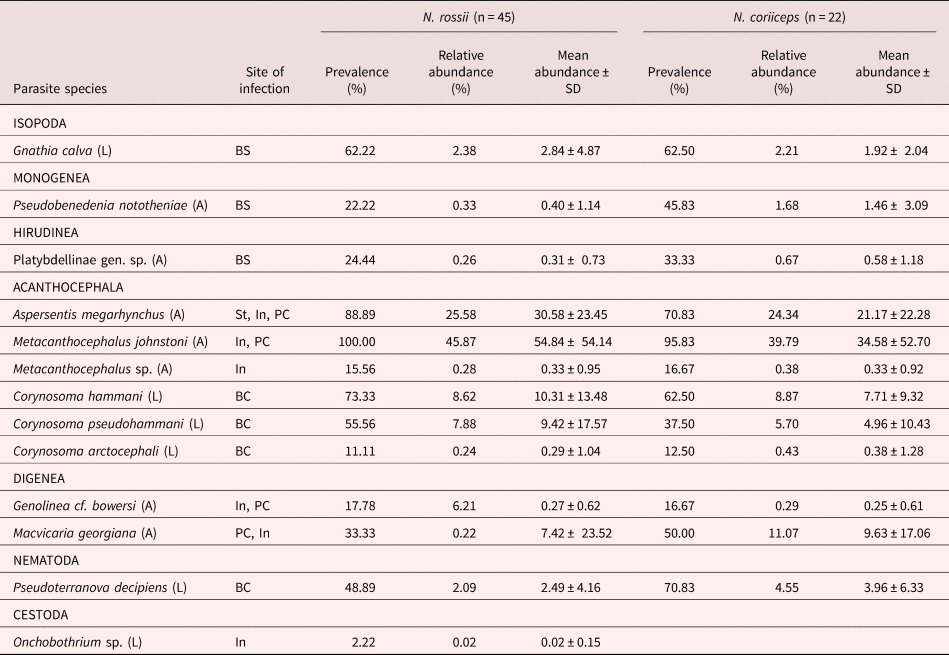
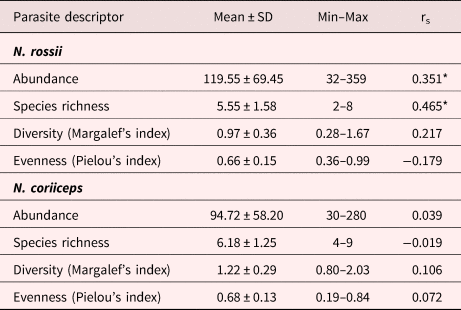
A total of 5380 individual parasites corresponding to 13 taxa were collected from the entire N. rossii sample (table 1). All fish were parasitized, and each host individual had at least two parasite taxa and 32 individual parasites (table 2). From the entire N. coriiceps sample, 2084 individual parasites corresponding to 12 taxa were collected (table 1). All fish were parasitized, and each host individual had at least four parasite taxa and 30 individual parasites (table 2).
Parasite taxa found in Notothenia rossii and N. coriiceps, with site of infection, prevalence, and relative and mean abundances (± SD). Abbreviations: A, adults; L, Larvae; BS, body surface; St, Stomach; In, intestine; PC, Pyloric caeca.

Mean (± SD), minimum and maximum (Min–Max) values of parasite infracommunity descriptors of fish (N. rossii and N. coriiceps), and Spearman correlation coefficients (rs) between these descriptors and total host body length (cm). r = Pearson correlation coefficient, *: significant correlation (P < 0.05).

Acanthocephalans had more species, abundance and prevalence in the fish compared to other parasitic taxa. Considering their relative abundance, acanthocephalans represented more than 79% of all parasites from both fish. Aspersentis megarhynchus and Metacanthocephalus johnstoni were the most prevalent and abundant species and were also the most dominant parasites (tables 1 and 2). Most parasite taxa showed overdispersed distributions (table 1).
The parasites were identified morphologically to the lowest possible taxonomic level. However, there were some identification issues, such as unclear taxonomy in the cases of gnathiid isopods and leeches from Antarctica. The isopods found in N. rossii were consistent with the description of Gnathia calva. This isopod was placed in the genus Caecognathia, but we could not find the author who made a new combination with that specific name. As Wägele (Reference Wägele1987) did not transfer the species to another genus (as mentioned in some articles) and the isopods were also consistent with the characteristics of the genus Gnathia (see Cohen and Poore, Reference Cohen and Poore1994), we decided to identify our specimens as G. calva. Regarding Antarctic leeches, there have been deficiencies in several species descriptions (Meyer and Burreson, Reference Meyer and Burreson1990) that make them difficult to identify. Following a key provided by Utevsky (Reference Utevsky2005), our specimens belonged to the subfamily Platybdellinae; however, they were not morphologically similar with any of the species listed in that subfamily, so we could not further identify these parasites.
Among the acanthocephalans, Metacanthocephalus sp. had a short and robust body that differed from described species (Laskowski and Zdzitowiecki, Reference Laskowski, Zdzitowiecki, Klimpel, Kuhn and Mehlhorn2017), particularly from M. johnstoni in the proportion between the proboscis and body length. Tetraphyllideans are normally difficult to identify because of the simplicity of their bodies; however, the only specimen found in N. rossii had trilocular bothridia, which identified it as Onchobothrium sp. (Laskowski and Rocka, Reference Laskowski and Rocka2014).
The monogenean Pseudobenedenia nototheniae was the only parasite that significantly differed in abundance (U = 342.5, P = 0.041) and prevalence (χ2 = 5.22, P = 0.027) between the two fish species, being more abundant and prevalent in N. coriiceps than N. rossii (table 1). The nematode Pseudoterranova decipiens was also significantly more prevalent in N. coriiceps than N. rossii (χ2 = 4.89, P = 0.028), but no difference was found in its abundance (table 1). The richness (U = 404.5, P = 0.226), abundance (U = 383.5, P = 0.136), and diversity evenness (U = 438, P = 0.372) of the parasite infracommunities did not differ between the fish species. However, species diversity (U = 309.5, P = 0.009) was higher in N. coriiceps than N. rossii (table 2).
Total length was significantly correlated with fish weight (N. rossii: r = 0.922, P < 0.001; N. coriiceps: r = 0.85, P < 0.001); therefore, fish body length, which is the variable most used to represent body size in several other studies, was considered for correlations with parasite descriptors. Parasite abundance was not correlated with species richness (N. rossii: r = 0.084, P = 0.581; N. coriiceps: r = 0.195, P < 0.383). However, both of these descriptors increased with fish length only for N. rossii (table 2), but diversity and evenness did not correlate with fish body length in any fish species (table 2).
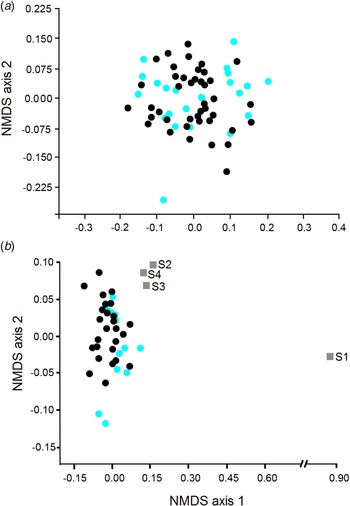
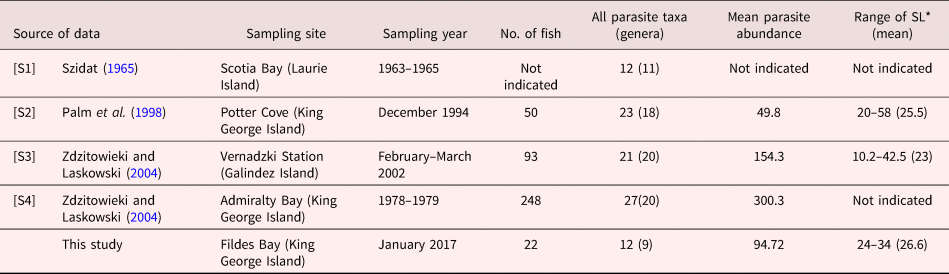
The results of ANOSIM showed that parasite composition based on abundances (R = –0.051, P = 0.824, fig. 1a) and the presence–absence of species (R = 0.037, P = 0.181, fig. 1b) did not differ significantly between N. coriiceps and N. rossii. Considering the previous information about the parasite communities of N. coriiceps, we observed that parasite composition showed some differences between studies. Szidat's (Reference Szidat1965) data differed from other studies according to the NMDS ordination analysis (fig. 1b), sharing just 31–38% of parasites with other fish samples. The data of Palm et al. (Reference Palm1998) and Zdzitowiecki and Laskowski's (Reference Zdzitowiecki and Laskowski2004) had 61–71% similarity in parasite species. The parasites found in this study showed 33–44% similarity with other studies. However, the samples collected from nearby King George Island (Palm et al., Reference Palm1998; Zdzitowiecki and Laskowski, Reference Zdzitowiecki and Laskowski2004; this study) were more similar. Meanwhile, the sample collected from Laurie Island, one of the South Orkney Islands, was the most distinct from the other fish samples (Szidat, Reference Szidat1965) (table 3, fig. 1b).
Non-metric multidimensional scaling ordinations of Notothenia rossii (black dots) and N. coriiceps (light blue dots) parasite communities based on (a) parasite abundances and (b) presence–absence of parasites, which also include data from other studies of parasite communities of N. coriiceps (S1: Szidat (Reference Szidat1965); S2: Palm et al. (Reference Palm1998); S3 and S4: Zdzitowiecki and Laskowski (Reference Zdzitowiecki and Laskowski2004)).

Data comparison of various studies of parasites of N. coriiceps.

*SL: standard length of fish
Discussion
The parasite richness of N. rossii and N. coriiceps was composed of 13 and 12 taxa, respectively, which is similar to other nototheniid fishes, which usually have nine to 21 parasite taxa (Palm et al., Reference Palm1998, Reference Palm, Klimpel and Walter2007; Zdzitowiecki and Laskowski, Reference Zdzitowiecki and Laskowski2004). There were no host-specific parasites in these notothens; all parasites found in the present study had already been recorded in several other fish species (Palm et al., Reference Palm, Klimpel and Walter2007; Oğuz et al., Reference Oğuz2015; Münster et al., Reference Münster2017), therefore several parasite taxa of notothen species have been considered generalists, which can be an important characteristic for parasite resilience in cases in which the abundances of host species change for any reason. Nevertheless, it is important to note that the species diversity increases when molecular analyses are applied because these techniques facilitate recognition of cryptic species (Trontelj and Fišer, Reference Trontelj and Fišer2009). Molecular analyses have been applied recently to Antarctic parasites to identify species and also to clarify morphological diagnosis of species (e.g. Laskowski and Rocka, Reference Laskowski and Rocka2014; Sokolov et al., Reference Sokolov, Khasanov and Gordeev2018).
Notothenia rossii and N. coriiceps shared most of the parasite taxa; however, species diversity was higher in N. coriiceps because parasite abundances were less variable than in N. rossii. Additionally, the N. rossii and N. coriiceps parasite communities were very similar, possibly because they are congeneric and sympatric species, thus allowing them to share most parasite taxa. Moreover, most parasites showed similar abundance and prevalence (except P. nototheniae and P. decipiens), which is unusual for related and congeneric species (e.g. Muñoz et al., Reference Muñoz, Grutter and Cribb2006), because congeneric species still differ in some ecological characteristics, such as use of habitat and food, in order to reduce competition, which affect the parasite community composition and loads (Poulin, Reference Poulin2007). This finding suggests two possibilities: (1) N. rossii and N. coriiceps may live in a habitat with a great number of resources, for which they do not have to compete and thus they share space and prey, obtaining the same parasite taxa in similar abundance; or (2) parasite larvae can use several intermediate hosts (such as several crustacean species), so parasites have a greater opportunity to infect the fish (Desdevises et al., Reference Desdevises2002).
Notothenia rossii was larger than N. coriiceps; however, fish body length did not play a large role in parasitological descriptors. Only parasite richness and abundance increased significantly with the body length of N. rossii, but this may have been a consequence of the larger sample size and larger range of fish size found in this species. This may also indicate that parasites have different population dynamics within their hosts, as shown by parasite infection paths and lifespans, but other host characteristics (such as density and movement) may also affect populations and parasite communities (Esch and Fernandez, Reference Esch and Fernandez1993). Diversity was constant across fish body length, as was evenness, which means that the relative abundances of parasite species in each infracommunity are constant across the range of fish body lengths tested.
Some parasite taxa are common throughout the notothens presented in this study. For example, Corynosoma, Macvicaria and Pseudobenedenia were present in all samples, not only in N. rossii and N. coriiceps but also in samples of N. coriiceps obtained at different sampling times and localities (Szidat, Reference Szidat1965; Palm et al., Reference Palm1998; Zdzitowiecki and Laskowski, Reference Zdzitowiecki and Laskowski2004) (table 3). Studies have shown that parasite communities change over spatio-temporal scales. For example, Zdzitowiecki and White (Reference Zdzitowiecki and White1992) revealed differences in the composition and abundance of digeneans from different sampling sites, and Laskowski et al. (Reference Laskowski, Korczak-Abshire and Zdzitowiecki2012) showed changes in acanthocephalan abundance over time. Also, species of digeneans in N. coriiceps changed in abundance and mean intensity between decades at King George Island (Laskowski et al., Reference Laskowski, Jeżewski and Zdzitowiecki2014). In particular, Macvicaria georgiana was dominant (98% prevalence) during 1978–1979, sub-dominant (92%) during 2007–2008, and common (50%) in 2017 (this study). The decreasing prevalence of this digenean indicates changes in the environment, probably as a result of pollution and climate change, which could affect intermediate host abundances and thus parasite transmission (Laskowski et al., Reference Laskowski, Jeżewski and Zdzitowiecki2014).
Samples of N. coriiceps collected from King George Island showed different percentages of similarity with each other, but they were relatively similar following the ordination analysis done in this study (fig. 1b). However, the samples collected from Laurie Island, approximately 700 km from King George Island, had several parasites that were distinct from the other samples. Notothenoiid fish are significantly associated with the coastal shelf and do not live at great depths (Moteki et al., Reference Moteki2011), which limits their distribution between distant islands. Therefore, N. coriiceps from Laurie Island may be a different fish population than the one in our study.
Parasite community analysis may be very complex in situations in which parasite richness and abundance are high. One reason for this is that there are several species with unclear taxonomical statuses (for example, leeches have not been well described and there is confusion in their identification) (Meyer and Burreson, Reference Meyer and Burreson1990; Utevsky, Reference Utevsky2007). Similarly, gnathiid isopods in the larval stages are not easy to distinguish, and the taxonomical key is related to adult stages (Cohen and Poore, Reference Cohen and Poore1994). Also, there are morphological similarities with overlapping morphometry among acanthocephalan species of Corynosoma and among digeneans of Macvicaria (Zdzitowiecki, Reference Zdzitowiecki1997; Laskowski and Zdzitowiecki, Reference Laskowski, Zdzitowiecki, Klimpel, Kuhn and Mehlhorn2017), making identification difficult. Parasites contribute greatly to the biodiversity of any ecosystem, but estimating parasite diversity can be inaccurate if taxonomic keys are not clear with respect to species distinction. Therefore, much work remains to be done on the taxonomical issues of Antarctic parasites.
In conclusion, in this study we found two congeneric and sympatric Antarctic fish species that were highly similar in their parasite communities, which indicates they are in a habitat with sufficient resources and similar use of resources, allowing them to become parasitized with the same taxa and abundance of parasites. Considering other studies on N. coriiceps, we found that geographical distance is an important variable in the composition of the parasite community, mainly because notothens do not swim long distances and their distribution is limited to the coastal flat. In this context, parasites may be good indicators of environmental conditions and host migrations, which are aspects rarely considered in parasitological studies of Antarctic fish.
Acknowledgements
We thank all of the staff of Instituto Antártico Chileno (INACH) for their help on the field trips to Antarctica.
Financial support
This study was supported by research project RT 32–16 granted to GM.
Conflict of interest
None.
Ethical standards
Permission (# 69/2017) for fish capture was provided by the Chilean Antarctic Institute (INACH), according to the Protocol on Environmental Protection to the Antarctic Treaty, and the Principles of the Scientific Committee on Antarctic Research.