INTRODUCTION
The Arabic plural system is well known for its richness and complexity. It consists of two modes of derivation, which either string morphological units together linearly (concatenative mode) or transpose them upon each other using units below the word level (non-concatenative mode). The application of the concatenative strategy generates the so-called sound plurals, whereas the use of the non-concatenative strategy produces the broken plurals. The sound and broken plurals have often been compared, respectively, to regular and irregular plurals in English (Boudelaa & Gaskell, Reference Boudelaa and Gaskell2002; Mimouni, Kehayia & Jarema, Reference Mimouni, Kehayia and Jarema1998). It is not surprising, therefore, that research on the acquisition of Arabic plural morphology has often been embedded within theoretical debates on how regular and irregular morphemes are acquired, accessed, and processed (Aljenaie, Abdalla & Farghal, Reference Aljenaie, Abdalla and Farghal2011; Ravid & Farah, Reference Ravid and Farah1999, Reference Ravid, Farah, Stephany and Voeikova2009; Ravid & Hayek, Reference Ravid and Hayek2003). The debate centers mainly on whether children use a single mechanism or dual mechanisms for storing and processing regular and irregular forms. This debate originates in research on English regular and irregular past tense morphology, but has been extended to the plural system in a number of languages, including Arabic.
According to the dual-route account, regular and irregular forms are stored and processed in two independent ways (e.g. Marcus, Pinker, Ullman, Hollander, Rosen & Xu, Reference Marcus, Pinker, Ullman, Hollander, Rosen and Xu1992; Pinker, Reference Pinker1999; Pinker & Prince, Reference Pinker and Prince1988; Pinker & Ullman, Reference Pinker and Ullman2002). Regular forms are stored as decomposed morphological units (e.g. talk + ed) and processed by generic rule application. Given their rule-based computation, frequency has no effect on the processing of regular forms. Moreover, novel or nonce words are computed based on regular inflectional rules. Irregular forms, on the other hand, are stored as whole units and processed by associative patterning, i.e. by linking the phonological forms of different lexical entries. Irregular forms that are frequent or phonologically similar to other frequent forms are retrieved more easily than those that are not. This type of processing explains over-regularization errors (e.g. *wented) as well as the disappearance of uninflected stems once the regular forms are acquired (i.e. children start regularizing non-learned irregular forms instead of just using uninflected singular forms). The single route account suggests that all inflected words are stored and processed by associative patterning which is based on phonological and semantic similarity between base and inflected forms (e.g. Elman, Bates, Karmiloff-Smith, Johnson, Parisi & Plunkett, Reference Elman, Bates, Karmiloff-Smith, Johnson, Parisi and Plunkett1996; Plunkett & Marchman, Reference Plunkett and Marchman1996; Rumelhart & McClelland, Reference Rumelhart, McClelland, McClelland and Rumelhart1986). According to this approach, the retrieval of both regular and irregular forms is largely determined by their frequency or the frequency of the class to which they belong. The frequency of certain forms is also responsible for their over-regularization to other less frequent forms.
Although regularity, which is often associated with productivity or defaultness in the relevant literature, is a main divider of plural inflections in Arabic, previous studies on the L1 acquisition of Arabic plurals indicate that plural forms that fall within the regular or irregular categories may not always be acquired in the same pace (Aljenaie et al., Reference Aljenaie, Abdalla and Farghal2011; Ravid & Farah, Reference Ravid and Farah1999, Reference Ravid, Farah, Stephany and Voeikova2009; Ravid & Hayek, Reference Ravid and Hayek2003). Likewise, research on heritage and L2 learners of Arabic show that plural forms that exhibit similar degrees of (ir)regularity may not be equally developed in heritage or L2 grammars (Albirini & Benmamoun, in press; Benmamoun, Albirini, Montrul & Saadah, Reference Benmamoun, Albirini, Montrul and Saadah2014). This suggests that other factors may be involved in the acquisition of plural morphology, especially since the Arabic sound and broken plurals incorporate multiple paradigms that vary in various respects (e.g. Benmamoun, Reference Benmamoun and Shimron2003; McCarthy, Reference McCarthy1979, McCarthy & Prince, Reference McCarthy and Prince1990; Ratcliffe, Reference Ratcliffe1998; Watson, Reference Watson2007). The present study investigates whether and how the trajectory of acquiring the various plural forms is influenced by four factors: their predictability, frequency, transparency, and productivity. Predictability refers to the degree to which a plural form may be detected based on the phonological, semantic, and structural features of its singular base (Gregory, Raymond, Bell, Fosler-Lussier & Jurafsky, Reference Gregory, Raymond, Bell, Fosler-Lussier and Jurafsky2000; Lahaa & Dressler, Reference Laaha, Dressler, Kiefer, Ladányi and Siptár2012). Morphological transparency refers to the extent to which a plural pattern is parsable into its basic units. In English, for example, the plural form hands (hand + s) is more transparent than feet. Productivity is the extent to which a morpheme can be extended to foreign words, neologisms, and a certain class of words (Dressler, Reference Dressler2003).
Previous studies suggest that the acquisition of plural morphology follows a predictable order, according to which children undergo three stages: pre-morphology, proto-morphology, and morphology proper (Dressler, Reference Dressler1997). Children initially rely on rote-learned forms, then start detecting the different pluralization patterns, and eventually develop an adult-like plural system. Yet, a number of studies report a U-shaped curve in the acquisition of plural morphology, where the proto-morphology phase is marked by the over-generalization of a productive and frequent plural form, such as the plural -s in English, which acts as the default form (Bybee, Reference Bybee1995; Bybee & Slobin, Reference Bybee and Slobin1982; Dressler, Reference Dressler, Booij, Lehmann and Mugdan2000; Omar, Reference Omar1973; Ravid & Farah, Reference Ravid and Farah1999; Saiegh-Haddad, Hadieh & Ravid, Reference Saiegh-Haddad, Hadieh and Ravid2012; Strauss, Reference Strauss and Strauss1982). This trend has been attested in studies on the acquisition of plural morphology by Arabic-speaking children, which show that the concatenative suffix -aat is often extended to the less productive and less frequent plural forms in the early years of language development (Aljenaie et al., Reference Aljenaie, Abdalla and Farghal2011; Omar, Reference Omar1973; Ravid & Farah, Reference Ravid and Farah1999). The question that the present study investigates is whether the default strategy changes with age, especially in the light of corpus studies pointing to the high frequency of certain non-concatenative patterns in child- and adult-directed speech (Albirini, Reference Albirini2014; Boudelaa & Gaskell, Reference Boudelaa and Gaskell2002; Plunket & Nakisa, Reference Plunkett and Nakisa1997). The study aims to explore error types and over-generalization strategies that children of different ages use and how they relate to the properties of the examined plural forms.
THE PLURAL SYSTEM IN JORDANIAN ARABIC
Arabic is a Semitic language that derives words either by attaching prefixes or suffixes to a base (e.g. verb, noun, or adjective) or by mapping morphological units upon one other. The first strategy is referred to as concatenative derivation. For example, the formation of the adjective ʔurdune ‘Jordanian’ in (1) is realized by suffixation of the morphemes -e to the nominal base. The properties of the base remain largely unchanged.
-
(1) ʔurdun → ʔurdun-e
Jordan Jordan-adj
‘Jordanian’
The second method of deriving words in Arabic is through the mapping of a consonantal root onto a template with a fixed prosody and vocalic pattern. This is referred to as non-concatenative derivation (McCarthy, Reference McCarthy1979). For example, the active participle kaatib ‘writer/writing’ in (2) is derived from the verbal base katab ‘wrote.3s’, based on the template CaaCiC.Footnote 1 It is beyond the scope of this paper to go into the details of how the mapping is carried out, but it is clear that there is no affixation to the right or left edges of the verbal base.
-
(2) katab ‘to write’ → kaatib ‘writer/writing’
Plural morphology in Arabic utilizes both the concatenative and non-concatenative modes of derivation (McCarthy, Reference McCarthy1979). The application of the concatenative strategy to singular stems generates what has been called masculine sound plurals (MSP) and feminine sound plurals (FSP). In Jordanian Arabic, MSP are derived by attaching the suffix -iin to singular nouns and adjectives, whereas FSP are created by appending the suffix -aat to singular nouns and adjectives. For example, in (3), the addition of the suffix -iin to the singular masculine noun fallaħ ‘farmer.m’ yields the plural form fallaħiin ‘farmers.m’, and the attachment of -aat to the singular feminine noun fallaħa ‘farmer.f’ in (4) generates the plural form fallaħaat ‘farmers.f’. The concatenative plural strategy is similar to the regular pluralization technique deployed in English because it involves the simple and productive process of attaching a plural morpheme to a singular stem (e.g. farmer → farmers).
-
(3) fallaħ ‘farmer.m’ → fallaħiin ‘farmers.m’
-
(4) fallaħa ‘farmer.f’ → fallaħaat ‘farmers.f’
Although both are often considered as regular, MSP and FSP differ in a number of respects. The FSP morpheme applies to both human and non-human nouns, and it is used with nouns grammatically marked as feminine by the suffix -a (saaʕa ‘hour’ → saaʕaat), semantically feminine nouns (bint ‘girl’ → banaat), and most loan words (e.g. combuter ‘computer’ → combuteraat). It is also used with some masculine nouns, such as the penta-lateral pattern CuCCaCaC (e.g. mužtamaʕ ‘society’ → mužtamaʕaat). However, the MSP morpheme is restricted to human masculine nouns, and it applies only to certain categories within this class of nouns. Hence, it is less productive, less frequent, and less predictable than the FSP suffix. One pattern of human masculine nouns to which the MSP morpheme applies consistently is the form CuCaCCiC (e.g. muhandis ‘engineer’ → muhandisiin). However, many human masculine plurals are derived through the non-concatenative strategy.
Non-concatenative derivation does not deploy the simple morpheme-suffixation process used in its concatenative counterpart. Rather, it involves forms in which the consonantal and/or vocalic structure of the singular stem is often broken through morphological processes within the stem (McCarthy, Reference McCarthy1979). The application of these derivational processes generates the so-called broken plurals (BRP). In BRP, the key element that connects the singular and its plural counterpart is the root. The root is a consonantal unit that denotes an abstract meaning represented in all its derivations. For example, the root ‘k-t-b’ is the base of such words as katab ‘write’, kitaab ‘book’, kaatib ‘writer’, kutub ‘books’, and maktaba ‘library’. In BRP, the consonants comprising the root of the singular stem remain intact (although new consonants may be added), but the vowels of the vocalic melody often change partially or completely:
-
(5) kalb ‘dog’ → klaab ‘dogs’
-
(6) kaatib ‘writer’ → kuttaab ‘writers’
Example (5) illustrates a broken plural form that is realized by a vocalic melody (aa) and a syllabic structure (k + laab) that are different from those found in the singular. Likewise, the vocalic melody of the plural form kuttaab ‘writers’ in (6), namely u-aa, and the doubled/ geminated second consonant of the root sets it clearly apart from its singular stem.
Although there are competing accounts for the derivation of non-concatenative plurals, it is widely believed that the derivation of BRP is dissimilar to the derivation of sound plurals (Benmamoun, Reference Benmamoun1999, Reference Benmamoun and Shimron2003; Hammond, Reference Hammond1988; Idrissi, Prunet & Béland, Reference Idrissi, Prunet and Béland2008; McCarthy & Prince, Reference McCarthy and Prince1990; Prunet, Béland & Idrissi, Reference Prunet, Béland and Idrissi2000; Ratcliffe, Reference Ratcliffe1998). BRP have traditionally been categorized in the literature as irregular, mainly because most broken forms are unproductive and unpredictable. However, some BRP categories are in fact predictable and productive. For example, the plural pattern CaCaaCiC is derived predictably and productively from the trilateral ‘noun of place’ CaCCaC (e.g. maTbax ‘kitchen’ → maTaabix). Moreover, this pattern falls within the so-called ‘iambic plurals’, which are realized with the initial sequence (CVCVV+) and are singled out as the most frequent BRP pattern (McCarthy & Prince, Reference McCarthy and Prince1990; Plunkett & Nakisa, Reference Plunkett and Nakisa1997). In fact, Plunkett and Nakisa (Reference Plunkett and Nakisa1997) found that the iambic class of BRP exceeds in frequency the sound plurals. On this basis, they predicted its accurate use and over-generalization by older children.
Moreover, although BRP are generally considered less transparent than sound plurals, some broken patterns are considered relatively more opaque than others. For example, the defective and geminated patterns illustrated in (7) and (8) are generally less transparent than other broken forms because they contain, respectively, long vowel/glide alternations and geminate/non-geminate alternations.
-
(7) biir (well) → byaar
-
(8) sadd (dam) → suduud
In (7), the singular base consists of one single syllable with two root consonants and a long high vowel that serves as the nucleus of the syllable. In the plural, a glide surfaces and is followed by a long low vowel. In (8) the geminate consonant (dd) of the singular noun sadd is split in the broken plural with one consonant serving as coda of one syllable and the other consonant serving as onset of the following syllable. The defective and geminated patterns are predictable insofar as they consistently involve the insertion of a vowel after the glide or between the disintegrated geminate, but they are unpredictable with regard to the types of vowel (a, u, i) in their vocalic melodies.
The BRP patterns are derived from both human and non-human nouns, but when they are used with humans they primarily apply to masculine nouns. It is clear that the different plural forms vary considerably with regard to transparency, frequency, productivity, and predictability. The present study examines eight plural patterns (see Table 1). To help with the readability of the paper, three-letter acronyms are used to denote the large classes of feminine sound plurals (FSP), masculine sound plurals (MSP), and broken plurals (BRP), whereas two-letter abbreviations are used for plural forms within these classes.
-
– Human feminine sound plurals (HF) derived from singular nouns grammatically marked feminine by -a.
-
– Non-human feminine sound plurals (NF) derived from loan words that lack the feminine marker.
-
– Masculine sound plurals derived predictably from human masculine singulars of the pattern CuCaCCiC (PM).
-
– Masculine sound plurals derived from human masculine singulars that do not have a predictable plural form (UM).
-
– Iambic broken plurals derived predictably from non-human masculine singulars of the pattern CaCCaC (nouns of place) (PB).
-
– Iambic broken plurals derived from non-human singulars that do not have a predictable plural form (UB).
-
– Geminate broken plurals (GB).
-
– Defective broken plurals (DB).
Summary description of the eight plural forms

notes: HF = human feminine sound; NF = non-human feminine sound; PM = predictable masculine sound; UM = unpredictable masculine sound; PB = predictable broken; UB = unpredictable broken; DB = defective broken; GB = geminate broken.
A plural form is transparent when it uses simple suffixation (i.e. sound plurals, HF, NF, PM, and UM), less transparent if it uses template mapping (PB and UB), and least transparent if it uses template mapping and involves defective or geminate roots (GB and DB). The concept of predictability rests on the extent to which the phonological, semantic, or structural properties of a singular stem yield a specific plural form. Thus, singular nouns ending in the feminine -a and foreign nouns have a predictable FSP form (applicable to HF and NF). Likewise, human masculine singulars of the pattern CuCaCCiC and non-human masculine singulars of the pattern CaCCaC have predictable MSP and PB forms, respectively (applicable to PM and PB). DB and GB plurals are less predictable because they always involve, respectively, the insertion of a vowel after a glide or between the disintegrated geminate, but the vowel itself is unpredictable. The least predictable forms are the UM and UB, because their singular stems allow for a variety of potential plural patterns. According to Dressler (Reference Dressler2003), a form is productive when it applies to foreign words, neologisms, and a certain class of nouns (which is the case in HF and NF), less productive when it pertains only to a certain class of nouns (PM and PB), and least productive if it is used only with some words in a certain class of nouns (UM, UB, DB, and GB). Lastly, HF, NF, PB, and UB are classified as frequent, PM and UM as less frequent, and GB and DB as least frequent, based on corpus studies of child- and adult-directed speech (Albirini, Reference Albirini2014; Badry, Reference Badry1983; Boudelaa & Gaskell, Reference Boudelaa and Gaskell2002; Plunket & Nakisa, Reference Plunkett and Nakisa1997).Footnote 2 These studies show that FSP and iambic broken plurals (in this study, HF, NF, PB, and UB) are the most common plural forms, followed by MSP (i.e. PM and UM), which are followed by a number of broken patterns (including DB and GB; see Badry, Reference Badry1983).
Table 1 provides a summary description of the eight plural forms in terms of the properties under study. For descriptive purposes, the labels ‘yes,’ ‘partly’, and ‘no’ are used to reflect the relative gradation in transparency, predictability, productivity, and frequency.
PREVIOUS STUDIES
One of the most documented aspects of Arabic plural morphology is the variable acquisition ages of different plural forms. For example, the FSP class is reported to be acquired early in childhood, like regular plurals in such morphologically simple languages as English and Spanish (e.g. Aguirre & Marrero, Reference Aguirre, Marrero, Stephany and Voeikova2009; Wood, Kouider & Carey, Reference Wood, Kouider and Carey2009). However, some broken plural forms (such as the geminate and defective) are not mastered even beyond the age of six, thus replicating the patterns found in highly inflected languages, such as Russian (Slobin, Reference Slobin, Smith and Miller1966, Reference Slobin, Ferguson and Slobin1973). Since most of the late acquired forms typically fall under the broken plurals, it has often been suggested that non-concatenative morphology is more difficult to acquire than concatenative morphology (McCarthy & Prince, Reference McCarthy and Prince1990; Omar, Reference Omar1973; Slobin, Reference Slobin, Ferguson and Slobin1973).
In a longitudinal study, Omar (Reference Omar1973) examined the acquisition of Arabic plural morphology by 31 children aged 0;6 to fifteen years in an Egyptian village. The analysis of her data, collected from conversations, elicitation tasks and a 20-item plural formation test, showed that sound plurals are acquired earlier than broken plurals (around the age of three). However, the children over-generalized the use of the feminine plural marker -aat (and not the masculine plural marker -iin), especially in the contexts where the broken plural is expected (kura ‘ball’ → kuraat; correct form is kuwar). The children were able to form several broken patterns by the age of five, but they still displayed incomplete acquisition of broken plurals even beyond the age of seven.
Ravid and Farah (Reference Ravid and Farah1999) examined the acquisition of noun plurals in Palestinian Arabic. The study sample consisted of 48 children distributed equally among four age groups: two, three, four, and five years. The stimuli were 42 items, representing the three main plural types: 14 masculine sound (stem+iin), 14 feminine sound (stem+aat), and 14 broken (representing 7 patterns). The children were presented with singular nouns (with pictures) and were asked to produce their plural forms. The findings indicate that feminine sound plurals were completely acquired earlier (age three) than the masculine sound and broken forms, which evolved gradually as they progressed in age. Even the oldest group in the study (five years) found problems with masculine sound and broken plurals. However, the participants showed a better command of broken than masculine sound forms. Moreover, the children showed a tendency to regularize broken forms (by using sound for broken plurals). The most frequent regularization error was the use of feminine sound plurals. Irregularization errors (using broken for sound plurals) appeared only with older groups.
Similar patterns were reported by studies on other Arabic dialects (Aljenaie et al., Reference Aljenaie, Abdalla and Farghal2011; Ravid & Farah, Reference Ravid, Farah, Stephany and Voeikova2009; Ravid & Hayek, Reference Ravid and Hayek2003; Saiegh-Haddad et al., Reference Saiegh-Haddad, Hadieh and Ravid2012). What emerges from these L1 studies is that FSP seem to be the default category that is acquired earlier than and often extended to the MSP and BRP forms. Although the MSP forms are considered regular, they are not acquired earlier than the BRP forms. Moreover, plurals of nonsense words are mostly generated through the application of the FSP morpheme -aat. While the previous analyses looked at FSP, MSP, and BRP as monolithic classes, the current study seeks to examine different patterns within these classes of plural, focusing in particular on patterns that show different degrees of predictability, frequency, transparency, and productivity. By examining these patterns, we will have a more complete picture of the role of different factors in the acquisition of plural morphology.
The present study aims to investigate the development of the complex Arabic plural system in children aged between three and eight years. In addition, the study examines whether the potentially sequential acquisition of the different plural patterns is influenced by their predictability, frequency, transparency, and productivity. Based on previous studies on the acquisition of plural morphology in Arabic and other morphologically rich languages, rote-learned and uninflected singular forms are expected to precede the development of plural morphology. Another expectation is the early emergence and mastery of the productive, frequent, transparent, and predictable HF and NF categories and the extension of the FSP marker to BRP and MSP forms. On the other hand, forms that are less productive, frequent, predictable, and transparent are expected to develop over the course of several years. Lastly, although PB and UB emerge later, they are expected to be used as default forms along with the FSP morpheme because of their prevalence in the language.
THE STUDY
Participants
The study involved 60 children representing six age groups: three (average = 3;7), four (average = 4;7), five (average = 5;8), six (average = 6;5), seven (average = 7;3), and eight (average = 8;9) years. The participants were equally divided among six age groups (10 participants per group). The selection of this age range was informed by previous studies on complex plural systems (e.g. Omar, Reference Omar1973; Slobin, Reference Slobin, Ferguson and Slobin1973), which show that some plural forms start to emerge at the age of three and may take a few years to develop completely. The data were collected from a school with grades running from preschool to twelfth grade. The data collection occurred during an early summer business trip to Jordan. All of the participants were born and raised in an urban setting in Jordan and none had developmental or language problems.
Tasks
The participants were asked to complete two elicited oral production tasks. In the first task, the subjects were shown 40 pictures representing singular nouns along with 40 pictures corresponding to their plural forms. None of the words used in the study has an alternative plural form (e.g. collective plural). The target plural forms were divided equally into 20 sound and 20 broken plurals distributed among 8 categories: 5 human feminine sound (HF), 5 non-human feminine sound (NF), 5 predictable masculine sound (PM), 5 unpredictable masculine sound (UM), predictable broken pattern CaCaaCiC (PB), unpredictable broken (UB), 5 geminate broken (GB), and 5 defective broken (DB) plurals (Table 1). The pictures were randomized before being presented to the subjects on paper. As they viewed the pictures, the participants were given the singular words orally by the experimenter, and they were asked to provide their corresponding plural forms. They were also instructed to ask for repetition if a stimulus was unclear or unintelligible and to guess plurals that they did not know. The following instructions, in translation, were provided to each participant: “I am going to show you some pictures, two pictures on each sheet of paper. I will tell you the name of the picture on the left side of the sheet, and I want you to tell me what you see on the right side. You can ask me to repeat if you do not hear or understand what I have said. The pictures are easy, but, if you do not know or cannot remember any picture, try to guess.” In collecting the data, some of the younger participants did not respond to a number of stimuli. Therefore, the experimenter had to repeat them a few times before they responded.
For the second task, the participants were presented with 40 pictures of singular unfamiliar objects/people along with 40 pictures corresponding to their plural forms. They were provided orally with nonsense singular nouns corresponding to the pictures, and were asked to generate their plural forms. The nonsense words used in this experiment were based on the words used in the first task with the last letter of each singular stem being changed (e.g. laaʕib ‘player’ → laaʕiš). Thus, each nonsense word in this task had a corresponding real word in the first task that had the same pattern (e.g. laaʕib ‘player’ = laaʕiš ‘nonsense word’ = CaaCiC). The goal was to examine how speakers pluralize new words denoting objects/people of varying patterns irrespective of word knowledge or familiarity. We used pictures to ensure that both the patterns (e.g. muhandis = CuCaCCiC) and the referents (e.g. human masculine) were known to the participants. The pictures standing for the HF, PM, and UM categories were of unfamiliar humans. The NF category was represented by unfamiliar electronic devices. The rest of the pictures were unfamiliar objects. Again, the participants were instructed to ask for repetition if a stimulus was unclear or unintelligible.
In addition to the two main tasks, the subjects were asked orally about their demographic and language background. Additional demographic information was obtained from the school after taking written consent from the parents. The subjects were asked to complete the nonsense-word task before the real-word task to avoid priming effects. However, the results of the real-word task are presented first for organizational purposes.
Results from the real-word task
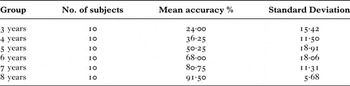
The recorded material was transcribed verbatim in an Excel document. The number of target and non-target responses was counted in the two tasks. For Task 1, the number and percentages of correct and incorrect responses were calculated for each subject and then compared across the six age groups. In addition, the patterns of errors were quantified for each group and across the eight plural types. The number of accurate responses was recorded out of the five words given in each category and then out of the forty words in the whole task. Accuracy was analyzed using a generalized linear mixed model (GLMM) in which accuracy is modeled as the rate of binomial distribution with five trials (n = 5) in the case of the eight plural categories or forty trials (n = 40) for the whole plural-formation task. Subject and within-subject variations (category*subject) were included as random factors in the model. Compound symmetric covariance structure was used to account for the repeated measures on each subject. Least square means (LSM) and their standard errors were computed with the model. Pairwise differences of LSMs were tested using multiple comparison adjustment. An adjusted p-value that is less than ·05 indicates a significant LSM difference at the ·05 level. The analysis was performed using PROC GLIMMIX in SAS 9·4 (SAS Institute Inc., Cary, North Carolina). Table 2 summarizes the overall accuracy percentages and standard deviations of the groups on the real-word plural formation task.
Mean accuracy percentages and standard deviations on the real-word plural task

As Table 2 demonstrates, the participants' ability to form plurals correctly increased with age, progressing from 24% accuracy for the three-year-old group, through 36·25% (four-year-olds), 50·25% (five-year-olds), 68·00% (six-year-olds), and 80·75% (seven-year-olds), to 91·50% (eight-year-olds). The GLMM analysis showed a significant difference among the six age groups with regard to the overall plural-formation accuracies (F(5,54) = 31·05, p < ·001). Pairwise comparisons using simulated multi-comparison adjustments revealed that all groups were significantly different from one another with significance levels of < ·01 (three- and five-year-olds) and < ·001 (the other group comparisons). Non-significant differences were found only between the following age groups: three-year-olds and four-year-olds (p = ·317), four-year-olds and five-year-olds (p = ·401), five-year-olds and six-year-olds (p = ·125), six-year-olds and seven-year-olds (p = ·295), and seven-year-olds and eight-year-olds (p = ·101). The fact that none of the groups was significantly different from its one year younger or one year older counterparts indicates that the development of the Arabic plural morphology proceeds rather slowly.
The different age groups showed variable performance on the eight plural categories under study (Table 3). The three-year-olds showed only a slightly better performance on the HF category (44%) compared to the other categories. However, the four-year-olds showed a relatively higher performance split between the HF and NF categories (66% and 54%, respectively) and the remaining categories, in which their accuracy rates ranged between 16% (DB) and 42% (UB). The same applies to the five- and six-year-olds, who had high accuracy rates on the two feminine-sound categories, namely HF (82% and 88%) and NF (86% and 100%), compared to the masculine-sound and broken categories. The scores of the two oldest age groups (seven and eight years) were marked by ceiling or near-ceiling accuracies on the predictable patterns (i.e. HF, NF, PM, PB) and incomplete mastery of the less predictable ones.
Mean accuracy percentages and standard deviations (SD) on the eight plural categories in the real-word plural task

notes: HF = human feminine sound; NF = non-human feminine sound; PM = predictable masculine sound; UM = unpredictable masculine sound; PB = predictable broken; UB = unpredictable broken; DB = defective broken; GB = geminate broken.
The GLMM analysis for the eight plural categories across the six age groups revealed a significant main effect of plural category (F(7,378) = 4·81, p < ·001); the participants' accuracy scores varied significantly based on plural category. There was also a significant effect of age (F(5,54) = 12·67, p < ·001); the participants' ability to derive the various plural forms accurately increased with age. A marginally significant interaction was also found between age group and plural categories (F(35,378) = 1·34, p = ·098); the discrepancy in the participants' accuracies on the eight plural categories was relatively more visible in the middle-aged groups (five and six years) than in the younger and older groups. The five- and six-year-olds approached adult-like performance on HF and NF, whereas their performance on the other categories was non-adult-like. However, in the case of the younger and older groups, the gap in their accuracies on the individual plural types is narrower.
Pairwise comparisons among the plural categories within each age group revealed no significant difference between HF and NF in any age group. Apart from this exception, significant differences were found among the categories depending on age. At age three, there were significant differences between HF and PB (p = ·01), HF and DB (p = ·02), NF and PB (p = ·03), and UB and PB (p = ·02). In addition, a marginally significant difference was found between UB and DB (p = ·06). At age four, significant differences were detected between HF and PM (p = ·04), HF and PB (p = ·04), HF and DB (p = ·001), HF and GB (p=.01), and NF and DB (p = ·02). At age five, the contrast between the HF and NF categories and the remaining categories became transparent. Thus, HF was significantly different from PM (p = ·01), UM (p = ·02), PB (p = ·01), DB (p = ·001), and GB (p = ·001). Similarly, NF diverged significantly from PM (p = ·002), UM (p = ·004), PB (p = ·001), UB (p = ·03), DB (p < ·001), and GB (p < ·001). At age six, significant differences were found only between HF and UM (p = ·01), HF and DB (p = ·01), and HF and GB (p = ·03). A marginally significant difference existed between PB and DB (p = ·09). When children reach the age of seven, the difference between HF and NF and the predictable patterns, namely PM and PB, disappears. However, significant or marginally significant differences were found between HF and each of the other categories: UM (p = ·01), UB (p = ·09), DB (p = ·01), and GB (p = ·06). Similarly, NF diverged in significant or marginally significant ways from UM (p = ·01), UB (p = ·08), DB (p = ·01), and GB (p = ·05). By the age of eight, the children reach adult-like performance and no significant differences were found between the different categories.
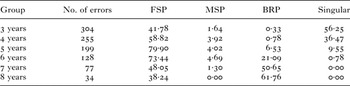
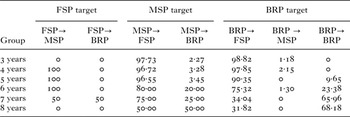
The six age groups diverged considerably in terms of the distribution and rates of the errors that they produced. The errors were sorted into four patterns: (1) feminine sound plurals (FSP), (2) masculine sound plurals (MSP), (3) broken plurals (BRP), and (4) singular forms (which consisted mainly of analytic errors, such as talat mudarris ‘three teacher’). Table 4 illustrates these error patterns, and Tables 5 and 6 demonstrate the distribution and percentages of the errors, which here represent the plural forms used in error by the children rather than the target plural paradigms.
Types of non-target errors produced by children on the real-word task

notes: FSP = feminine sound plurals; MSP = masculine sound plurals; BRP = broken plurals.
The number, mean percentages, and patterns of non-target errors produced by children on the real-word task

notes: FSP = feminine sound plurals; MSP = masculine sound plurals; BRP = broken plurals.
The distribution and mean percentages of non-target errors produced by children on the real-word task

notes: FSP = feminine sound plurals; MSP = masculine sound plurals; BRP = broken plurals.
As Table 5 shows, the frequency of errors decreased with age, ranging from 304 in the case of the three-year-olds to 34 for the eight-year-olds. In terms of the error distribution, the three-year-old group resorted primarily to repeating the singular stimuli (56·25%). The four-year olds continued to utilize uninflected singular stems (36·47%), but relied more frequently on FSP as the default strategy (58·82%). FSP was the default form for the five- and six-year-olds (79·90% and 73·44%, respectively). However, a shift is noticed in the case of the seven- and eight-year-olds, who resorted primarily to BRP as the default strategoy (50·65% and 61·76%), with FSP falling back to a less salient role.
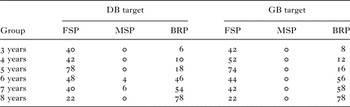
When we look closely at the pluralization strategies employed by the participants (i.e. after excluding the singular errors), a number of patterns emerge (Table 6). First, when the target FSP is not used, the participants use MSP as the default strategy (100%), except in the case of seven-year-olds, who used BRP as frequently as MSP. Likewise, when the participants do not produce the target MSP, they employ FSP as the major substitute, except in the case of the eight-year-olds, whose non-target responses are distributed equally between FSP and BRP (50% each). The situation becomes more complicated when the target form is BRP. Whereas the younger age groups (three, four, five, and six) mainly utilize the FSP morpheme, the seven- and eight-year-olds use non-target BRP patterns (65·96% and 68·18%, respectively). In other words, they become more sensitive to the non-concatentive option.
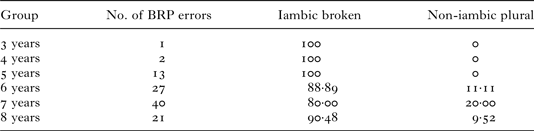
Lastly, we examined the distribution of the iambic and non-iambic BRP errors in the real-word task. Table 7 summarizes the percentages of the iambic and non-iambic plural forms used in error by the participants. The data show that the iambic pattern was prevalent across the six age groups; its frequency percentage ranged from 80% (seven-year-olds) to 100% (three-, four-, and five-year-olds). The predominance of iambic plurals reflects their high frequency in child- and adult-directed speech, as has been confirmed by a number of corpus studies.
Number and mean accuracy percentages of iambic and non-iambic broken plural non-target errors produced by children on the real-word task

note: BRP = broken plurals.
Results from the nonsense-word task
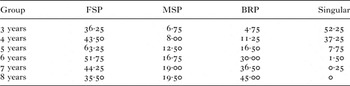
The second task was designed to examine the plural formation strategies that speakers use with new/unfamiliar words. Since word knowledge is not a factor here, the aim was to verify the relationship between the pluralization strategies that the participants use and the structural, semantic, and phonological cues in the relevant singular stems. Another aim was to determine the default strategy or strategies that they use when they encounter new or unfamiliar words. Table 8 illustrates the frequency percentages of FSP, MSP, and BRP forms in the speakers' responses as well as uninflected forms that were merely repetitions of the singular stimuli.
Frequency percentages on the nonsense-word task

notes: FSP = feminine sound plurals; MSP = masculine sound plurals; BRP = broken plurals.
The response patterns in this task replicate those observed in the real-word task. The three-year-olds mainly repeated singular words (52·25%). The uninflected singular stems still figured predominantly in the responses of the four-year-old children (37·25%), who resorted even more frequently to the FSP morpheme (43·50%). FSP was the dominant plural form for the five- and six-year-olds (63·25% and 51·75%, respectively). Although FSP continued to be prevalent at the age of seven (44·25%), BRP emerged as a second common pluralization strategy (36·50%). As was the case in the real-word task, BRP became the preferred way for encoding plurality for the eight-year-old group in the nonsense-word task (45·00%). The GLMM analysis for the three monolithic plural types in the six age groups showed a significant effect of plural type (F(2,108) = 35·68, p < ·001); the participants' frequency percentages varied significantly based on plural type. There was also a significant effect of age (F(5,54) = 8·16, p < ·001); the distribution of participants' frequency scores changed with age, with MSP and BRP becoming significantly more frequent. There was also a significant interaction between age group and plural type (F(10,108) = 3·38, p < ·001); the variance in the participants' frequency scores (due to the predominance of FSP) was more salient in the younger groups and less so in the older groups. Pairwise comparisons pointed to significant differences between FSP and MSP in the three-year-old group (p = ·004), four-year-old group (p < ·001), five-year-old group (p < ·001), six-year-old group (p < ·001), and seven-year-old group (p = ·02). FSP differed significantly from BRP at the ages of three (p < ·001), four (p < ·001), and eight (p < ·001). Lastly, MSP diverged significantly from BRP only at the ages of six (p = ·003) and seven (p = ·001).
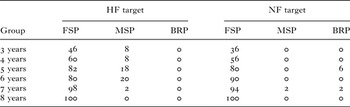
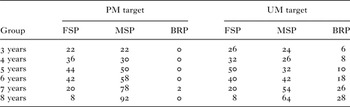
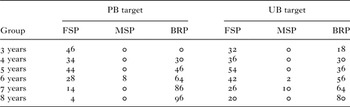
I also examined the frequency of the pluralization strategies employed by the participants (i.e. after excluding the singular responses) across the eight plural categories. Regardless of their age, the participants deployed the FSP morpheme at a relatively high frequency in the obligatory contexts of HF and NF (Table 9). When the target plurals involve the use of any of the MSP (Table 10) or BRP (Tables 11 and 12) patterns, however, the use of the target plurals is always rivaled by the presence of non-target FSP in the three or four youngest groups before the target forms become the dominant patterns (seven- and eight-year-olds). As was the case in the real-word task, the participants deployed the target plurals at higher frequencies in the predictable patterns (HF, NF, PM, and PB) than in the less predictable patterns (UM, UB, DB, and GB). In fact, at the age of eight, the frequency percentages of the target plurals reach ceiling in the predictable HF, NF, PM, and PB forms, whereas their frequency rates did not come close to ceiling in the remaining categories.
Frequency percentages of the pluralization strategies in target HF and NF (both under the FSP category)

notes: HF = human feminine sound; NF = non-human feminine sound.
Frequency percentages of the pluralization strategies in target PM and UM (both under the MSP category)

notes: PM = predictable masculine sound; UM = unpredictable masculine sound.
Frequency percentages of the pluralization strategies in target PB and UB (both under the BRP category)

notes: PB = predictable broken; UB = unpredictable broken.
Frequency percentages of the pluralization strategies in target DB and GB (both under the BRP category)

notes: DB = defective broken; GB = geminate broken.
The GLMM analysis was performed to check the participants' ability to deploy the target inflection (FSP, MSP, BRP) in the eight plural categories and across the six age groups. The test yielded a significant effect of plural category (F(7,378) = 3·32, p < ·01); the participants' ability to use the target inflections was significantly affected by the category of the target plural. There was also a significant effect of group (F(5,54) = 5·79, p < ·001); the participants' use of the target plurals increased with age. There was no significant interaction between plural type and age (p > ·05). With respect to age, pairwise comparisons pointed to significant differences between the six groups with significant levels of < ·05 (five- and seven-year-olds) and < ·01 (the remaining comparisons). The only non-significant differences were between the following groups: three-year-olds and four-year-olds (p = ·35), four-year-olds and five-year-olds (p = ·47), five-year-olds and six-year-olds (p = ·45), six-year-olds and seven-year-olds (p = ·58), and seven-year-olds and eight-year-olds (p = ·32). With regard to plural category, pairwise comparisons exhibited significant differences in terms of the frequency of target plurals in HF and NF, on the one hand, and on the other, the remaining plural types (p < ·001), but not between these two plural types (p = 1·0). Significant differences were also found between target-plural frequencies in PM, on the one hand, and, on the other, DB and GB (p = ·006 and p = ·027, respectively). Similarly, the frequency score of target plurals on PB was significantly different from those on DB and GB (p = ·01, p = ·05, respectively). Lastly, a marginally significant difference was found between UB and DB (p = ·069).
DISCUSSION
The study examined the development of plural morphology in Jordanian children aged between three and eight. In addition, the study explored the role of the predictability, transparency, productivity, and frequency of different plural forms in determining the trajectory that Jordanian-Arabic-speaking children follow in acquiring this complex inflectional system. By doing so, the study sought to expand the analysis of the acquisition of plural morphology beyond the regular−irregular dichotomy to a more comprehensive approach that takes into account other relevant properties of the acquired forms. The Arabic plural system is an optimal testing ground for this approach because it involves multiple plural forms that vary considerably in terms of their predictability, transparency, productivity, and frequency.
The trajectory that the participants in this study follow in acquiring the Arabic plural system confirms the three-phase characterization of the development of plural morphology (pre-morphology, proto-morphology, and morphology proper), although these stages are not clear-cut with respect to age. The pre-morphological phase appears in the output of some of the three-year-olds, who rely predominantly on uninflected singular forms and produce fewer correctly inflected plural forms, some of which may have been rote-learned. Moreover, these children do not display notable asymmetry in the distribution of the different plural categories. In other words, they do not perform notably better on a particular category than the rest, which may indicate that the notion of default is not in place yet at this stage. The predominant use of uninflected singular forms suggests that the morphological representation of plurality may not be fully developed at this stage. However, the pre-morphology phase may have been more visible in younger children, who were not involved in this study.Footnote 3
The proto-morphological stage seems to evolve at the age of four, which is marked by the continued use of singular uninflected stems, increased accuracy across the different plural categories, particularly HF and NF, and the overextension of the FSP morpheme to other categories. These developments indicate that children are still in the process of detecting and constructing the various plural markers based on patterns in their input. Ages five and six mark the children's internalization of plural morphology because children are able to deploy the various plural morphemes at this stage. However, children still make mistakes, particularly in MSP and BRP forms, which may underline their incomplete knowledge of the application of the morphological paradigms to the relevant singular stems. At the ages of seven and eight, the participants come close to the morphology proper stage as they display full command of four plural forms (HF, NF, PM, PB) and approximate adult-like performance on the remaining categories. The U-shaped trajectory in the acquisition of plural morphology reported in previous research is not supported in this study. Although the proto-morphology phase (roughly between four to six years) is marked by the overgeneralization of FSP (Aljenaie et al., Reference Aljenaie, Abdalla and Farghal2011; Omar, Reference Omar1973; Ravid & Farah, Reference Ravid and Farah1999; Saiegh-Haddad et al., Reference Saiegh-Haddad, Hadieh and Ravid2012), the participants' ability to derive plural forms did not decline at any particular age, but increased steadily. Moreover, as Marcus et al. (Reference Marcus, Pinker, Ullman, Hollander, Rosen and Xu1992) have observed based on a similar finding, over-regularization does not seem to be tied to a particular developmental phase, but seems to occur throughout language development.
An examination of the development of the different morphological paradigms reveals a number of patterns. First, when we consider FSP, MSP, and BRP as monolithic classes of plurals, children are able to acquire the FSP forms earlier than the MSP and BRP patterns, which is consistent with previous studies on the acquisition of the Arabic plural system (Aljenaie et al., Reference Aljenaie, Abdalla and Farghal2011; Omar, Reference Omar1973; Ravid & Farah, Reference Ravid and Farah1999; Ravid & Hayek, Reference Ravid and Hayek2003; Saiegh-Haddad et al., Reference Saiegh-Haddad, Hadieh and Ravid2012). This may be due to the productivity and frequency of FSP. The FSP marker may be used with human and non-human, feminine and masculine, Arabic and foreign nouns. Thus, it is semantically unmarked in comparison to the MSP and BRP markings. The MSP morpheme is less productive because it is semantically specified for (+human) nouns. MSP create an additional challenge for children because the MSP morpheme applies only to a set of human masculine nouns (that is, human masculine singulars may be pluralized by MSP, FSP, and BRP markings). Likewise, the various BRP patterns apply selectively to human and non-human singulars, which makes them less productive.
Predictability and transparency do not seem to play a conspicuous role in the early stages of the development of the plural system (especially between three and five years), because forms that display similar transparency and predictability do not seem to be equally developed. This becomes evident when we compare the acquisition of the eight plural categories under study individually. For example, like HF and NF plurals, the PM and UM forms employ simple suffixation (-iin) that leaves the singular stem largely intact. Despite their comparable transparency, however, children are more successful in deriving plurals through FSP suffixation than MSP suffixation. Likewise, PB is a predictable pattern, but it lags developmentally behind the HF and NF categories possibly because it is less productive and less frequent (Table 1). Since most of the plural forms learned at this age (three years) are rote-learned, it is possible that the words in the PB category are not frequent enough in the speech directed to younger children to allow the rote access strategy. This, however, may not reflect the frequency of the plural pattern itself, which is the focus of the present study, but may relate to the frequency of individual words − a trend that may be particularly relevant to the younger children.
While productivity and frequency seem to play a major role in the early development of the different plural forms, children's utilization of the predictability of the plural forms becomes gradually more apparent as they progress in age. For example, by the age of eight, all of the four predictable patterns are fully acquired (HF, NF, PM, and PB), whereas none of the less predictable forms is. The same trend appears in comparing plural forms whose main difference lies in their predictability. Thus, between the two MSP forms, the predictable PM is fully acquired by the age of eight, although the UM is as frequent and transparent. Likewise, the PB becomes fully developed by the age of eight, unlike the less predictable broken forms UB, DB, and GB. This indicates that, in terms of predictability, singular stems that provide phonological and structural cues are probably easier for children to detect and acquire. Semantic cues are also important. As noted above, the UM pattern is the most problematic pattern even to the eight-year-olds. The difficulty of this pattern lies in that human masculine singulars may be inflected by both concatenative and non-concatenative strategies. In other words, the fact that a singular noun is masculine and human increases the number of options for children and hence makes the pluralization task more difficult.
The effect of transparency on the acquisition of plural morphology seems to be less evident in this study. The pattern that is most illuminating in this case is UM. Though transparent, the UM form seems to emerge along with the other plural forms. Strikingly, however, the children gradually become less competent in inflecting the UM form compared to the other categories. What is relevant to us here is that, after the rote-learning stage, the transparent UM form becomes less developed than the other transparent (HF, NF, and PM) and less transparent (PB, UB, DB, GB) forms. In the case of HF, NF, and PM, the role of transparency is confounded by other factors (predictability) and therefore there is no independent piece of evidence for its facilitative role. The dubious role of transparency can be seen when we compare the children's accuracies on the three broken forms: UB, DB, and GB. The children across the different age groups perform as well on the opaque DB and GB forms as on the less opaque UB. However, the fact that the DB and GB forms are relatively more predictable than the UB form makes it difficult to tease apart the role of transparency in the acquisition of this form.
The patterns found in the real-word task were confirmed in the nonsense-word task. For example, the path that children follow in learning the plural markers seems uniform in both the real-word task and the nonsense task; children start by using a sizable number of uninflected singular nouns (three- to four-year-olds), then tend to overgeneralize FSP (five- to six-year-olds), and eventually become more successful in deploying the target FSP, MSP, and BRP forms (seven- to eight-year-olds). Likewise, relative to the MSP and BRP markers, the FSP morpheme is used more frequently with the relevant HF and NF forms at an earlier age and is gradually extended to MSP and BRP. Plural patterns that are predictable are used at high frequencies by the ages of seven and eight, whereas the less predictable forms are not completely acquired by children at this age. Overall, the percentages of non-target patterns in the real-word and nonsense-word tasks were similar, which indicates that children's derivation of the different plural forms is rule- or pattern-governed, rather than based on word familiarity. This is particularly true in children aged over five. This is consistent with previous findings on plural morphology in Arabic and other languages (e.g. Aljenaie et al., Reference Aljenaie, Abdalla and Farghal2011; Berko, Reference Berko1958).
At this point, it is relevant to bring up the issue of default. The present study indicates that the notion of default is not fully developed in the youngest group (three-year-olds), but starts to evolve afterwards. Children start to use FSP as the main default marker by the age of four and over-generalize it relatively steadily by the ages of five and six. This finding is consistent with those reported in previous studies concerning the overextension of FSP to MSP and BRP at the early stages in the development of plural morphology (Aljenai et al., Reference Aljenaie, Abdalla and Farghal2011; Omar, Reference Omar1973; Ravid & Farah, Reference Ravid and Farah1999). However, a noticeable shift occurs at the ages of seven and eight; children not only become more successful in deploying BRP, but, when they make a mistake, they tend to substitute BRP patterns with other BRP forms − a pattern that has also been reported by Marcus et al. (Reference Marcus, Pinker, Ullman, Hollander, Rosen and Xu1992). The iambic form accounts for the majority of the BRP errors at every stage of the children's language development, and it becomes a dominant default strategy at the ages of seven and eight, along with the FSP. This developmental pattern has been predicted by Plunkett and Nakisa (Reference Plunkett and Nakisa1997), based on their study of the distribution of the different plural markings in the Arabic language.
The double-default account is also confirmed in adult speakers whose Arabic language development is interrupted by a second, more dominant, language at an early age, which is typically the case of first- or second-generation Arab immigrants (i.e. heritage speakers) (Benmamoun et al., Reference Benmamoun, Albirini, Montrul and Saadah2014). Benmamoun and his associates (2014) examined the acquisition of plural morphology by Palestinian and Egyptian heritage speakers and found that the iambic BRP pattern is next only to FSP in terms of prevalence in the errors that heritage speakers make in inflecting six plural forms (HF, NF, DB, GB, and mixed masculine sound and broken plurals). This is not surprising given the fact that heritage speakers have been found to display child-like L1 acquisition patterns due to their shift to a second language at an early age (Albirini, Reference Albirini2013). In general, the deployment of two default forms indicates that, at a later stage of their language development, child learners of Arabic as L1 become more sensitive to the distribution of the FSP and the iambic BRP in the language of adult speakers of Arabic, and they select their default strategy based on this knowledge.
The findings have theoretical implications for the study of Arabic plural morphology and the development of complex inflectional systems in general. The data provide conflicting evidence for the single-route and dual-route models. The dual-route model predicts the disappearance of uninflected singulars when children acquire the relevant inflections. This prediction is borne out in the data because children rarely use the uninflected singular once they internalize the different plural paradigms (around age five). The derivation of the non-learned BRP forms through the regular -aat morpheme falls in line with the dual-role model, as has been indicated by previous studies (Aljenaie et al., Reference Aljenaie, Abdalla and Farghal2011; Omar, Reference Omar1973; Ravid & Farah, Reference Ravid and Farah1999, Reference Ravid, Farah, Stephany and Voeikova2009). However, FSP is generalized to the regular MSP, which calls into question the split between regular and irregular forms. Moreover, the regular MSP is generally neither as successfully learned nor as widely overgeneralized as FSP, which poses another challenge to the dual-route model.
Children pluralize the nonsense words by analogy, as predicted by the single-route model. However, its prediction concerning the unproblematic acquisition of frequent forms is not totally supported in the study. While frequency seems to play a role in the early stages of language development, its role is less evident in the later stages. For example, children are overall more accurate in inflecting the PM and PB forms than the comparably frequent UM and UB patterns. Moreover, the single-route model may not explain the acquisition of the infrequent DB and GB patterns before the relatively more frequent UB form. The dual-route and single-route models have been used fruitfully in a number of contexts, particularly when the regular−irregular division is the major player in the acquisition of a given inflectional system. However, the encoding of plurality in Arabic goes beyond the regular−irregular dichotomy and involves a number of idiosyncratic properties that distinguish the various plural forms. The study of these properties may help provide a more nuanced account of the development of the Arabic plural system and inflectional morphology in general.
The present findings confirm a number of patterns that have been reported on complex plural systems, such as German. For example, in accordance with previous research on German, this study suggests that children do not produce many plural nouns at an early age and may spend several years acquiring the different paradigms of plurality (e.g. Clahsen, Rothweiler, Woest & Marcus, Reference Clahsen, Rothweiler, Woest and Marcus1992; Szagun, Reference Szagun2001). In this respect, Arab and German children diverge considerably from counterparts acquiring simpler plural systems, such as English (e.g. Marcus et al., Reference Marcus, Pinker, Ullman, Hollander, Rosen and Xu1992; Wood et al., Reference Wood, Kouider and Carey2009). In keeping with previous reports, too, the present results point to the important role of frequency in the patterns of errors generated by younger children (Szagun, Reference Szagun2001). The study highlights the need to approach the plural forms beyond the regular−irregular dichotomy, as has also been suggested in other morphologically rich languages (Szagun, Reference Szagun2001). However, the study provides novel findings that may be relevant to a wide array of languages. One of the important findings in this study is that children use different input and structural cues at different stages of their language development. In addition, they become more sensitive to frequency distributions in adult language as they become older. The findings also reveal that multiple default forms may exist in the same language and that the notion of default is not always fixed but may change with age.
In conclusion, the study shows that the properties of the plural forms, including productivity, predictability, and frequency, determine to a large extent the sequence and pace in which these forms are acquired. While productivity and frequency seem to play a more prominent role in the early stages of language acquisition (when children are still in the process of detecting and constructing the various plural markings), predictability becomes a critical factor in the children's ability to reach adult-like competence. Finally, children use feminine sound plurals as the default form at an early age, but they seem to use two default forms as they become older. The study underscores the importance of studying the acquisition of morphologically rich systems (such as Arabic plural morphology) with an eye on the idiosyncrasies of these systems. This may allow for a more complete picture of the patterns observed.