Because of the consecutive periods of economic recession and associated changes on the labor market, contemporary jobs have become less stable. According to Anderson and Pontusson (Reference Anderson and Pontusson2007) about 25% of the employees in 15 Organization for Economic Co-operation and Development (OECD) countries reported to feel insecure about the future of their job. Mirroring this evolution, during the past decade scholarly interest in job insecurity has been increasing (Sverke, De Witte, Näswall, & Hellgren, Reference Sverke, De Witte, Näswall and Hellgren2010). Abundant evidence pointed at the negative consequences of job insecurity for employees and employers alike, for example in terms of well-being, job attitudes and turnover (Cheng & Chan, Reference Cheng and Chan2008; Sverke, Hellgren, & Näswall, Reference Sverke, Hellgren and Näswall2002). Most research, however, only attested to the drawbacks of potential job loss in general, labeled as quantitative job insecurity. As such, the potential negative effects of unwanted changes in valued characteristics of the current job, coined as qualitative job insecurity, remained relatively understudied (De Witte, De Cuyper, Vander Elst, Vanbelle, & Niesen, Reference De Witte, De Cuyper, Vander Elst, Vanbelle and Niesen2012; Sverke et al., Reference Sverke, Hellgren and Näswall2002).
Building on Ashford, Lee and Bobko (Reference Ashford, Lee and Bobko1989), however, qualitative job insecurity is expected to carry many negative consequences. Initial research associated qualitative job insecurity with decreased work attitudes, such as job satisfaction and turnover intentions (Hellgren, Sverke, & Isaksson, Reference Hellgren, Sverke and Isaksson1999). Negative associations with well-being were also found, for example in terms of emotional exhaustion and self-reported health (De Cuyper, De Witte, Kinnunen, & Nätti, Reference De Cuyper, De Witte, Krausz, Mohr, Rigotti, Guest, Isaksson and De Witte2010; De Witte et al., Reference De Witte, De Cuyper, Handaja, Sverke, Näswall and Hellgren2010). Because of the boosting demand for flexibility in the labor market, changes within one’s current job are increasingly likely. The first aim of the current contribution is therefore to contribute to our understanding of qualitative job insecurity. Replicate earlier research on quantitative job insecurity, we examine the relations between qualitative job insecurity and work related well-being, in terms of burnout and work engagement, two important complementary aspects of employees’ well-being (Demerouti, Mostert, & Bakker, Reference Demerouti, Mostert and Bakker2010). As such, this study is among the first to examine the relationship between quantitative as well as qualitative job insecurity and positive aspects of employees’ well-being.
As insecurity is omnipresent, apart from gaining insight in the negative correlates of job insecurity, it seems important to understand how such negative consequences can be avoided. Employees themselves may need to play a key role in this matter. The second aim of this study is therefore to examine how individual characteristics can buffer the negative associations of quantitative and qualitative job insecurity. Previous research found that need for closure (Chirumbolo & Areni, Reference Chirumbolo and Areni2010) and external locus of control (Näswall, Sverke, & Hellgren, Reference Näswall, Sverke and Hellgren2005) moderate the associations of quantitative job insecurity. We argue that humor may also play this role for both quantitative and qualitative job insecurity. As such, this study plays a pioneering role in examining potential buffers for the negative associations of qualitative job insecurity. We focus on humor, and more specifically, self-enhancing and affiliative humor (Martin, Puhlik-Doris, Larsen, Gray, & Weir, Reference Martin, Puhlik-Doris, Larsen, Gray and Weir2003) as they might constitute important personal resources, which recently gained interest in the context of work (Van den Broeck, Vander Elst, Dikkers, De Lange, & De Witte, Reference Van den Broeck, Vander Elst, Dikkers, De Lange and De Witte2012). To substantiate our hypotheses, we rely on the conservation of resources theory (COR; Hobfoll, Reference Hobfoll2002), which is used in both the literature on job insecurity and humor. The following paragraphs detail job insecurity and humor, as well as the rationale behind the hypotheses.
Job insecurity
Job insecurity is defined as employees’ subjective thoughts and feelings regarding the continuity of their job in the future (Sverke et al., Reference Sverke, Hellgren and Näswall2002). Two types of job insecurity can be distinguished (Hellgren et al., Reference Hellgren, Sverke and Isaksson1999). On the one hand, job insecurity may pertain to the loss of one’s job as such, which is referred to as quantitative job insecurity. On the other hand, employees might feel insecure about the loss or deterioration of valued job features, such as career opportunities or employment conditions, even when their job is not at stake. This is labeled as qualitative job insecurity.
Job insecurity yields negative consequences, which can be for example explained by the conservation of resources theory (COR; Hobfoll, Reference Hobfoll2002). COR argues that people are driven to gain and retain resources. Resources include all objects, personal characteristics, conditions or energies that are valued by the individual or serve as means to attain such valued aspects (Gorgievski & Hobfoll, Reference Gorgievski, Hobfoll and Halbesleben2008; Hobfoll, Reference Hobfoll1989). Job security can be seen as a valued resource. For many employees, quantitative job security is valuable in its own right (Warr, Reference Warr2008). It furthermore guarantees the availability of other resources such as money to fulfill one’s economic needs. Therefore, it is modeled as a resource (Demerouti, Bakker, Nachreiner, & Schaufeli, Reference Demerouti, Bakker, Nachreiner and Schaufeli2001). Similarly, qualitative job insecurity warrants valued job aspects such as the content of one’s work and career opportunities (Hellgren et al., Reference Hellgren, Sverke and Isaksson1999). These are equally considered as important job resources (e.g., Demerouti et al., Reference Demerouti, Bakker, Nachreiner and Schaufeli2001). Following COR, we argue that the potential loss of one’s job (i.e., quantitative job insecurity) or valued job aspects (i.e., qualitative job insecurity) reflects a threat of one’s resources and therefore elicits a stress reaction.
Consistent with this view, several scholars point at the negative outcomes of both quantitative and qualitative job insecurity in terms of stress (De Witte, Reference De Witte2005; Probst, Reference Probst, Barling and Cooper2008) and decreased well-being, for example reduced engagement (De Cuyper, Bernhard-Oettel, Berntson, De Witte, & Alarco, Reference De Cuyper, Bernhard-Oettel, Berntson, De Witte and Alarco2008; Mauno, Kinnunen, Mäkikangas, & Nätti, Reference Mauno, Kinnunen, Mäkikangas and Nätti2005). Both types of job insecurity were also found to be negatively associated with job performance (Cheng & Chan, Reference Cheng and Chan2008; Fischmann, De Witte, Sulea, & Iliescu, Reference Fischmann, De Witte, Sulea and Iliescu2018) and positively with turnover intentions (Sverke et al., Reference Sverke, Hellgren and Näswall2002; Urbanaviciute, Lazauskaite-Zabielske, Vander Elst, & De Witte, Reference Urbanaviciute, Lazauskaite-Zabielske, Vander Elst and De Witte2018).
As quantitative and qualitative job insecurity have previously been shown to particularly influence work-related well-being (De Witte, Vander Elst, & De Cuyper, Reference De Witte, Vander Elst, De Cuyper, Vuori, Blonk and Price2015; Hu, Jiang, Probst, & Liu, Reference Hu, Jiang, Probst and Liu2018; Sverke et al., Reference Sverke, Hellgren and Näswall2002; Vander Elst, Richter et al., Reference Vander Elst, Richter, Sverke, Näswall, De Cuyper and De Witte2014), we selected burnout and work engagement as dependent variables. The majority of previous research, however, has focused on quantitative job insecurity, leaving the impact of qualitative job insecurity relatively understudied (De Witte et al., Reference De Witte, De Cuyper, Vander Elst, Vanbelle and Niesen2012). The current study aims to tap into this issue by also addressing the relationship between qualitative job insecurity and burnout and work engagement.
Burnout refers to a state of impaired mental health, often in response to the prolonged exposure to emotional and interpersonal job stressors (Maslach, Schaufeli, & Leiter, Reference Maslach, Schaufeli and Leiter2001). Burnout is mostly characterized by feelings of exhaustion, that is, feeling emotionally and physically drained, and cynicism, that is, taking a distant attitude towards work. Engagement is, in contrast, a positive, fulfilling, work-related state of mind (Schaufeli, Salanova, González-Romá, & Bakker, Reference Schaufeli, Salanova, González-Romá and Bakker2002). It is mostly defined by vigor, or bursting with energy, and dedication or considering one’s work meaningful (Schaufeli et al., Reference Schaufeli, Salanova, González-Romá and Bakker2002).
These core burnout and engagement dimensions are viewed as conceptual opposites of each other (González-Romá, Schaufeli, Bakker, & Lloret, Reference González-Romá, Schaufeli, Bakker and Lloret2006), as prior research has demonstrated that burnout and work engagement consist of two distinct underlying bipolar dimensions, coined as energy and identification. González-Romá and colleagues (2006) showed that the dimension “energy” is characterized by exhaustion-vigor, whereas “identification” is defined by the poles cynicism-dedication. Therefore, we consider positive affect in terms of work engagement and negative affect in terms of burnout to be opposite aspects within the broader construct of employee well-being (Taris, Ybema, & van Beek, Reference Taris, Ybema and van Beek2017). Burnout and engagement are not only important for employees’ well-being, but are also relevant from an employers’ perspective, as they both contribute to organizations’ success via increased organization commitment, performance, and reduced turnover (Bakker & Demerouti, Reference Bakker and Demerouti2007).
Following the literature and previous empirical findings on job insecurity, we hypothesize:
Hypothesis 1: Quantitative job insecurity relates positively to exhaustion and cynicism (Hypothesis 1a) and negatively to vigor and dedication (Hypothesis 1b).
Hypothesis 2: Qualitative job insecurity relates positively to exhaustion and cynicism (Hypothesis 2a) and negatively to vigor and dedication (Hypothesis 2b).
Previous meta-analyses however indicated large variations in the effect sizes of the relationships between job insecurity and work related outcomes, particularly with respect to well-being (Cheng & Chan, Reference Cheng and Chan2008; Sverke et al., Reference Sverke, Hellgren and Näswall2002). This hints at the impact of moderators. Previous research examined how demographic characteristics such as age and gender impacted on this relationship (Sverke et al., Reference Sverke, Hellgren and Näswall2002). Others showed that characteristics of one’s job (e.g., type of contract or job position; De Cuyper & De Witte, Reference De Cuyper and De Witte2006; Lim, Reference Lim1997) or organizational characteristics (e.g., communication and participation in decision making; König, Debus, Häusler, Lendenmann, & Kleinmann, Reference König, Debus, Häusler, Lendenmann and Kleinmann2010; Vander Elst, Baillien, De Cuyper, & De Witte, Reference Vander Elst, Baillien, De Cuyper and De Witte2010) may play a similar buffering role.
Recent research also tapped into recovery experiences (Kinnunen, Mauno, & Siltaloppi, Reference Kinnunen, Mauno and Siltaloppi2010) and dispositions such as negative and positive affectivity as potential moderators of job insecurity, (Näswall et al., Reference Näswall, Sverke and Hellgren2005; Vander Elst, Bosman, De Cuyper, Stouten, & De Witte, Reference Vander Elst, Bosman, De Cuyper, Stouten and De Witte2013). However, research on such individual characteristics affecting the job insecurity-well-being relationship is still relatively scarce. Identifying individual characteristics buffering for the negative impact of job insecurity is nevertheless important, as it opens possibilities for individual employees themselves to alter the negative impact of their insecure situation. Against this background, the current research wants to answer the call to scrutinize individual difference variables buffering for job insecurity. Specifically, in line with the positive psychology stressing the importance of individuals’ strengths (Seligman & Csikszentmihalyi, Reference Seligman and Csikszentmihalyi2000), we want to examine whether employees’ personal use of particular styles of humor may assist them in offsetting the adverse outcomes of job insecurity.
Humor
Humor has a long tradition within psychology, which has resulted in the development of various perspectives on the construct (Mesmer-Magnus, Glew, & Viswesvaran, Reference Mesmer-Magnus, Glew and Viswesvaran2012). However, a central tenet of the humor literature is the humor-health hypothesis, stating that the use of humor enhances individuals’ well-being and health (Martin et al., Reference Martin, Puhlik-Doris, Larsen, Gray and Weir2003). Results are however indecisive, leading Martin and colleagues (2003) to suggest that only the use of particular types of humor would enhance individuals’ well-being and health, while others have less positive or even harmful effects (Kuiper & Martin, Reference Kuiper, Martin, Raskin and Ruch2007; Martin, Reference Martin2001).
Specifically, Martin and colleagues (2003) differentiated between four humor types depending on whether humor is used towards oneself or others, and whether it is benign and benevolent or detrimental and injurious. First, self-enhancing humor reflects a positive type of humor which is directed to oneself. It is defined as a tendency to be amused by the incongruences of life and to have a genuine humorous outlook, even in times of stress. Second, affiliative humor refers to the use of benign humor to amuse others, to facilitate relationships and to reduce interpersonal tensions. Third, self-defeating humor is categorized as a negative type of humor directed to oneself. It involves making disparaging jokes at one’s own expense as a specific ingratiation tactic. Finally, aggressive humor involves purposely alienating, hurting or manipulating others, mostly to defend oneself against threat. While self-enhancing and affiliative humor are suggested to be adaptive for one’s well-being, aggressive and self-defeating humor are considered to be maladaptive.
In line with this conceptualization, the benign types of humor have been positively related to life satisfaction and affective well-being, and negatively to depression, anxiety and low self-esteem, while the maladaptive types of humor showed the opposite pattern (Jovanovic, Reference Jovanovic2011; Martin et al., Reference Martin, Puhlik-Doris, Larsen, Gray and Weir2003). Similarly, with respect to the work context, self-enhancing and affiliative humor were found to associate positively to work engagement and negatively to burnout, suggesting that benign types of humor might also enhance employees’ work related well-being (Van den Broeck et al., Reference Van den Broeck, Vander Elst, Dikkers, De Lange and De Witte2012).
In line with the humor-health hypothesis, the current study aims to expand this line of work, and wants to examine whether self-enhancing and affiliative humor might also enhance workers’ well-being by buffering stressors such as job insecurity. This expectation builds on previous theorizing in the humor literature suggesting that humor may serve as a coping style (Lefcourt & Martin, Reference Lefcourt and Martin1986). Although some evidence exists that humor relates to coping (e.g. Erickson & Feldstein, Reference Erickson and Feldstein2007), the assumption that humor might offset the impact of negative life events has not often been tested, especially not within the work context (Van den Broeck et al., Reference Van den Broeck, Vander Elst, Dikkers, De Lange and De Witte2012). Following recent developments in the humor literature, particularly the benign types of humor may play a buffering role, and will therefore be used in this study. This is because self-enhancing and affiliative humor are considered types of behavior reflecting a benign outlook towards oneself and others (Martin et al., Reference Martin, Puhlik-Doris, Larsen, Gray and Weir2003). Therefore, in line with COR theory, we argue that they can be considered as personal resources.
COR theory defines personal resources as “aspects of the self that are generally linked to resilience” (Hobfoll, Johnson, Ennis, & Jackson, Reference Hobfoll, Johnson, Ennis and Jackson2003, p. 632), such as key skills and personal traits (e.g., self-efficacy and optimism) (Hobfoll, Halbesleben, Neveu, & Westman, Reference Hobfoll, Halbesleben, Neveu and Westman2018). Humor adheres to this definition, as prior research has demonstrated that positive humor styles are significantly related to higher levels of resilience (Edwards & Martin, Reference Edwards and Martin2014). By approaching a stressful event from a non-serious perspective, self-enhancing and affiliative humor seem to function as a means to distance oneself from a stressor and effectively manage negative emotions (Guenter, Schreurs, van Emmerik, Gijsbers, & van Iterson, Reference Guenter, Schreurs, van Emmerik, Gijsbers and van Iterson2013; Scheel & Gockel, Reference Scheel and Gockel2017).
According to COR, having resources adds to individuals’ psychological and physical well-being and is therefore rewarding in its own right. However, resources may equally assist in dealing with stressful circumstances. This is because individuals endowed with high resources can invest more resources to overcome potential difficulties, and are therefore less likely to experience the negative consequences of stressful demands. As personal resources, self-enhancing and affiliative humor may add to the pool of resources assisting employees to deal with the health-impairing associations of job insecurity (see Kinnunen, Feldt, & Mauno, Reference Kinnunen, Feldt and Mauno2003 for a similar reasoning with respect to self-esteem). Although, to the best of our knowledge, no research has thus far investigated the moderating role of humor on the negative outcomes of job insecurity, indirect evidence for the stress-buffering effect of humor is provided by a meta-analysis of positive humor in the workplace (Mesmer-Magnus et al., Reference Mesmer-Magnus, Glew and Viswesvaran2012). The findings of this study suggest that positive employee humor mitigates the negative effects of workplace stress on burnout, as it gives employees the tools to reframe a stressful work event, reduce tension and effectively cope with negative emotions (Mesmer-Magnus et al., Reference Mesmer-Magnus, Glew and Viswesvaran2012). In addition, a recent study by Scheel, Putz and Kurzawa (Reference Scheel, Putz and Kurzawa2017) indicated that laughter during work breaks buffers the detrimental consequences of workplace demands.
Therefore, in line with the aforementioned theoretical and empirical evidence, we hypothesize:
Hypothesis 3: Self-enhancing humor buffers the associations of quantitative job insecurity such that quantitative job insecurity relates less positively to exhaustion and cynicism (Hypothesis 3a) and less negatively to vigor and dedication (Hypothesis 3b) among employees using high as opposed to low levels of self-enhancing humor.
Hypothesis 4: Affiliative humor buffers the associations of quantitative job insecurity such that quantitative job insecurity relates less positively to exhaustion and cynicism (Hypothesis 4a) and less negatively to vigor and dedication (Hypothesis 4b) among employees using high as opposed to low levels of affiliative humor.
Hypothesis 5: Self-enhancing humor buffers the associations of qualitative job insecurity such that qualitative job insecurity relates less positively to exhaustion and cynicism (Hypothesis 5a) and less negatively to vigor and dedication (Hypothesis 5b) among employees using high as opposed to low levels of self-enhancing humor.
Hypothesis 6: Affiliative humor buffers the associations of qualitative job insecurity such that qualitative job insecurity relates less positively to exhaustion and cynicism (Hypothesis 6a) and less negatively to vigor and dedication (Hypothesis 6b) among employees using high as opposed to low levels of affiliative humor.
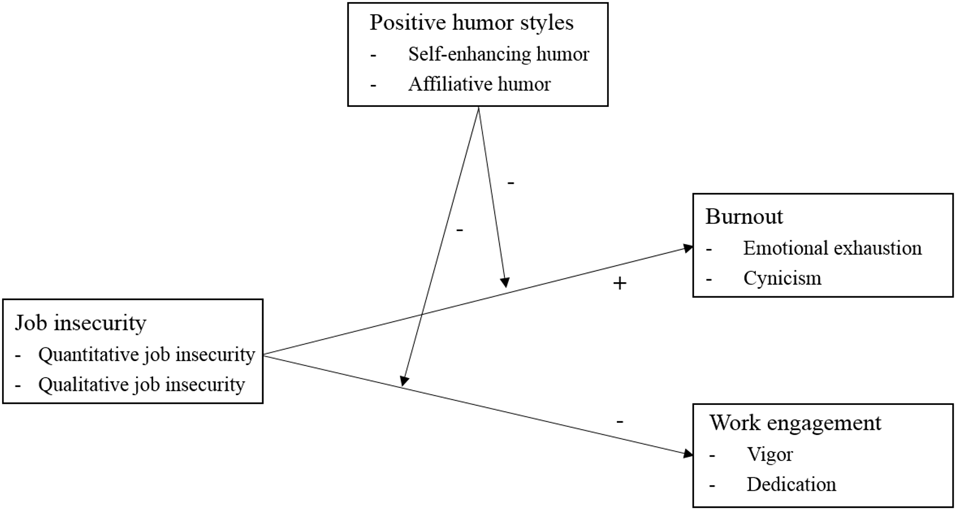
Figure 1 depicts these hypothesized relationships along with the other hypotheses in our conceptual model.
Theoretical model

Method
Procedure and Participants
To validly test the relationships between job aspects and outcomes, Warr (Reference Warr1990) advises to target respondents with varying working circumstances. To arrive at such a heterogeneous sample, a large data collection was set up in collaboration with a Flemish HR-magazine during spring 2009. Readers of the magazine were invited to voluntary participate in an anonymous internet study on work-related well-being via the website of the magazine and the weekly electronic newsletter. In total, 3,133 workers provided complete information and therefore constitute the sample of the current study (see Vander Elst, Van den Broeck, De Witte, & De Cuyper, Reference Vander Elst, van den Broeck, De Witte and De Cuyper2012 for a full description of the data-collection procedure).
The sample included somewhat more women (62%) than men (38%). Age ranged from 18 to 65 years (M = 39.60 years; SD = 10.61). About 2% of the participants only attended primary education, 33% followed secondary education, 45% obtained a bachelor degree, and 21% attended university. Accordingly, few participants (10%) were employed as blue-collar workers, 38% performed an administrative job, 46% were professionals, and 6% were board members. Tenure ranged from less than a year to 44 years (M = 11.35 years; SD = 10.23). Participants worked either in the private (67%) or public sector (33%). The majority of the participants was employed on a permanent basis (90%) and worked full-time (76%).
Measures
Job Insecurity. Quantitative Job Insecurity was measured with four items from the Job Insecurity Scale (De Witte, Reference De Witte, Bouwen, De Witte and Tailleu2000), including items such as ‘I think I will lose my job in the near future’ (for a validation: Vander Elst, De Witte, & De Cuyper, Reference Vander Elst, De Witte and De Cuyper2014). Qualitative Job Insecurity was assessed with five items. These items covered one’s job content (e.g., ‘I feel insecure about the content of my job in the future’), career opportunities (e.g., ‘I am insecure about my chances for promotion’) and employment conditions (e.g., ‘I’m afraid I will be relocated in the future’). These items tap into similar aspects as the items of De Witte and colleagues (2010), and have been successfully used in previous studies (e.g., Fischmann et al., Reference Fischmann, De Witte, Sulea and Iliescu2018; Niesen, Van Hootegem, Handaja, Battistelli, & De Witte, Reference Niesen, Van Hootegem, Handaja, Battistelli and De Witte2018; Van den Broeck et al., Reference Van den Broeck, Sulea, Vander Elst, Fischmann, Iliescu and De Witte2014). All items were rated on a five-point Likert-type scale ranging from 1 (totally disagree) to 5 (totally agree).
Humor. Self-enhancing and affiliative humor were tapped with the respective scales of the Humour Styles Questionnaire (Martin et al., Reference Martin, Puhlik-Doris, Larsen, Gray and Weir2003). Self-enhancing humor included eight items such as ‘If I am feeling sad or upset, I usually lose my sense of humor’ (reverse coded). Affiliative humor was assessed with eight items such as ‘I laugh and joke a lot with my closest friends’. Responses were coded on a seven-point Likert scale ranging from 1 (totally disagree) to 7 (totally agree).
Work-related well-being. Work engagement was assessed with the subscales of vigor and dedication of the Utrecht Work-Engagement scale (Schaufeli et al., Reference Schaufeli, Salanova, González-Romá and Bakker2002). Vigor included five items such as ‘At my work, I feel bursting with energy’. Dedication was measured via five items such as ‘I am proud of the work I do’. Burnout was measured via the subscales of exhaustion and cynicism of the Dutch version of the Maslach Burnout Inventory-General Survey (Schaufeli & van Dierendonck, Reference Schaufeli and van Dierendonck2001). Exhaustion included five items such as ‘I feel totally exhausted in my job’. Cynicism was tapped with four items, including ‘I doubt the usefulness of my job’. Both work engagement and burnout were measured on a seven-point scale from 0 (never) to 6 (always, every day).
Control variables. In testing the hypotheses, we controlled for relevant demographic and work-related characteristics covarying with job insecurity and employee well-being (Becker et al., Reference Becker, Atinc, Breaugh, Carlson, Edwards and Spector2016). We included age (in years), as prior research has indicated that this can be of influence in levels of job insecurity (Cheng & Chan, Reference Cheng and Chan2008; Stynen, Forrier, Sels, & De Witte, Reference Stynen, Forrier, Sels and De Witte2015), burnout and engagement (Ahola, Honkonen, Virtanen, Aromaa, & Lönnqvist, Reference Ahola, Honkonen, Virtanen, Aromaa and Lönnqvist2008; Johnson, Machowski, Holdsworth, Kern, & Zapf, Reference Johnson, Machowski, Holdsworth, Kern and Zapf2017; Kim & Kang, Reference Kim and Kang2017). Gender (dummy coded into 0 = female, 1 = male) was also included since a number of studies have indicated that perceptions of job insecurity (Mauno & Kinnunen, Reference Mauno and Kinnunen2002) and well-being might vary between men and women (Camgoz, Ekmekci, Karapinar, & Guler, Reference Camgoz, Ekmekci, Karapinar and Guler2016; Maslach et al., Reference Maslach, Schaufeli and Leiter2001). In addition, we controlled for whether one has a temporary or a permanent contract (dummy coded as 0 = temporary, 1 = permanent), since job insecurity (De Cuyper, De Witte, Krausz, Mohr, & Rigotti, Reference De Cuyper, De Witte, Krausz, Mohr, Rigotti, Guest, Isaksson and De Witte2010; De Cuyper & De Witte, Reference De Cuyper and De Witte2006), and burnout and well-being effects (De Cuyper, De Jong et al., Reference De Cuyper, Bernhard-Oettel, Berntson, De Witte and Alarco2008) have been shown to vary according to one’s contract type. Type of employment was also included as a covariate (dummy coded as 0 = part-time, 1 = full-time), as part-time employees typically have lower scores on job insecurity (Bernhard-Oettel, Sverke, & De Witte, Reference Bernhard-Oettel, Sverke and De Witte2005) but also on burnout (Burke, Dolan, & Fiksenbaum, Reference Burke, Dolan and Fiksenbaum2014; Burke & Greenglass, Reference Burke and Greenglass2000), thereby possibly functioning as a third variable in the relationship between job insecurity and well-being. Sector (dummy coded as 0 = public sector, 1 = private sector) was also controlled for, since research has demonstrated that the type of sector influences both job insecurity (Mauno & Kinnunen, Reference Mauno and Kinnunen2002) and well-being scores (Maslach et al., Reference Maslach, Schaufeli and Leiter2001; Schaufeli, Bakker, & Salanova, Reference Schaufeli, Bakker and Salanova2006). Lastly, we included occupational position (dummy coded into administrative worker and professional, with blue collar workers as reference category) as a control variable, building on prior research that indicates that job insecurity (De Witte & Näswall, Reference De Witte and Näswall2003), burnout and work engagement (Maslach et al., Reference Maslach, Schaufeli and Leiter2001; Schreurs, van Emmerik, De Cuyper, Notelaers, & De Witte, Reference Schreurs, van Emmerik, De Cuyper, Notelaers and De Witte2011) covary according to one’s occupational level.
Analyses
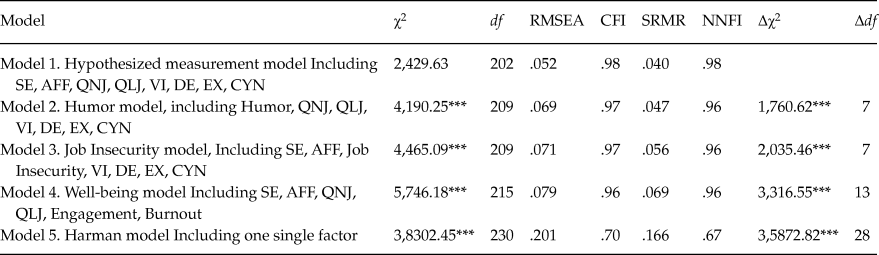
Following the two-step procedure recommended by Anderson and Gerbing (Reference Anderson and Gerbing1988), we first conducted a confirmatory factor analysis to examine the fit of the expected measurement model (Model 1) relative to alternative models in which conceptually related constructs were collapsed into one variable (Models 2-4). As all concepts were measured cross-sectionally, common method variance might have influenced the results. To test for this possibility, we compared Model 1 to Model 5 including only a common method factor. To reduce measurement errors, each concept was represented by item parcels. The parceling procedure was based on the item-to-construct balance averaging the items with the highest loadings with the items with the lowest loadings, minimizing the loading differences among the manifest variables (see Little, Cunningham, Shahar, & Widaman, Reference Little, Cunningham, Shahar and Widaman2002). Model fit was evaluated using the comparative fit index (CFI) and the Non-Normed Fit Index (NNFI), as well as the standardized root-mean-square residual (SRMR) and the root-mean-square error of approximation (RMSEA). Values of the CFI and NNFI of .95 and above indicate good fit, while values of .08 and .06 or less are desirable for the SRMR and RSMEA, respectively. The Chi-square difference test was used to compare nested models (Byrne, Reference Byrne2001).
Second, as suggested by Aiken and West (Reference Aiken and West1991), we tested the hypotheses through a series of multiple regression analyses predicting the components of work engagement and burnout as dependent variables. The first step of each analysis included the control variables. In the second step, either quantitative or qualitative job insecurity was included, allowing testing Hypotheses 1 and 2, respectively. Previous research has examined the relative impact of quantitative and qualitative job insecurity by including them in the same analysis, thereby controlling for the shared variance between quantitative and qualitative job insecurity (e.g., Hellgren et al., Reference Hellgren, Sverke and Isaksson1999). However, as employees might feel insecure about the future of their job as well as their valued job features, this might lead to an underestimation of the associations of both types of job insecurity. To avoid this problem, we align with Boya, Demiral, Ergör, Akvardar, and De Witte (Reference Boya, Demiral, Ergör, Akvardar and De Witte2008) and include qualitative and quantitative job insecurity in separate analysis.
In the third step, either self-enhancing or affiliative humor was added to test Hypotheses 3 and 4. As both types of humor generally correlate highly (Martin et al., Reference Martin, Puhlik-Doris, Larsen, Gray and Weir2003), causing them to combine into a positive humor profile (Galloway, Reference Galloway2010), separate analyses were performed for self-enhancing and affiliative humor. In the final step, the two-way interactions between each of the humor styles and the job insecurity types were added to test Hypotheses 3 and 4. All variables were standardized before computing the interaction terms, to avoid problems of multicollineaity and improve the interpretability (Cohen, Cohen, West, & Aiken, Reference Cohen, Cohen, West and Aiken2003).
Results
Preliminary Analysis
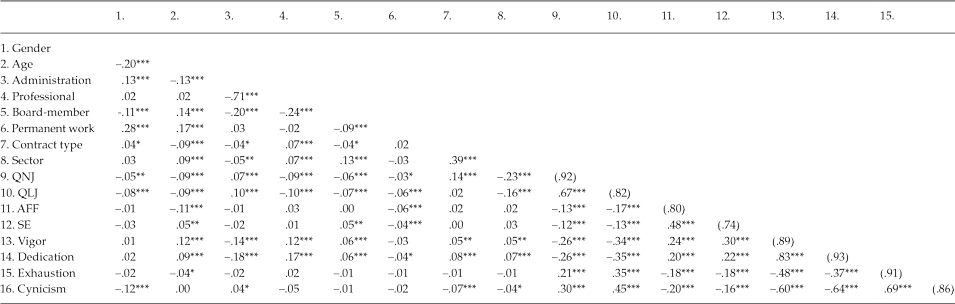
Information regarding the correlations and reliabilities of the scales can be found in Table 1. All scales showed good internal consistency. To examine the divergent validity of our constructs, we compared the expected measurement model including qualitative and quantitative job insecurity, self-enhancing and affiliative humor, as well as vigor, dedictation, exhaustion and cynicism (Model 1) with five alternative models in which the related constructs were combined (Models 2 – 4). As displayed in Table 2, Model 1 provided good fit to the data, which was better than the fit of the alternative Models 2 to 4, attesting to the distinctiveness of each of the concepts. Model 1 also fitted better to the data than Model 5, suggesting common method variance did not significantly influence respondents’ answers.
Chronbach Alphas and Correlations of the Demographic Variables, Humor, Job Insecurity, Engagement and Burnout

Note. SE = self–enhancing humor; AFF = affiliative humor; QNJ = quantitative job insecurity; QLJ = qualitative job insecurity. *p < .05, **p<.01, ***p<.001.
Results of the Confirmatory Factor Analysis Establishing the Measurement Model

Note. SE = self-enhancing humor; AFF = affiliative humor; QNJ = quantitative job insecurity; QLJ = qualitative job insecurity; VI = vigor; DE = dedication; EX = exhaustion; CYN = cynicism; *p < .05, **p<.01, ***p<.001.
Scale scores were computed as the mean of the items scores (see Table 1). As respects the study variables, a positive relationship was found between quantitative and qualitative job insecurity. Both types of insecurity were negatively related to affiliative and self-enhancing humor. They were also negatively associated with vigor and dedication, and positively with exhaustion and cynicism. This aligns with the expectations and the literature. In line with the humor framework (Martin et al., Reference Martin, Puhlik-Doris, Larsen, Gray and Weir2003) and previous findings, both types of humor related positively to each other. They also related positively with vigor and dedication, and were negatively related to exhaustion and cynicism. Both aspects of engagement related positively to each other and negatively to the burnout components, which were also positively associated with each other.
Primary Analysis
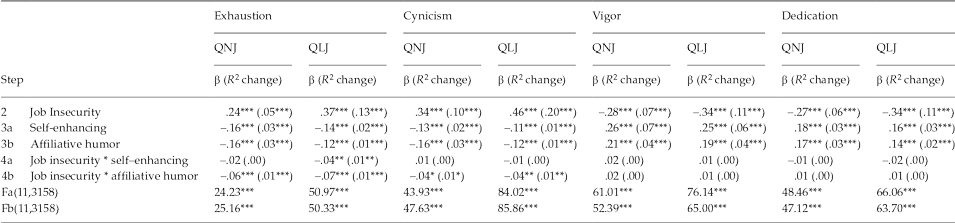
The results of the regression analysis are outlined in Table 3. In the first step of the analysis, the control variables were regressed on burnout and work engagement. With respect to burnout, it was shown that older employees experienced less exhaustion, while women reported more cynicism than men. Concerning work engagement, women and older employees experienced more vigor and dedication, as was also the case for professionals, board members and part-time employed. Administrative personnel in contrast reported less dedication. The control variables predicted up to 5% of the variance in the outcome variables.
Standardized Regression Coefficients of Humor and Job Insecurity Predicting Engagement and Burnout

Note. *p < .05, **p<.01, ***p<.001.
Regarding the main effects of job insecurity, in Hypothesis 1, we predicted that quantitative job insecurity would be positively related to both exhaustion and cynicism, but negatively to vigor and dedication. The results of Step 2 showed positive associations of quantitative job insecurity with the burnout components and negative associations with the components of engagement. Hypothesis 1 was thus supported. Hypothesis 2 stated that qualitative job insecurity would be positively related to exhaustion and cynicism, and negatively to vigor and dedication. Results of Step 2 of the regression analysis provided evidence for these associations, supporting Hypothesis 2. In Step 3 of the regression analyses, self-enhancing and affiliative humor were found to be negatively related to exhaustion and cynicism, and positively to vigor and dedication. Concerning the interactions, Hypothesis 3 posited that the associations of quantitative job insecurity with the dimensions of burnout and work engagement would be buffered by self-enhancing humor. However, for none of the dependent variables, a significant interaction between quantitative job insecurity and self-enhancing humor was found. Hypothesis 3 was thus not corroborated.
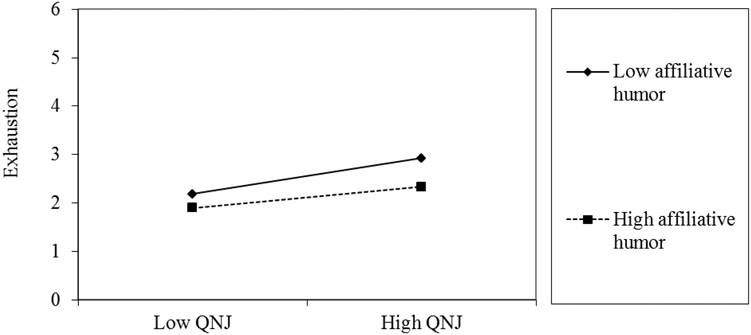
Hypothesis 4 suggested that affiliative humor would buffer the positive and negative associations of quantitative job insecurity with the components of burnout and work engagement, respectively. In line with this hypothesis, Step 3 of the regression analysis showed that quantitative job insecurity interacted with affiliative humor in the predication of exhaustion and cynicism. As also plotted in Figure 2 the positive association of quantitative job insecurity with exhaustion (βlow = .35, SE = .04, t = 5.30; βhigh = .19, SE = .04, t = 9.56, p’s < .001), as well as with cynicism (βlow = .43, SE = .04, t = 12.33; βhigh = .34, SE = .03, t = 10.09, p’s < .001), was higher among workers with low levels of affiliative humor than among workers with high levels of affiliative humor. Affiliative humor thus buffered the positive relationship between quantitative job insecurity and the indicators of burnout. Quantitative job insecurity did not interact with affiliative humor in the prediction of vigor and dedication. Only partial support was thus found for Hypothesis 4.
Interaction Effects of Quantitative Job Insecurity and Affiliative Humor in the Prediction of Exhaustion

Hypothesis 5 suggested that self-enhancing humor would buffer for the relationships between qualitative job insecurity and the components of burnout and work engagement. Step 4 of the regression analysis, indicated a significant interaction between qualitative job insecurity and self-enhancing humor in the prediction of exhaustion. Similar to as displayed in Figure 2, the positive association of qualitative job insecurity with exhaustion (βlow = .49, SE = .03, t = 15.74; βhigh = .39, SE = .03, t = 12.86, p’s < .001) was higher among workers with low levels of self-enhancing humor than among workers with high levels of self-enhancing humor. This means that self-enhancing humor buffered the qualitative job insecurity-exhaustion relationship. No other significant interactions between qualitative job insecurity and self-enhancing humor were found. Hypothesis 5 was thus partially corroborated.
Hypothesis 6 posited that affiliative humor would buffer the relationships of qualitative humor with the components of burnout and work engagement. Step 3 of the regression analysis provided evidence for the interaction between qualitative job insecurity and affiliative humor in the predication of exhaustion and cynicism. The positive association of qualitative job insecurity with exhaustion (βlow =.53, SE = .03, t = 15.82, β high =.35, SE = .03, t = 11.56; p’s < .001), as well as with cynicism (βlow =.61, SE = .03, t = 19.65, βhigh = .50, SE = .03, t = 17.77; p’s < .001) was higher among workers with low levels of affiliative humor than among workers with high levels of affiliative humor. Affiliative humor thus acted as a buffer. This resembles the results displayed in Figure 2, and provides support for Hypothesis 6.
Discussion
Against the background of the increasing instability in the labor market, the current study examined the associations between both quantitative and qualitative job insecurity and employees’ work-related well-being in terms of burnout and work engagement. Most importantly, this study aimed to uncover whether individual difference variables, and more specifically, self-enhancing and affiliative humor, may be modeled as personal resources as outlined in COR (Hobfoll, Reference Hobfoll2002) and therefore assist employees in avoiding the negative associates of both types of job insecurity.
Regarding job insecurity, the results first replicate previous findings on quantitative job insecurity, as quantitative job insecurity was positively related to exhaustion and cynicism as most important components of burnout, and negatively to vigor and dedication as indicators of work engagement (e.g. Vander Elst et al., Reference Vander Elst, Bosman, De Cuyper, Stouten and De Witte2013). Similar findings were obtained for qualitative job insecurity, which indicates that not only risking one’s job, but also risking to lose valued job aspects might yield highly negative consequences. Along conservation of resources (COR) theory, these results indicate that employees who are threatened with resource loss might become more defensive to conserve existing resources (Hobfoll et al., Reference Hobfoll, Halbesleben, Neveu and Westman2018). This defensive posture is energy consuming, and, consequently, also resource consuming (De Cuyper, Mäkikangas, Kinnunen, Mauno, & De Witte, Reference De Cuyper, Mäkikangas, Kinnunen, Mauno and De Witte2012), ultimately resulting in increased exhaustion and cynicism, and reduced vigor and dedication.
In line with De Witte et al. (Reference De Witte, De Cuyper, Handaja, Sverke, Näswall and Hellgren2010), both types of job insecurity are thus problematic. These results highlight the importance of gaining more knowledge on qualitative job insecurity, both conceptually and methodologically. Such research might also tap into the antecedents and consequences of qualitative job insecurity, and shed light on the relative weight of both types of job insecurity. Studies might for example clarify whether employees feeling insecure about the future existence of their job (i.e., quantitative insecurity) are also more likely to be insecure about the content of their future job (i.e., qualitative insecurity), or whether both types of job insecurity are relatively independent.
In addition, results regarding the job insecurity - humor interaction indicate that particularly affiliative humor may serve as a buffer to offset the associations of quantitative and qualitative insecurity and both burnout dimensions. These results support the assumption that affiliative humor serves as a personal resource, as suggested in COR, strengthening employees’ capacities to deal with insecure situations (Hobfoll Reference Hobfoll2002). The experience of positive emotions might compound over time and act as a trigger for other personal resources, thereby functioning as reserves that can be drawn upon to improve coping and emotion regulation (Dikkers, Doosje, & de Lange, Reference Dikkers, Doosje, de Lange, Houdmont, Leka and Sinclair2012). Affiliative humor might especially lead to the creation of other resources, as sharing positive emotions helps to create social bonds between people (Scheel & Gockel, Reference Scheel and Gockel2017), resulting in resource caravans. These enhanced social bonds, might, in turn, build social support, which might take the form of emotional or instrumental support, assisting in emotion-focused and problem-focused coping, respectively.
Self-enhancing humor interacted with qualitative job insecurity in predicting exhaustion. However, no other interactions could be found. Taking a positive outlook and using humor to cheer oneself up thus seems to be insufficient to deal with a severe stressor such as quantitative job insecurity. The relative lack of evidence for the interaction between self-enhancing humor and job insecurity might suggest that the role of others, as is for example the case for affiliative humor, is essential to offset the negative associations of job insecurity. No interactions between both types of humor and job insecurity could be established with respect to work engagement. This provides further evidence for the divergent validity of burnout and work engagement (Demerouti et al., Reference Demerouti, Mostert and Bakker2010). It equally calls for future research on the likely different processes via which job insecurity relates to the positive and negative aspects of individuals’ well-being.
The present study also found significant main effects of positive humor styles on the components of both burnout and work engagement. This is in line with previous studies, which indicate that the use of positive humor might not only have a stress-buffering effect but might also prevent the experience of stress in the first place. For instance, a diary study showed that employees are more engaged on days that they expressed positive humor (Guenter et al., Reference Guenter, Schreurs, van Emmerik, Gijsbers and van Iterson2013), and a study by Hugelshofer, Kwon, Reff and Olson (Reference Hugelshofer, Kwon, Reff and Olson2006) demonstrated that the use of affiliative and self-enhancing humor was associated with fewer depressive symptoms. Humor seems to simultaneously have a main and a moderating effect, suggesting that there are different ways in which humor functions. Along these lines, humor might also operate as a mediator in the relationship between job insecurity and employee well-being. Although few studies have addressed humor as a consequence of work stressors, it is possible that individual job insecurity, and the job insecure climate that results from this, undermine employees’ use of self-enhancing and affiliative humor, respectively (Låstad, Vander Elst, & De Witte, Reference Låstad, Vander Elst and De Witte2016). Hence, future research might benefit from investigating whether humor also functions as a mediator, and under which conditions a moderating versus a mediating role is most likely.
Finally, more understanding seems to be needed on the moderating impact of the benign types of humor. Notably, previous research suggested that self-enhancing and affilitative humor particularly enhanced the association between job resources and work engagement, but not burnout (Van den Broeck et al., Reference Van den Broeck, Vander Elst, Dikkers, De Lange and De Witte2012). Future studies might further tap into the differential roles the types of humor may play in enhancing work related well-being.
Some limitations need to be taken into account in interpreting the current results. First, all data were gathered cross-sectionally. To avoid problems of common method effects, we followed the recommendations of Podsakoff, MacKenzie, Lee and Podsakoff, (2003) during data collection. For example, we used different answering scales and stressed that participation in the study was voluntarily and anonymous. The CFA indicated that these measures were effective and that common method variance did not significantly influence our results. Although job insecurity is by definition a subjective phenomenon, future research could further add to this line of work by employing objective measures of the other variables of interest. The objective evaluation of the use of humor might be of particular interest, as well as the study of its effect on others. Does affiliative humor need to be positively received by others in order to be effective?
Second, as the current study is cross-sectional in nature, no causal conclusions can be drawn. In line with the literature on job insecurity and humor, we modeled job insecurity and humor as antecedents of work-related well-being (Hellgren & Sverke, Reference Hellgren and Sverke2003). However, job insecurity might also be viewed as a consequence of employees’ well-being, which would point at a reciprocal relationship. It might be plausible that less engaged and burned out individuals are more vulnerable to become insecure about their work-related future. Although prior research has provided evidence for the impact of job insecurity on employee well-being over time (De Witte, Pienaar, & De Cuyper, Reference De Witte, Pienaar and De Cuyper2016), future research might still benefit from investigating the possibility of reciprocal relationships, and the role of humor within these relationships, using a longitudinal design. They might particularly test whether affiliative humor also buffers situations of continuous job insecurity, which have been indicated as most problematic (Dekker & Schaufeli, Reference Dekker and Schaufeli1995). They might also uncover the processes through which affiliative humor might excerpt its buffering impact.
Third, we examined self-enhancing and affiliative humor, as particularly these benign types of humor have been suggested to serve as a coping mechanism or personal resource increasing individuals’ well-being (Martin, Reference Martin2004). However, future research could also tap into the role of the negative types of humor, that is self-defeating and aggressive humor, and examine the role of these types of humor for employees’ health at work, and in insecure times in particular. Following the superiority theory of humor (Cooper, Reference Cooper2008), for example, employees using aggressive humor might experience enhanced power over the job insecure situation and therefore feel less threatened. The use of self-defeating humor would then have the opposite effect.
The current results add to the literature on job insecurity in attesting to the detrimental correlates of both quantitative and qualitative job insecurity with respect to burnout and work engagement. As such, the results highlight that practitioners do need to take care of both types of job insecurity. Despite the continuous changes in the labor market and the associated high levels of job insecurity, interventions might be aimed at reducing quantitative and qualitative insecurity, for example via communicating openly and stopping rumors as soon as possible (Greenhalgh & Rosenblatt, Reference Greenhalgh and Rosenblatt1984). Perceptions of job insecurity can also be reduced by involving employees in decision making about the future of their jobs and the organization, as participation in decision making increases workers’ control over the situation (De Witte et al., Reference De Witte, Vander Elst, De Cuyper, Vuori, Blonk and Price2015). In addition, employers could invest in employees’ perceived employability, as prior research has demonstrated that the perceived possibilities to obtain new employment reduce perceived job insecurity (De Cuyper, Bernhard-Oettel, et al., Reference De Cuyper, Bernhard-Oettel, Berntson, De Witte and Alarco2008; De Cuyper et al., Reference De Cuyper, Mäkikangas, Kinnunen, Mauno and De Witte2012).
On the positive side, the results also provided evidence for the association of self-enhancing and affiliative humor as potential drivers of work related well-being. As this study found some buffering effects of humor on burnout, we believe that practitioners might consider humor as a tool to buffer the negative consequences of job insecurity. Supervisors might facilitate the use of positive humor by eliminating job hindrances (Van den Broeck et al., Reference Van den Broeck, Vander Elst, Dikkers, De Lange and De Witte2012) and by using positive humor styles themselves (Priest & Swain, Reference Priest and Swain2002). Additionally, it is important to generate a work climate that enables, or at least allows, laughter at the workplace, thereby giving employees ways to counter stressful situations (Scheel & Gockel, Reference Scheel and Gockel2017).